The Famous Letter Where Freud Breaks His Relationship with Jung (1913)
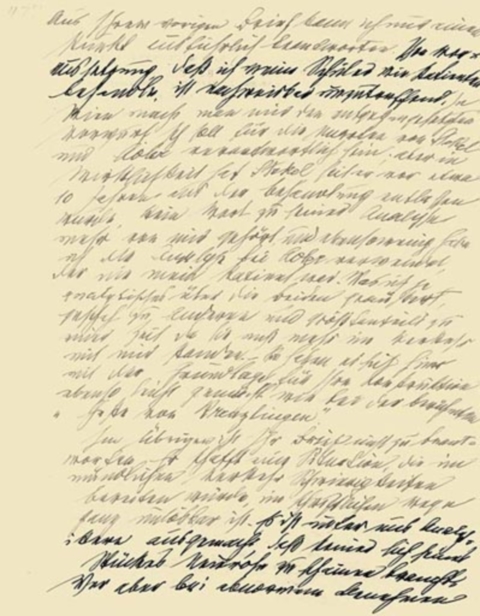
Freud and Jung. Jung and Freud. History has closely associated these two who did so much examination of the mind in early 20th-century Europe, but the simple connection of their names belies a much more complicated relationship between the men themselves. At the top of the post, you can see the letter that Sigmund Freud, father of psychoanalysis, wrote to Carl Gustav Jung, founder of analytical psychology, in order to end that relationship entirely. “At first Freud saw in Jung a successor who might lead the psychoanalytic movement into the future,” say the curator’s comments at the Library of Congress’ web site, “but by 1913 relations between the two men had soured.
While Freud claims in his letter that it is ‘demonstrably untrue’ that he treats his followers as patients, in the very same letter we find him alluding to Jung’s ‘illness.’ ” Freud calls it “a convention among us analysts that none of us need feel ashamed of his own neurosis. But one [meaning Jung] who while behaving abnormally keeps shouting that he is normal gives ground for the suspicion that he lacks insight into his illness. Accordingly, I propose that we abandon our personal relations entirely.”
“I shall lose nothing by it,” he continues, “for my only emotional tie with you has been a long thin thread — the lingering effect of past disappointments — and you have everything to gain, in view of the remark you recently made to the effect that an intimate relationship with a man inhibited your scientific freedom.” This relationship, writes Lionel Trilling in a review of The Correspondence Between Sigmund Freud and C.G. Jung, “had its bright beginning in 1906 and came to its embittered end in 1913,” when Freud wrote this letter. “Freud and Jung were not good for one another; their connection made them susceptible to false attitudes and ambiguous tones. [ … ] The intellectual and professional differences between the two men, profound as these eventually became, would perhaps not of themselves have brought about a break so drastic as did take place had not their alienating tendency been reinforced by personal conflicts.” Only a comparative study of Freud and Jung’s methods would yield a complete understanding of their roles in the struggle for the soul of psychoanalysis. But on a more basic level, this hardly counts as the first nor the last collapse, in any field of human endeavor, of a perhaps overdetermined succession between an eminence and his would-be protege — though it may count as one of the most eloquently documented ones.
Related Content:
Sigmund Freud Speaks: The Only Known Recording of His Voice, 1938
Face to Face with Carl Jung: ‘Man Cannot Stand a Meaningless Life’
Carl Gustav Jung Ponders Death
Colin Marshall hosts and produces Notebook on Cities and Culture and writes essays on cities, language, Asia, and men’s style. He’s at work on a book about Los Angeles, A Los Angeles Primer. Follow him on Twitter at @colinmarshall or on Facebook.
Read More...Sound Effects Genius Michael Winslow Performs the Sounds of 32 Typewriters (1898–1983)
“When forced to leave my house for an extended period of time, I take my typewriter with me,” once wrote essayist-humorist David Sedaris. “Together we endure the wretchedness of passing through the X‑ray scanner. The laptops roll merrily down the belt, while I’m instructed to stand aside and open my bag. To me it seems like a normal enough thing to be carrying, but the typewriter’s declining popularity arouses suspicion and I wind up eliciting the sort of reaction one might expect when traveling with a cannon. ‘It’s a typewriter,’ I say. ‘You use it to write angry letters to airport security.’ ” But Sedaris, one of the last high-profile hold-outs against electronic word processing, wrote those words almost fifteen years ago — even before airport security really cracked down in our post‑9/11 reality. Surely he has since picked up and presumably learned to use a computer. We now find ourselves in an age when typewriter usage has transcended the status of an act of nostalgia and attained the status of an act of rebellion; if you insist on using a classic old Underwood Remington, or an Invicta, or a Continental Standard, or Olympia Monika Deluxe, well, you must really have a statement to make.
Yet I daresay that for all their mechanical heft, freedom from internet-borne distraction, and thoroughly analog aesthetic appeal, typewriters bring with them a number of burdens. We have their difficulty in clearing TSA lines, yes, but also their thirst for physical ink and paper (“I can always look at my loaded wastepaper basket and tell myself that if I failed,” said Sedaris, “at least I took a few trees down with me”), and their noise — oh my, their noise. You can hear the varying sounds of 32 models belonging to many successive typewriter generations in the video at the top of the post. They don’t come as straight recordings, but as sounds reproduced by mouth to perfection by that one-in-a-million mimic Michael Winslow, best known from the Police Academy movies as Sergeant Larvell “Motor Mouth” Jones. “The History of the Typewriter Recited by Michael Winslow” originated in the mind of Spanish artist Ignacio Uriarte, who, according to Frieze, “has employed standard office supplies such as Biros, highlighters and jotters,” not to mention “the ubiquitous spreadsheet tool Microsoft Excel, perhaps soon facing its own obsolescence.” This production “tellingly culminates with the sounds of a machine from 1983, the year before the arrival of the first home computer with a graphical interface.” Which leads one to wonder: can Winslow do hard drive noises?
We’ll definitely add “The History of the Typewriter Recited by Michael Winslow” to our collection, 4,000+ Free Movies Online: Great Classics, Indies, Noir, Westerns, Documentaries & More.
via Kottke
Related Content:
The Enduring Analog Underworld of Gramercy Typewriter
Woody Allen’s Typewriter, Scissors and Stapler: The Great Filmmaker Shows Us How He Writes
Discover Friedrich Nietzsche’s Curious Typewriter, the “Malling-Hansen Writing Ball”
Mark Twain Wrote the First Book Ever Written With a Typewriter
Disruptive Technology: Student Brings Typewriter to Class
Colin Marshall hosts and produces Notebook on Cities and Culture and writes essays on cities, language, Asia, and men’s style. He’s at work on a book about Los Angeles, A Los Angeles Primer. Follow him on Twitter at @colinmarshall or on Facebook.
Read More...Free Math Textbooks
Free textbooks (aka open textbooks) written by knowledgable scholars are a relatively new phenomenon. Below, find a meta list of Free Math Textbooks, part of our larger collection 200 Free Textbooks: A Meta Collection. Also see our online collection, 1,700 Free Online Courses from Top Universities.
- Abstract Algebra: The Basic Graduate Year by Robert B. Ash, University of Illinois
- Abstract Algebra: Theory and Applications by Thomas W. Judson, Stephen F. Austin State University
- Advanced Algebra II by Kenny Felder, Raleigh Charter High School
- Advanced Calculus by Sternberg Shlomo and Lynn Loomis, Harvard University
- Algebra 1 (Grades 9 & 10) by Andrew and Anne Gloag, High Tech High in San Diego, California
- Algebra and Analysis for Computer Science by Jean Gallier, University of Pennsylvania.
- Applied Probability by Paul Pfeiffer, Rice University
- Basic Analysis by Jiří Lebl, University of Illinois at Urbana-Champaign
- Basic Concepts of Mathematics by Elias Zakon, The University of Windsor
- Basic Probability Theory by Robert B. Ash, University of Illinois
- Basic Probability and Statistics by Brenda Meery, high school mathematics teacher in Glace Bay, Nova Scotia
- Book of Proof by Dr. Richard Hammack, Virginia Commonwealth University
- Calculus for Beginners and Artists by MIT
- Calculus Online Textbook, by Gilbert Strang, MIT
- Calculus (PDF) by David Guichard, Whitman College.
- Calculus (PDF) by Gilbert Strang, MIT
- Calculus 1 by Paul Dawkins, Lamar University
- Calculus 2 by Paul Dawkins, Lamar University
- Calculus 3 by Paul Dawkins, Lamar University
- Calculus with Applications, by Daniel Kleitman, MIT
- CK-12 Geometry (Grades 10–12) by multiple authors. Covers California curriculum.
- CK-12 Single Variable Calculus (Grades 11–12) by Multiple authors. Covers California curriculum.
- CK-12 Trigonometry — Second Edition (Grades 10–12) by multiple authors. Covers California curriculum.
- Collaborative Statistics by Barbara Illowsky, Ph.D and Susan Dean, De Anza College
- College Algebra by Paul Dawkins, Lamar University
- Complex Analysis by George Cain, Georgia Institute of Technology
- Complex Variables by Robert B. Ash, University of Illinois
- Computational Geometry by Nicholas M. Patrikalakis, Takashi Maekawa, MIT
- A Computational Introduction to Number Theory and Algebra by Victor Shoup, NYU
- A Course In Algebraic Number Theory by Robert B. Ash, University of Illinois
- A Course In Commutative Algebra by Robert B. Ash, University of Illinois
- Design of Comparative Experiments by R. A. Bailey, University of London
- Difference Equations to Differential Equations: An Introduction to Calculus by Dan Sloughter, Furman University
- Differential Equations by Paul Dawkins, Lamar University
- Discrete Mathematics: An Open Introduction by Oscar Levin, University of Northern Colorado
- Dynamical Systems by S. Sternberg, Harvard University
- Electronic Statistics Textbook by T. Hill & P. Lewicki.
- Elementary Abstract Algebra by W. Edwin Clark, University of Southern Florida
- Elementary Calculus: An Infinitesimal Approach by H. Jerome Keisler, University of Wisconsin-Madison
- Elementary Differential Equations (PDF) by William F. Trench, Trinity University
- Elementary Differential Equations with Boundary Value Problems (PDF) by William F. Trench, Trinity University
- Student Solutions Manual for Elementary Differential Equations and Elementary Differential Equations with Boundary Value Problems (PDF) by William F. Trench, Trinity University
- Elementary Linear Algebra by Keith Matthews, University of Queensland
- Elementary Number Theory by W. Edwin Clark, University of Southern Florida
- Elements of Abstract and Linear Algebra by Edwin H. Connell, University of Miami
- First Course in Complex Analysis by Matthias Beck, Gerald Marchesi, and Dennis Pixton, SUNY — Binghamton
- First Course in Linear Algebra by Dr. Robert Beezer, University of Puget Sound
- Functions Defined by Improper Integrals (PDF) by William F. Trench, Trinity University
- GeneratingFunctionology by Herbert Wilf, University of Pennsylvania
- Introduction to Matrix Algebra by Autar K Kaw, University of South Florida
- Introduction to Probability, Statistics, and Random Processes by Hossein Pishro-Nik, UMass Amherst
- Introduction to Probability (PDF) by Charles Grinstead & J. Laurie Snell, Swarthmore & Dartmouth Colleges
- Introduction to Real Analysis (PDF) by William F. Trench, Trinity University
- An Introduction to Statistical Learning (PDF) by Gareth James, Daniela Witten, Trevor Hastie and Robert Tibshirani
- Introduction to Social Network Methods by Robert A. Hanneman and Mark Riddle, UC Riverside
- Introduction to Statistical Thought by Michael Lavine, UMASS
- Introduction to the Theory of Numbers by Leo Moser, McGill
- Introductory Statistics: Concepts, Models, and Applications by David W. Stockburger, Missouri State
- Lectures on Probability, Statistics and Econometrics by Marco Taboga, Economist, Bank of Italy
- Lectures on Statistics by Robert B. Ash, University of Illinois
- Linear Algebra (PDF) by Jim Hefferon, Saint Michael’s College
- Linear Algebra by Paul Dawkins, Lamar University
- Math Alive by Ingrid Daubechies, Princeton University
- Math in Society by David Lipmann, Pierce College
- Math, Numerics, and Programming (for Mechanical Engineers) by Masayuki Yano, MIT
- Mathematical Methods of Engineering Analysis (PDF) by Erhan Çinlar and Robert J. Vanderbei, Princeton University
- Multivariable Calculus by George Cain & James Herod, Georgia Tech
- Proofs and Concepts: The Fundamentals of Abstract Mathematics by Dave Witte Morris and Joy Morris, University of Lethbridge
- Real Variables with Basic Metric Space Topology by Robert B. Ash, University of Illinois
- Statistics by Philip B. Stark, University of California — UC Berkeley
- A Summary of Calculus by Karl Heinz Dovermann, University of Hawaii
- The Book “A=B” by Marko Petkovsek, Herbert Wilf and Doron Zeilberger, Univ. of Pennsylvania and Rutgers
- The Elements of Statistical Learning by Trevor Hastie, Robert Tibshirani and Jerome Friedman
- The Method of Lagrange Multipliers (PDF) by William Trench, Trinity University
- The Calculus of Functions of Several Variables by Dan Sloughter, Furman University
- Yet Another Calculus Text by Dan Sloughter, Furman University
Free Textbooks: Computer Science
Free textbooks (aka open textbooks) written by knowledgable scholars are a relatively new phenomenon. Below, find a meta list of Free Computer Science Textbooks, part of our larger collection 200 Free Textbooks: A Meta Collection. Also see our online collection, 1,700 Free Online Courses from Top Universities.
- A Byte of Python, by Swaroop C H
- A First Course in Electrical and Computer Engineering by Louis Scharf, Colorado State
- Artificial Intelligence: Foundations of Computational Agents by David Poole and Alan Mackworth, University of British Columbia
- Bits, Signals, and Packets: An Introduction to Digital Communications and Networks by Hari Balakrishnan, Christopher Terman, and George Verghese, MIT
- Code Like a Pythonista: Idiomatic Python, by David Goodger
- Computational Geometry by Nicholas M. Patrikalakis, Takashi Maekawa, MIT
- Digital Circuit Projects: An Overview of Digital Circuits Through Implementing Integrated Circuits by Charles W. Kann, Gettysburg College
- Dive into Python, by Mark Pilgrim
- Foundations of Computer Science by Al Aho (Columbia) and Jeff Ullman (Stanford)
- High Performance Computing by Charles Severance, University of Michigan
- How to Design Programs: An Introduction to Computing and Programming, Multiple Authors
- How to Think Like a Computer Scientist: C ++ ( PDF) by Allen B. Downey, Olin College
- How to Think Like a Computer Scientist: Java by Allen B. Downey, Olin College
- How to Think Like a Computer Scientist: Python by Allen B. Downey, Olin College
- Implementing a One Address CPU in Logisim by Charles W. Kann III, Gettysburg College
- Information Technology and the Networked Economy by Patrick McKeown, University of Georgia
- Information Theory, Inference, and Learning Algorithms by David MacKay, Cambridge
- Introduction To MIPS Assembly Language Programming by Charles W. Kann III, Gettysburg College
- Neural Networks and Deep Learning, by Michael Nielsen, Research Fellow at the Recurse Center
- Patterns for Beginning Programmers (with Examples in Java), by David Bernstein, James Madison University
- Philosophy of Computer Science by William J. Rapaport, University at Buffalo, The State University of New York
- Principles of Computer System Design: An Introduction (Part II) by Jerome Saltzer and M. Frans Kaashoek.
- Principles of Programming Languages by Grad Students, Johns Hopkins
- Programming Languages: Application and Interpretation by Dr. Shriram Krishnamurthi, Brown University.
- Prolog and Natural-Language Analysis by Fernando C. N. Pereira and Stuart M. Shieber, U Penn & Harvard
- Python for Informatics: Exploring Information by Charles Severance, University of Michigan
- Structure and Interpretation of Computer Programs by Jerry Sussman & Julie Sussman
- Teach Yourself WordPerfect Mac by John Rethorst
- The Princeton Bitcoin Textbook by Arvind Narayanan (Princeton) and colleagues
Read 9 Free Books By Noam Chomsky Online

Image by Andrew Rusk, via Wikimedia Commons
The gross and ever-increasing degree of economic inequality in the United States has become a phenomenon that even the country’s elites can no longer ignore since the explosive publication of Thomas Piketty’s Capital in the 21st Century. The book’s highly technical marshaling of data speaks primarily to economists and secondarily to liberal policymakers. Piketty’s calls for redistribution have lead to charges of “Marxism” from the other end of the political spectrum—due to some inevitable degree to the book’s provocative title. Yet in the reckoning of actual Marxist Slavoj Žižek, the French economist is still “a good Keynsian” who believes that “capitalism is ultimately the only game in town.” While the Marxist left may critique Piketty’s policy recommendations for their reliance on state capitalism, another fierce leftist thinker—Žižek’s sometime intellectual rival Noam Chomsky—might critique them for their acquiescence to state power.
Chomsky’s role as a public intellectual has placed him at the forefront of the left-anarchist fight against neoliberal political economy and the U.S. foreign and domestic policies that drive it. Whether those policies come from nominally liberal or conservative administrations, Chomsky asserts time and again that they ultimately serve the needs of elites at the expense of masses of people at home and abroad who pay the very dear cost of perpetual wars over resources and markets. In his 2013 book On Anarchism, Chomsky leaves little room for equivocation in his assessment of the role elites play in maintaining a state apparatus that suppresses popular movements:
If it is plausible that ideology will in general serve as a mask for self-interest, then it is a natural presumption that intellectuals, in interpreting history or formulating policy, will tend to adopt an elitist position, condemning popular movements and mass participation in decision making, and emphasizing rather the necessity for supervision by those who possess the knowledge and understanding that is required (so they claim) to manage society and control social change.
This excerpt is but one minute example of Chomsky’s fiercely independent stance against abuse of power in all its forms and his tireless advocacy for popular social movements. As Henry Giroux writes in a recent assessment of Chomsky’s voluminous body of work, what his many diverse books share is “a luminous theoretical, political, and forensic analysis of the functioning of the current global power structure, new and old modes of oppressive authority, and the ways in which neoliberal economic and social policies have produced more savage forms of global domination and corporate sovereignty.” And while he can sound like a doomsayer, Chomsky’s work also offers “the possibility of political and economic alternatives” and “a fresh language for a collective sense of agency and resistance.”
Today we offer a collection of Chomsky’s political books and interviews free to read online, courtesy of Znet. While these texts come from the 1990s, it’s surprising how fresh and relevant they still sound today. Chomsky’s granular parsing of economic, social, and military operations explains the engineering of the economic situation Piketty details, one ever more characterized by the title of a Chomsky interview, “The Prosperous Few and the Restless Many.” See links to nine books below. To read, click on links to either the “Content Overview” or “Table of Contents.” The books can also be found in our collection, 800 Free eBooks for iPad, Kindle & Other Devices.
Necessary Illusions: Thought Control in Democratic Societies (1989): Based on the Massey Lectures, delivered in Canada in November 1988, Necessary Illusions argues that, far from performing a watchdog role, the “free press” serves the needs of those in power.
Deterring Democracy (1991): Chomsky details the major shift in global politics that has left the United States unchallenged as the preeminent military power even as its economic might has declined drastically in the face of competition from Germany and Japan. Deterring Democracy points to the potentially catastrophic consequences of this new imbalance, and reveals a world in which the United States exploits its advantage ruthlessly to enforce its national interests — from Nicaragua to the Philippines, Panama to the Middle East.
Year 501: The Conquest Continues (1993): Analyzing Haiti, Latin America, Cuba, Indonesia, and even pockets of the Third World developing in the United States, Noam Chomsky draws parallels between the genocide of colonial times and the murder and exploitation associated with modern-day imperialism.
Rethinking Camelot: JFK, the Vietnam War, and U.S. Political Culture (1993)
What Uncle Sam Really Wants (1993): A brilliant distillation of the real motivations behind U.S. foreign policy, compiled from talks and interviews completed between 1986 and 1991, with particular attention to Central America. [Note: If you have problems accessing this text, you can read it via this PDF.]
The Prosperous Few and the Restless Many (1994): A fascinating state-of-the-world report from the man the New York Times called “arguably the most important intellectual alive.”
Secrets, Lies and Democracy (1994): An interview with David Barsamian
Keeping the Rabble in Line (1994): Interviews with David Barsamian
Excerpts from Powers and Prospects: Reflections on Human Nature and the Social Order (1996): A scathing critique of orthodox views and government policy. See full text in pdf form here.
And for exponentially more Chomsky, see Chomsky.info, which hosts well over a hundred of his topical articles from the Vietnam era to the present.
Related Content:
Noam Chomsky Calls Postmodern Critiques of Science Over-Inflated “Polysyllabic Truisms”
Filmmaker Michel Gondry Presents an Animated Conversation with Noam Chomsky
Clash of the Titans: Noam Chomsky & Michel Foucault Debate Human Nature & Power on Dutch TV, 1971
Josh Jones is a writer and musician based in Durham, NC. Follow him at @jdmagness.
Read More...The Acid Test Reels: Ken Kesey & The Grateful Dead’s Soundtrack for the 1960s Famous LSD Parties
“If you remember the ‘60s, you weren’t there.” The quote was supposedly uttered by Grace Slick. Or Paul Kantner. Or Dennis Hopper. The truth is no one really remembers who said it first.
Of course, the “60s” was not simply the decade that came between the ‘50s and the ‘70s but a shorthand for a generational revolt fueled in part by one stupid war and a general disillusionment with consumer capitalism. The ground zero for the “60s,” at least in the United States, was in San Francisco and, at the center of the scene, there was Ken Kesey, the Merry Pranksters and their legendary counterculture bacchanalias called Acid Tests. These happenings featured groovy flashing lights, live music from the likes of The Grateful Dead, and copious amounts of LSD. Up top, Kesey explains the meaning of the Acid Tests for you:
Thanks to the internet, you can experience a bit of what these original hippie fests were like. Above is audio from two shows in January 1966 which had Kesey and longtime Merry Prankster Ken Babbs cracking jokes and dropping truth bombs in between songs from the Grateful Dead. Below is the set list of that show along with the audio of two more shows with Kesey and the Dead. Some of the track listings might be incomplete probably because everyone was having too much fun to take notes. So crank it up and turn on, tune in and drop out.
The Fillmore Acid Test
Fillmore Auditorium, San Francisco, CA
January 8, 1966
1. Stage Chaos/More Power Rap
2. King Bee
3. I’m A Hog For You Baby
4. Caution: Do Not Step On Tracks >
5. Death Don’t Have No Mercy
6. Star Spangled Banner / closing remarksThe Sound City Acid Test
363 6th Street, San Francisco, CA
January 29, 1966
7. Ken Kesey interviewed by Frank Fey
8. Ken Babbs and harmonica
9. Take Two: Ken Kesey
10. Bull
11. Peggy The Pistol
12. One-way Ticket
13. Bells And Fairies
14. Levitation
15. Trip X
16. The End
The Pico Acid Test
Danish Center, Los Angeles, CA
March 12, 1966
1. Viola Lee Blues
2. You See A Broken Heart
3. In The Midnight Hour
[mis-dated, according to David Lemieux, and not corresponding to the vault copy’s setlist; these are probably from 3/19/1966]The San Francisco State Acid Test
Whatever It Is Festival
San Francisco State University, San Francisco, CA
Stereo Control Room Master (rec. 4:00AM — 6:00AM)
October 2, 1966
4. The Head Has Become Fat Rap
5. A Mexican Story: 25 Bennies
6. A Tarnished Galahad
7. Get It Off The Ground Rap >
8. It’s Good To Be God Rap >
9. Nirvana Army Rap >
10. The Butcher Is Back
11. Acid Test Graduation Announcement
12. Send Me To The Moon >Closing Rap
Credits on 10/2/66:
Voices: Ken Kesey and Hugh Romney
Guitar: Ken Kesey
Violin: Dale Kesey
Organ: Jerry Garcia
Engineering: Steve Newman, Ken Kesey, Mountain Girl
The San Francisco State Acid Test
Whatever It Is Festival
San Francisco State University, San Francisco, CA
October 2, 1966
1. Ken Kesey’s dialogue (isolated remix)Merry Prankster Sound Collage Sequences
October 2, 1966
2. Prankster Music/Sound Collage #1(sequence 1)
3. Kesey Rap > Prankster Music/Sound Collage #2 (sequence 2)
4. Prankster Sound Collage #3 > Prankster Raga(sequence 3)
Prankster Recordings broadcast over the P.A.End of Whatever It Is Festival
October 2, 1966
5. Closing Jam
6. Prankster ElectronicsAcid Test Graduation Jam
Winterland, San Francisco, CA
October 31, 1966
7. Jam Session (musicians unknown)
from The World Of Acid film soundtrack
Related Content:
Ken Kesey Talks About the Meaning of the Acid Tests in a Classic Interview
UC Santa Cruz Opens a Deadhead’s Delight: The Grateful Dead Archive is Now Online
The Grateful Dead Rock the National Anthem at Candlestick Park: Opening Day, 1993
Bob Dylan and The Grateful Dead Rehearse Together in Summer 1987. Listen to 74 Tracks.
Jonathan Crow is a Los Angeles-based writer and filmmaker whose work has appeared in Yahoo!, The Hollywood Reporter, and other publications. You can follow him at @jonccrow.
Read More...Slavoj Žižek Tells Jokes (NSFW)
For Sigmund Freud, a joke was never just a joke, but a window into the unconscious, laughter an anxious symptom of recognition that something lost has resurfaced, distorted into humor. For Slovenian psychoanalytic philosopher Slavoj Žižek, jokes function similarly. And yet, in keeping with his commitment to leftist politics, he uses jokes not to expose the hidden terrain of individual psyches but “to evoke binds of historical circumstances hard to indicate by other means.” So writes Kenneth Baker in a brief SFGate review of the recent Žižek’s Jokes, a book-length compilation of Žižekisms published by MIT Press. Baker also points out a defining feature of Žižek’s humor: “Many of Žižek’s jokes preserve or even amplify the vulgarity of their demotic or pop cultural origins.” Take the NSFW joke he tells above at the expense of a Montenegrin friend. Žižek explains the joke as part of his maybe dubious strategy of countering racism with “progressive racism” or the “solidarity” of “shared obscenity”—the use of potentially uncomfortable ethnic humor to expose uncomfortable political truths that get repressed or papered over by politeness.
Some of Žižek’s humor is more trigger-warning worthy, such as his retelling of this old Soviet dissident joke or this “very dirty joke” he reportedly heard from a Palestinian Christian acquaintance. On the other hand, some of his “dirty jokes” replace vulgarity with theory. For example, Žižek likes to tell a “truly obscene” version of the famously filthy joke “The Aristocrats,” which you’ll know if you’ve seen, or only read about, the film of the same name. And yet in his take, instead of a series of increasingly disgusting acts, the family performs “a short course in Hegelian thought, debating the true meaning of the negativity, of sublation, of absolute knowing, etc.” This is perhaps an example of what Baker refers to as Žižekian jokes that are “baffling to readers not conversant with the gnarly dialectics of his thought, which does not lend itself easily to sampling.” Be that as it may, much of Žižek’s humor works without the theoretical context, and some of it is even tame enough for water cooler interludes. Below are four examples of “safe” jokes, culled from website Critical Theory’s list of “The 10 Best Žižek Jokes to Get You Through Finals” (which itself culls from Žižek’s Jokes). “Some of the jokes [in Žižek’s book] provide hilarious insights into Hegelian dialectics, Lacanian psychoanalysis or ideology,” writes Critical Theory, “Others are just funny, and most are somewhat offensive—a characteristic Žižek admittedly doesn’t care to correct.”
#1 There is an old Jewish joke, loved by Derrida…
about a group of Jews in a synagogue publicly admitting their nullity in the eyes of God. First, a rabbi stands up and says: “O God, I know I am worthless. I am nothing!” After he has finished, a rich businessman stands up and says, beating himself on the chest: “O God, I am also worthless, obsessed with material wealth. I am nothing!” After this spectacle, a poor ordinary Jew also stands up and also proclaims: “O God, I am nothing.” The rich businessman kicks the rabbi and whispers in his ear with scorn: “What insolence! Who is that guy who dares to claim that he is nothing too!”
#4 When the Turkish Communist writer Panait Istrati visited the Soviet Union in the mid- 1930s, the time of the big purges…
and show trials, a Soviet apologist trying to convince him about the need for violence against the enemies evoked the proverb “You can’t make an omelet without breaking eggs,” to which Istrati tersely replied: “All right. I can see the broken eggs. Where’s this omelet of yours?”
We should say the same about the austerity measures imposed by IMF: the Greeks would have the full right to say, “OK, we are breaking our eggs for all of Europe, but where’s the omelet you are promising us?”
#7 This also makes meaningless the Christian joke…
according to which, when, in John 8:1–11, Christ says to those who want to stone the woman taken in adultery, “Let him who is without sin among you be the first to throw a stone!” he is immediately hit by a stone, and then shouts back: “Mother! I asked you to stay at home!”
#8 In an old joke from the defunct German Democratic Republic,…
a German worker gets a job in Siberia; aware of how all mail will be read by censors, he tells his friends: “Let’s establish a code: if a letter you will get from me is written in ordinary blue ink, it is true; if it is written in red ink, it is false.” After a month, his friends get the first letter, written in blue ink: “Everything is wonderful here: stores are full, food is abundant, apartments are large and properly heated, movie theaters show films from the West, there are many beautiful girls ready for an affair—the only thing unavailable is red ink.”
And is this not our situation till now? We have all the freedoms one wants—the only thing missing is the “red ink”: we “feel free” because we lack the very language to articulate our unfreedom. What this lack of red ink means is that, today, all the main terms we use to designate the present conflict —“war on terror,” “democracy and freedom,” “human rights,” etc.—are false terms, mystifying our perception of the situation instead of allowing us to think it. The task today is to give the protesters red ink.
For more of Slavoj Žižek’s witticism, vulgarity, and humorous critiques of ideological formations, political history, and Hegelian and Lacanian thought, pick up a copy of Žižek’s Jokes, and see this Youtube compilation of the politically incorrect leftist philosopher’s humor caught on tape.
Related Content:
Slavoj Žižek: What Fullfils You Creatively Isn’t What Makes You Happy
Žižek!: 2005 Documentary Reveals the “Academic Rock Star” and “Monster” of a Man
In His Latest Film, Slavoj Žižek Claims “The Only Way to Be an Atheist is Through Christianity”
Josh Jones is a writer and musician based in Durham, NC. Follow him at @jdmagness.
Read More...The British Library Puts Online 1,200 Literary Treasures From Great Romantic & Victorian Writers
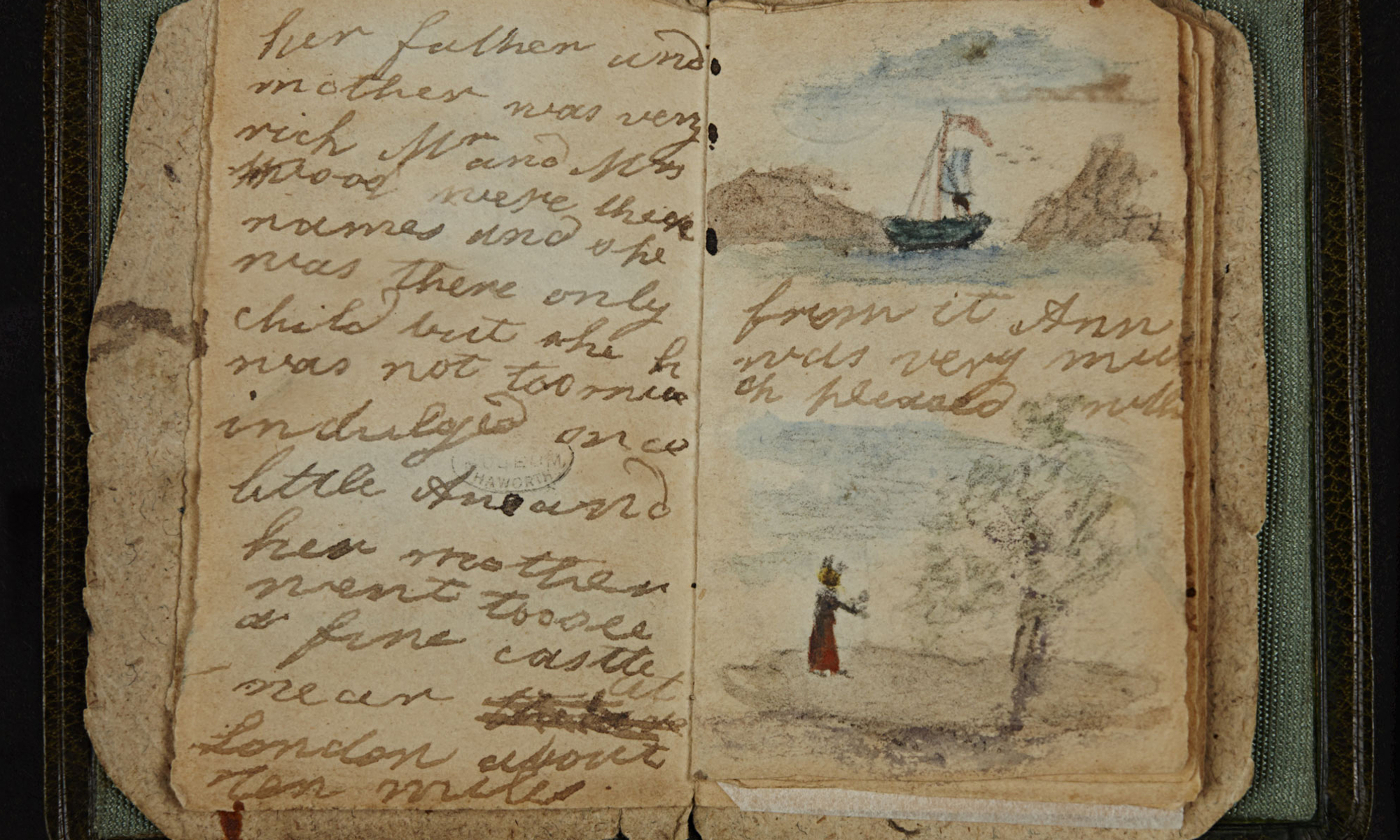
We’ve long known the internet’s power to facilitate access to the great books (see, for instance, our collection of 600 eBooks free online), but recent projects like the British Library’s Discovering Literature have shown us that it can also help us engage with those great books. The site, says a MetaFilter user who goes under Horace Rumpole, offers “a portal to digitized collections and supporting material. The first installment, Romantics and Victorians, includes work from Austen, the Brontës, Dickens, and Blake, and forthcoming modules will expand coverage of the site to encompass everything from Beowulf to the present day.” For now, if you enjoy classic English Romantic and Victorian novels, prepare to take that enjoyment to a higher level by immersing yourself in all manner of early manuscripts, authors’ papers and personal effects, and related pieces of contemporary media.
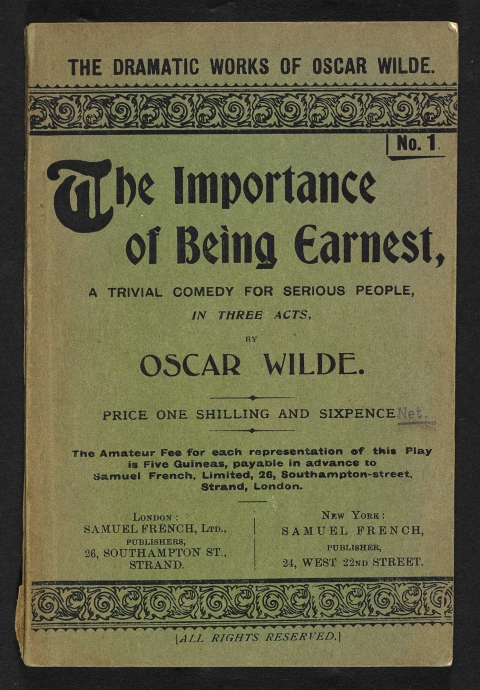
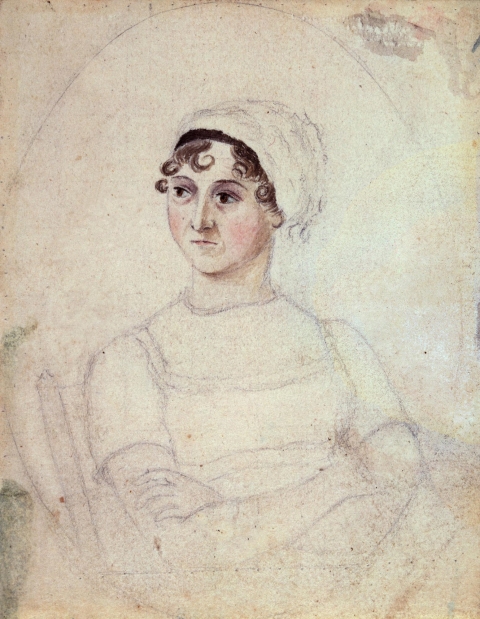
If you count yourself a Jane Austen fan, for instance, you can now scroll down her Discovering Literature author page and find “a host of texts” to do with her life, her work, and the intersection between them, “including the opinions — mostly positive — her friends and family had of her novels, copied out by the author (though ‘her immediate family is shown to have disagreed over which of her books was better’).” That comes from The Guardian’s Alison Flood, writing up the site’s collection of not just Austen accoutrements but items from writers like William Wordsworth, Oscar Wilde, and Mary Shelley, “as well as diaries, letters, newspaper clippings from the time and photographs, in an attempt to bring the period to life.”
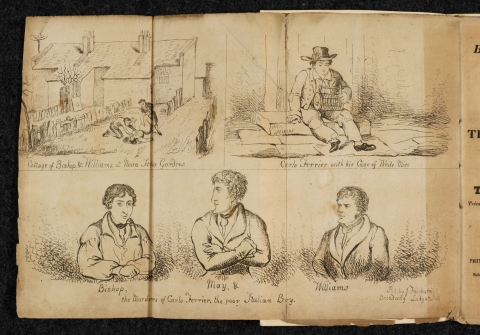
Flood cites “a survey of more than 500 English teachers, which found that 82% believe secondary school students ‘find it hard to identify’ with classic authors” on their classes’ syllabi. In response, Discovering Literature appears to have given special attention to oft-assigned writers like Charles Dickens, whose collection of materials on the site includes a literary sketch published at age 23, color illustrations for both an 1885 and 1911 edition of Oliver Twist (as well as the 1848 review that destroyed his relationship with the book’s previous illustrator), and “The Italian Boy,” an early work of journalism on “a brutal crime that occurred in London in 1831, a ‘copy-cat’ murder following upon those of the infamous Burke and Hare in Edinburgh.” The site’s archives also contain analytical essays on each writer’s body of work, like “Oliver Twist and the Workhouse” and “Status, Rank, and Class in Jane Austen’s Novels” — ideal for when these re-enthused students, previously unable to connect to the Romantic and Victorian eras’ most respected authors, reach grad school.
The image at the very top shows the earliest known writings of Charlotte Brontë.
Related Content:
Read Jane Austen’s Manuscripts Online
Charles Dickens’ Hand-Edited Copy of His Classic Holiday Tale, A Christmas Carol
Colin Marshall hosts and produces Notebook on Cities and Culture and writes essays on cities, language, Asia, and men’s style. He’s at work on a book about Los Angeles, A Los Angeles Primer. Follow him on Twitter at @colinmarshall or on Facebook.
Read More...13 Lectures from Allen Ginsberg’s “History of Poetry” Course (1975)
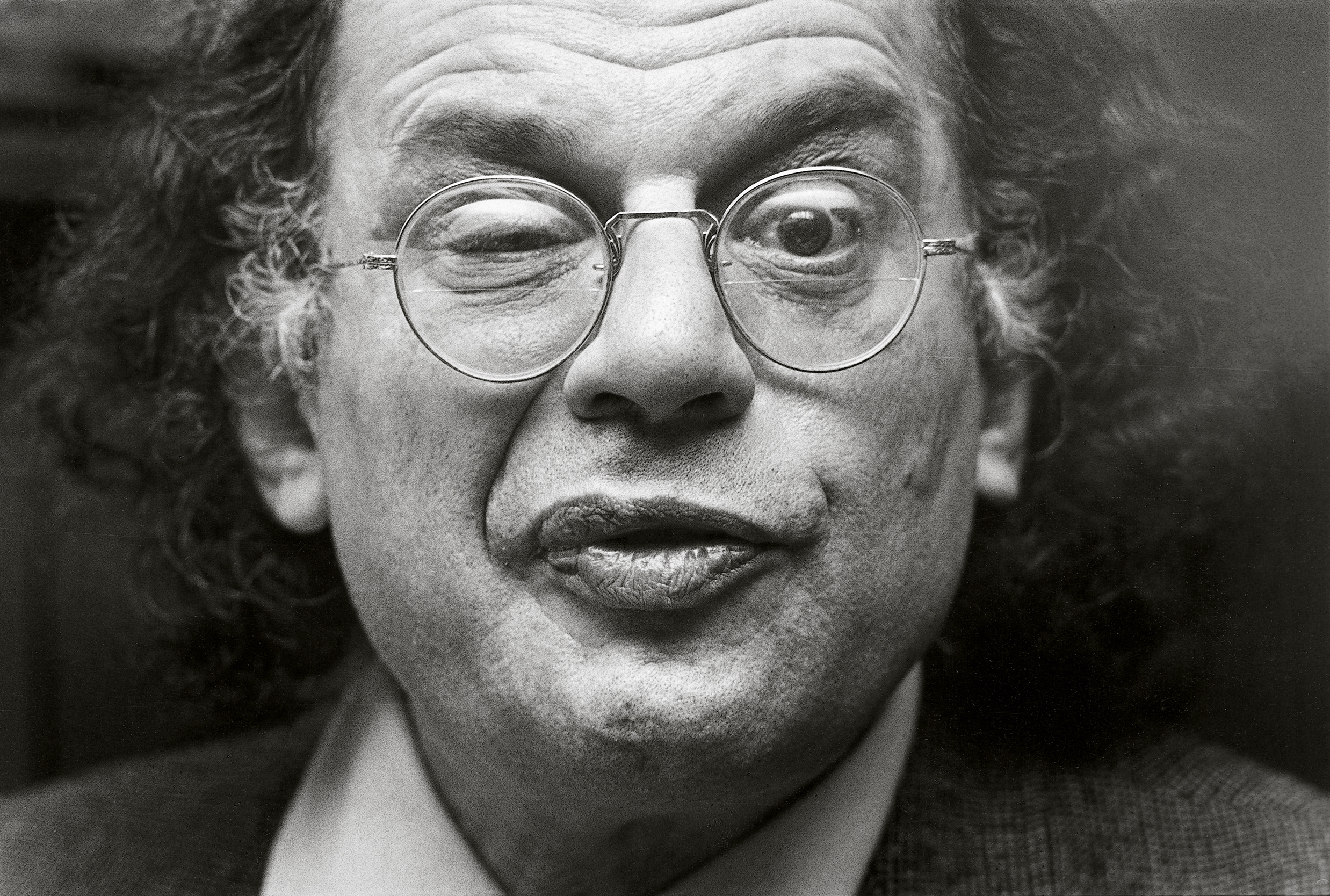
Image by Michiel Hendryckx, via Wikimedia Commons
If you want to understand poetry, ask a poet. “What is this?” you ask, “some kind of Zen saying?” Obvious, but subtle? Maybe. What I mean to say is that I have found poetry one of those distinctive practices of which the practitioners themselves—rather than scholars and critics—make the best expositors, even in such seemingly academic subject areas as the history of poetry. Of course, poets, like critics, get things wrong, and not every poet is a natural teacher, but only poets understand poetry from the inside out, as a living, breathing exercise practiced the world over by every culture for all recorded history, linked by common insights into the nature of language and existence. Certainly Allen Ginsberg understood, and taught, poetry this way, in his summer lectures at the Jack Kerouac School of Disembodied poetics, which he co-founded with Anne Waldman at Chogyam Trungpa Rinpoche’s Naropa University in 1974.
We’ve previously featured some of Ginsberg’s Naropa lectures here at Open Culture, including his 1980 short course on Shakespeare’s The Tempest and his lecture on “Expansive Poetics” from 1981. Today, we bring you several selections from his lengthy series of lectures on the “History of Poetry,” which he delivered in 1975. Currently, thirteen of Ginsberg’s lectures in the series are available online through the Internet Archive, and they are each well worth an attentive listen. Actually, we should say there are twelve Ginsberg lectures available, since Ginsberg’s fellow Beat Gregory Corso led the first class in the series while Ginsberg was ill.
Corso taught the class in a “Socratic” style, allowing students to ask him any questions they liked and describing his own process and his relationships with other Beat poets. You can hear his lectures here. When Ginsberg took over the “History of Poetry” lectures, he began (above) with discussion of another natural poet-educator, the idiosyncratic scholar Ezra Pound, whose formally precise interpretation of the Anglo-Saxon poem “The Seafarer” introduced many modern readers to ancient alliterative Old English poetics. (Poet W.S. Merwin sits in on the lecture and offers occasional laconic commentary and correction.)
Ginsberg references Pound’s pithy text The ABC of Reading and discusses his penchant for “ransack[ing] the world’s literature, looking for usable verse forms.” Pound, says Ginsberg—“the most heroic poet of the century”—taught poetry in his own “cranky and personal” way, and Ginsberg, less cranky, does something similar, teaching “just the poems that I like (or the poems I found in my own ear,” though he is “much less systematic than Pound.” He goes on to discuss 18th and 19th century poetics and sound and rhythm in poetry. One of the personal quirks of Ginsberg’s style is his insistence that his students take meditation classes and his claim that “the English verse that was taught in high school” is very close to the “primary Buddhist understanding of transiency.” But one can leave aside Ginsberg’s Buddhist preoccupations—appropriate to his teaching at a Buddhist university, of course—and still profit greatly from his lectures. Below, find links to eleven more of Ginsberg’s “History of Poetry” lectures, with descriptions from the Internet Archive. Unfortunately, it appears that several of the lecture recordings have not been preserved, or at least haven’t made it to the archive, but there’s more than enough material here for a thorough immersion in Ginsberg’s historical poetics. Also, be sure to see AllenGinsberg.org for transcriptions of his “History of Poetry” lectures. You can find these lectures listed in our collection of Free Literature Courses, part of our larger list, 1,700 Free Online Courses from Top Universities.
Part 3: class on the history of poetry by Allen Ginsberg, in a series of classes in the Summer of 1975. Gregory Corso helps teach the class. Percy Bysshe Shelley and Thomas Hood are discussed extensively. The class reads from Shelley, and Ginsberg recites Shelley’s “Ode to the west wind.”
Part 10: A class on the history of poetry by Allen Ginsberg, in a series of classes from 1975. Ginsburg discusses William Shakespeare and Ben Johnson in detail. Putting poetry to music, and the poet James Shirley are also discussed.
Part 11: A class on the history of poetry by Allen Ginsberg, in a series of classes by Ginsberg in the summer of 1975. Ginsberg discusses the metaphysical poets during the seventeenth century, specifically John Donne and Andrew Marvell. Ginsberg reads and discusses several of Donne’s and Marvell’s poems. There is also a discussion of the metaphysical poets and Gnosticism.
Part 12: [Ginsberg continues his discussion of Gnosticism and talks about Milton and Wordsworth]
Part 14: Second half of a class on the history of poetry by Allen Ginsberg, from a series of classes during the summer of 1975. Ginsberg talks about the songs of the poet William Blake. He sings to the class accompanied with his harmonium, performing several selections from Blake’s “Songs of innocence” and “Songs of experience.”
Part 15: First half of a class on the history of poetry by Allen Ginsberg. from a series of classes during the summer of 1975. Ginsberg discusses the 19th century American poet, Walt Whitman, and a French poet of the same period, Arthur Rimbaud. He also discusses the poets’ biographies and their innovative approaches to style and poetics, followed by a reading by Ginsberg of a selection of Whitman’s and Rimbaud’s work.
Part 16: Second half of a class, and first half of the following class, on the history of poetry by Allen Ginsberg, from a class series during the summer of 1975. The first twenty minutes continues a class from the previous recording, on the work and innovation of the American poet Walt Whitman and the French poet Arthur Rimbaud. The remainder of the recording begins an introduction and analysis of the French poet Guillaume Apollinaire.
Part 17: A class on the history of poetry by Allen Ginsberg, from a series of classes during the summer of 1975. Ginsberg discusses the poets Guillaume Apollinaire, Vladimir Mayakovsky, and Federico Garcia Lorca. The New York School poet Frank O’Hara is also briefly discussed. Ginsberg reads a selection of poems from the their works, followed by a class discussion.
Part 18: First half of a class about the history of poetry by Allen Ginsberg, from a series of classes during the summer of 1975. Ginsberg discusses the American poet, and one of his mentors, William Carlos Williams. Ginsberg reads selections from Williams’ work, and discusses his style and background.
Part 19: Second half of a class on the history of poetry by Allen Ginsberg, from a series of classes during the summer of 1975. Ginsberg discusses the poets William Carlos Williams, Gregory Corso and Jack Kerouac. He includes several personal anecdotes about the poets and reads selections from their works. A class discussion follows.
Part 20: A snippet of material that may conclude a class on the history of poetry by Allen Ginsberg, from a class series during the summer of 1975. The recording includes three minutes and six seconds of Ginsberg talking about the morality of William Carlos Williams and the subject of poetry and perception
Related Content:
Hear Allen Ginsberg’s Short Free Course on Shakespeare’s Play, The Tempest (1980)
“Expansive Poetics” by Allen Ginsberg: A Free Course from 1981
Josh Jones is a writer and musician based in Durham, NC. Follow him at @jdmagness.
Read More...Jean-Luc Godard Gives a Dramatic Reading of Hannah Arendt’s “On the Nature of Totalitarianism”
If you have watched any movie by Jean-Luc Godard you know that he’s never been one to hide behind the façade of film narrative. His movies are personal. Sure they are also intellectually demanding, unabashedly political, and occasionally impenetrable but they are definitely personal. This is a guy, after all, who made Pierrot le Fou, a film that is, among other things, a painfully honest investigation of the breakdown of his marriage with Anna Karina starring Anna Karina.
But you wouldn’t think of Godard as a filmmaker who would readily step in front of the camera like Orson Welles or (regrettably) Quentin Tarantino. But if you’ve been itching to see Godard perform an extended monologue then check out the video above.
The piece is from the 1997 movie We’re Still Here (Nous sommes tous encore ici), directed Anne-Marie Miéville who is Godard’s longtime creative and romantic partner, and it shows the rumpled, unshaven director quoting from Hannah Arendt’s essay “On the Nature of Totalitarianism.” The soliloquy, presented on a bare stage to an empty theater, is about tyranny, isolation and free will and is delivered with a surprising amount of skill and emotion. You can read along below:
If it were true that eternal laws existed, ruling everything, human in an absolute way and which only required of each human being complete obedience, the freedom would only be a farce. One man’s wisdom would be enough. Human contacts would no longer have any importance, preserved perfect activity alone would matter, operating within the context set up by this wisdom which recognizes the Law. This is not the content of ideologies, but the same logic which totalitarian leaders use which produces this familiar ground and the certainty of the Law without exception.
Logic, that’s to say pure reason without regard for facts and experience, is the real vice of solitude. But the vices of solitude are caused uniquely by the despair associated with isolation. And the isolation which exists in our world, where human contacts have been broken by the collapse of our common home, again following the disastrous consequences of revolutions, themselves a result of previous collapse.
This isolation has stopped being a psychological question to which we can do justice with the help of nice expressions devoid of meaning, like ‘introverted’ and ‘extraverted’. Isolation as a result of absence of friends and of alienation is, from the point of view of man, the sickness which our world is suffering from, even if it is true, we can notice fewer and fewer people than before who cling on to each other without the slightest support. Those people do not benefit from communication methods offered by a world with common interests. These help us escape together, from the curse of inhumanity, in a society where everyone seems superfluous and considered as such by others.
Isolation is not solitude. In solitude, we are never alone with ourselves. In solitude we are always two in one, and we become one, a complete individual with richness and the limits of its exact features, only in relation to the others and in their company. The big metaphysical questions, the search for God, liberty and immortality, relations between man and the world, being and nothingness or again between life and death, are always posed in solitude, when man is alone with himself, therefore, in the virtual company of all. The fact of being, even for a moment, diverted from one’s own individuality allows it to formulate mankind’s eternal questions, which go beyond the questions posed in different ways by each individual.
The risk in solitude is always of losing oneself. It could be said that this is a professional risk for the philosopher. Since he seeks out truth and preoccupies himself with questions, which we describe as metaphysical but which are indeed the only questions to preoccupy everyone. The philosopher’s solution has been to notice that there is apparently in the human mind itself one element capable of compelling the other and thus creating power. Usually we call this faculty Logic, and it intervenes each time that we declare that a principle or an utterance possesses in itself a convincing force, that is to say a quality which really compels the person to subscribe to it.
Recently we realized that the tyranny, not of reason but argumentation, like an immense compulsive force exercised on the mind of men can serve specifically political tyranny. But this truth also remains that every end in history necessarily contains a new beginning. This beginning is the only promise, the only message which the end can ever give. St Augustine said that man was created so that there could be a beginning. This beginning is guaranteed by each new birth, it is, in truth, each man.
Related Content:
Hannah Arendt Discusses Philosophy, Politics & Eichmann in Rare 1964 TV Interview
Hannah Arendt’s Original Articles on “the Banality of Evil” in the New Yorker Archive
A Young Jean-Luc Godard Picks the 10 Best American Films Ever Made (1963)
Jean-Luc Godard’s After-Shave Commercial for Schick (1971)
Jonathan Crow is a Los Angeles-based writer and filmmaker whose work has appeared in Yahoo!, The Hollywood Reporter, and other publications. You can follow him at @jonccrow.
Read More...Support Us
We're hoping to rely on loyal readers, rather than erratic ads. Please click the Donate button and support Open Culture. You can use Paypal, Venmo, Patreon, even Crypto! We thank you!

About Us

Open Culture scours the web for the best educational media. We find the free courses and audio books you need, the language lessons & educational videos you want, and plenty of enlightenment in between.
Advertise With Us
FREE UPDATES!
GET OUR DAILY EMAIL
Get the best cultural and educational resources on the web curated for you in a daily email. We never spam. Unsubscribe at any time.
FOLLOW ON SOCIAL MEDIA
Open Culture editor Dan Colman scours the web for the best educational media. He finds the free courses and audio books you need, the language lessons & movies you want, and plenty of enlightenment in between.
Advertise With Us



