Learn How Crayons Are Made, Courtesy of 1980s Videos by Sesame Street and Mr. Rogers
Some things are difficult to improve upon. Take crayons. The new generation may be clamoring for shades like “mango tango” and “jazzberry jam” but the actual technology appears unchanged since Sesame Street detailed the process in the early 80s, in the lovely, non verbal documentary above. Not a product placement in sight, I might add, though few can mistake that familiar green and gold box.
Those who prefer a bit more explanation might prefer Fred Rogers’ hypnotic step-by-step guide, playing in perpetuity on Picture Picture.
By the time the industry’s giant gorilla got around to weighing in, the wooden collection boxes and analog counters had been replaced, but otherwise, it’s still business as usual on the ol’ crayon-manufacturing floor. Don’t expect to find the recipe for the “secret proprietary blend of pigments and other ingredients” any time soon. Just know they’re capable of cranking out 8500 crayons per minute. For those playing along at home, that’s enough to encircle the globe 6 times per calendar year, with a full third owing their existence to solar energy.
There’s a Homeland Security-ish vibe to some of the dialogue, but the Life of an American Crayon, above, does our native assembly lines proud. Prouder than the American slaughterhouse, anyway, or some other factory floors, I could name. The workers seem content enough to stay in their positions for decades, happily declaring allegiance to this or that hue.
Related Content:
Philip Glass Composes for Sesame Street (1979)
How Animated Cartoons Are Made: Watch a Short, Charming Primer from 1919
Ayun Halliday is an author, homeschooler, and Chief Primatologist of the East Village Inky zine. Follow her @AyunHalliday
Read More...
Watch The Reality of the Virtual: 74 Minutes of Pure Slavoj Žižek (2004)
Slavoj Žižek must make a tempting documentary subject; you have only to fire up the camera and let him do his thing. Or at least the Slovenian academic provocateur and intellectual performance artist, in films like The Pervert’s Guide to Cinema, The Pervert’s Guide to Ideology, and Žižek!, has given the impression that he can effortlessly carry a film all by himself. The directors of those aforementioned movies did a bit more than sit Žižek down before a rolling camera, but Ben Wright, maker of The Reality of the Virtual, seems to have taken the man’s raw oratorical value as the very premise of his project. This 74-minute documentary — if even the word “documentary” suits such a radically simplified form — simply has Žižek sit at a table, in front of some bookshelves, and talk, ostensibly about “real effects produced by something which does not yet fully exist,” as he identifies them in the realms of psychoanalysis, politics, sociology, physics, and popular culture.
“Shot by Ben Wright over the course of a single day,” writes the New York Times’ Nathan Lee, “here is the apotheosis of the talking-head movie, made up entirely of seven long, static takes of Mr. Žižek,” animated only by his own “habitual repertory of twitches, spasms and uncontrolled perspiration, an alarming frenzy of exuberance that contributes to his reputation as a rock star of philosophy.” The theme at hand, which certainly has something to do with belief and truth, possibility and impossibility, the reality within the unreal and the unreal within reality, takes him through the widest possible range of associated subjects. Those who appreciate Žižek primarily as a master of focused digression — and I have to imagine his fan base contains many such people — will find no purer expression of that particular skill. Then again, to truly experience Žižek, maybe you have to take an actual class taught by him. If The Reality of the Virtual inspires you to do so, count yourself as braver than I.
Find many more heady films on our list of Free Documentaries, part of our larger collection, 4,000+ Free Movies Online: Great Classics, Indies, Noir, Westerns, Documentaries & More.
Related Content:
Žižek!: 2005 Documentary Reveals the “Academic Rock Star” and “Monster” of a Man
A Shirtless Slavoj Žižek Explains the Purpose of Philosophy from the Comfort of His Bed
Colin Marshall hosts and produces Notebook on Cities and Culture and writes essays on cities, language, Asia, and men’s style. He’s at work on a book about Los Angeles, A Los Angeles Primer. Follow him on Twitter at @colinmarshall or on Facebook.
Read More...The First Animations of Mike Judge, Creator of Beavis and Butt-head & Office Space (1991)
Mike Judge first became famous for creating the crude and crudely drawn cartoon series Beavis and Butt-head (find complete episodes online here). The show was about two high school burnouts whose running commentary on the latest music videos was so boneheaded and baldly vulgar that you couldn’t help but laugh. Prissy culture warriors pointed to the show as yet another symptom of America’s decline while legions of stoned college students gleefully tuned in. In 1998, Judge made the jump to live action features with Office Space, a hilarious, if uneven, take on the banalities of American corporate culture. It’s one of those movies that no one saw in the theater but, thanks to cable, everyone of a certain age can quote. (“If you can come in on Saturday, that would be great.”) Currently, he is the creator for the hit HBO series Silicon Valley.
Judge started in animation after working for a spell as first a computer programmer and then a blues bassist. After seeing an animation cel on display in a local movie theater in 1989, he ran out and bought a Bolex 16mm camera and started making movies. Two years later, he was producing odd, thoroughly unpolished animated shorts that made the rounds in film festivals, eventually launching a career in Hollywood.
Above is a short about Milton, the nebbish stapler-obsessed cubicle dweller who was the genesis for Office Space. Stephen Root played him in the movie. His boss is the same passive-aggressive prick as in the movie though played with less unctuous zeal as Gary Cole’s performance. The short proved to be such a success that MTV’s Liquid Television ordered more.
Next is The Honky Problem, about an emotionally unbalanced country singer named ‘Inbred Jed.’ He wants you to know that he is really, really, really happy to be playing at a remote trailer parker populated by a bunch of characters out of a David Lynch movie. In fact, if it weren’t for the jokey voice over at the end, this short is creepy enough to almost pass for an episode of Lynch’s own animated series, Dumbland.
And there’s this short also from 1991 called simply Huh?, which pits the shrill against the oblivious.
You can find more Animations in our collection, 4,000+ Free Movies Online: Great Classics, Indies, Noir, Westerns, Documentaries & More.
Related Content:
Dumbland, David Lynch’s Twisted Animated Series (NSFW)
Watch All of Terry Gilliam’s Monty Python Animations in a Row
Tim Burton’s The World of Stainboy: Watch the Complete Animated Series
Jonathan Crow is a Los Angeles-based writer and filmmaker whose work has appeared in Yahoo!, The Hollywood Reporter, and other publications. You can follow him at @jonccrow.
Read More...The New Yorker Web Site is Entirely Free This Summer (Until It Goes Behind a Paywall This Fall)

Yesterday, The New Yorker magazine published “A Note to Readers,” announcing the new strategy behind its web site. The site now has a different look and feel. It will also be governed by a new set of economics, which will include putting the entire site behind a paywall. The editors write, “in the fall, we [will] move to a second phase, implementing an easier-to-use, logical, metered paywall. Subscribers will continue to have access to everything; non-subscribers will be able to read a limited number of pieces—and then it’s up to them to subscribe. You’ve likely seen this system elsewhere—at the Times, for instance—and we will do all we can to make it work seamlessly.”
But, until then, the site won’t be half open (as it has been during recent years). It’ll be entirely open. Again, the editors write: “Beginning this week, absolutely everything new that we publish—the work in the print magazine and the work published online only—will be unlocked. All of it, for everyone. Call it a summer-long free-for-all. Non-subscribers will get a chance to explore The New Yorker fully and freely, just as subscribers always have.”
What should you read while The New Yorker is open? I’d focus on the old stuff, which will presumably get locked up too. Here are a few quick suggestions: Truman Capote’s In Cold Blood serialized in the pages of the magazine in 1965; J.D. Salinger’s January 1948 publication of his enduring short story “A Perfect Day for a Banana Fish;” and, of course, Hannah Arendt’s original articles on “the Banality of Evil”? If you have problems reading the text (in the latter two cases), be sure to click the pages to zoom in.
via GalleyCat
Read More...
Hunter S. Thompson’s Conspiratorial 9/11 Interview: “The Public Version of the News is Never Really What Happened”
Having read almost everything the prolific Fear and Loathing in Las Vegas author Hunter S. Thompson ever wrote, I don’t know if I would call him paranoid, per se. Nor do I know if I would call him not paranoid. He certainly trusted no entity with power, especially not governments, and really especially not the United States government. So by the time September 11, 2001 came around, he had little goodwill to spare for any of the major players involved in its aftermath. “The towers are gone now, reduced to bloody rubble, along with all hopes for Peace in Our Time, in the United States or any other country,” he wrote in his September 12 ESPN column. “Make no mistake about it: We are At War now — with somebody — and we will stay At War with that mysterious Enemy for the rest of our lives. It will be a Religious War, a sort of Christian Jihad, fueled by religious hatred and led by merciless fanatics on both sides.”
A year later, Australia’s ABC Radio National got Thompson’s assessment of the situation. Host Mick O’Regan opens the now famous interview above by asking how he thought the U.S. media had performed in the new post‑9/11 reality. “ ‘Shamefully’ is a word that comes to mind,” responds Thompson. “American journalism I think has been cowed and intimidated by the massive flag-sucking, this patriotic orgy that the White House keeps whipping up. You know if you criticise the President it’s unpatriotic and there’s something wrong with you, you may be a terrorist.” And does he think 9/11 “worked in favor of the Bush Administration?” For Thompson’s full answer, blogger Scratchingdog tracked down the original recording of the interview, not the edited version actually aired on ABC, and heard this:
Oh, absolutely. Absolutely. And I have spent enough time on the inside of, well, in the White House and you know, campaigns and I’ve known enough people who do these things, think this way, to know that the public version of the news or whatever event, is never really what happened. And these people I think are willing to take that even further, so I don’t assume that I know the truth of what went on that day, and yeah, just looking around and looking for who had the motive, who had the opportunity, who had the equipment, who had the will. Yeah, these people were looting the treasury and they knew the economy was going into a spiral downward.
9/11 conspiracy theorists have made much of this response and other Thompsonian analysis found in the unedited interview, going so far as to suggest that maybe — just maybe — the writer died three years later of something other than suicide. Given Thompson’s compulsion to speak truth to power, and sometimes to wave firearms around in front of it, any fan of his work can’t help but harshly scrutinize, and often pre-emptively dismiss, any and all “official stories” they happen to hear. We’ll never know whether Thompson would have approved of the “9/11 Truth” movement in the forms it has taken today, but they do share his spirit of creative distrust. And perhaps a touch of paranoia gave his writing its distinctive verve. Nobody moves into what they unfailingly describe as a “fortified compound,” after all, without at least a little bit of it.
Related Content:
Read 11 Free Articles by Hunter S. Thompson That Span His Gonzo Journalist Career (1965–2005)
Hunter S. Thompson’s Harrowing, Chemical-Filled Daily Routine
Hunter S. Thompson Calls Tech Support, Unleashes a Tirade Full of Fear and Loathing (NSFW)
Noam Chomsky Schools 9/11 Truther; Explains the Science of Making Credible Claims
Colin Marshall hosts and produces Notebook on Cities and Culture and writes essays on cities, language, Asia, and men’s style. He’s at work on a book about Los Angeles, A Los Angeles Primer. Follow him on Twitter at @colinmarshall or on Facebook.
Read More...Flannery O’Connor’s Satirical Cartoons: 1942–1945
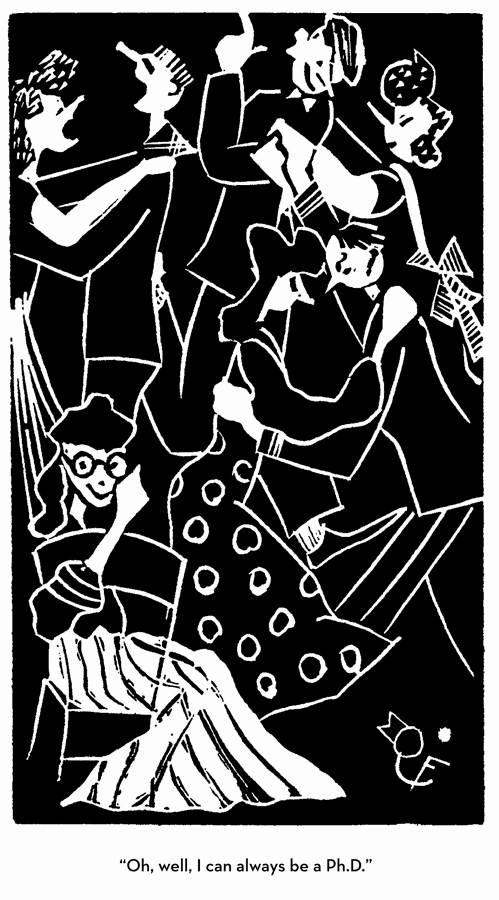
Sci-fi author B.C. Kowalski recently posted a short essay on why the advice to write every day is, for lack of a suitable euphemism, “bullshit.” Not that there’s anything wrong with it, Kowalski maintains. Only that it’s not the only way. It’s said Thackeray wrote every morning at dawn. Jack Kerouac wrote (and drank) in binges. Every writer finds some method in-between. The point is to “do what works for you” and to “experiment.” Kowalski might have added a third term: diversify. It’s worked for so many famous writers after all. James Joyce had his music, Sylvia Plath her art, Hemingway his machismo. Faulkner drew cartoons, as did his fellow Southern writer Flannery O’Connor, his equal, I’d say, in the art of the American grotesque. Through both writers ran a deep vein of pessimistic humor, oblique, but detectable, even in scenes of highest pathos.
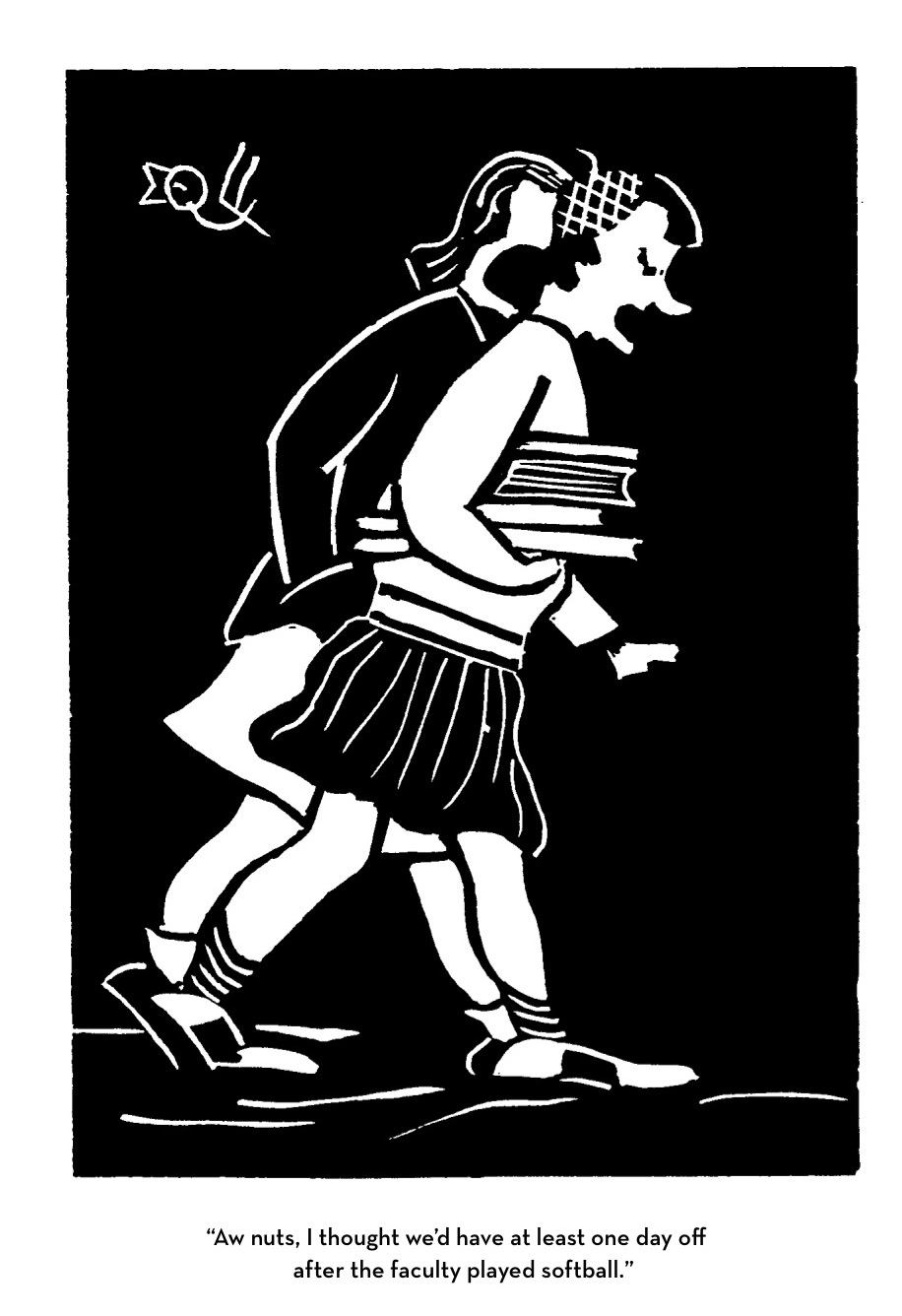
O’Connor’s visual work, writes Kelly Gerald in The Paris Review, was a “way of seeing she described as part of the ‘habit of art’”—a way to train her fiction writer’s eye. Her cartoons hew closely to her authorial voice: a lone sardonic observer, supremely confident in her assessments of human weakness. Perhaps a better comparison than Faulkner is with British poet and doodler Stevie Smith, whose bleak vision and razor-sharp wit similarly cut through mountains of… shall we say, bullshit. In both pen & ink and linoleum cuts, O’Connor set deadpan one-liners against images of pretension, conformity, and the banality of college life. In the cartoon at the top, she seems to mock the pursuit of credentials as a refuge for the socially disaffected. Above, a campaigner for a low-level office deploys bombastic pseudo-Leninist rhetoric, and in the cartoon below, a cranky character escapes a horde of identical WAVES.
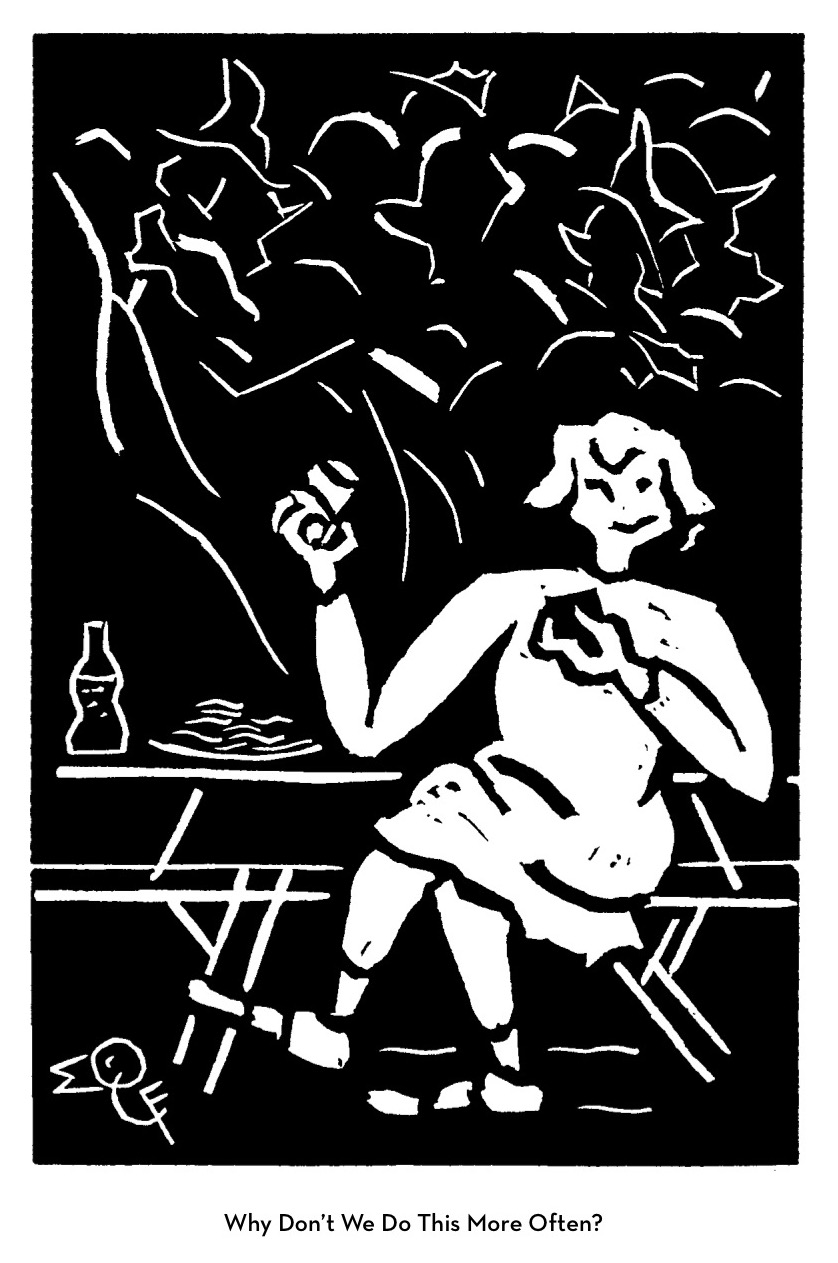
O’Connor was an intensely visual writer with, Gerald writes, a “natural proclivity for capturing the humorous character of real people and concrete situations,” fully credible even at their most extreme (as in the increasingly horrific self-lacerations of Wise Blood’s Hazel Motes). She began drawing at five and produced small books and sketches as a child, eventually publishing cartoons in almost every issue of her high-school and college’s newspapers and yearbooks. Her alma mater Georgia College, then known as Georgia State College for Women, has published a book featuring her cartoons from her undergraduate years, 1942–45.
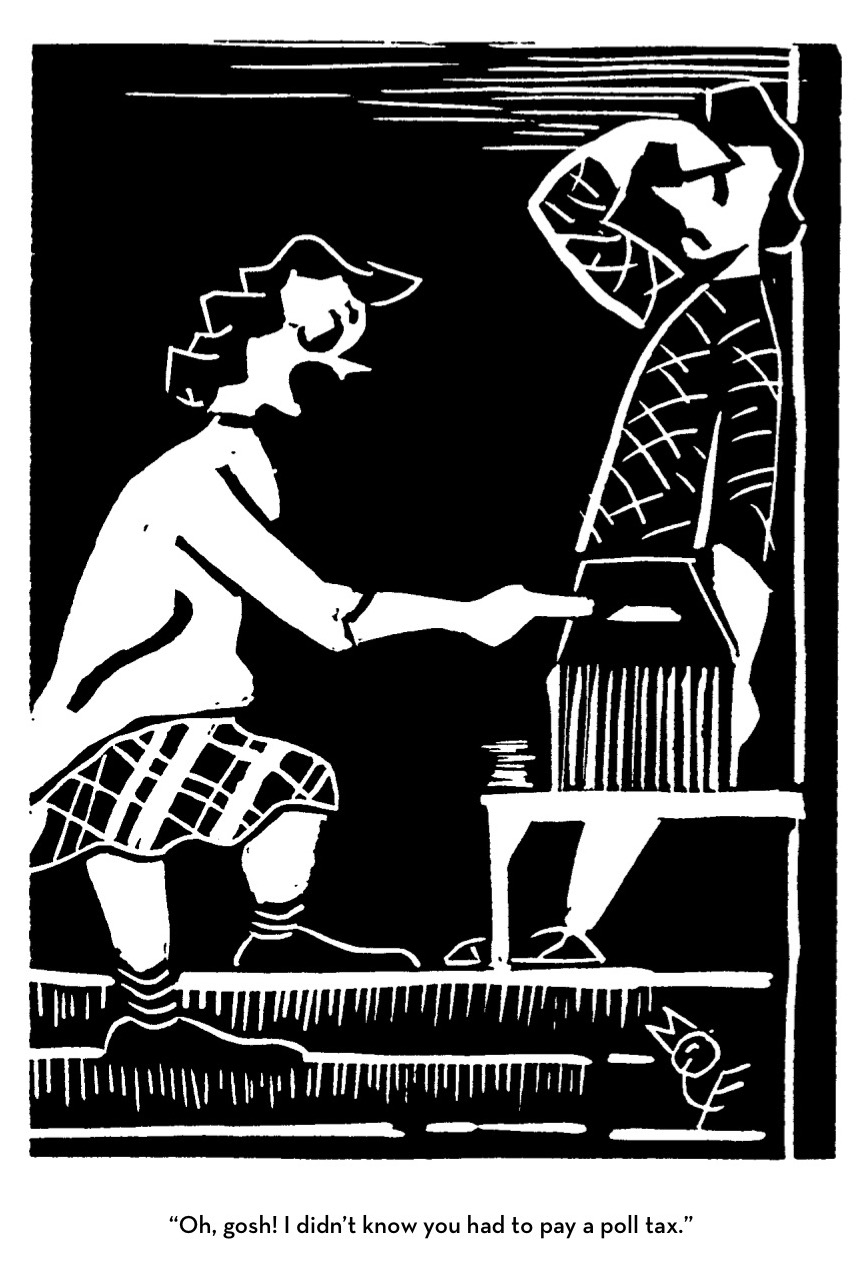
More recently, Gerald edited a collection called Flannery O’Connor: The Cartoons for Fantagraphics. In his introduction, artist Barry Moser describes in detail the technique of her linoleum cuts, calling them “coarse in technical terms.” And yet, “her rudimentary handling of the medium notwithstanding, O’Connor’s prints offer glimpses into the work of the writer she would become” with their “little O’Connor petards aimed at the walls of pretentiousness, academics, student politics, and student committees.” Had O’Connor continued making cartoons into her publishing years, she might have, like B.C. Kowalski, aimed one of those petards at those who dispense dogmatic, cookie-cutter writing advice as well.
Related Content:
The Art of William Faulkner: Drawings from 1916–1925
The Art of Sylvia Plath: Revisit Her Sketches, Self-Portraits, Drawings & Illustrated Letters
The Art of Franz Kafka: Drawings from 1907–1917
Rare 1959 Audio: Flannery O’Connor Reads ‘A Good Man is Hard to Find’
Flannery O’Connor: Friends Don’t Let Friends Read Ayn Rand (1960)
Josh Jones is a writer and musician based in Durham, NC. Follow him at @jdmagness
Read More...Listen to Audio Arts: The 1970s Tape Cassette Arts Magazine Featuring Andy Warhol, Marcel Duchamp & Many Others
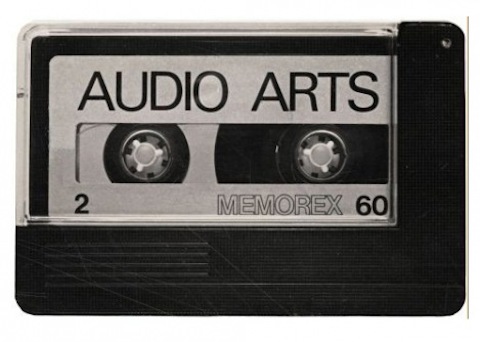
As a podcaster, I’ve long since grown used to the idea of periodically issuing audio content. But the convenient recording, internet, and computer, and mobile listening technologies that made such a medium possible only really converged in the early 2000s. How would I have gone about it had I wanted to put out a “podcast,” say, 40 years earlier? We have one such example in Audio Arts, a British contemporary art “sound magazine” distributed through the mail on audio cassettes. “The seventies were the years of conceptual art with text adding value to the actual works,” co-creator William Furlong once said in an interview. “As an artist I was more interested in ‘discussion,’ the idea of language and the people that already worked in conceptual fields in Great Britain. Soon I realised there weren’t magazines capable of reporting such material inspired by conversation, sounds and discussions. The evocative force of a voice is lost with the written word as it will only ever be a written voice.”
Furlong, a sculptor, and Barry Barker, a gallerist, began publishing Audio Arts in 1973. Its run lasted until, astonishingly, 2006, by which time its archives had come to 25 volumes of four issues each. Its list of subscribers included the formidable Tate, such fans that they actually acquired the magazine’s master tapes, digitized them, and made them all publicly available on their web site. No longer must you seek out nth-generation duplicated analog cassettes and dig out your Walkman; now you can simply stream on your media player of choice every issue from January 1973, “four cassettes with contributions from Caroline Tisdall, Noam Chomsky, James Joyce and W.B. Yeats,” to January 2006, which caps everything off with contributions by Gilbert & George and Jake and Dinos Chapman. Other notable artistic presences include Marcel Duchamp in Volume 2, Philip Glass in Volume 6, and Andy Warhol in Volume 8. Helpfully, Tate has also put together a section with tools to explore Audio Arts’ highlights — something more than a few modern-day podcasts could no doubt use.
via @WFMU
Related Content:
Andy Warhol Interviews Alfred Hitchcock (1974)
Library of Congress Releases Audio Archive of Interviews with Rock ‘n’ Roll Icons
Colin Marshall hosts and produces Notebook on Cities and Culture and writes essays on cities, language, Asia, and men’s style. He’s at work on a book about Los Angeles, A Los Angeles Primer. Follow him on Twitter at @colinmarshall or on Facebook.
Read More...Routledge Gives Free Access to 6,000 eBooks in June (Including Philosophy & Cultural Studies Texts)
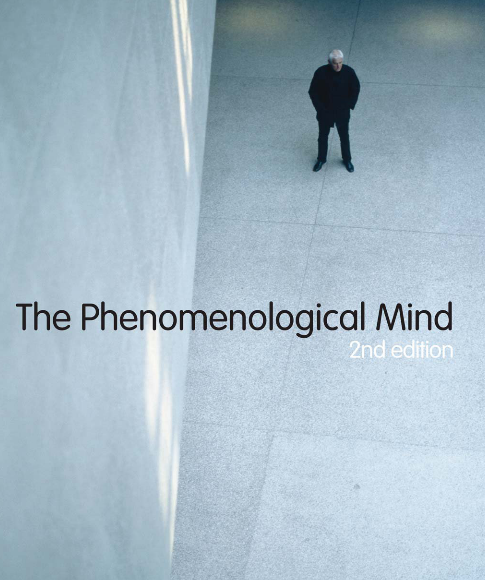
A quick note: After digitizing over 15,000 books, Routledge has made 6,000 of these e‑texts free for viewing during the month of June. You can browse the complete list of titles in Routledge’s e‑catalog by clicking here. Once you have selected a title, you can then click the blue “View Inside this Book” button to start reading the text. The collection includes lots of works focused on Economics, Finance and Business; Politics and International Relations; and Philosophy and Cultural Studies.The latter category will undoubtedly interest our many philosophically-minded readers. Among the texts you will find Foucault and Education; Cultural Analysis The Work of Peter L. Berger, Mary Douglas, Michel Foucault, and Jürgen Habermas; Heidegger and the Romantics: The Literary Invention of Meaning; The Notebooks of Simone Weil; and A Historical Introduction to Phenomenology. The image above comes from The Phenomenological Mind by Shaun Gallagher and Dan Zahavi.
via Leiter Reports
Related Content:
800 Free eBooks for iPad, Kindle & Other DevicesFree Online Philosophy Courses
Michel Foucault: Free Lectures on Truth, Discourse & The Self
170 Free Textbooks: A Meta Collection
Read 9 Books By Noam Chomsky Free Online
Read More...
Carl Jung Writes a Review of Joyce’s Ulysses and Mails It To The Author (1932)
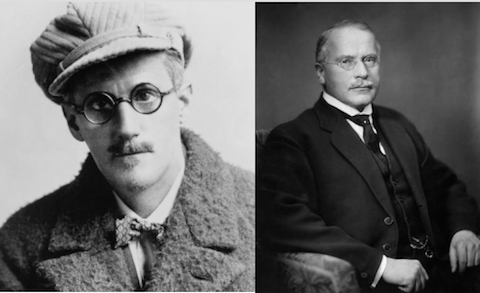
Feelings about James Joyce’s Ulysses tend to fall roughly into one of two camps: the religiously reverent or the exasperated/bored/overwhelmed. As popular examples of the former, we have the many thousand celebrants of Bloomsday—June 16th, the date on which the novel is set in 1904. These revelries approach the level of saints’ days, with re-enactments and pilgrimages to important Dublin sites. On the other side, we have the reactions of Virginia Woolf, say, or certain friends of mine who left wry comments on Bloomsday posts about picking up something more “readable” to celebrate. (A third category, the scandalized, has more or less died off, as scatology, blasphemy, and cuckoldry have become the stuff of sitcoms.) Another famous reader, Carl Jung, seems at first to damn the novel with some faint praise and much scathing criticism in a 1932 essay for Europäische Revue, but ends up, despite himself, writing about the book in the language of a true believer.
A great many readers of Jung’s essay may perhaps nod their heads at sentences like “Yes, I admit I feel I have been made a fool of” and “one should never rub the reader’s nose into his own stupidity, but that is just what Ulysses does.” To illustrate his boredom with the novel, he quotes “an old uncle,” who says “’Do you know how the devil tortures souls in hell? […] He keeps them waiting.’” This remark, Jung writes, “occurred to me when I was plowing through Ulysses for the first time. Every sentence raises an expectation which is not fulfilled; finally, out of sheer resignation, you come to expect nothing any longer.” But while Jung’s critique may validate certain hasty readers’ hatred of Joyce’s nearly unavoidable 20th century masterwork, it also probes deeply into why the novel resonates.
For all of his frustration with the book—his sense that it “always gives the reader an irritating sense of inferiority”—Jung nonetheless bestows upon it the highest praise, comparing Joyce to other prophetic European writers of earlier ages like Goethe and Nietzsche. “It seems to me now,” he writes, “that all that is negative in Joyce’s work, all that is cold-blooded, bizarre and banal, grotesque and devilish, is a positive virtue for which it deserves praise.” Ulysses is “a devotional book for the object-besotted white man,” a “spiritual exercise, an aesthetic discipline, an agonizing ritual, an arcane procedure, eighteen alchemical alembics piled on top of one another […] a world has passed away, and is made new.” He ends the essay by quoting the novel’s entire final paragraph. (Find longer excerpts of Jung’s essay here and here.)
Jung not only wrote what may be the most critically honest yet also glowing response to the novel, but he also took it upon himself in September of 1932 to send a copy of the essay to the author along with the letter below. Letters of Note tells us that Joyce “was both annoyed and proud,” a fittingly divided response to such an ambivalent review.
Dear Sir,
Your Ulysses has presented the world such an upsetting psychological problem that repeatedly I have been called in as a supposed authority on psychological matters.
Ulysses proved to be an exceedingly hard nut and it has forced my mind not only to most unusual efforts, but also to rather extravagant peregrinations (speaking from the standpoint of a scientist). Your book as a whole has given me no end of trouble and I was brooding over it for about three years until I succeeded to put myself into it. But I must tell you that I’m profoundly grateful to yourself as well as to your gigantic opus, because I learned a great deal from it. I shall probably never be quite sure whether I did enjoy it, because it meant too much grinding of nerves and of grey matter. I also don’t know whether you will enjoy what I have written about Ulysses because I couldn’t help telling the world how much I was bored, how I grumbled, how I cursed and how I admired. The 40 pages of non stop run at the end is a string of veritable psychological peaches. I suppose the devil’s grandmother knows so much about the real psychology of a woman, I didn’t.
Well, I just try to recommend my little essay to you, as an amusing attempt of a perfect stranger that went astray in the labyrinth of your Ulysses and happened to get out of it again by sheer good luck. At all events you may gather from my article what Ulysses has done to a supposedly balanced psychologist.
With the expression of my deepest appreciation, I remain, dear Sir,
Yours faithfully,
C. G. Jung
With this letter of introduction, Jung was “a perfect stranger” to Joyce no longer. In fact, two years later, Joyce would call on the psychologist to treat his daughter Lucia, who suffered from schizophrenia, a tragic story told in Carol Loeb Schloss’s biography of the novelist’s famously troubled child. For his care of Lucia and his careful attention to Ulysses, Joyce would inscribe Jung’s copy of the book: “To Dr. C.G. Jung, with grateful appreciation of his aid and counsel. James Joyce. Xmas 1934, Zurich.”
via Letters of Note
Related Content:
Everything You Need to Enjoy Reading James Joyce’s Ulysses on Bloomsday
The Very First Reviews of James Joyce’s Ulysses: “A Work of High Genius” (1922)
Josh Jones is a writer and musician based in Durham, NC. Follow him at @jdmagness
Read More...Hear Roger Waters’ Early, Work-in-Progress Recordings of Pink Floyd’s The Wall
My first exposure to Pink Floyd’s rock opera The Wall left me feeling nothing less than astonishment. And though I never had the chance to see the outrageous stage show, with its very literal wall and giant inflatable pig, the film has always struck me as a suitably dark piece of psychodrama. Over a great many subsequent listens, the melodramatic double-album can still blow my mind, but I’ve come to feel that some of the strongest material are those songs penned jointly by Roger Waters and David Gilmour, and those are relatively few. (Mark Blake quotes Gilmour as saying “things like ‘Comfortably Numb’ were the last embers of mine and Roger’s ability to work collaboratively together.) The bulk of the album belongs to Waters, its autobiographical details and personal themes, and the album and film can sometimes feel as stifled and claustrophobic as its protagonist does. This is either a creative failing or a brilliant melding of form and content.
Inspired by an incident in which an exasperated Waters spat on a rowdy fan at a stadium show in Montreal during the band’s 1977 “In the Flesh Tour,” The Wall documents the painful rise and even more painful fall of a fictive rock star named, of course, Pink (played by Bob Geldof in the film version), whose life closely parallels Waters’, down to the spitting. It has always seemed an odd irony that Waters responded to the alienation of touring massive stadiums by creating a stadium show bigger than anything the band had yet done, but it speaks to the bassist and singer’s grandiose personality and obsessive desire to turn his angst into theater. Oftentimes the results were spectacular, other times bombastic and confusing (at least to critics, some of whom are easily confused). The recording of the album, as many well know, strained the band almost to breaking, and by many accounts, Waters’ imperiousness didn’t help matters, to say the least.
All of the behind-the-scenes drama may or may not eclipse the drama of the album itself, depending on your level of fandom and interest in Pink Floyd biography. Lovers of Waters’ epic rock dramaturgy will find edification at the extensive online critical commentary Pink Floyd The Wall: A Complete Analysis, an online work in progress that delivers on its title. For a very brief account of the story behind the story, co-producer Bob Ezrin’s interview with Grammy.com offers perspective from someone involved in the project who wasn’t a member of what came to seem like The Roger Waters’ Band. Ezrin describes The Wall as “Roger’s own project and not a group effort,” and his own role as “a kind of referee between him and the rest of the band.”
In the beginning we had a very long demo that Roger had written. We started to separate out the pieces, and when we looked at the storyline we realized what we needed was a through line, something to get us from start to finish.
Ezrin recounts that he “closed [his] eyes and wrote out the movie that would become The Wall,” handed the script out to the band, and marked songs missing from Waters’ demo as “’TBW’—‘to be written.’” (Among those songs was “Comfortably Numb.”)
The recordings at the top of the post—which surfaced in 2001 with the title Under Construction—represent a step in The Wall’s evolutionary development between Waters’ rudimentary demos (short excerpts above) and the completed album. (See the Youtube page for a complete tracklist. Contrary to the uploader’s description, Roger Waters certainly does not play all the instruments.) While Under Construction has generally been referred to as a “demo,” Rick Karhu of Pink Floyd fanzine Spare Bricks expresses his doubts about the use of a term he takes to denote “a fairly polished recording”: “Demos are not rough recordings or works-in-progress […]. I doubt very much that Under Construction is a demo of The Wall.”
It’s too rough around the edges—at times shockingly so—to be strictly considered a demo recording. At points, things are haphazardly edited together. Songs cut off abruptly, fade unexpectedly or drop out entirely for a moment as if someone at the mixing desk hit the wrong button at some point. Vocal tracks peak-out, often causing anguish to the listener’s ear drums. Some instrument lines (mostly the bass guitar) meander through the background as if the person playing is making up the part as they go. Equalization is nonexistent on most tracks. Overall, most of it sounds like a 4‑track recording by a band who has only the vaguest notion of how the equipment works.
Lest we take this description as disparagement, Karhu clarifies: “It is precisely for those reasons […] that I love them dearly and consider them one of the most valuable, unauthorized Floyd recordings to be unearthed. Ever.” Many Youtube commenters agree, some even arguing that these rough sketches are superior to the final polished product. It’s a debate I won’t weigh in on, though I will say that like Karhu, I enjoy the lo-fi raggedness of this version of The Wall. It seems to convey the emotionally frayed edges of these songs in a way the slick production of the studio album may not at times. Either as a mere document of the album’s early history or an alternate, fragmented—and hence more traumatized—take on The Wall, this unofficial version is haunting and strange. Does it perhaps better represent Waters’ desire to make his psychic unease into art? We invite you to judge for yourselves. And if, like me, you can listen to “Comfortably Numb” (and that incredible guitar solo) on repeat for hours on end, you may be interested to hear David Gilmour discuss the song’s composition in the interview below.
Hear more demo tracks on YouTube here.
Related Content:
David Gilmour & David Bowie Sing “Comfortably Numb” Live (2006)
Watch Documentaries on the Making of Pink Floyd’s Dark Side of the Moon and Wish You Were Here
Josh Jones is a writer and musician based in Durham, NC. Follow him at @jdmagness.
Read More...Support Us
We're hoping to rely on loyal readers, rather than erratic ads. Please click the Donate button and support Open Culture. You can use Paypal, Venmo, Patreon, even Crypto! We thank you!

About Us

Open Culture scours the web for the best educational media. We find the free courses and audio books you need, the language lessons & educational videos you want, and plenty of enlightenment in between.
Advertise With Us
FREE UPDATES!
GET OUR DAILY EMAIL
Get the best cultural and educational resources on the web curated for you in a daily email. We never spam. Unsubscribe at any time.
FOLLOW ON SOCIAL MEDIA
Open Culture editor Dan Colman scours the web for the best educational media. He finds the free courses and audio books you need, the language lessons & movies you want, and plenty of enlightenment in between.
Advertise With Us

