Hear Allen Ginsberg Teach “Literary History of the Beats”: Audio Lectures from His 1977 & 1981 Naropa Courses
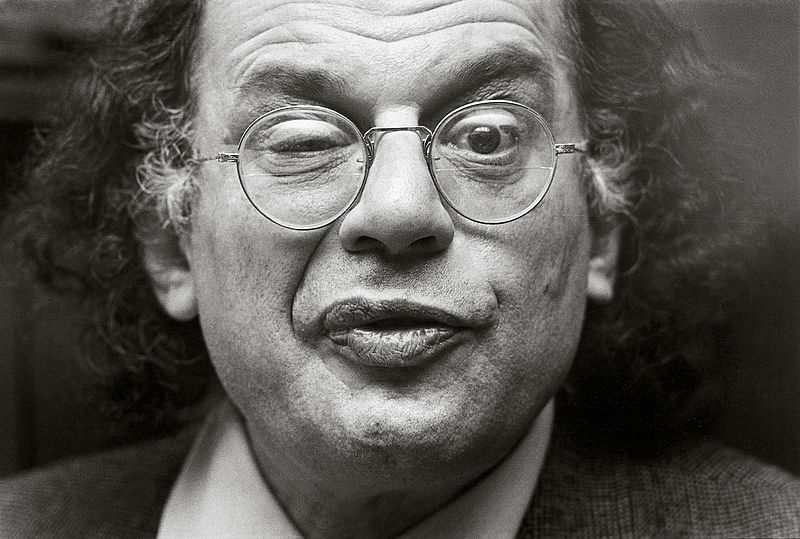
Image by Michiel Hendryckx, via Wikimedia Commons
It’s not often one gets the opportunity to take a course on a major literary movement taught by a founding member of that movement. Imagine sitting in on lectures on Romantic poetry taught by John Keats or William Wordsworth? It may be the case, however, that the Romantic poets would have a hard time of it in the cutthroat world of professionalized academic poetry, a world Allen Ginsberg helped create in 1974 with the founding of his Jack Kerouac School of Disembodied Poetics at Naropa University, almost twenty years after he brought hip modern poetry to the masses with the wildly popular City Lights paperback edition of Howl and Other Poems. (Here you can listen to the first recording of Ginsberg reading that famous poem.)
Dismissed by the modernist old guard as “vacuous self-promoters” in their time, the Beats’ legend often portrays them as paragons of artistic integrity. There’s no reason they couldn’t be both in some sense. The anti-authoritarian pranks and poses gained them notoriety for matters of style, and their dedication to radicalizing American literature provided the substance.
As the Academy of American Poets writes, “there is a clear work ethic that reverberates in their lives and in their writing, and in the eyes of many readers and critics, the Beats fostered a sustained, authentic, and compelling attack on post-World War II American Culture,” rejecting both “the stultifying materialism and conformism of the cold war era” and “the highly wrought and controlled aesthetic of modernist stalwarts.”
Thanks to the archives at Naropa, we can hear Ginsberg himself lecture on both the style and substance of Beat literary culture in a series of lectures he delivered in 1977 for his summer course called “Literary History of the Beats.” We’ve previously featured the extensive “specialized reading list” Ginsberg handed students for that class, which he titled “Celestial Homework.” In the first series of lectures—divided in 18 parts in the archive—hear him discuss the list. The Naropa archive describes the first lecture as diving “right into the 40’s lives of Ginsberg, Kerouac, Burroughs, Herbert Huncke, and others living in NYC at that time. From consuming Benzadrine inhalers to the discovery of the void, Ginsberg’s account and analyses are entertaining and lively as well as insightful.” Hear part one of that talk at the top of the post, and part two just above.
Ginsberg focuses on the 40s as the period of Beat origins in his 1977 class. Another section of the course—taught in 1981—covers the 50s, with topics such as “Burroughs’ recommended reading lists,” “Burroughs on drugs and society,” and “the founding of the study of semantics.” Hear the first lecture in that series just above.
Literary History of the Beats will be added to our collection, 1,700 Free Online Courses from Top Universities.
Image above was taken by Marcelo Noah.
Related Content:
William S. Burroughs Teaches a Free Course on Creative Reading and Writing (1979)
“Expansive Poetics” by Allen Ginsberg: A Free Course from 1981
13 Lectures from Allen Ginsberg’s “History of Poetry” Course (1975)
Download 55 Free Online Literature Courses: From Dante and Milton to Kerouac and Tolkien
Josh Jones is a writer and musician based in Durham, NC. Follow him at @jdmagness.
Read More...Watch Frank Zappa Play Michael Nesmith on The Monkees (1967)
In December 1967, The Monkees blew their audience’s minds by hosting Frank Zappa, “participant in and perhaps even leader of” the Mothers Of Invention.
Or did they?
The tidal wave of affection that comprises twenty-first century Monkees mania makes us forget that children were the primary audience for The Monkees’ titular sitcom. (One might also say that The Monkees were the sitcom’s titular band.)
But even if the kids at home weren’t sufficiently conversant in the musical underground to identify the special guest star of the episode, “The Monkees Blow Their Minds,” we are.
It’s a joy to see Zappa and The Monkees’ supremely laid back Michael Nesmith (he auditioned for the show with his laundry bag in tow) impersonating each other.
Zappa’s idea, apparently. He’s in complete control of the gimmick from the get go, whereas Nesmith struggles to keep their names straight and his prosthetic nose in place before getting up to speed.
It’s important to remember that it’s not Frank, but Nesmith playing Frank who accuses The Monkees’ music of being banal and insipid.
Zappa himself was a great supporter of The Monkees. “When people hated us more than anything, he said kind things about us,” Nesmith recalled in Barry Miles’ Zappa biography. Zappa attempted to teach Nesmith how to play lead guitar, and offered drummer Micky Dolenz a post-Monkees gig with The Mothers of Invention.
Their mutual warmth makes lines like “You’re the popular musician! I’m dirty gross and ugly” palatable. It put me in mind of comedian Zach Galifianakis’ Between Two Ferns, and countless other loosely rehearsed web series.
After a couple of minutes, Nesmith gets his hat back to conduct as Zappa smashes up a car to the tune of the Mother’s Of Invention’s “Mother People.”
Watch the full episode here, or if pressed for time, perhaps just Zappa’s cameo in the Monkees’ movie Head, as a studio lot bull wrangler who counsels lead singer Davy Jones on his career.
Related Content:
A Young Frank Zappa Turns the Bicycle into a Musical Instrument on The Steve Allen Show (1963)
In One of his Final Interviews, Frank Zappa Pronounces Himself “Totally Unrepentant”
Ayun Halliday is an author, homeschooler, and Chief Primatologist of the East Village Inky zine. Follow her @AyunHalliday
Read More...
The Avant-Garde Project: An Archive of Music by 200 Cutting-Edge Composers, Including Stravinsky, Schoenberg, Cage & More
 Every sphere of recorded music, from late-1960s folk to Philadelphia hip-hop to Japanese jazz (a personal pursuit of mine), has its crate-diggers, those happy to flip through hundreds — nay, hundreds of thousands — of obscure, forgotten vinyl albums in search of their subgenre’s even obscurer, more forgotten gems. This holds especially true, if not in number than in avidity, for enthusiasts of the 20th-century classical-experimental-electroacoustic tradition that The Avant-Garde Project takes as its preservation mandate. The site offers material “digitized from LPs whose music has in most cases never been released on CD, and so is effectively inaccessible to the vast majority of music listeners today.” To the best of the Archive’s knowledge, the LPs are all currently out of print, and all the music is extracted with an analog rig that ranks as “near state-of-the-art, producing almost none of the tracking distortion or surface noise normally associated with LPs.”
The Avant-Garde Project’s efforts, the archive of which you can browse here (or alphabetically by composer, or through choice samplers, or through the “AGP top twenty,” or through the founder’s personal favorites), has borne a great deal of fruit so far, especially from such music-history class favorites as Arnold Schoenberg, whose String Trio performed by the Los Angeles String Trio you can hear above, and Igor Stravinsky, whose Symphony of Psalms you’ll find below. Everything in the Avant-Garde Project’s archive comes downloadable as torrents of Free Lossless Audio Codec (FLAC) files. This audiophile’s compression format of choice requires a bit of special but easily obtained software to play or burn to CDs, all of which you can get explained here (with even more information here). Those who’d like to keep it simple (if not quite as aurally pristine) can listen through a smaller version of the archive at Ubuweb. Either way, you’ll enjoy all the artistic richness of rare 20th-century classical-experimental-electroacoustic music with none of the digging.
Related Content:
Extensive Archive of Avant-Garde & Modernist Magazines (1890–1939) Now Available Online
Vi Hart Uses Her Video Magic to Demystify Stravinsky and Schoenberg’s 12-Tone Compositions
Stravinsky’s The Rite of Spring, Visualized in a Computer Animation for Its 100th Anniversary
Interviews with Schoenberg and Bartók
Hear Theodor Adorno’s Avant-Garde Musical Compositions
Colin Marshall hosts and produces Notebook on Cities and Culture and writes essays on cities, language, Asia, and men’s style. He’s at work on a book about Los Angeles, A Los Angeles Primer. Follow him on Twitter at @colinmarshall or on Facebook.
Read More...Hear David Foster Wallace Read His Own Essays & Short Fiction on the 6th Anniversary of His Death,
Yesterday, of course, marked the 13th anniversary of the horrible attacks on the Twin Towers and the Pentagon. Today marks the 6th anniversary of David Foster Wallace’s death by suicide. The two events are related not only by proximity, and not because they are comparable tragedies, but because Wallace’s work, in particular his 1993 essay “E Unibus Pluram: Television and U.S. Fiction,” has become such a touchstone for the discourse of “post-irony” or “the new sincerity” since 9/11, when Vanity Fair editor Graydon Carter and others proclaimed the “end of irony.” But the cultural consciousness has shifted measurably since those heady days of fervent affirmation. In a reconsideration of Wallace on irony, Bradley Warshauer writes, “he wasn’t wrong—but he is obsolete.” Our national discourse—as much as it can be defined in broad terms—may have, some argue, swung further toward sincerity and sentimental reverence than Wallace would have liked. And he may have been much more an ironist than he liked to believe.
Wallace, writes Warshauer, was “a wannabe sentimentalist who was too absurdly talented and probably too obsessed with the artificiality of fiction to be the sort of ‘anti-rebel’ that he himself talked about.” While he may have romanticized the high-minded figure who “stands for” things in uncomplicated ways, Wallace himself was complicated, prickly, and just too hyper-aware—of himself and others—to be seduced by easy sentiment, what Somerset Maugham called “unearned emotion.” While his work pulls us still toward deeper levels of analysis, toward contemplation and critique, toward serious considerations of value, it does not do so by eschewing irony. In the descriptive force of his prose are the evasions, parries, asides, circumlocutions, and jarringly odd juxtapositions of the ironist, the satirist, and—what might be the same thing—the moralist. “The inherent contradiction”—the irony, if you will—of Wallace’s stance, Washauer argues, citing 1999’s Brief Interviews With Hideous Men, is that he himself “was addicted to ironic detachment.” But, of course, it’s not so simple as that.
Today we bring you several readings by David Foster Wallace of his own work. We begin at the top with “Death is Not the End” from Brief Interviews, that collection of “weird metafiction” that couches raw and painful confessions in layers of irony. Below it, from that same collection, we have “Suicide as a Sort of Present,” a piece that, in hindsight, offers its own potential morbidly ironic readings. Just above, hear Wallace read the short story “Incarnations of Burned Children” from the 2005 collection Oblivion, full of stories Wyatt Mason described as “tightly withhold[ing]… hiding on high shelves the keys that unlock their treasures.” Replete with tiny mechanisms that can take many careful readings to parse, these stories are fine-art studies in ironic language and situations.
One may class David Foster Wallace as a master ironist, despite his critical stance against its overuse, but this reduces the full range of his mastery to one mode among so many. His work embraced the voice of irony and the voice of sincerity as equally valid rhetorical means, alternating between the two in what A.O. Scott once called a “feedback loop.” “The View From Mrs. Thompson’s,” the essay Wallace reads above from 2005’s essay collection Consider the Lobster, is a piece he wrote just days after 9/11. Written quickly as a commission from Rolling Stone, the essay records his trenchant observations of the reactions in Bloomington, Illinois between September 11–13. It’s a piece that showcases the tension between Wallace’s sincere desire for immediacy and his almost uncontrollable impulse to amused detachment. And hearing Wallace commemorate the tragic events we remembered yesterday highlights the sad irony of memorializing his own death today.
You can hear many more of David Foster Wallace’s readings and interviews at the David Foster Wallace Audio Project, and be sure to stop by our sizable collection, 30 Free Essays & Stories by David Foster Wallace on the Web.
Related Content:
‘This Is Water’: Complete Audio of David Foster Wallace’s Kenyon Graduation Speech (2005)
David Foster Wallace: The Big, Uncut Interview (2003)
David Foster Wallace’s 1994 Syllabus: How to Teach Serious Literature with Lightweight Books
Read Two Poems David Foster Wallace Wrote During His Elementary School Days
Josh Jones is a writer and musician based in Durham, NC. Follow him at @jdmagness
Read More...Haruki Murakami Lists the Three Essential Qualities For All Serious Novelists (And Runners)

Image by wakarimasita, via Wikimedia Commons
We’ve brought you a wealth of Haruki Murakami lately, and for good reason. Not only does the wildly popular Japanese novelist have a new novel out, he also has an upcoming novella, The Strange Library, a 96-page story about, well, a “strange trip to the library,” due from Knopf on December 2nd. Admirably prolific, writing roughly 3–4 novels per decade since his first in 1979, and a few collections of stories and essays, the notoriously shy Murakami took to writing somewhat late in life at age 30, and to running even later at 33. The latter pursuit gave him a great deal of material for his essay collection What I Talk About When I Talk About Running.
Like other authors who write nonfiction pieces on their avocations—Jamaica Kincaid on gardening, Hemingway on hunting—in his running book, Murakami can’t help but turn his passion for fitness into a metaphor for reading and writing. Given his natural reticence, he begins, with a disclaimer: “a gentleman shouldn’t go on and on about what he does to stay fit.”
Nevertheless, the ultra-marathoner can’t help but indulge. At one point, the writing on running turns to writing on writing, and a summary of the qualities the good novelist must have. Read his thoughts condensed below.
Talent:
Like Flannery O’Connor, whose thoughts on the MFA degree we quoted a few days ago, Murakami frames talent as an attribute that can’t be taught or bought. For the writer, talent is “more of a prerequisite than a necessary quality […] No matter how much enthusiasm and effort you put into writing, if you totally lack literary talent you can forget about being a novelist.” One feels this should go without saying, but for whatever reason, it seems that more people entertain the idea of becoming a writer longer in life than that of becoming, say, a musician or a painter. Maybe this is why Murakami then makes an analogy to music as a pursuit in which, ideally, natural aptitude is indispensable. But in mentioning two of his favorite composers, Schubert and Mozart, Murakami makes the point that these are examples of artists “whose genius went out in a blaze of glory.” He is quick to point out that “for the vast majority of us this isn’t the model we follow.” The novelist as runner, we might say, should train for a career running marathons.
Focus:
Murakami-as-runner, an Economist review muses, is “if not a madman […] a very focused man.” One would have to be to finish 27 marathons, including a 62-mile monster in Hokkaido, and several triathlons. The qualities that serve him in his physical discipline are also those he identifies as necessary in the novelist. Murakami defines focus as “the ability to concentrate all your limited talents on whatever’s critical at the moment. Without that you can’t accomplish anything of value.” He “generally concentrate[s] on work for three or four hours every morning. I sit at my desk and focus totally on what I’m writing. I don’t see anything else, I don’t think about anything else.” Murakami’s running memoir may contain “long descriptions of training schedules and diet,” but when it comes to writing, there seems to be one overwhelmingly singular way to go about things. Just sit down and do it.
Endurance:
Consider yourself more of a sprinter? Maybe stick to short stories. “If you concentrate on writing three or four hours a day and feel tired after a week of this,” Murakami chides, “you’re not going to be able to write a long work. What’s needed of the writer of fiction—at least one who hopes to write a novel—is the energy to focus every day for half a year, or a year, or two years. Fortunately, these two disciplines—focus and endurance—are different from talent, since they can be acquired and sharpened through training.” The act of acquisition, Murakami writes, “is a lot like the training of muscles I wrote of a moment ago. [It] involves the same process as jogging every day to strengthen your muscles and develop a runner’s physique.”
Clearly there’s little room for spacing out waiting around for inspiration. To extend the analogy, this might be likened to the rare desire one gets to try a new, challenging routine, an impulse that wanes pretty quickly once things get painful and dull. But in writing, Murakami suggests, sometimes it’s enough just to show up. He refers to the discipline of Raymond Chandler, who “made sure he sat down at his desk every single day and concentrated” even if he wrote not a word. It’s a fitting image for what Murakami describes as the writer’s need to “transmit the object of your focus to your entire body.” I wonder if it’s not going too far to claim that this sentence betrays the real subject of Murakami’s running book.
via 99u
Related Content:
Haruki Murakami’s Passion for Jazz: Discover the Novelist’s Jazz Playlist, Jazz Essay & Jazz Bar
Josh Jones is a writer and musician based in Durham, NC. Follow him at @jdmagness
Read More...Andy Warhol’s 85 Polaroid Portraits: Mick Jagger, Yoko Ono, O.J. Simpson & Many Others (1970–1987)
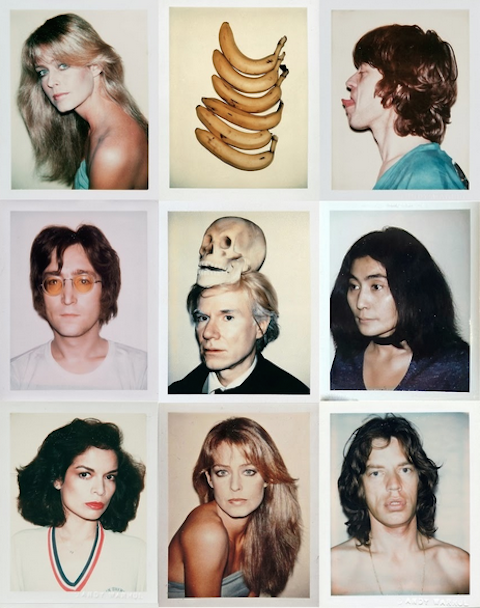
Polaroid photography, which looked about to fade out forever for a while there, has in recent years made a comeback. Chalk it up, if you must, to a grand revaluing wave of the physically analog in our age of digital ephemerality — the same tide on which enthusiasm for vinyl, zines, and even VHS tapes has risen again. But we must acknowledge that Andy Warhol, in a sense, got there first. It hardly counts as the only matter on which the mastermind of the Factory showed prescience; take, for instance, his quip about everyone in the future getting fifteen minutes of fame, a prediction which, as Jonathan Lethem put it, has in our present hardened into “drab processional.” Some of these very 21st-century people now enjoying (or enduring) their own fifteen minutes — most of them presumably not even born within Warhol’s lifetime — surely keep a Polaroid camera at hand. They acknowledge, on some level, what the consummate 20th-century “pop artist” sensed: that the ostensibly cheap and disposable, including self-developing film used for untrained vacation snapshots and mere reference material for “real” works of art, has its own kind of permanence.
Here we have a selection of Warhol’s own works of Polaroid photography, a medium he took up around 1970 and used to further his interest in portraiture. The University of California, Berkeley Art Museum, just one of the institutions to put them on display, says that “these images often served as the basis for his commissioned portraits, silk-screen paintings, drawings, and prints.” The wide subset they showed “reveals that superstars were not the only figures that Warhol photographed with his Polaroid Big Shot, the distinct plastic camera he used for the majority of his sittings. Over half of those who sat for him were little known or remain unidentified.” Whether of Mick Jagger, Yoko Ono, O.J. Simpson, Debbie Harry, himself, a row of bananas, or someone faintly recognizable yet ultimately unnamable, each of Warhol’s Polaroids remains “fully identified with the artwork that ultimately grew out of it; the face depicted becomes a kind of signifier for larger cultural concepts of beauty, power, and worth.”
You can see at least 85 of Warhol’s polaroid portraits at a site called These Americans.
Now what would Warhol, a known early enthusiast of computer art, have said about the arrival of Instagram filters meant to make our instantaneous, high-resolution digital photos look like Polaroids again?
Related Content:
Andy Warhol Digitally Paints Debbie Harry with the Amiga 1000 Computer (1985)
Andy Warhol’s Lost Computer Art Found on 30-Year-Old Floppy Disks
The Masterful Polaroid Pictures Taken by Filmmaker Andrei Tarkovsky
Watch Laurence Olivier, Liv Ullmann and Christopher Plummer’s Classic Polaroid Ads
A Celebration of Retro Media: Vinyl, Cassettes, VHS, and Polaroid Too
Colin Marshall hosts and produces Notebook on Cities and Culture and writes essays on cities, language, Asia, and men’s style. He’s at work on a book about Los Angeles, A Los Angeles Primer. Follow him on Twitter at @colinmarshall or on Facebook.
Read More...William S. Burroughs Sends Anti-Fan Letter to In Cold Blood Author Truman Capote: “You Have Sold Out Your Talent”
On July 23, 1970, William S. Burroughs wrote Truman Capote a letter. “This is not a fan letter in the usual sense — unless you refer to ceiling fans in Panama.” Instead, Burroughs’s missive is a poison pen letter, blistering even by the high standards of New York literary circles. Of course, Capote, author of Breakfast at Tiffany’s and In Cold Blood, was no stranger to feuds. He often traded witty, venomous barbs with the likes of Gore Vidal and Norman Mailer. Yet Burroughs’s letter comes off as much darker and, with the benefit of hindsight, much more unnerving.
As Thom Robinson thoroughly details in his article for RealityStudio, the two had a long and complicated past filled with professional jealousy and personal disdain. They first met when Burroughs was a struggling writer and Capote was working as a copy boy at The New Yorker in the early 1940s. Burroughs was no doubt rankled by Capote’s meteoric rise to literary stardom just after the war, thanks to some highly-praised short stories that appeared in Harper’s Bazaar and other publications. Burroughs and his fellow Beat writers ridiculed Capote in their private letters. In a letter to Allen Ginsberg, Jack Kerouac described Capote’s work as “full of bull on every page.” When Kerouac’s On the Road was published, Capote dismissed the book by saying, “[it] isn’t writing at all — it’s typing.”
When Naked Lunch was finally released in America in 1962, three years after its publication in France, William S. Burroughs became a literary icon. (Hear Burroughs read Naked Lunch here.) At the same time, Capote was starting to develop a genre he called creative non-fiction, which would eventually culminate with In Cold Blood. When talking about his book in a 1968 interview with Playboy, Capote compared Burroughs’s writing with his own. In Cold Blood “is really the most avant-garde form of writing existent today […] creative fiction writing has gone as far as it can experimentally. […] Of course we have writers like William Burroughs, whose brand of verbal surface trivia is amusing and occasionally fascinating, but there’s no base for moving forward in that area.” At another point, Capote quipped, “Norman Mailer thinks [he] is a genius, which I think is ludicrous beyond words. I don’t think William Burroughs has an ounce of talent.”
So when Burroughs put pen to paper in 1970, he already had plenty of reasons to dislike Capote. In the letter, though, Burroughs’s ire was specifically directed at Capote’s dubious ethics in writing In Cold Blood, a book that Burroughs described as “a dull unreadable book which could have been written by any staff writer on The New Yorker.” (Note: You can read an early version of In Cold Blood in The New Yorker itself.)
The spine of In Cold Blood is the first-hand account of convicted killers Dick Hickock and Perry Smith. Capote spent hours interviewing them and in the process grew close to them, especially Smith. In spite of this, Capote did little to help their defense. (This is the subject of not one but two movies, by the way, Capote and Infamous.) Critic Kenneth Tynan, in a scathing review for The Observer, cried foul. “For the first time an influential writer of the front rank has been placed in a position of privileged intimacy with criminals about to die, and–in my view–done less than he might have to save them,” he wrote. “An attempt to help (by supplying new psychiatric testimony) might easily have failed: what one misses is any sign that it was ever contemplated.” The fact of the matter was that the book worked better if they died. Though Capote’s biographer Gerald Clarke argued that there was little that the writer could have done to save the two, he conceded that “Tynan was right when he suggested that Truman did not want to save them.”
Seemingly repulsed by Capote’s entire project, Burroughs took the Tynan’s critique one step further. He argued that Capote not only sold out his subjects but served as a mouthpiece for those in power.
I feel that [Tynan] was much too lenient. Your recent appearance before a senatorial committee on which occasion you spoke in favor of continuing the present police practice of extracting confessions by denying the accused the right of consulting consul prior to making a statement also came to my attention. In effect you were speaking in approval of standard police procedure: obtaining statements through brutality and duress, whereas an intelligent police force would rely on evidence rather than enforced confessions. […] You have placed your services at the disposal of interests who are turning America into a police state by the simple device of deliberately fostering the conditions that give rise to criminality and then demanding increased police powers and the retention of capital punishment to deal with the situation they have created.
For someone who had frequently been on the wrong end of the law and for someone who spent his life giving voice to the marginalized, this was an anathema. Burroughs then delivered a chilling, voodoo-style curse:
You have betrayed and sold out the talent that was granted you by this department. That talent is now officially withdrawn. Enjoy your dirty money. You will never have anything else. You will never write another sentence above the level of In Cold Blood. As a writer you are finished. Over and out.
Burroughs’ curse seemed to have worked. 1970 was the high-water mark of Capote’s career. He never wrote another novel after In Cold Blood, though he labored for years on a never completed book called Answered Prayers. He spent the rest of his life on a downward alcoholic spiral until his death in 1984.
You can read the entire letter, which is kept at the Burroughs Archive of the New York Public Library’s Berg Collection, below:
July 23, 1970
My Dear Mr. Truman Capote
This is not a fan letter in the usual sense — unless you refer to ceiling fans in Panama. Rather call this a letter from “the reader” — vital statistics are not in capital letters — a selection from marginal notes on material submitted as all “writing” is submitted to this department. I have followed your literary development from its inception, conducting on behalf of the department I represent a series of inquiries as exhaustive as your own recent investigations in the sun flower state. I have interviewed all your characters beginning with Miriam — in her case withholding sugar over a period of several days proved sufficient inducement to render her quite communicative — I prefer to have all the facts at my disposal before taking action. Needless to say, I have read the recent exchange of genialities between Mr. Kenneth Tynan and yourself. I feel that he was much too lenient. Your recent appearance before a senatorial committee on which occasion you spoke in favor of continuing the present police practice of extracting confessions by denying the accused the right of consulting consul prior to making a statement also came to my attention. In effect you were speaking in approval of standard police procedure: obtaining statements through brutality and duress, whereas an intelligent police force would rely on evidence rather than enforced confessions. You further cheapened yourself by reiterating the banal argument that echoes through letters to the editor whenever the issue of capital punishment is raised: “Why all this sympathy for the murderer and none for his innocent victims?” I have in line of duty read all your published work. The early work was in some respects promising — I refer particularly to the short stories. You were granted an area for psychic development. It seemed for a while as if you would make good use of this grant. You choose instead to sell out a talent that is not yours to sell. You have written a dull unreadable book which could have been written by any staff writer on the New Yorker — (an undercover reactionary periodical dedicated to the interests of vested American wealth). You have placed your services at the disposal of interests who are turning America into a police state by the simple device of deliberately fostering the conditions that give rise to criminality and then demanding increased police powers and the retention of capital punishment to deal with the situation they have created. You have betrayed and sold out the talent that was granted you by this department. That talent is now officially withdrawn. Enjoy your dirty money. You will never have anything else. You will never write another sentence above the level of In Cold Blood. As a writer you are finished. Over and out. Are you tracking me? Know who I am? You know me, Truman. You have known me for a long time. This is my last visit.
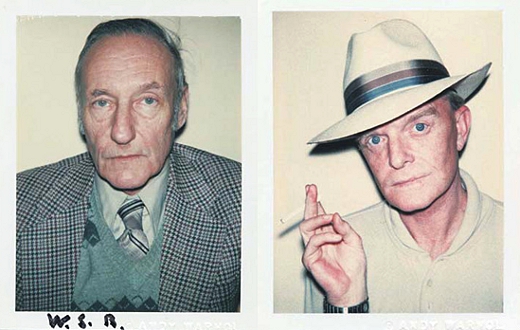
The polaroids above were taken by Andy Warhol.
via: Flavorwire/Letters of Note/RealityStudio
Related Content:
William S. Burroughs Reads His First Novel, Junky
William S. Burroughs on the Art of Cut-up Writing
550 Free Audio Books: Download Great Books for Free
Jonathan Crow is a Los Angeles-based writer and filmmaker whose work has appeared in Yahoo!, The Hollywood Reporter, and other publications. You can follow him at @jonccrow. And check out his blog Veeptopus, featuring one new drawing of a vice president with an octopus on his head daily.
Read More...Fellini’s Three Bank of Rome Commercials, the Last Thing He Did Behind a Camera (1992)
It happened before, and it still happens now and again today, but in the second half of the twentieth century, auteurs really got into making commercials: Ingmar Bergman, Jean-Luc Godard, David Lynch. Not, perhaps, the first names in filmmaking you’d associate with commerciality, but there we have it. Where, though, to place Federico Fellini, director of La Dolce Vita, Satyricon, and Amarcord, movies that, while hardly assembled by the numbers, could never resist the entertaining and even pleasurable (or the somehow pleasurably displeasurable) spectacle? On one hand, Fellini went so far as to campaign against commercials airing during the broadcast of motion pictures; on the other hand, he made a few of the things, and not minor ones, either. In a post here on Fellini’s own commercials, Mike Springer referenced a trio shot for the Bank of Rome, quoting on the subject Fellini biographer Peter Bondanella, who notes their inspiration by “various dreams Fellini had sketched out in his dream notebooks,” and other Fellini biographer Tullio Kezich, who describes them as “the golden autumn of a patriarch of cinema who, for a moment, holds again the reins of creation.” Today, we present all three.
“Money is everywhere but so is poetry,” Fellini himself once said. “What we lack are the poets.” In these three spots, the creator synonymous with Italian auteurhood brings poetry and money together — even more so than most commercial-making “creative” filmmakers, given the overtly financial nature of the client’s business. You can read more about the project, “the last thing he did behind a camera,” at Sight & Sound: “In 1992, the year before his death, [Fellini] realised his best corporate work. [ … ] Here Fellini comprehended, skilfully conveyed and exposed the ultimate essence of advertising: the creation of needs and fears that the given product will magically solve.” The setup involves Paolo Villaggio as a nightmare-plagued man and Fernando Rey as his attentively listening analyst — and in addition to his professional interests, evidently quite a Bank of Rome enthusiast. The spot at the top of the post includes English subtitles, but as with Fellini’s features, even non-Italophones can expect rich, long-form (by commercial standards) audiovisual experiences watching the other two as well (above) — and ones, unlike any experience you’d have actually stepping into a bank, not quite of this reality. Today, we present all three, the last films Fellini ever made.
Related Content:
Fellini’s Fantastic TV Commercials
Watch All of the Commercials That David Lynch Has Directed: A Big 30-Minute Compilation
Jean-Luc Godard’s After-Shave Commercial for Schick
Ingmar Bergman’s Soap Commercials Wash Away the Existential Despair
Colin Marshall hosts and produces Notebook on Cities and Culture and writes essays on cities, language, Asia, and men’s style. He’s at work on a book about Los Angeles, A Los Angeles Primer. Follow him on Twitter at @colinmarshall or on Facebook.
Read More...Jorge Luis Borges Reviews Citizen Kane — and Gets a Response from Orson Welles
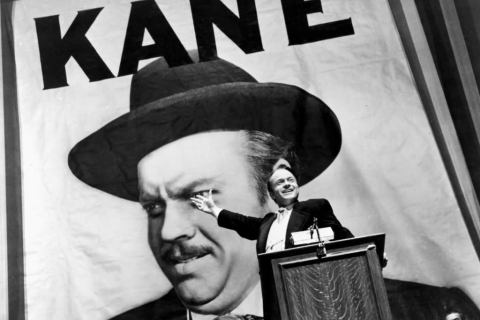
When we discover Jorge Luis Borges, we usually discover him through his short stories — or at least through his own highly distinctive uses of the short story form. Those many of us who thereupon decide to read everything the man ever wrote sooner or later find that he ventured into other realms of short text as well. Borges spent time as a poet, an essayist, and even as something of a film critic, a period of his career that will delight the sizable cinephilic segment of his readership. “I’m almost a century late to this party,” writes one such fan, Brendan Kiley at The Stranger, “but I recently stumbled into the movie reviews of Jorge Luis Borges (in his Selected Non-Fictions) and they’re fantastic: gloomy, sometimes bitchy, hilarious.” He first highlights Borges’ 1941 assessment of Citizen Kane, which Interrelevant provides in its incisive, unsparing, referential, and very brief entirety:
AN OVERWHELMING FILM
Citizen Kane (called The Citizen in Argentina) has at least two plots. The first, pointlessly banal, attempts to milk applause from dimwits: a vain millionaire collects statues, gardens, palaces, swimming pools, diamonds, cars, libraries, man and women. Like an earlier collector (whose observations are usually ascribed to the Holy Ghost), he discovers that this cornucopia of miscellany is a vanity of vanities: all is vanity. At the point of death, he yearns for one single thing in the universe, the humble sled he played with as a child!
The second plot is far superior. It links the Koheleth to the memory of another nihilist, Franz Kafka. A kind of metaphysical detective story, its subject (both psychological and allegorical) is the investigation of a man’s inner self, through the works he has wrought, the words he has spoken, the many lives he has ruined. The same technique was used by Joseph Conrad in Chance (1914) and in that beautiful film The Power and the Glory: a rhapsody of miscellaneous scenes without chronological order. Overwhelmingly, endlessly, Orson Welles shows fragments of the life of the man, Charles Foster Kane, and invites us to combine them and to reconstruct him.
Form of multiplicity and incongruity abound in the film: the first scenes record the treasures amassed by Kane; in one of the last, a poor woman, luxuriant and suffering, plays with an enormous jigsaw puzzle on the floor of a palace that is also a museum. At the end we realize that the fragments are not governed by any secret unity: the detested Charles Foster Kane is a simulacrum, a chaos of appearances. (A possible corollary, foreseen by David Hume, Ernst Mach, and our own Macedonio Fernandez: no man knows who he is, no man is anyone.) In a story by Chesterton — “The Head of Caesar,” I think — the hero observes that nothing is so frightening as a labyrinth with no center. This film is precisely that labyrinth.
We all know that a party, a palace, a great undertaking, a lunch for writers and journalists, an atmosphere of cordial and spontaneous camaraderie, are essentially horrendous. Citizen Kane is the first film to show such things with an awareness of this truth.
The production is, in general, worthy of its vast subject. The cinematography has a striking depth, and there are shots whose farthest planes (like Pre-Raphaelite paintings) are as precise and detailed as the close-ups. I venture to guess, nonetheless, that Citizen Kane will endure as a certain Griffith or Pudovkin films have “endured”—films whose historical value is undeniable but which no one cares to see again. It is too gigantic, pedantic, tedious. It is not intelligent, though it is the work of genius—in the most nocturnal and Germanic sense of that bad word.
“A kind of metaphysical detective story,” “a labyrinth with no center,” “the work of a genius” — why, if I didn’t know better, I’d think Borges here describes his own work. Welles himself didn’t go ignorant of his film’s Borgesian nature, or at least of the tendency of others to point out its Borgesian nature, not always in a positive light. “Some people called it warmed-over Borges,” Welles recalled in a conversation 42 years later with the filmmaker Henry Jaglom. Nor did he forget Borges’ own critique: “He said that it was pedantic, which is a very strange thing to say about it, and that it was a labyrinth. And that the worst thing about a labyrinth is that there’s no way out. And this is a labyrinth of a movie with no way out. Borges is half-blind. Never forget that. But you know, I could take it that he and Sartre” — who thought the film’s image “too much in love with itself” — “simply hated Kane. In their minds, they were seeing— and attacking — something else. It’s them, not my work.” Defensive though this may sound, it identifies the impulse that had the author of Labyrinths seeing all those labyrinths in the movie: to quote Anaïs Nin, a writer contemporary though not often brought into the same context with Borges, “We don’t see things as they are, we see them as we are.”
You can also read Borges’ 1933 review of King Kong here.
Related Content:
Orson Welles Explains Why Ignorance Was His Major “Gift” to Citizen Kane
Two Drawings by Jorge Luis Borges Illustrate the Author’s Obsessions
Jorge Luis Borges: “Soccer is Popular Because Stupidity is Popular”
Jorge Luis Borges’ 1967–8 Norton Lectures On Poetry (And Everything Else Literary)
Jorge Luis Borges’ Favorite Short Stories (Read 7 Free Online)
Colin Marshall hosts and produces Notebook on Cities and Culture and writes essays on cities, language, Asia, and men’s style. He’s at work on a book about Los Angeles, A Los Angeles Primer. Follow him on Twitter at @colinmarshall or on Facebook.
Read More...Hear Michel Foucault’s Lecture “The Culture of the Self,” Presented in English at UC Berkeley (1983)
Michel Foucault’s time in the United States in the last years of his life, particularly his time as a lecturer at UC Berkeley, proved to be extraordinarily productive in the development of his theoretical understanding of what he saw as the central question facing the contemporary West: the question of the self. In his 1983 Berkeley lectures in English on “The Culture of the Self,” Foucault stated and restated the question in a variety of ways—“What are we in our actuality?,” “What are we today?”—and his investigations amount to “an alternative to the traditional philosophical questions: What is the world? What is man? What is truth? What is knowledge? How can we know something? And so on.” So write the editors of the posthumously published 1988 essay collection Technologies of the Self, titled after a lecture Foucault delivered at the University of Vermont in 1982.
In that talk, Foucault notes that “the hermeneutics of the self has been confused with theologies of the soul—concupiscence, sin, and the fall from grace.” The technique of confession, central even to secular psychoanalysis, informs a subjectivity that, for Foucault, always develops under the ever-watchful eyes of normalizing institutions. But in “The Culture of the Self,” Foucault reaches back to ancient Greek conceptions of “care of the self” (epimelieia beautou) to locate a subjectivity derived from a different tradition—a counterpoint to religious confessional and Freudian subjectivities and one he has discussed in terms of the technique of “self writing.” (The Care of the Self also happens to be the subtitle of the third volume of Foucault’s History of Sexuality, and “The Culture of the Self” the title of its second chapter.)
The notion that one is granted selfhood through the ministrations of others comes in for ridicule in the first few minutes of his “Culture of the Self” lecture above. Foucault relates a story by second century Greek satirist Lucian to illustrate a humorous point about “those guys who nowadays regularly visit a kind of master who takes their money from them in order to teach them how to take care of themselves.” He identifies the ancient version of this dubious authority as the philosopher, but it seems that he intends in modern times to refer more broadly to psychiatrists, psychologists, and all manner of religious figures and self-help gurus.
Foucault sets up the joke to introduce his first entrée into the pursuit of “the historical ontology of ourselves,” a consideration of Kant’s essay “What is Enlightenment?” In that work, the most prominent German Enlightenment philosopher describes “man’s emergence from his self-imposed nonage,” a term he defines as “the inability to use one’s own understanding without another’s guidance.” From there, Foucault opens up his investigation to an analysis of “three sets of relations: our relations to truth, our relations to obligation, our relations to ourselves and to the others.” You’ll have to listen to the full set of lectures, above in all five parts, to follow Foucault’s inquiry through its many passages and divergences and learn how he arrives at this conclusion: “The self is not so much something hidden and therefore something to be excavated but as a correlate of the technologies of self that it co-evolves with over millennium.”
The Q&A session, above, was held on a different day and is also well worth a listen. Foucault addresses several queries about his own methodology, issues of disciplinary boundaries, and other clarifying (or not) concerns related to his main lecture. See this site for a transcript of the questions from the audiences and Foucault’s insightful, and sometimes quite funny, answers.
Related Content:
Michel Foucault and Alain Badiou Discuss “Philosophy and Psychology” on French TV (1965)
Watch a “Lost Interview” With Michel Foucault: Missing for 30 Years But Now Recovered
Download 100 Free Philosophy Courses and Start Living the Examined Life
Josh Jones is a writer and musician based in Durham, NC. Follow him at @jdmagness
Read More...Support Us
We're hoping to rely on loyal readers, rather than erratic ads. Please click the Donate button and support Open Culture. You can use Paypal, Venmo, Patreon, even Crypto! We thank you!

About Us

Open Culture scours the web for the best educational media. We find the free courses and audio books you need, the language lessons & educational videos you want, and plenty of enlightenment in between.
Advertise With Us
FREE UPDATES!
GET OUR DAILY EMAIL
Get the best cultural and educational resources on the web curated for you in a daily email. We never spam. Unsubscribe at any time.
FOLLOW ON SOCIAL MEDIA
Open Culture editor Dan Colman scours the web for the best educational media. He finds the free courses and audio books you need, the language lessons & movies you want, and plenty of enlightenment in between.
Advertise With Us



