A Radio Play Based on Pink Floyd’s The Dark Side of the Moon. Coming Monday. Watch the Trailer.
This year, Pink Floyd’s masterful prog rock album The Dark Side of the Moon turns 40. Yes, 40. Exploring themes ranging from conflict and greed, to mental illness and the passing of time, The Dark Side of the Moon has “everything you’d ever want … : Grand, transporting melodies, synapse-ripping synth experiments and sound collages, intricate musicianship, state-of-the-art studio sound and John Lennon-meets-Thom Yorke lyrics like ‘The lunatic is on the grass/Remembering games and daisy chains and laughs/Got to keep the loonies on the path.’ ” Or, so that’s how Rolling Stone magazine sums up the album that it now ranks 43rd on its list of “The 500 Greatest Albums of All Time.”
Next Monday, BBC Radio 2 will honor Pink Floyd’s magnum opus with a new radio drama from legendary playwright Sir Tom Stoppard. Apparently Stoppard (who co-wrote the screenplays for Brazil and Shakespeare in Love) first considered writing a play based on the album back in 1973. Now, some 40 years later, he has “transformed the Pink Floyd classic into a psychedelic mash-up of Kantian philosophy, epic rock and John Prescott soundbites,” writes The Independent. To get you ready for Darkside, as the play will be called, Aardman Animations has created a three-minute trailer that evokes themes from the album and play. Says the director Darren Dubicki:
I spent time absorbing the rich detail from the Pink Floyd album, their art and the drama script. What was fundamentally important to us was that we retained a consistent visual tone that echoed the imagery created over the years for the band. The insanely surreal and powerful artwork created by Storm Thorgerson and Hipgnosis has always had a strong distortion on reality. Their sense of space and twisted context make for some uncomfortably beautiful art. This tone has been consistent for decades and we wanted to honour this with our contemporary digital, and analogue, slant on the style.
You can watch the trailer above, and find some wonderful Pink Floyd material in the section below.
Related Content:
Pink Floyd’s David Gilmour Sings Shakespeare’s Sonnet 18
Watch Pink Floyd Plays Live in the Ruins of Pompeii (1972)
Pink Floyd’s Roger Waters Performs The Wall at the Berlin Wall (1990)
Read More...The Very Concise Suicide Note by Kodak Founder George Eastman: “My Work is Done. Why Wait?” (1932)
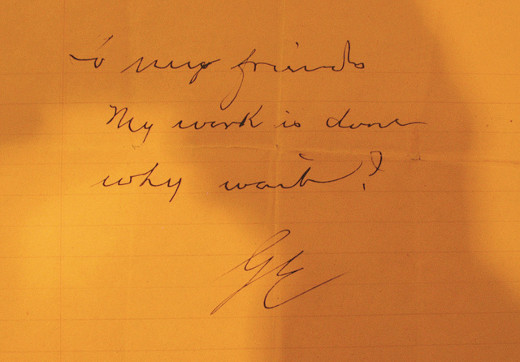
In 1932 George Eastman, the 77 year old entrepreneur who established the Eastman Kodak Company, popularized the use of roll film, and brought photography to the mainstream, found himself in declining health. Suffering from lumbar spinal stenosis, a narrowing of the spinal canal that can lead to considerable back pain and difficulty walking, Eastman was depressed and increasingly disabled. On March 14th, he committed suicide by firing a single gunshot through his heart. An act as brief, and to the point, as the note he left behind. It read:
To my friends
My work is done
Why wait?
GE
If you would like to support the mission of Open Culture, consider making a donation to our site. It’s hard to rely 100% on ads, and your contributions will help us continue providing the best free cultural and educational materials to learners everywhere. You can contribute through PayPal, Patreon, and Venmo (@openculture). Thanks!
Related Content:
How Film Was Made: A Kodak Nostalgia Moment
Early Experiments in Color Film (1895–1935)
Anne Sexton, Confessional Poet, Reads “Wanting to Die” in Ominous 1966 Video
Read More...Inside the Rhapsody: A Short Documentary on the Making of Queen’s Classic Song, ‘Bohemian Rhapsody’ (2002)
“Bohemian Rhapsody” by Queen is one of the most audacious pop songs ever made. Part ballad, part opera, part heavy metal orgasm, the song has six distinct sections and took over a month to record. At just under six minutes, “Bohemian Rhapsody” was considered too long for pop radio. “The record company, in their infinite ignorance, of course immediately suggested that we cut it down,” said Queen drummer Roger Taylor, who stood by his bandmates and refused to let the song be cut. “It really was hit or miss. It was either going to be massive or it was going to be nothing.”
“Bohemian Rhapsody,” of course, went on to become one of the most popular songs in music history. It spent nine weeks at number one in the UK following its release in the fall of 1975, and went back to number one after the death of singer Freddie Mercury in 1991. In America the song peaked at number nine in 1976 and re-entered the charts at number two in 1992, when it was featured in the movie Wayne’s World. Last year, an ITV poll in Great Britain listed “Bohemian Rhapsody” as “The Nation’s Favorite Number One” song in 60 years of music.
Above, in the 3‑part mini documentary Inside the Rhapsody, Queen takes you inside the making of the song. And, along the way, guitarist Brian May goes back to the mixing board to explain the complexity of layers that went into realizing Mercury’s vision for the song. The original 24-track analogue recording system was far too limited, so the band used the ping-pong technique to “bounce” literally hundreds of overdubs into the mix. May explains how the operatic vocal layers were inspired by the “cascading strings” effect made famous by Annunzio Paolo Mantovani, a technique May first tried out in 1974 with the guitar solo on “Killer Queen.”
For more on the making of “Bohemian Rhapsody,” please see our post, “Listen to Freddie Mercury’s Wondrous Piano and Vocal Tracks for ‘Bohemian Rhapsody’ (1975).” And for a reminder of how it all came together, here’s the official video:
Inside the Rhapsody has been added to our collection, 285 Free Documentaries Online.
Related content:
Queen Documentary Pays Tribute to the Rock Band That Conquered the World
Read More...Michel Foucault — Beyond Good and Evil: 1993 Documentary Explores the Theorist’s Controversial Life and Philosophy
Michel Foucault’s colorful life and hugely influential work were both struggles against limitation—the limits of language, of social structures and stultifying historical identities. As such, he managed to provoke scholars of every possible persuasion, since he called into question all positive programs—the ancient imperial, feudal, and liberal humanist—while steadfastly refusing to replace them with comprehensive alternative systems. And yet systems, social institutions of power and domination, were precisely the problem in Foucault’s estimation. Through his technique of raiding archives to produce an “archaeology of knowledge,” Foucault showed how every institution is shot through with what William E. Connolly calls “arbitrary… systemic cruelty.”
The 1993 documentary film above, Michel Foucault: Beyond Good and Evil, explores the philosopher and his complex and controversial life through interviews with colleagues and biographers and re-enactments of Foucault’s storied exploits in the American counterculture. Biographer James Miller points out that Foucault was “preoccupied with exploring states that were beyond normal everyday experience… drugs, certain forms of eroticism,” as a way to “reconfigure the world and his place in it.” In this, says anthropologist Paul Rabinow, Foucault sought to resurrect the questions that sober analytic philosophy had largely abandoned: questions about what it means to be human, beyond the social categories we take as natural and given.
You can find Michel Foucault: Beyond Good and Evil listed in our collection, 4,000+ Free Movies Online: Great Classics, Indies, Noir, Westerns, Documentaries & More.
Related Content:
Michel Foucault: Free Lectures on Truth, Discourse & The Self
Clash of the Titans: Noam Chomsky & Michel Foucault Debate Human Nature & Power on Dutch TV, 1971
John Searle on Foucault and the Obscurantism in French Philosophy
Josh Jones is a writer and musician based in Washington, DC. Follow him at @jdmagness
Read More...Alfred Hitchcock’s 50 Ways to Kill a Character (and Our Favorite Hitch Resources on the Web)
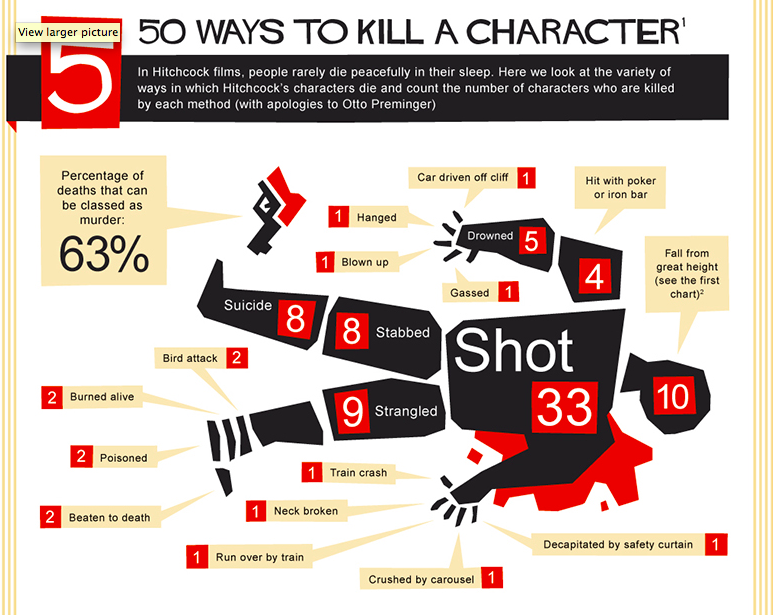 Alfred Hitchcock would have celebrated his 114th birthday today. And, to mark the occasion, The Guardian has created a big infographic that delves into the themes and motifs that Hitchcock obsessed over in his many films. Above, we have a segment showing the way Hitchcock characters die, and the number of people who die according to particular methods. The best part is that you can download the infographic for free online.
Now time for us to dish up our favorite Hitchcock material found on the web. The best of the best:
Watch 20 Free Hitchcock Movies Online
Alfred Hitchcock’s Seven-Minute Editing Master Class
François Truffaut’s Big 12 Hour Interview with Alfred Hitchcock
37 Hitchcock Cameos over 50 Years: All in One Video
36 Hitchcock Murder Scenes Climaxing in Unison
Salvador Dalí Creates a Dream Sequence for Spellbound, Hitchcock’s Psychoanalytic Thriller
Alfred Hitchcock’s Rules for Watching Psycho (1960)
Read More...Watch the Original Audition Tapes for Breaking Bad Before the Final Season Debuts
“Breaking Bad is the first story to truly commit the full spectrum of New Mexico to film,” writes Rachel Syme in a New Yorker post on the critically acclaimed AMC series’ use of and effect on her home state. “The grandiose vistas, the soaring altitudes, the banal office complexes, the Kokopellis and Kachina dolls, the seamy warehouses, the marshmallow clouds. The show seems to root itself deeper in the landscape with every new montage. It has become our newest monument.” With the concluding season of the exploits of chemistry-teacher-turned-methamphetamine-dealer Walter White debuting this Sunday, Breaking Bad fans have no doubt steeled themselves for a televisual plunge back into its very own Albuquerque, which “still looks like the Wild West, a scorched, hazy, lawless place where rugged individualism might just tip over into criminal behavior at any moment,” an interpretation Syme deems “not wholly inaccurate.”
To assist you in your own re-entry into Breaking Bad’s thoroughly amoral but unstoppably compelling reality, we’ve rounded up a few audition tapes which let you witness the early formation of three of the show’s characters. Everyone talks about Bryan Cranston’s starring performance as Walter, and given his grounded execution of a near-novelistic arc of improbable transformation, rightly so. But what about his wife and eventual money launderer Skyler, as portrayed by Anna Gunn? Or her brother-in-law Hank, the gung-ho DEA agent played by Dean Norris? Or Aaron Paul as Jesse, Walter’s former student and current partner in crime? In a series so highly praised for the writing of its characters, you don’t want to think about just one. Or maybe your memories of them have grown dim, in which case you’ll want to spend eight minutes with this recap of the previous seasons before you settle down for the final one.
Related Content:
Inside Breaking Bad: Watch Conan O’Brien’s Extended Interview with the Show’s Cast and Creator
Inside Breaking Bad: Watch Conan O’Brien’s Extended Interview with the Show’s Cast and Creator
Colin Marshall hosts and produces Notebook on Cities and Culture and writes essays on literature, film, cities, Asia, and aesthetics. He’s at work on a book about Los Angeles, A Los Angeles Primer. Follow him on Twitter at @colinmarshall.
Read More...Master of Light: A Close Look at the Paintings of Johannes Vermeer Narrated by Meryl Streep
We all thrilled to Johannes Vermeer painting his best-known portrait as dramatized in Peter Webber’s 2003 film Girl with a Pearl Earring. But for every heightened, scintillating feature film built around a well-known artist, there exists — or should exist, anyway — a documentary that examines the work itself in greater detail. For such a counterpart to the aforementioned Colin Firth/Scarlett Johansson vehicle, I nominate Joe Krakora’s 2001 Vermeer: Master of Light, a rich look at the paintings of the well-known visual chronicler of seventeenth-century middle-class Dutch life, whose use of color could reach pretty formidable heights of scintillation itself. Providing its narration, we have a certain Meryl Streep.

Click each image for a larger version
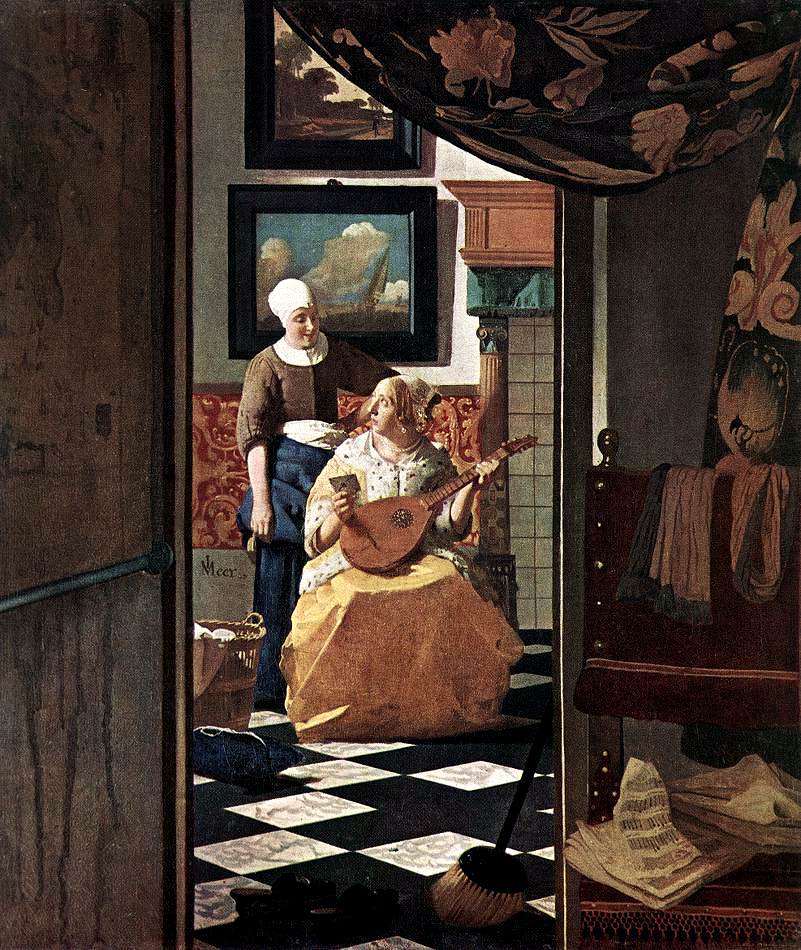
Streep’s words and those of the documentary’s expert interviewees must of necessity focus on Vermeer’s actual paintings, since we know little of the painter’s life. And we don’t even have very many paintings to talk about: living from 1632 to 1672, Vermeer turned out fewer than 40 canvases. But what canvases: Master of Light goes into detail on his particular mastery not only of light and color, but of textures, perspectives, and seemingly minor but nonetheless painstaking touches. We do, however, offer a viewing tip: unless you particularly enjoy shots of light through windows, you may want to begin the video at 5:22 or so. The analysis of Vermeer takes its time coming, but when it begins, it offers a wealth of surprising detail — just as do the paintings themselves. But don’t believe me; find out for yourself by viewing fifteen of them up close at the Google Art Project, including Lady at the Virginal with a Gentleman just above, or, below, The Love Letter.
Related Content:
The Rijksmuseum Puts 125,000 Dutch Masterpieces Online, and Lets You Remix Its Art
Flashmob Recreates Rembrandt’s “The Night Watch” in a Dutch Shopping Mall
The National Gallery Makes 25,000 Images of Artwork Freely Available Online
Google “Art Project” Brings Great Paintings & Museums to You
Colin Marshall hosts and produces Notebook on Cities and Culture and writes essays on literature, film, cities, Asia, and aesthetics. He’s at work on a book about Los Angeles, A Los Angeles Primer. Follow him on Twitter at @colinmarshall.
Read More...The Historic Meeting Between Dickens and Dostoevsky Revealed as a Great Literary Hoax
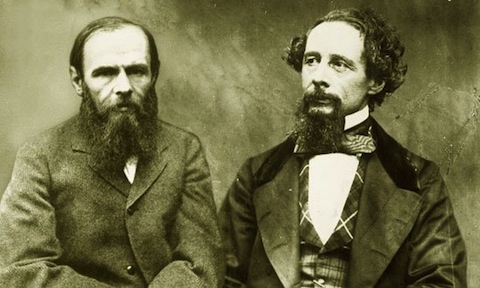
Given the way nineteenth-century literature is sometimes conceived—as the special province of a few great, hairy celebrity novelists—one might imagine that a meeting between Charles Dickens and Fyodor Dostoevsky would not be an unusual occurrence. Maybe it was even routine, like Jay Z and Kanye bumping elbows at a party! So when I read that the two had once met, in London in 1862, my first thought was, “well, sure. And then Herman Melville and Gustave Flaubert stopped by, and they got into a brawl over the check.” Alright, that’s ridiculous. Melville didn’t achieve any degree of fame until after his death, after all, and while the other three were respected, even wildly famous (in Dickens’ case), it is unlikely they read much of each other, much less traveled hundreds of miles for personal visits.
And yet, the story of Dickens and Dostoevsky—since revealed to be as much a fabrication as the image above—was plausible enough to find purchase in two recent Dickens biographies. Though the two men had vastly different sensibilities, their shared experiences of the seamier side of life, and their sprawling serialized novels cataloguing their time’s social ills in great detail, would seem likely to draw them together. New York Times literary critic Michiko Kakutani seemed to think so when she repeated the story as told in Claire Tomalin’s 2011 Charles Dickens, A Life. Tomalin—who found the story in the Dickensian, the journal of the Dickens Fellowship, and reported it in good faith—recounts how the Russian novelist intentionally sought out his English counterpart in London, and, upon finding him, heard Dickens bare his soul, confessing that he longed to be like his honest, simple characters, but used his own personal failings to construct his villains.
The story might still have currency had not several Russian literature scholars read Kakutani’s review and found it far too credulous: Why would Dostoevsky have only mentioned the encounter in a letter written sixteen years after the fact, a letter no scholar has seen? What language would the two men have in common—and if they had one, probably French, would they be fluent enough to have a heart to heart? And even if Dostoevsky visited London in 1862, as it seems, he did, would he have intentionally sought out Charles Dickens? Eric Naiman, professor of Slavic Language and Literatures at UC Berkeley, doubted all of this, and, in undertaking some research, found it to be the elaborate production of a man named A.D. Harvey, who has created for himself a coterie of fictional academic identities so thorough as to constitute what Naiman calls a “community of scholars who can analyse, supplement and occasionally even ruthlessly criticise each other’s work.”
As far as literary hoaxers go, Harvey is quite accomplished. You may find his story—driven, as such things often are, by wounded ego, misplaced talent, vanity, and frustrated ambition—much more interesting than any supposed tête-à-tête between the Russian and British novelists. A recent Guardian piece profiles the “man behind the great Dickens and Dostoevsky hoax,” and Eric Naiman’s exhaustive Times Literary Supplement expose of the hoax shows us just how deeply embedded such spurious lore can become in a literary community before it can be rooted out by skeptical scholars. The lesson here is trite, I guess. Don’t believe everything you read. But when we’re inclined—mostly for good reasons—to trust the word of those who pose as experts and authorities, this can be a hard lesson to heed.
Related Content:
Find works by Dostoevsky and Dickens in our collections of Free Audio Books and Free eBooks.
Albert Camus Talks About Adapting Dostoyevsky for the Theatre, 1959
Watch Piotr Dumala’s Wonderful Animations of Literary Works by Kafka and Dostoevsky
Celebrate the 200th Birthday of Charles Dickens with Free Movies, eBooks and Audio Books
Josh Jones is a writer and musician based in Washington, DC. Follow him at @jdmagness
Read More...Slavoj Žižek Publishes a Very Clearly Written Essay-Length Response to Chomsky’s “Brutal” Criticisms
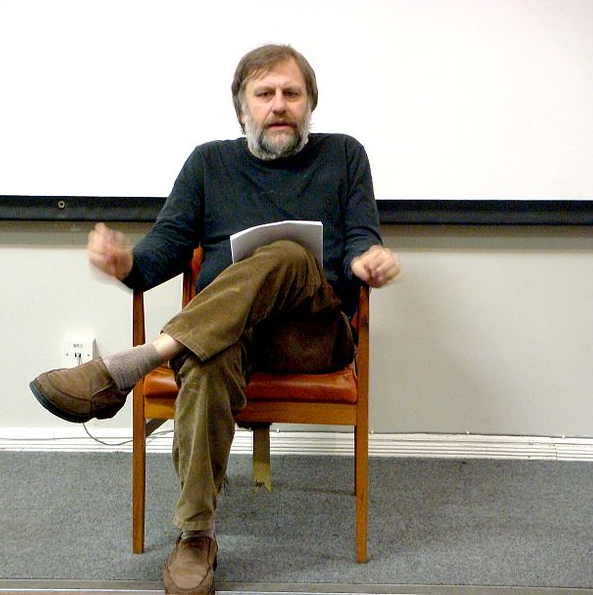
Fur has flown, claws and teeth were bared, and folding chairs were thrown! But of course I refer to the bristly exchange between those two stars of the academic left, Slavoj Žižek and Noam Chomsky. And yes, I’m poking fun at the way we—and the blogosphere du jour—have turned their shots at one another into some kind of celebrity slapfight or epic rap battle grudge match. We aim to entertain as well as inform, it’s true, and it’s hard to take any of this too seriously, since partisans of either thinker will tend to walk away with their previous assumptions confirmed once everyone goes back to their corners.
But despite the seeming cattiness of Chomsky and Žižek’s highly mediated exchanges (perhaps we’re drumming it up because a simple face-to-face debate has yet to occur, and probably won’t), there is a great deal of substance to their volleys and ripostes, as they butt up against critical questions about what philosophy is and what role it can and should play in political struggle. As to the former, must all philosophy emulate the sciences? Must it be empirical and consistently make transparent truth claims? Might not “theory,” for example (a word Chomsky dismisses in this context), use the forms of literature—elaborate metaphor, playful systems of reference, symbolism and analogy? Or make use of psychoanalytic and Marxian terminology in evocative and novel ways in serious attempts to engage with ideological formations that do not reveal themselves in simple terms?
Another issue raised by Chomsky’s critiques: should the work of philosophers who identify with the political left endeavor for a clarity of expression and a direct utility for those who labor under systems of oppression, lest obscurantist and jargon-laden writing become itself an oppressive tool and self-referential game played for elitist intellectuals? These are all important questions that neither Žižek nor Chomsky has yet taken on directly, but that both have obliquely addressed in testy off-the-cuff verbal interviews, and that might be pursued by more disinterested parties who could use their exchange as an exemplar of a current methodological rift that needs to be more fully explored, if never, perhaps, fully resolved. As Žižek makes quite clear in his most recent—and very clearly-written—essay-length reply to Chomsky’s latest comment on his work (published in full on the Verso Books blog), this is a very old conflict.
Žižek spends the bulk of his reply exonerating himself of the charges Chomsky levies against him, and finding much common ground with Chomsky along the way, while ultimately defending his so-called continental approach. He provides ample citations of his own work and others to support his claims, and he is detailed and specific in his historical analysis. Žižek is skeptical of Chomsky’s claims to stand up for “victims of Third World suffering,” and he makes it plain where the two disagree, noting, however, that their antagonism is mostly a territorial dispute over questions of style (with Chomsky as a slightly morose guardian of serious, scientific thought and Žižek as a sometimes buffoonish practitioner of a much more literary tradition). He ends with a dig that is sure to keep fanning the flames:
To avoid a misunderstanding, I am not advocating here the “postmodern” idea that our theories are just stories we are telling each other, stories which cannot be grounded in facts; I am also not advocating a purely neutral unbiased view. My point is that the plurality of stories and biases is itself grounded in our real struggles. With regard to Chomsky, I claim that his bias sometimes leads him to selections of facts and conclusions which obfuscate the complex reality he is trying to analyze.
………………….
Consequently, what today, in the predominant Western public speech, the “Human Rights of the Third World suffering victims” effectively mean is the right of the Western powers themselves to intervene—politically, economically, culturally, militarily—in the Third World countries of their choice on behalf of the defense of Human Rights. My disagreement with Chomsky’s political analyses lies elsewhere: his neglect of how ideology works, as well as the problematic nature of his biased dealing with facts which often leads him to do what he accuses his opponents of doing.
But I think that the differences in our political positions are so minimal that they cannot really account for the thoroughly dismissive tone of Chomsky’s attack on me. Our conflict is really about something else—it is simply a new chapter in the endless gigantomachy between so-called continental philosophy and the Anglo-Saxon empiricist tradition. There is nothing specific in Chomsky’s critique—the same accusations of irrationality, of empty posturing, of playing with fancy words, were heard hundreds of times against Hegel, against Heidegger, against Derrida, etc. What stands out is only the blind brutality of his dismissal
I think one can convincingly show that the continental tradition in philosophy, although often difficult to decode, and sometimes—I am the first to admit this—defiled by fancy jargon, remains in its core a mode of thinking which has its own rationality, inclusive of respect for empirical data. And I furthermore think that, in order to grasp the difficult predicament we are in today, to get an adequate cognitive mapping of our situation, one should not shirk the resorts of the continental tradition in all its guises, from the Hegelian dialectics to the French “deconstruction.” Chomsky obviously doesn’t agree with me here. So what if—just another fancy idea of mine—what if Chomsky cannot find anything in my work that goes “beyond the level of something you can explain in five minutes to a twelve-year-old” because, when he deals with continental thought, it is his mind which functions as the mind of a twelve-year-old, the mind which is unable to distinguish serious philosophical reflection from empty posturing and playing with empty words?
Related Content:
Noam Chomsky Slams Žižek and Lacan: Empty ‘Posturing’
Slavoj Žižek Responds to Noam Chomsky: ‘I Don’t Know a Guy Who Was So Often Empirically Wrong’
The Feud Continues: Noam Chomsky Responds to Žižek, Describes Remarks as ‘Sheer Fantasy’
Josh Jones is a writer and musician based in Washington, DC. Follow him at @jdmagness
Read More...Hannah Arendt Discusses Philosophy, Politics & Eichmann in Rare 1964 TV Interview
Hannah Arendt’s work has come under some critical fire lately, what with the release of the Margarethe Von Trotta-directed biopic, starring German actress Barbara Sukowa as the controversial political theorist. At issue in the film and the surrounding commentary are Arendt’s (allegedly misleading) characterizations of the subject of her 1963 book Eichmann in Jerusalem, as well as her ambivalent—some have said callous, even “victim-blaming”—treatment of other Jews. None of these controversies are new, however. As Arendt scholar Roger Berkowitz notes in a recent New York Times editorial, at the time of her book’s publication, “Nearly every major literary and philosophical figure in New York chose sides in what the writer Irving Howe called a ‘civil war’ among New York intellectuals.”
While acknowledging Arendt’s flaws, Berkowitz seeks to exonerate the best-known concept that emerged from her work on Eichmann’s trial, the “banality of evil.” And while it can be comforting to have an interpreter explain, and defend, the work of a major, controversial, thinker, there is no intellectual substitute for engaging with the work itself.
In the age of the media interview—radio, television, podcast and otherwise—one can usually see and hear an author explain her views in person. And so we have the interview above (in German with English subtitles), in which Arendt sits with television presenter and journalist Gunter Gaus for a German program called Zur Person (The Person), a Charlie Rose-like show that featured celebrities, important thinkers, and politicians (including an appearance by Henry Kissinger).
A blogger at Jewish Philosophy Place writes that Arendt’s interview—a transcript of which was later published in The Portable Hannah Arendt as “What Remains? Language Remains”—is “slow and deliberative, not sharp and declarative, moving in circles, not straight lines.” The interview touches on a variety of topics, drawing on ideas expressed in Arendt’s earlier works, The Origins of Totalitarianism and The Human Condition. She is somewhat cagey when it comes to the so-called “Eichmann Controversy,” and she may have had personal as well as professional reasons for indirection. Her affair with her former professor, avowed and unrepentant Nazi Martin Heidegger, dogged her post-war career, and the aforementioned intellectual “civil war” probably increased her circumspection.
Arendt’s critics, then and now, often remark upon what the Jewish Philosophy Place writer succinctly calls her “disdain for others.” While the new biopic (trailer above) may obscure much of this critical controversy—unfilmable as such things are anyway—readers wishing to understand one of the Holocaust’s most famous interpreters should read, and hear, her in her own words before making any judgments.
Related Content:
Hannah Arendt’s Original Articles on “the Banality of Evil” in the New Yorker Archive
Martin Heidegger Talks About Language, Being, Marx & Religion in Vintage 1960s Interviews
Download 90 Free Philosophy Courses and Start Living the Examined Life
Josh Jones is a writer and musician based in Washington, DC. Follow him at @jdmagness
Read More...Support Us
We're hoping to rely on loyal readers, rather than erratic ads. Please click the Donate button and support Open Culture. You can use Paypal, Venmo, Patreon, even Crypto! We thank you!

About Us

Open Culture scours the web for the best educational media. We find the free courses and audio books you need, the language lessons & educational videos you want, and plenty of enlightenment in between.
Advertise With Us
FREE UPDATES!
GET OUR DAILY EMAIL
Get the best cultural and educational resources on the web curated for you in a daily email. We never spam. Unsubscribe at any time.
FOLLOW ON SOCIAL MEDIA
Open Culture editor Dan Colman scours the web for the best educational media. He finds the free courses and audio books you need, the language lessons & movies you want, and plenty of enlightenment in between.
Advertise With Us


