Noam Chomsky Calls Postmodern Critiques of Science Over-Inflated “Polysyllabic Truisms”
To the delight and satisfaction of hundreds of our readers, we recently featured an interview in which Noam Chomsky slams postmodernist intellectuals like Slavoj Zizek and Jacques Lacan as “charlatans” and posers. The turn against postmodernism has been long in coming, a backlash the political right has made theater of for years, but that thinkers on the political left, like anarchist Chomsky, Marxist Vivek Chibber, and self-described “old leftist” Alan Sokal have pursued with just as much vigor (and more rigor). In the interview clip above, Chomsky makes a blanket critique of what the interviewer calls the “left criticism of science” as imperialist, racist, sexist, etc. His answers shed quite a bit of light on what Chomsky perceives as the political ramifications of postmodern thought as well as the origins of the discourse.
Chomsky characterizes leftist postmodern academics as “a category of intellectuals who are undoubtedly perfectly sincere” (I suspect this is a bit of uncharacteristic politesse on his part). Nonetheless, in his critique, such thinkers use “polysyllabic words and complicated constructions” to make claims that are “all very inflated” and which have “a terrible effect on the third world.” Chomsky argues (as does Chibber) that “in the third world, popular movements really need serious intellectuals to participate. If they’re all ranting postmodernists… well, they’re gone.” His assessment of postmodern critiques of science echoes his criticism of Zizek and Lacan. (Chomsky appears to use the words “polysyllabic” and “monosyllabic” as terms for jargon vs. ordinary language.):
It’s considered very left wing, very advanced. Some of what appears in it sort of actually makes sense, but when you reproduce it in monosyllables, it turns out to be truisms. It’s perfectly true that when you look at scientists in the West, they’re mostly men, it’s perfectly true that women have had a hard time breaking into the scientific fields, and it’s perfectly true that there are institutional factors determining how science proceeds that reflect power structures. All of this can be described literally in monosyllables, and it turns out to be truisms. On the other hand, you don’t get to be a respected intellectual by presenting truisms in monosyllables.
This last point is something Chomsky elaborates on as the impetus for post-structuralism in the academy, saying “it’s pretty easy to figure out what’s going on. Suppose you’re a literary scholar…. If you do your work seriously, that’s fine, but you don’t get any prizes for it.” He makes the claim that humanities scholars use mystifying jargon and cook up “theory” in order to compete with theoretical physicists and mathematicians, who get prizes, grants, and prestige for advancing incredibly complicated scientific work.
Even more than this general accusation against theorists in the humanities, Chomsky makes the political point that French intellectuals in Paris, “the center of the rot,” were the last group of leftists to be dedicated, “flaming” Stalinists and Maoists. In order to save face, such people had to suddenly become “the first people in the world to have discovered the gulags.” It’s a very damning characterization, and one he could no doubt support, as he does all of his claims, with a dizzying number of specific examples, though he declines to name names here. He does, however, reference Alan Sokal and Jean Bricmont’s sadly out-of-print Intellectual Impostures, a book that patiently exposes French post-structuralist thinkers’ abuse of scientific concepts. (Sokal, a physics professor, famously punked a well-regarded humanities journal in the mid-nineties with a phony article).
Chomsky’s cranky contrarianism is nothing new, and some of his polemic recalls the analytic case against “continental” philosophy or Karl Popper’s case against pseudo-science, although his investment is political as much as philosophical. The interviewer then moves on to religion. Chomsky’s thoughts on that subject are generally nuanced and fair-minded, but we don’t get to hear them here, alas, though he’s had plenty to say elsewhere.
Related Content:
Noam Chomsky Slams Žižek and Lacan: Empty ‘Posturing’
Clash of the Titans: Noam Chomsky & Michel Foucault Debate Human Nature & Power on Dutch TV, 1971
Noam Chomsky Spells Out the Purpose of Education
Josh Jones is a writer and musician based in Washington, DC. Follow him at @jdmagness
Read More...Cutting-Edge Technology Reconstructs the Battle of Gettysburg 150 Years Later

Today, as the U.S. celebrates the “nation’s birthday,” we also round the corner of the 150th anniversary of Gettysburg, the bloodiest and arguably most decisive battle of an internal struggle that never ceases to haunt the national psyche. With over 50,000 Union and Confederate soldiers killed, injured, gone missing, or captured during the days of July 1–3, 1863, historians continue to pore over the most minute details of the battle strategies of Generals Lee and Meade. Today’s digital imaging and satellite technology means that our views of the action are in many ways far superior to anything commanders on the field could have hoped for.
Since 2000, the National Park Service has used military engineering techniques to restore the historic battlefield to something resembling its 1863 state, and, in the past few years, cartographers and researchers Anne Kelly Knowles, Dan Miller, Alex Tait, and Allen Carroll have analyzed new and old maps of the Pennsylvania terrain in and around Gettysburg to get a renewed appreciation for what the generals could and could not see during the conflict. Confederate officers had their views obstructed not only by limited mapping technology and relative field positions, but also by their own communication failures. As Knowles points out at the Smithsonian’s website:
We know that Confederate general Robert E. Lee was virtually blind at Gettysburg, as his formerly brilliant cavalry leader J.E.B. Stuart failed to inform him of Federal positions, and Confederate scouts’ reconnaissance was poor. The Confederates’ field positions, generally on lower ground than Yankee positions, further put Lee at a disadvantage. A striking contrast in visual perception came when Union Gen. Gouvernour K. Warren spotted Confederate troops from Little Round Top and called in reinforcements just in time to save the Federal line.
Using so-called GIS (Geographic Information Systems), Knowles and her team are able to show what was hidden from the solders’ views during such key moments as Pickett’s Charge. The team used several period maps, like the 1863 “isometrical drawing” at the top, in their reconstructions. They also used satellite images from NASA, including the May 2013 picture below from the Operational Land Imager (OLI). You can see Knowles and her team’s painstaking geographical and topographic reconstructions of the country’s costliest rift at the Smithsonian Magazine’s site.

Related Content:
Hiroshima Atomic Bombing Remembered with Google Earth
The Gettysburg Address Animated
Josh Jones is a writer and musician based in Washington, DC. Follow him at @jdmagness
Read More...New Yorker Cartoon Editor Bob Mankoff Reveals the Secret of a Successful New Yorker Cartoon
A friend of mine rails against the New Yorker’s weekly cartoon caption contest, insisting that while the reader-submitted entries are universally bad, the winner is always the weakest of the lot.
I disagree, agog at people’s cleverness. Any line I come up with feels too obvious or too obscure. Unlike my friend, I never feel I could do better.
Cartoon editor Bob Mankoff’s recent TED Talk offers some key insights into what the magazine is looking for (incongruity, dispositional humor, cognitive mash ups), as well as what it’s not interested in (gross-out jokes, mild child-centered cannibalism) He also cites former contributor and author of my father’s favorite New Yorker cartoon, E.B. White on the futility of analyzing humor.
Frequent contributor Matthew Diffee’s short satirical film Being Bob suggests Mankoff editorial selections owe much to gut response (and a jerking knee). Such intuition is hard won. Mankoff gleefully alludes to the 2000 rejection letters he himself received between 1974 and 1977, following an unceremonious dismissal from psychology school. Then, finally, he got his first acceptance.
That acceptance letter is something to see.
Ayun Halliday used Charles Barsotti’s New Yorker cartoon of a dancing bird as her highschool yearbook’s senior saying. Follow her @AyunHalliday
Related Content:
The New Yorker’s Fiction Podcast: Where Great Writers Read Stories by Great Writers
Improv with New Yorker Cartoonists
Einstein’s Relativity: An Animated New Yorker Cartoon
Read More...Noam Chomsky Slams Žižek and Lacan: Empty ‘Posturing’
Noam Chomsky’s well-known political views have tended to overshadow his groundbreaking work as a linguist and analytic philosopher. As a result, people sometimes assume that because Chomsky is a leftist, he would find common intellectual ground with the postmodernist philosophers of the European Left.
Big mistake.
In this brief excerpt from a December, 2012 interview with Veterans Unplugged, Chomsky is asked about the ideas of Slavoj Žižek, Jacques Lacan and Jacques Derrida. The M.I.T. scholar, who elsewhere has described some of those figures and their followers as “cults,” doesn’t mince words:
What you’re referring to is what’s called “theory.” And when I said I’m not interested in theory, what I meant is, I’m not interested in posturing–using fancy terms like polysyllables and pretending you have a theory when you have no theory whatsoever. So there’s no theory in any of this stuff, not in the sense of theory that anyone is familiar with in the sciences or any other serious field. Try to find in all of the work you mentioned some principles from which you can deduce conclusions, empirically testable propositions where it all goes beyond the level of something you can explain in five minutes to a twelve-year-old. See if you can find that when the fancy words are decoded. I can’t. So I’m not interested in that kind of posturing. Žižek is an extreme example of it. I don’t see anything to what he’s saying. Jacques Lacan I actually knew. I kind of liked him. We had meetings every once in awhile. But quite frankly I thought he was a total charlatan. He was just posturing for the television cameras in the way many Paris intellectuals do. Why this is influential, I haven’t the slightest idea. I don’t see anything there that should be influential.
via Leiter Reports
Related content:
John Searle on Foucault and the Obscurantism in French Philosophy
Jacques Lacan Talks About Psychoanalysis with Panache (1973)
Read More...What Do Most Philosophers Believe? A Wide-Ranging Survey Project Gives Us Some Idea
What do most philosophers believe? The question may only interest other philosophers—and when it comes to such esoteric concerns as the “analytic synthetic distinction,” this is probably true. But when it comes to the big issues that have given every thoughtful person at least one sleepless night, or the questions regularly explored by speculative fictions like Star Trek or zombie movies, the rest of us might sit up and take notice.
Two contemporary philosophers, David Chalmers and David Bourget, decided to find out where their colleagues stood on 30 different philosophical issues by constructing a rigorous survey that ended up accounting for the views of over 3,000 professors, graduate students, and independent thinkers. Most of the respondents were affiliated with prestigious philosophy departments in the English-speaking world, though several continental European departments are also represented.
Some semi-famous names come up in a perusal of the list of public respondents, like A.C. Grayling and Massimo Pigliucci. For the most part, however, the survey group represents the rank-and-file, toiling away as teachers, thinkers, writers, and researchers at colleges across the Western world. You survey geeks out there can dig deeply into Chalmers and Bourget’s detailed accounting of their methodology here. But for a quick and dirty summary, let’s take a couple of general categories and look at the results.
Metaphysics:
The issues that fall under this heading broadly involve questions about what exists, and why and how it does. Here’s a breakdown of some of the biggies:
- God: atheism 72.8%; theism 14.6%; other 12.6%
Granted, this is an oversimplification. Popular notions of these categories don’t necessarily correspond to more subtle distinctions among philosophers, who may be strong or weak atheists (or theists), or hold some version of deism, agnosticism, or none of the above.
- Free will: compatibilism 59.1%; libertarianism 13.7%; no free will 12.2%; other 14.9%
Compatibilism, the majority view here, is the theory that we can choose our actions to some degree, and to some degree they are determined by prior events. Libertarianism (related to, but not synonymous with, the political philosophy) claims that all of our actions are freely chosen.
- Metaphilosophy: naturalism 49.8%; non-naturalism 25.9%; other 24.3%
Naturalism, according to the Oxford English Dictionary, is “the idea or belief that only natural (as opposed to supernatural or spiritual) laws and forces operate in the world,” or “the belief that nothing exists beyond the natural world.” Note that metaphysical naturalism needs to be distinguished from methodological naturalism, which nearly all scholars and scientists embrace.
- Abstract objects: Platonism 39.3%; nominalism 37.7%; other 23.0%
This distinction gets at whether abstractions like geometry or the laws of logic exist in some immutable form “out there” in the universe (as Platonic ideas) or whether they are “nominal,” no more than convenient formulas we create and apply to our observations. It’s a debate at least as old as the ancient Greeks.
Personal Identity:
In this general category, we deal with questions about what it means to be a person and how we can exist as seemingly coherent individuals over time in a world in constant flux. Let’s take two fun examples that deal with these quandaries, shall we?
- Teletransporter: survival 36.2%; death 31.1%; other 32.7%
Here, we’re dealing with a thought experiment proposed by Derek Parfit (one of the participants in the survey) that pretty much takes the Star Trek transporter technology (or the horror version in The Fly) and asks whether the transported individual—completely disintegrated and reconstituted somewhere else—is the same person as the original. In other words, can a “person” survive this process or does the individual die and a new one take its place? The question hinges on ideas about a “soul” or “spirit” that exists apart from the material body and asks whether or not we are nothing more than very specific arrangements of matter and energy.
- Zombies: conceivable but not metaphysically possible 35.6%; metaphysically possible 23.3%; inconceivable 16.0%; other 25.1%
Zombies are everywhere. Try to escape them! You can’t. Their prevalence in popular culture is mirrored in the philosophy world, where zombies have long served as metaphors for the possibility of a pure (and ravenous) bodily existence, devoid of conscious self-awareness. The prospect may be as frightening as the zombies of the Walking Dead, but is it a real possibility? A significant number of philosophers seem to think so.
As I said, these are just a few of the issues Chalmers and Bourget’s survey queries. Physicist Sean Carroll has a quick summary of all of the results on his blog, and Chalmers and Bourget have made all of their data and analysis very transparent and freely available at their Philpapers site. David Chalmers, who specializes in philosophy of mind and looks like one of Spinal Tap’s doomed drummers, spills the beans on his ideas of consciousness in the video at the top.
Related Content:
Do Physicists Believe in God?
50 Famous Academics & Scientists Talk About God
Daniel Dennett and Cornel West Decode the Philosophy of The Matrix in 2004 Film
Download 90 Free Philosophy Courses and Start Living the Examined Life
Josh Jones is a writer and musician based in Washington, DC. Follow him at @jdmagness
Read More...“Performance Philosopher” Jason Silva Introduces Mind-Altering New Video Series, “Shots of Awe”
Remember that 1996 documentary The Cruise, chronicle of New City Tour guide Timothy “Speed” Levitch, who compressed encyclopedias full of references into a manic spitfire style? Well, “performance philosopher” Jason Silva’s monologues are a bit like Levitch’s, with a lot less Woody Allen and a lot more of Richard Linklater’s animated headtrip Waking Life.
Silva’s got a new webseries out called “Shots of Awe,” which he describes as “freestyle philosophy videos [that] celebrate existential jazz, big questions, technology and science.” These short videos are indeed “shots,” with each one coming in at under three minutes. The short above, “Awe,” defines the term as “an experience of such perpetual vastness you literally have to reconfigure your mental models of the world to assimilate it.”
While the English prof. in me winces at the use of “literally” here (“mental model” is a metaphor, after all), the video’s machine-gun editing and Silva’s “contrast between banality and wonder” have me convinced he’s onto something. Check out the series’ trailer here and see two additional episodes, “Singularity” (below) and “Mortality.” The series is hosted on Discovery’s TestTube network and follows up Silva’s Espresso video series.
Related Content:
Josh Jones is a writer and musician based in Washington, DC. Follow him at @jdmagness
Read More...Rick Wakeman Tells the Story of the Mellotron, the Oddball Proto-Synthesizer Pioneered by the Beatles

Image Tobias Akerboom via Wikimedia Commons
Did you know that the Spanish guitar intro to the Beatles’ “Bungalow Bill” was not played by George Harrison, but rather by an odd electronic instrument called a Mellotron, the same strange proto-synthesizer responsible for the flute intro to “Strawberry Fields Forever”? You’ll learn quite a bit more about the “rash breaking out all over pop music” that was the Mellotron in the audio story above, narrated by Rick Wakeman.
From the aforementioned Beatles’ songs to The Band’s “This Wheel’s on Fire” to pretty much every song in 60s pop and 70s progressive rock, as well as in 60s revivalists like Oasis, the Mellotron makes an appearance. It even shows up on Skynyrd’s “Freebird” of all things.
Wakeman sketches the history of the oddball instrument, from its humble beginnings in the garage of California inventor Harry Chamberlin, to its popularization by salesman Bill Fransen, who took Chamberlin’s design and made it his own.
Bear in mind, as we enter the world of Mellotronics, that the instrumental bits you hear throughout Wakeman’s story were played by someone, sometime. The sounds made by this keyboard-like thing are in fact actual parts from live orchestras and sundry other musical arrangements, recorded onto tape loops and configured in an ingenious way so that they correspond to a standard keyboard and a variety of presets and knobby-dially-things.
You might even call it an analog sampler. The more technically-minded among you may wish to read this Sound on Sound article for specs. For you enthusiasts, keyboardist Mike Pindar of the Moody Blues—whose “Nights in White Satin” would never have been without the Mellotron—demonstrates the instrument’s inner workings in the short video above.
Inventor Harry Chamberlin originally designed the Mellotron (which he called, of course, the Chamberlin) to re-create the sound of an orchestra at home, or in the local lodge or cabaret, presumably. This is the use Paul McCartney divines in the funky demonstration of his Mellotron above. Sir Paul, in a cabaret setting, does a goofy lounge singer act, then plays the “Strawberry Fields” intro.
Digital synthesizers and computers overtook the Mellotron, as they did all analog electronics. But like all things old, it’s new again, in simulated form, available to iPhone users via the Manetron app (Mellotron also makes a physical, digital version of their vintage instrument). The story and sound of the Mellotron recently inspired a full documentary treatment in the 2010 film Mellodrama: The Mellotron Movie, now out on DVD, which may be the most compelling documentary about a pioneering electronic instrument ever made (far better than 2004’s disappointing Moog). As former Beach Boy Brian Wilson says in the film, “the Mellotron stays cool.” And indeed, it does.
via Coudal
Related Content:
The Genius of Brian Eno On Display in 80 Minute Q&A: Talks Art, iPad Apps, ABBA, & More
All Hail the Beat: How the 1980 Roland TR-808 Drum Machine Changed Pop Music
The “Amen Break”: The Most Famous 6‑Second Drum Loop & How It Spawned a Sampling Revolution
Josh Jones is a writer and musician based in Washington, DC. Follow him at @jdmagness
Read More...What Happens on the Internet in 60 Seconds
Chances are in the past week you’ve read some argument about how the internet has destroyed the middle class, democracy, culture, etc, or a rebuttal of one of the above. I can’t add much to these debates. They sometimes sound like arguments over whether telephony is a boon or a curse. These technologies—as long as the grid’s up and running—we shall always have with us.
Sociological speculation notwithstanding, the exponentially increasing computing power that pushes our online interactions to ever-dizzying speeds is surely something to pause and marvel at, if not to fear. The short video above from Buzzfeed takes us on a wild ride through the millions of transactions that occur online in a single minute. Here we learn that in sixty-seconds, there will be 2,000,000 Google searches, 27,800 uploads to Instagram, 278,000 Tweets, 1,875,000 Facebook likes, a “low estimate” of 200,000 people streaming porn….
Actually, it does start to seem like all this online activity is pretty narrowly focused, or maybe that’s a limitation of the survey. Another video from 2011 (below) and infographics here and here offer some comparative analytics.
Related Content:
How Brewster Kahle and the Internet Archive Will Preserve the Infinite Information on the Web
Josh Jones is a writer and musician based in Washington, DC. Follow him at @jdmagness
Read More...Neil Young Busts a Music Store for Selling a Bootleg CSNY Album (1971)
Grizzled granddad of rock Neil Young has railed against so-called “lossy” digital formats—our current standard of consumer audio—for at least a couple of years now, promising to replace Mp3s with his own high-end digital service and player. He even references concerns about digital music quality on the alternately cranky and wistful endless jam opening track “Driftin’ Back,” from his most recent album, Psychedelic Pills.
His advocacy is admirable, given the dismal sound of so much digital music these days. I suppose it takes a fogey like Young—who remembers what records sounded like in the Golden Age of analog—to care about the decline of audio quality. Given Young’s dismay over disposable digital formats, one might assume he’d take a hard stance against one of their biggest drivers: music piracy. Instead, Young has gone on record saying
It doesn’t affect me because I look at the internet as the new radio. I look at the radio as gone. […] Piracy is the new radio. That’s how music gets around. […] That’s the radio. If you really want to hear it, let’s make it available, let them hear it, let them hear the 95 percent of it.
This position makes a certain amount of sense. Mp3s, like broadcast audio, are cheap simulacra of master recordings—useful as promotional tools. Those who care deeply about sound quality should be willing to pay for it in the form of lossless digital audio, CD, or vinyl. Listeners neither pay for traditional radio nor for stolen Mp3s.
That difference may explain why Young expressed a very different view of piracy forty-two years ago. Let’s drift back to 1971, when Young found bootlegged vinyl copies of Dylan and CSNY albums at a record store (above). In the first few minutes, Young meanders, the camera following. But skip ahead to 3:30 and watch him discover the bootlegs and confront the clerk, who has no idea who he is. The clerk stammers and stutters, Neil demands answers and then dramatically walks out with the CSNY bootleg album, forcing the clerk to pull him back in and call a higher-up. Then Neil makes a case for his musical property. (All while The Beatles’ Magical Mystery Tour plays in the background.)
It’s a pretty amazing exchange that shows how invested young Neil Young was in managing the products of his labor. He’s not so young and hungry now, the industry has undergone some seismic shifts, but he’s still fighting for control over his sound. And he has good reason to. Psychedelic Pills is an instant classic, as endearing as Neil in ’71. Check him out below in a live performance that year for the BBC.
Related Content:
Neil Young Busking in Glasgow, 1976: The Story Behind the Footage
‘The Needle and the Damage Done’: Neil Young Plays Two Songs on The Johnny Cash Show, 1971
Free: Listen to Dave Grohl’s Soundtrack for New Film Celebrating the Days of Analog Recording
Josh Jones is a writer and musician based in Washington, DC. Follow him at @jdmagness
Read More...Daniel Dennett Presents Seven Tools For Critical Thinking
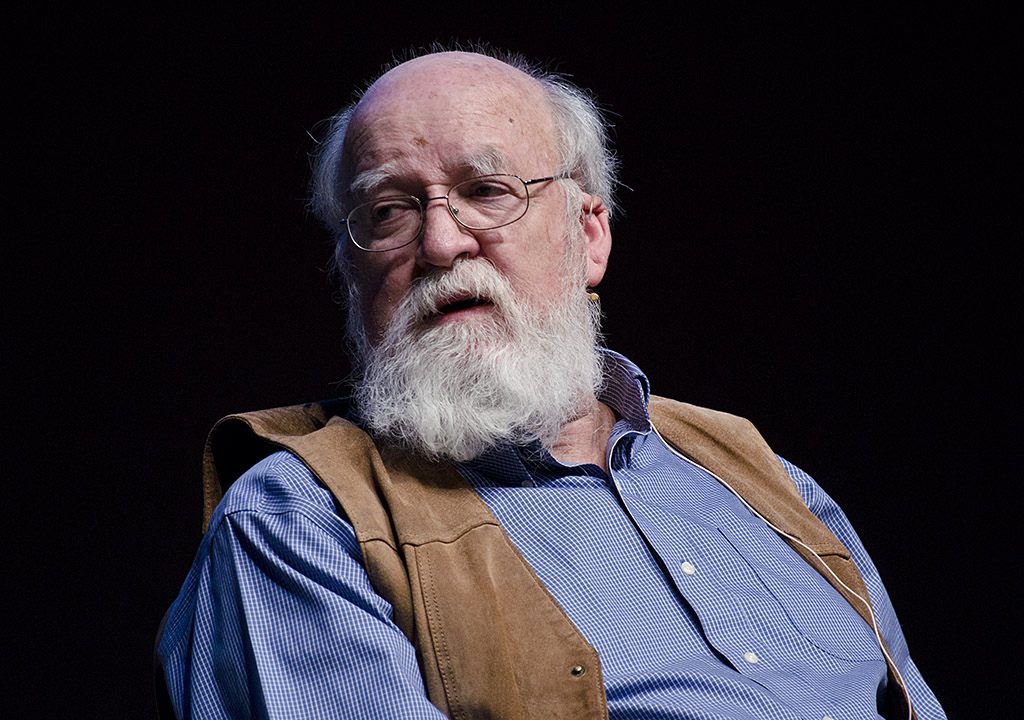
Love him or hate him, many of our readers may know enough about Daniel C. Dennett to have formed some opinion of his work. While Dennett can be a soft-spoken, jovial presence, he doesn’t suffer fuzzy thinking or banal platitudes— what he calls “deepities”—lightly. Whether he’s explaining (or explaining away) consciousness, religion, or free will, Dennett’s materialist philosophy leaves little-to-no room for mystical speculation or sentimentalism. So it should come as no surprise that his latest book, Intuition Pumps And Other Tools for Thinking, is a hard-headed how-to for cutting through common cognitive biases and logical fallacies.
In a recent Guardian article, Dennett excerpts seven tools for thinking from the new book. Having taught critical thinking and argumentation to undergraduates for years, I can say that his advice is pretty much standard fare of critical reasoning. But Dennett’s formulations are uniquely—and bluntly—his own. Below is a brief summary of his seven tools.
1. Use Your Mistakes
Dennett’s first tool recommends rigorous intellectual honesty, self-scrutiny, and trial and error. In typical fashion, he puts it this way: “when you make a mistake, you should learn to take a deep breath, grit your teeth and then examine your own recollections of the mistake as ruthlessly and as dispassionately as you can manage.” This tool is a close relative of the scientific method, in which every error offers an opportunity to learn, rather than a chance to mope and grumble.
2. Respect Your Opponent
Often known as reading in “good faith” or “being charitable,” this second point is as much a rhetorical as a logical tool, since the essence of persuasion involves getting people to actually listen to you. And they won’t if you’re overly nitpicky, pedantic, mean-spirited, hasty, or unfair. As Dennett puts it, “your targets will be a receptive audience for your criticism: you have already shown that you understand their positions as well as they do, and have demonstrated good judgment.”
3. The “Surely” Klaxon
A “Klaxon” is a loud, electric horn—such as a car horn—an urgent warning. In this point, Dennett asks us to treat the word “surely” as a rhetorical warning sign that an author of an argumentative essay has stated an “ill-examined ‘truism’” without offering sufficient reason or evidence, hoping the reader will quickly agree and move on. While this is not always the case, writes Dennett, such verbiage often signals a weak point in an argument, since these words would not be necessary if the author, and reader, really could be “sure.”
4. Answer Rhetorical Questions
Like the use of “surely,” a rhetorical question can be a substitute for thinking. While rhetorical questions depend on the sense that “the answer is so obvious that you’d be embarrassed to answer it,” Dennett recommends doing so anyway. He illustrates the point with a Peanuts cartoon: “Charlie Brown had just asked, rhetorically: ‘Who’s to say what is right and wrong here?’ and Lucy responded, in the next panel: ‘I will.’” Lucy’s answer “surely” caught Charlie Brown off-guard. And if he were engaged in genuine philosophical debate, it would force him to re-examine his assumptions.
5. Employ Occam’s Razor
The 14th-century English philosopher William of Occam lent his name to this principle, which previously went by the name of lex parsimonious, or the law of parsimony. Dennett summarizes it this way: “The idea is straightforward: don’t concoct a complicated, extravagant theory if you’ve got a simpler one (containing fewer ingredients, fewer entities) that handles the phenomenon just as well.”
6. Don’t Waste Your Time on Rubbish
Displaying characteristic gruffness in his summary, Dennett’s sixth point expounds “Sturgeon’s law,” which states that roughly “90% of everything is crap.” While he concedes this may be an exaggeration, the point is that there’s no point in wasting your time on arguments that simply aren’t any good, even, or especially, for the sake of ideological axe-grinding.
7. Beware of Deepities
Dennett saves for last one of his favorite boogeymen, the “deepity,” a term he takes from computer scientist Joseph Weizenbaum. A deepity is “a proposition that seems both important and true—and profound—but that achieves this effect by being ambiguous.” Here is where Dennett’s devotion to clarity at all costs tends to split his readers into two camps. Some think his drive for precision is an admirable analytic ethic; some think he manifests an unfair bias against the language of metaphysicians, mystics, theologians, continental and post-modern philosophers, and maybe even poets. Who am I to decide? (Don’t answer that).
You’ll have to make up your own mind about whether Dennett’s last rule applies in all cases, but his first six can’t be beat when it comes to critically vetting the myriad claims routinely vying for our attention and agreement.
via Mefi
Related Content:
Daniel Dennett and Cornel West Decode the Philosophy of The Matrix in 2004 Film
Daniel Dennett (a la Jeff Foxworthy) Does the Routine, “You Might be an Atheist If…”
90 Free Online Philosophy Courses
Josh Jones is a writer and musician based in Washington, DC. Follow him @jdmagness
Read More...Support Us
We're hoping to rely on loyal readers, rather than erratic ads. Please click the Donate button and support Open Culture. You can use Paypal, Venmo, Patreon, even Crypto! We thank you!

About Us

Open Culture scours the web for the best educational media. We find the free courses and audio books you need, the language lessons & educational videos you want, and plenty of enlightenment in between.
Advertise With Us
FREE UPDATES!
GET OUR DAILY EMAIL
Get the best cultural and educational resources on the web curated for you in a daily email. We never spam. Unsubscribe at any time.
FOLLOW ON SOCIAL MEDIA
Open Culture editor Dan Colman scours the web for the best educational media. He finds the free courses and audio books you need, the language lessons & movies you want, and plenty of enlightenment in between.
Advertise With Us



.jpg)