7 Nobel Speeches by 7 Great Writers: Hemingway, Faulkner, and More
William Faulkner, 1949:
Almost every year since 1901, the Swedish Academy has apportioned one fifth of the interest from the fortune bequeathed by dynamite inventor Alfred Nobel to honor, as Nobel said in his will, “the person who shall have produced in the field of literature the most outstanding work in an ideal direction.”
Many of the greatest writers of the past 112 years have received the Nobel Prize in Literature, but there have been some glaring omissions right from the start. When Leo Tolstoy was passed over in 1901 (the prize went to the French poet Sully Prudhomme) he was so offended he refused later nominations. The list of great writers who were alive after 1901 but never received the prize is jaw-dropping. In addition to Tolstoy, it includes James Joyce, Virginia Woolf, Mark Twain, Joseph Conrad, Anton Chekhov, Marcel Proust, Henry James, Henrik Ibsen, Émile Zola, Robert Frost, W.H. Auden, F. Scott Fitzgerald, Jorge Luis Borges and Vladimir Nabokov.
But the Nobel committee has honored many worthy writers, and today we’ve gathered together seven speeches by seven laureates. Our choice was restricted by the limitations of what is available online in English. We have focused on the short speeches traditionally given on December 10 of every year at the Nobel banquet in Stockholm. With the exception of short excerpts from Bertrand Russell’s lecture, we have passed over the longer Nobel lectures (which typically run about 40 minutes) presented to the Swedish Academy on a different day than the banquet.
We begin above with one of the most often-quoted Nobel speeches: William Faulkner’s eloquent acceptance of the 1949 prize. There was actually no prize in literature given in 1949, but the committee decided to award that year’s medal 12 months later to Faulkner, citing his “powerful and artistically unique contribution to the modern American novel.” Faulkner gave his speech on December 10, 1950, in the same ceremony with Bertrand Russell. Unfortunately the audio cuts off just before the finish. To follow along and read the missing ending, click here to open the full text in a new window. Faulkner stumbles a few times during his delivery. You can listen to his smoother 1954 reading of a polished version of the speech here.
Bertrand Russell, 1950:
The British logician and philosopher Bertrand Russell was one of several prize-winners in literature who were primarily known for their work in other fields. (The short list includes statesman Winston Churchill and philosopher Henri Bergson.) In addition to his ground-breaking contributions to mathematics and analytic philosophy, Russell wrote many books for the general reader. In 1950 the Nobel committee cited his “varied and significant writings in which he champions humanitarian ideals and freedom of thought.” Above are two short audio clips from Russell’s December 11, 1950 Nobel lecture, “What Desires are Politically Important?” You can click here to open the full text in a new window.
Ernest Hemingway, 1954:
The American writer Ernest Hemingway was awarded the 1954 prize “for his mastery of the art of narrative, most recently demonstrated in The Old Man and the Sea, and for the influence that he has exerted on contemporary style.” Hemingway was not feeling well enough in December of 1954 to travel to Stockholm, so he asked John C. Cabot, United States Ambassador to Sweden, to deliver the speech for him. Fortunately we do have this recording from sometime that month of Hemingway reading his speech at a radio station in Havana, Cuba. You can click here to open the full text in a new window.
John Steinbeck, 1962:
The American writer John Steinbeck, author of The Grapes of Wrath and Of Mice and Men, was awarded the Nobel in 1962 “for his realistic and imaginative writings, combining as they do sympathetic humor and keen social perception.” To read along as you watch Steinbeck give his speech, click here to open the text in a new window.
V.S. Naipaul, 2001:
Jumping ahead from 1962 all the way to 2001, we have video of the speech given by the Trinidadian-British writer V.S. Naipaul, author of such books as In a Free State and A Bend in the River. Naipaul was cited by the Nobel committee “for having united perceptive narrative and incorruptible scrutiny in works that compel us to see the presence of suppressed histories.” You can click here to open a text of Naipaul’s banquet speech in a new window.
Orhan Pamuk, 2006:
The Turkish writer Orhan Pamuk, author of such books as The Museum of Innocence and Snow, received the prize in 2006. The Nobel committee praised the Istanbul-based writer, “who in the quest for the melancholic soul of his native city has discovered new symbols for the clash and interlacing of cultures.” To read Pamuk’s banquet speech, click here to open the text in a new window.
Mario Vargas Llosa, 2010:
The prolific Peruvian-Spanish writer Mario Vargas Llosa, author of such novels as Conversation in the Cathedral and Death in the Andes, was cited by the Nobel committee in 2010 “for his cartography of structures of power and his trenchant images of the individual’s resistance, revolt, and defeat.” To read along with Vargas Llosa as he speaks, click here to open the text in a new window.
Read More...Five Cultural Tours of Los Angeles
As an Open Culture reader, you surely enjoy a vast range of interests, and what serves as a more robust nexus of interests than the modern city? Each city produces an infinitude of fascinating case studies in architecture, economics, politics, and social psychology. But even when you examine the less obviously city-relevant intellectual pursuits — language, film, literature, technology, style — countless more connections reveal themselves. Because I’ve found organizing cultural interests by city so fruitful, I offer you here a set of resources to do with Los Angeles, California. These are just a few of the countless possible perceptions of the capital of mainstream cinema, the terminus of mankind’s westward push, the creator and destroyer of new urban forms, and above all the great divider of opinion. Architectural historian Reyner Banham voices his own at the top of Reyner Banham Loves Los Angeles, a 1972 BBC television documentary in which the architectural historian gives a personal tour of the city: “I love the place with a passion that goes beyond sense or reason.”
“They make movies here,” says CalArts professor Thom Andersen in the narration of Los Angeles Plays Itself. “I live here. Sometimes I think that gives me the right to criticize the way movies depict my city.” But he does much more than criticize in his video essay’s nearly three-hour analysis of the roles Los Angeles has played onscreen: as itself, as other cities, and, most often, as no city in particular. Chapman University’s Huell Howser Archive collects the late California-explorer’s nonfictional video journeys in places like Venice Beach, the ever-rising downtown, and even in a helicopter above the city. For a similarly aerial perspective, but a historical one, watch this 1958 footage of Hollywood from above. And for a point of view more forcefully expressed, look no further than Ice Cube’s celebration of Los Angeles as midcentury design mecca, especially for the work of aesthetic luminaries (and Powers of Ten filmmakers) Charles and Ray Eames. “A lot of people think L.A. is just eyesore after eyesore, full of mini-malls, palm trees and billboards,” he says. “So what? They don’t know the L.A. I know.”
- Reyner Banham Loves Los Angeles
- Los Angeles Plays Itself
- Chapman University’s Huell Howser Archive
- Hollywood by Helicopter
- Ice Cube Celebrates the Eames
Colin Marshall hosts and produces Notebook on Cities and Culture and writes essays on literature, film, cities, Asia, and aesthetics. He’s at work on a book about Los Angeles, A Los Angeles Primer. Follow him on Twitter at @colinmarshall.
Read More...David Foster Wallace’s Famous Commencement Speech “This is Water” Visualized in a Short Film
David Foster Wallace was a hyper-anxious chronicler of the minute details of a certain kind of upper-middle-class American life. In his hands, it took on sometimes luminous, sometimes jaundiced qualities. Wallace was also something of a metaphysician: reflective teacher, wise-beyond-his-years thinker, and (tragically in hindsight) quite self-deprecating literary superstar. In the latter capacity, he was often called on to perform the duties of a docent, administering commencement speeches, for example, which he did for the graduating class of Kenyon in 2005.
He began with a story: two young fish meet an older fish, who asks them “How’s the water?” The younger fish look at each other and say, “What the hell is water?” Foster Wallace explains the story this way:
The point of the fish story is merely that the most obvious, important realities are often the ones that are hardest to see and talk about. Stated as an English sentence, of course, this is just a banal platitude, but the fact is that in the day to day trenches of adult existence, banal platitudes can have a life or death importance, or so I wish to suggest to you on this dry and lovely morning.
Foster Wallace acknowledges that the anecdote is a cliché of the genre of commencement speeches. He follows it up by challenging, then re-affirming, another cliché: that the purpose of a liberal arts education is to “teach you how to think.” The whole speech is well worth hearing.
In the video above, “This is Water,” The Glossary—“fine purveyors of stimulating videograms”—take an abridged version of the original audio recording and set it to a series of provocative images. In their interpretation, Foster Wallace’s speech takes on the kind of middle-class neurosis of David Fincher’s realization of Chuck Palahniuk’s Fight Club.
It’s a dystopian vision of post-grad life that brings vivid clarity to one of my mentors’ pieces of advice: “There are two worst things: One, you don’t get a job. Two, you get a job.” Or one could always quote Morrissey: “I was looking for a job, and then I found a job. And heaven knows I’m miserable now.” I still haven’t figured out what’s worse. I hope some of those Kenyon grads have.
If you would like to support the mission of Open Culture, consider making a donation to our site. It’s hard to rely 100% on ads, and your contributions will help us continue providing the best free cultural and educational materials to learners everywhere. You can contribute through PayPal, Patreon, and Venmo (@openculture). Thanks!
Related Content:
David Foster Wallace’s 1994 Syllabus: How to Teach Serious Literature with Lightweight Books
David Foster Wallace: The Big, Uncut Interview (2003)
David Foster Wallace Breaks Down Five Common Word Usage Mistakes in English
Josh Jones is a writer and musician based in Washington, DC. Follow him @jdmagness
Read More...History Declassified: New Archive Reveals Once-Secret Documents from World Governments
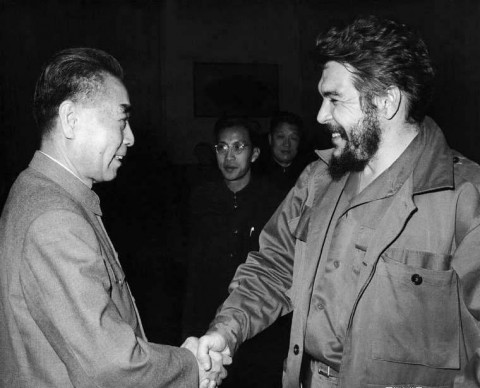
In the early ’90s, the so-called “Iron Archives” of Russian political documents from the Cold War era opened up to historians, shedding light on the earliest days of Mao Zedong and Joseph Stalin’s diplomatic alliance.
But not all of the Russian documents were declassified at that time. The Woodrow Wilson International Center for Scholars has launched a new digital archive containing recently declassified materials from some 100 different international collections, including a cable Mao sent to Commander Filippov (Stalin’s alias) eagerly detailing his plans to study Russia and complaining about his poor health.
The subsequent exchange between the two world leaders is as banal as their later correspondence would be ideological. Mao suggests, once his health improves, that they use the aerodrome in Weixian for his departure and he includes the exact dimensions of the landing strip. One wonders whether Obama and Israeli President Shimon Peres worked so closely together on travel details for their meetings in March.
The details contained in the thousands of cables, telegrams and memos are part of the fun. Other documents exchanged between the KGB chairman and East German Minister in July, 1981 include blunt language about the difficulties of reading the Reagan Administration’s intentions and the importance of quashing the Polish Solidarity Movement.
Because the world’s biggest issues tend to have long roots, there is a lot of material here that echoes today’s headlines. Here, the Soviet Minister of Foreign Affairs records a 1958 memo about his assessment of North Korea’s plans for a nuclear program.
During a 1960 global communist delegation meeting, Mao Zedong spoke at length with Che Guevara about sugar sales, American influence and counter-revolutionaries.
As a side note, the Wilson Center is a one of the more intellectual memorials to an American president. Woodrow Wilson was, after all, the only President of the United States to hold a Ph.D. The Center is one of the world’s top think tanks, with research and projects focused on U.S.-Russia relations, the Middle East, North Korea and, oddly, emerging nanotechnologies. But, of course, the Wilson Center is more known for its centrist analysis of international diplomacy issues.
The new digital archive (whose tagline is “International History Declassified”) offers several ways to search: by place, year (beginning with1938) or subject. For scholars or history buffs, this is a trove worth browsing.
Kate Rix writes about education and digital media. Visit her website: .
Read More...Jane Austen, Game Theorist: UCLA Poli Sci Prof Finds Shrewd Strategy in “Cluelessness”
Professional jealousy is probably the worst reason to dismiss a new perspective, whether it comes from within one’s field, outside it, or anywhere else. Snobbery leads to inbreeding and intellectual dead-ends. So when Michael Chwe, an associate professor of political science at UCLA who specializes in game theory, has an epiphany about Jane Austen as a proto-game theorist, maybe his insights should change the way English profs—and everyone else—read the author of Pride and Prejudice.
I don’t know. I haven’t read Chwe’s book, Jane Austen: Game Theorist (read a sample chapter here), but I’ll confess, I’m skeptical of anyone who calls Austen’s literary work a “research program” that has “results” in a book of “230 diagram-heavy pages.” It seems to miss the point somehow. Austen is perhaps these days the most-adapted of British writers, and her academic cachet couldn’t be higher. But the best takes on her work—whether scholarly or popular—are fun, focused on character and language, not technocratic theory.
But maybe I’ve misjudged Chwe’s intent. He was, after all, inspired to read Austen by “watching movies and reading books with his children.” And one of the concepts Chwe ascribes to Austen is that of “cluelessness,” a term he takes from that classic nineties movie Clueless (inspired by Austen’s Emma, clip above). In Chwe’s analysis, cluelessness is not at all garden-variety stupidity; it’s the benevolent deviousness of Elizabeth Bennet or the “dumb blonde” act Alicia Silverstone’s character pulls off in convincing others that she doesn’t know what she’s doing, all the while manipulating, cajoling, and demurring to get her way.
Chwe also pursues the darker side of cluelessness, relating it to grim episodes like the 2004 killing of four private contractors in Falluja. Overall, his book identifies fifty “manipulation strategies” he finds in Austen. While his book seems to promise some entertaining observations it also might further confirm for serious Austen readers that the eighteenth-century novelist was one of the most psychologically insightful writers of the past few centuries.
Related Content:
New Stamp Collection Celebrates Six Novels by Jane Austen
As Pride and Prejudice Turns 200, Read Jane Austen’s Manuscripts Online
Josh Jones is a writer and musician based in Washington, DC. Follow him @jmagness
Read More...The Physics of Mosh Pits at Heavy Metal Concerts (Explained by Cornell Grad Students)
Speaking at the American Physical Society last month, Matthew Bierbaum, a Cornell grad student, presented a talk called “Collective Motion at Heavy Metal Concerts,” where he made the case that physics is everywhere, even in a mosh pit at a heavy metal show. Along with three other Cornell researchers, Bierbaum has analyzed and modeled the collective motions of moshers in various YouTube concert videos (like the one below) and discovered that “dancers collide with each other randomly and at a distribution of speeds that resembles particles in a two-dimensional gas,” writes Lauren Wolfe in Chemical & Engineering News.
To try and understand what’s happening in mosh pits, the researchers used a flocking-based simulation that helps “model living beings as simple particles, reducing complex behavioral dynamics to a few basic rules,” says Itai Cohen, the head of the research team. From this study, the Cornell team hopes to learn more about how seemingly chaotic crowds behave, and how smarter exit routes and evacuation strategies can be designed.
You can learn more about their research by perusing the team’s published paper “Collective Motion of Moshers at Heavy Metal Concerts” or by watching Bierbaum’s aforementioned presentation in the grainy video below below.
If you would like to support the mission of Open Culture, consider making a donation to our site. It’s hard to rely 100% on ads, and your contributions will help us continue providing the best free cultural and educational materials to learners everywhere. You can contribute through PayPal, Patreon, and Venmo (@openculture). Thanks!
Related Content:
The Physics of Coffee Rings Finally Explained
Physics from Hell: How Dante’s Inferno Inspired Galileo’s Physics
Michio Kaku Explains the Physics Behind Absolutely Everything
Read More...Martin Heidegger Talks About Language, Being, Marx & Religion in Vintage 1960s Interviews
German philosopher Martin Heidegger, whom readers of post-structuralist theory have to thank for popularizing the ubiquitous phrase “always already,” was a very labored writer who coined much of his own terminology and gave many a translator migraines. His prose betrays an obsession with the power of language that many of his students and successors, such as Jacques Derrida and Michel Foucault, inherited in the construction of their own elaborate theories. While Heidegger’s first book Being and Time (1927) had enormous influence on Existentialist and Phenomenological thought, he also wrote extensively on technology, theology, and art and poetics, engaging with the ideas of Edmund Husserl, Kierkegaard, Nietzsche, and the romantic German poet Friedrich Hӧlderlin.
In the short film above, see the man himself in excerpts from a lecture and three different interviews. The footage comes from a 1975 documentary called Heidegger’s Speeches. Heidegger first discusses some theory of language, quoting Goethe, then, in an interview, talks about how he came to the central preoccupation of his philosophical career: the “question of being,” or Dasein. The third interview concerns Heidegger’s thoughts on Karl Marx. He quotes Marx’s radical dictum, “philosophers have only interpreted the world; the point is to change it,” and offers a critical perspective based in hermeneutics. In the fourth and final interview segment, Heidegger proffers some thoughts on religion and communism.
For a much fuller picture of Heidegger’s life and work, watch the BBC documentary above, from their Existentialist series “Human All Too Human” that begins with Nietzsche and ends with Sartre. And this page also has video of a number of philosophers discussing Heidegger’s work, which left such a lasting impression on the character of late modern and postmodern thought that it’s hard to find a contemporary philosopher who doesn’t owe some sort of debt to him.
It may be impossible to overstate Heidegger’s importance to twentieth century European philosophy in general, and upon several prominent Jewish thinkers in particular like his former student and lover Hannah Arendt and ethicist Emmanuel Levinas. But it also must be said that Heidegger’s legacy is tainted with controversy. While it’s typically good form to separate a thinker’s work from his or her personal lapses, Heidegger’s lapses of judgment, if that’s what they were, are not so easy to ignore. As the documentary above informs us, Heidegger was a Nazi. A reviewer of a recent biography colorfully sums up the case this way:
Let’s be clear about this: Martin Heidegger, a thinker many regard as the most important philosopher of the twentieth century, was indeed a bona-fide, arm-aloft, palm-outstretched Nazi. Zealously renewing his party membership every year between 1933 and 1945, his commitment to the National Socialist cause was unstinting. Nowhere was this more in evidence than in his public role as rector of Freiburg University, where he praised ‘the inner truth and greatness’ of Nazism in his 1933 rectoral address, and later penned a paean to murdered Nazi thug Leo Schlageter. Heidegger was no token fascist; he was jack-booted and ready. Wearing a swastika on his lapel at all times he, alongside his proud, virulently anti-Semitic wife, also practised private discrimination against Jews, from fellow existentialist philosopher Karl Jaspers to his one-time mentor Edmund Husserl. Not that he was without friends. In fact his friendship with Eugene Fischer, director of Berlin Institute for Racial Hygiene, lasted years.
Heidegger’s Nazi sympathies are hardly evident in his philosophical work, yet it is still difficult for many readers to reconcile these facts about his life. Some refer to a 1966 Der Spiegel interview in which the philosopher explained away his Nazism as exigent circumstances. Sort of what we call today a non-apology apology. Others, like onetime admirer Levinas, don’t find the task so easy. In a commentary on forgiveness, Levinas once wrote, “One can forgive many Germans, but there are some Germans it is difficult to forgive. It is difficult to forgive Heidegger.”
You can find more resources on Heidegger in our archive of free online philosophy courses.
Related Content:
Friedrich Nietzsche & Existentialism Explained to Five-Year-Olds (in Comical Video by Reddit)
Walter Kaufmann’s Lectures on Nietzsche, Kierkegaard and Sartre (1960)
Hannah Arendt’s Original Articles on “the Banality of Evil” in the New Yorker Archive
Josh Jones is a writer and musician based in Washington, DC. Follow him @jdmagness
Read More...Italian Photographer Maurizio Galimberti Creates Cubist Polaroid Collages of Artists & Celebrities
Five years ago Polaroid announced that they would no longer make analog instamatic film. At that moment, if one listened carefully, one could almost hear some of the 20th century’s most famous artists wail in despair, even from the grave. Ansel Adams loved Polaroid and shot some of his famous Yosemite images in that format first.
But a technique with that kind of following doesn’t die off easily. Two ardent Polaroid fans—ardent enough to actually attend the closure of a Polaroid factory in the Netherlands—met and came up with a plan to save the factory and Polaroid instant film. They called their plan the Impossible Project. They leased one of the Dutch factory buildings and eventually fired up the machines again, turning out new instant film.
Lucky for us. Artists like David Hockney have long made beautiful use of Polaroid instant photos to construct cubist collages. One of the best at this is the Italian photographer Maurizio Galimberti who creates terrific celebrity portraits using a Polaroid.
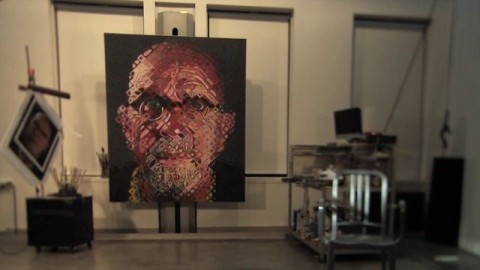
Galimberti considers himself a painter who uses a camera. Watching the video of his photo shoot with painter Chuck Close, it’s interesting to observe how similar Galimberti’s photo collage (above) is to Close’s own painted self-portraits.
Galimberti also has pretty good access to celebrities, having shot the portrait of Johnny Depp and this one of George Clooney at the 2003 Venice Film Festival.
Galimberti posts a number of more recent celebrity portraits on his website, where he also displays his abstract city photo collages.
Kate Rix writes about digital media and education. Visit her website: .
Read More...“Professor Risk” at Cambridge University Says “One of the Biggest Risks is Being Too Cautious”
To eat bacon sandwiches? Or not to eat bacon sandwiches? That’s a question tackled by David Spiegelhalter, who holds the title, “Winton Professor for the Public Understanding of Risk” at Cambridge University. Sometimes they just call him “Professor Risk” for short.
In his academic work, Spiegelhalter looks at risk and uncertainty every day, seeing how they affect the lives of individuals and society. You’d figure that this might make him more cautious than the rest of us. But that’s not how it turns out. After analyzing all of the data, Spiegelhalter comes to this conclusion: some calculated risks are worth it. They have minimal downside and make life worth living. Or, looked at a little differently, sometimes “one of the biggest risks [in life] is being too cautious.”
You can stay current on Spiegelhalter’s thinking by following his blog Understanding Uncertainty.
If you would like to support the mission of Open Culture, consider making a donation to our site. It’s hard to rely 100% on ads, and your contributions will help us continue providing the best free cultural and educational materials to learners everywhere. You can contribute through PayPal, Patreon, and Venmo (@openculture). Thanks!
Related Content:
J.K. Rowling Tells Harvard Grads Why Success Begins with Failure
Paulo Coelho on The Fear of Failure
Find Courses from Cambridge in our Collection of Free Courses Online
Read More...
A Look Back at Jim Carroll: How the Poet and Basketball Diaries Author Finally Finished His First Novel
Like so many denizens of the New York that produced Warhol and The Velvet Underground, then gritty punk rock, hip-hop, and no wave, poet Jim Carroll didn’t fare so well into Bloomberg-era NYC, a developer’s paradise and destination for urban professionals and tourists, but not so much a haven for struggling artists. As the city changed, its creative characters either rose above its shifting demographics, moved away, or—as Carroll did—retreated. Carroll, who died in 2009 at 60, spent his last years in the upper Manhattan neighborhood of Inwood—once a bustling Irish-Catholic enclave—living in the same building where he’d grown up and writing against time to finish his first and only novel, The Petting Zoo. His last years were by no means tragic, however. Given the tumult of his early years as an addict, and the long list of friends from the downtown New York scene that Carroll lost along the way—to overdoses, AIDS, cancer, suicide—I’d say he was a literary survivor, who died (at his writing desk, it’s said) doing what he loved most.
Carroll came to mainstream consciousness with the release of a 1995 film starring Leonardo DiCaprio, based on the book Carroll’s most known for: the 1978 memoir The Basketball Diaries, a collection of teenage journal entries from his double life as a high school basketball star and junkie hustler. But even with that movie’s nods to Carroll’s mature years as a poet and musician, it’s doubtful that few people came away with much more than a vague sense of what the street-wise Catholic schoolboy DiCaprio character had gone on to do. Which is a shame, because Carroll really was a terrific writer, from his debut poetry publications in the 60s and on throughout the next three decades. Even in the obscurity and semi-seclusion of his later years, he wrote wise, incisive essays and criticism (such as this 2002 review of Kurt Cobain’s published Journals for the Los Angeles Times). And despite the memoir and film’s popularity, Carroll considered himself primarily a poet, in the symbolist tradition of his literary heroes Rilke, Rimbaud, and Ashbery. (See Carroll at top, in his harsh New York accent, read from his 1986 collection of poems, The Book of Nods.)
In a manner of speaking, Carroll suffered the curse of one-hit-wonderism, except in his case, he was lucky enough to have two hits—the memoir (and later film) and the song, “People Who Died,” from Catholic Boy, his debut album with the Jim Carroll Band (video above), which even made it onto the E.T. soundtrack (giving Carroll royalties for life). The band came about with the encouragement of Carroll’s fellow poet and former roommate Patti Smith, after Carroll kicked heroin and moved to California. Carroll wrote songs for Blue Oyster Cult and Boz Scaggs and collaborated with Rancid, Sonic Youth’s Lee Ranaldo, Patti Smith guitarist Lenny Kaye, and guitarist Anton Sanko (on his 1998 return to music, Pools of Mercury). His years in rock and roll transmuted through most of the nineties into dramatic readings, spoken word performances, and lively monologues, such as those collected on the 1991 release Praying Mantis. In the track below, “The Loss of American Innocence,” Carroll delivers some shambling, and pretty funny, stories about the characters in his novel-in-progress.
Carroll had been telling these stories about Billy the downtown painter and a certain chatty raven since the late 80s. As the monologues crystallized into short prose pieces, he slowly, painstakingly assembled them into The Petting Zoo, which saw publication in 2010. It took him twenty years, and he didn’t live to see it published, but he left a final legacy behind, and it’s a flawed but serious work worth reading. In 2010, Carroll’s longtime friends Patti Smith and Lenny Kaye celebrated the novel’s publication with readings and performances at the Barnes and Noble in Union Square. Below, see Smith read an excerpt from The Petting Zoo. The sound’s a bit tinny and the camera shakes, but it’s worth it to see living legend Smith read from Carroll’s legendary final song.
Related Content:
Patti Smith Reads Her Final Words to Robert Mapplethorpe
Rock and Roll Heart, 1998 Documentary Retraces the Remarkable Career of Lou Reed
Josh Jones is a writer and musician based in Washington, DC. Follow him @jdmagness
Read More...Support Us
We're hoping to rely on loyal readers, rather than erratic ads. Please click the Donate button and support Open Culture. You can use Paypal, Venmo, Patreon, even Crypto! We thank you!

About Us

Open Culture scours the web for the best educational media. We find the free courses and audio books you need, the language lessons & educational videos you want, and plenty of enlightenment in between.
Advertise With Us
FREE UPDATES!
GET OUR DAILY EMAIL
Get the best cultural and educational resources on the web curated for you in a daily email. We never spam. Unsubscribe at any time.
FOLLOW ON SOCIAL MEDIA
Open Culture editor Dan Colman scours the web for the best educational media. He finds the free courses and audio books you need, the language lessons & movies you want, and plenty of enlightenment in between.
Advertise With Us



