Leonard Bernstein Demystifies the Rock Revolution for Curious (if Square) Grown-Ups in 1967
Many of today’s thirteen-year-olds surely have the Beatles on their iPods (or their iPhones or Androids, or whatever now ranks as the cutting-edge adolescent’s listening device of choice). Yet they would have been born in 2000, forty years after the dissolution of the Beatles themselves. Their parents would probably have been born in the sixties, already the height of the band’s creativity. The startling implication: these kids rock out to some of the very same songs their grandparents may well have loved. As P.J. O’Rourke once wrote upon spotting an aged hippie with a walker and a hearing aid at an Iraq War protest, sic transit generation gap. But back in 1967, when that gap yawned so chasmically wide as to render any communication across it seemingly impossible, the young Baby Boomers and their own Great Depression, Second World War-forged parents used the musical landscape to draw their battle lines. Who could broker a peace? Enter composer, pianist, and New York Philharmonic director Leonard Bernstein. Born in 1918 and hailed as one of the most accomplished and astute musical minds in American history, he could not only appreciate the techniques and innovations of the youth-driven pop-rock explosion of the sixties, he could get the ear of his middle-aged peers and explain to them just what they were missing.
The television broadcast Inside Pop: The Rock Revolution gave Bernstein a mass-communication platform on which perform this analysis, asking aloud the questions of (a) why this music so infuriates Americans over a certain age and (b) why he himself likes it so much. Decked out in a square-friendly suit and tie and appearing on the even square-friendlier CBS network, Bernstein plays clips of songs by the Beatles, Bob Dylan, the Rolling Stones, the Byrds, and the Association, breaking down the genuine musicological merits of each: their vocal expressions, their unexpected key changes, their countless sonic layers, their stripped-down melodic sense, and their lyrics’ adeptness of implication (“one of our teenager’s strongest weapons”). Bernstein also calls upon “Society’s Child” singer-songwriter Janis Ian and Beach Boys mastermind Brian Wilson to perform live. Quite a few crew-cut, cardigan-clad, martini-sipping adults must have come away from Inside Pop with a new, if grudging, appreciation for the craft of these long-haired youngsters. But now, to address the concerns of the 21st century’s bewildered grown-ups, who will go on television and explain dubstep?
If you would like to support the mission of Open Culture, consider making a donation to our site. It’s hard to rely 100% on ads, and your contributions will help us continue providing the best free cultural and educational materials to learners everywhere. You can contribute through PayPal, Patreon, and Venmo (@openculture). Thanks!
Related content:
Leonard Bernstein’s Masterful Lectures on Music (11+ Hours of Video Recorded in 1973)
Leonard Bernstein’s First “Young People’s Concert” at Carnegie Hall Asks, “What Does Music Mean?”
Colin Marshall hosts and produces Notebook on Cities and Culture and writes essays on literature, film, cities, Asia, and aesthetics. He’s at work on a book about Los Angeles, A Los Angeles Primer. Follow him on Twitter at @colinmarshall.
Read More...David Foster Wallace Breaks Down Five Common Word Usage Mistakes in English
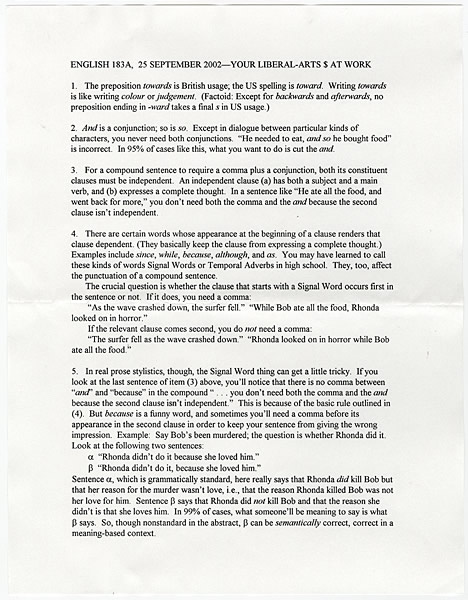
What advantage, I recently asked a trilingual writer, could you possibly find in using such an improvised, confusing, irregular patchwork of a language as English? She replied that this very improvisation, irregularity, and even confusion comes from the vast freedom of expression (and of invention of new expressions) that English offers over other European tongues. This goes even more so for American English, the variant with whose combination of carefully shaded nuances and smashing colloquialisms David Foster Wallace so dazzled his readers. Like many writers, Wallace also taught writing, but those of us not lucky enough to receive his direct instruction can still behold his teaching materials, archived online at the University of Texas at Austin’s Harry Ransom Center.
See, for instance, Wallace’s handout on five common usage mistakes, from his Fall 2002 section of English 183A at Pomona College (an advanced fiction writing class, taught last Spring by Jonathan Lethem). “The preposition towards is British usage; the US spelling is toward.” Fair enough. “And is a conjunction; so is so,” he continues. “Except in dialogue between particular kinds of characters, you never need both conjunctions.” Handy to know! Then, things get more technical: “For a compound sentence to require a comma plus a conjunction, both its constituent clauses must be independent.” As Wallace goes deeper, I feel even more sympathy for those who learn English as a second language, as I did when I read “Tense Present,” his Harper’s review of Bryan A. Garner’s A Dictionary of Modern American Usage. If the hardcore grammar talk tires you, feel free to peruse the Ransom Center’s other artifacts of Wallace’s time in the classroom—which we covered in a post last week—such as his syllabus for English 102: Literary Analysis, his guidelines for papers, and the marginalia in his copy of Carrie.
Related Content:
30 Free Essays & Stories by David Foster Wallace on the Web
David Foster Wallace: The Big, Uncut Interview (2003)
David Foster Wallace’s 1994 Syllabus
Colin Marshall hosts and produces Notebook on Cities and Culture and writes essays on literature, film, cities, Asia, and aesthetics. He’s at work on a book about Los Angeles, A Los Angeles Primer. Follow him on Twitter at @colinmarshall.
Read More...Visit the Museum of Endangered Sounds, and Experience a Blast from Technology’s Past
As gearheads go, Brendan Chilcutt’s a pretty sentimental guy, and not just because he signs his correspondence with “love.” In January, 2012, he founded the Museum of Endangered Sounds to keep outmoded technology’s most iconic noises from vanishing from the collective memory. Click on any image in the museum’s online collection to be transported in the Proustian sense.
Some of the exhibits—a manual typewriter, a rotary phone—were already amply preserved, thanks to a proliferation of cinematic appearances in their heyday.
Others might well have slipped away unnoticed, if not for Chilcutt’s curatorial efforts. Remember that number you could call to have a recorded voice inform you of the correct time? How about the static of an analog TV tuned to an empty station? The hum of a malfunctioning Discman, the chirp of a Tamagotchi…wait, what’s that I hear? The disconcerting whoosh of time speeding up?
Drown it out by activating all thirty exhibits at once. Let them sound their barbaric yawps simultaneously as the kids try to figure out what that racket is.
h/t goes to @sheerly
Related Content:
“Glitch” Artists Compose with Software Crashes and Corrupted Files
40 Great Filmmakers Go Old School, Shoot Short Films with 100 Year Old Camera
How Film Was Made: A Kodak Nostalgia Moment
Ayun Halliday is still trying to text on a cell phone from 2003
Read More...David Foster Wallace’s 1994 Syllabus: How to Teach Serious Literature with Lightweight Books
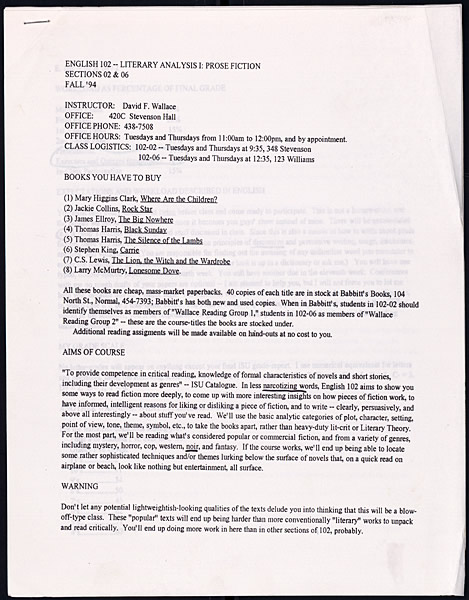
Note: click here to see the full syllabus and other related teaching materials.
As anyone who’s ever done it knows, the art of syllabussing is a fine one. (Yes, it’s a word; don’t look it up, take my word for it—Syllabussing: creating the perfect syllabus for a college-level course). It requires precision planning, stellar formatting and copy-editing skills, and near-perfect knowledge of the college-student psyche. For one, the syllabus must explain in clear terms what students can expect from the class and what the class expects from them. And it must do this without sounding so dry and pedantic that half the class drops in the first week. For another, the perfect syllabus (there’s no such thing, but one must strive) should function as both an FAQ and a contract: need to know how to format your papers? See the syllabus. Forgot when the paper was due? Too bad—see the syllabus. And so on. Most teachers learn over time that a class can stand or fall on the strength of this document.
Which brings us to the syllabussing skills of one David Foster Wallace, encyclopedic literary obsessive, modern-day moralist, English professor. Love his work or hate it, it may be safe to say that Wallace was perhaps one of the most careful (or care-full) writers of his generation. And given the criteria above, you might just have to admire the fine art of his syllabi. Well, so you can, thanks to the University of Texas at Austin’s Harry Ransom Center, which has scans available online of the syllabus for Wallace’s intro course “English 102-Literary Analysis: Prose Fiction” (first page above), along with other course documents. These documents—From the Fall ’94 semester at Illinois State University, where Wallace taught from 1993 to 2002—reveal the professionally pedagogical side of the literary wunderkind, a side every teacher will connect with right away.
The text in the image above is admittedly tiny (you can request higher resolution scans on the UT Austin site), but if you squint hard, you’ll see under “Aims of Course” that Wallace quotes the official ISU description of his class, then translates it into his own words:
In less narcotizing words, English 102 aims to show you some ways to read fiction more deeply, to come up with more interesting insights on how pieces of fiction work, to have informed intelligent reasons for liking or disliking a piece of fiction, and to write—clearly, persuasively, and above all interestingly—about stuff you’ve read.
Having taught my own versions of such a class, I’m a little jealous of his (uncharacteristically?) informal concision.
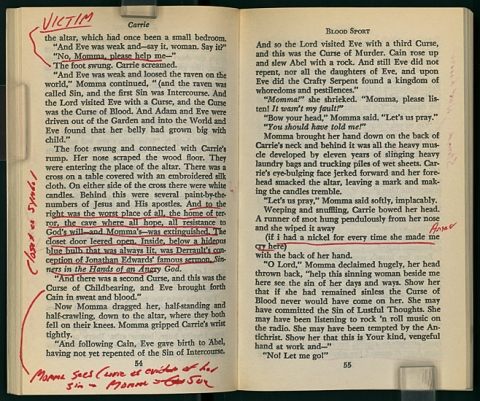
Wallace’s choice of texts is of interest as well—surprising for a writer most detractors call “pretentious.” For his class, Wallace prescribed airport-bookstore standards—what he calls “popular or commercial fiction”—such as Jackie Collins’ Rock Star, Stephen King’s Carrie, Thomas Harris’s The Silence of the Lambs, and James Elroy’s The Big Nowhere. The UT Austin site also has scans of some well-worn paperback teacher’s copies, with the red-ink marginal notes, discussion questions, and underlines one finds behind every podium. In the image above, Wallace has underlined a line of dialogue in Carrie, annotating it with the word “victim” in all-caps. Of the books Wallace requires, he writes in a section of the syllabus above called “Warning”:
Don’t let any potential lightweightish-looking qualities of the texts delude you into thinking that this will be a blow-off-type class. These “popular” texts will end up being harder than more conventionally “literary” works to unpack and read critically. You’ll end up doing more work in here than in other sections of 102, probably.
Something about that “probably” at the end grabs me (again: the precision… the college-student psyche). I admire this brave approach. Having taught conventionally “literary” stuff for years, I can say that some so-called literary fiction is formulaic in the extreme, all but containing checkboxes for the standard lit-crit categories. The commercial stuff isn’t always so careful (which is why it’s so often more fun).
UT Austin’s Harry Ransom Center houses David Foster Wallace’s library and papers, but you’ll have to make a trip to Texas (and present some academic credentials) to access most of the archive. They have scanned a few other choice pieces, however, such as the handwritten first page from a draft of his literary masterpiece/dorm-room doorstop, Infinite Jest.
Related Content:
Download 55 Free Online Literature Courses: From Dante and Milton to Kerouac and Tolkien
Donald Barthelme’s Syllabus Highlights 81 Books Essential for a Literary Education
30 Free Essays & Stories by David Foster Wallace on the Web
David Foster Wallace: The Big, Uncut Interview (2003)
Josh Jones is a writer, editor, musician, and oftentime English teacher to easily-distracted undergraduates. Follow him @jdmagness
Read More...Download Eight Free Lectures on The Hobbit by “The Tolkien Professor,” Corey Olsen
The name Corey Olsen may already be familiar to some readers—or at least those readers who venerate the literary accomplishments of one J.R.R. Tolkien. And if you don’t know Olsen by his real name, you may know him as “The Tolkien Professor,” his internet moniker since 2009, when Olsen, an English Professor at Washington College and lifelong student of Tolkien’s writing, decided to share his own scholarly work with a public “eager to be included in thoughtful, literary conversation” about The Hobbit and The Lord of the Rings trilogy.
For the past four years, Olsen has published specifically online lectures about Tolkien’s work, as well as recordings of his Washington College seminars on Tolkien’s fiction and academic work. He has most recently founded Signum University, an online, non-profit Liberal Arts college that aims to open the experience of high-quality higher ed to everyone, regardless of their means or their location. Signum has, in turn, spawned the Mythgard Institute, which seems (as the name implies) more exclusively focused on the fantasy and science fiction genres that are Olsen’s métier. (There are also college prep options in Signum and Mythgard Academies).
So, Professor Olsen is busy, and he’s happy to be sharing his wealth of Tolkien knowledge with a very receptive public. His most recent course, an eight-part lecture series on The Hobbit, is now available on his site. (iTunes U also has it as of January 31st. Watch the promo for the course above. We also have the class listed in our collection of 650 Free Courses Online.) The course comes via the Mythgard Institute and begins at the beginning in a lecture entitled “Took & Baggins” focused on The Hobbit’s first chapter, “An Unexpected Party.” Recorded before the release of Peter Jackson’s first installment of his trilogy of Hobbit films, the lecture starts with Olsen’s speculations about what those films might look like. He says:
From the beginning, I have thought this was a mistake… a big mistake to go backwards. It seems to me that an audience familiar with the epic grandeur of Peter Jackson’s trilogy is going to bring expectations to a new Tolkien movie that’s going to set a Hobbit film up for one of two very likely failures. Either the movie is going to try tell Bilbo’s story in the mode and register of the Lord of the Rings, and therefore strip the story of the light-heartedness and whimsicality that makes it so delightful, or it’s going to try to be true to the tone and spirit of the book, and will therefore seem kind of silly and childish to an audience hoping for a successor to Peter Jackson’s films.
This is a very canny prediction, and such canniness distinguishes Olsen’s approach to everything Tolkien. He is attuned not only to all of the scholarly minutiae that distinguishes academic Tolkien studies, but he is also well-aware of issues of audience reception and the ever-evolving role of Tolkien’s work in popular culture. As his first lecture continues, Professor Olsen makes it quite clear that The Hobbit was deliberately written as a children’s story, and the successive books were meant to be as well. The Lord of the Rings books became more adult, darker and more fraught with heavy theological and mythical significance, as Tolkien composed them. This happened in part because Tolkien was writing with his own children in mind as his readers, and as he wrote, his kids grew up.
Tolkien, Olsen points out, was by training a philologist—a scholar who specializes in the study of languages—so he thought about not only what words mean, but where they come from and when. As such, he intended The Hobbit to possess a “linguistic playfulness,” mixing ancient and modern words and usages, making up words a la Lewis Carroll, to create a lighthearted and comic atmosphere from the beginning of the novel. Olsen provides us with several examples of this method in his first lecture. Overall, his analysis is a thorough evaluation of the novel in the terms of its language, its composition, its many layers of genre and style—drawing from Tolkien’s explicitly articulated theories of narrative—and its historical and literary allusions. All presented in a very enthusiastic and accessible style that is aimed at every adult reader and lover of Tolkien, not just fellow scholars, who tend to speak a specialized language that excludes nearly everyone outside their narrow coterie.
In the video above—a TED talk Olsen delivered at TEDx Chester River—he discusses how the world of academe, that specialized world that excludes almost everyone, had become a stifling and rather meaningless place for him when he decided to become the online Tolkien Professor. Olsen had what he calls an existential crisis about academia and scholarly publishing—What’s the point?, he thought. Who’s going to read it? Since most people can’t access scholarly publications even if they wanted to, and since he was writing on Tolkien, one of the world’s most popular authors, he felt doubly irrelevant as a cloistered academic, since Tolkien fans are everywhere. Then he discovered something everybody else already knew about the internet—it’s an ideal medium for publishing and disseminating any kind of information, and it’s crowded with people desperate to learn about and discuss the liberal arts. As more and more academics discover this as well, more also cure their existential malaise by opening up their work to everyone online, becoming resources, not gatekeepers, for knowledge.
Related Content:
Listen to J.R.R. Tolkien Read a Lengthy Excerpt from The Hobbit (1952)
Fantastic BBC Footage of J.R.R. Tolkien in 1968
Free Audio: Download the Complete Chronicles of Narnia by C.S. Lewis
Josh Jones is a writer, editor, and musician based in Washington, DC. Follow him @jdmagness
Read More...Hear Walt Whitman (Maybe) Reading the First Four Lines of His Poem, “America” (1890)
Of all American poets, almost no one looms larger than Walt Whitman. As I once heard an old poet acquaintance say, American poets don’t need Shakespeare and the Bible; we’ve got Dickinson and Whitman. Indeed, Whitman’s voice emerges from the past like some American Moses, showing the way forward, opening his arms to hold his fractious countrymen together. One can bloviate all day about Walt Whitman. He tends to have that effect. But even Whitman, he of the serpentine lines full of the cargo of the continent, stretching from left margin to right, ocean to ocean, could be relatively succinct, and even about his favorite subject, America. Take his poem “America” from 1888:
Centre of equal daughters, equal sons,
All, all alike endear’d, grown, ungrown, young or old,
Strong, ample, fair, enduring, capable, rich,
Perennial with the Earth, with Freedom, Law and Love,
A grand, sane, towering, seated Mother,
Chair’d in the adamant of Time.
Now, believe it or not, you can hear what may well be the voice of Walt Whitman, American Moses, emerging from the past to read the first four lines of “America,” from a wax cylinder recording above. Most likely captured in 1889 or 1890 by Thomas Edison, this reading was originally found on a cassette called “The Voice of the Poets,” discovered in a library by Whitman scholar Larry Don Griffin. The cassette, made in 1974 and including the voices of Edna St. Vincent Millay and William Carlos Williams, takes the Whitman audio from a 1951 NBC radio program, whose announcer, Leon Pearson, claims comes from a wax cylinder recording made in 1890.
Surprisingly, the ’74 cassette tape, which landed in libraries across the country, seemed to go unnoticed by scholars until Griffin mentioned it in the Walt Whitman Quarterly Review in 1992. This mention sparked debate about the authenticity of the recording, and once scholarly debate is sparked, the fire can burn for decades, whole careers built on its embers. In this case, some scholars, including historian Allen Koenigsberg, argued that since no original wax cylinder has appeared, and mention of the recording in Edison’s correspondence is inconclusive, the provenance is suspect. Furthermore, Koenigsberg argued, the recording quality seems too good for the period. His conclusion comes backed by the analysis of audio experts. According to The Edisonian, a Rutger’s University Edison newsletter:
Analysts for both the Library of Congress and the Rodgers and Hammerstein Archives consulted on the case and agreed that the clarity of the recording was beyond what could be achieved in 1889 or 1890… the sound analysis along with the documentation difficulties led Koeningsberg to conclude that “the supposed Whitman recording is a fascinating fake.”
On the other side of this debate is the editor of the Walt Whitman Quarterly Review, Ed Folsom, who presents his case in an article simply titled “The Whitman Recording,” in which he discusses problems with the Library of Congress analysis. Yet another partisan for authenticity, William Grimes—who covered the controversy for The New York Times points out that the voice sounds like what Whitman’s would have, and he makes a compelling argument that the poem would not at all be the obvious choice for a fake. Grimes cites unnamed “specialists in the history of the phonograph,” whom, he writes, “agree… that the possibility of outright fraud or a hoax is unlikely.”
And on it goes. No one can definitively settle the case, unless new evidence should come to light. With no intention of maligning Ed Folsom’s good faith, I can imagine the Whitman Quarterly editor wanting this to be true more than historian Koenigsberg and the LOC analysts. But I also want it to be Whitman, and so I’m glad to make an exuberant leap of American faith and think it’s him. From Edison wax cylinder recording, to radio broadcast, to cassette, to mp3, over more than a century of American poetry—it would be a perfectly Whitmanesque journey.
via @stevesilberman
Related Content:
Voices from the 19th Century: Tennyson, Gladstone, Whitman & Tchaikovsky
Thomas Edison Recites “Mary Had a Little Lamb” in Early Voice Recording
Mark Twain Captured on Film by Thomas Edison in 1909.
Josh Jones is a writer, editor, and musician based in Washington, DC. Follow him @jdmagness
Read More...Alain de Botton Proposes a Kinder, Gentler Philosophy of Success
For better or worse, Alain de Botton is the face of pop philosophy. He has advocated “religion for atheists” in a book of the same name (to the deep consternation of some atheists and the eloquent interest of others); he has distilled selected philosophical nuggets into self-help in his The Consolations of Philosophy; and most recently, he’s tackled a subject close to everybody’s heart (to put it charitably) in How to Think More About Sex. As a corollary to his intellectual interests in human betterment, de Botton also oversees The School of Life, a “cultural enterprise offering good ideas for everyday life” with a base in Central London and a colorful online presence. Many critics disdain de Botton’s shotgun approach to philosophy, but it gets people reading (not just his own books), and gets them talking, rather than just shouting at each other.
In addition to his publishing, de Botton is an accomplished and engaging speaker. Although himself a committed secularist, in his TED talks, he has posed some formidable challenges to the smug certainties of liberal secularism and the often brutal certainties of libertarian meritocracy. Apropos of the latter, in the talk above, de Botton takes on what he calls “job snobbery,” the dominant form of snobbery today, he says, and a global phenomenon. Certainly, we can all remember any number of times when the question “What do you do?” has either made us exhale with pride or feel like we might shrivel up and blow away. De Botton takes this common experience and draws from it some interesting inferences: for example, against the idea that we (one assumes he means Westerners) live in a materialistic society, de Botton posits that we primarily use material goods and career status not as ends in themselves but as the means to receive emotional rewards from those who choose how much love or respect to “spend” on us based on where we land in any social hierarchy.
Accordingly, de Botton asks us to see someone in a Ferrari not as greedy but as “incredibly vulnerable and in need of love” (he does not address other possible compensations of middle-aged men in overly-expensive cars). For de Botton, modern society turns the whole world into a school, where equals compete with each other relentlessly. But the problem with the analogy is that in the wider world, the admirable spirit of equality runs up against the realities of increasingly entrenched inequities. Our inability to see this is nurturned, de Botton points out, by an industry that sells us all the fiction that, with just enough know-how and gumption, anyone can become the next Mark Zuckerberg or Steve Jobs. But if this were true, of course, there would be hundreds of thousands of Zuckerbergs and Jobs.
For de Botton, when we believe that those who make it to the top do so only on merit, we also, in a callous way, believe those at the bottom deserve their place and should stay there—a belief that takes no account of the accidents of birth and the enormity of factors outside anyone’s control. This shift in thinking, he says—especially in the United States—gets reflected in a shift in language. Where in former times someone in tough circumstances might be called “unfortunate” or “down on their luck,” they are now more likely to be called “a loser,” a social condition that exacerbates feelings of personal failure and increases the numbers of suicides. The rest of de Botton’s richly observed talk lays out his philosophical and psychological alternatives to the irrational reasoning that makes everyone responsible for everything that happens to them. As a consequence of softening the harsh binary logic of success/failure, de Botton concludes, we can find greater meaning and happiness in the work we choose to do—because we love it, not because it buys us love.
Related Content:
Alain De Botton Turns His Philosophical Mind To Developing “Better Porn”
Alain de Botton’s Quest for The Perfect Home and Architectural Happiness
Socrates on TV, Courtesy of Alain de Botton (2000)
Josh Jones is a writer, editor, and musician based in Washington, DC. Follow him @jdmagness
Read More...Meet “Dashan,” the Canadian Comedian Who Achieved Accidental Stardom in China
Western students of the Chinese language tend to know Dashan. Sometimes they don’t like him very much. The variety of possible explanations obviously includes simple jealousy, since Dashan (given name Mark Rowswell) enjoys fame across China for his mastery of Mandarin. But just as this anti-Dashan resentment actually springs from more complicated causes, so the fervently pro-Dashan feelings of millions of Chinese fans spring from more than his unusual fluency. Ambassador to China’s Funny Bone, the fifty-minute documentary above, traces Dashan’s seemingly uncalculated rise from his undergraduate days in Chinese studies at the University of Toronto, to his breakthrough appearance on China Central Television’s 1988 New Year’s Gala, to his inescapable presence on the Chinese stage and screen — including but by no means limited to endorsing a “Canadian fast food restaurant.” This sort of celebrity makes one instinctively want to paraphrase Samuel Johnson’s line about the dog walking on its hind legs: even if a westerner speaking Chinese on television is not done well, audiences are surprised to find it done at all.
But Dashan does do it well, and he does it in a context even more challenging than a four-legged animal walking upright: the traditional form of language comedy known as xiangsheng. The documentary shows Dashan performing as part of a duo, and just above you can see him going solo. Outside of this specialized setting, observers have compared his mild, easygoing, friendly — dare I say Canadian? — persona to Dick Clark’s; one interviewee in Ambassador even describes him as harmlessly symbolizing Canada just as a panda symbolizes China. Yet his detractors have grown vocal enough to prompt someone to publicly ask, on question-and-answer site Quora, “Why do so many Chinese learners seem to hate Dashan?” The top answer comes from Dashan himself, who provides a thorough, clearheaded, and self-aware analysis of the perception of his character. He even cites, approvingly, the answer from China watcher and rocker Kaiser Kuo: “Dashan seems like a nice enough guy, but for some reason every once in a while I have the urge to punch him in the face.”
Colin Marshall hosts and produces Notebook on Cities and Culture and writes essays on literature, film, cities, Asia, and aesthetics. He’s at work on a book about Los Angeles, A Los Angeles Primer. Follow him on Twitter at @colinmarshall.
Read More...Cornell Launches Archive of 150,000 Bird Calls and Animal Sounds, with Recordings Going Back to 1929
Ornithologists and bird watchers rejoice. After a dozen years, The Cornell Lab of Ornithology’s Macaulay Library has fully digitized its nearly 150,000 audio recordings (a total running time of 7,513 hours), representing close to 9,000 different species, such as the very unsettling-sounding Barred Owl (above). While the collection also includes the sounds of whales, elephants, frogs, primates, and other animals, the primary emphasis here is on birds (it is a Lab of Ornithology, after all), and there is an incredible range of calls. Cornell recommends some of the highlights below:
Earliest recording: Cornell Lab founder Arthur Allen was a pioneer in sound recording. On a spring day in 1929 he recorded this Song Sparrow sounding much as they do today
Youngest bird: This clip from 1966 records the sounds of an Ostrich chick while it is still inside the egg – and the researchers as they watch
Liveliest wake-up call: A dawn chorus in tropical Queensland, Australia is bursting at the seams with warbles, squeals, whistles, booms and hoots
Best candidate to appear on a John Coltrane record: The indri, a lemur with a voice that is part moan, part jazz clarinet
Most spines tingled: The incomparable voice of a Common Loon on an Adirondacks lake in 1992
Most erratic construction project: the staccato hammering sounds of a walrus under water
Most likely to be mistaken for aliens arriving: Birds-of-paradise make some amazing sounds – here’s the UFO-sound of a Curl-crested Manucode in New Guinea
Whether you’re an enthusiastic birder, practicing scientist, or sound-sample hunter, you’ll find something to blow your mind at the extensive collections of the Macaulay Library. Both amateur and professional naturalists, for example, can acquire, visualize, measure, and analyze animal sounds with a free version of the Cornell Lab’s proprietary interactive sound analysis software, Raven.
And admirers of the astonishing variety and beauty of the bird-of-paradise should stay tuned for the Bird-of-Paradise Project website, launching this month. Sign up to receive an email when the full site launches. Meanwhile, watch the project’s spellbinding trailer below.
Visit the Cornell Lab of Ornithology’s YouTube page for more fascinating bird videos.
Related Content
ParaHawking in Nepal: What It’s Really Like to Fly with Birds
The Wild Kingdom: Brought to You by Mutual of Omaha (and YouTube)
Josh Jones is a freelance writer, editor, and musician based in Washington, DC. Follow him @jdmagness
Read More...Watch Häxan, the Classic Cinematic Study of Witchcraft Narrated by William S. Burroughs (1922)
Some pictures from the silent era, like F.W. Murnau’s Nosferatu, couldn’t look more clearly like ancestors of the modern horror film. Tracing the distant origins of other forms — of documentary, say — proves a trickier task. Hence the value of a movie like Benjamin Christensen’s Häxan, also known as Witchcraft Through the Ages, which not only mounts a nonfictional investigation into humanity’s perception of “witches” throughout the ages, but does so with the aid of dramatic sequences as eerie as any of Count Orlok running amok. Given that Christensen’s meticulously researched historical creation demanded a larger budget than any other Scandinavian film to that point, you could also view it as an antecedent of today’s visually elaborate, spectacle-intensive blockbusters. Like many well-known silent films, Häxan has undergone multiple releases, each running different lengths, with different scores. You see above the 1968 version, which reduces Christensen’s original 104-minute cut to a brisk 77 minutes and accompanies it with a jaunty, richly incongruous five-piece jazz score by Daniel Humair.
Atop the music we hear the history of the persecution of “witches,” from the primitive era to medieval times to then-modern times, when the idea of the “hysterical woman” gained purchase in the zeitgeist. Narrating this story in the 1968 version is none other than writer and Beat icon William S. Burroughs, who, despite his flamboyantly artistic personality, delivers an ultimately sober analysis. The film takes the position that witchcraft, far from a reality in and of itself, arises and re-arises as an invention of the superstitious, the irrational, and those disinclined to understand the nature of mental illness. If that subject sounds more suitable for an academic paper, remember that this research comes delivered by the bold visual strokes of proto-horror silent film, close reading of the fifteenth-century inquisitor’s treatise Malleus Maleficarum, and the man who wrote Naked Lunch.
via Biblioklept
Related Content:
Watch the Quintessential Vampire Film Nosferatu Free Online as Halloween Approaches
The Pixies’ Black Francis Creates Soundtrack for Famous German Expressionist Film, The Golem
Colin Marshall hosts and produces Notebook on Cities and Culture and writes essays on literature, film, cities, Asia, and aesthetics. He’s at work on a book about Los Angeles, A Los Angeles Primer. Follow him on Twitter at @colinmarshall.
Read More...Support Us
We're hoping to rely on loyal readers, rather than erratic ads. Please click the Donate button and support Open Culture. You can use Paypal, Venmo, Patreon, even Crypto! We thank you!

About Us

Open Culture scours the web for the best educational media. We find the free courses and audio books you need, the language lessons & educational videos you want, and plenty of enlightenment in between.
Advertise With Us
FREE UPDATES!
GET OUR DAILY EMAIL
Get the best cultural and educational resources on the web curated for you in a daily email. We never spam. Unsubscribe at any time.
FOLLOW ON SOCIAL MEDIA
Open Culture editor Dan Colman scours the web for the best educational media. He finds the free courses and audio books you need, the language lessons & movies you want, and plenty of enlightenment in between.
Advertise With Us

