The Enigma Machine: How Alan Turing Helped Break the Unbreakable Nazi Code
In 2001, none other than Sir Mick Jagger bought the rights to a novel by Robert Harris called Enigma. The novel, a fictionalized account of WWII British codebreakers, then became a feature film, written by Tom Stoppard, produced by Sir Mick, and starring Mr. Dougray Scott and Ms. Kate Winslett as derring-do Bletchley Park mathematicians and cryptanalysts employed in a race against time and the Nazis to break the fabled Enigma code before all hell breaks loose. It all sounds very dramatic (and I’ve heard the film is entertaining), but things didn’t happen quite like that. Reality is never so formulaic or so good-looking. But the Enigma code was broken, and the story of the code machine and its eventual decryption is fascinating on its own terms. As University of Cambridge “Enigma Project Officer” Dr. James Grime says–in the series of videos above and below–it’s a story of “how mathematicians can save lives.” Still with me?
Okay, so in the first video above, Dr. Grime gives us a thorough tour of the Enigma machine (Sir Mick owns one, by the way… but back to the history…). Developed by the Germans, it’s a marvelous encryption method set into a small box that when opened resembles little more than a fancy WWII-era typewriter. Oh, but it’s clever, you see, because the Enigma machine (the one above belongs to science writer Simon Singh) translates ordinary messages into code through an ingenious method by which no letter in the code ever repeats, making it almost impossible to decode in the ordinary ways. The machine was quite complicated for its time; it works by sending the characters typed by the keys through a series of circuits—first through three rotors like those on a combination bike lock, but each with 26 places instead of ten.
Now at this point, the machine was nothing more than what was available to any bank or business wishing to transmit trade secrets. But the German military machines had an extra layer of encoding: at the front of their machines was a “plugboard,” something like a small switchboard. This allowed the coding coming through the rotors to be resequenced for an extra level of scrambling. In the German military machines, the total number of possible combinations for message encryptions comes to a staggering figure in the quadrillions. (The exact number? 158,962,555,217,826,360,000). There’s a little more to the machine than that, but Dr. Grime can explain it much better than I.
Of course, the Enigma Machine had to have a fatal flaw. Otherwise, no novel, no movie, no drama (and maybe no victory?). What was it, you ask? Amazingly, as you will learn above, the very thing that made the Enigma nearly impossible to break, its ability to encode messages without ever repeating a letter, also made the code decipherable. But first, Alan Turing had to step in. Sadly, Turing is missing from Enigma the film. (More sadly, he was disgraced by the country he served, which put him on trial for his sexuality and humiliated him to the point of suicide). But as Grime shows above, Turing is one of the real heroes of the Enigma code story. Cryptanalysts initially discovered that they could decipher ordinary words and phrases (like “Heil Hitler”) in the Enigma messages by matching them up with strings of random letters that never repeated.
But this was not enough. In order for the Enigma code to work for the Germans, each operator—sender and receiver—had to have exactly the same settings on their rotors and plugboards. (The messages were transmitted over radio via Morse code). Each month had its own settings, printed on code sheets in soluble ink that easily dissolved in water. If the Allied codebreakers deciphered the settings, their decryption would be useless weeks later. Furthermore, the German navy had a more complicated method of encoding than either the army or air force. The Polish had developed a machine called the Bombe, which could decipher army and air force codes, but not navy. What Turing did, along with Gordon Welchman, was develop his own version of the Bombe machine, which allowed him to break any version of the Enigma code in under 20 minutes since it bypassed most of the tedious guesswork and trial and error involved in earlier by-hand methods.
This is all very dramatic stuff, and we haven’t had one celebrity step in to dress it up. While I’m certain that Enigma the film is a treat, I’m grateful to Dr. Grime for his engagement with the actual codebreaking methods and real personalities involved.
A third video of extra footage and outtakes is available here if you’re still hungry for more WWII codebreaking secrets.
via Science Dump
Josh Jones is a writer and musician. He recently completed a dissertation on land, literature, and labor.
Read More...The Very First Film of J.G. Ballard’s Crash, Starring Ballard Himself (1971)
The Collins English Dictionary defines “Ballardian” as “resembling or suggestive of the conditions described in J. G. Ballard’s novels and stories, especially dystopian modernity, bleak man-made landscapes and the psychological effects of technological, social or environmental developments.” You’ll find no more distilled dose of the Ballardian than in Ballard’s book The Atrocity Exhibition, a 1969 experimental novel, or collection of fragments, or what’s been called a collection of “condensed novels.” Subject to an obscenity trial in the United States and the subsequent pulping of nearly a whole print run, the book has earned a permanent place in the canon of controversial literature. Its twelfth chapter, “Crash!”, even provided the seed for a Ballard novel to come: 1973’s Crash, a story of symphorophilia which David Cronenberg adapted into a film 23 years later. The movie, in its turn, stoked a furor in the United Kingdom, culminating in a Daily Mail campaign to ban it. But as far as filming material born of Ballard’s fascination with the intersection of auto wrecks and sexuality, Cronenberg didn’t get there first.
Susan Emerling and Zoe Beloff drew from Crash the novel to make the still-unreleased Nightmare Angel in 1986, but fifteen years before that, Harley Cokeliss turned “Crash!” the chapter into Crash! the short film (also known as The Atrocity Exhibition). Casting Ballard himself in the starring role and Gabrielle Drake (sister of singer-songwriter Nick Drake) opposite, Cokeliss crafts a vision almost oppressively of the seventies: the protagonist’s wide, striped shirt collar dominates his even wider jacket collar below the grim visage he wears while ensconced in the suit of armor that is his hulking American vehicle. “I think the key image of the twentieth century is the man in the motor car,” Ballard says in voiceover. “Have we reached a point now in the seventies where we only make sense in terms of these huge technological systems? I think so myself, and that it is the vital job of the writer to try to analyze and understand the huge significance of this metallized dream.” If this Ballardian vision resonates with you, see also Simon Sellars’ thorough essay on the film at fan site Ballardian.
Related Content
Sci-Fi Author J.G. Ballard Predicts the Rise of Social Media (1977)
Hear Five JG Ballard Stories Presented as Radio Dramas
J.G. Ballard’s Experimental Text Collages: His 1958 Foray into Avant-Garde Literature
Colin Marshall hosts and produces Notebook on Cities and Culture and writes essays on literature, film, cities, Asia, and aesthetics. He’s at work on a book about Los Angeles, A Los Angeles Primer. Follow him on Twitter at @colinmarshall.
Read More...The Best of Open Culture 2012: Free Music, Film, Books, Life Advice & More
Another year gone by. Another 1200+ cultural blog posts in the books. Which ones did you like best? We let the data decide. Below, you’ll find the 17 that struck a chord with you.
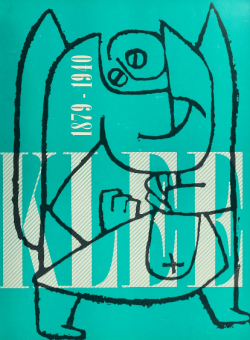 Free Art Books from The Guggenheim and The Met: Way back in January, the Guggenheim made 65 art catalogues available online, all free of charge. The catalogues offer an intellectual and visual introduction to the work of Calder, Munch, Bacon, and Kandinsky, among others. Then, months later, The Met followed suit and launched MetPublications, a portal that now makes available 370 out-of-print art titles, including works on Vermeer, da Vinci, Degas and more.
The Best Animated Films of All Time, According to Terry Gilliam: Terry Gilliam knows something about animation. For years, he produced wonderful animations for Monty Python (watch his cutout animation primer here), creating the opening credits and distinctive buffers that linked together the offbeat comedy sketches. Given these bona fides, you don’t want to miss Gilliam’s list, The 10 Best Animated Films of All Time.
The Higgs Boson, AKA the God Particle, Explained with Animation: Hands down, it was the biggest scientific discovery of the year. But what is the Higgs Boson exactly? Are you still not sure? Phd Comics explains the concept with animation.
Here Comes The Sun: The Lost Guitar Solo by George Harrison: Here’s another great discovery — the long lost guitar solo by George Harrison from my favorite Beatles’ song, “Here Comes the Sun.” In this clip, George Martin (Beatles’ producer) and Dhani Harrison (the guitarist’s son) bring the forgotten solo back to life. When you’re done taking this sentimental journey, also see another favorite of mine: guitarist Randy Bachman demystifying the opening chord of ‘A Hard Day’s Night’.
18 Animations of Classic Literary Works: From Plato and Shakespeare, to Kafka, Hemingway and Calvino: Over the years we have featured literary works that have been wonderfully re-imagined by animators. Rather than leaving these wondrous works buried in the archives, we brought them back and put them all on display. And what better place to start than with a foundational text — Plato’s Republic.
Ray Bradbury Offers 12 Essential Writing Tips and Explains Why Literature Saves Civilization: In June, we lost Ray Bradbury, who now joins Isaac Asimov, Arthur C. Clarke, Robert A. Heinlein, and Philip K. Dick in the pantheon of science fiction. In this post, we revisit two moments when Bradbury offered his personal thoughts on the art and purpose of writing — something he contemplated during the 74 years that separated his first story from the last.
Free Science Fiction Classics on the Web: Speaking of science fiction, we brought you a roundup of some of the great Science Fiction, Fantasy and Dystopian classics available on the web in audio, video and text formats. They include Orwell’s 1984, Huxley’s Brave New World, Asimov’s Foundation Trilogy, C.S. Lewis’ Chronicles of Narnia, many stories by Philip K. Dick and Neil Gaiman, and much more. Find more great works in our collections of Free Audio Books and Free eBooks.
This is Your Brain in Love: Scenes from the Stanford Love Competition: Can one person experience love more deeply than another? That’s what Stanford researchers and filmmaker Brent Hoff set out to understand when they hosted the 1st Annual Love Competition. Seven contestants, ranging from 10 to 75 years of age, took part. And they each spent five minutes in an fMRI machine. It’s to hard watch this short film and not shed a happy tear.
Rare 1959 Audio: Flannery O’Connor Reads ‘A Good Man is Hard to Find’: In April of 1959–five years before her death at the age of 39 from lupus–Flannery O’Connor ventured away from her secluded family farm in Milledgeville, Georgia, to give a reading at Vanderbilt University. She read one of her most famous and unsettling stories, “A Good Man is Hard to Find.” The audio is one of two known recordings of the author reading that story.
33 Free Oscar Winning Films Available on the Web: On the eve of the 2012 Academy Awards, we scouted around the web and found 33 Oscar-winning (or nominated) films from previous years. The list includes many short films, but also some long ones, like Sergei Bondarchuk’s epic version of War & Peace. Sit back, enjoy, and don’t forget our collection of 500 Free Movies Online, where you’ll find many great noir films, westerns, classics, documentaries and more.
The Story Of Menstruation: Walt Disney’s Sex Ed Film from 1946: Staying with movies for a second, we also showed you a very different mid-1940s Disney production – The Story of Menstruation. Made in the 1940s, an estimated 105 million students watched the film in sex ed classes across the US.
30 Free Essays & Stories by David Foster Wallace on the Web: We spent some time tracking down 23 free stories and essays published by David Foster Wallace between 1989 and 2011, mostly in major U.S. publications like The New Yorker, Harper’s, The Atlantic, and The Paris Review. Enjoy, and don’t miss our other collections of free writings by Philip K. Dick and Neil Gaiman.
Everything I Know: 42 Hours of Buckminster Fuller’s Visionary Lectures Free Online (1975): In January 1975, Buckminster Fuller sat down to deliver the twelve lectures that make up Everything I Know, all captured on video and enhanced with the most exciting bluescreen technology of the day. The lecture series is now online and free to enjoy, so please do so.
10 Great Performances From 10 Legendary Jazz Artists: Django, Miles, Monk, Coltrane & More: It’s pretty much what the title says. Great performances by some of our greatest jazz artists. It starts with Billie Holiday singing “Strange Fruit.”
Sigmund Freud Speaks: The Only Known Recording of His Voice, 1938: On December 7, 1938, a British radio crew visited Sigmund Freud at his newhome at Hampstead, North London. He was 81 years old and suffering from incurable jaw cancer. Every word was an agony to speak. The recording is the only known audio recording of Freud, the founder of psychoanalysis and one of the towering intellectual figures of the 20th century. Also see: Sigmund Freud’s Home Movies: A Rare Glimpse of His Private Life.
Serial Entrepreneur Damon Horowitz Says “Quit Your Tech Job and Get a Ph.D. in the Humanities”: Philosophy professor and “serial entrepreneur” Damon Horowitz explains why he left a highly-paid tech career, in which he sought the keys to artificial intelligence, to pursue a Ph.D. in Philosophy at Stanford. Readers will also enjoy The Illustrated Guide to a Ph.D.
Leonard Bernstein’s Masterful Lectures on Music (11+ Hours of Video Recorded in 1973): Delivered at Harvard in ’73, Leonard Bernstein’s lecture series, “The Unanswered Question,” covered a lot of terrain, touching on poetry, linguistics, philosophy and physics. But the focus inevitably comes back to music — to how music works, or to the underlying grammar of music. The masterful lectures run over 11 hours. They’re added to our collection of 650 Free Online Courses. You can also find Borges’ lectures at Harvard here.
Kurt Vonnegut’s Eight Tips on How to Write a Good Short Story: When it came to giving advice to writers, Kurt Vonnegut was never dull. He once tried to warn people away from using semicolons by characterizing them as “transvestite hermaphrodites representing absolutely nothing.” In this brief video, Vonnegut offers eight tips on how to write a short story.
Free Online Certificate Courses & MOOCs from Great Universities: A Complete List: We gathered a list of 200 free massive open online courses (MOOCs) offered by leading universities. Most of these free courses offer “certificates” or “statements of completion.” Many new courses start in January 2013. So be sure to check it out. Also don’t miss our other new resource collection: 200 Free Kids Educational Resources: Video Lessons, Apps, Books, Websites & Beyond.
Read More...David Bowie’s First American Fan Letter And His Evolving Views of the U.S. (1967–1997)
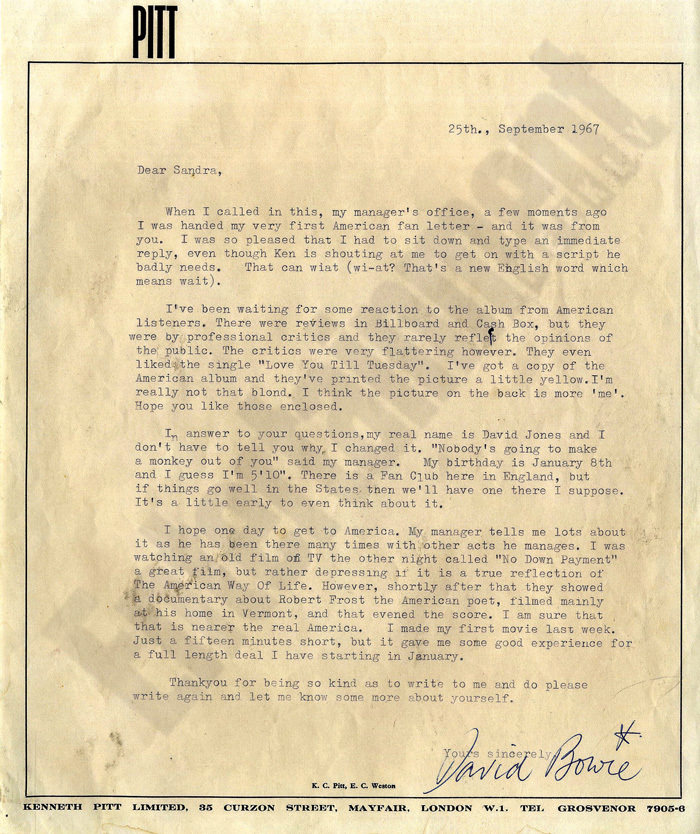
David Bowie’s relationship with America has typified the outsider’s view: an ambivalence ranging from fascination to fear that he expressed in a reply to his first letter from a U.S. fan in 1967 (click to read in large format). The fan, intrepid 14-year-old Sandra Dodd, had gotten her hands on an advance copy of Bowie’s first album and written him to praise his work and offer to start a fan club for him stateside. Bowie’s response is very interesting. We’ve written before about his rise from obscure R&B and folk singer to Ziggy Stardust, which required him to shake off a natural shyness to inhabit his breakout persona. In the letter, the 20-year-old Bowie initially comes off as a naïve, slightly self-involved young pop singer. Then, after answering the usual fan queries—what’s his real name, birthday, height—he turns to the subject of the U.S., a country he had yet to visit. Bowie writes:
I hope one day to get to America. My manager tells me lots about it as he has been there many times with other acts he manages. I was watching an old film on TV the other night called “No Down Payment” a great film, but rather depressing if it is a true reflection of The American Way Of Life. However, shortly after that they showed a documentary about Robert Frost the American poet, filmed mainly at his home in Vermont, and that evened the score. I am sure that that is nearer the real America.
Drawing his impressions from movies, Bowie references two views. The first, Martin Ritt’s 1957 No Down Payment, is full of the banality and melodrama we’ve come to expect from Mad Men, making incisive critiques of mid-50s cultural problems simmering under the surface of the suburbs like alcoholism, racism, and infidelity. As one fan writes, the film depicted what “no one wanted to see… a soiled American Dream,” or what Bowie capitalizes as “The American Way Of Life.”
The other view Bowie takes of the States comes from a film on Robert Frost—most likely 1963’s Robert Frost: A Lover’s Quarrel With the World. Little wonder this film “evened the score” for the lyrical young songwriter, who chooses in his letter to believe it represents the “real America,” a sentiment he would not hold for long.
Flash forward to 1984, and Bowie is an international pop star. Most fans would argue his best work was far behind him, but the 80s saw him break out into more mainstream film roles in The Elephant Man and Labyrinth that kept him at the forefront of American pop culture. His soundtrack work was memorable as well, although the track below “This is Not America,” written with Pat Metheny for The Falcon and the Snowman doesn’t get much attention these days. Bowie’s impressionistic lyrics–which Metheny called “profound and meaningful”–show him in mourning for the country that puzzled his younger self:
A little piece of you
The little peace in me
Will die
For this is not America
Blossom fails to bloom
This season
Promise not to stare
Too long
For this is not a miracle
And again, move forward to 1997, thirty years after Bowie’s letter above, and we find him in a jaundiced mood in “I’m Afraid of Americans” from his album Earthling (the song originally appeared on what may be one of the most cynical films ever made, Showgirls). Bowie explained the genesis of the song in a press release:
I’m Afraid of Americans’ was written by myself and Eno. It’s not as truly hostile about Americans as say “Born in the USA”: it’s merely sardonic. I was traveling in Java when the first McDonalds went up: it was like, “for fuck’s sake.” The invasion by any homogenized culture is so depressing, the erection of another Disney World in, say, Umbria, Italy, more so. It strangles the indigenous culture and narrows expression of life.
The cultural homogenization that so depressed the young Bowie in No Down Payment is now a global phenomenon, and the well-traveled, worldly Bowie seems to harbor few illusions when he sings:
Johnny’s in America
No tricks at the wheel
No one needs anyone
They don’t even just pretend
In the award-winning video, Trent Reznor plays a Travis Bickle-like figure, a menacing creature of alienation and unprovoked, random violence and Bowie a paranoid outsider running from what he perceives as citizens attacking each other on every streetcorner. Stripped of the 50s veneer, it’s a country where people “don’t even pretend”; the violence and misanthropy are now on full display. It’s a view of America that hasn’t dimmed since the mid-nineties. It’s simply moved out of the city and spilled out into the once self-contained suburbs. These three artifacts show Bowie’s evolution in relation to a country that he hoped to find the best in, that nearly always embraced him, and that came to freak him out and piss him off in later years.
via Letters of Note
Josh Jones is a writer and scholar currently completing a dissertation on landscape, literature, and labor.
Read More...Jean-Paul Sartre Writes a Script for John Huston’s Film on Freud (1958)
In 1958, legendary director John Huston decided to make a film about the life of Sigmund Freud. Having met Jean-Paul Sarte in 1952 during the filming of Moulin Rouge, Huston felt the philosopher would be the ideal person to script the Freud film, since Sartre knew Freud’s work so well and since Huston surmised that he would have “an objective and logical approach.” Despite Sartre’s obvious talents, this still seems like an odd choice on its face, given the specific demands of screenwriting versus philosophical or literary work. But Sartre had some experience writing for the screen by that time—like most literary screenwriters, he’d mostly done it for the money and disavowed most of this work in hindsight–and he loved the movies and respected Huston. The director and the existentialist philosopher also had very similar views of their biographical subject:
Ironically both Sartre and Huston considered themselves anti-Freud for largely the same reason: Sartre because as a Communist he believed the role of the psychoanalyst was limited and of little social importance. For his part Huston felt that psychoanalysis was an indulgence for bored house wives and the problem children of the rich while the “movers and shakers”’ were too busy for it and those that most needed it couldn’t afford it.
Huston and Sartre’s treatment of Freud promised to be critical, but the partnership soon soured due to Sartre’s inability to keep his script at feature length. First, he delivered a modest 95-page treatment. This, however, became a 300-page draft in 1959 that Huston calculated would produce an unacceptable five-hour-long film (see an image from Sartre’s draft screenplay below, and click it to read it in a larger format).

When Huston and Sartre met in person in Galway to find a way to cut the screenplay down to a reasonable length, their working relationship was less than cordial. In Huston’s recollection, Sartre never stopped talking long enough for anyone else to get a word in. The director also remembered that Sartre was “as ugly as a human being can be.” Sartre’s remembrance is hardly more flattering of Huston, if somewhat more comic; he described the director in a letter to his wife Simone de Beauvoir as a pretentious, thoughtless character.…
…in moments of childish vanity, when he puts on a red dinner jacket or rides a horse (not very well) or counts his paintings or tells workmen what to do. Impossible to hold his attention five minutes: he can no longer work, he runs away from thinking.
After their Galway meeting, during which Huston tried and failed to hypnotize Sartre, the philosopher attempted another revision, but this time, he sent Huston an even longer draft, for an eight-hour film. At this point, Huston gave up on Sartre and salvaged what he could, eventually enlisting the help of German screenwriter Wolfgang Reinhardt to finish the script. Huston finally made his Freud film, released in 1962 as Freud: The Secret Passion, with Montgomery Clift as the doctor (see the trailer for the film above).
Unsurprisingly, Sartre had his name removed from the final film. For a fuller account of the meeting of Huston and Sartre, see the second chapter of Elizabeth Roudinesco’s Philosophy in Turbulent Times, where you’ll find other fascinating details like Sartre’s desire to cast Marilyn Monroe as Anna O and Huston’s bemusement at Sartre’s dental hygiene.
Josh Jones is a doctoral candidate in English at Fordham University and a co-founder and former managing editor of Guernica / A Magazine of Arts and Politics.
Read More...
Annie Leibovitz, Photographer of Icons and Iconic Photographer, Profiled on American Masters
One must take care, when writing about well-connected cultural figures, not to abuse the word iconic. But when one writes about the photographer Annie Leibovitz, one almost has to abuse it. Here we have a woman who took two of the most memorable photos of John Lennon, collaborated (to the extent possible) with Hunter S. Thompson, went on tour with the Rolling Stones, followed Richard Nixon out of the White House the last time he left it, convinced Whoopi Goldberg to get into a bathtub of milk, and loved Susan Sontag. This whole post couldn’t possibly contain a complete list of her professional and personal involvement with the, yes, icons of twentieth-century popular culture. Her portraits of them became icons themselves, which, in turn, made Leibovitz herself iconic. For a visually rich sense of the scope of her life and career, look no further than the documentary above, Life Through a Lens.
This 2008 production comes from the PBS-distributed American Masters television series, which we featured on Tuesday. Directed by Leibovitz’s own sister and therefore possessed of the unusual familial insight you’d expect, Life Through a Lens also includes a great many of the hard-to-interview luminaries without which no profile of this photographer could be complete. We hear from Arnold Schwarzenegger, Jann Wenner, Hillary Clinton, Gloria Steinem, Patti Smith, Mick Jagger, Keith Richards, Bette Midler, Yoko Ono, and George Clooney, to name but a few of her admirers who’ve held their own at the business end of her camera. In the four years since this documentary, Leibovitz’s photographs — now of 21st-century celebrities like Miley Cyrus, Sasha Baron Cohen, Lady Gaga, Rihanna, and LeBron James — have continued to impress in the pages of Vogue and Vanity Fair. Whenever someone rises toward iconic status, Annie Leibovitz’s visual imagination can’t be far behind.
Related content:
Watch PBS’ American Masters Documentaries (Including Scorsese’s Homage to Kazan) Free Online
Alfred Stieglitz: The Eloquent Eye, a Revealing Look at “The Father of Modern Photography”
1972 Diane Arbus Documentary Interviews Those Who Knew the American Photographer Best
Henri Cartier-Bresson and the Decisive Moment
Colin Marshall hosts and produces Notebook on Cities and Culture. Follow him on Twitter at @colinmarshall.
Read More...
Watch as Alberto Giacometti Paints and Pursues the Elusive “Apparition” (1965)
The Swiss artist Alberto Giacometti is most often remembered for his famously thin, elongated sculptures of the human form. But Giacometti was a similarly brilliant and original draughtsman who maintained that drawing was the central skill of an artist. “One must stick exclusively to drawing,” he once said. “If one dominates drawing even a little bit then everything else becomes possible.”
Giacometti the draughtsman had a distinctive way of reworking a line, of going over it again and again as if he were sculpting in plaster. “When I make my drawings,” Giacometti said, “the path traced by my pencil on the sheet of paper is, to some extent, analogous to the gesture of a man groping his way in the darkness.” The resulting tangle of lines give his drawings a special vibrancy, a sense of motion and depth on the two-dimensional plane.
In this excerpt from the 1966 film Alberto Giacometti by the Swiss photographer Ernst Scheidegger, we watch as Giacometti paints the foundational lines of a portrait at his studio in Montparnasse. The footage was probably shot in 1965, the last year of Giacometti’s life. The artist reportedly saw the film not long before his death on January 11, 1966. Watching the film, we get a sense of Giacometti’s care for geometry as he draws organizational lines to work out the proportions. Giacometti would often leave these intersecting vertical, horizontal and diagonal lines–which would emerge organically as he went along–in his finished works.
In the German narration, the speaker describes Giacometti’s almost mystical sense of the process: A face appears on the canvas which is his own face but also that of another, distant person who will appear out of the depth if only you reach out for him. But as you do reach out the person recedes, remaining just beyond your grasp. “The apparition,” Giacometti once said: “Sometimes I think I can trap it, but then I lose it again and must begin once more.”
Special thanks to Matthias Rascher for his linguistic help.
Related Content:
Vintage Footage of Picasso and Jackson Pollock Painting … Through Glass
Wassily Kandinsky Caught in the Act of Creation, 1926
Read More...Khan Academy Releases New App for iPhone & iPod Touch, Giving You Mobile Access to 3600 Videos
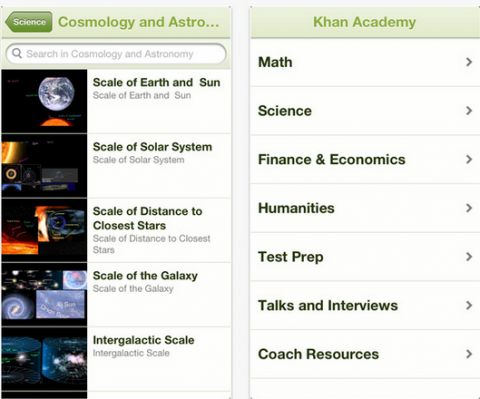 Non-profit Khan Academy, an organization dedicated to “providing a free world-class education for anyone anywhere,” does so primarily through online video courses and lectures. The over 3600 videos are free and access is open to anyone (anywhere), allowing K‑12 students to study math, science, computer science, finance & economics, humanities, and test prep. The organization was founded in 2006 by MIT and Harvard grad Salman Khan, who began by tutoring relatives and friends in Bangladesh while he worked as a hedge fund analyst in the States. His videos became so in-demand that he decided to quit his job and distribute them full-time, funded by donations from individuals and major donors like the Bill and Melinda Gates Foundation.
While there is a healthy amount of skepticism about the efficacy of Khan’s methods, there’s no shortage of demand for the kind of instruction he offers to students all over the world. To further meet that demand, Khan Academy has just released an app for iPhone and iPod Touch. Unlike the app released this past March for the iPad, the iPhone version does not allow interactivity. Users can view videos but cannot, as with the iPad app, download playlists, read subtitles, and log progress, making this version “more for consumption rather than full interaction.” Nevertheless, and whether critics like it or not, this represents a further step for distance learning, as education increasingly moves out of the classroom and into the handheld devices of networks of students no longer restricted by geography or physical mobility.
The app has been added to our brand-spanking new collection: 200 Free K‑12 Educational Resources: Video Lessons, Web Sites, Apps & More
Via Makeuseof
Josh Jones is a doctoral candidate in English at Fordham University and a co-founder and former managing editor of Guernica / A Magazine of Arts and Politics.
Read More...After a Tour of Slavoj Žižek’s Pad, You’ll Never See Interior Design in the Same Way
How to react to celebrity academic Slavoj Žižek? You could see him as a wild-eyed visionary and grow infatuated with his powerful-sounding ideas about power, violence, cinema, psychoanalysis, and perversion. Or you could see him as a Pied Piper for delusional graduate students and grow enraged at his perpetuation of fashionable nonsense. But you’d do best, I would argue, to take him simply as a source of entertainment. How could you do otherwise, watching the above clip from Astra Taylor’s documentary Žižek! (previously featured on Open Culture here)? In these three minutes, the sweating Sublime Object of Ideology author gives us a tour of his pad, spending much time and excitement on his kitchen repurposed as a closet: clothes and sheets in the cupboards, socks in the drawers. “I am a narcissist. I keep everything,” he pronounces, having moved onto the shelves and shelves of his own work, from the pamphlets of his “dissident days” to his latest books in Japanese translation.
But it’s his poster of Josef Stalin that really draws your attention — just as Žižek meant it to. If he didn’t, he wouldn’t have hung it in his entryway, making it the first sight every guest gets of his home. Here he describes it not as a proclamation of Stalinism, exactly, but as — in line with everything else he does — a provocation. “This is just for people who come to be shocked and hopefully to get out,” he explains. “My big worry is not to be ignored, but to be accepted. Of course, it’s not that I’m simply a Stalinist. That would be crazy, tasteless, and so on. But obviously there is something in it that it’s not simply a joke. When I say the only change is that the left appropriates fascism and so on, it’s not a cheap joke. The point is to avoid the trap of standard liberal oppositions: freedom versus totalitarian order, and so on, to rehabilitate notions of discipline, collective order, subordination, sacrifice, all that. I don’t think this is inherently fascist.”
via Biblioklept
Related content:
Žižek!: 2005 Documentary Reveals the “Academic Rock Star” and “Monster” of a Man
Examined Life Drops Academic Celebrities Into the Real World (2008)
Derrida: A 2002 Documentary on the Abstract Philosopher and the Everyday Man
Colin Marshall hosts and produces Notebook on Cities and Culture. Follow him on Twitter at @colinmarshall.
Read More...Bertrand Russell and F.C. Copleston Debate the Existence of God, 1948
On January 28, 1948 the British philosophers F.C. Copleston and Bertrand Russell squared off on BBC radio for a debate on the existence of God. Copleston was a Jesuit priest who believed in God. Russell maintained that while he was technically agnostic on the existence of the Judeo-Christian God–just as he was technically agnostic on the existence of the Greek gods Zeus and Poseidon–he was for all intents and purposes an atheist.
The famous debate is divided into two parts: metaphysical and moral. In the metaphysical part, which is presented here, Copleston espouses what is known as the cosmological argument for the existence of God. Elements of the cosmological argument go back at least as far as Plato and Aristotle, who held that the universe required a “prime mover” outside of itself. The version embraced by Copleston is derived from one of Thomas Aquinas’ five ways to prove the existence of God. In his Summa Theologica, Aquinas writes:
The third way is taken from possibility and necessity and runs thus. We find in nature things that are possible to be and not possible to be, since they are found to be generated and corrupted. But it is impossible for these always to exist, for that which can not-be at some time is not. Therefore, if everything can not-be, then at one time there was nothing in existence, because that which does not exist begins to exist only through something already existing. Therefore if at one time nothing was in existence, it would have been impossible for anything to have begun to exist; and thus now nothing would be in existence–which is absurd. Therefore, not all beings are merely possible, but there must exist something the existence of which is necessary. But every necessary thing has its necessity caused by another, or not. Now it is impossible to go on to infinity in necessary things which have their necessity caused by another, as has already been proved in regard to efficient causes. Therefore, we cannot but admit the existence of some being having of itself its own necessity, and not receiving it from another, but rather causing in others their necessity. This all men speak of as God.
Copleston adopts Gottfried Wilhelm Leibniz’s Principle of Sufficient Reason as a cornerstone of his argument. In his 1714 essay “The Principles of Nature and Grace, Based on Reason,” Leibniz asserts that nothing can exist without a sufficient reason, including the Universe. “This sufficient reason for the existence of the Universe cannot be found in the series of contingent things,” writes Leibniz. “The sufficient reason, therefore, which needs not further reason, must be outside of this series of contingent things and is found in a substance which…is a necessary being bearing the reason for its existence within itself; otherwise we should not yet have a sufficient reason with which to stop. This final reason for things is called God.”
Russell takes exception to Copleston’s use of Leibniz’s concept of a necessary being. The term “necessary,” he argues, can only be applied to analytic propositions–propositions which are derived logically and which would be self-contradictory to deny. An analytic proposition would fall under Leibniz’s category of “truths of reason,” or a priori truths. Yet Copleston admits his argument is based on a posteriori grounds, or what Leibniz called “truths of fact.” Russell first poked holes in Leibniz’s version of the cosmological argument nearly half a century before his debate with Copleston. In A Critical Exposition of the Philosophy of Leibniz, published in 1900, Russell says of the cosmological argument:
It has a formal vice, in that it starts from finite existence as its datum, and admitting this to be contingent, it proceeds to infer an existent which is not contingent. But as the premiss is contingent, the conclusion also must be contingent. This is only to be avoided by pointing out that the argument is analytic, that it proceeds from a complex proposition to one which is logically presupposed in it, and that necessary truths may be involved in those that are contingent. But such a procedure is not properly a proof of the presupposition. If a judgement A presupposes another B, then, no doubt, if A is true, B is true. But it is impossible that there should be valid grounds for admitting A, which are not also grounds for admitting B. In Euclid, for example, if you admit the propositions, you must admit the axioms; but it would be absurd to give this as a reason for admitting the axioms.
Perhaps the most memorable moment of the debate on the cosmological argument comes near the end, when Russell criticizes Copleston’s assertion that because everything contained within the Universe is contingent, the Universe as a whole must also be contingent. “I can illustrate what seems to me your fallacy,” says Russell. “Every man who exists has a mother, and it seems to me your argument is that therefore the human race must have a mother, but obviously the human race hasn’t a mother–that’s a different logical sphere.” For Russell it was enough to accept that the Universe simply exists. Or as David Hume points out in his Dialogues Concerning Natural Religion, if there must be a necessarily existent being, why can’t it be the Universe as a whole?
The audio version of the debate above is abridged. To read a transcript of the entire debate, click here to open the text in a new window.
Related content:
Face to Face with Bertrand Russell: ‘Love is Wise, Hatred is Foolish’
Three Passions of Bertrand Russell (and a Collection of Free Texts)
Read More...Support Us
We're hoping to rely on loyal readers, rather than erratic ads. Please click the Donate button and support Open Culture. You can use Paypal, Venmo, Patreon, even Crypto! We thank you!

About Us

Open Culture scours the web for the best educational media. We find the free courses and audio books you need, the language lessons & educational videos you want, and plenty of enlightenment in between.
Advertise With Us
FREE UPDATES!
GET OUR DAILY EMAIL
Get the best cultural and educational resources on the web curated for you in a daily email. We never spam. Unsubscribe at any time.
FOLLOW ON SOCIAL MEDIA
Open Culture editor Dan Colman scours the web for the best educational media. He finds the free courses and audio books you need, the language lessons & movies you want, and plenty of enlightenment in between.
Advertise With Us