Venice is Way Under Water…
Venice is made up of 124 islands, 183 canals and 438 bridges, with water constantly flowing in and around it. As the video below explains, the city has historically developed an elaborate way of defending itself against the seas. But occasionally mother nature wins out, and floods take their toll on the city. This year it’s particularly bad. Heavy rains and strong winds have left Venice 70% submerged, with water levels reaching 60 inches. It marks the sixth worst flood recorded in the past 150 years. You can find footage above, and a pretty remarkable photo gallery over at The Atlantic. And then another compelling set at Boston.com.
via @eugenephoto
Read More...Massive Open Online Courses (MOOCs) Go International
 A few quick notes from the MOOC front.…
The first major providers of Massive Open Online Courses (MOOCs) got their start in Silicon Valley, Cambridge, Massachusetts and Canada. Now we’re seeing them sprout up outside of the United States. Take for example OpenLearning.com, a venture born out of the University of New South Wales (UNSW) in Sydney, Australia. Starting this week, you can begin taking two of their courses (Observing and Analysing Performance in Sport & Services Marketing – The Next Level). Or you can check into a 12-week course that recently got underway: UNSW Computing 1.
Meanwhile, if you can exercise a little patience, you can eventually start taking classes with the University of Western Australia. By next March, the Perth-based university plans to offer two courses (one in sociology, the other in oceanography) using an adapted version of Stanford’s open source platform, Class2Go. The courses will be delivered over mobile phones.
Finally, if you’re looking to learn a new language, why not try SpanishMooc? It’s billed as “the first open online Spanish course for everyone.” And it’s seemingly run as an independent project not associated with an existing university. The 12-week course will start on January 21, 2013.
For a complete list of MOOCs, visit our collection of 130 Free Online Certificate Courses from Great Universities.
Read More...Filmmaker Errol Morris Gives Us “11 Excellent Reasons Not to Vote?”
All throughout this interminably long presidential election cycle, which has been going on since at least 2010, I’ve had a laser-like focus on political news. You might even call it a death grip. Because I’m a politics junkie. It’s a disease, I know, I recognize I need help, and I’ll get it—after November 6th. As a politics junkie, I am subject to a certain severe irritation: profound exasperation with those mythical beasts called “undecided voters,” who are even more galling than third party voters are to hyper-partisans. “What?” I shout at the radio, when one of these crypto-zoological creatures calls in. “You dreamers, you oblivious blockheaded dreamers!” I shout, and other things. Yes, in my mania, I’ve shouted these things at the radio, because how can people not have made up their minds months ago, been glued to internet news and opinion for hours, pored over miniscule policy details, destroyed their eyesight, collapsed their spine under the weight of civic duty? How, indeed. But perhaps (and every politics junkie fears this possibility), the undecided voters aren’t idiots—perhaps they’re thoughtful, kind, trusting, truly… dare I say it, independent….
Now with all of our weird vitriol directed at the “undecideds,” preternaturally myopic junkies lose sight of a bloc with the power to bend, break, or shatter the scales altogether—non-voters. In a nation that has expended trillions of dollars, thousands of lives, and quite a lot of international good will to give others the right to vote in Iraq, Libya, Afghanistan, we make a pretty poor showing at the polls every four years, with roughly half of us declining to exercise our fundamental right to vote for our leaders. Think about that: half. Fifty percent of Americans: when women only won the right in 1920 and after amending the Constitution. When African Americans fought for a hundred years and only fully won the right in 1965 with the Voting Rights Act. These are significant–if significantly belated—achievements, and, to be sure, they’re the reason so many people treasure their vote as a precious token of political autonomy. But non-voters are an invisible enigma: no one talks much about the appallingly low turnout in this country, except to mention it in passing. So documentary filmmaker Errol Morris (The Thin Blue Line, The Fog of War), provocateur and social critic, decided to discuss the issue with over 50 people under the age of 40. The result is the short film above, teasingly titled “11 Reasons Not to Vote?”
What Morris found confounds the faithful—the junkies scowling into their microfiche readers. Non-voters, and the undecided, can take a larger view; as Morris points out in his accompanying New York Times essay, non-voters not only comment on the fact that no major party candidate has discussed issues so many people care about—poverty, climate change, the drug war, the dysfunctional prison system—but non-voters realize that if no one’s talking, nothing will be done. Some of them may be cynical, but many more may justly say they’re realists. Perhaps it’s us, the voters, who are dreamers.
The 11 reasons Morris gives, with tongue lodged in cheek, are as follows (with my explanatory glosses in parentheses):
- You can’t depend on demigods (Hint: politicians aren’t demigods, even when they seem so)
- Like jazz, apathy is an American art form (slack, an appropriate response to political fundamentalism?)
- Florida (debacle, year 2000)
- The Electoral College (does anyone understand this thing?)
- Missed entrepreneurial opportunities (one vote, one price)
- Potential extradition (absentee ballot if under rendition?)
- Awkward family dinners (voting out of spite for family members)
- Traffic (accidents on the way to polls canceled out by dating opportunities at the polls)
- Forced analogies (warning: involves football)
- Overzealous advocates (carrots and sticks)
- Masculinity is underappreciated (The Man: stick it to him)
I come away from Morris’s exercise subdued, not cured, but perhaps ready to wean myself away enough to look at why we make elections matter so much, when they seem to do so little for so many. That said, however, I’m still going to vote. The comment that struck me more than any other was this: “If you don’t vote, you cancel your own vote.” Morris replies, “that’d be stupid.” And it would be, I think, damn it all.
Josh Jones is a doctoral candidate in English at Fordham University and a co-founder and former managing editor of Guernica / A Magazine of Arts and Politics.
Read More...Neil Young Reveals the New Killer Gadget That Will Save Music
In the opening minutes of his new memoir Waging Heavy Peace (I listened to the audio book, and you can too for free), Neil Young talks about his model trains, his extensive collection of vintage cars, and not much about music per se — although he does highlight his entrepreneurial effort to save the music industry with a new-fangled audio system called PureTone.
For quite some time now, Young has lamented the decline of music during the digital age. It’s not pirating that’s the culprit. It’s the MP3, a format that degrades the quality of the music we hear. Speaking at a Wall Street Journal conference earlier this year (watch here), Young complained that the MP3 can’t “transfer the depth of the art.” “My goal,” he continued, “is to try and rescue the art form that I’ve been practicing for the past 50 years.”
Enter PureTone, which has actually been renamed Pono more recently. The device/music service will hit the market next year, and it essentially promises to let fans hear recordings in super high fidelity, as if they owned the original master tapes created by various artists. Not long ago, Flea, the bassist of the Red Hot Chili Peppers, raved about the sound of Pono, telling Rolling Stone: “It’s not like some vague thing that you need dogs’ ears to hear. It’s a drastic difference.”
If that’s right, Young may do a great service for musicians everywhere, and make a lot of money for himself and others along the way. I mean imagine the number of remasters that could hit the market in the comings years, starting with two by Bob Dylan — The Freewheelin’ Bob Dylan and Highway 61 Revisited. A perfect place to begin.
Related Content:
Neil Young on the Travesty of MP3s
Read More...World Shakespeare Festival Presents 37 Plays by the Bard in 37 Languages: Watch Them Online
I’ve seen Shakespeare performed all over the country, from Central Park to Golden Gate Park, and in every kind of adaptation imaginable. By far, the most memorable performance for me was a Noh staging of Othello, in Japanese, with masks and haunting chorus. I didn’t understand a word of it, but I spent the entire performance riveted by the culture shock of watching a play I knew so well transformed by a cultural vocabulary I didn’t. While I’ve sometimes bristled at best-selling literary critic Harold Bloom’s seemingly banal claims about Shakespeare’s “universal genius,” I cannot deny that the Bard’s work seems to translate across time and space without a loss of its incredible power and pathos.
Shakespeare-lovers in London this past spring were treated to a similar experience as mine, magnified by 37. As part of the massive World Shakespeare Festival, the Globe to Globe project presented an unprecedented opportunity for theatergoers to see all 37 of Shakespeare’s plays performed in 37 different languages at the bard’s own theater, the Globe. The plays (watch them here) were staged by some of the world’s top theater directors, with over six-hundred actors from “all nations” and attended by “audiences from every corner of our polyglot community.” In a time when various parts of Europe struggle to come to terms with increasingly multicultural demographics, this festival was an opportunity for a global theater fellowship of actors and audiences to come together in mutual appreciation and camaraderie.
The video above gives us a glimpse of several ceremonial, behind-the-scenes moments; before each performance, a member of the company sprinkled alcohol around the stage as an offering to the god of theater and wine, Dionysus. In a rapid montage, we see a dozen different actors from various plays sprint, skip, dance, and slide across the front of the stage, joyfully pouring libations. Afterward, another actor releases two balloons, one labeled The Globe, the other with the company’s name. The productions, all available to view online, are impressive not only for their linguistic range, but also for the range of costuming and stagecraft on display. Watch, for example, Troilus and Cressida in Maori, with a fierce band of Maori warriors stomping across the stage. Or see The Merry Wives of Windsor in Swahili by Nairobi’s Bitter Pill Company. To my delight, the Japanese production of Corolianus by the Chiten company features actors in Noh masks. As an added bonus, the Globe to Globe site has audio of actors from the various companies discussing their experiences of the festival in both their native languages and in English.
Related Content:
Shakespeare’s Satirical Sonnet 130, As Read By Stephen Fry
Impressionist Does Shakespeare in 25 Celebrity Voices
Josh Jones is a doctoral candidate in English at Fordham University and a co-founder and former managing editor of Guernica / A Magazine of Arts and Politics.
Read More...
Election 2012: Your Free Ticket to a Popular Stanford Course
Last Tuesday night, Stanford University kicked off a big course on the 2012 Election. 600 students packed into a crowded auditorium, filling every seat, waiting for the course to begin. Led by David Kennedy (Pulitzer Prize-winning historian), Rob Reich (Political Science, Stanford), and James Steyer (CEO, Common Sense Media), the course brings together “experts from Stanford’s faculty, along with distinguished participants in and analysts of American politics.” And, together, they’re examining major issues at stake in the election — foreign policy, the economy, the Supreme Court, campaign financing, campaign strategy, etc.
The first week featured conversations with two seasoned campaign strategists — Mark McKinnon and Chris Lehane — who put away their daggers and had an unusually civil conversation about the Obama-Romney contest, and the state of American politics more generally. Also joining the conversation was Gary Segura, a Stanford expert in polling, who offered up some firm predictions about the election.
Although the course is filled to capacity, you can attend the course virtually on iTunes and YouTube for free. (It will be added to our collection of 500 Free Courses Online.) A complete list of upcoming speakers can be found here.
Full disclosure: This course was partly organized by Stanford Continuing Studies where I happily spend my working days. If you live in the San Francisco Bay Area, you should check out our amazing program.
Read More...
Sean Connery Reads C.P. Cavafy’s Epic Poem “Ithaca,” Set to the Music of Vangelis
This video combines three things that make me happy: the voice of Sean Connery, the music of Vangelis (Blade Runner, Chariots of Fire), and the poetry of C.P. Cavafy. Put them all together and you get a blissful soundscape of rolling synth lines, rolling Scottish R’s, and a succession of Homeric images and anaphoric lines. And the video’s quite nice as well.
Cavafy, whose work, I’m told, is really untranslatable from the original Greek, always seems to come out pretty well to me in English. “Ithaca,” one of his most popular poems, expresses what in lesser hands might be a banal sentiment akin to “it’s the journey, not the destination.” But in Cavafy’s poem, the journey is both Odysseus’s and ours; it’s epic where our lives seem small, and it translates our minor wanderings to the realm of mythic history.
Anyway, it seems rude to say much more and drown the poem in commentary. So, follow along with Sean Connery and enjoy… happy Friday.
Find the text of the poem after the jump. (more…)
Read More...Philosopher Slavoj Zizek Interprets Hitchcock’s Vertigo in The Pervert’s Guide to Cinema (2006)
Philosopher and psychoanalyst Slavoj Zizek is a polarizing figure, in and out of the Academy. He has been accused of misogyny and opportunism, and a Guardian columnist once wondered if he is “the Borat of philosophy.” The latter epithet might be as much a reference to his occasional boorishness as to his Slovenian-accented English. Despite (or because of) these qualities, Zizek has become a fascinating public intellectual, in part because all of his work is shot through with pop culture references as diffuse as the most studied of fanboys. And even though Zizek, a student of the Freudian theorist Jacques Lacan, can get deeply obscure with the best of his peers, his enthusiasm and rapid-fire free-associations mark him as a true fan of everything he surveys.
The Zizek I just described is fully in evidence in the short clip above from the three-part documentary The Pervert’s Guide to Cinema. Directed by Sophie Fiennes (sister of Joseph and Ralph), The Pervert’s Guide places Zizek in original locations and replica sets of several classic films—David Lynch’s Blue Velvet, Stanley Kubrick’s Eyes Wide Shut, and Hitchcock’s Vertigo, to name just a few. Zizek’s scenes of commentary are edited with scenes from the films to give the impression that he is speaking from within the films themselves. It’s a novel approach and works particularly well in the video above, where Zizek gives us his take on Vertigo. As he says of Hitchcock’s film—which could apply to the one he is in as well—“often things begin as a fake, inauthentic, artificial, but you get caught in your own game.” Viewers of The Pervert’s Guide get caught in Zizek’s interpretive game; it’s a fascinating, ridiculous, and unsettling one.
In the clip, through a series of close analyses of plot points and camera angles, Zizek concludes that Vertigo is the realization of a male fantasy, which necessarily involves violence and nightmarish transformations. In the “male libidinal economy,” he says, in the jargon‑y psychoanalytic speak of his trade, women must be “mortified” before they are acceptable sexual partners. Slipping out of academic argot, he clarifies: “to paraphrase an old saying, the only good woman is a dead woman.” It’s this kind of blunt and utterly unsentimental way of speaking that raises the hackles of some of Zizek’s critics. But I’m not here to defend him. Watching (and reading) him for me is a game of edge-of-your seat “what outrageous or incomprehensible thing is he going to say next?” and I’ll admit, I enjoy it. So I’ll leave you with a final Zizek-ism. Perhaps it will scare you off for good, or perhaps you’re game for a few more rounds of “perversion” with this encyclopedic critic of the self, the social, and the sexual:
“A subject,” says Zizek, “is a partial something, a face, something we see. Behind it, there is a void, a nothingness. And of course, we spontaneously tend to fill in that nothingness with our fantasies about the wealth of human personality and so on, and so on. To see what is lacking in reality, to see it as that, there you see subjectivity. To confront subjectivity means to confront femininity. Woman is the subject. Masculinity is a fake.”
You can watch the film in its entirety here.
via Biblioklept
Related Content:
Žižek!: 2005 Documentary Reveals the “Academic Rock Star” and “Monster” of a Man
Good Capitalist Karma: Zizek Animated
Slavoj Žižek: How the Marx Brothers Embody Freud’s Id, Ego & Super-Ego
Josh Jones is a doctoral candidate in English at Fordham University and a co-founder and former managing editor of Guernica / A Magazine of Arts and Politics.
Read More...Fear of a Female Planet: Kim Gordon (Sonic Youth) on Why Russia and the US Need a Pussy Riot
Courageous feminist punk band Pussy Riot has received more public exposure than they ever could have hoped for since three members were arrested after a February 21st performance at Moscow’s Christ the Savior Cathedral and charged with “hooliganism.” The band formed last September in direct response to Vladimir Putin’s decision to seek the presidency again in March 2012, and they have demonstrated against his rule ever since, staging confrontational, but non-violent, protest performances in Red Square and other Russian landmarks. They draw much of their energy and inspiration from working-class British Oi! bands of the 80s, the American feminist punk of the 90s Riot Grrrl movement, and from the stalwart Sonic Youth, whose three decade run has put singer/bassist Kim Gordon in the spotlight as a musician, artist, and icon.
In the video interview above from Exploded View, Gordon offers her take on Pussy Riot’s significance and their relevance to the political struggles of women in the U.S.. Gordon reads Pussy Riot as “dissident art… targeted as a weapon” against a system, and its authoritarian leader, that has widely suppressed dissent. Like the notorious online collective Anonymous and their endlessly proliferating Guy Fawkes masks, Pussy Riot eschews the trappings of individual fame, wearing balaclavas to obscure their identities. As they state in a Vice Magazine interview before the arrests, “new members can join the bunch and it does not really matter who takes part in the next act—there can be three of us or eight, like in our last gig on the Red Square, or even 15. Pussy Riot is a pulsating and growing body.” The band keeps its focus on the body, as a growing collective or as a symbol of resistance to patriarchal control. One member explains the band’s name in the Vice interview:
A female sex organ, which is supposed to be receiving and shapeless, suddenly starts a radical rebellion against the cultural order, which tries to constantly define it and show its appropriate place. Sexists have certain ideas about how a woman should behave, and Putin, by the way, also has a couple thoughts on how Russians should live. Fighting against all that—that’s Pussy Riot.
The choice of name—which has forced dozens of newscasters to say the word “pussy” with a straight face—is, in all seriousness, a pointed reference to what Gordon calls a “fear of women,” which may explain what nearly everyone who has an opinion on the case characterizes as an extremely disproportionate sentence for the three convicted members. As Gordon says above, “Clearly Putin is afraid.” Relating the events in Russia to the backlash against women’s legislative gains in this country, Gordon says, “what’s going on in Washington is really indicative of that [fear],” and she wonders “why there aren’t more men who aren’t concerned about it or bringing it up. It’s beyond a women’s issue.” Nevertheless, she strongly implies that the U.S. is ripe for a “pussy riot”—a new punk-rock women’s movement—since “women make natural anarchists and revolutionaries because they’ve always been second-class citizens and had to claw their way up.”
Pussy Riot has cited Sonic Youth’s “Kool Thing” (above) as an influence, a taunting feminist retort to male come-ons that asks its target “are you gonna liberate us girls / From male white corporate oppression?” The unstated answer is, no, he isn’t. As Gordon implies above, and as Pussy Riot explain in an interview with The Guardian below, the only response to so-called “wars on women” everywhere may be a “feminist whip”:
Josh Jones is a doctoral candidate in English at Fordham University and a co-founder and former managing editor of Guernica / A Magazine of Arts and Politics.
Read More...
The Evolution of F. Scott Fitzgerald’s Signature: From 5 Years Old to 21
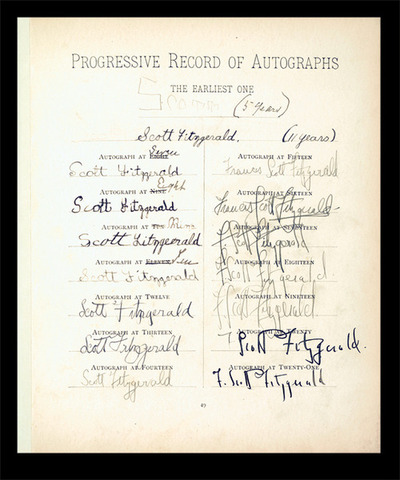
Take, for example, the evolution of Fitzgerald’s signature (above). From the labored scrawls of a five year-old, to the practiced script of an eleven-year-old schoolboy, to the experimental teenaged poses, we see the lettering get looser, more stylized, then tighten up again as it assumes its own mature identity in the confidently elegant near-calligraphy of the 21-year-old Fitzgerald–an evolution that traces the writer’s creative growth from uncertain but passionate youth to disciplined artist. Alright, maybe that’s all nonsense. I’m no expert. The practice of handwriting analysis, or graphology, is generally a forensic tool used to identify the marks of criminal suspects and detect forgeries, not a mindreading technique, although it does get used that way. One site, for example, provides an analysis of one of Fitzgerald’s 1924 letters to Carl Van Vechten. From the minute characteristics of the Gatsby novelist’s script, the analyst divines that he is “creative,” “artistic,” and appreciates the finer things in life. Color me a little skeptical.
But maybe there is something to my theory of Fitzgerald’s growing maturity and self-conscious certainty as evidenced by his signatures. He published This Side of Paradise to great acclaim three years after the final signature above. In the prior signatures, we see him struggling for control as he wrote and revised an earlier unpublished novel called The Romantic Egotist, which Fitzgerald himself told editor Perkins was “a tedious, disconnected casserole.” The outsized, extravagant lettering of the artist in his late teens is nothing if not “romantic.” But Fitzgerald achieved just enough control in his short life to write a veritable treasure chest of stories (many brilliant and some just plain silly) and a handful of novels, including, of course, the one for which he’s best known. Most of the rest of the time, as most everyone knows, he was kind of a mess.
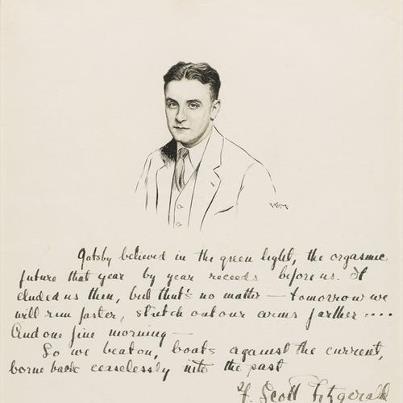
Try a little amateur handwriting analysis of your own on the last sentence of The Great Gatsby, written in Fitzgerald’s own hand below a portrait of the writer by artist Robert Kastor.
via I always wanted to be a Tenenbaum
Josh Jones is a doctoral candidate in English at Fordham University and a co-founder and former managing editor of Guernica / A Magazine of Arts and Politics.
Read More...Support Us
We're hoping to rely on loyal readers, rather than erratic ads. Please click the Donate button and support Open Culture. You can use Paypal, Venmo, Patreon, even Crypto! We thank you!

About Us

Open Culture scours the web for the best educational media. We find the free courses and audio books you need, the language lessons & educational videos you want, and plenty of enlightenment in between.
Advertise With Us
FREE UPDATES!
GET OUR DAILY EMAIL
Get the best cultural and educational resources on the web curated for you in a daily email. We never spam. Unsubscribe at any time.
FOLLOW ON SOCIAL MEDIA
Open Culture editor Dan Colman scours the web for the best educational media. He finds the free courses and audio books you need, the language lessons & movies you want, and plenty of enlightenment in between.
Advertise With Us

