Free Courses on the Coronavirus: What You Need to Know About the Emerging Pandemic

The coronavirus has spread out of China, into South Korea, Japan and now Italy. We’re settling into the reality that we’re likely facing a pandemic. It’s time to educate ourselves–to take some free courses on COVID-19.
In response to the outbreak, Imperial College London has put together a free course (offered through Coursera) called “Science Matters: Let’s Talk About COVID-19.” The course will teach you the “science underpinning the novel Coronavirus outbreak,” so that you can understand “how the spread of the epidemic is modeled, how transmissibility of infections is estimated, what the challenges are in estimating the case fatality ratio, and also … the importance of community involvement in responding to the epidemic.” You can get started with this course right now.
Alternatively you can sign up for COVID-19: Tackling the Novel Coronavirus. Created by FutureLearn and The London School of Hygiene and Tropical Medicine, this course looks at “how COVID-19 emerged, was identified and spreads, the public health measures for the virus worldwide, and what is needed to address COVID-19 and prevent it [from] spreading.” Although the course is now open for enrollment, it won’t officially start until March 22.
Both courses will be added to our collection, 1,700 Free Online Courses from Top Universities.
Note: The University of Hong Kong also offer a course on Epidemics.
If you would like to support the mission of Open Culture, consider making a donation to our site. It’s hard to rely 100% on ads, and your contributions will help us continue providing the best free cultural and educational materials to learners everywhere. You can contribute through PayPal, Patreon, and Venmo (@openculture). Thanks!
Related Content:
Read More...
New Digital Archive Will Bring Medieval Chants Back to Life: Project Amra Will Feature 300 Digitized Manuscripts and Many Audio Recordings
Among historians of European Christianity, it long seemed a settled question that Irish Catholicism, the so-called “Celtic Rite,” differed significantly in the middle ages from its Roman counterpart. This despite the fact that the phrase Celtic Rite “must not be taken to imply any necessary homogeneity,” notes the Catholic Encyclopedia, “for the evidence such as it is, is in favour of considerable diversity.” Far from an insular religion, Irish Catholicism spread to France, Germany, Switzerland, Italy, and Northern Spain through the missions of St. Columbanus and others, and both influenced and absorbed the Continent’s practices throughout the medieval period.
Historians have recently set out to “restore [the Irish Church] to its rightful place on the European historical map,” writes Trinity College Dublin’s Ann Buckley in her introduction to a book of scholarly essays called Music, Liturgy, and the Veneration of Saints of the Medieval Irish Church in a European Context.
To varying degrees, all of the scholars represented in this collection write to counter the essentializing “quest for what might be unique or ‘other’ about Ireland and Irish culture” among all other European national and religious histories.
Buckley’s writing on the veneration of Irish saints has made a significant contribution to this effort, and her decade and a half of archival work has helped create the Amra project, which aims “to digitize and make freely available online over 300 manuscripts containing liturgical material associated with some 40 Irish saints which are located in research libraries across Europe.” So write Medievalists.net, who also point out some of the most exciting aspects of this accessible resource:
The digital archive, when completed, will also incorporate recordings and performing editions of all the chants and prayers from the original manuscripts, as well as translations of the Latin texts into a number of European languages. In this way, contemporary audiences can enjoy first-hand the devotional songs associated with Irish saints, bringing them out of their slumber after more than half a millennium.
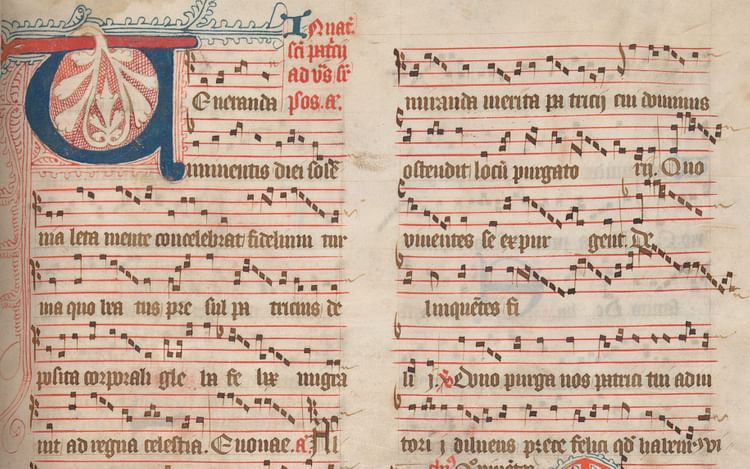
You can hear one antiphonal chant, “Magni patris/Mente mundi,” from the Office St. Patrick, just above. Perhaps unsurprisingly, “no other Irish saint is represented so extensively or with such variety in medieval liturgical sources,” writes Buckley. Manuscript hymns, prayers, and offices for Patrick have been found in Dublin, Oxford, Cambridge, the British Library, and “in the Vienna Schottenkloster dating from the time of its foundation by Irish Benedictine monks in the twelfth century.” (See the opening of the Office of St. Patrick, “Venerenda imminentis,” from a late-15th century manuscript, at the top.)
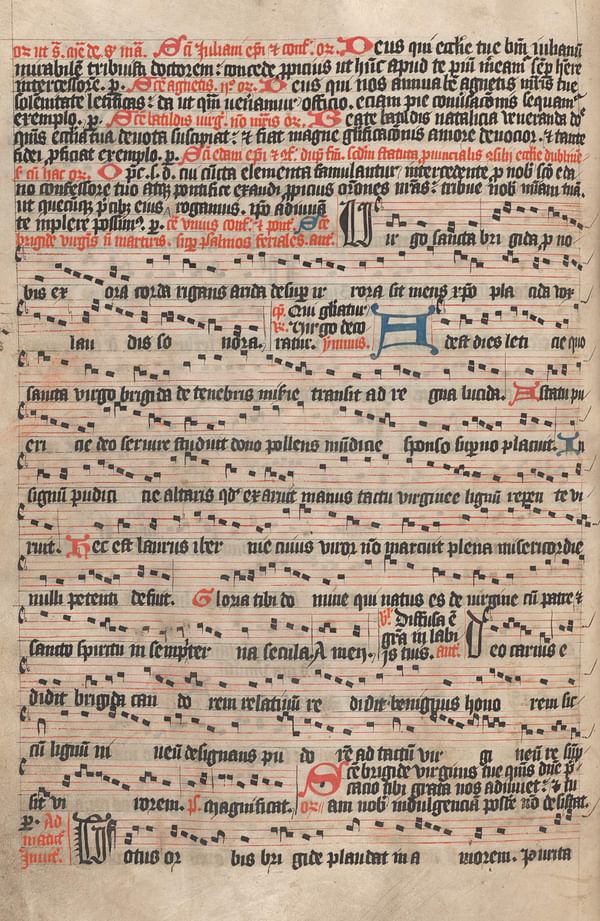
Other saints represented in the archival material include Brigit, Colmcille, Columbanus, Canice, Declan, Ciaran, Finian, and Laurence O’Toole. The missionary monks all received their own “offices,” liturgical ceremonies performed on their feast days. Many of the manuscripts, such as the opening of the Office of St. Brigit, above, contain musical notation, allowing musicologists like Buckley to recreate the sound of Irish Catholicism as it existed in Ireland, Britain, and Continental Europe several hundred years ago.
The project is developing a digital archive of such recordings, as well as “a fully searchable database,” Medievalists.net notes, with “interactive maps showing the geographical distribution of the cults of Irish saints across Europe, and of the libraries where the manuscripts are now housed. A series of documentary films is also envisaged.” You don’t have to be a specialist in the history of the Irish Church, or an Irish Catholic, for that matter, to get excited about the many ways such a rich resource will bring this medieval history to new life.
Related Content:
The Medieval Masterpiece, the Book of Kells, Is Now Digitized & Put Online
Josh Jones is a writer and musician based in Durham, NC. Follow him at @jdmagness
Read More...Watch More Than 400 Classic Korean Films Free Online Thanks to the Korean Film Archive
Even if you don’t know much about Korea, or indeed about film, it’s safe to say that you know at least one Korean film: Bong Joon-ho’s Parasite, which has circled the world gathering acclaim and awards since its release last spring. First it won the Palme d’Or at the Cannes Film Festival, becoming the first Korean production to do so; more recently, it made film history even more dramatically at the Academy Awards. There it won Oscars not just for Best International Feature Film, Best Original Screenplay, and Best Director, but also Best Picture, becoming the first non-English-language film to do so. For many viewers, Parasite and its director seem to have come out of nowhere, but lovers of Korean cinema know full well that they come out of a rich tradition — and a robust industry.
Maybe you thrilled to Bong’s suspenseful, funny, and violent tale of class warfare as much as the Academy did. Maybe you’ve even seen the work of Bong’s contemporaries: Park Chan-wook, he of the controversial hit Oldboy; the even more transgressive Kim Ki-duk; the prolific Hong Sangsoo, with his Woody Allen-meets-Éric Rohmer sensibility.
But do you know their sonsaengnim, the generations of Korean filmmakers who went before them? Now you can, no matter where in the world you are, on the Korean Film Archive’s Youtube channel. There, at no charge, you can experience decades of Korean cinema and hundreds of works of Korean cinematic art, including but not limited to those of mid-20th-century masters like Kim Ki-young, Im Kwon-taek, and my personal favorite Kim Soo-yong, director of haunting, even brazen pictures of the 1960s and 70s like Mist and Night Journey.
I actually met the then-octogenarian Kim Soo-yong a few years ago, when he called me over to his table out of curiosity about what a foreigner was doing at a screening of Mist. It happened at the Korean Film Archive’s cinematheque (known as Cinematheque KOFA) here in Seoul, where I’ve lived for the past few years. During that time I’ve also been writing a Korea Blog for the Los Angeles Review of Books, which occasionally features essays on the classic Korean films made available online by the Korean Film Archive. I began the series with Night Journey, and more recently have written up pictures like the 1960s neorealist cry of agony Aimless Bullet, the 1970s college-under-dictatorship comedy The March of Fools, the 1980s Westernization comedy Chil-su and Man-su, the 1990s food-sex-horror satirical mixture 301, 302, and others.
If you need more suggestions as to where to start with the KOFA’s more than 400 free films online, pay a visit to the Korean Movie Database (KMDb), where KOFA regularly post selections from their catalog. This month’s picks are “spy thriller films from the 1950s to 1970s infused with the anti-communist ideology during the time.” Previous months have rounded up “melodramas that are filled with women’s desire and craving for love,” films about “individual or family tragedies leading to historical tragedies,” and “heart-warming classical movies all the family members can enjoy together.” You can watch all these films either on the KMDb (which requires free registration) or on KOFA’s ever-growing Youtube channel. Either way, as we say here in Korea, 재미있게 보세요.
Related Content:
Martin Scorsese Introduces Filmmaker Hong Sangsoo, “The Woody Allen of Korea”
The Five Best North Korean Movies: Watch Them Free Online
Based in Seoul, Colin Marshall writes and broadcasts on cities, language, and culture. His projects include the book The Stateless City: a Walk through 21st-Century Los Angeles and the video series The City in Cinema. Follow him on Twitter at @colinmarshall or on Facebook.
Read More...America’s First Drag Queen Was Also America’s First LGBTQ Activist and a Former Slave
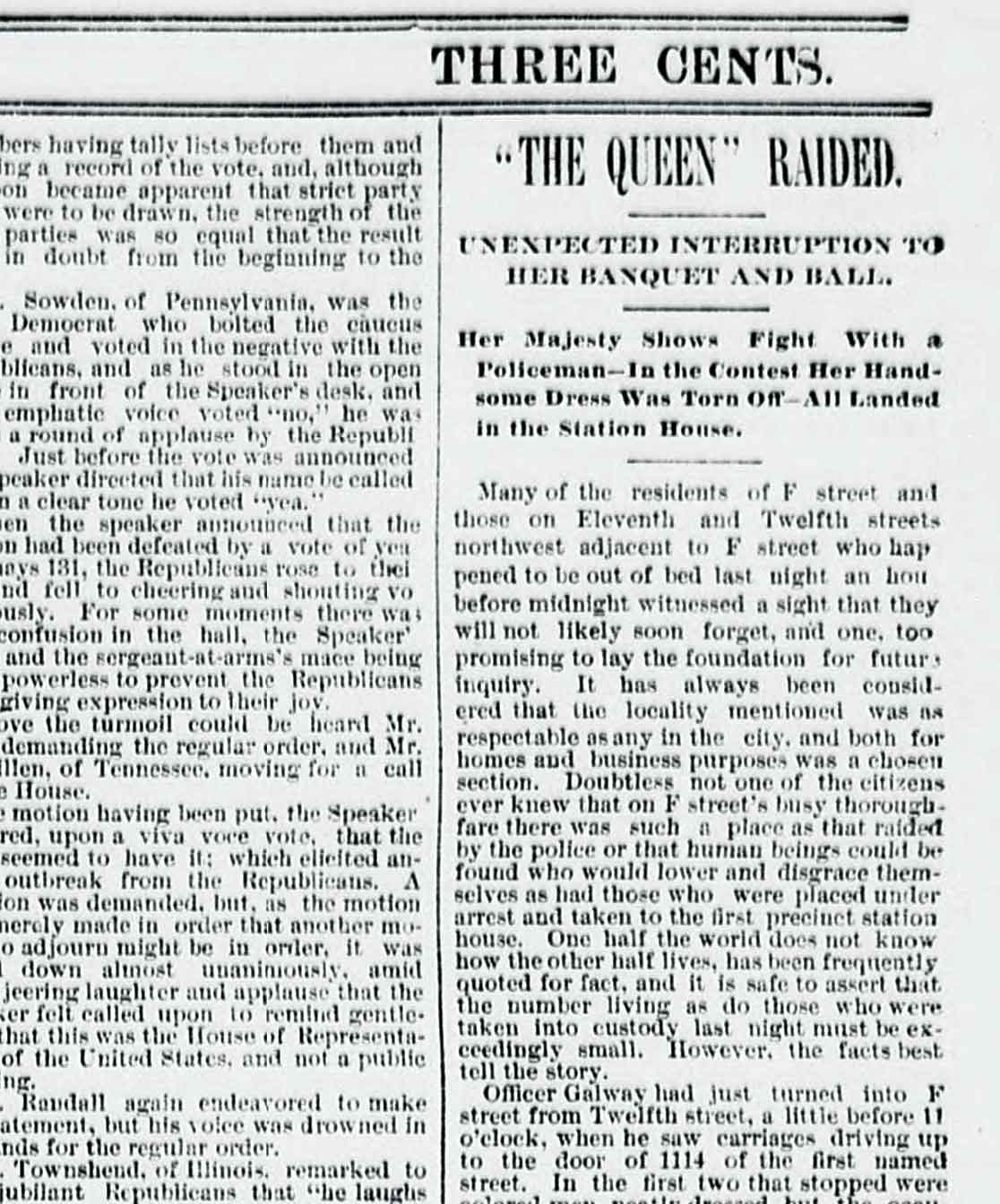
Negro Dive Raided. Thirteen Black Men Dressed as Women Surprised at Supper and Arrested. —The Washington Post, April 13, 1888
Sometimes, when we are engaged as either participant in, or eyewitness to, the making of history, its easy to forget the history-makers who came earlier, who dug the trenches that allow our modern battles to be waged out in the open.
Take America’s first self-appointed “queen of drag” and pioneering LGBTQ activist, William Dorsey Swann, born into slavery around 1858.
30 years later, Swann faced down white officers busting a drag ball in a “quiet-looking house” on Washington, DC’s F street, near 12th.
“You is no gentleman,” Swann allegedly told the arresting officer, while half the guests broke for freedom, correctly surmising that anyone who remained would see their names published in the next day’s newspaper as participants in a bizarre and unseemly ritual.
A lurid Washington Post clipping about the raid caught the eye of writer, historian, and former Oberlin College Drag Ball queen, Channing Gerard Joseph, who was researching an assignment for a Columbia University graduate level investigative reporting class:
An animated conversation, carried on in effeminate tones, was in progress as the officers approached the door, but when they opened it and the form of Lieut. Amiss was visible to the people in the room a panic ensued. A scramble was made for the windows and doors and some of the people jumped to the roofs of adjoining buildings. Others stripped off their dresses and danced about the room almost in a nude condition, while several, headed by a big negro named Dorsey, who was arrayed in a gorgeous dress of cream-colored satin, rushed towards the officers and tried to prevent their entering.
Joseph’s interest did not flag when his reporting class project was turned in. House of Swann: Where Slaves Became Queens will be published in 2021.
Meanwhile you can bone up on Swann, Swann’s jail time for running a brothel, and the Washington DC drag scene of the Swann era in Joseph’s essay for The Nation, “The First Drag Queen Was a Former Slave.”
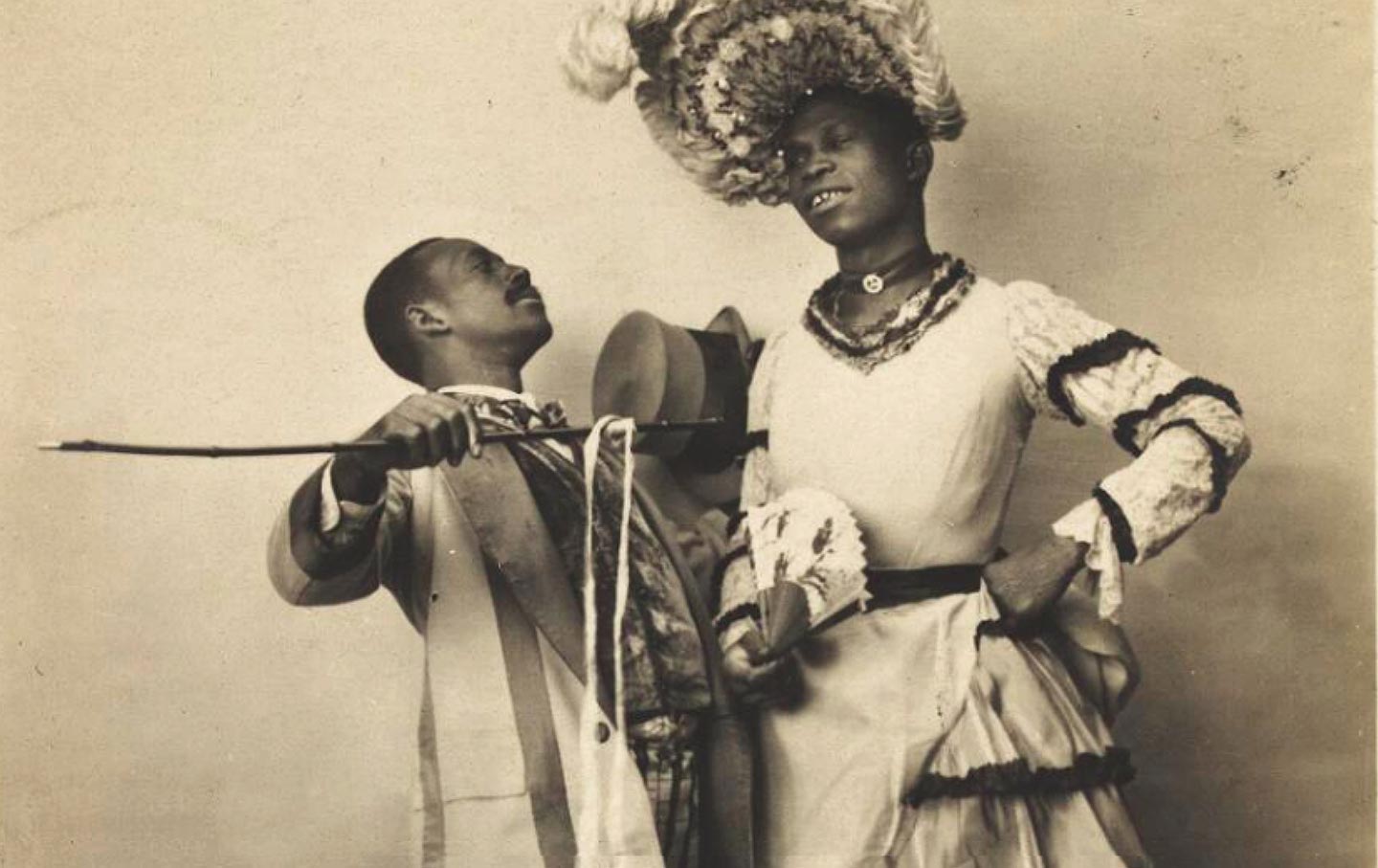
Please note that William Dorsey Swann does not appear in the photo at the top of the page. As per Joseph:
The dancers — one in striped pants, the other in a dress — were recorded in France by Louis Lumière. Though their names are lost, they are believed to be American. In the show, they performed a version of the cakewalk, a dance invented by enslaved people, and the precursor to vogueing.
Related Content:
Before Brokeback: The First Same-Sex Kiss in Cinema (1927)
When John Waters Appeared on The Simpsons and Changed America’s LGBTQ Views (1997)
Ayun Halliday is an author, illustrator, theater maker and Chief Primatologist of the East Village Inky zine. Join Ayun’s company Theater of the Apes in New York City this March for her book-based variety series, Necromancers of the Public Domain, and the world premiere of Greg Kotis’ new musical, I AM NOBODY. Follow her @AyunHalliday.
Read More...Chick Corea (RIP) Offers 16 Pieces of “Cheap But Good Advice for Playing Music in a Group” (1985)
Jazz instrumentalists who “play the changes” have learned to make improvisation look easy. In live performance, the audience shouldn’t see the years of study and practice behind what Willie Thomas calls at Jazz Everyone, “a system that combines the basic jazz language with the important music theory concepts” and at the same time “allows a player to focus on how the music fits the tune and not the chord symbols and scales that often incumber performance.”
That may seem like a wordy explanation, but Thomas is careful to explicate the cliché “play the changes” for maximum meaning, drawing on over forty years of experience himself learning the principle as a “useful tool for self expression through jazz music.” The idea of playing to the tune may seem fundamentally obvious, but the more one develops as a student, the farther away one can get from lived experience.
How might musicians apply ideals about ensemble playing to actual ensemble playing? For answers to this question, we might turn to jazz legend Chick Corea, member of Miles Davis’s band during the pathbreaking In a Silent Way and Bitches Brew sessions; player in and leader of more Grammy-winning ensembles than perhaps anyone else (he’s collected 23 awards so far); and “one of the jazz world’s most thoughtful and lucid champions.”
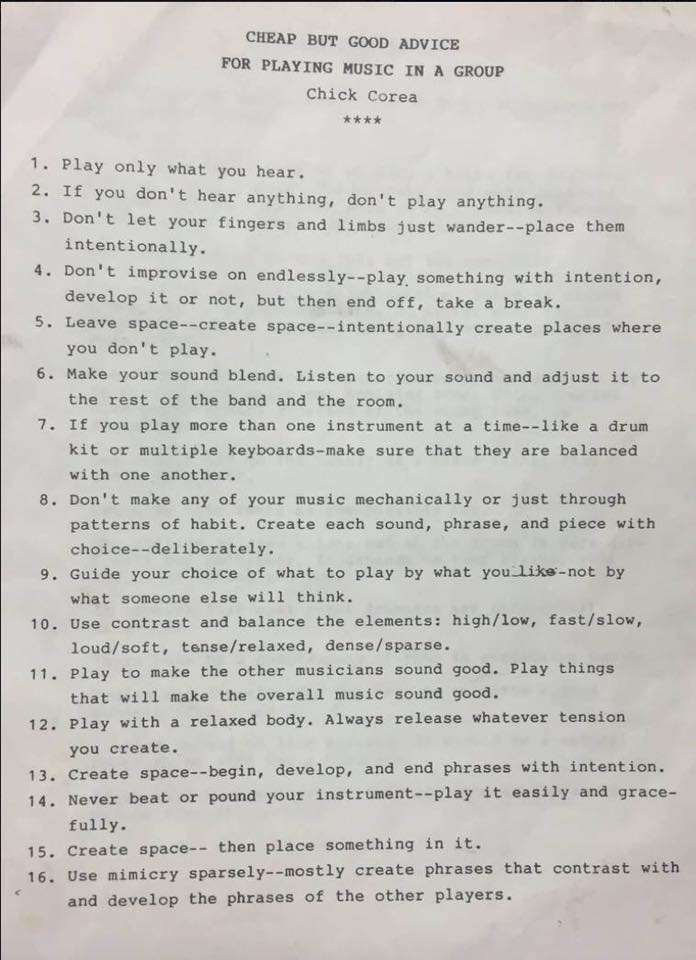
This description comes from a Christian Science Monitor write-up of Corea’s appearance in a two-hour Q&A session at Berklee College of Music in 1985, where the pianist and jazz fusion keyboard master had students pick up the typed handout above at the door. He begins with the simplest, but most important advice, “Play only what you hear,” then elaborates in 16 rules which you can read in full below.
Corea’s primary metaphor is architectural—performance, he says, is about creating spaces and tastefully filling them. Doing this well requires serious study and practice. Then it requires remembering some basic rules, or Chick Corea’s “Cheap But Good Advice for Playing Music in a Group.” My favorite: “always release whatever tension you create.” Like much of you we find here, it’s good all-around advice for every endeavor.
- Play only what you hear.
- If you don’t hear anything, don’t play anything.
- Don’t let your fingers and limbs just wander—place these intentionally.
- Don’t improvise on endlessly—play something with intention, develop it or not, but then end off, take a break.
- Leave space—create space—intentionally create places where you don’t play.
- Make your sound blend. Listen to your sound and adjust it to the rest of the band and the room.
- If you play more than one instrument at a time—like a drum kit or multiple keyboards—make sure that they are balanced with one another.
- Don’t make any of your music mechanically or just through patterns of habit. Create each sound, phrase, and piece with choice—deliberately.
- Guide your choice of what to play by what you like—not by what someone else will think.
- Use contrast and balance the elements: high/low, fast/slow, loud/soft, tense/relaxed, dense/sparse.
- Play to make the other musicians sound good. Play things that will make the overall music sound good.
- Play with a relaxed body. Always release whatever tension you create.
- Create space—begin, develop, and end phrases with intention.
- Never beat or pound your instrument—play it easily and gracefully.
- Create space—then place something in it.
- Use mimicry sparsely—mostly create phrases that contrast with and develop the phrases of the other players.
via Nate Chinen
Related Content:
Thelonious Monk’s 25 Tips for Musicians (1960)
John Coltrane Draws a Picture Illustrating the Mathematics of Music
Josh Jones is a writer and musician based in Durham, NC. Follow him at @jdmagness
Read More...Cooking with Wool: Watch Mouthwatering Tiny Woolen Food Animations
Our fascination with tiny food can be traced to the mouthwatering illustrations in Beatrix Potter’s The Tale of Two Bad Mice.
Just like the dollhouse-sized comestibles that so confounded the titular rodents, Tom Thumb and Huncamunca, animator Andrea Love’s miniature pasta with red sauce is as inedible as it is appetizing.
The self-taught stop motion specialist’s medium of choice is wool.
In an interview with Dragon Frame stop motion software’s company blog, when they featured Cooking with Wool: Breakfast, above, Love explained:
I like to make short personal projects experimenting with the different ways to animate wool. The technique is called needle felting and it involves shaping wool with a barbed needle. I love the fuzzy aesthetic, and feel like the possibilities are endless. Everything in this video is made out of wool or felt, and is built over rigid insulation foam. This was a weekend/evening project, done over the course of three days… It is very challenging working with tiny bits of wool, but also amazing how much detail can be achieved on a small scale when you consider that it is just tiny clumps of fur.
Forget the showstoppers—the melting butter, the fried eggs flipping in the pan, the steam rising from cup and kettle…
Let’s take a moment to admire the attention to detail that went into the background aspects—the rubber spatula, the bananas, the cheery flecked wallpaper…
The only thing missing is a potholder to handle that piping hot cast iron skillet.
Perhaps she ran out of wool?
The Port Townsend, Washington resident, who graduated from Hampshire College with a concentration in film studies and sustainable agriculture, whips up her teeny weeny wooly meals in the same basement studio where she crafts promotional videos for local businesses, including the yarn shop where she sources her wool rovings.
View more of Andrea Love’s fiber-art stop motion animations, including a “digital” banana painting created with a woolen tablet and stylus, on her website and Instagram page.
Related Content:
The Online Knitting Reference Library: Download 300 Knitting Books Published From 1849 to 2012
Behold an Anatomically Correct Replica of the Human Brain, Knitted by a Psychiatrist
20+ Knitters and Crochet Artists Stitch an Astonishing 3‑D Recreation of Picasso’s Guernica
Ayun Halliday is an author, illustrator, theater maker and Chief Primatologist of the East Village Inky zine. Join her in NYC on Monday, February 3 for New York: The Nation’s Metropolis the 21st installment of her book-based variety show, Necromancers of the Public Domain. Follow her @AyunHalliday.
Read More...How Dick Cavett Brought Sophistication to Late Night Talk Shows: Watch 270 Classic Interviews Online
Just as the avuncular presence of Ed Sullivan helped ease middle America into accepting Elvis Presley and The Beatles, the aw-shucks midwestern charm of Dick Cavett made Woodstock hippies seem downright cuddly when he had Jefferson Airplane, David Crosby, and Joni Mitchell on just after the legendary music festival in 1969. He had a way of making everyone around him comfortable enough to reveal just a little more than they might otherwise. (See Jimi Hendrix talk about his National Anthem performance, below.)
Born in Nebraska in 1937, “the only persona [Cavett] bothered to, or needed to, develop for working on camera was of a boy from Nebraska dazzled by the bright lights of New York,” as Clive James writes in an appreciation of the TV host. As he interviewed the biggest stars of late sixties, seventies, and eighties on the long-running Dick Cavett Show, Cavett’s easygoing Midwestern demeanor disarmed both his guests and audiences. He kept them engaged with his erudition, quick wit, and breadth of cultural knowledge.
Cavett, writes James, was “the most distinguished talk-show host in America… a true sophisticate with a daunting intellectual range.” He was also an empathic interviewer who could lead his guests beyond the stock responses they were used to giving in TV interviews. (David Bowie, below, reveals how he was influenced by his fans.)
A trained gymnast and self-taught magician—Cavett met fellow magician Johnny Carson in the early 50s at a magic convention—the talk-show host left Nebraska for Yale and never looked back. (He once joked, quoting Abe Burrows, “How ya gonna keep ‘em down on the farm, after they’ve seen the farm?”) After college, he moved to New York to pursue acting. There, he got his first comedy writing job, when he handed some of his jokes to Tonight Show host Jack Paar in an elevator. He befriended Stan Laurel, Groucho Marx, and all the biggest names in comedy, and wrote for Jerry Lewis and Merv Griffin.
Once he had his own late-night talk show, however, which ran opposite Johnny Carson’s Tonight Show, it became clear that he was doing something very different. “Cavett never mugged, never whooped it up for the audience, rarely told a formally constructed joke, and listened to the guest,” writes James. He became “famous enough not to be able to go out except in disguise,” but “his style did not suit a mass audience.” This is what made—and still makes—Cavett worth watching.
He had Brian de Palma and Martin Scorsese on to talk about how they’re each other’s best critics, and Scorsese revealed that he did additional shooting for The Last Waltz after De Palma saw it.
Robin Williams came on to demonstrate his developing Popeye voice during the shooting of the Robert Altman film in 1979. In the clip above, he talks about feeling like “a monkey on a string” and working through his depression.
Lucille Ball told the story of her early years in show business, and her time working as a model, and Dick Van Dyke talked frankly about his alcoholism and the stigma surrounding addiction.
These are just a few of the 270+ surprising clips you’ll find on the Dick Cavett Show YouTube channel, where George Carlin, Muhammad Ali, Marlon Brando, George Harrison, John Lennon, Ian McKellen, Julie Andrews, and too many more stars to name say things they rarely said anywhere else, as Cavett draws them out and keeps them talking.
Related Content:
George Harrison in the Spotlight: The Dick Cavett Show (1971)
John Lennon & Yoko Ono’s Two Appearances on The Dick Cavett Show in 1971 and 72
Josh Jones is a writer and musician based in Durham, NC. Follow him at @jdmagness
Read More...A Brief History of John Baldessari (RIP) Narrated by Tom Waits: A Tribute to the Late “Godfather of Conceptual Art”
All modern art is conceptual in some way, bound to aesthetic theories and combative manifestoes against complacency. But only in the movement known as capital “C” Conceptual Art do the ideas become more important than the objects. Conceptual Art traces its history to Marcel Duchamp and the Surrealists who declared war on the bourgeois cultural status quo.
Later experimental artists did the same by elevating mass culture to the status of high art: advertising, comic books, Hollywood spectacle, and—in the past twenty-five years or so—the Internet: Pop Art foregrounded concepts over objects by means of pastiche and metacommentary. The work of L.A. artist Ed Ruscha, for example, centers slogans and clichés over ambiguous images that sometimes look like stock desktop backgrounds.
Both Duchamp and Ruscha were influences on American Conceptualist John Baldessari, who passed away yesterday at age 88, leaving behind a legacy as “arguably America’s most influential Conceptual artist,” according to L.A. Times critic Christopher Knight. Born of European parents and raised in Southern California, Baldessari incorporated humor, satire, and Pop Art elements into his work.
He did not begin his career, however, as part of a movement, and he never expected to have much of an audience. In the early sixties, he was teaching high school art in San Diego and felt “totally isolated,” he says in the interview with Knight below. Baldessari resigned himself to a “normal life,” painting when he could on the weekends. These conditions inspired him to “try to figure out what art meant for me, what was the bottom line.”
Baldessari answers the question, to laughs from the audience, with typical laconic wit: “anything you put on canvas is art.” Baldessari reversed Duchamp’s formula. Put a cinderblock in a museum, he says, and it becomes art through context, but put a canvas on the street and it doesn’t become something else. It always retains its status as an art object. Such objects, for Baldessari, served mainly as material platforms for ideas.
“Pictures are not enough, Baldessari seems to suggest,” writes Alex Greenberger in an ARTnews tribute. “Concepts matter equally, if not even more.” Baldessari has been called “the godfather of Conceptual Art” for this insight, says Tom Waits says in his narration of “A Brief History of John Baldessari” at the top. He’s also been called a “master of appropriation” and “Surrealist for the digital age.” He never limited himself to just canvas but worked in almost every medium of visual and textual art.
Those media included credit card and iPhone app design. Art isn’t only material: it is virtual, ephemeral, and disposable. Baldessari demonstrated his own commitment to destroying the past when, in 1970, he burned all of the work he had made between 1953 and 1966 for a conceptual piece called The Cremation Project. But he wasn’t an art world anarchist. As he toyed with and challenged tradition, he also helped instill it.
Baldessari become famous enough to have warranted a guest spot on The Simpsons (and was awarded a National Medal of Arts). He became wealthy enough by far to quit his day job. But he never stopped teaching, from high school to posts at CalArts, UCLA, and UC San Diego. “I’ve taught all my life,” he said in 2003, “Everything from grade school to college to juvenile delinquents.”
We might be inclined to see in his teaching philosophy a key to understanding his conceptual universe: “I set out to right all the things wrong with my own art education. But I found that you can’t really teach art, you can just sort of set the stage for it.”
Related Content:
Hear Marcel Duchamp Read “The Creative Act,” A Short Lecture on What Makes Great Art, Great
Roy Lichtenstein and Andy Warhol Demystify Their Pop Art in Vintage 1966 Film
When Brian Eno & Other Artists Peed in Marcel Duchamp’s Famous Urinal
Josh Jones is a writer and musician based in Durham, NC. Follow him at @jdmagness
Read More...The Names of 1.8 Million Emancipated Slaves Are Now Searchable in the World’s Largest Genealogical Database, Helping African Americans Find Lost Ancestors
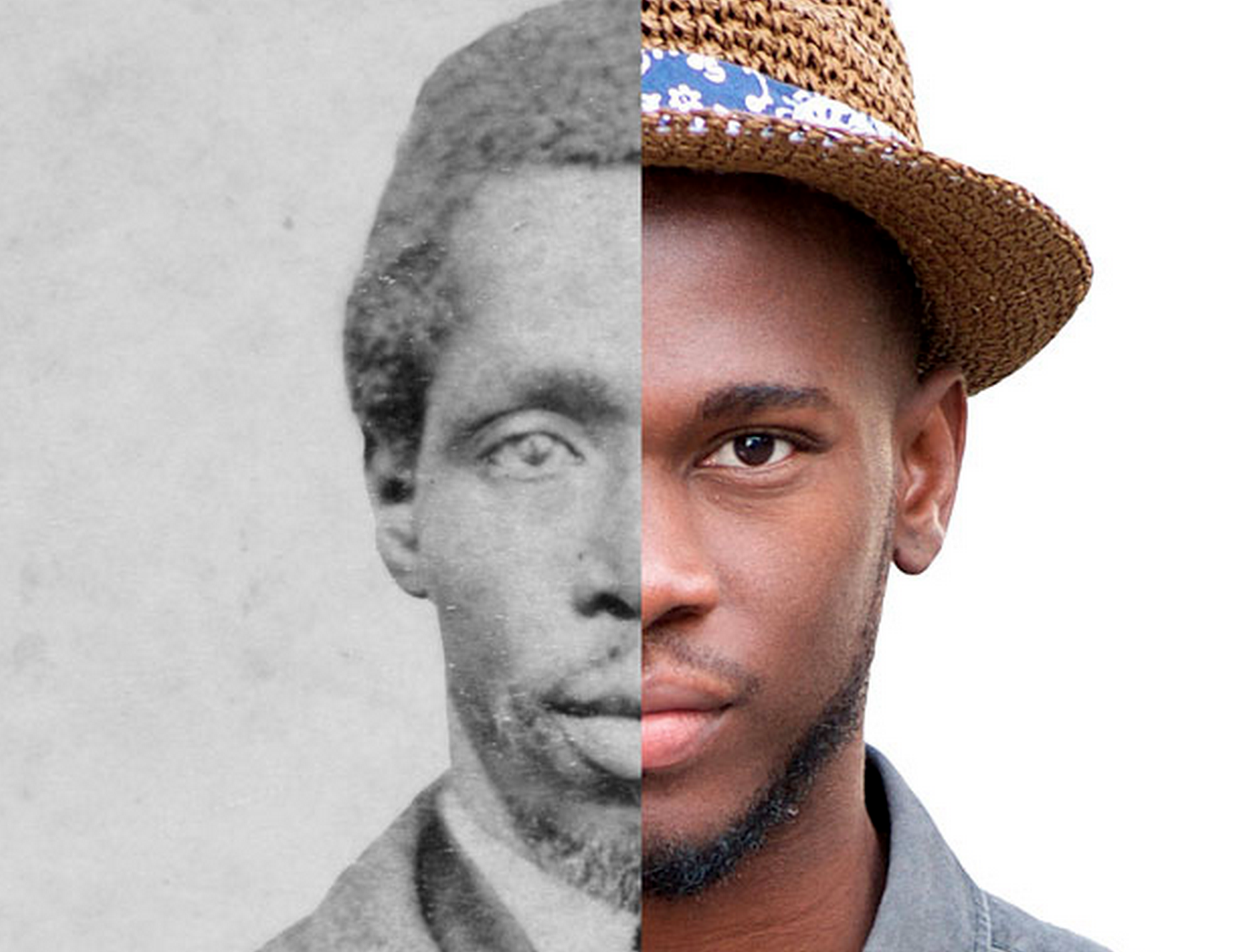
The successes of the Freedman’s Bureau, initiated by Abraham Lincoln in 1865 and first administered under Oliver Howard’s War Department, are all the more remarkable considering the intense popular and political opposition to the agency. Under Lincoln’s successor, impeached Southern Democrat Andrew Johnson, the Bureau at times became a hostile entity to the very people it was meant to aid and protect—the formerly enslaved, especially, but also poor whites devastated by the war. After years of defunding, understaffing, and violent insurgency the Freedman’s Bureau was officially dissolved in 1872.
In those first few years after emancipation, however, the Bureau built several hospitals and over a thousand rural schools in the South, established the Historically Black College and University system, and “created millions of records,” notes the National Museum of African American History and Culture (NMAAHC), “that contain the names of hundreds of thousands of formerly enslaved individuals and Southern white refugees.” Those records have enabled historians to reconstruct the lives of people who might otherwise have disappeared from the record and helped genealogists trace family connections that might have been irrevocably broken.
As we noted back in 2015, those records have become part of a digitization project named for the Bureau and spearheaded by the Smithsonian, the National Archives, the Afro-American Historical and Genealogical Society, and the Church of Jesus Christ of Latter Day Saints, whose FamilySearch is the largest genealogy organization in the world. “Using modern, digital and web-based technology and the power of [over 25,000!] volunteers,” says Hollis Gentry, a genealogical specialist at the NMAAHC, the Freedman’s Bureau Project “is unlocking information from a transformative era in the history of African American families and the American nation.”
That information is now available to the general public, “globally via the web” here, as of June 20th, 2016, allowing “all of us to enlarge our understanding of the past.” More specifically, the Freedman’s Bureau Project and FamilySearch allows African Americans to recover their family history in a database that now includes “the names of nearly 1.8 million men, women and children” recorded by Freedman’s Bureau workers and entered by Freedman’s Bureau Project volunteers 150 years later. This incredible database will give millions of people descended from both former slaves and white Civil War refugees the ability to find their ancestors.
There’s still more work to be done. In collaboration with the NMAAHC, the Smithsonian Transcription Center is currently relying on volunteers to transcribe all of the digital scans provided by FamilySearch. “When completed, the papers will be keyword searchable. This joint effort will help increase access to the Freedmen’s Bureau collection and help the public learn more about the United States in the Reconstruction Era,” a critical time in U.S. history that is woefully underrepresented or deliberately whitewashed in textbooks and curricula.
“The records left by the Freedmen’s Bureau through its work between 1865 and 1872 constitute the richest and most extensive documentary source available for investigating the African American experience in the post-Civil War and Reconstruction eras,” writes the National Archives. Soon, all of those documents will be publicly available for everyone to read. For now, those with roots in the U.S. South can search the Freedman’s Bureau Project database to discover more about their family heritage and history.
And while the Smithsonian’s transcription project is underway, those who want to learn more can visit the Freedman’s Bureau Online, which has transcribed hundreds of documents, including labor records, narratives of “outrages committed on freedmen,” and marriage registers.
Related Content:
Visualizing Slavery: The Map Abraham Lincoln Spent Hours Studying During the Civil War
The Civil War and Reconstruction: A Free Course
Josh Jones is a writer and musician based in Durham, NC. Follow him at @jdmagness
Read More...“Don’t Try”: The Philosophy of the Hardworking Charles Bukowski
If Charles Bukowski were alive today, what would you ask him? Best to avoid the standard questions put to writers about how or why they chose to become writers — not just because Bukowski would surely respond with a few colorfully choice words of dismissal, but because he embodied the lack of choice that characterizes the life of every serious creator. According to the Pursuit of Wonder video essay above, Bukowski dropped out of college halfway through in order to write. After a period spent “bouncing around the United States, doing short-term blue-collar jobs while writing hundred of short stories,” none of which broke him into the literary big time, came a highly unproductive period of blue-collar jobs without the accompanying writing.
At the end of a writing-free decade, Bukowski “nearly died from a serious bleeding ulcer.” This got him back on track, as brushes with mortality tend to do: he subsequently quit his job at the post office and returned to writing full-time. It was only a few years before he went back to work at the post office, but this time he kept writing, putting in the real work at the typewriter before each shift at the day job. He did so without the prospect of success anywhere in the offing, at least not before he reached middle age. “It took Bukowski years and years of writing and toiling and trying to finally have circumstances work out in his favor so he could gain traction and find success as a writer,” says the video’s narrator. And yet, as we’ve previously noted here at Open Culture, into Bukowski’s gravestone are chiseled these words: “Don’t try.”
“How could a man who became successful in fulfilling his idea of himself — a man who, although it took a while, found immense respect and recognition for his craft, all because of his relentless trying — how could this man leave the words don’t try as his final offering?” We might interpret them in light of a letter from Bukowski to a friend, the writer and publisher William Packard. “Too many writers write for the wrong reasons,” declared Bukowski. “They want to get famous or they want to get rich or they want to get laid by the girls with the bluebells in their hair… When everything goes best, it’s not because you chose writing, but because writing chose you.” Bukowski didn’t decide to be a writer; nobody actually dedicated to a pursuit ever had to decide which pursuit it would be.
“We work too hard. We try too hard,” Bukowski writes to Packard. “Don’t try. Don’t work. It’s there. Looking right at us, aching to kick out of the closed womb.” He may have meant, as the video’s narrator puts it, that “if you have to try to try, if you have to try to care about something or have to try to want something, perhaps you don’t care about it, and perhaps you don’t want it.” And “if the thought of not doing the thing hurts more than the thought of potentially suffering through the process, if the thought of a life without it or never having tried it at all terrifies you, if it comes to you, through you, out of you, almost as if you’re not trying, perhaps Bukowski might say here, try, and ‘if you’re going to try, go all the way.’ ” That quote comes from Bukowski’s novel Factotum — the story of a writer in search of blue-collar work that won’t get in the way of his one true craft — and we might do well to take it one sentence further: “Otherwise, don’t even start.”
Related Content:
“Don’t Try”: Charles Bukowski’s Concise Philosophy of Art and Life
Charles Bukowski Explains What Good Writing and the Good Life Have in Common
Charles Bukowski Reads His Poem “The Secret of My Endurance”
Based in Seoul, Colin Marshall writes and broadcasts on cities, language, and culture. His projects include the book The Stateless City: a Walk through 21st-Century Los Angeles and the video series The City in Cinema. Follow him on Twitter at @colinmarshall or on Facebook.
Read More...Support Us
We're hoping to rely on loyal readers, rather than erratic ads. Please click the Donate button and support Open Culture. You can use Paypal, Venmo, Patreon, even Crypto! We thank you!

About Us

Open Culture scours the web for the best educational media. We find the free courses and audio books you need, the language lessons & educational videos you want, and plenty of enlightenment in between.
Advertise With Us
FREE UPDATES!
GET OUR DAILY EMAIL
Get the best cultural and educational resources on the web curated for you in a daily email. We never spam. Unsubscribe at any time.
FOLLOW ON SOCIAL MEDIA
Open Culture editor Dan Colman scours the web for the best educational media. He finds the free courses and audio books you need, the language lessons & movies you want, and plenty of enlightenment in between.
Advertise With Us

