Louis Armstrong Remembers How He Survived the 1918 Flu Epidemic in New Orleans
Born into poverty in New Orleans in 1901, and growing up during some of the most brutal years of segregation in the South, Louis Armstrong first lived with his grandmother, next in a “Colored Waif’s Home” after dropping out of school at age 11, then with his mother and sister in a home so small they had to sleep in the same bed. After already living through the first World War, he would go on to witness the Spanish Flu epidemic, the Great Depression, World War II, the Cold War, and the turbulent 1960s and the Vietnam conflict.
That’s a lot for one lifetime, though for much of it, Armstrong was a star and living legend who beat the odds and rose above his origins with will and talent. Even so, he suffered some severe ups and downs during the hard times, touring so much to cover his debts in the lean 1930s, for example, that he injured his lips and fingers, and finally moving to Europe when the mob came after him.
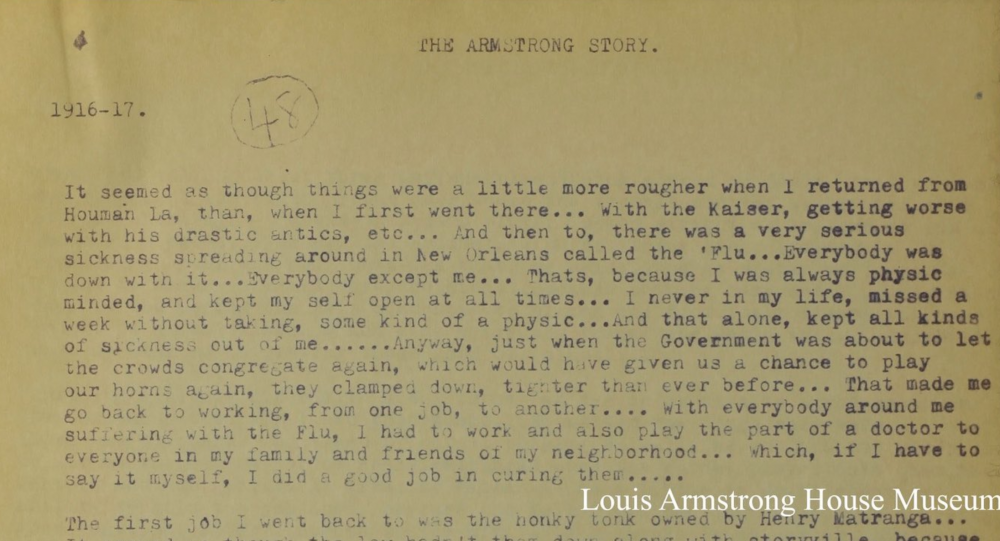
Armstrong’s descriptions of his experience of the 1918 influenza pandemic—as he remembers it in his 1954 memoir Satchmo: My Life in New Orleans—are almost jaunty, as you can partly see in the typescript page above from the Louis Armstrong House. But he remembered it from the perspective of a 17-year-old musician in robust health—who seemed to have some kind of resistance to the flu.
He devotes no more than two paragraphs to the flu, which hit the city hard in October of that year. According to the Influenza Encyclopedia, an online project documenting the flu in the U.S. between 1918–1919, New Orleans city authorities “acted immediately,” once they discovered the outbreak, arrived by cargo ship the month before.
On October 9th, the New Orleans Superintendent of Health, “with Mayor Martine Behrman’s consent and the blessing of state authorities… ordered closed all schools (public, private, and parochial, as well as commercial colleges), churches, theaters, movie houses, and other places of amusement, and [prohibited] public gatherings such as sporting events and public funerals and weddings.”
For a struggling young musician making a living playing clubs and riverboats, the closure of “other places of amusement” took a serious toll. The loss of livelihood is what seems to have hurt Armstrong the most when he returned to the city from touring, still unsure if the Great War would end.
When I came back from Houma things were much tougher. The Kaiser’s monkey business was getting worse, and, what is more, a serious flu epidemic had hit New Orleans. Everybody was down with it, except me. That was because I was physic-minded. I never missed a week without a physic, and that kept all kinds of sickness out of me.
Whatever “physic” helped Armstrong’s avoid infection, it wasn’t for lack of exposure. In lieu of playing the trumpet he began caring for the sick, since all of the hospitals, even those that would take black patients, were completely overcrowded.
Just when the government was about to let crowds of people congregate again so that we could play our horns once more the lid was clamped down tighter than ever. That forced me to take any odd jobs I could get. With everybody suffering from the flu, I had to work and play the doctor to everyone in my family as well as all my friends in the neighborhood. If I do say so, I did a good job curing them.
We might imagine some of those “odd jobs” were what we now call “essential”—i.e. low paid and high risk under the circumstances. He persevered and finally got a gig playing a “honky-tonk” that avoided a shut-down because it was “third rate,” and he “could play a lot of blues for cheap prostitutes and hustlers.” Few things could get Satchmo down, it seemed, not even a flu pandemic, but he was one of the lucky ones—luckily for the future of jazz. Only, we don’t have to imagine how hard this must have been for him. We just have to take a look around.
Learn more about the 1918 influenza epidemic in the U.S. at the Influenza Encyclopedia and read the rest of Armstrong’s account of his formative years at the Internet Archive.
Related Content:
Louis Armstrong Plays Historic Cold War Concerts in East Berlin & Budapest (1965)
Josh Jones is a writer and musician based in Durham, NC. Follow him at @jdmagness
Read More...Coursera Makes Courses & Certificates Free During Coronavirus Quarantine: Take Courses in Psychology, Music, Wellness, Professional Development & More Online

Over the past decade or two, developments in the technology of the World Wide Web have made learning at home possible in a way it wasn’t before. Over the past month or two, learning at home has gone from option to necessity, prevented as many of us are from going out to a classroom by the coronavirus pandemic. If you’ve taken courses on the internet before — and especially if you’ve picked them from our selection of 1,500 you can take for free — you’ve no doubt heard of Coursera, one of the major online learning platforms. Now through May 31st, a period during which the number of potential students will surely remain high, Coursera has made more of its classes free for the taking.
“To help our community during this critical time, we’re launching new, free resources, as well as surfacing interesting course collections, community discussions, and expert interviews,” says the official Coursera blog. “While many courses on Coursera are already available for free without a certificate, this promotion enables you to not only access lectures and quizzes, but also to earn a free certificate for courses that offer them.” The blog highlights these collections of courses, describing them as follows:
- Free online courses for mental health and well-being: from de-mystifying mindfulness to understanding the science of happiness, we’ve collected top wellness courses to help you prioritize mental health and well-being during these uncertain times.
- Free online courses for high school students: from calculus to guitar for beginners, we’ve rounded up courses to help high school students everywhere keep learning.
- Free online courses for college students: from preparing for an interview to learning data science, we’ve collected courses to make it easier to keep learning.
- Free online courses for career development: from creative problem solving to personal branding, we identified courses to help you build important career skills.
- Free online courses for building your cloud technology career: from machine learning to cloud computing, we’ve curated a set of courses to help you grow your career in an increasingly digital world.
- Free online courses for understanding public health: from the science behind COVID-19 to communicating during global emergencies, we’re making popular public health courses completely free.
- Free online courses in Spanish: from wellness to professional development, we’re making popular Spanish-language courses available for free.
The post also includes the following instructions for how to redeem a free course:
- First, click the link to visit a promotion page.
- From the promotion page, click to visit a specific course and wait for the page to fully load. Once loaded, you will see a promotion banner at the top of the page. If you don’t see the banner, please refresh the page.
- Next, click the “Enroll for free” button.
- Select “Purchase Course.” Note that with the promotion applied, there will be a message in parentheses that says “Your promotion will automatically be applied at checkout.”
- At checkout, your purchase total will read “$0.”
- Complete check out and start learning!
Among Coursera’s current free offerings you’ll find a host of courses including “Getting Started with Music Theory” from Michigan State University, “Social Psychology” from Wesleyan University, and “Cloud Computing Basics” from LearnQuest. You’re as likely to come across subject areas into which you’ve long been meaning to get deeper as practical education pertinent to the times we now live in. Take “Sit Less, Get Active” from the University of Edinburgh, or “Science Matters: Let’s Talk About COVID-19” from Imperial College London, a virus-related course of the kind we’ve previously featured here on Open Culture. The University of California, San Diego’s “Converting Challenges into Opportunities” is also not without its relevance, to the future as well as the present. After all, the coronavirus will hardly be the last challenge in which we’ll need to find our own opportunities.
Related Content:
1,700 Free Online Courses from Top Universities.
Free Courses on the Coronavirus: What You Need to Know About the Emerging Pandemic
Dyson Creates 44 Free Engineering & Science Challenges for Kids Quarantined During COVID-19
Based in Seoul, Colin Marshall writes and broadcasts on cities, language, and culture. His projects include the book The Stateless City: a Walk through 21st-Century Los Angeles and the video series The City in Cinema. Follow him on Twitter at @colinmarshall, on Facebook, or on Instagram.
Read More...Ingenious Improvised Recreations of Vermeer’s Girl with a Pearl Earring, Using Materials Found Around the House
One can only tolerate so many educational videos in self-isolation before the brain begins to rebel.
Hands-on learning. That’s what we’re craving.
And ultimately, that’s what the Getty provides with an addictive challenge to captive audiences on Twitter, Facebook, and Instagram to re-create iconic artworks using three household objects.
Participants are encouraged to look at the Getty’s downloadable, digitized collection and beyond for a piece that speaks to them, possibly because of their ability to match it by dint of hair color, physique or perfect prop.)
Certain works quickly emerged as favorites, with Johannes Vermeer’s Girl with a Pearl Earring (c. 1665) the clear front runner.
The Mauritshuis, where Girl with a Pearl Earring is quarantined, along with other Hague-dwellers such as Rembrandt’s The Anatomy Lesson of Dr Nicolaes Tulp and Fabritius’ The Goldfinch, describes it thusly:
Girl with a Pearl Earring is Vermeer’s most famous painting. It is not a portrait, but a ‘tronie’ – a painting of an imaginary figure. Tronies depict a certain type or character; in this case a girl in exotic dress, wearing an oriental turban and an improbably large pearl in her ear.
Johannes Vermeer was the master of light. This is shown here in the softness of the girl’s face and the glimmers of light on her moist lips. And of course, the shining pearl.
Let’s have a look, shall we?
View this post on Instagram
View this post on Instagram
View this post on Instagram
Vermeer’s extraordinary application of light and shadow is a tall order for most amateurs, but it’s wonderful to see how much careful consideration has been given to the original subject’s expression, the cant of her head, the arrangement of her garments.
It seems the best way to study a work of art is to become that work of art… especially when one is trapped at home, seeking distraction, and forced to improvise with available objects.
Let us pray we’ll be set loose long before Halloween, but also that the challenge takers won’t forget how ingenious, easily sourced, and cost-effective their costumes were: a pillowcase, a button, an inverted party dress, the hem of a sibling’s blue t‑shirt, rescued from the rag bag still smelling faintly of vinegar from pre-coronavirus household cleaning.
That off-the-rack “sexy cat” won’t stand a chance.
View this post on Instagram
View this post on Instagram
View this post on Instagram
View this post on Instagram
No one’s disqualified if the number of items used in service of these recreations exceeds the originally stiuplated 3. As long as the participants are having (educational!) fun, this is one of those challenges where everybody wins… especially the baby, the dog, the guy with the mustache and the lady with the turkey on her head, even though the baby and the guy with the mustache forgot their earrings.
View this post on Instagram
View this post on Instagram
View this post on Instagram
View this post on Instagram
Some tips for participants accompany a handful of memorable entries on the Getty’s behind-the-scenes blog, The Iris. We’ve got links to a number of world class museums’ and libraries’ digital collections here and can’t wait to see what you come up with.
Meanwhile, enjoy even more recreations by searching for #gettychallenge or having a look at the Instagram of Tussen Kunst & Quarantaine, whose attempt to conjure Girl With A Pearl Earring using a placemat, a towel and a garlic bulb, launched the project that prompted the Getty and the Rijksmuseum to follow suit.
Extra points if you accept the #neckruffchallenge inspired by our history-loving artist friend, Tyler Gunther’s take on the #gettychallenge, below.
View this post on Instagram
Related Content:
Flashmob Recreates Rembrandt’s “The Night Watch” in a Dutch Shopping Mall
Ayun Halliday is an author, illustrator, theater maker and Chief Primatologist of the East Village Inky zine. She has been crowdsourcing art in isolation, most recently a hastily assembled tribute to the classic 60s social line dance, The Madison. Follow her @AyunHalliday.
Read More...Customize Your Zoom Virtual Background with Free Works of Art

Limitations stimulate creativity. While that phrasing is credited to business-management scholar Henry Mintzberg, the idea itself has a long history. We know we work more fruitfully when we work within boundaries, and we’ve known ever since our capabilities were limited in ways barely imaginable today. With the ongoing coronavirus pandemic having temporarily redrawn the boundaries of our lives, many of us have already begun to rediscover our own creativity. Some have even done it on Zoom, the teleconferencing software used by businesses and institutions to keep their meetings and classes going even in a time of social distancing.
Instead of their bedrooms or offices, students and office workers have started appearing in settings like a 1970s disco, the Taj Mahal, and the starship Enterprise. The technology making this possible is the “virtual background,” explained in the official Zoom instructional video down below.
Word of the virtual background’s possibilities has spread through institutions everywhere. It certainly has at the Getty, whose digital editor Caitlin Shamberg notes that “the Getty’s Open Content program includes over 100,000 images that are free and downloadable. This means they’re also fair game to use as your own custom background.”
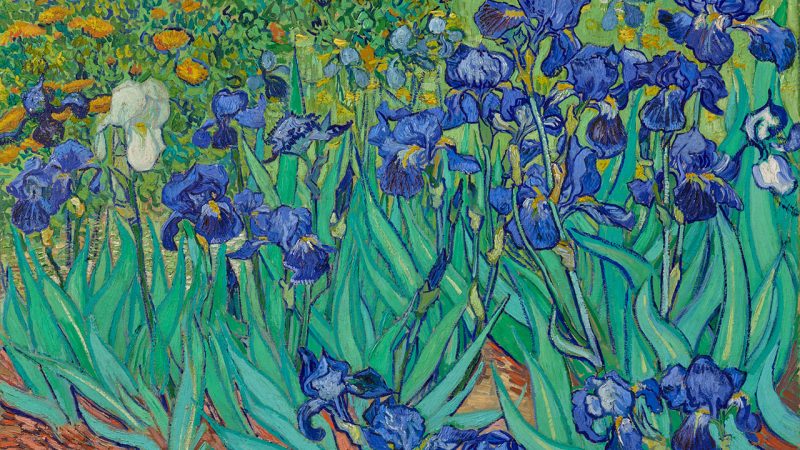
From the Getty’s digital collection Shamberg offers such works suitable for Zoom as Van Gogh’s Irises, Turner’s Van Tromp, going about to please his Masters, Ships a Sea, getting a Good Wetting, and other canvasses of such reliably pleasing settings as 18th-century Venice and a 16th-century forest with a rabbit. The Verge’s Natt Garun recently rounded up a few resources where you can find more promising virtual-background material, from bingo cards to beaches to “pop culture homes” including “Carrie Bradshaw’s apartment from Sex and the City, your favorite Friends lofts, Seinfeld living rooms, and more.”
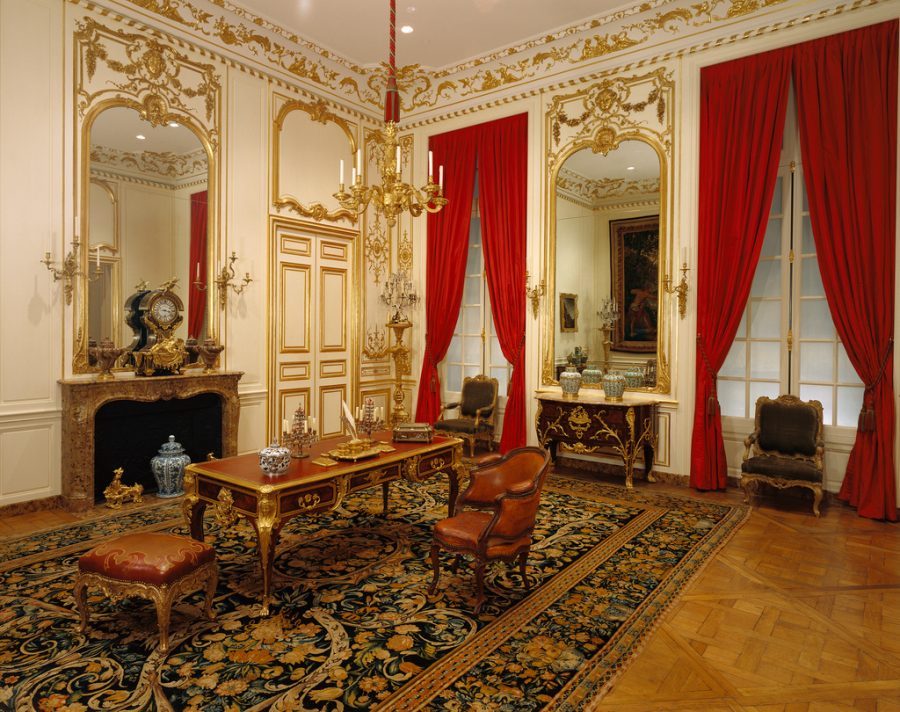
Here at Open Culture, we’ll point you to the thirty world-class museums that have put two million works of art online, many of which institutions have made them available for download. In this post appears, from the Metropolitan Museum of Art, Katsushika Hokusai’s Under the Wave off Kanagawa (whose evolution to the status of an iconic ukiyo‑e print we’ve previously covered); from the Getty, an 18th-century room “originally used as a bedroom or large cabinet in a private Parisian home at number 18 place Vendôme”; and from the Los Angeles County Museum of Art, George Bellows’ The Coming Storm.
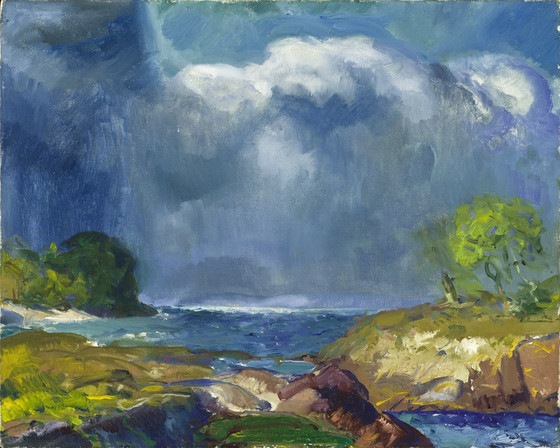
That last work, pictured above, has a certain metaphorical resonance with the situation the world now finds itself in, hoping though we are that the storm of COVID-19 is now passing rather than still coming. But while we’re sheltering from it — and continuing to carry on business as usual as best we can — we might as well get take every opportunity to get artistic. Find many more artistic images to download here.
Related Content:
The Metropolitan Museum of Art Puts 400,000 High-Res Images Online & Makes Them Free to Use
LA County Museum Makes 20,000 Artistic Images Available for Free Download
Take a Virtual Tour of 30 World-Class Museums & Safely Visit 2 Million Works of Fine Art
Based in Seoul, Colin Marshall writes and broadcasts on cities, language, and culture. His projects include the book The Stateless City: a Walk through 21st-Century Los Angeles and the video series The City in Cinema. Follow him on Twitter at @colinmarshall, on Facebook, or on Instagram.
Read More...Miles Davis’ Bitches Brew Turns 50: Celebrate the Funk-Jazz-Psych-Rock Masterpiece
I shouldn’t have to tell you that Miles Davis’ Bitches Brew, released fifty years ago this month, is a groundbreaking record. The funk-jazz-psych-rock masterpiece has been handed that award in “best of” lists for half a century. “Bitches Brew is NOT LIKE OTHER records of its time, or any other time,” Rick Frystak announced emphatically on the Amoeba Records blog last year, on the 50th anniversary of the album’s 1969 “hatching” onstage and in the studio. How could it be otherwise?
Davis “gave his band very little instruction” about what to do, bassist and Jazz Night in America host Christian McBride tells NPR’s Audie Cornish. “Miles might come in with sheet music with, like, four bars. And then you just, do what you do.”
Or as guitarist John McLaughlin remembers it, in the clip above from The Miles Davis Story, “I don’t think even Miles had a clear idea of what he wanted to do. But he was a man of such impeccable intuition that the moment that thing happened, he knew it. He said, ‘that’s it.’”
“What got recorded was the process,” says bassist Dave Holland, of figuring out, for example, how to make three keyboards at once work. Author and Miles Davis scholar Paul Tingen tones down the idea that the band made it all up on the spot. “Three of the pieces had already been broken in during live concerts,” he writes, such as the live clip of “Bitches Brew” in Copenhagen, 1969, above. And many of the musicians did get to rehearse before the studio sessions.
But during much of the album’s making, Miles “brought in these musical sketches that nobody had seen,” Davis himself says, and the band, featuring 13 musicians in total, found their way. Tingen writes:
On the third day the rhythm section consisted of as many as 11 players: three keyboardists, electric guitar, two basses, four drummers/percussionists and a bass clarinet. Miles had pulled out the stops in his search for a heavier bottom end.
The album’s heaviness, Davis’ tape echo, and McLaughlin’s squealing, distorted guitar turned off many jazzheads. “A lot of people felt that he was an artistic traitor,” McBride explains. “But I think that there were a number of college kids who were listening to progressive rock [and] soul music who absolutely loved this record.” Davis was booked to open for the Grateful Dead, Neil Young, and the Steve Miller Band. A new generation was turned on to jazz almost overnight.
After Bitches Brew, jazz kept fusing with rock instrumentation and overdrive, “from Chick Corea with Return to Forever and Wayne Shorter with Weather Report to Herbie Hancock with The Headhunters”—and, of course, McLaughlin’s Mahavishnu Orchestra. As Coltrane’s experimental 60s records had done, Davis’ bedrock fusion album freed rock from its formulas, giving it space to spread out and explore. Even Radiohead cited it as an influence on their groundbreaking 1997 Ok Computer. “It was building something up and watching it fall apart,” says Thom Yorke, “that’s the beauty of it.”
The album’s initial rejection in jazz circles didn’t last, as anyone familiar with the music’s direction knows. Davis determined its course in the 70s (as cover artist Mati Karwein determined its look). “I’m not sure if jazz ever got unplugged,” says McBride, and influential contemporary jazz fusionists like Kamasi Washington, Thundercat, and The Comet is Coming prove his point. Fifty years ago, the ground was broken for experimental electric jazz, and musicians are still building on Miles’ Bitches Brew intuitions.
Related Content:
Hear a 65-Hour, Chronological Playlist of Miles Davis’ Revolutionary Jazz Albums
Josh Jones is a writer and musician based in Durham, NC. Follow him at @jdmagness
Read More...Bob Dylan Releases a Cryptic 17-Minute Song about the JFK Assassination: Hear a “Murder Most Foul”
Like an Old Testament prophet with smartphone, Bob Dylan has appeared the midst of catastrophe to drop a new previously unreleased track, “Murder Most Foul,” on Twitter. Ostensibly a 17-minute song about JFK’s assassination, it’s “the first evidence of original songwriting that we’ve had in eight years from one of the most original songwriters of our era,” writes Kevin Dettmar, Professor of English at Pomona College, for The New Yorker.
The move seems like a weird one—“’weird’ with its full Shakespearean force, as in the ‘weird sisters’ of ‘Macbeth.’” Its title, however, comes from Hamlet. Uttered by the ghost of Hamlet’s father, the phrase shows us the murdered king pronouncing judgment on his own death. It is also the title of the third Miss Marple film, released in the U.S. in 1964, the same year (to the month) that the Warren commission submitted its report to Lyndon Johnson.
Is Dylan pulling us into what may be the most bottomless of modern conspiracy theories, with a Shakespearean allusion suggesting we might hear the song as emanating from Kennedy himself? He’s more than aware of what he’s doing with the many specific references to the murder, drawing out the most committed of conspiracy theorists in YouTube comments. As Andy Greene writes at Rolling Stone, “Murder Most Foul” is:
Packed with references only JFK buffs will likely recognize, like the ‘triple underpass’ near Dealey Plaza, the removal of his brain during the autopsy, and the ‘three bums comin’ all dressed in rags’ captured on the Zapruder film that conspiracy theorists have been obsessing over for decades. Clearly, Dylan has spent a lot of time reading books and watching documentaries about this.
There is so much more besides. Dylan weaves densely allusive texts, just as another poet to whom he bears some comparison, John Milton, whose work has been background for Dylan’s songwriting for decades, including a sly allusion to Paradise Lost in 1965’s “Desolation Row,” another prophetic work that stretches over the ten-minute mark (and ends with passengers on the Titanic shouting “Which side are you on?”)
In 2006, Dylan opened an episode of his Theme Time Radio Hour broadcast with lines from the first book of Paradise Lost: describing Satan “hurled headlong flaming from the ethereal sky.” Dylan has long been obsessed with the Devil, as literary scholar Aidan Day argues in a comparison of Dylan and Milton. Likewise, he is obsessed with apocalyptic falls from grace. Songs abound with images of the powerful brought low, the lowly brought lower, and the whole world sinking like an ocean liner. He returned to the theme in 2012’s “The Tempest,” a 14-minute epic about the Titanic.
Why JFK, and why now? As he vaguely notes, the song was “recorded a while back.” Dettmar estimates sometime in the last decade. Does it live up to Dylan’s earlier epics? Hear it above and judge for yourself. (And see many of its lyrical references at its Genius page.) Dettmar calls its first half “doggerel” and the opening lines do sound like a fifth-grade history presentation: “’Twas a dark day in Dallas, November, ‘63/The day that would live on in infamy.”
Is this cliché or a satire of cliché? (Dylan was fond of “ ‘Twas the Night Before Christmas.”) Things soon take a darker turn, with lines full of Miltonian portent: assassination becomes regicide: The day they blew out the brains of the king/Thousands were watching, no one saw a thing.
Allusions tumble out, line after line. Once Dylan gets to Wolfman Jack, verse two begins, and “something amazing happens,” writes Dettmar. “We’re presented with another version of the Great American Songbook.”—JFK’s death now prelude for all the cultural shifts to come. “Wolfman, oh Wolfman, oh Wolfman, howl/Rub-a-dub-dub, it’s a murder most foul.” NPR’s Bob Boilen and Ann Powers have compiled a playlist of the dozens of songs referenced in the second half of “Murder Most Foul,” a compilation of the music Dylan admires most.
What is he up to in this track? Is “Murder Most Foul” a summation of Dylan’s career? Dylanologists will be puzzling it out for years. But the last line of his Twitter announcement sure sounds like a cryptic farewell wrapped in a warning: “Stay safe,” Dylan writes, “stay observant, and may God be with you.”
Related Content:
A Massive 55-Hour Chronological Playlist of Bob Dylan Songs: Stream 763 Tracks
Hear Bob Dylan’s Newly-Released Nobel Lecture: A Meditation on Music, Literature & Lyrics
Bob Dylan’s Thanksgiving Radio Show: A Playlist of 18 Delectable Songs
Josh Jones is a writer and musician based in Durham, NC. Follow him at @jdmagness
Read More...Coursera Providing Free Access to Its Course Catalog to Universities Impacted by COVID-19

FYI: If you work in a university impacted by COVID-19, Coursera invites you to leverage their course catalogue. The company’s CEO writes:
The spread of the coronavirus (COVID-19) is the most serious global health security threat in decades. In many countries, restrictions imposed by government agencies have disrupted daily routines for millions, including students. Many universities in the impacted regions have suspended face-to-face seminars, closed campuses, and are scrambling to find a solution to minimize disruption for their students.
We are fortunate to have university and industry partners, who have been at the forefront of responding to the challenges humanity has faced from time to time. Inspired by their support and consistent with our mission of serving learners everywhere, we are launching a global effort to assist universities and colleges seeking to offer online courseware in response to the coronavirus.
Starting today, we’ll provide every impacted university in the world with free access to our course catalogue through Coursera for Campus. Universities can sign up to provide their enrolled students with access to more than 3,800 courses and 400 Specializations from Coursera’s top university and industry partners. These institutions will have access until July 31, 2020, after which we plan to provide month-to-month extensions depending on prevailing risk assessments. Students who enroll on or before July 31 will continue to have access until Sept. 30, 2020.
Over the past few weeks, Duke University has been using Coursera for Campus to serve impacted students at their Duke Kunshan campus in China. This effort has been swiftly adopted by students and widely recognized by the broader community. We believe that Coursera for Campus can be an effective resource to help all higher education institutions respond to the impact of coronavirus.
As a global community of educators, we are honored to be serving fellow institutions and student communities during this crisis. Over the next few days, we will also hold webinars and share more resources, including experiences from our partner community, to help institutions looking to transition online during this crisis. Stay tuned.
Sign up for Coursera’s Coronavirus program here.
If you would like to support the mission of Open Culture, consider making a donation to our site. It’s hard to rely 100% on ads, and your contributions will help us continue providing the best free cultural and educational materials to learners everywhere. You can contribute through PayPal, Patreon, and Venmo (@openculture). Thanks!
Read More...The Summerhill School, the Radical Educational Experiment That Let Students Learn What, When, and How They Want (1966)
Among the political and social revolutions of the 1960s, the movement to democratize education is of central historical importance. Parents and politicians were entrenched in battles over integrating local schools years after 1954’s Brown v. Board of Education. Sit-ins and protests on college campuses made similar student unrest today seem mild by comparison. Meanwhile, quieter, though no less radical, educational movements proliferated in communes, homeschools, and communities that could pay for private schools.
Most of these experimental methods drew from older sources, such as the theories of Rudolf Steiner and Maria Montessori, both of whom died before the Age of Aquarius. One movement that got its start decades earlier was popularized in the 60s when its founder A.S. Neill published the influential Summerhill: A Radical Approach to Child Rearing, a classic work of alternative pedagogy in which the Scottish writer and educator described the radical ideas developed in his Summerhill School in England, first founded in 1921.
Neill’s school “helped to pioneer the ‘free school’ philosophy,” writes Aeon, “in which lessons are never mandatory and nearly every aspect of student life can be put to a vote.” His methods “and a rising countercultural movement inspired similar institutions to open around the world.” When Neill first published his book, however, he was very much on the defensive, against “an increasing reaction against progressive education,” psychologist Erich Fromm wrote in the book’s foreword.
At the extreme end of this backlash Fromm situates “the remarkable success in teaching achieved in the Soviet Union,” where “the old-fashioned methods of authoritarianism are applied in full strength.” Fromm defended experiments like Neill’s, despite their “often disappointing” results, as a natural outgrowth of the Enlightenment.
During the eighteenth century, the ideas of freedom, democracy, and self-determination were proclaimed by progressive thinkers; and by the first half of the 1900’s these ideas came to fruition in the field of education. The basic principle of such self-determination was the replacement of authority by freedom, to teach the child without the use of force by appealing to his curiosity and spontaneous needs, and thus to get him interested in the world around him. This attitude marked the beginning of progressive education and was an important step in human development.
What seemed anarchic to its detractors had its roots in the tradition of individual liberty against feudal traditions of unquestioned authority. But Neill was less like John Locke, who included children in his category of irrational beings (along with “idiots” and “Indians”) than he was like Jean Jacques Rousseau. Fromm suggests this too: “A.S. Neill’s system is a radical approach to child rearing because it represents the true principle of education without fear. In Summerhill School authority does not mask a system of manipulation.”
Students decide what they want to learn, and what they don’t, with no curriculum, requirements, or testing to speak of and no structured time or mandatory attendance. Is such a thing even possible in practice? How could educators manage and measure student progress, or ensure their students learn anything at all? What might this look like? Find out in the 1966 National Film Board of Canada documentary Summerhill, above, full of “candid moments and scenes,” Aeon writes, “that evoke the rhythms of daily life at the school and give a sense of the children’s lived experience.”
Disorganized, but not chaotic, classroom bustle contrasts with idyllic, sunlit moments on Summerhill’s verdant grounds and honest criticism, some from the students themselves. One girl admits that the free play wears thin after a while and that “there probably aren’t such good facilities for learning here, after a certain level. But you can always go somewhere else afterwards” (though many would have difficulty with entrance exams). Another student talks about the struggle to study without structure to help minimize distractions. Despite Neill’s philosophical aversion to fear, she says “you’re always afraid of missing something.”
We also meet the man himself, A.S. Neill, a rumpled, avuncular figure at 83 years old, who proclaims freedom as the answer for students who struggle in school, and for students who don’t. If we’re honest, we might all admit we felt this strongly as children ourselves. It may never be an impulse that’s compatible with contemporary goals for education, which is often geared toward workplace training at the expense of creative thinking. But for many students, the opportunity to pursue their own course on their own terms can become the impetus for a lifetime of independent thought and action. I can’t think of a loftier educational goal.
Related Content:
Noam Chomsky Spells Out the Purpose of Education
Noam Chomsky Defines What It Means to Be a Truly Educated Person
Josh Jones is a writer and musician based in Durham, NC. Follow him at @jdmagness
Read More...Jeremy Bentham’s Mummified Body Is Still on Display–Much Like Other Aging British Rock Stars
Plato’s ideal of philosopher-kings seems more unlikely by the day, but most modern readers of The Republic don’t see his state as an improvement, with its rigid caste system and state control over childbearing and rearing. Plato’s Socrates did not love democracy, though he did argue that men and women (those of the guardian class, at least) should receive an equal education. So too did many prominent European political philosophers of the 18th and 19th centuries, who had at least as much influence on world affairs as Plato did on Athens, for better and worse.
One such thinker, Jeremy Bentham, is often remembered as the inventor of the panopticon, a dystopian prison design that makes inmates internalize their own surveillance, believing they could be watched at any time by unseen eyes. Made infamous by Michel Foucault in the mid-20th century, the proposal was first intended as humane reform, consistent with the tenets of Bentham’s philosophical innovation, Utilitarianism, often associated with his most famous disciple, John Stuart Mill.
Bentham may also have been one of the most progressive secular philosophers of any age—espousing full political rights for everyone—by which he actually meant everyone, not only European landowning men. “In his own time,” writes Faramerz Dabhoiwala at The Guardian, Bentham “was celebrated around the globe. Countless practical efforts at social and political reform drew inspiration from him. […] He was made an honorary citizen of revolutionary France, while the Guatemalan leader José del Valle acclaimed him as ‘the legislator of the world.’ Never before or since has the English-speaking world produced a more politically engaged and internationally influential thinker across such a broad range of subjects.”
Bentham took the role seriously, though there may be the seeds of a morbid practical joke in his last philosophical act.
As he lay dying in the spring of 1832, the great philosopher Jeremy Bentham left detailed directions for the preservation of his corpse. First, it was to be publicly dissected in front of an invited audience. Then, the preserved head and skeleton were to be reassembled, clothed, and displayed ‘in the attitude in which I am sitting when engaged in thought and writing.’ His desire to be preserved forever was a political statement. As the foremost secular thinker of his time, he wanted to use his body, as he had his mind, to defy religious superstitions and advance real, scientific knowledge. Almost 200 years later, Bentham’s ‘auto-icon’ still sits, staring off into space, in the cloisters of University College London.
His full-body parody of saints’ relics doesn’t just sit in London, in the “appropriate box or case” he specified in his instructions. It has also sat in its box in cities across England, Germany, and New York’s Metropolitan Museum of Art. “Not unlike an aging British rock star,” writes Isaac Schultz at Atlas Obscura, “the older he gets, the more tours he seems to go on. Sometimes Bentham’s severed, mummified head,” with its terrifying, unblinking glass eyes, “accompanies the rest of him.” Sometimes it doesn’t.
The head, which was supposed to have been kept atop the fully dressed skeleton, was mishandled and damaged in the creation of the “auto-icon” and replaced by a wax replica (surely an accident and not a way to mitigate the creepiness). What did Bentham mean by all of this? And what is an “auto-icon”? Though it sounds like the sort of inscrutable prank Salvador Dali might have played at the end, Bentham described the idea straightforwardly in his pamphlet Auto-Icon; or, Farther Uses of the Dead to the Living. The philosopher, says Hannah Cornish, science curator at the University College London, genuinely “thought it’d catch on.”
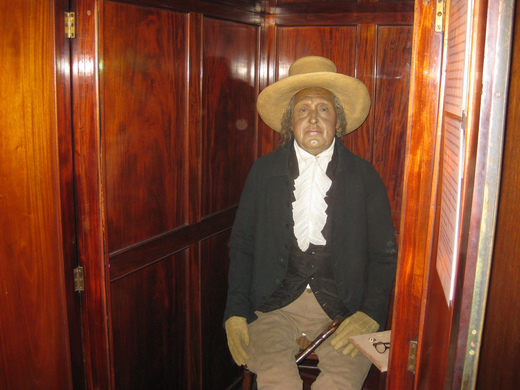
Photo via Wikimedia Commons
In his short, final work of moral philosophy, Bentham shows that, like Plato, he didn’t quite get the point of making art, advancing a theory that becoming one’s own icon would eliminate the need for paintings, statues, and the like, since “identity is preferable to similitude” (to the extent that a mummified corpse is identical to a living person). Other utilitarian reasons include benefits to science, reduced public health risks, and creating “agreeable associations with death.”
Also, in what must have been intended with at least some undercurrent of humor, he asked that his remains “occasionally be brought into meetings involving his still-living friends,” writes Schultz, “so that what’s left of Bentham might enjoy their company.”
Learn more about Bentham’s “auto-icon” in the Atlas Obscura videos here, including the video further up showing how a team of professionals packed up and moved the whole macabre assemblage to its new home across the University of London campus. And read an even more detailed description, with several photographs, of how the oldest partially mummified British rock star philosopher travels, here.
Related Content:
97-Year-Old Philosopher Ponders the Meaning of Life: “What Is the Point of It All?”
Josh Jones is a writer and musician based in Durham, NC. Follow him at @jdmagness.
Read More...Americans Visited Libraries Almost Twice as Often as They Went to the Movies Last Year, a New Survey Shows
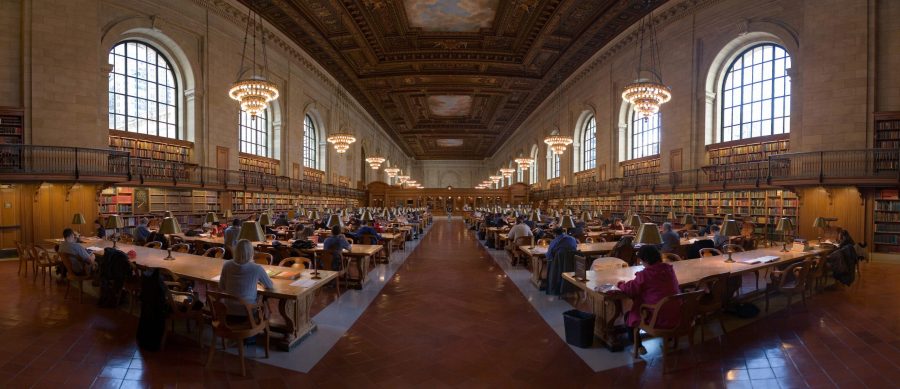
Image via Wikimedia Commons
One recurring story over the past year, covered by every major news outlet, asks whether streaming services are “killing” movie theaters (or if they are killing themselves). Another looks into the trend of binge-watching, and the effect of an entertainment ecosystem built on shows that seem to stream themselves. Given the ubiquity of this kind of coverage, we might be forgiven for suspecting that the U.S. is turning into a mass of passive home viewers transfixed by supernatural thrillers, dark comedies, reality TV, teen dramas, etc.….
This isn’t entirely the case.… While others tally up the number of eyeballs on variously-sized screens, veteran polling outfit Gallup spent part of December 2019 asking Americans around the country what they did when they went out. Among the nine activities they listed—including movies, concerts, sporting events, museums, zoos, and casinos—“visiting the library remains the most common cultural activity Americans engage in, by far,” averaging 10.5 visits per year, notes Justin McCarthy at Gallup News.
To put that “by far” into perspective, those polled reported, on average, going to the library almost twice as often as going to the movies, the second-place activity, over the past year. But as with all such polling data, we should not draw hasty conclusions without looking at specifics. Gallup breaks down the demographics by gender, age, income, region, and by households with and without children. Surprisingly, they found very little difference between the latter two groups’ reported library trips.
Among the other categories, we find that women reported going to libraries almost twice as often as men; that people between 18–29 report going over twice as often as those between 50–64—perhaps due to college assignments; and that low income households report going at much higher rates than those in higher brackets. “Cost seems to be a factor driving these trends,” writes Brigit Katz at Smithsonian. “Visiting the library is free, as are the variety of services libraries offer, including Wi-Fi.”
Indeed, “29 percent of library-going Americans over the age of 16 went to use computers, the internet or a public Wi-Fi network.” Libraries are places to gain access to cultural experiences that can be cost-prohibitive elsewhere: to take free classes and enjoy free movies, music, and, yes, books. The number of average visits has remained unchanged since a similar poll in 2001, “suggesting libraries are as popular now as they were at the turn of the millennium.” Trips to the movies, on the other hand, are down an average of 1.3 visits.
Make of the data what you will in the full breakdown at Gallup News. The telephone survey has a very small sample size—1,024 adults in all 50 states—which may not be at all representative of the whole. Nonetheless, McCarthy concludes that “despite the proliferation of digital-based activities over the past two decades… libraries have endured.” May they continue to do so, and to serve the needs of all Americans, especially those who might otherwise have little access to the kinds of knowledge, information, and culture that libraries steward.
via Smithsonian
Related Content:
The New York Public Library Announces the Top 10 Checked-Out Books of All Time
Josh Jones is a writer and musician based in Durham, NC. Follow him at @jdmagness.
Read More...Support Us
We're hoping to rely on loyal readers, rather than erratic ads. Please click the Donate button and support Open Culture. You can use Paypal, Venmo, Patreon, even Crypto! We thank you!

About Us

Open Culture scours the web for the best educational media. We find the free courses and audio books you need, the language lessons & educational videos you want, and plenty of enlightenment in between.
Advertise With Us
FREE UPDATES!
GET OUR DAILY EMAIL
Get the best cultural and educational resources on the web curated for you in a daily email. We never spam. Unsubscribe at any time.
FOLLOW ON SOCIAL MEDIA
Open Culture editor Dan Colman scours the web for the best educational media. He finds the free courses and audio books you need, the language lessons & movies you want, and plenty of enlightenment in between.
Advertise With Us



