Stream 15 Hours of the John Peel Sessions: 255 Tracks by Syd Barrett, David Bowie, Siouxsie and the Banshees & Other Artists
For fans of what came to be called “alternative music,” the discovery of new artists and bands felt like a genuine adventure before the internet irrevocably changed music consumption. A few official venues acted as guides—magazines like Trouser Press and NME, shows like 120 Minutes, MTV’s late-night showcase of post-punk, new wave, industrial, etc. Word of mouth, local zines, college radio, mixtape gifts, and the purloined contents of older brothers and sisters’ record collections went a long way. Many of us had access to independent record stores that stocked all sorts of underground oddities, often run by obsessive know-it-alls like High Fidelity’s Rob Gordon.
Venturing into that world could be an intimidating experience. But one dependable marker of quality hardly ever let young seekers down: the name of BBC DJ and curator extraordinaire John Peel. Peel’s influence on the musical trends of the last forty years is incalculable, and impossible to summarize in brief. (Learn about his legacy at this BBC tribute page.) From 1967 to his death in 2004, he recorded up and coming and underground bands in intimate sessions at BBC studios, and many of these classic recordings came out on his Strange Fruit label.
No matter the band, no matter the genre, the mysterious gray cover of a Peel Sessions release always promised something worth forking over one’s hard-earned lawnmowing money to hear. Peel broadcast and recorded Nirvana before “Smells Like Teen Spirit” hit the mainstream; introduced his listeners to now-legends like Joy Division, The Smiths, and The Specials; gave Bowie his first break before his Ziggy Stardust fame; and played Bob Marley before Catch a Fire made him world famous.
These sessions and many more have been lovingly compiled in one Spotify playlist by Sebastien Vanblaere. If you have nostalgic memories of putting on a Peel Sessions record or cassette and having your mind blown by music the likes of which you’d never heard before, you may find your favorites here. My personal touchstone is Siouxsie and the Banshees’ Peel Session recordings, which to this day I prefer to their still excellent studio releases (hear “Love in a Void” at the top). Something about the way those focused live sessions were recorded, and the immediacy of their raw, uncluttered mixes, make them feel very personal, like a concert in your living room.
While I associate Peel’s name mainly with the post-punk niche of my youth, his eclectic tastes spanned the gamut. Before he gave the Ramones, The Damned, and other punk bands their first major play in the mid-seventies, Peel championed the psychedelic spacerock of Pink Floyd, the droning krautrock of Neu!, and the uncategorizable weirdness of Captain Beefheart; “he was among the first (and only) DJs anywhere,” writes the Houston Press, “to broadcast reggae, punk, hardcore, grindcore, grime and dubstep music over the radio.”
Peel’s relevance never waned because his interest in finding, broadcasting, and recording new music never did either, but the playlist here mostly represents his pre-1990 favs, and sticks closely to rock, punk, new wave, and folk. See this page for a full listing of every John Peel session, from 1967 to three posthumous releases in 2004. And for a sense of the incredible breadth and eclectic inclusiveness of Peel’s musical tastes, visit the John Peel Archive, an online project cataloguing every single record in Peel’s collection. They’re currently up to 2679 of over 100,000 records total.
Related Content:
Revisit the Radio Sessions and Record Collection of Groundbreaking BBC DJ John Peel
Josh Jones is a writer and musician based in Durham, NC. Follow him at @jdmagness
Read More...32 Animated Videos by Wireless Philosophy Teach You the Essentials of Critical Thinking
Do you know someone whose arguments consist of baldly specious reasoning, hopelessly confused categories, archipelagos of logical fallacies buttressed by seawalls of cognitive biases? Surely you do. Perhaps such a person would welcome some instruction on the properties of critical thinking and argumentation? Not likely? Well, just in case, you may wish to send them over to this series of Wireless Philosophy (or “WiPhi”) videos by philosophy instructor Geoff Pynn of Northern Illinois University and doctoral students Kelley Schiffman of Yale, Paul Henne of Duke, and several other philosophy and psychology graduates.
What is critical thinking? “Critical thinking,” says Pynn, “is about making sure that you have good reasons for your beliefs.” Now, there’s quite a bit more to it than that, as the various instructors explain over the course of 32 short lessons (watch them all at the bottom of the post), but Pynn’s introductory video above lays out the foundation. Good reasons logically support the beliefs or conclusions one adopts—from degrees of probability to absolute certainty (a rare condition indeed). The sense of “good” here, Pynn specifies, does not relate to moral goodness, but to logical coherence and truth value. Though many ethicists and philosophers would disagree, he notes that it isn’t necessarily “morally wrong or evil or wicked” to believe something on the basis of bad reasons. But in order to think rationally, we need to distinguish “good” reasons from “bad” ones.
“A good reason for a belief,” Pynn says, “is one that makes it probable. That is, it’s one that makes the belief likely to be true. The very best reasons for a belief make it certain. They guarantee it.” In his next two videos, above and below, he discusses these two classes of argument—one relating to certainty, the other probability. The first class, deductive arguments, occur in the classic, Aristotelian form of the syllogism, and they should guarantee their conclusions, meaning that “it’s impossible for the premises to be true while the conclusion is false” (provided the form of the argument itself is correct). In such an instance, we say the argument is “valid,” a technical philosophical term that roughly corresponds to what we mean by a “good, cogent, or reasonable” argument. Some properties of deductive reasoning—validity, truth, and soundness—receive their own explanatory videos later in the series.
In abductive arguments (or what are also called “inductive arguments”), above, we reason informally to the best, most probable explanation. In these kinds of arguments, the premises do not guarantee the conclusion, and the arguments are not bound in rigid formal syllogisms. Rather, we must make a leap—or an inference—to what seems like the most likely conclusion given the reasoning and evidence. Finding additional evidence, or finding that some of our evidence or reasoning is incorrect or must be rethought, should force us to reassess the likelihood of our conclusion and make new inferences. Most scientific explanations rely on abductive reasoning, which is why they are subject to retraction or revision. New evidence—or new understandings of the evidence—often requires new conclusions.
As for understanding probability—the likelihood that reasons provide sufficient justification for inferring particular conclusions—well… this is where we often get into trouble, falling victim to all sorts of fallacies. And when it comes to interpreting evidence, we’re prey to a number of psychological biases that prevent us from making fair assessments. WiPhi brings previous video series to bear on these problems of argumentation, one on Formal and Informal Fallacies and another on Cognitive Biases.

When it comes to a general theory of probability itself, we would all benefit from some understanding of what’s called Bayes’ Theorem, named for the 18th century statistician and philosopher Thomas Bayes. Bayes’ Theorem can seem forbidding, but its wide application across a range of disciplines speaks to its importance. “Some philosophers,” says CUNY graduate student Ian Olasov in his video lesson above, “even think it’s the key to understanding what it means to think rationally.”
Bayesian reasoning, informal logic, sound, valid, and true arguments… all of these modes of critical thinking help us make sense of the tangles of information we find ourselves caught up in daily. Though some of our less rationally-inclined acquaintances may not be receptive to good introductory lessons like these, it’s worth the effort to pass them along. And while we’re at it, we can sharpen our own reasoning skills and learn quite a bit about where we go right and where we go wrong as critical thinkers in Wireless Philosophy’s thorough, high quality series of video lessons.
Find more helpful resources in the Relateds below.
If you would like to support the mission of Open Culture, consider making a donation to our site. It’s hard to rely 100% on ads, and your contributions will help us continue providing the best free cultural and educational materials to learners everywhere. You can contribute through PayPal, Patreon, and Venmo (@openculture). Thanks!
Related Content:
Carl Sagan Presents His “Baloney Detection Kit”: 8 Tools for Skeptical Thinking
How to Spot Bullshit: A Primer by Princeton Philosopher Harry Frankfurt
Michael Shermer’s Baloney Detection Kit: What to Ask Before Believing
Daniel Dennett Presents Seven Tools For Critical Thinking
1,700 Free Online Courses from Top Universities
Josh Jones is a writer and musician based in Durham, NC. Follow him at @jdmagness
Read More...
What’s the Essence of Music & Sound?: Meditations from Radiolab’s Jad Abumrad Presented in a Short, Creative Film
If you’ve ever listened to Radiolab, one of the most popular and enduring podcasts out there, you know how much music (and sound more generally) plays a special role in the show’s production. And that’s all largely the creation of Radiolab’s co-host, Jad Abumrad. You know those “jaggedy sounds, little plurps and things, strange staccato, percussive things” that make the show so distinctive? That’s all Abumrad, who majored in experimental music composition and production at Oberlin College.
To get inside Abumrad’s thinking about music (what is sound? what is music? why do we organize sound into music?) watch the video above. Mac Premo interviewed Jad, then turned the conversation into a short creative film. Note: If you don’t react well to seeing fast-moving images, you might want to skip this one.
If you would like to support the mission of Open Culture, consider making a donation to our site. It’s hard to rely 100% on ads, and your contributions will help us continue providing the best free cultural and educational materials to learners everywhere. You can contribute through PayPal, Patreon, and Venmo (@openculture). Thanks!
Read More...Hear the Great Mixtapes Richard Linklater Created to Psych Up the Actors in Dazed and Confused and Everybody Wants Some!!
Richard Linklater’s films have become increasingly sophisticated as the 90s indie breakout writer-director has grown into his auteurhood. From the loose stoner vérité of Slackers (watch it online) to the loose but heady animation of Waking Life to the painstakingly meticulous “model of cinematic realism” of Boyhood, Linklater has a uniquely American vision and the undeniable talent to realize it in full.
But mostly when I think of Linklater, I think—excuse my language—of cock rock.
I think of Dazed and Confused’s super senior Wooderson, leaning against a muscle car, drawling “alright, alright, alright,” and cranking Aerosmith. I think of wild-eyed Jack Black in School of Rock, strapping a Gibson Flying V on an uptight, sweater-vested youth and teaching him Black Sabbath’s “Iron Man” riff. And now, I think of a gang of short shorts-wearing college baseball dudes in the “campus bromance” Everybody Wants Some!!, singing along (above) to Sugar Hill Gang’s “Rapper’s Delight”…. wait…
So, okay, it ain’t all cock rock. But Linklater’s films are often so dude-centric, and so informed by popular music of certain eras, that he titled two of his most personal—Dazed and Confused and its recent “spiritual sequel”—after anthems from the two most archetypically cock rock bands, Led Zeppelin and Van Halen.
Where Dazed and Confused’s high school milieu more or less stayed anchored in 70s hard rock, Everybody Wants Some!!—like its comparatively adventurous college jocks—takes several musical detours from beer-and-babes 80s clichés. The film’s soundtrack, for example, includes “deep cuts” from Brian Eno, obscure local Texas punk rock band The Big Boys, and L.A.-based 80s New Wave/R&B band The Busboys.
It’s true, then, that the songs choices on Everybody Wants Some!!, which you can hear almost in their entirely (sans a few) above, are fairly diverse, genre-wise, compared to the cock-rock-heavy list of songs from Dazed and Confused (further up). And when it comes to Linklater’s musical inspirations for both films, we see that difference as well.
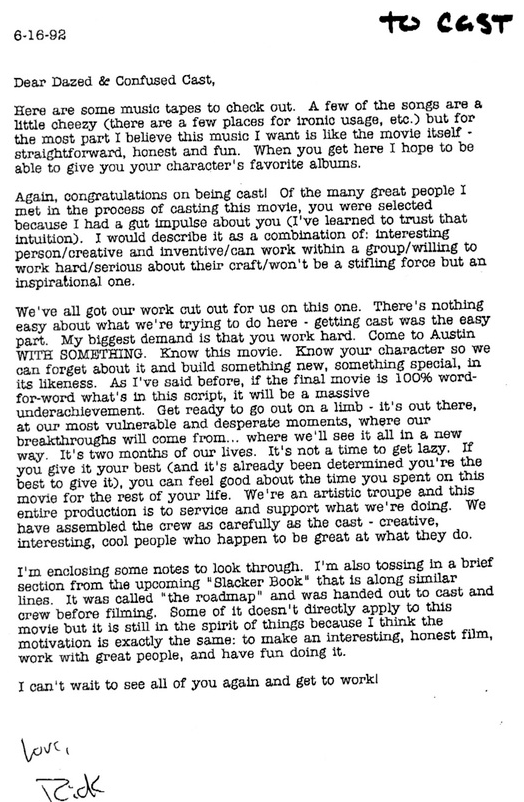
As the Criterion Collection blog documents—bringing us the 1992 letter above (read it here) from Linklater to his cast—the director put together “a thoughtful series of mixtapes to get his cast into the mind-set” of Dazed and Confused. And Criterion put together the Spotify playlist below of the songs Linklater gave his actors. As you’ll see, it’s mostly balls-to-the-wall hard rock, with some obligatory 70s disco and a few cuts from Lou Reed, David Bowie, and Elton John. In his accompanying letter, Linklater admits “a few of the songs are a little cheezy,” but also notes “there are a few places for ironic usage.” For the most part, he says, “this music… is like the movie itself—straightforward, honest and fun.”
When it came time to begin shooting Everybody Wants Some!! (get the official soundtrack here), Linklater again used the same method to get his cast in the mood, circulating the songs in the playlist below (though probably not on cassettes). Here we get a much more diverse, comprehensive musical summary of the decade in question, with Michael Jackson sitting next to Elvis Costello, Pat Benatar and Dire Straits next to Pink Floyd, Sister Sledge, Queen, and Chaka Khan.
It’s an interesting transition that may—musically—signal the move from teenage fandom to the more curious, adventurous listening habits of early adulthood. College, after all, is not only where young Americans of the modern era discover new sexual and chemical pleasures, but also where they acquire new musical tastes. And in the 80s especially, the boundaries of pop music expanded.
“That’s just how it felt to me to be a young person at that time. It was cool to be into everything,” Linklater commented to Cornelia Rowe at Yahoo: “There was a lot of newness in the era. You didn’t really appreciate it at the time – it’s like, there are all these new bands! There’s this new wave, punk, party, R&B – there’s a thing called rap music from New York!”
The athlete bros in Linklater’s latest, very male-oriented piece of cinematic nostalgia “at once embody and upend the stereotype of the shallow, sexually entitled jock,” writes A.O. Scott in his review. Roaming far afield of their comfort zones, they “have a good time wherever they are.” That’s pretty much guaranteed, I think, with the finely-curated 80s gems in these playlists as their soundtrack.
via the Criterion Collection
Related Content:
Watch Free Online: Richard Linklater’s Slacker, the Classic Gen‑X Indie Film
Josh Jones is a writer and musician based in Durham, NC. Follow him at @jdmagness
Read More...Explore Harvard’s Iconic Spaces with 360° Interactive Videos
For me, nothing captures those occasional feelings of post-graduate yearning like “I Wish I Could Go Back to College,” a N‑quite-SFW track from the Broadway musical, Avenue Q.
With all due respect, it feels like the five members of Harvard University’s just-graduated Class of 2016 sharing their recollections in the interactive 360° video project, Harvard Students Say Farewell, left a few crucial details out. (Note: Youtube 360 videos only work in Chrome, Firefox, Internet Explorer, or Opera browsers.)
It’s completely safe for prospective parents, not a keg or condom wrapper in sight. (The project is hosted on Harvard’s official Youtube channel.)
Unsurprisingly, Harvard appears to have been the participants’ universal first choice of college. Hasty Pudding performer, Joshuah Campbell, above, a self-described “Black kid from the country,” confides that it was the only place he applied to.
He may have arrived wondering how he would fit in, but four years later, his grubby dorm room is one of the “iconic” Harvard locations viewers can explore digitally as he briefly reflects upon his experience.
That’s about as down and dirty as this series gets. The human subjects seem to have been selected with an eye toward diversity and humility, rather than the clenched Boston Brahmin jaw that once defined the institution.
Meanwhile, the libraries, quads, and theaters through which this new breed of Harvard men and women wander attest to the place’s ongoing exclusivity.
Sreeja Kalapurakkel, above, a member of the Harvard South Asian Dance Company, knew what she was getting into, as a student at a respected Boston secondary school. Shortly after graduation, she sung Harvard’s praises somewhat more frankly on her Facebook page:
Each day of my time at Harvard was filled with everything that makes life beautiful: darkness, struggle, despair, loneliness, friendship, hope, perseverance, light. Every experience, every lesson, every friend transformed me into someone more human and gave me something new to fight for.
Harvard, like every other college in the land, has relaxed its policy on ending a sentence in a preposition.
Ana-Maria Constantin arrived sight unseen from her native Romania to pull us out onto the deck of the Smithsonian Astrophysical Observatory.
On to the locker room! Hockey captain Kyle Criscuolo joins the Detroit Red Wings, reflecting that Harvard student athletes enjoy no special treatment. In future, the university may want to require them to listen to Will Stephen’s lecture, “How to Sound Smart in a TED Talk.” Criscuolo sounds sincere, but also stiff, as if reading from a sheet of paper, or the digital equivalent thereof.
(Thereof is an adverb, by the way. Not a preposition. I checked.)
Harvard Art Museums Student Board member Rachel Thompson paints herself so meekly, I’m tempted to check with her freshman year roommate. Was she really so filled with self doubt? I’ve always assumed Harvard acceptance letters would puff the recipient up. Good lord, imagine the effect the rejection letters must have!
Use a mouse to explore the immersive environment on your computer, or the YouTube app to navigate on a mobile device. Use a virtual reality headset and the Harvard Crimson staff’s vocabulary list to enhance the experience even more.
The complete playlist is here.
Related Content:
Harvard Presents Free Courses with the Open Learning Initiative
NPR Launches Database of Best Commencement Speeches Ever
The Harvard Classics: Download All 51 Volumes as Free eBooks
Ayun Halliday is an author, illustrator, Chief Primatologist of the East Village Inky zine, and a Northwestern University grad. Follow her @AyunHalliday
Read More...Filmmaker Ken Burns Urges Stanford Graduates to Defeat Trump & the Retrograde Forces Threatening the U.S.
This time of year, we see graduation speeches popping up all over the web. The commencement address as a genre focuses on the opportunities, challenges, and responsibilities graduates will face post-college, and often espouses timeless life lessons and philosophies. But this year, as you may have seen, esteemed documentary filmmaker Ken Burns took the opportunity of his graduation speech, presented to the 2016 class at Stanford University, to address the timeliest of issues: the upcoming presidential election and the threat of “an incipient proto-fascism.” The graduation just happened to fall on the same day as the deadliest mass-shooting in recent American history.
Voters are angry at the system, we’re told again and again, and frankly the overwhelming majority of us have every reason to be. But anger can be intoxicating, and the segment of the electorate that carried Donald Trump to power seems drunk with rage and hostility. The promise of Trumpism puts me in mind of historian and critic Richard Slotkin’s classic study of U.S. mythology, Regeneration Through Violence, which describes the nation’s compulsion to purge the country of threatening others in order to restore some myth of lost innocence. “I will give you everything, I’m the only one,” the candidate vows, while scapegoating group after group for the country’s problems.
In his Stanford commencement speech on Sunday, Burns decried “the dictatorial tendencies of the candidate with zero experience in the much maligned but subtle art of governance; who is against lots of things, but doesn’t seem to be for anything, offering only bombastic and contradictory promises and terrifying Orwellian statements.” The Republican candidate for president is “a person,” Burns said in his impassioned speech, “who easily lies, creating an environment where truth doesn’t seem to matter.”
As a student of history, I recognize this type. He emerges everywhere and in all eras. We see nurtured in his campaign an incipient proto-fascism, a nativist anti-immigrant Know Nothing-ism, a disrespect for the judiciary, the prospect of women losing authority over their own bodies, African-Americans again asked to go to the back of the line, voter suppression gleefully promoted, jingoistic saber-rattling, a total lack of historical awareness, a political paranoia that, predictably, points fingers, always making the other wrong. These are all virulent strains that have at times infected us in the past. But they now loom in front of us again — all happening at once. We know from our history books that these are the diseases of ancient and now fallen empires. The sense of commonwealth, of shared sacrifice, of trust, so much a part of American life, is eroding fast, spurred along and amplified by an amoral internet that permits a lie to circle the globe three times before the truth can get started.
We no longer have the luxury of neutrality or “balance,” or even of bemused disdain. Many of our media institutions have largely failed to expose this charlatan, torn between a nagging responsibility to good journalism and the big ratings a media circus always delivers. In fact, they have given him the abundant airtime he so desperately craves, so much so that it has actually worn down our natural human revulsion to this kind of behavior. Hey, he’s rich; he must be doing something right. He is not. Edward R. Murrow would have exposed this naked emperor months ago. He is an insult to our history. Do not be deceived by his momentary “good behavior.” It is only a spoiled, misbehaving child hoping somehow to still have dessert.
And do not think that the tragedy in Orlando underscores his points. It does not. We must “disenthrall ourselves,” as Abraham Lincoln said, from the culture of violence and guns. And then “we shall save our country.”
The words of Lincoln that Burns quotes come from the president’s annual remarks to congress in 1862, in which Lincoln made the case for the Emancipation Proclamation, one month before signing it. (A document, ironically, that Slotkin says “radically expanded the existing powers of the presidency” in its pursuit of a just cause.) In his address, Lincoln makes a forceful moral argument, all the more eloquent for its characteristic brevity.
Fellow-citizens, we cannot escape history. We of this Congress and this administration, will be remembered in spite of ourselves. No personal significance, or insignificance, can spare one or another of us.
Likewise, Burns—addressing future leaders at an elite institution—makes his case for heeding the lessons of history, considering posterity, and rejecting Trump, independent of partisan interests: “This is not a liberal or conservative issue, a red state-blue state divide. This is an American issue.” He also implores “those ‘Vichy Republicans’ who have endorsed him to please, please reconsider.” The horrific mass murder in Orlando has further inflamed what Burns calls “the troubling, unfiltered Tourette’s of [Trump’s] tribalism”—with renewed calls for bans on all Muslims, more inflammatory insinuations that the president colludes with terrorists, and bizarre allegations that a Clinton aide is a Saudi agent.
Trump did not invent this rhetoric of bigotry, conspiracy, and paranoia, but he has manipulated and exploited it more effectively than anyone else, to potentially disastrous effect. “The next few months of your ‘commencement,’ ” Burns says, “that is to say, your future, will be critical to the survival of our republic.” He urges the graduating Stanford class to take action: “before you do anything with your well-earned degree, you must do everything you can to defeat the retrograde forces that have invaded our democratic process.” Those processes may already be deeply compromised by moneyed interests, but destroying the edifice on which they’re built, Burns suggests, will hardly restore any supposedly lost “greatness.” Watch Burns’ full commencement speech above.
Related Content:
Ken Burns on the Art of Storytelling: “It’s Lying Twenty-Four Times a Second”
Noam Chomsky on Whether the Rise of Trump Resembles the Rise of Fascism in 1930s Germany
Princeton Historian Sean Wilentz on How Trump May Change (If Not Destroy) the GOP
J.K. Rowling Defends Donald Trump’s Right to Be “Offensive and Bigoted”
Josh Jones is a writer and musician based in Durham, NC. Follow him at @jdmagness
Read More...1,000-Year-Old Manuscript of Beowulf Digitized and Now Online
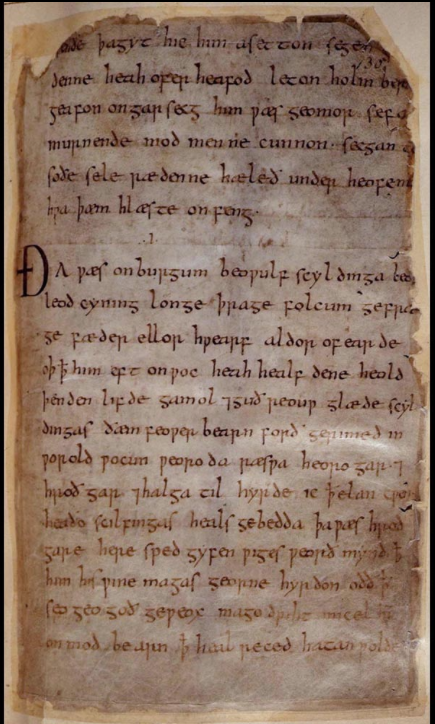
One outcome of the upcoming “Brexit” vote, we’re told, might free the UK to pursue its own unfettered destiny, or might plunge it into isolationist decline. The economic issues are beyond my ken, but as a reader and student of English literature, I’ve always been struck by the fact that the oldest poem in English, Beowulf, shows us an already internationalized Britain absorbing all sorts of European influences. From the Germanic roots of the poem’s Anglo-Saxon language to the Scandinavian roots of its narrative, the ancient epic reflects a Britain tied to the continent. With pagan, native traditions mingled with later Christian echoes, and local legends with those of the Danes and Swedes, Beowulf preserves many of the island nation’s polyglot, multi-national origins.
Irish poet Seamus Heaney—whose work engaged with the ironies and complications of tribalism and nationalism—had a deep respect for Beowulf; in the introduction to his translation of the poem, Heaney describes it as a tale “as elaborate as the beautiful contrivances of its language. Its narrative elements may belong to a previous age but as a work of art it lives in its own continuous present, equal to our knowledge of reality in the present time.” Though we’ve come to think of it as an essential work of English literature, Beowulf might have disappeared into the mists of history had not the only manuscript of the poem survived “more or less by chance.” The “unique copy,” writes Heaney, “(now in the British Library) barely survived a fire in the eighteenth century and was then transcribed and titled, retranscribed and edited, translated and adapted, interpreted and taught, until it has become an acknowledged classic.”
Now, the British Library’s digitization of that sole manuscript allows us to peel back the layers of canonization and see how the poem first entered a literary tradition. Originally “passed down orally over many generations, and modified by each successive bard,” writes the British Library, Beowulf took this fixed form when “the existing copy was made at an unknown location in Anglo-Saxon England.” Not only is the location unknown, but the date as well: “its age has to be calculated by analyzing the scribes’ handwriting. Some scholars have suggested that the manuscript was made at the end of the 10th century, others in the early decades of the 11th, perhaps as late as the reign of King Cnut, who ruled England from 1016 until 1035.”
These scholarly debates may not interest the average reader much. The poem survived long enough to be written down, then became known as great literature these many centuries later, because the rich poetic language and the compelling story it tells captivate us still. Nonetheless, though we may all know the general outlines of its hero’s contest with the monster Grendel and his mother, many of the cultural concepts from the world of Beowulf strike modern readers as totally alien. Likewise the poem’s language, Old English, resembles no form of English we’ve encountered before. Scholars like J.R.R. Tolkien and poets like Heaney have done much to shape our appreciation for the ancient work, and we might say that without their interventions, it would not live, as Heaney writes, “in its own continuous present” but in a distant, unrecognizable past.
You can hear Heaney read his translation of the poem on Youtube. Read Tolkien’s famous essay on the poem here, and hear it read in its original language at our previous post. Learn more about the single manuscript that preserved the epic poem for posterity at the British Library’s website.
Find Beowulf listed in our collection, 800 Free eBooks for iPad, Kindle & Other Devices.
Related Content:
Seamus Heaney Reads His Exquisite Translation of Beowulf and His Memorable 1995 Nobel Lecture
Hear Beowulf Read In the Original Old English: How Many Words Do You Recognize?
Josh Jones is a writer and musician based in Durham, NC. Follow him at @jdmagness
Read More...How to Look at Art: A Short Visual Guide by Cartoonist Lynda Barry
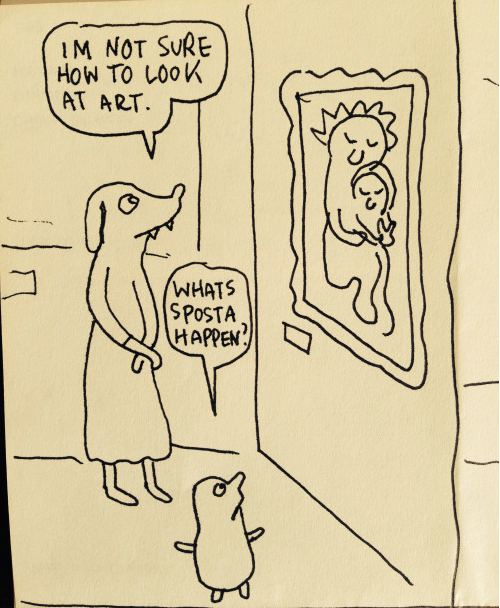
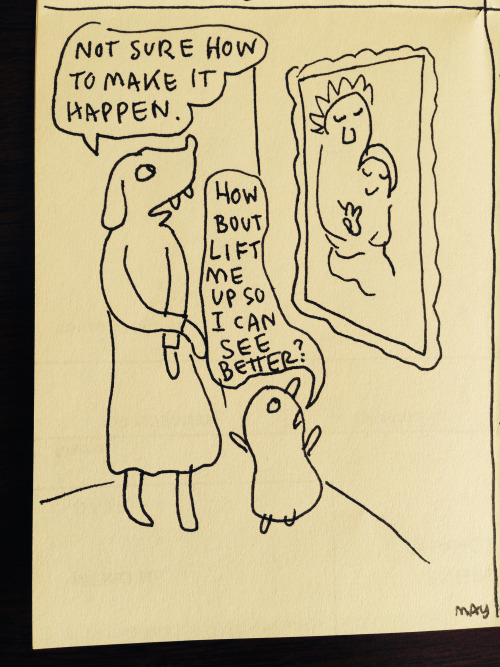
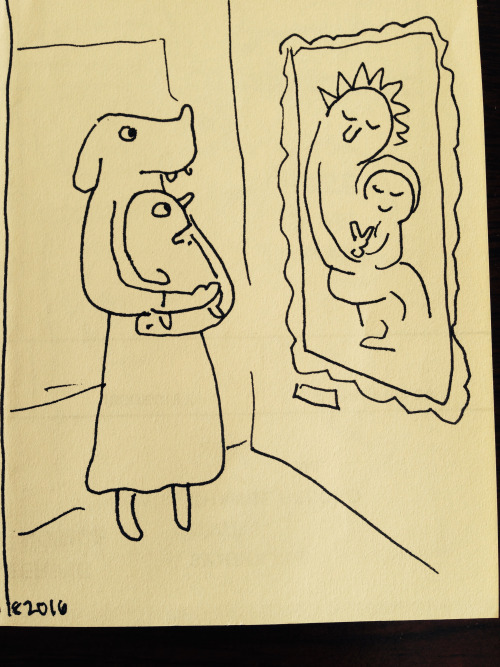
Despite the small, narrative doodle posted to her Tumblr a couple of weeks back, inspirational teacher and cartoonist Lynda Barry clearly has no shortage of strategies for viewing art in a meaningful way.
She takes a Socratic approach with students and readers eager to forge a deeper personal connection to images.
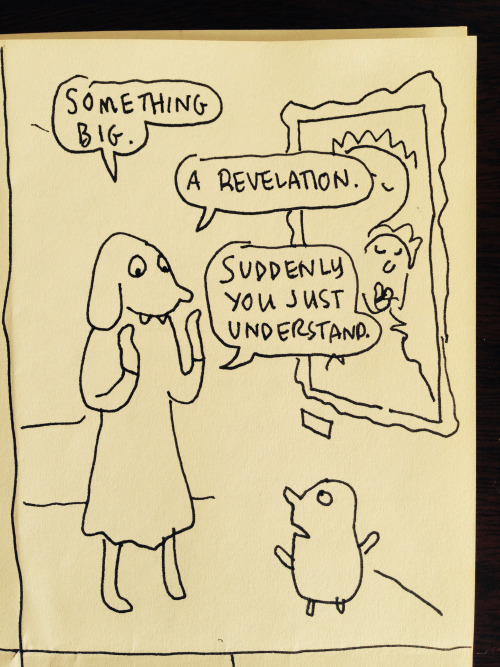
She traces this tendency back forty years, to when she studied with Marilyn Frasca at Evergreen State College. Could Frasca have anticipated what she wrought when she asked the young Barry, “What is an image?”
For Barry, who claims to have spent over forty years trying to answer the above question, there will almost always be an emotional component. In a 2010 interview with The Paris Review, she addressed the ways in which art, visual and otherwise, can fill certain crucial holes:
In the course of human life we have a million phantom-limb pains—losing a parent when you’re little, being in a war, even something as dumb as having a mean teacher—and seeing it somehow reflected, whether it’s in our own work or listening to a song, is a way to deal with it.
The Greeks knew about it. They called it catharsis, right? And without it we’re fucked. I think this is the thing that keeps our mental health or emotional health in balance, and we’re born with an impulse toward it.
No wonder the snaggle-toothed dog woman on Barry’s Tumblr looks so anxious. She craves that elusive something that never much troubled Helen Hockinson’s museum-going comic matrons.
(Had revelation been on the menu, those ladies would have dutifully paged through the most highly recommended guidebook of the day, confident they’d find it within those pages.)
These days, the internet abounds with pointers on how to get the most from art.
Houston’s Museum of Fine Arts lobbies for a four-point method, well suited to classroom discussion.
The Washington Post’s Pulitzer Prize-winning art and architecture critic Philip Kennicott prescribes time and silence.
Another critic, New York magazine’s firebrand, Jerry Saltz, recommends an aggressively tactile approach for those who would look at art like an artist. Get up close. Cop a feel. Try to see how any given piece is made. (He himself is given to contemplating art with his hips thrust forward and head tilted back as far as it will go, in duplication of Jasper Johns’ stance.)
Looking for something more graphic? Abstract Expressionist Ad Reinhardt helped the post-War public get a handle on modern art in his iconic How to Look series.
Former museum educator, Cindy Ingram, the Art Curator for Kids, echoes the spirit of Barry’s sentiment when she states that a child’s interpretation of a work’s meaning is no less valid than Wikipedia’s, the museum’s, or even the artist’s. Adults, don’t squelch a child viewer’s joy of art by telling him or her what to think!
Of course, some of us don’t mind a hint or two to help us feel we’re on the right track. Those in that camp might enjoy the Metropolitan Museum of Art’s 82nd and 5th series, in which expert curators wax rhapsodic about their love of particular works in the collection.
You understand that this is just the tip of the proverbial ‘berg…
Readers, if you have any tips for achieving revelation through art, please share them by leaving a comment below.
And don’t forget to lift your shorter companion up so he can see better.
Barry’s short series of images originally appeared on her Tumblr.
Related Content:
Cartoonist Lynda Barry Shows You How to Draw Batman in Her UW-Madison Course, “Making Comics”
Join Cartoonist Lynda Barry for a University-Level Course on Doodling and Neuroscience
Ayun Halliday is an author, illustrator, and Chief Primatologist of the East Village Inky zine. Follow her @AyunHalliday
Read More...Speak and Read French, by Armand and Louise Bégué
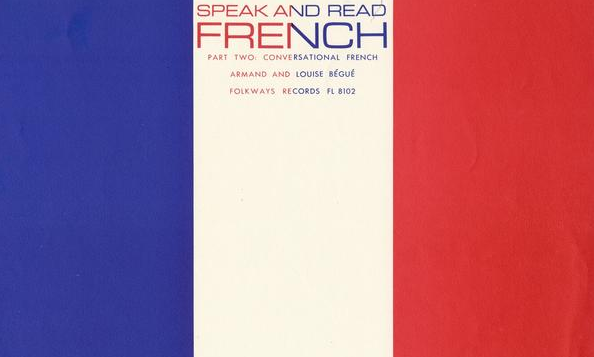
Speak and Read French, Part 1: Basic and Intermediate
“This album is the first of three volumes of a French language course: Speak and Read French, created by Armand Bégué, a professor at Brooklyn College and his wife, Louise Bégué, in 1959. The recording, for basic and intermediate levels, focuses on words and expressions frequently used in French.”
Speak and Read French, Vol. 2: Basic and Intermediate
“This album is the second part of a basic French language lesson developed by Armand Bégué, a professor at Brooklyn College and his wife, Louise Bégué, in 1959. This recording focuses on words and expressions frequently used in French.”
Speak and Read French, Part 3: French Literature
“This album is the third of three volumes in a French language course: Speak and Read French, created by Armand Bégué, a professor at Brooklyn College and his wife, Louise Bégué, in 1959. The speaker reads excerpts from great texts written by famous French authors such as: “Thoughts” by Blaise Pascal, “Discourse on the Method” by René Descartes and “The Wolf and the Stork” by Jean de La Fontaine.”
Find them all in our collection, Free Lessons in Foreign Languages.
Read More...The British Library Digitizes 300 Literary Treasures from 20th Century Authors: Virginia Woolf, T.S. Eliot, James Joyce & More
As a young college student, I spent hours wandering through my university’s library, looking in a state of awe at the number of books contained therein by writers whose names I knew or who seemed vaguely familiar, and by hundreds, thousands, more I’d never heard of. Always content to immerse myself in secluded corners for days on end with a good book, I couldn’t have felt more at home.
The internet was in its infancy, and my online life at the time consisted of awkward, plain-text emails sent once or twice a week and the occasional clunky, slow-loading website, promising much but delivering little. Excitable futurists made extravagant predictions about how hypertext and interactivity would revolutionize the book. These seemed like intriguing but unnecessary solutions in search of a problem.
To the bookish, the book is a perfected technology that cannot be improved upon except by the publishing of more books. While interactive texts—with linked annotations, biographies, historical precis, critical essays, and the like—have much enhanced life for students, they have not in any way improved upon the simple act of reading for pleasure and edification—an activity, wrote Virginia Woolf, requiring nothing more than “the rarest qualities of imagination, insight, and judgment.”
Though Woolf would likely have been unimpressed with all that talk of hypertextual innovation, I imagine she would have marveled at the online world for offering something to the reader we have never had until the past couple decades: free and instant access to thousands of books, from literary classics to biographies to histories to poetry—all genres upon which Woolf offered advice about how to read on their own terms. Without the anxious admissions process and costly tuition, anyone with a computer now has access to a significant portion of the average college library.
And now anyone with a computer has access to a significant portion of the British Library’s rare collections as well, thanks to the venerable institution’s new online collection: “Discovering Literature: 20th Century.”
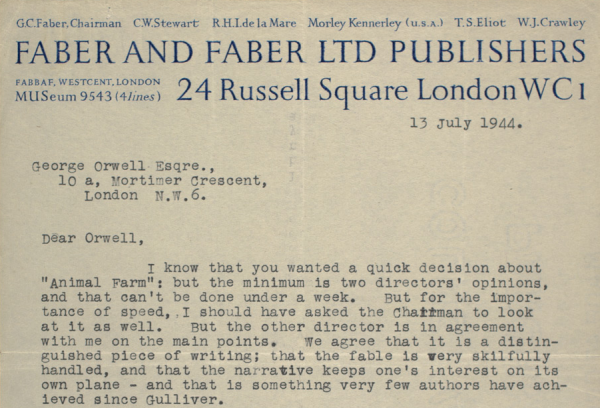
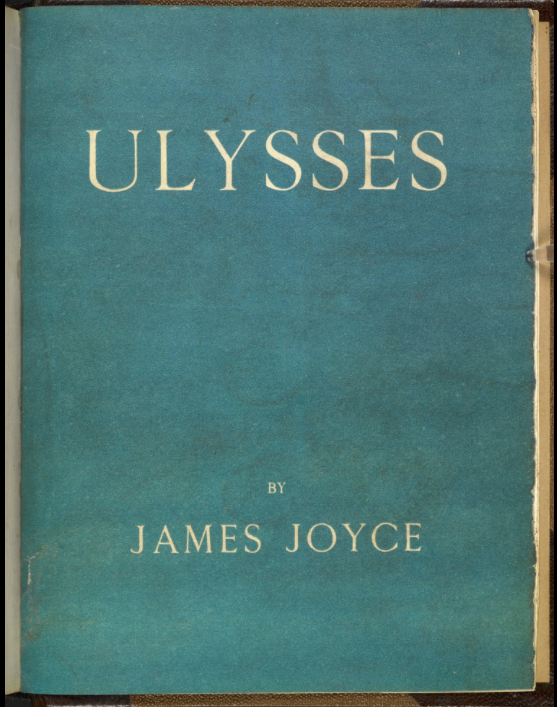
Readers of our site will know of Open Culture’s affinity for 20th century modernist literature, like that of Virginia Woolf, and for the dystopian fiction of George Orwell. These authors and greats of more recent vintage are all well-represented in the British Library collection. You’ll find such treasures as a scanned first edition of James Joyce’s Ulysses, first American edition of Anthony Burgess’ A Clockwork Orange, and first edition of Woolf’s A Room of One’s Own. These are just a few of the classic novels available in the “over 300 treasures” of the collection, writes the British Library.
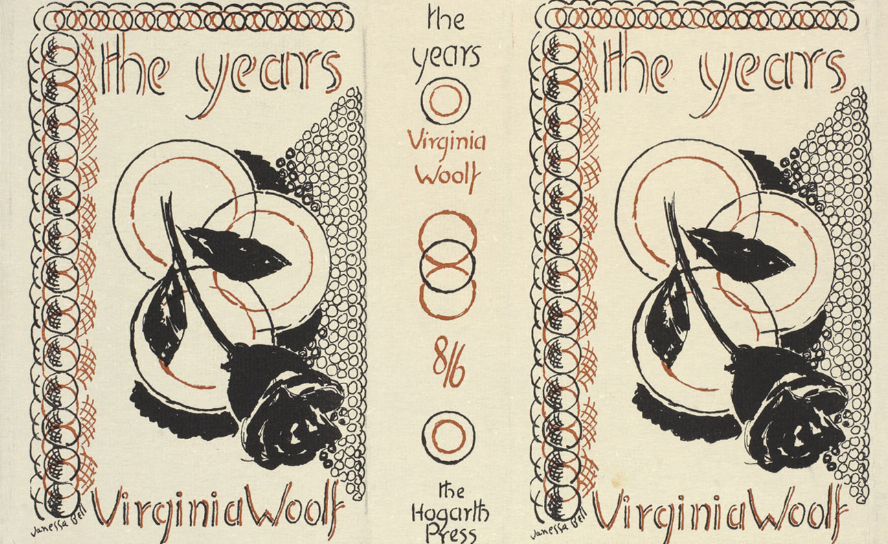
The online library offers a paradise for readers, certainly. And also a heaven for scholars. Included among the rare first editions and critical essays and interviews on the site’s main page are “online for the first time… literary drafts… notebooks, letters, diaries, newspapers and photographs from Virginia Woolf, Ted Hughes, Angela Carter and Hanif Kureishi among others.”
Some incredible highlights include:
- Typescript of T.S. Eliot’s The Waste Land with Ezra Pound’s Handwritten annotations
- George Orwell’s Notes for 1984
- T.S. Eliot’s Faber & Faber Letter Rejecting Orwell’s Animal Farm (featured on Open Culture previously)
- Typescript Second Draft of Sylvia Plath’s The Bell Jar
- Letters on the Printing of James Joyce’s A Portrait of the Artist as a Young Man and Ulysses
- Typescript Notes of J.G. Ballard’s High-Rise, with a Draft of the Novel
- Notebook Drafts of Virginia Woolf’s Mrs. Dalloway
- Notebook of Research and Ideas for Angela Carter’s Wise Children
- Ezra Pound’s 1914 Poetry Anthology Des Imagistes
And as if all this—and so many more 20th century literary treasures—weren’t enough, the collection also tucks in some wonderful artifacts from previous eras, such as a collection of manuscript poems by John Keats, including the Odes and Robert Burton’s encyclopedic 1628 study of depression, The Anatomy of Melancholy.
“Until now,” says Anna Lobbenberg, the Library’s Digital Programmes Manager, “these treasures could only be viewed in the British Library Reading Rooms or on display in exhibitions—now Discovery Literature: 20th Century will bring these items to anyone in the world with an internet connection.” It truly is, for the lover of books, a brave new world (a book whose 1932 original dust jacket you can see here).
Related Content:
Virginia Woolf Offers Gentle Advice on “How One Should Read a Book”
Josh Jones is a writer and musician based in Durham, NC. Follow him at @jdmagness
Read More...Support Us
We're hoping to rely on loyal readers, rather than erratic ads. Please click the Donate button and support Open Culture. You can use Paypal, Venmo, Patreon, even Crypto! We thank you!

About Us

Open Culture scours the web for the best educational media. We find the free courses and audio books you need, the language lessons & educational videos you want, and plenty of enlightenment in between.
Advertise With Us
FREE UPDATES!
GET OUR DAILY EMAIL
Get the best cultural and educational resources on the web curated for you in a daily email. We never spam. Unsubscribe at any time.
FOLLOW ON SOCIAL MEDIA
Open Culture editor Dan Colman scours the web for the best educational media. He finds the free courses and audio books you need, the language lessons & movies you want, and plenty of enlightenment in between.
Advertise With Us


