Ezra Pound’s Fiery 1939 Reading of His Early Poem, ‘Sestina: Altaforte’
In this rare recording from 1939, Ezra Pound gives a passionate reading of his early work about a warmongering 12th century troubadour, a poem called “Sestina: Altaforte.”
The poem was written in early 1909, when Pound was an ambitious 23-year-old American living in London. At that time Pound was in the habit of spending hours every day poring over books in the British Museum reading room.
“I resolved that at thirty I would know more about poetry than any man living,” wrote Pound, “that I would know the dynamic content from the shell, that I would know what was accounted poetry everywhere, what part of poetry was ‘indestructible,’ what part could not be lost by translation, and–scarcely less important what effects were obtainable in one language only and were utterly incapable of being translated.”
In pursuit of this goal, Pound “learned more or less of nine foreign languages.” Among those was Occitan, or Langue d’oc, the language of the medieval troubadours. Pound had become fascinated with the troubadours while studing romance literature at Hamilton College and the University of Pennsylvania. One figure who especially intrigued him was Bertran de Born, the late-12th century nobleman, warrior and troubadour who was immortalized by Dante Alighieri in Canto XXVIII of the Inferno as one of the sowers of discord in Circle Eight, condemned to be hacked to pieces over and over again for his role in fomenting a quarrel between King Henry II of England and his sons Richard II (the “Lionheart”) and Prince Henry. In John Ciardi’s translation of the Inferno, Dante describes the hideous figure of Bertran, his head cut off for the sin of sowing discord between kinsmen:
I saw it there; I seem to see it still–
a body without a head, that moved along
like all the others in that spew and spill.
It held the severed head by its own hair,
swinging it like a lantern in its hand;
and the head looked at us and wept in its despair.
It made itself a lamp of its own head,
and they were two in one and one in two;
how this can be, He knows who so commanded.
Pound would eventually translate several of Bertran’s surviving poems, but he found it difficult. He decided first to write his own poem in the voice of Bertran, incorporating bloodthirsty images from the medieval poet’s own verse and setting the new poem in the 12th century Sestina form, which originated with the troubadours of southern France. In his essay “How I Began,” Pound recalls the composition of “Sestina: Altaforte”:
I had De Born on my mind. I had found him untranslatable. Then it occurred to me that I might present him in this manner. I wanted the curious involution and recurrence of the Sestina. I knew more or less of the arrangement. I wrote the first strophe and then went to the Museum to make sure of the right order of permutations, for I was then living in Langham Street, next to the “pub,” and had hardly any books with me. I did the rest of the poem at a sitting. Technically it is one of my best, though a poem of such a theme could never be very important.
The Sestina is a complex form with 39 lines (six stanzas of six lines each followed by an envoi of three lines) all ending with one of six words that are grouped together in each stanza. For “Sestina: Altaforte,” Pound chose the words “clash,” “crimson,” “opposing,” “rejoicing,” “music” and “peace.” The images of clashing swords and crimson blood earned Pound’s poem the nickname “Bloody Sestina.” It was the first of his poems to make it into Ford Maddox Hueffer’s prestigious English Review. When Pound recited the poem in 1909 at a gathering of poets at a London restaurant, he reportedly put so much passion into his performance that “the table shook and cutlery vibrated in resonance with his voice.”
That same passion can be heard in the recording above, made thirty years later when Pound was visiting America for the first time in 28 years. It was recorded on May 17, 1939 in the Woodberry Poetry Room at Harvard University. For dramatic effect, Pound accompanied himself on a kettledrum. To read the words of “Sestina: Altaforte” as you listen to Pound’s voice, click here to open the text in a new window. And to hear all of Pound’s 1939 recordings, go to PennSound, where you can hear those recordings and many more by Pound.
Read More...Metamorphose: 1999 Documentary Reveals the Life & Work of Artist M.C. Escher
Made in 1999 by Dutch director Jan Bosdriesz, the documentary Metamorphose: M.C. Escher, 1898–1972 takes its title from one of Escher’s more well-known prints in which the word “metamorphose” transforms itself into patterns of abstract shapes and animals. It’s one of those college-dorm prints one thinks of when one thinks of M.C. Escher, and it’s wonderful in its own way. But the documentary reveals other sides of the artist—his art-school days, his sojourn in Italy—that produced a very different kind of work. Escher began as a student of architecture, enrolled in the School for Architecture and Decorative arts in Haarlem by his parents, who struggled to help him find his way after he failed his high school exams.
Once in Haarlem, the lonely and somewhat morose Escher finds himself drawn to graphic art instead. One of his teachers, accomplished Dutch artist Samuel Jessurun de Mesquita, whose influence is evident in Escher’s work and life, sees some of Escher’s linocuts and likes them. In archival footage of an interview with Escher, the artist says that Jessurun de Mesquita asked him, “Wouldn’t you rather be a graphic artist instead of an architect?”
Escher admits, “I wasn’t all that interested in architecture.” It’s a little bit of a surprising admission given Escher’s wild architectural imagination, but perhaps what he meant was that he wasn’t interested in the conventional, but rather in the architecture of the fantastic, the impossible spaces he imagined in much of his work.
We learn other things about Escher: One of his woodcuts from this period is titled “Never Think before You Begin,” showing a lonely figure on a dark and treacherous path with only a tiny light to guide him, a representation of Escher’s decision to pursue graphic art. The narrator informs us that “it took more than thirty years for him to earn enough from his work to live on.” Luckily, as with many artists who struggle for years, Escher had rich parents. We can thank them for their patronage. To give you some idea of Escher’s morbid character, we learn that he chose the topic “Dance of Death” for a three-hour lecture to his fellow art students in Haarlem. Escher told them, “The dance of death and life are two expressions with the same meaning. What else do we do other than dance death into our souls?”
Metamorphose is an impressive documentary, beautifully shot and edited, with a balance of stock footage of the period, interviews with the artist himself, and long, lingering shots of his work. The film covers Escher’s entire artistic life, ending with footage of the artist at work. These “last images” of Escher, the narrator says, “are not gloomy. We see an artist in his studio, doing the things he enjoys,” a man “proud of his success.” At the end of his life, he still honored his teacher, de Mesquita, and the South Italian coast that sheltered him during his formative years.
Related Content:
Mathematics Made Visible: The Extraordinary Art of M.C. Escher
Inspirations: A Short Film Celebrating the Mathematical Art of M.C. Escher
Josh Jones is a doctoral candidate in English at Fordham University and a co-founder and former managing editor of Guernica / A Magazine of Arts and Politics.
Read More...The Wire Re-Imagined as a Classic Video Role-Playing Game
If someone has insistently recommended that you watch the whole of The Wire, David Simon’s television series of Baltimorean institutional dysfunction, that person has — let’s face it — probably been a thirtyish white guy. But we thirtyish white guys do have our isolated moments of cultural astuteness, of which, according to all the legitimate critics, enthusing over The Wire counts as one. But we also go into voluptuous Proustian raptures at the sight of our favorite old video games, so you’d do well to take us with a grain of salt. The above video from CollegeHumor, a site that knows its audience, transposes the socially critical, borderline-nihilistic action of The Wire into the pixel-intensive, usually morally simplistic form of a console role-playing game from the late eighties or early nineties. This will make a certain overlap in the cultural Venn diagram quite excited indeed, and no doubt provide a source of strange fascination to the rest.
The player takes the role, for the most part, of troubled Baltimore Police Department Detective Jimmy McNulty, whose equippable items include “gun,” “badge,” “whiskey,” and “hair gel.” When he elects to “fight the system,” a turn-based battle launches, pitting McNulty against the system’s literal embodiment, a phalanx of invincible bureaucrats. The game renders a drug deal as the kind of store you’d visit in The Legend of Zelda. Items available: “crack,” “heroin,” and “mana potion.” One stage even turns into something of a graphic adventure, where the player, in search of evidence, clicks commands like “inspect,” “take,” and “hit,” although every possible action seems to result in nothing more than cursing from either McNulty or his partner Bunk Moreland. Clearly, this video contains a wealth of laughs for the Wire (or vintage role-playing game) diehard. If you’ve put off getting into the show, perhaps the prospect of getting these inside jokes will convince you to take the plunge. And putting in a few hours with the early Final Fantasy titles won’t hurt.
Related Content:
The Wire as Great Victorian Novel
Bill Moyers with The Wire’s David Simon
The Wire: Four Seasons in Four Minutes
Colin Marshall hosts and produces Notebook on Cities and Culture. Follow him on Twitter at @colinmarshall.
Read More...The Second Known Photo of Emily Dickinson Emerges
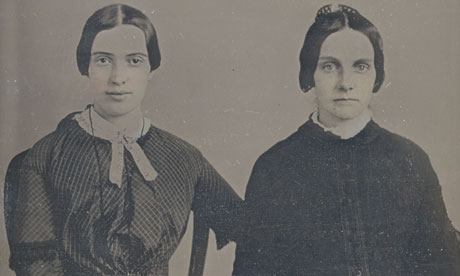
 Until now, we’ve only had one authenticated photo of the nineteenth century poet, Emily Dickinson (1830–1886). The photo (above), taken when she was only 16 years old, shows Dickinson as a youngster in high school circa 1847, well before her literary career came into full bloom. That has been the only visual trace of her to date.
But now, as The Guardian reports, Amherst College thinks it has discovered an 1859 daguerreotype showing the poet with her friend Kate Scott Turner. When this newly-discovered image was taken, Emily (on the left below) was 28 years old and likely writing her mysterious master letters, as one Metafilter reader points out.
Poems by Emily Dickinson can be found in our collection of Free eBooks and Free Audio Books, along with lots of other great works.
Herbie Hancock: All That’s Jazz!

“I think I was supposed to play jazz,” says Herbie Hancock. Hancock is one of the most noted jazz musicians of all time. He was born in Chicago in 1940, and it became apparent early on that he was a child piano prodigy. Herbie performed a Mozart piano concert with the Chicago Symphony Orchestra at age 11, then started playing jazz in high school and later double-majored in music and electrical engineering at Grinnell College. His fascination with musical gadgets led him to become one of the first jazz pianists to work with electronic keyboards. And his landmark albums blurred the boundaries of music, effortlessly mixing jazz with funk, soul, rhythm and the blues, forever changing the face of jazz. As Miles Davis once said, “Herbie was the step after Bud Powell and Thelonious Monk, and I haven’t heard anybody yet who has come after him.”
The documentary above — Herbie Hancock: All That’s Jazz — was produced for KCET’s signature news series “SoCal Connected.” It retraces the most important steps in Hancock’s career and shows us his home, the office where his award-winning music is composed and his private rituals. Very few people know that Herbie is a very religious person — he has been a practicing Buddhist for over forty years.
Bonus material:
- Correspondent Michael Okwu shares what it was like to spend time with Herbie Hancock.
- A wonderful performance of Herbie’s famous “Canteloupe Island” with Pat Metheny.
By profession, Matthias Rascher teaches English and History at a High School in northern Bavaria, Germany. In his free time he scours the web for good links and posts the best finds on Twitter.
Read More...
Ray Bradbury: “The Things That You Love Should Be Things That You Do.” “Books Teach Us That”
“I suppose you’re wondering why I’ve called you all here,” says Ray Bradbury above, in a lengthy interview with the The Big Read project sponsored by the National Endowment for the Arts. Breaking the ice with this stock phrase, Bradbury–author of Fahrenheit 451, The Illustrated Man, The Martian Chronicles, and several dozen more fantasy and sci-fi novels and short story collections (and some truly chilling horror)–begins to talk about… Love. Specifically a love of books. “Love,” he says, “is at the center of your life. The things that you do should be things that you love, and the things that you love, should be things that you do.” That’s what books teach us, he says, and it becomes his mantra.
Bradbury, who passed away in June, was certainly an early inspiration for me, and several million other bookish kids whose warmest memories involve discovering some strange, life-altering book on the shelf of a library. As he recounts his childhood experiences with books, he’s such an enthusiastic booster for public libraries that you may find yourself writing a check to your local branch in the first ten minutes of his talk. And it’s easy to see why his most famous novel sprang from what must have been a very pressing fear of the loss of books. Bradbury was largely self-taught. Unable to afford college, he pursued his fierce ambition to become a writer immediately out of high school and published his first short story, “Hollerbochen’s Dilemma,” at the age of nineteen. As he says above, he became a writer because, “I discovered that I was alive.” But I’m not doing it justice. You have to watch him tell it to really feel the thrill of this epiphany.
The Big Read’s mission is to create a “Nation of Readers,” and to do so, it posts free audio guides for classics such as Bradbury’s Fahrenheit 451, Hemingway’s A Farewell to Arms, and Fitzgerald’s The Great Gatsby. They also feature video interviews with other authors, like Amy Tan, Ernest J. Gaines, and Tobias Wolff. Each of the interviews is fantastic, and the readers’ guides are superb as well. Bradbury’s, for example, narrated by poet and author Dana Gioia, also features sci-fi giants Orson Scott Card and Ursula K. Le Guin, as well as several other writers who were inspired by his work.
Related Content:
Ray Bradbury Gives 12 Pieces of Writing Advice to Young Authors (2001)
Ray Bradbury: Literature is the Safety Valve of Civilization
Josh Jones is a doctoral candidate in English at Fordham University and a co-founder and former managing editor of Guernica / A Magazine of Arts and Politics.
Read More...Henry Rollins Pitches Education as the Key to Restoring Democracy
Henry Rollins had dropped out of college and was working at a Haagen-Dazs in Washington, DC when he joined the seminal L.A. hardcore punk band Black Flag in 1981, a career move that would shape the rest of the singer/author/actor/activist’s life. And although he left higher education for a more individualized path, Rollins has a very high regard for the potential of a good education to change people’s lives.
We’ve previously featured Rollins’ motivational Big Think talk to young people on the dangers of resentment. In the short, but equally inspiring, talk above–from the same set of interviews–Rollins describes education as the engine of a democratic society, “the great equalizer.” For Rollins, education is the key to a “more vigorous democracy.” And although he makes some arguable claims about the possibility of educational reform to substantially diminish the effects of institutionalized racism and poverty, his view of what an education should be corresponds to what educational reformers have stressed for decades—that moving to a focus on critical thinking, rather than “teaching to the test,” is a shift that needs to happen in order for students to become curious, intentional, and independent learners and, ultimately, free and independent citizens.
Rollins speculates that certain political actors and vested interests deliberately block educational reform to maintain the status quo. Whether or not you accept his analysis, there’s no denying that the state of primary, secondary, and higher education in the U.S. is dire, and the functional efficacy of our democratic process seems constantly in jeopardy. Alluding to the dictum attributed to Thomas Jefferson (who may not have actually written this) that “An educated citizenry is a vital requisite for our survival as a free people,” Rollins believes that educational reforms offer “the way out” of our current political gridlock and of the despairing situations underprivileged people are born into. I think he makes a pretty compelling case in just under four minutes.
Josh Jones is a doctoral candidate in English at Fordham University and a co-founder and former managing editor of Guernica / A Magazine of Arts and Politics.
Read More...Mnozil Brass: Europe’s Most Imaginative Brass Band
Here’s something fun. And a bit weird. Mnozil Brass is an Austrian septet that combines musical virtuosity with absurdist theatre. The group’s name means “nozzle,” and refers to the Mnozil Pub, a little place near the Vienna College of Music where the founding members used to get together to drink and play music. Since forming in 1992, and the group’s entertaining mixture of music and clowning has grown steadily in popularity. Above is a skit called “Slow Motion” from Mnozil Brass’s new DVD, Magic Moments. Think of it as a sort of “spaghetti western music recital.” There are several more samples below, to give you a sense of the lunacy:
The William Tell Overture:
Lonely Boy:
Bohemian Rhapsody:
Read More...
Kids (and Less Savvy Marketers) Imagine the Internet in 1995
In 1995, a group of 5th grade kids in Helena, Montana got together and made a PSA for the Internet (above). And, man, were they hip, with their techno music and their “by the time I’m in college, the internet will be your telephone, television, and workplace.” In the annals of overblown predictions and technological hubris, mid-nineties internet-fever will go down as the ultimate exception. These kids even anticipated the cute cat mania that would infect the internet forever. Of course, none of them could have foreseen the Twitter revolution, the Facebook decline, rubbable gifs, or spherical panoramic views of Mars, but that’s just quibbling.
It really is astonishing to look back a mere seventeen years at what a primitive technology the internet was. Of course it wasn’t necessarily evident at the time that the online world would indeed become our “telephone, television, and workplace,” and some naysayers, like astronomer and hacker-catcher Clifford Stoll, called BS on the hype. In a 1995 Newsweek article titled “The Internet? Bah!,” Stoll wrote:
The truth is no online database will replace your daily newspaper, no CD-ROM can take the place of a competent teacher and no computer network will change the way government works.
In 2010, Stoll was forced to retract, commenting on Boing Boing coverage of his sourpuss skepticism with:
“Of my many mistakes, flubs, and howlers, few have been as public as my 1995 howler.
But who could blame him? This was the age of such clunky Web services as AOL, which promises much in a 95 ad below, but ultimately delivered little.
Not all web advertising in 1995 looks so dated and silly. AOL’s competitor Prodigy, which fared even worse, certainly had a better ad agency. Their 95 ad below, featuring Barry White, is a romp.
All of this reflection warrants more wisdom from a chastened Clifford Stoll, who in a 2006 TED talk says: “If you really want to know about the future, don’t ask a technologist, a scientist, a physicist. No! Don’t ask somebody who’s writing code. No, if you want to know what society’s going to be like in 20 years, ask a kindergarten teacher.”
via Prefix
Josh Jones is a doctoral candidate in English at Fordham University and a co-founder and former managing editor of Guernica / A Magazine of Arts and Politics.
E.M. Forster: Why I Stopped Writing Novels (1958)
E.M. Forster’s later years are something of a riddle. After publishing five novels, including the classics A Passage to India and Howards End, Forster stopped writing fiction at the age of 45. He lived quietly for another 46 years and continued to write essays, short biographies and literary journalism — but no more novels.
The issues behind it are complicated, says Forster in this excerpt from a 1958 BBC interview. “But I think one of the reasons why I stopped writing novels,” he says, “is that the social aspect of the world changed so very much. I’d been accustomed to write about the old vanished world with its homes and its family life and its comparative peace. All of that went. And though I can think about it I cannot put it into fiction form.”
At the time of the interview Forster was an honorary fellow at King’s College, Cambridge, where he lived the final 24 years of his life. He speaks of his life at Cambridge, and of his own limitations as a writer, with a sincerity and humanity that readers will recognize from his books.
Read More...Support Us
We're hoping to rely on loyal readers, rather than erratic ads. Please click the Donate button and support Open Culture. You can use Paypal, Venmo, Patreon, even Crypto! We thank you!

About Us

Open Culture scours the web for the best educational media. We find the free courses and audio books you need, the language lessons & educational videos you want, and plenty of enlightenment in between.
Advertise With Us
FREE UPDATES!
GET OUR DAILY EMAIL
Get the best cultural and educational resources on the web curated for you in a daily email. We never spam. Unsubscribe at any time.
FOLLOW ON SOCIAL MEDIA
Open Culture editor Dan Colman scours the web for the best educational media. He finds the free courses and audio books you need, the language lessons & movies you want, and plenty of enlightenment in between.
Advertise With Us


