Has Science Refuted Religion? Sean Carroll and Michael Shermer vs. Dinesh D’Souza and Ian Hutchinson
Just yesterday, I sat across from a fellow wearing a t‑shirt emblazoned with the image of a gun-wielding Jesus blowing away Charles Darwin above the words “EVOLVE THIS!” At first I assumed he wore it to emphatically signal his belief that religion, specifically Christianity, refutes science, specifically biological evolution. Then, remembering that Jesus probably wouldn’t have used a handgun even had they been available in his day, I took the shirt as a mockery of the blunter varieties of creationist rhetoric. Looking it up later, I found out that the shirt comes from the movie Paul, so the wearer probably meant nothing more than to express his appreciation for what I understand to be one of 2011’s most underrated comedies. Yet the question lingers: has science refuted religion, or is it the other way around? The internet age provides us access to a virtually unlimited number of these debates, although you’ll often search in vain for matches of cogent, well-articulated arguments. Just take a look at the science-religion squabbles currently roiling in YouTube comment sections. Keep out of the comments, then, and stick to the videos, such as the debate above. In two hours comprising short segments of argument, rebuttal, cross-examination, and audience questions, the program pits Skeptic magazine publisher Michael Shermer and Caltech cosmologist Sean Carroll against MIT physicist Ian Hutchinson and King’s College president Dinesh D’Souza. In an unusually orderly, well-disciplined debate of this type, all four weigh in on one central proposition: “Has science refuted religion?” Carroll says that science, a “reality check” on human biases, offers the only explanations that work. Hutchinson blames not science but something he calls “scientism,” a belief in the absolute supremacy of scientific knowledge, for a variety of social and intellectual ills. Shermer describes religious belief as an evolutionarily determined characteristic of human beings, and an increasingly useless one at that. D’Souza upbraids science for failing not only to find answers to questions about human purpose and life’s meaning, but for throwing up its hands when presented them. All this offers a good bit of human drama as well, but in good fun; when I interviewed Shermer, a habitué of such debates, he mentioned often enjoying taking his ostensibly sworn intellectual enemies to beers and pizza afterward. Related Content: Richard Dawkins & John Lennox Debate Science & Atheism Does God Exist? Christopher Hitchens Debates Christian Philosopher William Lane Craig Animated: Stephen Fry & Ann Widdecombe Debate the Catholic Church Colin Marshall hosts and produces Notebook on Cities and Culture. Follow him on Twitter at @colinmarshall.
Read More...Bob Egan, Detective Extraordinaire, Finds the Real Locations of Iconic Album Covers
By day, Bob Egan is a mild-mannered commercial real estate agent in New York City. By night, and on weekends, he transforms himself into something of a pop culture detective, searching out the locations of famous record album covers and other famous pop images. About a year ago he started a Web site, PopSpotsNYC, to share his findings, and the site has been growing in popularity ever since.
Egan’s fascination with album cover locations began in 1977, when he moved to his first apartment in Greenwich Village and discovered he was only a block away from the place on Jones Street where The Freewheelin’ Bob Dylan cover photograph was shot in 1963, which showed Dylan walking arm-in-arm with his girlfriend, Suze Rotolo, on a cold February day.
“Living in Greenwich Village in the late 70s,” Egan told Open Culture, “I was surrounded by sites I had read about in college: Bleecker and Macdougal, The Bottom Line, the Mudd Club, CBGB’s, etc. I was soaking up information for years later, I guess, because it wasn’t until the mid 90s that I first went into Bleecker Bob’s and asked if they knew where the cover of Blonde on Blonde was shot. When they didn’t know, I said, Well why not find out myself?”
The Blonde on Blonde location remains a mystery, but Egan has tracked down a number of other Dylan cover locations, including Highway 61 Revisited (the front steps of a town house on Gramercy Park West), Another Side of Bob Dylan (the corner of 52nd Street and Broadway), and the single “I Want You” (a warehouse district on Jacob Street that was torn down long ago).
The Jacob Street location, also the site of a July 30, 1966 Saturday Evening Post cover of Dylan, was one of the hardest to find. “I searched through every curved street in New York and finally found it online in an old photo from the library,” Egan said. “The entire street, which was next to the Brooklyn Bridge, had been demolished 50 years ago, but I finally clicked on a library image and found myself staring straight into the exact spot Dylan was in the photo. I let out a whoop!”
Egan has found the exact locations of record albums and other famous images of a number of artists, including Bruce Springsteen, Neil Young, The Who, and Simon & Garfunkel. The choices reflect his taste in music. “I grew up during the classic rock era,” Egan said. “My ‘musical comfort food’ is Dylan, Van Morrison, Lou Reed, and The Grateful Dead.”
Even though the Grateful Dead was a West Coast group, Egan makes use of online tools like Google Street View and Bing Bird’s Eye to explore locations from his New York home. The 1970 album “Workingman’s Dead” is one of Egan’s current projects. “The Dead photo was supposedly taken next to a bus stop in the Mission District of San Francisco,” said Egan. “I bought a vintage map of the bus route from 1969 from the San Francisco transit museum and searched all the bus routes through the Mission with Street View, but still haven’t found it.”
When we asked Egan what drives his obsession, he said, “I think of it like this: If I went to England and someone asked me if I wanted to see Westminster Abbey or Abbey Road, I’d take Abbey Road.”
Below are several examples of Egan’s detective work. To see more, and to read the story behind each location, visit PopSpotsNYC.com.
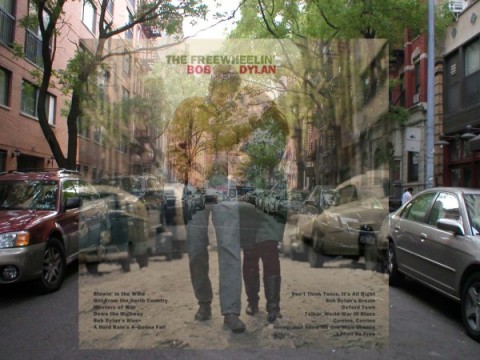
The album cover that started it all for Egan was The Freewheelin’ Bob Dylan, featuring Don Hunstein’s photo of Dylan and his girlfriend Suze Rotolo walking through snow at the north end of Jones Street, in Greenwich Village.
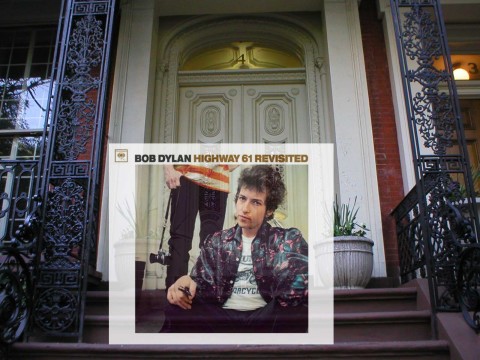
The location of the cover photo of Dylan’s 1965 album Highway 61 Revisited posed a challenge. Egan always assumed that Daniel Kramer’s photo of Dylan was taken indoors, but he eventually tracked it down to the front steps of a town house on Gramercy Park West that was the home of Dylan’s manager, Albert Grossman. The person standing behind Dylan in the photo, holding a camera by its strap, is the singer’s friend Bob Neuwirth.

What could be more British than the 1979 cover of The Kids Are Alright, by The Who? Actually, Art Kane’s photo was taken in America, at the little-known Carl Schurz Monument in the Morningside Heights area of New York City. Egan gives directions on how to find the place at his Web site.
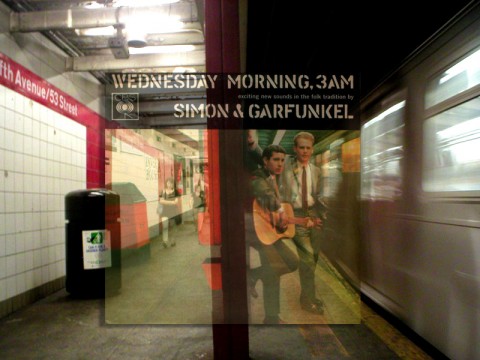
Egan found the precise location of Henry Parker’s cover photo for Simon & Garfunkel’s 1965 debut album, Wednesday Mourning 3 A.M.: the lower subway platform at Fifth Avenue and 53rd Street, for the outbound E and F lines.
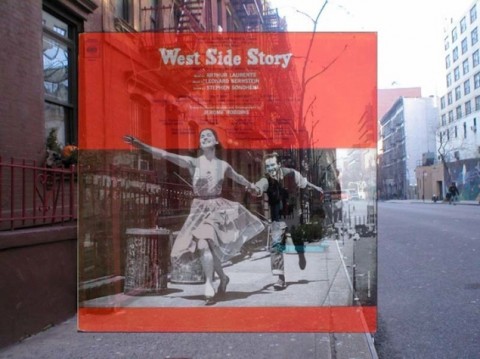
Leo Friedman’s cover photograph from the original 1957 cast recording of West Side Story shows characters Maria (Carol Lawrence) and Tony (Larry Kent) running through the Hell’s Kitchen neighborhood of New York. The location was actually one of Egan’s easier discoveries. “How did I find it,” he says on his Web site? “Pretty simple. If you look closely at the garbage can to the left of Maria–the address is right on it! 418 West 56th Street.” (All images courtesy Bob Egan/PopSpotsNYC.com)
Read More...T.S. Eliot Reads His Modernist Masterpieces “The Waste Land” and “The Love Song of J. Alfred Prufrock”
Did you know T.S. Eliot’s portentous and heavily allusive 1922 masterpiece “The Waste Land” was originally titled “He Do the Police in Different Voices,” a quote from Charles Dickens’ Our Mutual Friend? Filled with references to Dante’s Divine Comedy, Joseph Conrad’s Heart of Darkness, and James Frazier’s The Golden Bough, this most famous of high modernist poems—scourge of millions of college freshman each year—was a very different animal before notorious modernist impresario Ezra Pound got his hands on it. Pound’s heavy reworking is responsible for the poem you hear above, read by Eliot himself. The first image in the video shows Pound’s marginal annotations.
In the video above listen to Eliot read his second-most famous work, “The Love Song of J. Alfred Prufrock,” with the text of the poem choreographed by Wordookie, an open-source version of Wordle. “Prufrock,” first published in 1915, is as dense with literary allusions as “The Waste Land” (and thus as painful for the average undergraduate). And if Eliot’s reedy alto doesn’t deliver “Prufrock“ ‘s gravitas for you, listen to Anthony Hopkins read it here.
You can find these poems catalogued in our collection of 700 Free Audio Books and 800 Free eBooks.
If you would like to support the mission of Open Culture, consider making a donation to our site. It’s hard to rely 100% on ads, and your contributions will help us continue providing the best free cultural and educational materials to learners everywhere. You can contribute through PayPal, Patreon, and Venmo (@openculture). Thanks!
Related Content:
Rare 1959 Audio: Flannery O’Connor Reads ‘A Good Man is Hard to Find’
Rare Recording: Leo Tolstoy Reads From His Last Major Work in Four Languages, 1909
Nabokov Reads Lolita, Names the Great Books of the 20th Century
Read More...The Rolling Stones First Played 50 Years Ago; Watch Them Explode Into Fame Shortly Thereafter
Just four days ago, the Rolling Stones celebrated the fiftieth anniversary of their first concert, which happened on July 12, 1962 at London’s Marquee club. Articles have quoted lead singer Mick Jagger as describing the crowd that evening as the kind of audience they’d expected as a band: “college students having a night out,” an “art-school kind of crowd” who “weren’t particularly demonstrative, but they appreciated and enjoyed the set.” But the Stones’ demographic would soon both shift and expand dramatically: “A few months later we were playing in front of 11 year olds who were screaming at us.” You can witness this very phenomenon in the 1964 newsreel above; perhaps all of the kids lined up outside the theater aren’t quite that young, but we’re definitely not looking at a collegiate crowd. Still, what this full house (“in fact,” the narrator says, “it could have been filled ten times over”) lacks in maturity, they make up for in raw enthusiasm.
This short film comes from British Pathé, then known as Pathé News, a producer of newsreels from the very early twentieth century right up to the seventies. They captured the Stones performing in 1964, after they had already racked up a considerable degree of fame, especially in their own country. The show itself takes place in Kingston upon Hull, a medium-sided city in the northeast of England. Summoning the surprising sense of fun that mid-sixties English media sometimes could when covering popular culture, this newsreel, called Rolling Stones Gather Moss, opens with Jagger, Keith Richards, Brian Jones, Charlie Watts, and Bill Wyman trying to hitch a ride alongside the grassy road to the venue. “Little do they know, they’re having their legs pulled,” the announcer says of the unhesitating motorists, “because these apparent hitchhikers, so blandly ignored, are five of the most famous young men in show business, the Rolling Stones. Some of these motorists will be kicking themselves when they learn they missed the chance of a lifetime of getting to know them.” But the historical moment remains captured on film, as do countless others, among the 90,000 clips in Pathé’s online archive.
Related content:
The Rolling Stones Sing Jingle for Rice Krispies Commercial (1964)
Jean-Luc Godard Films The Rolling Stones Recording “Sympathy for the Devil” (1968)
The Rolling Stones Jam With Their Idol, Muddy Waters
John Lennon and The Rolling Stones Sing Buddy Holly
Colin Marshall hosts and produces Notebook on Cities and Culture. Follow him on Twitter at @colinmarshall.
Read More...Henry Rollins Remembers the Life-Changing Decision That Brought Him From Häagen-Dazs to Black Flag
Metafilter recently featured this Big Think clip of Henry Rollins telling the story of his most life-changing decision. This choice, of course, was the one that brought him to the front of punk rock band Black Flag. Before he made it, he could call himself only a college dropout assistant-managing a Washington, D.C. Häagen-Dazs. In 1981, after catching one of Black Flag’s New York shows — during which he happened to climb onstage and sing a song with them — he decided to try out to become the group’s actual singer. When Rollins ditched the ice cream game for the day (a forfeit, he recalls, of no more than $21) to audition, Black Flag went from his favorite band to his band. Thinking back, he realizes he had little to lose: if he didn’t give it a shot, he’d find himself looking down the barrel of a long, hard existence on his feet, answering to customers all day, every day. If he gave it a shot and didn’t make it, he’d at worst feel humiliated, but, as he puts it, “humiliation and young people kind of go together.”
“I don’t have talent,” Rollins insists. “I have tenacity. I have discipline. There was no choice for me but to work really hard.” You may recall him making a similar point in his previous Big Think video we featured, in which he recommended going at one’s pursuits with a “monastic obsession.” But this time, he adds a note of fear. He talks about coming to understand that, without relying on his four pillars of “application, discipline, focus, repetition,” an entity he calls “the America” would have gotten the better of him. This term seems to refer to the constant threat of crushing mediocrity he feels in the United States. “Every moment I am alive is because I have not been murdered by the America,” he says in another interview. “The tasks I set out for myself are what I do to beat the perfect pointlessness of life.” Even if you don’t conceive of your own situation quite so grimly, Rollins offers a perspective worth considering. Perhaps his recruitment into Black Flag strikes you as a lucky break; he certainly considers it one. But as Brian Eno, another cultural figure as well known for his point of view as his music, once said, “Luck is being ready.”
Related content:
Colin Marshall hosts and produces Notebook on Cities and Culture. Follow him on Twitter at @colinmarshall.
Read More...Does God Exist? Christopher Hitchens Debates Christian Philosopher William Lane Craig (2009)
When we talk about religion around here, we often end up talking about something that falls between agnosticism and atheism. That’s because public intellectuals who comment on religion frequently fall into those camps. Here and there, theists politely call us on it. They ask us to consider showing The Four Horsemen (Hitchens/Dawkins/Dennett/Harris) in meaningful conversation with religious thinkers. It would be a step toward creating some balance, they say. We’ve done some of that before. But it has been a while. So we’re bringing you today the 2009 debate between Hitchens and William Lane Craig, a Christian philosopher. It was held at Biola College, a school that offers a “Biblically Centered Education,” which puts Craig on the home court.
The basic question framing the debate is “Does God Exist?,” and the answers are all grounded in philosophy, though that didn’t stop the conversation from veering into biology, physics, cosmology, and moral theory. You might be surprised that Hitchens doesn’t take the strident atheist position that would have let more sparks fly. No, he ends up in a more agnostic place, and there’s a kind of a humility to his position, an acceptance that we just can’t know the answers to the big questions, at least not yet. That speaks to me intellectually. But I’m sure others will see things differently.
If you’re hungering for more, you can watch Craig debate Sam Harris here. We thank Taylor for sending these videos along.
Read More...Jon Stewart’s William & Mary Commencement Address: The Entire World is an Elective
In 1984, Jon Stewart graduated from The College of William & Mary. In 1999, he began hosting Comedy Central’s news program The Daily Show. In 2004, he returned to his alma mater, immeasurably more influential than he’d left it, to give its commencement address. Despite a dated crack or two — this was the heyday of George W. Bush, the President who arguably gave Stewart’s Daily Show persona both its foil and raison d’être — the speech’s core remains sound. You, Stewart tells the massed graduates, have the power to become the next “greatest generation,” though the chance appears especially clear and present because of how the last generation “broke” the world. “It just kind of got away from us,” he half-jokes, his grin compressed by seriousness. That admission follows a stream of self-deprecation hitting everything from his tendency toward profanity to his unusually large head as an undergraduate to how his presence onstage devalues William & Mary’s very reputation.
Whether or not you find the world broken, or whether or not you believe that a generation could break or fix it, Stewart still packs a number of worthwhile observations about the place into fifteen minutes. He perhaps delivers his most valuable words to these excited, anxious school-leavers when he contrasts the world to the academic environment they’ve just left: “There is no core curriculum. The entire place is an elective.” Stewart communicates, as many commencement speakers try to but few do so clearly, that you can’t plan your way directly to success in life, whatever “success” might mean to you. He certainly didn’t. “If you had been to William and Mary while I was here and found out that I would be the commencement speaker 20 years later, you would be somewhat surprised,” he admits. “And probably somewhat angry.”
Related content:
Conan O’Brien Kills It at Dartmouth Graduation
Jon Stewart: Teachers Have it Too Good (Wink)
‘This Is Water’: Complete Audio of David Foster Wallace’s Kenyon Graduation Speech (2005)
Colin Marshall hosts and produces Notebook on Cities and Culture. Follow him on Twitter at @colinmarshall.
Read More...
Rare Color Footage of the 1939 World Series: Yankees v. Reds
The 1939 World Series wasn’t much of a contest. The Yankees, led by Joltin’ Joe DiMaggio in center field, had won the last three championships. And they won this contest rather easily too, sweeping the Cincinnati Reds in four straight games. Yesterday, members of the Reddit community unearthed some rare color footage of the ’39 Series. In it, we catch glimpses of the Old Yankee Stadium, the actual House That Ruth Built; pitchers doing a different kind of windup; and a reminder that you could once buy five razors for 25 cents. Find more information on those at the Internet Museum of Safety Razors.
Related Content:
Princeton v. Yale, 1903: The Oldest College Football Game on Film
Lou Gehrig, Yankee Legend, Stars in 1938 Western Rawhide
Read More...The First Films of Great Directors: Kubrick, Coppola, Scorsese, Tarantino & Truffaut
Great directors — unless they’re Orson Welles — rarely start off making masterpieces. Their craft evolves, reminding us that great filmmaking (like everything else) takes talent, but also hard work. In case you’re doubtful, we’re presenting the first films by five iconic directors, all featured here before, but never brought together into one place. Some first films are downright choppy; some are workmanlike; some are more refined. But none exactly soar to cinematic heights. Above, we start you off with Quentin Tarantino’s 1987 debut film My Best Friend’s Birthday, a choppy production that has something unmistakably Tarantinoesque about it, according to Colin Marshall.
In some sense, [My Best Friend’s Birthday] bears an even deeper imprint of Tarantino’s personality than his subsequent films [Pulp Fiction, Reservoir Dogs], since he stars in it as well. To behold the early-twentysomething Tarantino portraying the good-hearted and aggressively enthusiastic but jittery and distractible rockabilly DJ Clarence Poole is to behold the Quentin Tarantino public persona in an embryonic form, a distilled form — or both.
Long before Francis Ford Coppola shot Apocalpyse Now and The Godfather in the 1970s, he made his real directorial debut with a 75-minute, black-and-white psychological horror film called Dementia 13 (1963). He had made a couple of small-time nudie films before that. But this was his first mainstream, legit effort.
As Colin, our resident film critic has noted here, “To watch Dementia 13 now is to witness Coppola’s control of tension and darkness in its embryonic — but still impressive — form. Nobody involved in the production could have deluded themselves about its goal of shooting a few maximally gruesome axe murders as quickly and cheaply as possible, but even such straitened circumstances allow for pockets of artistry to bubble through.”
When you think Coppola, you think Scorsese too, another director who put his stamp on 1970s and 1980s cinema with Mean Streets, Taxi Driver, Raging Bull, and Goodfellas. We recently revisited Scorsese’s NYU film school days during the early 1960s, when he first cut his teeth as a director. We showed you several of his early shorts (find them all here), but highlighted one of his earliest works, What’s a Nice Girl Like You Doing in a Place Like This (1963). Scorsese would later describe the film as “nine minutes of visual nonsense,” while also saying “it had no depth at all, but it was a lot of fun. And it won me a scholarship, so my father was able to use it for the tuition for the next year.”
Whereas Martin Scorsese went to NYU and leisurely studied the history and aesthetics of cinema, Stanley Kubrick, a poor student, skipped college, started working as a photographer for Look magazine, and eventually began making movies to eke out a living. In the early 1950s, Kubrick started shooting newsreel documentaries, hoping to turn a tidy profit. And here you’ll find his first effort, Day of the Fight, a 1951 noirish documentary on middleweight boxer Walter Cartier and his match with Bobby James. It’s a workmanlike film, yes. But not exactly an obvious prelude to 2001: A Space Odyssey and A Clockwork Orange. Mike Springer has more on Kubrick’s early documentaries here.
The 1957 film, Les Mistons (The Brats), was technically François Truffaut’s second film but the first that ever satisfied him. Senses of Cinema has elsewhere called it “the director’s first short film of any real consequence.” Relative to the early efforts of other directors, this short demonstrates a more mature set of filmmaking skills, the kind that would be on display two years later when Truffaut released Les quatre cents coups (The 400 Blows), one of the defining films of French New Wave cinema. Colin Marshall takes a closer look at Les Mistons right here.
If you would like to support the mission of Open Culture, consider making a donation to our site. It’s hard to rely 100% on ads, and your contributions will help us continue providing the best free cultural and educational materials to learners everywhere. You can contribute through PayPal, Patreon, and Venmo (@openculture). Thanks!
Read More...Neil Gaiman Gives Graduates 10 Essential Tips for Working in the Arts
Neil Gaiman, considered one of the top ten living post-modern writers, never went to college. He neither started nor finished his advanced studies, but rather put himself into the world and started writing. And write he did. He’s now the New York Times bestselling author of the novels Neverwhere, Stardust, and American Gods, among others, and he’s also the winner of the 2009 Newbery Medal and 2010 Carnegie Medal in Literature. (We have gathered free versions of Gaiman’s writing in audio & text here.) This weekend, Gaiman spoke at The University of the Arts in Philadelphia and told the graduating class all the things he wish he knew at their age. The talk runs 19 minutes. The distilled version appears below.
- Embrace the fact that you’re young. Accept that you don’t know what you’re doing. And don’t listen to anyone who says there are rules and limits.
- If you know your calling, go there. Stay on track. Keep moving towards it, even if the process takes time and requires sacrifice.
- Learn to accept failure. Know that things will go wrong. Then, when things go right, you’ll probably feel like a fraud. It’s normal.
- Make mistakes, glorious and fantastic ones. It means that you’re out there doing and trying things.
- When life gets hard, as it inevitably will, make good art. Just make good art.
- Make your own art, meaning the art that reflects your individuality and personal vision.
- Now a practical tip. You get freelance work if your work is good, if you’re easy to get along with, and if you’re on deadline. Actually you don’t need all three. Just two.
- Enjoy the ride, don’t fret the whole way. Stephen King gave that piece of advice to Neil years ago.
- Be wise and accomplish things in your career. If you have problems getting started, pretend you’re someone who is wise, who can get things done. It will help you along.
- Leave the world more interesting than it was before.
via Metafilter
Read More...Support Us
We're hoping to rely on loyal readers, rather than erratic ads. Please click the Donate button and support Open Culture. You can use Paypal, Venmo, Patreon, even Crypto! We thank you!

About Us

Open Culture scours the web for the best educational media. We find the free courses and audio books you need, the language lessons & educational videos you want, and plenty of enlightenment in between.
Advertise With Us
FREE UPDATES!
GET OUR DAILY EMAIL
Get the best cultural and educational resources on the web curated for you in a daily email. We never spam. Unsubscribe at any time.
FOLLOW ON SOCIAL MEDIA
Open Culture editor Dan Colman scours the web for the best educational media. He finds the free courses and audio books you need, the language lessons & movies you want, and plenty of enlightenment in between.
Advertise With Us



