A Master List of Free Language Learning Resources
Looking to learn a new language this summer? Then give this list a good look. The folks at Universitiesandcolleges.org have created “The Master List of Free Language Learning Resources,” which pulls together materials found across a range of different media. Here, you’ll find podcasts, open courses, iphone apps, and more. And the list notably includes our ever-popular collection How to Learn Languages for Free: Spanish, English, Chinese & 37 Other Languages, which will teach you about 40 different languages. Just download the audio lessons to your computer or mp3 player and you’ll be learning new languages on the go, at no cost.
Read More...‘Stanford Open Office Hours’ on Facebook
Think back to the office hours you attended in college. Now put a Web 2.0 slant on it. On Facebook, Stanford faculty members are now holding public office hours. This week, you can watch an introductory video (view here or below) by Philip Zimbardo, the psychology professor best known for the Stanford Prison Experiment, which explains why good people can commit unthinkable acts. His more recent research does a 180 and looks at how ordinary people commit heroic acts. And, separately, he’s trying to understand how our attitudes toward time affect our overall happiness (more on that here). Once you watch the initial video, you can pose questions to Prof Zimbardo in the comment thread beneath the clip. (You can do this through Tuesday afternoon). In the coming days, Prof. Zimbardo will respond to your questions in a follow-up video.
To participate, you will need to join Facebook and become a “fan” of Stanford’s Facebook page, And you’ll perhaps want to read over the ground rules for the Open Office Hours. Lastly, if you’re not a Fan of Open Culture’s Facebook Page, it’s time to get on board.
New Kindle Out, But Can You Read It at Night?
 Before you get dissuaded by my original comments, please see my latest update down below.
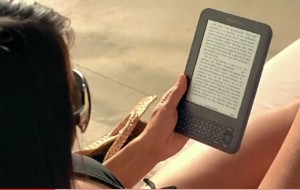
As we mentioned earlier this week, Amazon unveiled its new Kindle this morning in NYC. The Kindle DX ($489) features a large screen (9.7 inches measured diagonally) and it’s intended to make reading newspapers, college textbooks and PDFs a more user-friendly experience. Plenty of news outlets have provided coverage of the unveiling: Engadget, Gizmodo, Ars Technica, etc. And it’s mostly positive. But I’m left wondering if the Kindle DX addresses the major problem with Kindle 2 ($359). If you spend some time on Amazon’s Kindle discussion forum, you’ll see that one of the longest threads (so far containing 857 posts) is devoted to complaints about the Kindle’s light fonts and dark background — a bad combo, especially when you try to read it at night. (Others have kvetched about it here.) I bought the Kindle 2, and really loved it in many ways. But I couldn’t use it in lower light conditions. At night, the screen gets muddy, and the words don’t pop off of the page. And that’s a deal breaker for me. Meanwhile, with the same lighting, a traditional book reads perfectly well. The major problem with the Kindle gets down to this: Users can’t really customize the look & feel of the reading material. Yes, you can increase and decrease the size of the fonts. But you can’t make the fonts darker (unless you know how to hack the darn thing). Nor can you make the background lighter. This one-size-fits-all approach is what Gutenberg gave us in the 15th century. (Sorry, don’t mean to knock on Gutenberg.) It shouldn’t be what Amazon gives us for $359 in 2009. Could you imagine Apple serving this up? Hardly. And speaking of Apple, it may have its own e‑book reader coming soon. According to PC Magazine, Apple may be rolling out the iPad ($699), which could be an e‑book/internet reader and media player all rolled into one. For now, I’m waiting to see what Apple brings to market and hoping that Amazon finds religion. When they get the Kindle right, it will be great.
UPDATE: A year later, a new Kindle is out (see Wifi version here, and 3G wireless version here). The contrast is noticeably improved with this model. But, even better, Amazon now sells (separately) a case that has a built in retractable light. Taken together, you can now read the Kindle fairly well at night, under pretty much any light conditions. This Kindle I kept, and I’m a bigger fan than before.
Read More...The Invention of Self: One Woman, Eight Characters
At the TED Conference, actress Sarah Jones takes a funny look at “the invention of self,” which is a fancy way of saying she does some good impersonations. Coming up, Jones impersonates an elderly Jewish women, a young fast-talking Dominican college student, people from various nationalities (China, India, France, Germany, Jordan, etc.). And it’s all mixed with some humor. Runs about 21 minutes.
Read More...The Big List of OpenCourseWare Resources
The folks at universitiesandcolleges.org have provided a very handy resource here. They’ve sifted through the big OpenCourseWare universe and centralized the resources for over 500 college courses. In some cases, you’ll find audio lectures. In other cases, you’ll find lecture notes, reading lists, and homework assignments. This mega list makes it easy to browse through the different resources without having to skip from one OpenCourseWare web site to another. The page must have taken quite some time to put together. Very glad that they did it.
As a last note, the U&C folks were kind enough to include our collection of Free Courses on their list. Here, you get audio (and sometimes video) lectures from over 200 courses. Simply download them to your computer or mp3 player, and you’ll be transported right to the classroom of many fine universities across the world.
Read More...A Closer Look at YouTube EDU
On Thursday, we announced the launch of YouTube EDU. Now, as promised, it’s time to give you some more details about the new university video hub.
I had a chance to chat with Obadiah Greenberg, a key Googler behind the launch. And he gave me some insight into the genesis of the project. As you can imagine, YouTube EDU wasn’t built overnight. It took about a year to move from concept to launch. The work was driven along by a team of five, and they did it using Google’s famous 20% time policy. That is, they each committed essentially one day per week to bringing this project to fruition.
What you’re seeing now is essentially version 1.0. Obadiah expects YouTube EDU to evolve over time, especially as his team gathers data and feedback that will inform future iterations. But, make no mistake, this initial product has accomplished quite a bit. It centralizes the video collections from over 100 universities/colleges. This amounts to over 20,000 individual videos and 200 complete courses. It also makes these collections much easier for new users to discover and sift through. Back in early 2007, before YouTube really started working with universities, I kvetched in a public radio interview that GooTube could do more to organize the world of intellectual video, and now I certainly have a lot less to complain about (although I do still see some important tweaks that could be made here and there).
The universities participating in YouTube EDU have also had an upbeat response. Both Scott Stocker (Director of Web Communications at Stanford) and Genevieve Haines (Director of Integrated Communications at UCLA) welcomed the idea that many new visitors will encounter their video collections. As Genevieve put it, it’s never a bad thing when the world’s top video sharing site makes a big commitment to university content. This move opens up many long range possibilities for educators and students, she says. But, over the short term, it guarantees that schools will learn more about how the wider public engages with their videos. By looking at traffic patterns and user comments left on YouTube, the university teams will find out whether there’s a real market for serious lectures and courses, or whether users prefer lighter fare, or some combination of the two. With this knowledge in hand, media strategies will be revised.
For Ben Hubbard, who manages the webcasting initiative at UC Berkeley, YouTube EDU offers another perk. He told me: “There are a lot of universities and other centers for learning engaged with their local communities on YouTube, but it hasn’t always been very easy to find them. YouTube EDU makes it much easier for us to locate our peer institutions, connect around common interests, and perhaps even engage with one another in a more meaningful and productive way to create (or make more rich) a community of best practices.”
But perhaps the biggest plus is reserved for you and me. The Google team anticipates that the visibility of this project will open the floodgates, bringing many more universities to YouTube EDU in the coming months. This means that many more free lectures and courses will be coming online. A big plus for any reader of this blog. We’ll monitor all of this, and keep you posted as things move along …
Introducing YouTube EDU!
Here’s a little breaking news: Today, Google has launched YouTube EDU, which centralizes the content from over 100 universities and colleges (get list here). This robust collection gives you access to lectures by professors and world-renowned thought leaders, new research and campus tours. At the moment, you can access over 200 full courses from leading universities, including MIT, Stanford, UC Berkeley, UCLA, Yale and IIT/IISc. And it’s all searchable within YouTube EDU.
I plan to follow up with a more extensive piece soon. But I just wanted to get the word out and let you start checking it out. If you have any first impressions, please let us know what you think in the comments. Nice work Youtube!
Lastly, if you want to download hundreds of free university courses (mostly in audio) to your computer or mp3 player, check out our collection of Free University Courses here.
Follow us on Twitter at @openculture or sign up for our rss feed here.
Read More...The New Open Source Textbook
A little revolution is getting underway. The state of Virginia has published a new open source physics textbook under a Creative Commons license. As detailed in this piece from ZDNet, this peer-reviewed textbook was produced in less than six months by a team of authors, which included “active researchers, high school teachers, and college professors, as well as some retirees.” And it was launched on CK-12’s technology platform. Here comes the new world of textbook publishing. Quick to press, vetted, easy to revise, produced at a low cost by publishers, free for students. What’s not to like … except if you’re in the traditional textbook publishing business?
As a quick aside, you can find another free physics textbook (in e‑book format) at motionmountain.net.
via ccLearn Twitter Feed (Open Culture Twitter feed here)
Read More...Hitchens & D’Souza Go Mano-a-Mano on Faith
I didn’t think it would be possible, but it happened. I found my two least favorite intellectuals together on the same stage, and King’s College in NYC made it all possible. So, to mark the occasion, I bring you Dinesh D’Souza, the academy’s dressed up version of Ann Coulter, debating the ever surly Christopher Hitchens. The topic is faith and atheism. The debate is heated. And as you watch, you’ll see the charming personalities come out. The video continues with Part 2, Part 3, Part 4, Part 5, Part 6, Part 7, Part 8, Part 9, and Part 10. 90 minutes in total.
Read More...A Guide to E‑Books (and 100 E‑Text Classics)
A quick fyi: Mark Glaser at PBS’s MediaShift has just published a handy guide to e‑books. It covers the history of e‑books, the competing e‑book readers, the pros and cons of working with e‑books, what Google and Apple are now doing in this space, and more. Good stuff.
Separately, I also wanted to flag a collection that features e‑texts of 100 major literary classics. You’ll find it over at universitiesandcolleges.org.
Read More...Support Us
We're hoping to rely on loyal readers, rather than erratic ads. Please click the Donate button and support Open Culture. You can use Paypal, Venmo, Patreon, even Crypto! We thank you!

About Us

Open Culture scours the web for the best educational media. We find the free courses and audio books you need, the language lessons & educational videos you want, and plenty of enlightenment in between.
Advertise With Us
FREE UPDATES!
GET OUR DAILY EMAIL
Get the best cultural and educational resources on the web curated for you in a daily email. We never spam. Unsubscribe at any time.
FOLLOW ON SOCIAL MEDIA
Open Culture editor Dan Colman scours the web for the best educational media. He finds the free courses and audio books you need, the language lessons & movies you want, and plenty of enlightenment in between.
Advertise With Us

