Give Books Away; Get Books You Want
This is a great concept & service for our readers. BookMooch is an online book swapping web site that has 45,000 members and 750,000 books in its inventory. What goes on here is fairly straightforward. Users can give away books they’ve read in exchange for books they want to read — all for no money, other than the shipping costs. That makes it easy to support your reading habit, and it saves a few trees. The inner-workings of the book swapping are explained here and here. Have a look.
Check out our collection of free podcasts of free audiobooks
Read More...
A New Model for Investigative Journalism
As we’ve discussed before on this blog, one of the major casualties in the shifting new media landscape is the traditional investigative journalist–someone with the time and resources to research in-depth stories. In response to this problem a new group called Pro Publica is proposing a novel economic model: hire the journalists into a foundation and give their work away to the publications where it will make the biggest impact.
The new initiative, headed up by Paul Steiger, head editor at the Wall Street Journal for 16 years, will spend $10 million annually to support a newsroom of 24 journalists and 12 other staff in New York City. The money comes from Herbert and Marion Sandler, former heads of Golden West Financial Corporation, a big player in mortgages and savings.
It seems likely to me that Pro Publica will succeed in attracting some high-level talent, both because of Steiger and because many journalists have come to fear for their jobs in the shrinking newsrooms of traditional papers. The real question is how well this system will work in digging up and delivering quality reporting. What do you lose, and what do you gain, when your employer is no longer a “paper of record” but a private foundation funded by people with their own political agendas? On the other hand, it’s easy to argue that every newspaper already has some kind of political position, so maybe Pro Publica will be no different.
Read More...
Stephen Colbert For President
In yesterday’s New York Times, Stephen Colbert took over Maureen Dowd’s regular opinion column and made a funny case for why he could be the next US president. Read it here. Also listen to his interview last week on NPR’s Fresh Air (iTunes — Feed — Web Site). These appearances all figure into a media blitz designed to boost sales of Colbert’s newly-released book I Am America (And So Can You!), which is already #4 on Amazon’s bestseller list. Not bad.
Read More...Al Gore’s “Earth in the Balance”: A Free, Environment Friendly Copy (Almost)
Since the release of An Inconvenient Truth, Al Gore has had quite a run. He first won himself an Emmy, then an Oscar, and now the Nobel Peace Prize. Although the film represents Gore’s most well known work on the environment, it’s hardly where his environmental efforts began. His campaign goes back to the late 1970s, when he held congressional hearings on climate change and greenhouse gases. And it moves through the 1980s and then the 1990s, when he occupied the Vice Presidency. In 1992, while other political leaders quibbled over the pros and cons of NAFTA, Gore put the environment on the national agenda, really for the first time, when he published Earth in the Balance: Ecology and the Human Spirit. (The Bush administration then took it off the agenda, regrettably.) Gore’s book became a national bestseller, and it has since gone through several new editions, the latest having been issued just last year. You could buy the book, but the good news is that Google serves up large portions of the book online for free. It’s at a price you can’t beat, and it goes easy on the pulp. Have a good look. And also see below Gore’s comments upon learning about the Nobel Prize.
Read More...
The Future of Collaborative Culture?
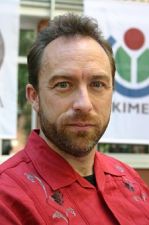 I just heard Jimmy Wales, founder of Wikipedia, speaking at Stanford Law School today. Wales is working on some new projects that he hopes will harness the community-driven collaboration of Wikipedia. He’s already had some success in branching out from the encyclopedia idea with Wikia, which is a “wiki farm” compiling information on a variety of different subjects (some of the most successful so far relate to video games).
What Wales spoke about today, however, is a new collaborative search project. The concept is still in its early stages, it seems, but the idea would be to harness the intelligence and dedication of human beings to produce search results significantly better than Google’s. This raises a few questions:
Is Google broken? It’s amazing what Google pulls up, but maybe we’ve all gotten so good at working with an imperfect system that we just tune out the spam and misinterpretations that still crop up.
Is a collaborative social model the appropriate solution to this problem? People are good at compiling encyclopedias, but they may not be good at emulating search rank algorithms. Also, Google is powered by millions of servers in dozens of data centers over the world managing petabytes of information. In other words, this may be a technology+money business, not a people+transparency business.
These issues aside, Wikipedia is one of the most amazing things to come out of the whole Internet experiment, so I’m excited to see what Wales comes up with. Has search become a basic service? Would it work better as an open-source system?
Read More...
Philosophers and Theorists on YouTube
When we announced last week that UC Berkeley had launched a new channel on YouTube, we were curtly informed by a European reader that Berkeley wasn’t the first to get into this game. Apparently, the European Graduate School (or EGS) has been at it for a while. The school’s YouTube collection features talks by important contemporary theorists and philosophers including Jacques Derrida, Jean Baudrillard, and Judith Butler. (There are also some filmmakers mixed in — take for example, Peter Greenaway and John Waters.) To be frank, much of the content runs counter to what we’re looking to do here — to make thinking less insular and emphasize ideas that speak to a thinking public. This is not to dismiss the caliber of the thinking presented here. It’s simply to comment on where it fits (or doesn’t fit) into the kind of project that we’re undertaking. However, if the ESG YouTube channel speaks to you, dig in. It’s yours to enjoy.
Read More...
The New Stanford Blog Directory: Stem Cells, Philosophy and Beyond
Blogs are abounding these days, and what’s unfortunately missing is an effective way to organize this new world of information and to make it accessible to others. Until a good, large-scale solution comes along (I don’t count Technorati or Google Blog Search as the real answer), some of this will get done the old fashioned way, the way Yahoo did it back in 1996 — that is, indexing by hand.
Last week, Stanford University launched the Stanford Blog Directory, which hopes to index the collective blogging wisdom coming out of the university community (faculty, staff, alumni, etc.). This small list will inevitably grow over time. But it already includes some blogs (in addition to Open Culture) that you may want to peruse. Let’s highlight a few:
Smart Energy Show: 6.6 billion people live on the earth today. 9.2 billion will be here by 2050. And, as time goes by, energy demand will inevitably push toward a breaking point. Smart Energy takes a close look at how we can meet “this rising demand without inflicting permanent damage” on our fragile environment. And it explains what science, governments and individuals can do to meet this challenge. The blog is written by Margot Gerritsena, professor in the Department of Energy Resources Engineering, and the blog posts are often accompanied by informative videos.
The Stem Cell Blog: Written by Christopher Thomas Scott, this blog examines the science, ethics, business and politics of stem cell research. Scott is particularly well positioned to do this. He is the Executive Director of Stanford’s Program on Stem Cells in Society and the author of Stem Cell Now: An Introduction to the Coming Medical Revolution. Plus he has taught a course called Straight Talk About Stem Cells that you can access on iTunes for free.
Philosophy Talk: Written by two Stanford philosophy professors, Ken Taylor and John Perry, this blog accompanies a weekly radio show (also called “Philosophy Talk”) that offers a “down-to-earth and no-nonsense approach” to philosophy that’s relevant to everyday life. Along the way, the blog/show explores philosophy that touches on our beliefs, relationships, passions and the world around us.
For more Stanford blogs, enter the Blog Directory here. For more Stanford content on Open Culture, click here.
Read More...
New Radiohead and R.E.M. at a Nice Price
In case you missed it, Radiohead released today its new album In Rainbows. What makes the album remarkable, in part, is how it’s being distributed. Buyers can go straight to the Radiohead web site (it’s not available on iTunes) and download the album as DRM-free MP3s. And, what is more, they can decide for themselves how much they’re willing to pay for the album. You can pay as much or as little as you want. That makes the new album pretty much qualify as a piece of “open culture.” (If you get it, please let us know in the comments how much you paid out. We’d be curious to know.)
Next up, REM. They’re releasing a live album next week (22 tracks recorded in album), but you can stream the whole album for free on Rhapsody right now, and the quality is nice and high. Source: Rolling Stone.
For more mp3s see our collection of MP3 Music Blogs.
Read More...
Goethe (and Shakespeare) on Google
Marking the start of the Frankfurt Book Fair, Google Book Search has launched a “microsite” dedicated to Germany’s most celebrated writer — Johann Wolfgang von Goethe. There, you can learn about his life and travels and, even better, get access to free digital versions of his writings. That’s right, you get to read Faust online for free. The potential rub is that you’ll need to speak German to generally avail yourself of this site, although there are some materials in English. To get more information on the new Goethe site, check out the Google Book Search blog.
Also be sure to see Google’s other microsite dedicated to Shakespeare.
Read More...
A Photographer’s Chronicle of the War in Iraq
Australian photographer Ashley Gilbertson documented for The New York Times the US invasion of Iraq, capturing the lightning fast overthrow of Saddam’s regime and then the slow lapse into civil war. His new book, Whiskey Tango Foxtrot: A Photographer’s Chronicle of the Iraq War, collects some of his best work. Combined, the printed photographs offer what he calls a visual “testament to what war actually is.” They let you see how decisions made by the Pentagon have real human costs on the ground in Iraq; or, put a little differently, the photos illustrate in stark detail “what foreign policy looks like from the ground up.” Below, you can watch a video that features an intelligent interview with Gilbertson and offers a good glimpse into his photographic work. Definitely give it some of your time.
Special Note: Support an Independent Press
We all know that an independent press is absolutely essential to preserving a democratic and open culture. Unfortunately, more than 80 percent of people live in countries without a free press. That means more than 5 billion people can’t trust what they read in the newspaper, hear on the radio or see on TV. Here is a very tangible way to empower independent journalists. Contributing $100 to the Media Development Loan Fund will provide independent journalists with printing presses and broadcasting equipment, tools that are essential to overcoming censorship and giving a voice to the unheard. Click here to get more information.
Read More...
Support Us
We're hoping to rely on loyal readers, rather than erratic ads. Please click the Donate button and support Open Culture. You can use Paypal, Venmo, Patreon, even Crypto! We thank you!

About Us

Open Culture scours the web for the best educational media. We find the free courses and audio books you need, the language lessons & educational videos you want, and plenty of enlightenment in between.
Advertise With Us
FREE UPDATES!
GET OUR DAILY EMAIL
Get the best cultural and educational resources on the web curated for you in a daily email. We never spam. Unsubscribe at any time.
FOLLOW ON SOCIAL MEDIA
Open Culture editor Dan Colman scours the web for the best educational media. He finds the free courses and audio books you need, the language lessons & movies you want, and plenty of enlightenment in between.
Advertise With Us

