On the Road: The Original Scroll
Jack Kerouac’s “On the Road” is turning 50 this month, something we recently noted. And to commemorate the event, Viking has just published the original draft of the novel (check it out here) that Kerouac banged out in three quick weeks, in a New York apartment, on eight long sheets of tracing paper, which he later taped together to create a 120-foot scroll (see photo). This new publication offers a reproduction of Kerouac’s first draft and lets you see how the beat classic changed from initial draft to publication. In the scroll, Kerouac uses the real names of friends instead of pseudonyms, and some of the details are a little more graphic. If you want to see footage of Kerouac reading from “On the Road,” feel free to refer back to our post on August 15.
For your daily dose of digital culture, subscribe to our feed.
Visit our Audiobooks Podcast Collection for free downloads of major literary works.
Read More...100 Great American Speeches
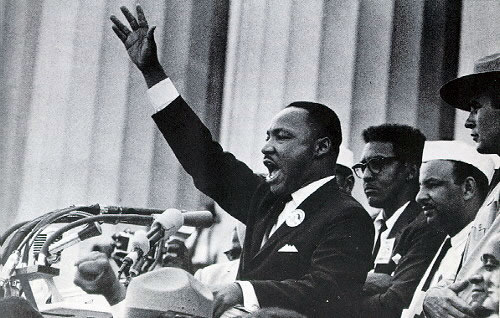 American Rhetoric has compiled its list of the top 100 American speeches, all of which can be conveniently accessed as mp3 files. Most of the speeches listed here are known for their eloquence, and many for the pivotal role they played in effecting major political and social change. The compilation lets you listen to F.D.R. leading the US through the Depression ( “There is nothing to fear but fear itself” ) as well as through World War II with his Fireside Chats. Then, there is Truman and Kennedy ( “Ich bin ein Berliner” ) fighting the Cold War, Nixon bolstering support for the Vietnam War with his “Great Silent Majority” speech, and Martin Luther King ( “I Have a Dream” ) and Malcolm X ( “The Ballot or the Bullet” ) pressing for civil rights in their different ways.
The speeches can be heard largely in full, and, while most are political in content, some gems are not. Take for example William Faulkner’s Nobel Prize acceptance speech, Lou Gehrig’s Farewell Address, Ursula Le Guin’s “A Left-Handed Commencement Address,” and Elie Wiesel’s “The Perils of Indifference.” Give these speeches some time, and it might be a while before you come back up for air.
 Subscribe to our feed in a reader
Related Content:
- Check out our Audiobook Podcast Collection
- Voices of American Presidents
- Vintage Radio Archive
- Malcolm X at Oxford University 1964
Learn the Art of Photography: The Nikon Way
The advent of digital cameras has changed photography as we know it. It has dramatically lowered the cost of photography, and we’re now snapping more photos than ever before. But we’re not necessarily taking better pictures.
This is where Nikon steps in. Their cameras make casual photographers immensely better than they actually are. (Trust me, I know.) And Nikon has now set up a free Digital Learning Center that offers tutorials and tips for taking a range of different pictures — portraits, travel photos, nature photography, etc. Questions that get tackled here include, but are not limited, to: “How can I take better portraits?” “How can I take photos at dusk without having them look completely dark?” “How do I get true-to-life skin tones?” “How can I get the moving figures in my photos to look like they’re in motion and not frozen?” “My portraits have red eyes. How can I prevent this?” Give a tour of the Learning Center here. And thanks to Lifehacker for putting this on our radar screen.
 Subscribe to our feed in a reader
Related Content:
- If you’d like to learn about digital photography using podcasts, check out Digital Photography Tips from the Top Floor (iTunes — Feed — Web Site). And, for that matter, if you need to learn how to use a podcast, spend some time with our Podcast Primer here.
- Also Slate recently put together a nice gallery of images featuring the work of Henri Cartier-Bresson, a master photographer who is considered the father of modern photojournalism.
- Finally, NPR’s Fresh Air just aired an interview with photojournalist Paul Watson on Witnessing War (iTunes Feed Web Site). It’s an intriguing but also quite haunting conversation.
15 Ways to Avert a Climate Crisis
 And now we bring you a public service announcement.…
Below, you can watch Al Gore talk about tangible ways that you can be a good environmental citizen. The first 5 minutes start with some wit and banter that would have served him well in 2000; the next 10 minutes get down to some business.
A few, quick related items: Google offers a free online copy of Gore’s major book on the environment, Earth in the Balance. Published first in 1992, the book demonstrates, among other things, Gore’s sustained commitment to this issue. Next, if you’ve never seen An Inconvenient Truth, then you may want to give a listen to Gore’s speech at Stanford’s Graduate School of Business (listen on iTunes here). It covers much of the same ground. Finally, this all reminds me of a television exposé that Bill Moyers aired a few months back. It’s called “Is God Green?,” and it takes a lengthy look at how conservative evangelical movements in the US are increasingly taking global warming seriously as an issue. (You can watch it here.) And if you know America, you know that’s essential for changing the nation’s environmental policies.
 Subscribe to our feed in a reader
A Short History of Man, God, and Political Philosophy
In case you missed it, The New York Times published a lengthy article — The Politics of God — last weekend which essentially traces how the thought of Thomas Hobbes, John Locke, and other major political philosophers gave us secular politics, and particularly the separation of Church and State. They’re innovations with many upsides, but also the downside that they put us at an intellectual distance from entire regions where faith still governs political affairs. This includes large swathes of the Middle East and other areas within the “Muslim orbit.” It’s a good piece to read if you’ve ever wondered how philosophy tangibly shapes our modern world. Written by Mark Lilla, a Columbia University professor, the highly-readable article is adapted from his new book, The Stillborn God: Religion, Politics, and the Modern West. Get the article here, and don’t forget to subscribe to our feed.
Related Content for Philosophy Buffs:
- Philosophy Bites (Philosophers Interviews on Podcast)
- Enlightenment on iTunes: The Philosophy of Immanuel Kant
- Philosophy Talk and Intelligent Design
- Plato To Go (The Republic Now on iTunes)
William Gibson, Father of Cyberpunk, Reads New Novel in Second Life
William Gibson, who launched the cyberpunk genre with the 1984 classic Neuromancer, hasn’t lost any steam. Pattern Recognition, published a good 20+ years later, won wide praise in 2005. Now, he’s come out with Spook Country, and it’s currently #66 on the Amazon bestseller list. Below, you can catch Gibson reading from his new work in Second Life. What can be more fitting?Also, you may want to check out BoingBoing’s “nerdgasmic” interview with Gibson (iTunes — Feed — MP3 Stream), plus Cory Doctorrow’s reverential review of the new work. And finally, if you need more, you can watch Gibson give a book talk at Cody’s in Berkeley CA, courtesy of Fora.Tv.For your daily dose of digital culture, subscribe to our feed.
Read More...The New Grammar Podcast on the Block
 It didn’t seem like an obvious blockbuster at first — at least not to me — but The Grammar Girl (iTunes — Feed — Web Site) has remained one of the most downloaded educational podcasts on iTunes. To be precise, each week, about 100,000 people download these short podcasts that offer “quick and dirty tips” for cleaning up your writing. And thanks to the enduring popularity of her free audio lessons, plus an appearance on Oprah, Mignon Fogarty, the creator of the Grammar Girl, has also managed to spin-off an audiobook ($9.95) that has driven strong sales. Plus she’s got a good, old-fashioned pulp book somewhere still in the pipeline.
It was perhaps, then, only a matter of time before Fogarty faced some friendly competition. The Grammar Grater (iTunes — Feed — Web Site) is a new podcast that approaches language issues from a slightly different angle. It focuses on “English words, grammar and usage for the Information Age,” which is to say that it deals with grammar issues that often arise when we write emails, blog posts, instant messages and beyond. Luke Taylor is the host, and, with him, you get a well-produced, often entertaining, podcast that touches on grammar issues that you’re bound to encounter in your daily electronic writing. Give the Girl and the Grater both a listen and you’ll almost certainly learn small bits that’ll make a big difference.
For your daily dose of digital culture, subscribe to our feed.
Also check out these other fine items:
- Life-Changing Books: Your Picks
- Free University Courses as Podcasts
- Authors@Google: Video Talks From the Epicenter of the Universe
- Everything You Always Wanted to Know About Sex
- 10 Unexpected Uses of the iPod
Your Secret iPod Shame
We talk a good deal about virtuous podcasts here. But this episode of The Brian Lehrer Show (iTunes — Feed — Web Site) coming out of NYC, focuses on the downright embarrassing songs that you have hidden on your iPod. And they talk about it with Kelefa Sanneh, the pop music critic from The New York Times. If you care to admit to your own songs of shame, you can use the veil of anonymity and list them in the comments below. And don’t worry, we won’t hold it against you… Have a good weekend.
Read More...Tracking Wikipedia’s Manipulations

All of this raised the question: Just how often is Wikipedia the victim of biased editing? And to what extent can corporate and political entries be trusted? According to Wired, some of these questions may be soon put to rest. A new web site called Wikipedia Scanner provides a “searchable database that ties millions of anonymous Wikipedia edits to organizations where those edits apparently originated…” Much more easily, users can now get a bead on just how prevalent these spin jobs are, and, more importantly, they can help keep these partisan edits under better control. Will Wikipedia Scanner (and program like it) help save Web 2.0? Perhaps so.

- Wikipedia’s (Sometimes Dirty) Little Secret
- College Bans Wikipedia
- How Web 2.0 Will Transform the Humanities
Voices of American Presidents
 Here’s another example of podcasts that bring the past back to life. Thanks to Michigan State University, you can listen to audio recordings of twenty modern American presidents (iTunes — Feed — Web Site), starting with Grover Cleveland (1892) and ending with GWB. The recordings mostly taken from inauguration addresses and State of the Union speeches include some good historical finds. Here you get Teddy Roosevelt blasting the elite’s subversion of the popular will, FDR speaking of an enduring democracy, Harry Truman calling for a lasting peace after World War II, JFK outlining the US response to the Cuban Missile Crisis, and Bill Clinton touting the longest peacetime economic expansion in modern American history.
For more archives of presidential speeches, here are a few other collections worth checking out:
FDR: A Presidency Revealed (iTunes — Feed — Web Site) Presented by the History Channel, this collection features some of FDR’s famous speeches, including his Fire Side Chats and his first inaugural address. (“There is nothing to fear but fear itself.”)
Presidential Archives Uncovered (iTunes — Feed — Web Site) Produced by the Presidential Libraries of the National Archives, this collection presents clips of presidents’ serious policy discussions as well as their personal conversations with family members. Includes talks by Presidents Hoover, Roosevelt, Truman, Eisenhower, Kennedy, Johnson, Nixon, Ford, Carter, Reagan, Bush, and Clinton.
Truman Library Podcasts (iTunes — Feed — Web Site) Among these recordings you will notably find a lengthy talk by David McCullough, Truman’s Pulitzer Prizing Winning biographer.
The Speeches of John F. Kennedy (iTunes — Feed — Web Site) A new but still small collection. Looks poised to grow, however.
Read More...Support Us
We're hoping to rely on loyal readers, rather than erratic ads. Please click the Donate button and support Open Culture. You can use Paypal, Venmo, Patreon, even Crypto! We thank you!

About Us

Open Culture scours the web for the best educational media. We find the free courses and audio books you need, the language lessons & educational videos you want, and plenty of enlightenment in between.
Advertise With Us
FREE UPDATES!
GET OUR DAILY EMAIL
Get the best cultural and educational resources on the web curated for you in a daily email. We never spam. Unsubscribe at any time.
FOLLOW ON SOCIAL MEDIA
Open Culture editor Dan Colman scours the web for the best educational media. He finds the free courses and audio books you need, the language lessons & movies you want, and plenty of enlightenment in between.
Advertise With Us


