Spike Lee’s List of 95 Essential Movies — Now with Women Filmmakers
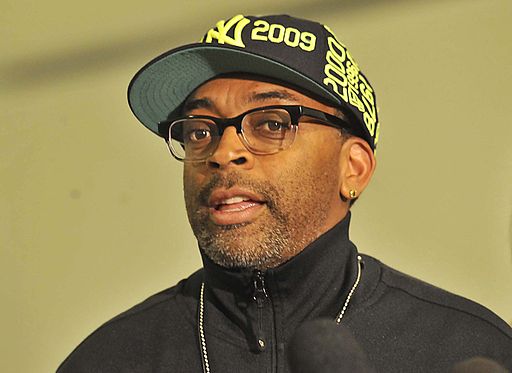
Image by José Cruz/ABr CC-BY-SA‑3.0
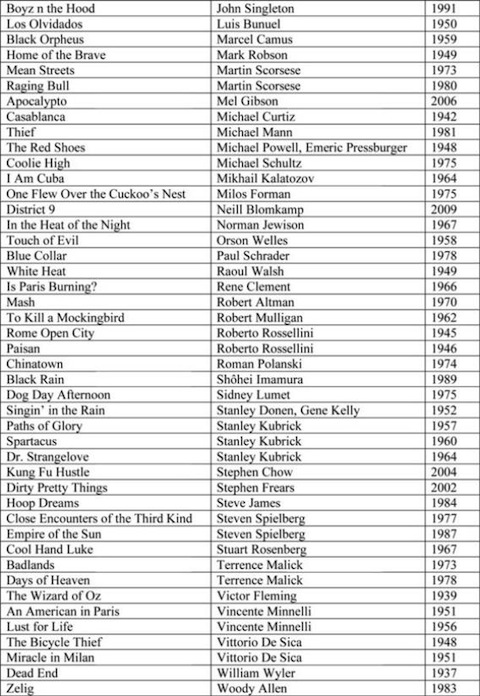
Last year, independent film icon and NYU professor Spike Lee turned to the crowdsourcing site Kickstarter to raise $1.25 million dollars for his latest film. To drum up publicity, he published his list of 87 “essential” movies that he hands out in his graduate film classes. And it is a very idiosyncratic list. Some great, overlooked movies like Charles Burnett’s Killer of Sheep and Steve James’s Hoop Dreams make the cut while other inclusions are more puzzling — Mel Gibson’s Apocalypto, for instance. Or Abel Ferrera’s Bad Lieutenant. The list’s exclusions, however, raised eyebrows. Citizen Kane (?!) somehow didn’t get a mention. Neither did Seven Samurai. Stanley Kubrick’s Spartacus somehow won out over 2001: A Space Odyssey. And such canonical directors as Yasujiro Ozu, Ingmar Bergman, Fritz Lang, John Ford and Charlie Chaplin were left out entirely.
But the internet really took Lee to task for the list’s most glaring omission – there are no women. To that last issue, Lee made amends. In his updated blog entry – “Thank You For That Coat Pulling” – Lee revamped the list to include eight movies by five female directors, bringing the total to 95.
- The Piano- Jane Campion (1993)
- Daughters of the Dust- Julie Dash (1991)
- The Hurt Locker- Kathryn Bigelow (2008)
- Sugar Cane Alley - Euzhan Palcy (1983)
- The Seduction of Mimi- Lina Wertmuller (1972)
- Love and Anarchy - Lina Wertmuller (1973)
- Swept Away - Lina Wertmuller (1974)
- Seven Beauties — Lina Wertmuller (1975)
Three of the four women ever to be nominated for a Best Director Oscar wound up on the list – Wertmuller, Campion, Bigelow. I guess Lee isn’t a fan of Sophia Coppola.
Lina Wertmuller managed to get four films on the new list – a feat not shared by any of her male counterparts. That’s right, she bested Kurosawa, Kubrick and Hitchcock. In her heyday, Wertmuller courted controversy by combining sex and left wing politics, which sounds right up Lee’s alley. Fairly or not, Wertmuller’s reputation hasn’t aged well, mostly because feminist critics pilloried her movie for being misogynous. And Guy Ritchie’s unfortunate remake of her 1974 movie Swept Away, starring Madonna, did little to burnish her prestige.
Also on the list is Julie Dash’s Daughter of the Dust, a lyrical landmark of indie cinema about Gullah women living on one of South Carolina’s barrier islands, and French director Euzhan Palcy’s little seen Sugar Cane Alley is about blacks toiling in the sugar cane fields of rural Martinique.
Indiewire notes that Lee’s additions bump the gender disparity up from 0% to about 8.7%. That’s not a lot, but according to Celluloid Ceiling’s 2013 report, it’s better than it is currently in Hollywood. Of the top 250 earning movies last year, only 6 were directed by women.
You can see Lee’s original list below:
Related Content:
Martin Scorsese Creates a List of 39 Essential Foreign Films for a Young Filmmaker
44 Essential Movies for the Student of Philosophy
The 10 Greatest Films of All Time According to 846 Film Critics
Jonathan Crow is a Los Angeles-based writer and filmmaker whose work has appeared in Yahoo!, The Hollywood Reporter, and other publications. You can follow him at @jonccrow. And check out his blog Veeptopus, featuring lots of pictures of vice presidents with octopuses on their heads. The Veeptopus store is here.
Read More...The Goddess: A Classic from the Golden Age of Chinese Cinema, Starring the Silent Film Icon Ruan Lingyu (1934)
Ruan Lingyu delivered one of the greatest performances in silent cinema, and yet to Western audiences, she is almost completely unknown.
Up until the Imperial Japanese Army invaded the city in 1937, Shanghai was the thriving, cosmopolitan cultural heart of China. The first Chinese film was made in Shanghai in 1905 and, for the next couple of decades, costumed retellings of traditional tales dominated the industry. Then, in the ‘30s, filmmakers like Sun Yu and Cheng Bugao started to make gritty, realistic movies about the struggles of the lower class. Perhaps the greatest of these films is Wu Yonggang’s 1935 masterpiece The Goddess, featuring an absolutely heartbreaking performance by Ruan. You can watch it above.
On paper, the story of The Goddess could easily be mistaken for films by Josef Von Sternberg or G.W. Pabst – a “fallen woman” weepie where the protagonist suffers for the sins of hypocritical society. Ruan plays the nameless lead, a beautiful, impoverished woman forced to sell her body to feed and educate her son. She soon falls in with The Boss, a porcine, dissolute gangster who serves as her pimp. She scrapes and struggles to keep her son out of the same gutter where she finds herself trapped. Yet, at every step, she and her son are taunted and shunned. When she spends everything she has to put her son into a good school, the child is expelled simply because the other parents don’t approve of her. “Even though I am a degenerate woman,” she begs to the school board, “don’t I have the right as a mother to raise him as a good boy?”
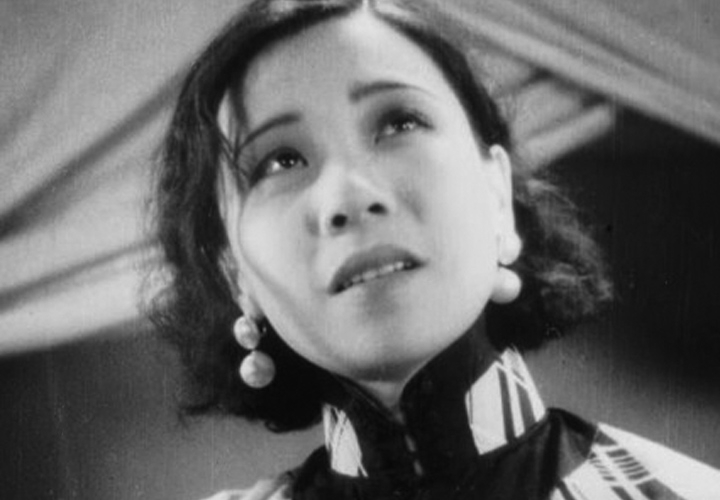
While silent film acting tended towards the histrionic, Ruan’s performance is naturalistic while still having an emotional rawness that few actors could match. Just watch the scene where the protagonist is watching her son perform during a school play. Her expression of unadulterated parental pride slowly curdles as she hears vicious whispers from nearby hausfraus. Like Greta Garbo or Marlene Dietrich, Ruan has a wounded beauty that simply rivets you to the screen.
Like many of the characters she played, Ruan came from humble beginnings and had perpetual romantic trouble. When her complicated personal life became the fodder for press, she took an overdose of sleeping pills on March 8, 1935, leaving behind a note that read, “Gossip is a fearful thing.” She was only 24. Ruan’s funeral procession was over three miles long and three women were reportedly so distraught over her death that they committed suicide. The funeral even ended up on the front page of the New York Times who called it “the most spectacular funeral of the century.”
In 1992, Maggie Cheung played Ruan for Stanley Kwan’s Center Stage (1992), which ended up winning a Best Actress prize at the Berlin International Film Festival.
The Goddess will be added to our list of Great Silent Films, part of our larger collection, 4,000+ Free Movies Online: Great Classics, Indies, Noir, Westerns, Documentaries & More.
Related Content:
101 Free Silent Films: The Great Classics
65 Free Charlie Chaplin Films Free Online
Jonathan Crow is a Los Angeles-based writer and filmmaker whose work has appeared in Yahoo!, The Hollywood Reporter, and other publications. You can follow him at @jonccrow. And check out his blog Veeptopus, featuring lots of pictures of vice presidents with octopuses on their heads. The Veeptopus store is here.
Read More...Follow Us on Facebook, Twitter … Or, Better Yet, Get Our Daily Email
Readers often ask us, “What’s the best way to make sure that I don’t miss any of your posts?” First and foremost we recommend signing up for our daily email. Each day, you will receive an email that tidily wraps up everything we’ve featured on the site over a 24 hour period. Faithfully it will appear in your inbox each day. Sign up for the free email here. And, to initiate the email subscription, please make sure that you click the verification link in the email you will receive upon registration.
You can always follow us on Twitter (@openculture) where we highlight our daily posts, plus many other cultural curiosities found on the web. Definitely give that a shot.
You can also like our Facebook page, and then Facebook will decide whether you get to see our posts. They just do the thinking for you. Lucky you.
Finally, consider subscribing to our RSS feed, especially if you use feed readers like Feedly. That will let you keep tabs on each and every post. The RSS address is: http://feeds.feedburner.com/OpenCulture
Read More...Charles & Ray Eames’ A Communications Primer Explains the Key to Clear Communication in the Modern Age (1953)
You might think that a movie about information from 1953 couldn’t possibly be relevant in the age of iPhone apps and the Internet but you’d be wrong. A Communications Primer, directed by that power couple of design Charles and Ray Eames, might refer to some hopelessly quaint technology – computer punch cards, for instance – but the underlying ideas are as current as anything you’re likely to see at a TED talk. You can watch it above.
In fact, the film made for IBM was the result of the first ever multi-media presentations that Charles Eames developed for the University of Georgia and UCLA. Using slides, music, narration and film, Eames broke down some elemental aspects of communications for the audience. Central to the film is an input/output diagram that was laid out by Claude Shannon, the father of information theory, in his 1949 book, The Mathematical Theory of Communication. As the perhaps overly soothing narrator intones, any message is transmitted by a signal through a channel to its receiver. While in the channel, the signal is altered and degraded by noise. The key to effective communication is to reduce “noise” (construed broadly) that interferes with the message and to generally simplify things.
The issue of signal vs noise is probably more relevant now in this age of perpetual distraction than it was during the Eisenhower administration. Every email, text message or Buzzfeed article seen individually is clearly a signal. Yet for someone trying to work, say on an article about a short film by Charles and Ray Eames, they are definitely noise.
The Eames use the terms “signal,” “noise,” and “communication” quite broadly. Not only do they use these terms to describe, say, a radio broadcast or a message being relayed by Morse code but also the creation of architecture, design and even visual art.
The source of a painting is the mind and experience of the painter. Message? His concept of a particular painting. Transmitter? His talent and technique. Signal? The painting itself. Receiver? All the eyes and nervous systems and previous conditioning of those who see the painting. Destination? Their minds, their emotions, their experience. Now in this case, the noise that tends to disrupt the signal can take many forms. It can be the quality of the light. The color of the light. The prejudices of the viewer. The idiosyncrasies of the painter.
Of course, a painting — or a poem, or a film by Andrei Tarkovsky — is a different kind of signal than an email. It’s message is multilayered and multivalent. And while a generation of cultural theorists would no doubt chafe at Eames’s reductive, Modernist view of art, it is still interesting to think of a painting in the same manner as smoke signals.
The film’s narrator continues:
But besides noise, there are other factors that can keep information from reaching its destination in tact. The background and conditioning of the receiving apparatus may so differ from that of the transmitter that it may be impossible for the receiver to pick up the signal without distortion.
That’s about as good a description of cable new pundits as I’ve ever seen.
A Communications Primer will be added to our collection, 4,000+ Free Movies Online: Great Classics, Indies, Noir, Westerns, Documentaries & More.
Related Content:
Charles & Ray Eames’ Iconic Film Powers of Ten (1977) and the Lesser-Known Prototype from 1968
Charles and Ray Eames’ Powers of Ten: The Classic Film Re-Imagined By 40 Artists
Jonathan Crow is a Los Angeles-based writer and filmmaker whose work has appeared in Yahoo!, The Hollywood Reporter, and other publications. You can follow him at @jonccrow. And check out his blog Veeptopus, featuring lots of pictures of vice presidents with octopuses on their heads. The Veeptopus store is here.
Read More...Learn The History of Philosophy in 247 Podcasts (With More to Come)
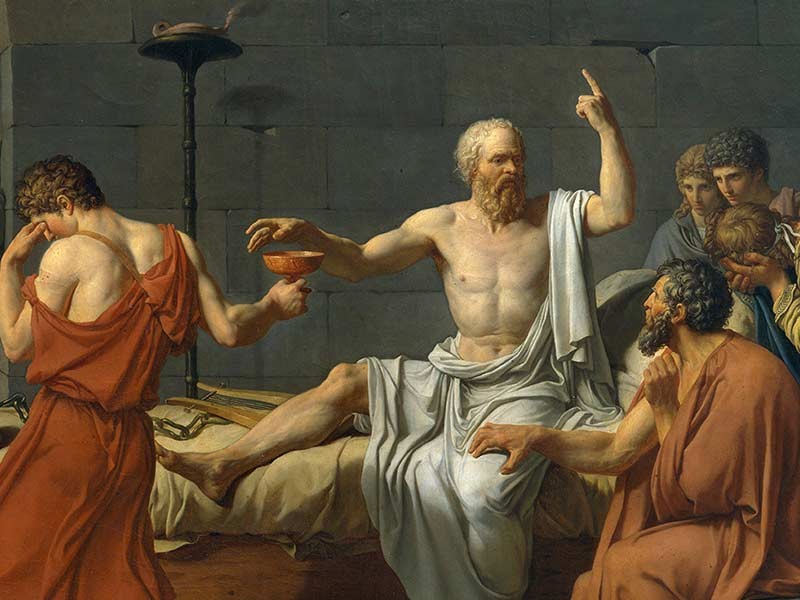
Yesterday we took a look at, or rather a listen to, the “podcasting renaissance,” highlighting a few of the new wave of shows and recommending some of the pre-existing ones you may have missed. Many Open Culture readers will remember our addiction to philosophy podcasts — The Partially Examined Life, Philosophy Bites, and Philosophize This!, to name but three of our favorites — and some may wonder if The History of Philosophy Without Any Gaps (iTunes – RSS Feed – Web Site), which we featured back in 2011 and again in 2012, survived the dark ages into which podcasting had apparently fallen. Could its host Peter Adamson, professor at Ludwig Maximilian University of Munich and King’s College London, have succumbed to the dreaded podfade somewhere between Plotnius on the soul and Christian asceticism?
Worry not, students of thought, for Adamson has continued these past few years, still regularly and gaplessly, to provide “the ideas and lives of the major philosophers as well as the lesser-known figures of the tradition.” Just this past weekend, he put up a twenty-minute episode on the Carolingian Renaissance. If you haven’t kept up with the show since we last posted about it, you’ve got a great deal of intellectually rich catching up to do. You will find more than 100 new podcasts, featuring short talks on Latin Platonism, Aristotelian philosophy’s “Baghdad school,” philosophy’s reign in Spain, Illuminationism, and women scholars and Islam. If you’ve wanted to learn the entire history philosophy in the most convenient possible manner, now’s the time to jump aboard. If you planned on waiting until Adamson gets to, say, Derrida, I fear you’ll have a bit of a daunting backlog on your hands — not to mention your ears and brain.
Note: This article was first published in November, 2014. As of February, 2016, there are 247 episodes in this series. The title of the post has been updated to reflect that.
Related Content:
The Partially Examined Life: A Philosophy Podcast
The History of Philosophy Without Any Gaps – Peter Adamson’s Podcast Still Going Strong
Philosophy Bites: Podcasting Ideas From Plato to Singularity Since 2007
Download 100 Free Philosophy Courses and Start Living the Examined Life
Take First-Class Philosophy Courses Anywhere with Free Oxford Podcasts
Colin Marshall hosts and produces Notebook on Cities and Culture and writes essays on cities, language, Asia, and men’s style. He’s at work on a book about Los Angeles, A Los Angeles Primer. Follow him on Twitter at @colinmarshall or on Facebook.
Read More...Jump Into the “Podcasting Renaissance” with These Intelligent Shows (and Tell Us Your Favorites)
You may have heard that podcasting has a renaissance going on. As a podcaster since the beginning stages of the medium — and one slightly surprised to find that the medium has now reached ten years of age — I can only welcome the news, though I never knew podcasting had gone into a dark age. New York Magazine’s Kevin Roose tells the story of the appearance of Apple’s iPod, followed by a flowering of “podcasts about politics, sports, literature, comedy,” “podcasts that sounded like NPR, and ones that sounded like Rush Limbaugh,” some that “lacked polish,” but most possessed of “a kind of energy to them that suited their audiences well.” But then, “sometime around 2009 or 2010, the podcast scene seemed to wither. The stalwarts (This American Life, Radiolab) stayed around at the top of the iTunes charts, but there wasn’t much else happening. Download numbers fell. Interest waned.” But ah, in this year of our Pod 2014, things have changed: “Today, a very different problem exists: There are too many great podcasts to keep up with.”
Roose, and hundreds upon hundreds of other people on the internet, recommends first and foremost Serial (iTunes — RSS — Soundcloud), “the true-crime drama hosted by This American Life producer Sarah Koenig,” a show sometimes credited with reviving podcasting itself. The New Yorker’s Sarah Larson calls it “the podcast we’ve been waiting for” in a piece giving a look into the reasons behind its success. Roos also gives special mention to another new show involving a name you might recognize from the This American Life orbit: Alex Blumberg’s StartUp (iTunes — RSS), a running document of the creator’s attempt to launch a podcasting business, the kind of venture that sounds less quixotic all the time. And Roose also names a personal favorite of mine, the well-known podcast about architecture and design — but Really, About Life Itself — 99% Invisible (iTunes — RSS).
If you feel like getting into this podcast renaissance, or if you’ve spent years as a podcast listener and just need some new material in your rotation, you could do much worse than starting with the three shows above. To add to that list, I can suggest no podcast more suited to the interests of Open Culture readers than In Our Time (iTunes — RSS), the long-running BBC Radio 4 program about the history of ideas wherein veteran broadcaster Melvyn Bragg interviews groups of Oxbridge experts on subjects like nuclear fusion, the Haitian revolution, Rudyard Kipling, the Battle of Talas, and the female pharaoh Hatshepsut — just in the past month. Personally, I so enjoy In Our Time that I went to interview Melvyn Bragg on my own podcast Notebook on Cities and Culture earlier this year.
Interviews and comedy have proven two of the most durable forms of content in podcasting, and anyone who hasn’t dipped into comedian Marc Maron’s in-depth and introspective interview show WTF (iTunes — RSS) — not that many haven’t at this point — has missed out on a sterling example of the kind of listening experiences podcasting, and only podcasting, has made possible. (You might consider also listening to my interview with Maron on The Los Angeles Review of Books podcast.) And while not necessarily comedy, I can’t imagine Open Culture readers not getting a laugh, and all other kinds of intellectual stimulation besides, out of the podcasting of Benjamen Walker. Walker, formerly the host of Too Much Information on the beloved independent radio station WFMU, recently launched a new show called Benjamen Walker’s Theory of Everything (iTunes — Soundcloud), a show of personal stories that explores all things to which those stories connect.
True, one complaint about podcasting in its early years held that the shows podcasters made went too personal — the old charge of “two or three guys sitting in basement talking about nothing” — but now that this decade-old medium has found more mature forms, the personal has become its art and its craft. I never hesitate to promote XO (iTunes — RSS), a show by Keith McNally, a podcast auteur whom I believe has done more to master the creative personal-story podcast than almost anybody, and he began doing it earlier. (As with Bragg, I went to his hometown of Toronto to interview him too.) But enough about my favorite podcasts; which ones do you tirelessly champion? Make your recommendations, and we’ll round them up in a post soon.
Related Content:
Shakespeare’s Restless World: A Portrait of the Bard’s Era in 20 Podcasts
Colin Marshall hosts and produces Notebook on Cities and Culture and writes essays on cities, language, Asia, and men’s style. He’s at work on a book about Los Angeles, A Los Angeles Primer. Follow him on Twitter at @colinmarshall or on Facebook.
Read More...53 New York Times Videos Teach Essential Cooking Techniques: From Poaching Eggs to Shucking Oysters
I was blessed to grow up around a grandmother who cooked every meal like she was feeding a dozen famished farmhands. She never spelled out all her various tricks and short cuts … let’s not call them hacks. She just did what she did, and I picked it up by osmosis, using a juice glass for a biscuit cutter and watching for pockmarks in the pancake batter. Endless hours in her kitchen made me a confident chef long before I was in a position to buy my own groceries.
Not everyone is so fortunate, I know.
They get their information from Julia Child, Martha Stewart, some pseudonymous food blogger or possibly my friend, Jesse, whose expertise as a builder extends to things culinary. He once insisted on showing me a more efficient way to cut up mango. My grandmother’s tropical fruit experience maxed out at oranges, so I was on my own in the separating mango flesh from mango bone department. I tried it his way a couple of times, before reverting to my non-way.
There’s undeniable competitiveness amongst those of us who pride ourselves on our cooking abilities. Our skills are our honor. So help me if I went on Top Chef, and some guest judge decreed I was doing something wrong!
For the record, The New York Times endorses Jesse’s mango technique above, in their short instructional video series, Cooking Techniques. There are 53 videos in total.
I can see how such a collection would come in handy for those who didn’t grow up around my grandmother, Jesse, or me.
And speaking of handy, all fledgling chefs are advised to get a firm handle on knife techniques before picking up a notoriously slippery-fleshed fruit and cutting toward their own fingers! Such recklessness would never have passed muster with the editors of the Betty Crocker New Boys and Girls Cookbook. The Times is living on the edge!
Some of the content has a dopey wash-rinse-repeat vibe, abetted by an oddly flavorless narrative voice. (Not everyone has Thug Kitchen’s narrative sparkle. I should be grateful for the personality shining through other Times videos, notably Bill Cunningham’s “On The Street.”)
I’ll eat those words should I ever need to shuck an oyster, another one of those culinary duties that had no place on my Midwestern grandmother’s agenda. Not to say that my kitchen abilities are limned by the culinary standards of 1970s Indiana. I fling around fish sauce and coconuts with Siamese abandon, but oysters always seem so damn daunting. Could owe to early readings of Lewis Carroll.
I don’t know what I was so afraid of. Apparently all it takes is 30 seconds and a dishtowel. (And an oyster knife, but we’ve got drawerfuls of those, the trickle down effect of my husband’s Cape Cod boyhood.)
Ultimately, it’s solid stuff, but though with apologies to our vegetarian readers, there’s more than one way to skin a cat. You can poach eggs a la the Times, or do it my way by adding a tablespoon of vinegar to the poaching water. No fussy pre-poach. Boom! Done!
Similarly stemming greens. My way, gleaned, not from my gran, but a handwritten, illustrated zine earlier this millennium, doesn’t even require a knife! Hold that kale stem side up, using your other hand as an ersatz prong, tearing the leaf from stem to stern.
Good heavens. Is that where that expression came from? Perhaps someone at the Times would know…. See all 53 of their cooking technique videos here.
Related Content:
Science & Cooking: Harvard’s Free Course on Making Cakes, Paella & Other Delicious Food
MIT Teaches You How to Speak Italian & Cook Italian Food All at Once (Free Online Course)
Ayun Halliday is an author, homeschooler, former food blogger and Chief Primatologist of the East Village Inky zine. Follow her @AyunHalliday
Read More...How to Dance Your Dissertation: See the Winning Video in the 2014 “Dance Your PhD” Contest
We’ve seen how modern dance can explain key concepts in statistics (e.g. correlation and sampling error). So why couldn’t dance also illustrate the conclusions of a plant biology doctoral dissertation?
Uma Nagendra, a graduate student at the University of Georgia, has just won the 2014 edition of the “Dance Your Ph.D.” contest. Sponsored by Science and HighWire Press, the contest asks grad students to “explain their Ph.D. research in the most jargon-free medium of all: dance.” (More criteria can be found over at the contest’s tips & tricks page.) According to Science magazine, Nagendra likes to spend “a good deal of her [free] time hanging upside down from a trapeze doing circus aerials.” It’s a creative outlet for her. And it offers a good way, it turns out, to visualize the conclusions of her dissertation exploring “Plant-soil feedbacks after severe tornado damage.”
The “Dance Your Ph.D.” contest allows each contestant to submit a video with a short piece of descriptive text. Here is what Nagendra wrote:
Many of the patterns we see in forests around the world are caused by the relationships that plants have with organisms in the soil. Some very diverse forests can only support as many different tree species as they do because soil-borne diseases prevent any one species from taking over. But what happens when a tornado comes along? Do the plants and soil organisms maintain this diversity-promoting relationship?
My PhD research focuses on how several different species of tree seedlings in the southern Appalachian mountains interact with soil organisms—and how tornadoes might mix things up. I study many different species. As an example, we can look at white pine (Pinus strobus), and the many pathogens that attack the roots of its seedlings.
The dance begins in an undisturbed forest. Because trees live for so long in one place, a mature pine tree accumulates a unique group of fungi around its roots—including pathogens that cause diseases in tree seedlings (in this case, Pythium and Rhizoctonia). White pine seedlings that are very close to a mature tree are more likely to be attacked by these pathogens—causing stunted growth, or even death. The farther away a seedling is from a mature tree, the less likely it is to get infected. These distant seedlings are more likely to survive to maturity. A pattern emerges where the mature pine trees are spaced far apart—leaving room for seedlings of other species to grow, and creating a diverse forest.
In the middle of the dance, we witness the tornado—and how it changes the forest environment. The mature pine tree dies, and the forest floor is no longer shaded. The soil becomes hotter and drier. Without the living mature tree as a host, specialist pathogens are less active, and many die. Because of this, I am predicting that plant-soil relationships in recently tornado-damaged areas may be much weaker. In the last part of the dance, seedlings close to the (killed) mature tree are no longer at greater risk for disease; they grow and survive the same as their more distant siblings. The changing plant-soil relationships after disturbances might be one piece in the puzzle of how diverse ecosystems change over time.
via Explore
Follow us on Facebook, Twitter and Google Plus and share intelligent media with your friends. Or better yet, sign up for our daily email and get a daily dose of Open Culture in your inbox.
Related Content:
Statistics Explained Through Modern Dance: A New Way of Teaching a Tough Subject
The Illustrated Guide to a Ph.D.
Serial Entrepreneur Damon Horowitz Says “Quit Your Tech Job and Get a Ph.D. in the Humanities”
Read More...Free: Stream Songs from Bob Dylan’s Upcoming Release, The Basement Tapes Complete
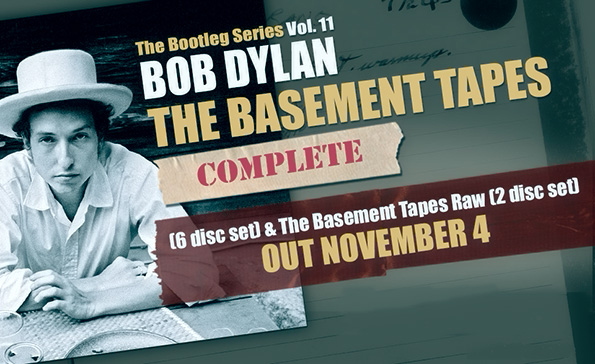
As his loyal fans already know, Bob Dylan will release next week a six-CD collection called The Basement Tapes Complete: The Bootleg Series, Vol. 11, which features 139 songs recorded during the late 1960s, when, Dylan, recovering from a motorcycle accident, holed himself up in a basement in Saugerties, NY and began playing music casually with The Band. The story behind the making of The Basement Tapes gets nicely told by Sasha Frere-Jones in the latest edition of The New Yorker, and over at NPR you can now stream a selection of songs from the upcoming Basement Tapes release. Just thought you might want to know.…
Related Content:
Bob Dylan Reads From T.S. Eliot’s Great Modernist Poem The Waste Land
Bob Dylan and The Grateful Dead Rehearse Together in Summer 1987. Listen to 74 Tracks.
The 1969 Bob Dylan-Johnny Cash Sessions: 12 Rare Recordings
Read More...Stephen Colbert Explains How The Colbert Report Is Made in a New Podcast

“I do the show in character, he’s an idiot, he’s willfully ignorant of what you know and care about, please honestly disabuse me of my ignorance and we’ll have a great time.”
This secret speaks to the heart of comedian and fake-pundit Stephen Colbert’s wildly popular Colbert Report. But how exactly does he manage to pull this rabbit from his hat, night after night grueling night?
The nuts and bolts of Colbert’s working day make for a fascinating inaugural episode of Working, a new Slate podcast hosted by David Plotz. It shares a title with radio personality Studs Terkel’s famous non-fictional examination, but Plotz’s project is more process oriented. Soup-to-nuts-and-bolts, if you will.
Colbert is happy to oblige with a Little Red Hen-like corn metaphor in which alcohol, not bread, is the ultimate goal.
His morning begins with a deep rummage through the headlines—Google News, Reddit, Slate, The Drudge Report, Fox News, Buzzfeed, The Huffington Post… imagine if this stack was made of paper. When does he have the time to google ex-girlfriends?
Whenever patterns and trends emerge, Colbert and his hard working team ferret out ways to impose his character onto them. Occasionally some lucky non-story will find itself elevated to Queen for a Day, if it speaks to something Colbert-the-character would care about passionately. The proposed ban on horse carriages in Central Park, the Colorado VA’s marijuana stance, and the self-declared lesbian trouple are three that have borne fruit of late.
From pitch meeting through read-aloud and rewrites, the school hours portion of Colbert’s day resembles that of other deadline-driven shows. He’s quick to acknowledge the contributions of a dedicated and like-minded staff, including executive producer Tom Purcell and head writer Opus—as in Bloom County—Moreschi.
As showtime approaches, Colbert swaps his jeans for a Brooks Brothers suit, and leaves the homey, dog-friendly townhouse where the bulk of the writing takes place for the studio next door.
There are last minute rewrites, a guest to greet, a Bic pen to be nibbled…
Ideally, he’ll get at least 10 minutes of headspace to become the monster of his own making, liberal America’s favorite willfully ignorant idiot. (Most of liberal America, anyway. My late-mother-in-law refused to believe it was an act, but it is.)
A bit of schtick with the makeup artist serves as a litmus test for audience responsiveness.
When the cameras roll, Colbert sticks close to his prompter, further proof that the character is a construct. Any improvisational impulses are unleashed during one-on-one interactions with the guest. With some 10,000 hours of comedy under his belt, his instincts tend toward the unerring.
At days end, he thanks the audience, the guest and everyone backstage except for one guy who gets a mere wave. The show is then edited at a zip squeal pace, and will hopefully fall into the “yay!” category. (The other choices are “solid” or “wrench to the head.”)
Colbert will only watch the show if there was a problem.
And then? The day begins again.
After peering through this window onto Colbert’s world, we’re stoked for future episodes of Working, when guests as varied as a rock musician, a hospice nurse, and porn star Jessica Drake walk Plotz through a typical day.
Related Content:
Stephen Colbert & Louis CK Recite The Gettysburg Address, With Some Help from Jerry Seinfeld
Stephen Colbert Tries to Make Sense of MOOCs with the Head of edX
A Serious Stephen Colbert Gives Advice on Love & Life to Teenage Girls
Ayun Halliday is the creator of The Mermaid’s Legs, a trauma-filled Hans Christian Andersen reboot premiering this week in NYC. See it! And follow her @AyunHalliday
Read More...Support Us
We're hoping to rely on loyal readers, rather than erratic ads. Please click the Donate button and support Open Culture. You can use Paypal, Venmo, Patreon, even Crypto! We thank you!

About Us

Open Culture scours the web for the best educational media. We find the free courses and audio books you need, the language lessons & educational videos you want, and plenty of enlightenment in between.
Advertise With Us
FREE UPDATES!
GET OUR DAILY EMAIL
Get the best cultural and educational resources on the web curated for you in a daily email. We never spam. Unsubscribe at any time.
FOLLOW ON SOCIAL MEDIA
Open Culture editor Dan Colman scours the web for the best educational media. He finds the free courses and audio books you need, the language lessons & movies you want, and plenty of enlightenment in between.
Advertise With Us

