The Making (and Remaking) of the Beach Boys’ Pet Sounds, Arguably the Greatest Rock Album of All Time
Rock ‘n’ roll has a sad tradition of geniuses who’ve succumbed to mental illness and addiction. Some of them have, paradoxically, produced some of the best music of their careers during periods of decline. We’d have to mention Pink Floyd’s Syd Barrett, Moby Grape’s Skip Spence, Big Star’s Chris Bell… all of whom recorded strange, intimate, and heartfelt solo albums after leaving their respective bands. Then, of course, there’s Brian Wilson, whose 1966 Pet Sounds re-invented pop, and laid the groundwork for Sgt. Pepper’s Lonely Hearts Club Band. (Wilson is said to have been inspired by Rubber Soul). We may know Pet Sounds as a Beach Boys release, but it was really Wilson’s record. In the video series here, “Behind the Sounds,” we get a unique listen in to the creation of the album by way of early takes, lots of studio chatter, and pop-up video style factoids in the Pet Sounds cover’s Cooper Black font over behind-the-scenes photos.
At the top, hear behind the sounds of “Wouldn’t It Be Nice.” Just above, hear the making of “I Know There’s An Answer,” and below, hear Parts 1 and 2 of the creation of “God Only Knows,” the lush, self-effacing ballad whose harpsichord and French horn intro clearly inspired the orchestration in songs like “Penny Lane” and “Strawberry Fields Forever.” See videos for the rest of Pet Sounds’ songs at the “Behind the Sounds” Youtube channel.
Pet Sounds has been named the greatest album of all time by NME and Mojo magazines and ranks at number two in Rolling Stone’s 500 Greatest Albums of All Time, right behind Sgt. Pepper’s. Wilson wrote the songs with lyricist Tony Asher during a time when he was pulling away from his sunny surf-pop group and expanding his repertoire of studio techniques in unprecedented ways. The songs can sound superficially like breezy Beach Boys pop, but reveal themselves as complex, baroque orchestrations that hold enough instrumental surprises and lyrical subtleties for a lifetime of listening. It’s a record both thoroughly of its time and thoroughly timeless.
Unlike many a tragic rock composer, Wilson has survived and recovered (many times over) into old age, recording and touring on and off with the Beach Boys and opening up about his darker times. And unless you’re spending this week under a rock somewhere, you’ll catch the BBC’s star-studded video re-make of “God Only Knows,” just below, circulating all over the ‘net. Both a promo for the more than two dozen musicians involved and a benefit single for charitable organization BBC Children in Need, the glamorous production features Wilson behind his piano, looking stately and healthy. For more on the making of Pet Sounds, see this 2002 BBC documentary, Art That Shook The World: The Beach Boys’ Pet Sounds. And please, amidst this flurry of Pet Sounds goodies, don’t forget to listen to the album itself, best appreciated, says Wilson, with “earphones, in the dark.”
Related Content:
John Belushi and Dan Aykroyd Get Brian Wilson Out of Bed and Force Him to Go Surfing, 1976
The Strawberry Fields Forever Demos: The Making of a Beatles Classic (1966)
Watch Documentaries on the Making of Pink Floyd’s Dark Side of the Moon and Wish You Were Here
Josh Jones is a writer and musician based in Durham, NC. Follow him at @jdmagness.
Read More...Longform’s New, Free App Lets You Read Great Journalism from Your Favorite Publishers

If you have managed to keep your attention span intact during this distracting information age, then you’re almost certainly familiar with Longform.org, a web site that makes it easy to find something great to read online, especially if you like reading informative, well-crafted works of non-fiction. Last week, Longform enhanced its service with the release of a new, free app for iPhone and iPad. It’s the “only 100% free app that filters out the internet junk and delivers nothing but smart, in-depth reads.” And, drawing on material from 1,000 publishers, the app lets readers “create their own custom feeds of high quality, feature-length journalism,” and then read it all on the go. It’s a mission that certainly aligns with ours, so we’re more than happy to give the new app a plug.
Sign up for our daily email and, once a day, we’ll bundle all of our daily posts and drop them in your inbox, in an easy-to-read format. You don’t have to come to us; we’ll come to you!
Read More...Let’s Learn Japanese: Two Classic Video Series to Get You Started in the Language
Say the name “Yan-san” to anyone who’s studied Japanese in the last thirty years, and you’ll probably get a reaction of delighted recognition. It means that, inside or outside the classroom, they studied with Let’s Learn Japanese, a series of educational videos produced by the Japan Foundation. The first “season,” if you like, came out in 1984, the time of an enormous Asian economic bubble that made the world’s future look Japanese, sending the language straight to the top of every international business-minded student’s to-do-list. (Sound familiar, current strugglers with Mandarin?) Its hero, a young man of deliberately ambiguous nationality named Yan — the Japanese all address him with the everyday honorific -san — turns up in Japan for a few years of life in Tokyo and works at an architecture firm, helped along by his host family the Katos, his eagerly team-playing co-workers (one of whom introduces himself, in English, with the phase, “We are friends — okay?”), and a variety of helpful citizens and professionals all across the Land of the Rising Sun.
This may sound like dull stuff — the stuff of run-of-the-mill language-learning videos — but Let’s Learn Japanese raised the bar for this sort of thing, in terms of not just production value and teaching effectiveness but sheer rewatchability. In addition to Yan-san’s life among the Japanese people, Let’s Learn Japanese also offers instructional segments led by Mary Althaus, still a professor at Tokyo’s Tsuda College, and imaginative illustrative skits performed by the indefatigable trio of Mine, Kaihō, and Sugihara. In the more advanced Season 2, released over a decade later in 1995, they’ve become the eerily similar Kodama, Andō, and Koyanagi, and Yan-san has become a graduate student with girlfriend troubles. Having watched all 52 episodes several times through, I can vouch for both its entertainment value and its effectiveness. (It also spurred me to start volunteering at the Japan Foundation, Los Angeles.) So can the foreigners who give a hero’s welcome to star Nick Muhrin (who, last I heard, still lives in Japan) when they run into him. I know I’ve learned enough to buy Yan-san a drink.
You can find more useful Japanese-learning materials to supplement all this in our archive of free language lessons. It includes resources ranging from the Foreign Service Institute’s digitized textbooks and tapes to podcasts like the life abroad-oriented Japanesepod101 [iTunes Free — Feed] and the anime-geared Japancast [iTunes Free — Feed]. 皆さんがんばって!
Related Content:
Learn 48 Languages Online for Free: Spanish, Chinese, English & More
Woody Allen Lives the “Delicious Life” in Early-80s Japanese Commercials
Wim Wenders Visits, Marvels at a Japanese Fake Food Workshop
Colin Marshall hosts and produces Notebook on Cities and Culture and writes essays on cities, language, Asia, and men’s style. He’s at work on a book about Los Angeles, A Los Angeles Primer. Follow him on Twitter at @colinmarshall or on Facebook.
Read More...Hear David Foster Wallace Read His Own Essays & Short Fiction on the 6th Anniversary of His Death,
Yesterday, of course, marked the 13th anniversary of the horrible attacks on the Twin Towers and the Pentagon. Today marks the 6th anniversary of David Foster Wallace’s death by suicide. The two events are related not only by proximity, and not because they are comparable tragedies, but because Wallace’s work, in particular his 1993 essay “E Unibus Pluram: Television and U.S. Fiction,” has become such a touchstone for the discourse of “post-irony” or “the new sincerity” since 9/11, when Vanity Fair editor Graydon Carter and others proclaimed the “end of irony.” But the cultural consciousness has shifted measurably since those heady days of fervent affirmation. In a reconsideration of Wallace on irony, Bradley Warshauer writes, “he wasn’t wrong—but he is obsolete.” Our national discourse—as much as it can be defined in broad terms—may have, some argue, swung further toward sincerity and sentimental reverence than Wallace would have liked. And he may have been much more an ironist than he liked to believe.
Wallace, writes Warshauer, was “a wannabe sentimentalist who was too absurdly talented and probably too obsessed with the artificiality of fiction to be the sort of ‘anti-rebel’ that he himself talked about.” While he may have romanticized the high-minded figure who “stands for” things in uncomplicated ways, Wallace himself was complicated, prickly, and just too hyper-aware—of himself and others—to be seduced by easy sentiment, what Somerset Maugham called “unearned emotion.” While his work pulls us still toward deeper levels of analysis, toward contemplation and critique, toward serious considerations of value, it does not do so by eschewing irony. In the descriptive force of his prose are the evasions, parries, asides, circumlocutions, and jarringly odd juxtapositions of the ironist, the satirist, and—what might be the same thing—the moralist. “The inherent contradiction”—the irony, if you will—of Wallace’s stance, Washauer argues, citing 1999’s Brief Interviews With Hideous Men, is that he himself “was addicted to ironic detachment.” But, of course, it’s not so simple as that.
Today we bring you several readings by David Foster Wallace of his own work. We begin at the top with “Death is Not the End” from Brief Interviews, that collection of “weird metafiction” that couches raw and painful confessions in layers of irony. Below it, from that same collection, we have “Suicide as a Sort of Present,” a piece that, in hindsight, offers its own potential morbidly ironic readings. Just above, hear Wallace read the short story “Incarnations of Burned Children” from the 2005 collection Oblivion, full of stories Wyatt Mason described as “tightly withhold[ing]… hiding on high shelves the keys that unlock their treasures.” Replete with tiny mechanisms that can take many careful readings to parse, these stories are fine-art studies in ironic language and situations.
One may class David Foster Wallace as a master ironist, despite his critical stance against its overuse, but this reduces the full range of his mastery to one mode among so many. His work embraced the voice of irony and the voice of sincerity as equally valid rhetorical means, alternating between the two in what A.O. Scott once called a “feedback loop.” “The View From Mrs. Thompson’s,” the essay Wallace reads above from 2005’s essay collection Consider the Lobster, is a piece he wrote just days after 9/11. Written quickly as a commission from Rolling Stone, the essay records his trenchant observations of the reactions in Bloomington, Illinois between September 11–13. It’s a piece that showcases the tension between Wallace’s sincere desire for immediacy and his almost uncontrollable impulse to amused detachment. And hearing Wallace commemorate the tragic events we remembered yesterday highlights the sad irony of memorializing his own death today.
You can hear many more of David Foster Wallace’s readings and interviews at the David Foster Wallace Audio Project, and be sure to stop by our sizable collection, 30 Free Essays & Stories by David Foster Wallace on the Web.
Related Content:
‘This Is Water’: Complete Audio of David Foster Wallace’s Kenyon Graduation Speech (2005)
David Foster Wallace: The Big, Uncut Interview (2003)
David Foster Wallace’s 1994 Syllabus: How to Teach Serious Literature with Lightweight Books
Read Two Poems David Foster Wallace Wrote During His Elementary School Days
Josh Jones is a writer and musician based in Durham, NC. Follow him at @jdmagness
Read More...The History of Rock n Roll in 10 Songs: A List Created by Legendary Rock Critic Greil Marcus
Rock critic and scholar Greil Marcus has just released a book with Yale Press called The History of Rock ‘n’ Roll in Ten Songs, and it appears to be an unusual take on a very hackneyed subject, as Marcus admits in the video trailer above: “Everybody knows the history of rock ‘n’ roll,” he says, “What if it was just about a few songs?” “Unlike all previous versions of rock ‘n’ roll,” writes Yale, “this book omits almost every iconic performer and ignores the storied events and turning points that everyone knows.” This is not entirely true—you’ve got your Beatles, you’ve got your Buddy Holly, but you’ve also got… Joy Division. And a number of other surprising, offbeat choices that don’t necessarily sound like rock ‘n’ roll history, but certainly tell it their various ways. “At any given moment,” Marcus says above, any of these songs “could contain the whole history […] the whole DNA of rock ‘n’ roll.”
Some of the choices seem like personal quirks. Nothing to get too bent out of shape about, if that’s your tendency, but odd nonetheless. The Flaming Groovies would not be a band I’d choose as representative of garage rock, if that’s what they represent. Their song “Shake Some Action” above may be better known for some from Cracker’s workmanlike cover on the Clueless soundtrack than as a genuine hit in its own right. But the single sure had a cool cover.
It also has some excellent guitar work and a perfectly distinctive tone that Marcus can’t forget. Its lyrics are by turns vapid and creepy, which, now that I think of it, perhaps makes this a perfect track to define much of rock ‘n’ roll history.
No one bested post-punk darlings Joy Division when it came to boyish good looks and relentless despair. In an oblique rock history sense, they were pivotal, taking the obscurantist minimalist experiments of bands like Wire and making them viable options for an entire genre of music. Marcus chooses “Transmission” instead of the much more popular “Love Will Tear Us Apart,” which has become almost a musical rite of passage for certain bands to cover. This was the last single the band released before singer Ian Curtis killed himself. “It’s sort of fitting then,” writes Consequence of Sound, “that this would be both one of the band’s most popular songs and also pave the way for New Order, specifically in terms of its sound and direction.” Little live footage of the band exists. See them above in 1979 on UK retro television program The Wedge (originally broadcast on Something Else with the Jam).
Marcus’ third choice is not really what we think of as rock and roll, but it’s a close cousin, and without doo wop, we’d have had no Lou Reed. 1956’s “In the Still of the Night,” written by Fred Parris and recorded by his Five Satins in a Catholic school basement, was a hit in the 90s for Boyz II Men on the R&B and Adult Contemporary charts and reliably appears in films about the fifties. Marcus also refers to a version recorded by the Slades, a white vocal group. The pairing illustrates the familiar fifties practice of white groups recording black artists—and often outselling them, though certainly not in this case—for presumably segregated audiences.
Etta James’ 1960 soaring lament “All I Could Do Was Cry” again seems a world away from rock and roll, with its lush studio string section and spacious, spare production. The song lacks the bite and growl of “At Last!” from the same album, but Marcus makes a weighty allusion in referring to two different versions. By including Beyoncé’s take on the song, the list hauls in the history of Chicago’s Chess records and Knowles’ outstanding performance as James in 2008’s Cadillac Records, a film that takes us from Muddy Waters’s electric blues to Chuck Berry’s hybrid crossover sound.
Yes, we have Buddy Holly, but we don’t have “Peggy Sue” or “Not Fade Away.” Instead Marcus gives us the B‑side to the posthumously released “Peggy Sue Got Married,” a song called “Crying, Waiting, Hoping.” Originally recorded by Holly alone in a Manhattan apartment and mixed with studio backing tracks by producer Jack Hansen in 1959, the song had nothing to do with Holly’s fame in life—hence the bad vocal sync in the video above. The band’s playing an entirely different song. Marcus chose this as symbolic of the Holly mythos after his death, which spread across the ocean to Merseybeat bands like the Beatles, who often covered this song and recorded it live on the BBC. Like the musicians who played on the first record, they aren’t just covering Holly, writes Marcus, “they’re conducting a kind of séance with him.”
Speaking of the Beatles: everyone knows their “Money (That’s What I Want),” but did you know that the song, performed in 1959 by Barrett Strong (above), was the first hit for Berry Gordy’s Motown records (then Tamla)? A direct link between American R&B and the UK variety, “Money” was a staple for British invasion bands in the early 60s.
I had never heard of The Brains before reading Marcus’ list. That’s not saying a whole lot, but I had also never heard Cyndi Lauper’s 1983 hit cover of their minor hit “Money Changes Everything,” or even the rare Smiths’ instrumental version, ardent fan though I am. So chalk that up to a musical blind spot, if you will, or take it as evidence of the song’s outlier status. Hear the 1978 original above. Marcus has said elsewhere of its raw, cynical honesty that “there’s no other way the decade could end.”
“This Magic Moment,” the 1960 hit by Ben E. King and the Drifters, sounds like the perfect choice of song for nostalgic boomers, not so much for jaded rock writers telling a new story of rock ‘n’ roll, but there you have it. Marcus also refers to a version by “Ben E. King with Lou Reed.” As far as I can tell, no such recording exists, but we do have a version by Reed alone. Hear it above.
The only way perhaps to discuss this ninth “song” in any rock ‘n’ roll context is by way of Lou Reed, it so happens. Reed’s “thoroughly alienating” Metal Machine Music consists of 64 minutes of feedback and distortion caused, some legends have it, by Reed recording the sound of his guitar leaning against a cranked-up amp. Artist Christian Marclay does him one better. “Guitar Drag” is exactly what it advertises, the sound—and video, above—of a guitar dragged behind a truck. Representing the pure noise of Metal Machine Music and the general destructiveness of rock ‘n’ roll, it also re-enacts the absolutely horrifying 1998 dragging death of James Byrd, Jr, one of the lowest moments in American racial history. Does this disturbing piece of sound/video art aestheticizing a racist murder, chilling and gruesome beyond words, belong on any list about rock ’n’ roll history? Greil Marcus thinks it does.
We return to familiar, if cloying territory with “To Know Is to Love Him,” an early hit for Phil Spector and his Teddy Bears in 1958 (above)—written not about a crush but about Spector’s deceased father after the words on his headstone. Next to the quaintness of this recording, Marcus also lists Amy Winehouse’s 2007 cover (below). Maybe he hears them at once, both songs haunting each other. Writing on the song in The Guardian after Winehouse’s death, Marcus says “it took 48 years to find its voice.” It’s a story of two incredibly talented, and tragically disturbed, rock ‘n’ roll characters, and one of the pain and loss that lie behind even the most bubblegum of hits. See Yale Press’s website for more on Marcus’ The History of Rock ‘n’ Roll in Ten Songs.
Related Content:
A History of Rock ‘n’ Roll in 100 Riffs
100 Years of Rock in Less Than a Minute: From Gospel to Grunge
Revisit The Life & Music of Sister Rosetta Tharpe: ‘The Godmother of Rock and Roll’
Josh Jones is a writer and musician based in Durham, NC. Follow him at @jdmagness
Read More...
Foodie Alert: New York Public Library Presents an Archive of 17,000 Restaurant Menus (1851–2008)
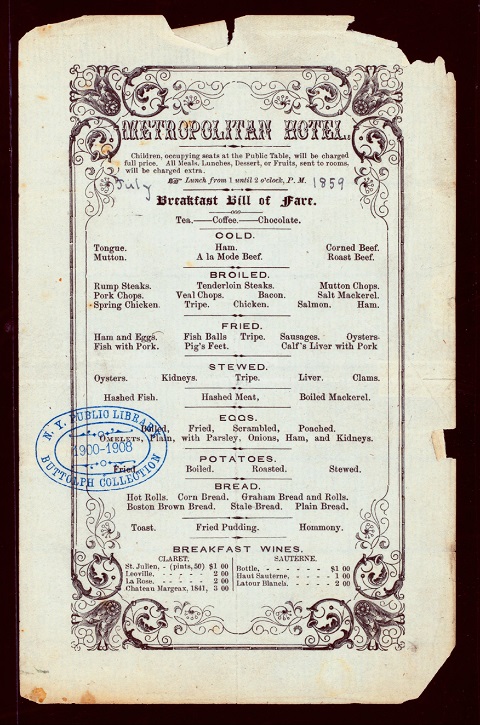
To be a New Yorker is to be a gourmand—of food carts, local diners, supermarkets, outer borough mercados, whatever latest upscale restaurant surfaces in a given season.… It is to be as likely to have a menu in hand as a newspaper, er… smartphone…, and it is to notice the design of said menus. Well, some of us have done that. Often the added attention goes unrewarded, but then sometimes it does. Now you, dear reader, can experience well over one-hundred years of staring at menus, thanks to the New York Public Library’s enormous digitized collection. Fancy a time warp through dining halls abroad? You’ll not only find several hundred New York restaurants represented here, but hundreds more from all over the world. With a collection of 17,000 menus and counting, a person could easily get lost.
You may notice I used the word “gourmand,” and not “foodie” above. While it might be a gross anachronism to call someone a “foodie” in 1859, the year the menu for the Metropolitan Hotel (above) was printed, it might also import a cosmopolitan concept of dining that didn’t seem to exist, at least at this establishment. More than anything, the menu resembles the various descriptions of pub food that populate Joyce’s Ulysses. Though much of it was delicious, I’m sure, for heavy eaters of meat, eggs, potatoes, and bread, you won’t find a vegetable so much as mentioned in passing. The fare does include such hearty staples as “Hashed Fish,” “Stale Bread,” and “Breakfast Wine.” The design marries flowery Victorian elements with the kind of font found in Old West typesets.
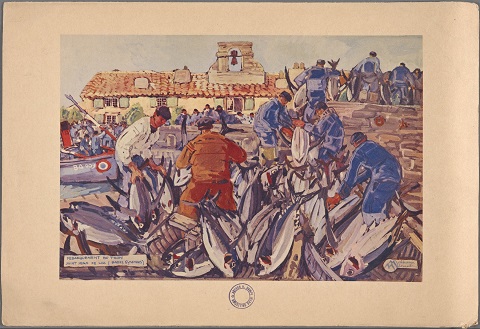
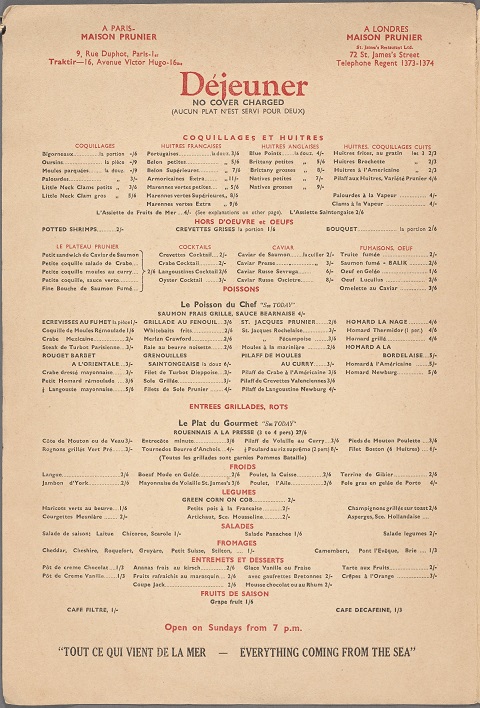
1939 was a good year for menus, at least in Europe. While New York institutions like the Waldorf Astoria practiced certain design austerities, the Maison Prunier, with locations in Paris and London, spared no expense in the printing of their full-color fishermans’ slice of life painting on the menu cover above and the elegant typography of its extensive contents below. A version was printed in English—though The New York Public Library (NYPL) doesn’t seem to have a copy of it digitized. One English phrase stands out at the bottom, however: the translation of “Tout Ce Qui Vient De La Mer–Everything From the Sea.” Other menus for this restaurant show the same kind of careful attention to design. Clicking on the pages of many of the NYPL menus—like this one from a 1938 Maison Prunier menu—brings up an interactive feature that links each dish to close-up views.
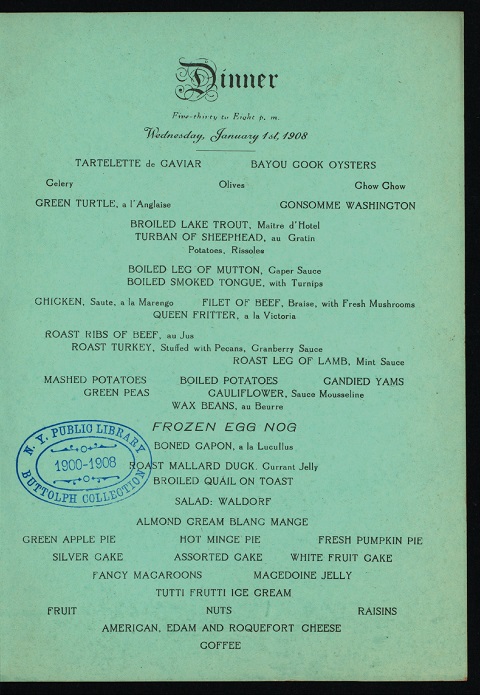
In a post on the NYPL menu collection, Buzzfeed specifically compares New York menus of today with those of 100 years ago, noting that prices quoted signify cents, not dollars. A 1914 Delmonico “Rib of Roast” would run you .75 cents, for example, while a 2014 rib eye there sells for 58 big ones. Of course then, as now, many restaurants considered it gauche to print prices at all. See, for example, the dinner menu at New Orleans’ St. Charles Hotel from 1908 below. We may have an all-inclusive feast here since this comes from a New Years Eve bill, which also includes a “Musical Program” in two parts and a list of local “Amusements” at such places as Blaney’s Lyric Theatre, Tulane, Dauphine, “French Orera” (sic), and the 2:00 pm races at City Park. Matinees and 8 o’clock shows every day except Sunday.
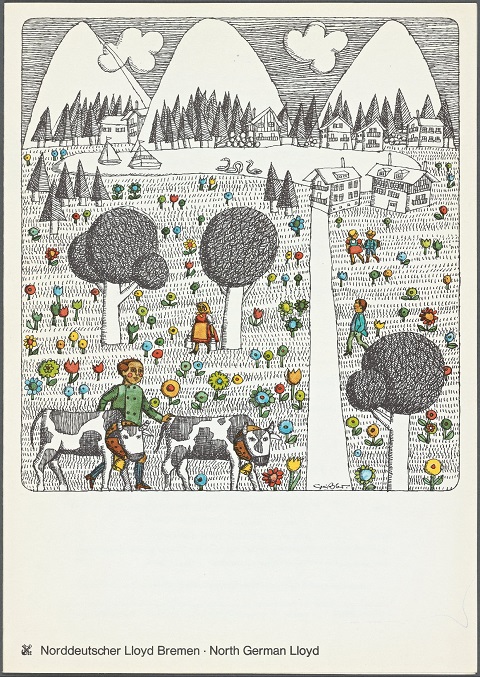
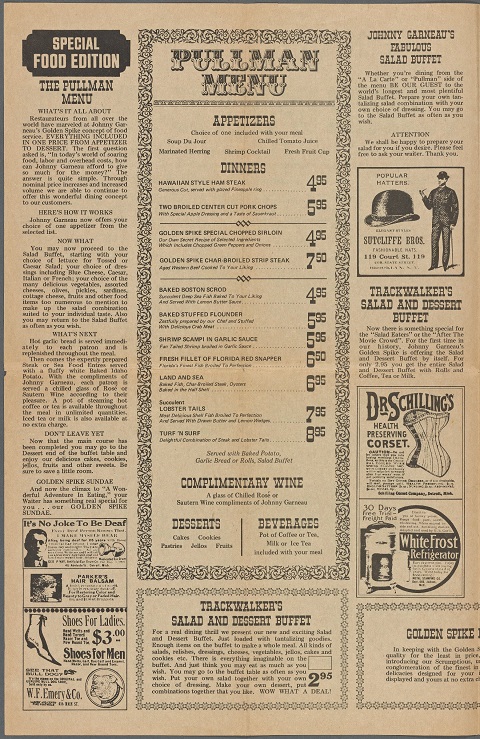
The sixties gave us an explosion of menus that parallel in many cases the breakout designs of magazine and album covers. See two standouts below. The North German Lloyd, just below, went with a funky children’s book-cover illustration for its 1969 menu cover, though its interior maintains a minimalist clarity. Below it, see the striking first page of a menu for Johnny Garneau’s Golden Spike from that same year. The cover boasts a nostalgic headline story for Promontory News: “Golden Spike is Driven: The last rail is laid! East meets West in Utah!” Put it on the cover of a Band or CSNY album and no one bats an eye.
See many, many, many more menus at the NYPL site. With the steady growth of food scholarship, this collection is certainly a boon to researchers, as well as curious gourmands, foodies, and rabid diners of all stripes.
via Buzzfeed
Related Content:
What Prisoners Ate at Alcatraz in 1946: A Vintage Prison Menu
Howard Johnson’s Presents a Children’s Menu Featuring Kubrick’s 2001: A Space Odyssey (1968)
Extensive Archive of Avant-Garde & Modernist Magazines (1890–1939) Now Available Online
Josh Jones is a writer and musician based in Durham, NC. Follow him at @jdmagness
Read More...Conspiracy Theory Rock: The Schoolhouse Rock Parody Saturday Night Live May Have Censored
You’ve probably seen “Illusion of Choice,” a 2011 infographic detailing how six media conglomerates “control a staggering 90% of what we read, watch, or listen to.” (The entities named are GE, News Corp, Disney, Viacom, Time Warner, and CBS.) Another “Illusion of Choice” infographic from last year documents how “ten huge corporations control the production of almost everything the average person buys.” Are these webs of corporate connection kooky conspiracy theories or genuine cause for alarm? Do the correlations between business entities cause political currents that undermine democracy and media independence? It’s not particularly controversial to think so given the amount of money corporations spend on lobbying and political campaigns. It’s not even particularly controversial to say so, at least for those of us who aren’t employed by, say, Viacom, Time Warner, GE, etc.
But pointing fingers at the corporatocracy may have not gone over so well for famed comedy writer Robert Smigel in 1998 when his recurring animated “Saturday TV Funhouse” segment produced the “Conspiracy Theory Rock” bit above for Saturday Night Live. A parody of the beloved Schoolhouse Rock educational ‘toons of the 70s, “Conspiracy Theory Rock” features a disheveled gentleman—a stereotype of the outsider crackpot—leading a sing-along about the machinations of the “Media-opoly.” Figured as greedy octopi (reminiscent of Matt Taibbi’s “vampire squid”), the media giants here, including GE, Westinghouse, Fox, and Disney, devour the smaller guys—the traditional networks—and “use them to say whatever they please and put down the opinions of anyone who disagrees.” The segment may have raised the ire of GE, who own NBC. It aired once with the original episode but was subsequently pulled from the show in syndication, though it’s been included in subsequent DVD compilations of “Saturday TV Funhouse.”
Now “Conspiracy Theory Rock” is circulating online—amplified by a Marc Maron tweet—as a “banned” clip, a misleading description that feeds right into the story of conspiracy. Editing a sketch from a syndicated comedy show, after all, is not tantamount to banning it. While the short piece makes the usual compelling case against corporate rule, it does so in a tongue-in-cheek way that allows for the possibility that some of these allegations are tenuous exaggerations. Our unwashed presenter, for example, ends the segment mumbling an incoherent non sequitur about Lorne Michaels and Marion Barry attending the same high school. For his part, Michaels has said the segment was cut because it “wasn’t funny.” He’s got a point—it isn’t—but it’s hard to believe it didn’t raise other objections from network executives. It wouldn’t be the first time the show has been accused of censoring a political sketch.
Related Content:
5 Musical Guests Banned From Saturday Night Live: From Elvis Costello to Frank Zappa
William S. Burroughs on Saturday Night Live, 1981: A Quick 100th Birthday Celebration
Schoolhouse Rock at 40: Revisit a Collection of Nostalgia-Inducing Educational Videos
Josh Jones is a writer and musician based in Durham, NC. Follow him at @jdmagness
Read More...Everyday Economics: A New Course by Marginal Revolution University Where Students Create the Syllabus
In 2012, Tyler Cowen and Alex Tabarrok, two econ professors at George Mason University, launched Marginal Revolution University (otherwise known as MRUniversity) which delivers free, interactive courses in the economics space. During its early days, MRUniversity created courses on The Great Economists, Development Economics, International Trade, and The Economic History of the Soviet Union. And now it’s creating a somewhat unconventional new course called Everyday Economics. The course tries to show how economics impacts people’s day-to-day lives. And, rather suitably, MRUniversity is inviting its students — everyday people around the globe — to vote for topics the course should cover. It’s what’s called a “student-driven” course.
The course is being built in stages, and you can already watch lectures (above) from the first section, taught by Don Boudreaux. It covers Trade and Prosperity broadly speaking, and gets into topics like The Hockey Stick of Human Prosperity and How the Division of Knowledge Saved My Son’s Life.
The next section, to be taught by Tyler Cowen, will focus on Food. And right now MRUniversity wants your input on the topics this section might focus on. For example, you might recommend that they explain “Why is tipping so prevalent in restaurants but not in other parts of the economy?” You can make your suggestions here.

What other topics will the course cover as it unfolds? It’s all still TBD. But, again, you’re invited to help shape the syllabus. Bigger picture suggestions are being sought here.
For more courses on the Dismal Science, don’t forget to peruse our list of Free Online Economics Courses. It part of our meta collection called, 1,700 Free Online Courses from Top Universities.
Related Content:
Marginal Revolution University Launches, Bringing Free Courses in Economics to the Web
The History of Economics & Economic Theory Explained with Comics, Starting with Adam Smith
150 Free Online Business Courses
Read More...A Serious Stephen Colbert Gives Advice on Love & Life to Teenage Girls
Rookie’s never less than worthy “Ask a Grown Man” series provides a forum for mature males like actor Jon Hamm and radio personality Ira Glass to offer thoughtful, straightforward advice and explanations, born of personal experience, to teenage girls (and other interested parties).
The most recent edition adds depth, and could just as accurately be titled “Ask a Level-Headed 50-Year-Old Father of Three, Who’s Been Happily Married to His Children’s Mother for Years.”
Lurking just beneath Stephen Colbert’s hawkish Colbert Report persona is a fair-minded, serious fellow, who’s unembarrassed to weigh in in favor of parental authority when a 19-year-old fan complains of her dad’s opposition to sleepovers at her boyfriend’s place while she’s still living at home. Perhaps she should’ve asked a grown man whom experience hadn’t equipped to see things from the other side of the fence, as Colbert foresees that his answer won’t “go over great with everyone.”
Surely, though, his late mother would approve.
Perhaps this segment should be called “Ask a Grown Man Whose Unequivocating Moral Compass Is Inconveniently Close to Your Dad’s, But Whose Position Allows Him to Offer Insights Without Losing His Temper or Going Off Message.”
Colbert’s children’s extremely low profile in the media’s line up of celebrity offspring reflects well on those charged with their upbringing. Were his 18-year-old daughter to take issue with the old man’s musings on Twitter or Snapchat, she’d have the luxury of doing so in the way of the average Rookie reader, rather than some obsessively observed nearly-grown baby bump.
As to how to tell whether a boy—or anyone—likes you, Colbert says “they want to hear your stories.”
As one viewer noted, “ask a grown-up, get grown-up answers.” Word.
Related Content:
Radiohead’s Thom Yorke Gives Teenage Girls Endearing Advice About Boys (And Much More)
Student Asks Noam Chomsky for Dating Advice
Nietzsche Dispenses Dating Advice in a Short Screwball Film, My Friend Friedrich
Ayun Halliday is an author, zine publisher, and mother of a teenage Rookie reader. Follow her @AyunHalliday
Read More...11-Year-Old Martin Scorsese Draws Storyboards for His Imagined Roman Epic Film, The Eternal City
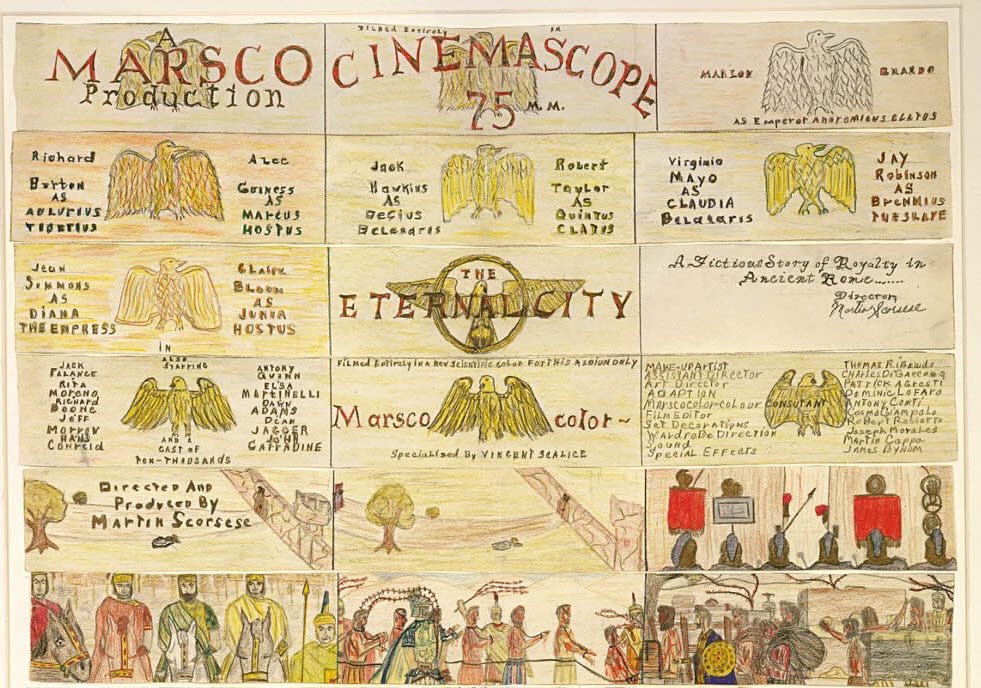
Martin Scorsese’s mean streets are as long gone as graffiti-festooned subway trains, the real Max’s Kansas City, and Yogi Berra’s pennant-winning Mets. But while the 1973 film that broke open his career is now over forty years old, Scorsese hasn’t looked back, nor has he stayed trapped in the rough milieu of New York gangster films. He’s adapted Edith Wharton, told stories of the Dalai Lama, Howard Hughes, handfuls of rock and blues stars, and cinematic hero Georges Méliès (sort of).
Last year’s The Wolf of Wall Street further cemented Scorsese’s reputation as a director with more breadth than almost any of his contemporaries. But it would perhaps be a mistake to call Scorsese’s genre-hopping an evolutionary development. The series of storyboards here for an imagined widescreen Roman epic called The Eternal City— drawn by 11-year-old Scorsese—show us that his vision always exceeded the cramped Little Italy streets of his youth.
Young Scorsese described his Cecil B. Demille-like production as “A fictitious story of Royalty in Ancient Rome,” and though he didn’t give us character names, he made sure to specify the film’s actors, casting Marlon Brando, Richard Burton, Virginia Mayo, and Alec Guinness, among others. As for Scorsese’s own role, The Independent notes, “it is striking that he has given himself a bigger credit as producer-director than any of the stars.” Reproduced in David Thompson’s series of interviews, Scorsese on Scorsese, the drawings’ impressive level of detail demonstrate a precocious eye for shot composition and the dramatic perspectives that characterize his mature work.
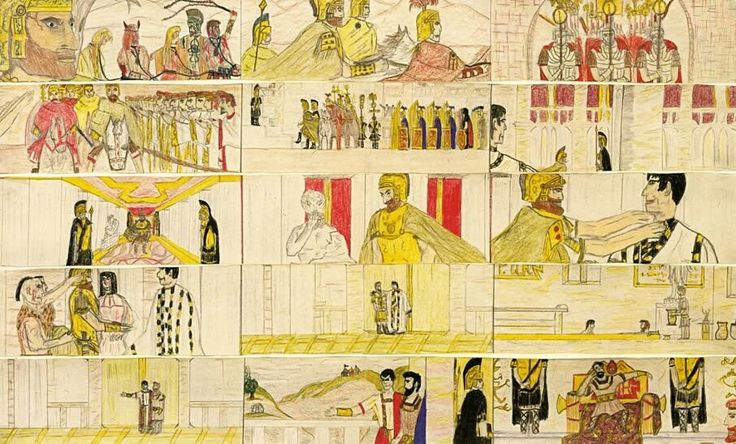
The director of such meticulously composed films as Taxi Driver and Goodfellas has had much to say about the importance of storyboards to his process. (We’ve previously featured his hand-drawn storyboards for Taxi Driver.) They are, he’s said, “the way to visualize the entire movie in advance,” to “show how I would imagine a scene and how it should move to the next.” And while many directors would make similar claims about this essential production tool, Scorsese cherishes the craft as well as the utility of the storyboard. “Pencil drawing is my favorite,” he remarks. “The pencil line leaves little impression on the paper, so if the storyboard is photocopied it loses something. I refer back to my original drawings in order for me to conjure up the idea I had when I saw the pencil line made.”
Can we look forward to Scorsese looking back, just once, to his plans for The Eternal City? He’d have to recast, of course, but given how confidently he sketches out each of his films on paper, the 71-year-old director might find much to work with in this youthful cinematic vision of antiquity.
View the storyboards in a larger format here.
Related Content:
Revisit Martin Scorsese’s Hand-Drawn Storyboards for Taxi Driver
Martin Scorsese’s Very First Films: Three Imaginative Short Works
Saul Bass’ Vivid Storyboards for Kubrick’s Spartacus (1960)
Josh Jones is a writer and musician based in Durham, NC. Follow him at @jdmagness
Read More...Support Us
We're hoping to rely on loyal readers, rather than erratic ads. Please click the Donate button and support Open Culture. You can use Paypal, Venmo, Patreon, even Crypto! We thank you!

About Us

Open Culture scours the web for the best educational media. We find the free courses and audio books you need, the language lessons & educational videos you want, and plenty of enlightenment in between.
Advertise With Us
FREE UPDATES!
GET OUR DAILY EMAIL
Get the best cultural and educational resources on the web curated for you in a daily email. We never spam. Unsubscribe at any time.
FOLLOW ON SOCIAL MEDIA
Open Culture editor Dan Colman scours the web for the best educational media. He finds the free courses and audio books you need, the language lessons & movies you want, and plenty of enlightenment in between.
Advertise With Us