Jimi Hendrix at Woodstock (1969)
What must it have been like to have been at Woodstock? Like, really have been there, not just watched the film or the 2009 movie about Woodstock, not just have gone to any of the several million muddy, druggy outdoor festivals that proliferated in Woodstock’s wake, but really been there, man? I’ll never know. The real experience of the 1960s can feel as forever irretrievable as that of the 1860s. But, wow, am I glad for the development of moving pictures and live audio recording in that 100 years.
Not only can we see the throngs of happy hippies making their way across Max and Miriam Yasgur’s dairy farm in the initial few minutes above, but we do not have to smell them! Seriously, the footage leading up to Jimi Hendrix’s Woodstock performance is fun, including a brief glimpse of Jerry Garcia hanging out with the people. But you’re here to see Jimi, so, if you can’t wait, skip to ahead. The crowd certainly waited—waited three days for Hendrix to close the festival Sunday night with his band Gypsy Sun & Rainbows. Then they waited some more, all night, in fact, until Hendrix finally took the stage at 8:00 a.m. that Monday morning, August 18, 1969. I imagine everyone who stayed would say it was well worth it. Part 2 of the video is here.
The performances, as you know, are legendarily blistering and include Hendrix’s famously screaming, feedback-drenched “Star-Spangled Banner.” See it above like you never could if you were knee-deep in mud and standing behind a crowd of thousands in the summer sun. Hear it above in audio from Internet Archive, who also have mp3 and ogg vorbis versions of each song for free download. And hear a radio documentary about that performance below. Enjoy!
Related Content:
‘Electric Church’: The Jimi Hendrix Experience Live in Stockholm, 1969
Jimi Hendrix’s Final Interview on September 11, 1970: Listen to the Complete Audio
Jimi Hendrix Unplugged: Two Rare Recordings of Hendrix Playing Acoustic Guitar
Josh Jones is a writer and musician based in Durham, NC. Follow him at @jdmagness
Read More...The Internet’s Own Boy: New Documentary About Aaron Swartz Now Free Online
On BoingBoing today, Cory Doctorow writes: “The Creative Commons-licensed version of The Internet’s Own Boy, Brian Knappenberger’s documentary about Aaron Swartz, is now available on the Internet Archive, which is especially useful for people outside of the US, who aren’t able to pay to see it online.… The Internet Archive makes the movie available to download or stream, in MPEG 4 and Ogg. There’s also a torrentable version.”
According to the film summary, the new documentary “depicts the life of American computer programmer, writer, political organizer and Internet activist Aaron Swartz. It features interviews with his family and friends as well as the internet luminaries who worked with him. The film tells his story up to his eventual suicide after a legal battle, and explores the questions of access to information and civil liberties that drove his work.”
The Internet’s Own Boy will be added to our collection, 285 Free Documentaries Online, part of our larger collection, 4,000+ Free Movies Online: Great Classics, Indies, Noir, Westerns, Documentaries & More.
Follow Open Culture on Facebook and Twitter and share intelligent media with your friends. Or better yet, sign up for our daily email and get a daily dose of Open Culture in your inbox. And if you want to make sure that our posts definitely appear in your Facebook newsfeed, just follow these simple steps.
Read More...John Lennon Illustrates Two of His Books with Playful Drawings (1964–1965)
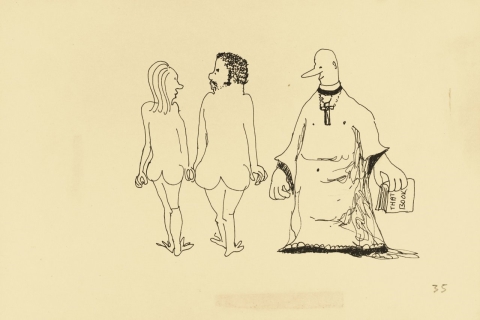
Upon his tragic early death at 40, John Lennon left behind a body of work few popular artists could hope to equal. And that’s only the published stuff. As we pointed out in a recent post on his home demos, the former Beatle also left hundreds of hours of tape recordings for his fans to sift through, and, as if that weren’t enough, Sotheby’s recently auctioned off a storehouse of original manuscripts and autographed drawings for two books Lennon wrote in the mid-sixties, In His Own Write (1964) and A Spaniard in the Works (1965), a Sherlock Holmes parody.
Lennon’s playful sense of humor and surreal imagination shine through the stories and poems in both books, as does his more moody broody side. If anything, Lennon’s wordplay and out-there line drawings closely resemble the work of Shel Silverstein, who was probably not an influence but certainly a kindred spirit. Sotheby’s specialist Gabriel Heaton cites as Lennon’s influence “the nonsense tradition of English literature,” and indeed Lewis Carroll comes to mind when reading his work. See, for example, “About The Awful,” his author’s statement for In His Own Write:
I was bored on the 9th of Octover 1940 when, I believe, the Nasties were still booming us led by Madolf Heatlump (who only had one). Anyway they didn’t get me. I attended to varicous schools in Liddypol. And still didn’t pass — much to my Aunties supplies. As a member of the most publified Beatles my (P, G, and R’s) records might seem funnier to some of you than this book, but as far as I’m conceived this correction of short writty is the most wonderfoul larf I’ve every ready.
God help and breed you all.
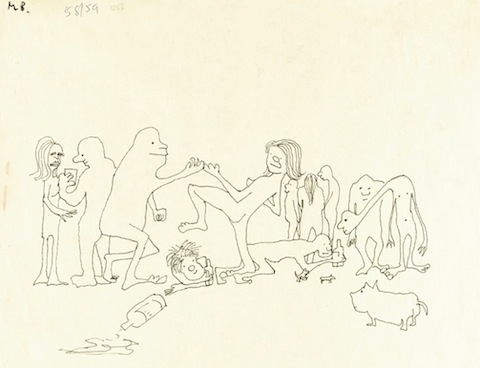
And then there’s the artwork. At the top, see an untitled ink drawing of a vicar leering at a nude couple (and holding in his hand “That Book”). The drawing above shows a clique of naked partiers, with the caption “Puffing and globbering they drugged theyselves rampling or dancing with wild abdomen, stubbing in wild postumes amonst themselves…”
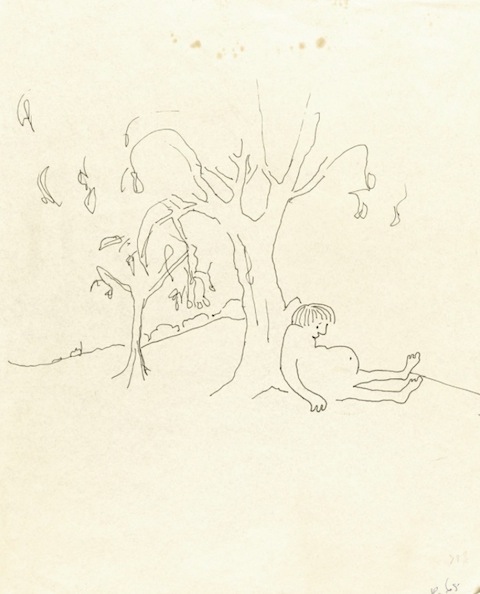
Recalling the artwork in Silverstein’s The Giving Tree, directly above we have a simple illustration for a poem called “I Sat Belonely,” captioned with the poem’s first two lines: “I Sat Belonely Down a Tree, Humbled Fat and Small” (read the full poem here).
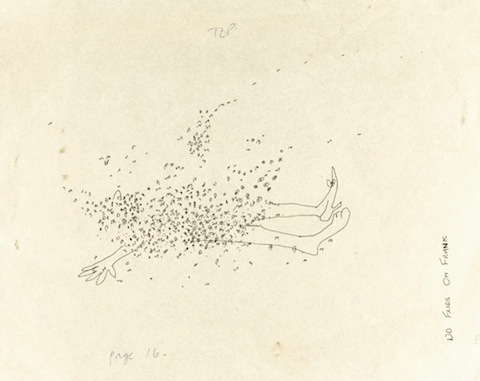
Another Silversteinian drawing is titled “A Lot of Flies on His Wife” from a short story called “No Flies on Frank,” whose title character speaks in an argot right out of James Joyce: “I carn’t not believe this incredible fact of truth about my very body which has not gained fat since mother begat me at childburn. Yea, though I wart through the valet of thy shadowy hut I will feed no norman. What grate qualmsy hath taken me thus into such a fatty hardbuckle.”
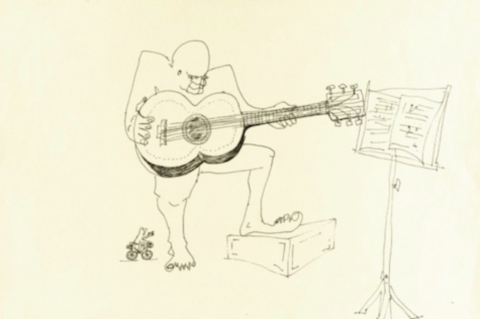
Just above, Lennon sketches a Picasso-like four-eyed guitarist in this untitled drawing (notice the tiny cyclist at his feet)—estimated by Sotheby’s between $15,000 and $25,000. The eighty nine lots that went up for auction included many other drawings (see more here) and some handwritten notes from Paul McCartney. All told, the sale netted close to $3 million, though for Lennon devotees, these artifacts are priceless. .
via The Daily Beast
Related Content:
John Lennon Plays Basketball with Miles Davis and Hangs Out with Allen Ginsberg & Friends
Josh Jones is a writer and musician based in Durham, NC. Follow him at @jdmagness.
Read More...Eudora Welty Writes a Quirky Letter Applying for a Job at The New Yorker (1933)
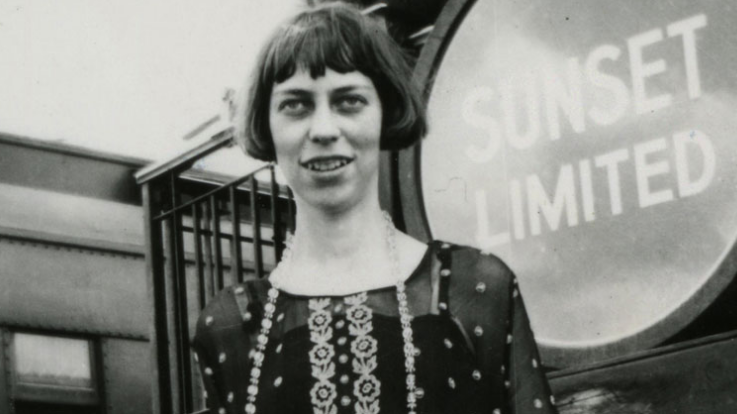
“Eudora Welty is one of the reasons that you thank God you know how to read,” writes an online reviewer of her autobiography One Writer’s Beginnings. It’s a sentiment with which I could not agree more. Whether in memoir, short story, or novel, Welty—winner of nearly every literary prize save the Nobel—speaks with the most highly individual of voices. (Welty once told a Paris Review interviewer that she doesn’t read anyone for “kindredness.”) Her prose, so attuned to its own rhythms, so confidently venturing into new realms of thought, seems to surprise even her. Indeed, teachers of writing could hardly do better than assign Welty to illustrate the elusive concept of “voice”—it’s a writerly quality she mastered early, or perhaps always possessed.
Take the 1933 letter below in which she introduces herself, a young postgraduate of 23, to The New Yorker in hopes of securing a position doing… well, whatever. She proposes “drum[ming] up opinions” on books and film, but only at the rate of “a little paragraph each morning—a little paragraph each night” (though she would “work like a slave” if asked). She also offers to replace cartoonist (and author of “The Secret Life of Walter Mitty”) James Thurber “in case he goes off the deep end.” The letter brims with winsome self-confidence and breezy optimism, as well as the unselfconscious self-awareness she makes look so easy: “That shows you how my mind works,” she writes, “quick, and away from the point.” The magazine staff, points out Shane Parrish of Farnam Street, “ignored her plea […] missing the obvious talent,” though of course they would begin publishing her stories just a few years later.
Read the letter in full below and marvel at how anyone could reject such a delightfully enthusiastic candidate (she would do just fine as a junior “publicity agent” for the WPA).
March 15, 1933
Gentlemen,
I suppose you’d be more interested in even a sleight‑o’-hand trick than you’d be in an application for a position with your magazine, but as usual you can’t have the thing you want most.
I am 23 years old, six weeks on the loose in N.Y. However, I was a New Yorker for a whole year in 1930–31 while attending advertising classes in Columbia’s School of Business. Actually I am a southerner, from Mississippi, the nation’s most backward state. Ramifications include Walter H. Page, who, unluckily for me, is no longer connected with Doubleday-Page, which is no longer Doubleday-Page, even. I have a B.A. (’29) from the University of Wisconsin, where I majored in English without a care in the world. For the last eighteen months I was languishing in my own office in a radio station in Jackson, Miss., writing continuities, dramas, mule feed advertisements, santa claus talks, and life insurance playlets; now I have given that up.
As to what I might do for you — I have seen an untoward amount of picture galleries and 15¢ movies lately, and could review them with my old prosperous detachment, I think; in fact, I recently coined a general word for Matisse’s pictures after seeing his latest at the Marie Harriman: concubineapple. That shows you how my mind works — quick, and away from the point. I read simply voraciously, and can drum up an opinion afterwards.
Since I have bought an India print, and a large number of phonograph records from a Mr. Nussbaum who picks them up, and a Cezanne Bathers one inch long (that shows you I read e. e. cummings I hope), I am anxious to have an apartment, not to mention a small portable phonograph. How I would like to work for you! A little paragraph each morning — a little paragraph each night, if you can’t hire me from daylight to dark, although I would work like a slave. I can also draw like Mr. Thurber, in case he goes off the deep end. I have studied flower painting.
There is no telling where I may apply, if you turn me down; I realize this will not phase you, but consider my other alternative: the U of N.C. offers for $12.00 to let me dance in Vachel Lindsay’s Congo. I congo on. I rest my case, repeating that I am a hard worker.
Truly yours,
Eudora Welty
Welty’s letter appears alongside dozens more remarkable missives in the beautiful new book, Letters of Note: An Eclectic Collection of Correspondence Deserving of a Wider Audience.
via Farnam Street/Brain Pickings
Related Content:
Ralph Waldo Emerson Writes a Job Recommendation for Walt Whitman (1863)
Read Rejection Letters Sent to Three Famous Artists: Sylvia Plath, Kurt Vonnegut & Andy Warhol
Gertrude Stein Gets a Snarky Rejection Letter from Publisher (1912)
Josh Jones is a writer and musician based in Durham, NC. Follow him at @jdmagness.
Read More...In Basho’s Footsteps: Hiking the Narrow Road to the Deep North Three Centuries Later
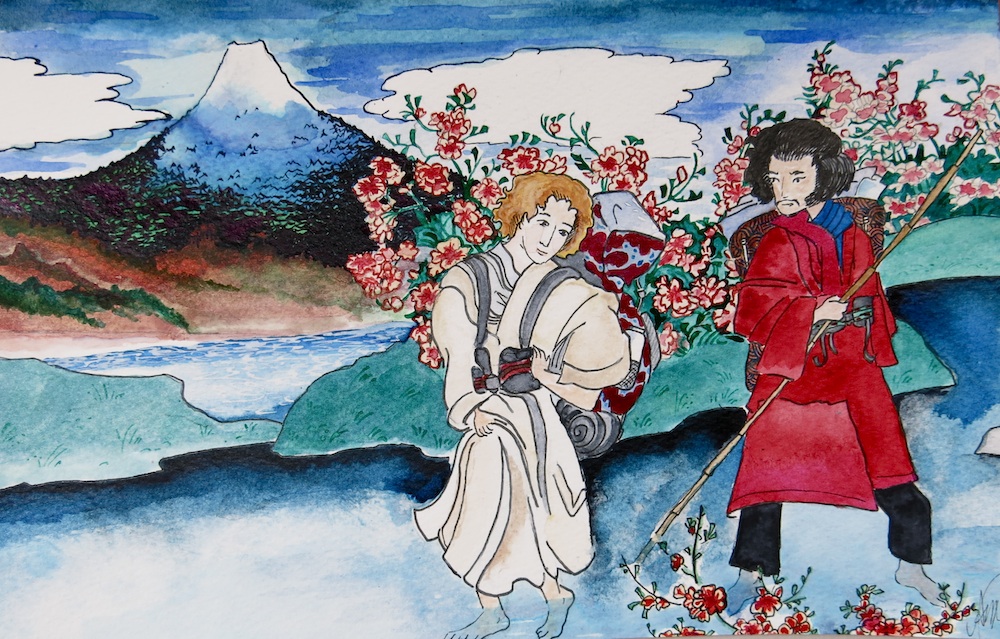
Matsuo Basho (1644–1694) lived his peculiar life on the conviction that art could create an awareness that allowed one to see into and communicate the essence of experience. Throughout his life he searched for the state of being one with the object of his poems, something he believed a poet needed to reach in order to write truthfully. This life-long search brought Basho to wandering. He thought that travelling would lead to a state of karumi (lightness), essential for art. In May 1689, when he was already a renowned poet in Japan, he sold his house and embarked on his greatest trip. Basho travelled light, always on foot and always slowly, looking carefully and deeply. He sought to leave everything behind (even himself) and have a direct experience with the nature around him, and he saw Zen Buddhism and travelling as the way to achieve this. He walked 2000 kilometers around the northern coast of Honshu (Japan’s main island), writing prose and poetry along the way, and compiling it all in a book that changed the course of Japanese literature, The Narrow Road to the Deep North.
We are Pablo Fernández (writer) and Anya Gleizer (painter), the adventurers and artists behind In Basho’s Footsteps. 325 years have passed since Basho began hiking the Narrow Road. This summer, we will retrace his trail, in an effort to come in contact with Basho’s approach to art and travelling. We will hike for three months, camping on the way, travelling as lightly and austerely as possible. We will write and paint along the route, and compile what we produce in an artist’s book. It will be hard, but art avails no compromises. Of course, apart from the physical and mental hardships, there are financial ones (flights and food for three months, and publishing costs). To make the project possible, we have used Kickstarter, a crowdfunding platform. With Kickstarter people are able to fund the projects they like, and receive a reward in exchange (we are giving our backers copies of our book, silk-screen prints and even paintings, depending on the pledge). This is a great way of creating an audience involved in the creation process. We don’t only receive financial support, but also very useful feedback, and we will be able to show our audience how the book is coming together. Because we want our art to reach as many people as possible, we are giving a digital edition of the book to everyone who backs the project with more than $5, before the book is accessible to the general public. Our Kickstarter campaign ends on June 4th. It has been a great success so far: We have already covered the travelling costs and now we are funding the publishing costs. For us, crowd-funding has opened up the traditional obstacles between creators and readers. This summer, with the help of all our supporters, we will retrace Basho’s Footsteps.
Editor’s note: This has been a guest post by Pablo Fernández and Anya Gleizer. Please consider supporting their great project here. Also find translations of Basho’s poetry in our collection, 800 Free eBooks for iPad, Kindle & Other Devices.
Read More...Ray Bradbury on Zen and the Art of Writing (1973)
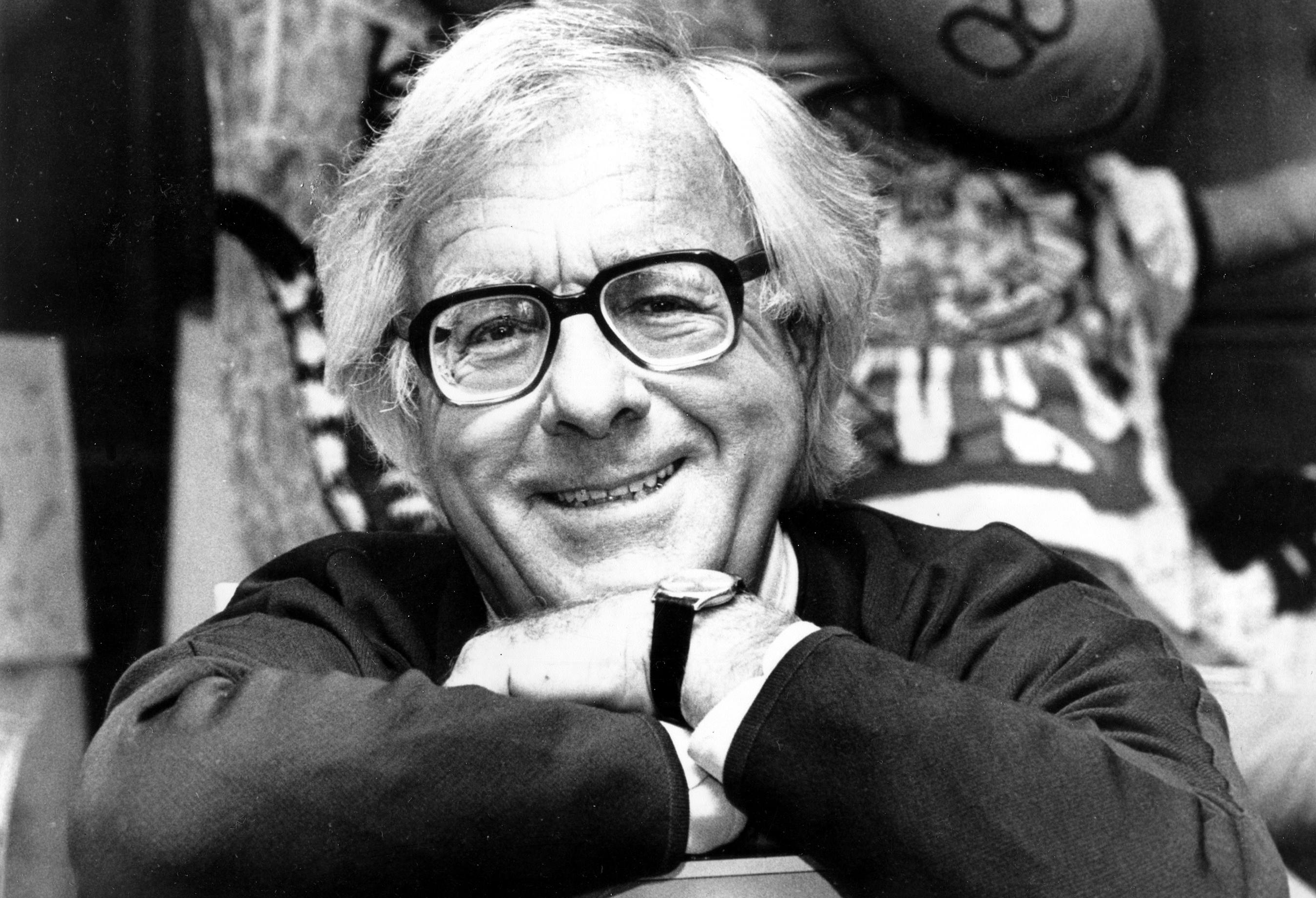
The prolific Ray Bradbury, author of Fahrenheit 451, The Martian Chronicles, and many other works both inside and outside the realm of science fiction, apparently suffered no shortage of creativity. Prolific in his fiction writing, he also proved generous in his encouragement of younger writers: we’ve previously featured not just his twelve essential pieces of writing advice but his secret to life and love. He even wrote enough on the subject of writing to constitute an entire book, the collection Zen in the Art of Writing: Essays on Creativity. In the 1973 title piece, Bradbury, hardly known as a Buddhist, explains his use of the term zen for its “shock value”: “The variety of reactions to it should guarantee me some sort of crowd, if only of curious onlookers, those who come to pity and stay to shout. The old sideshow Medicine Men who traveled about our country used calliope, drum, and Blackfoot Indian, to insure open-mouthed attention. I hope I will be forgiven for using ZEN in much the same way, at least here at the start. For, in the end, you may discover I’m not joking after all.”
He breaks down his own idea of zen in his writing process by first asking himself, “Now while I have you here before my platform, what words shall I whip forth painted in red letters ten feet tall?” He paints the following, and after each we include selections from the essay:
- WORK. “It is, above all, the word about which your career will revolve for a lifetime. Beginning now you should become not its slave, which is too mean a term, but its partner. Once you are really a co-sharer of existence with your work, that word will lose its repellent aspects. [ … ] We often indulge in made work, in false business, to keep from being bored. Or worse still we conceive the idea of working for money. The money becomes the object, the target, the end-all and be-all. Thus work, being important only as a means to that end, degenerates into boredom. Can we wonder then that we hate it so?”
- RELAXATION. “Impossible! you say. How can you work and relax? How can you create and not be a nervous wreck? [ … ] Tenseness results from not knowing or giving up trying to know. Work, giving us experience, results in new confidence and eventually in relaxation. The type of dynamic relaxation again, as in sculpting, where the sculptor does not consciously have to tell his fingers what to do. The surgeon does not tell his scalpel what to do. Nor does the athlete advise his body. Suddenly, a natural rhythm is achieved. The body thinks for itself.”
- DON’T THINK! “The writer who wants to tap the larger truth in himself must reject the temptations of Joyce or Camus or Tennessee Williams, as exhibited in the literary reviews. He must forget the money waiting for him in mass-circulation. He must ask himself, ‘What do I really think of the world, what do I love, fear, hate?’ and begin to pour this on paper. Then, through the emotions, working steadily, over a long period of time, his writing will clarify; he will relax because he thinks right and he will think even righter because he relaxes. The two will become interchangeable. At last he will begin to see himself.”
- FURTHER RELAXATION. “We should not look down on work nor look down on the forty-five out of fifty-two stories written in our first year as failures. To fail is to give up. But you are in the midst of a moving process. Nothing fails then. All goes on. Work is done. If good, you learn from it. If bad, you learn even more. Work done and behind you is a lesson to be studied. There is no failure unless one stops. Not to work is to cease, tighten up, become nervous and therefore destructive of the creative process. [ … ] Isn’t it obvious by now that the more we talk of work, the closer we come to Relaxation.”
- “Have I sounded like a cultist of some sort? A yogi feeding on kumquats, grapenuts and almonds here beneath the banyan tree? Let me assure you I speak of all these things only because they have worked for me for fifty years. And I think they might work for you. The true test is in the doing. Be pragmatic, then. If you’re not happy with the way your writing has gone, you might give my method a try. If you do, I think you might easily find a new definition for Work. And the word is LOVE.”
You can read much more about Bradbury’s method of working, relaxing, not thinking, and relaxing further still — and his thoughts on the joy of writing, keeping the muse fed, establishing a thousand-or-two-words-a-day habit, and “how to climb the tree of life, throw rocks at yourself, and get down without breaking your bones or your spirit” — in the book, Zen in the Art of Writing: Essays on Creativity.
Related Content:
Ray Bradbury Gives 12 Pieces of Writing Advice to Young Authors (2001)
The Secret of Life and Love, According to Ray Bradbury (1968)
Ray Bradbury: Literature is the Safety Valve of Civilization
Ray Bradbury: “The Things That You Love Should Be Things That You Do.” “Books Teach Us That”
Ray Bradbury: Story of a Writer 1963 Film Captures the Paradoxical Late Sci-Fi Author
Colin Marshall hosts and produces Notebook on Cities and Culture and writes essays on cities, language, Asia, and men’s style. He’s at work on a book about Los Angeles, A Los Angeles Primer. Follow him on Twitter at @colinmarshall or on Facebook.
Read More...The Importance of Kindness: An Animation of George Saunders’ Touching Graduation Speech
Ever since he was first published in The New Yorker back in 1992, George Saunders has been crafting a string of brilliant short stories that have reinvented the form. His stories are dark, funny, and satirical that then turn on a dime and become surprisingly moving. And the maddening thing about him is that he makes such tonal dexterity look easy. Over the course of his career, he has won piles of awards including a MacArthur “Genius” Fellowship in 2006. In 2013, his collection of short stories The Tenth of December was selected by the New York Times as one of the best books of the year. You can read 10 stories by Saunders free online here.
Last year, Saunders delivered the convocation speech for Syracuse University where he teaches writing. Most such speeches are dull and forgettable or, as was the case when Ross Perot spoke at my graduation, incoherent and churlish. Saunders’s speech, however, was something different — a quiet, self-effacing plea for empathy. When it was reprinted by the New York Times last July, the speech seemingly popped up on every third person’s Facebook feed.
Brooklyn-based group Serious Lunch has created an animated version of Saunders’ speech, voiced by the author himself. You can watch it above and read along below. You’ll probably want to call your mom or help an old lady across the street afterward.
I’d say, as a goal in life, you could do worse than try to be kinder.
In seventh grade, this new kid joined our class. In the interest of confidentiality, her name will be “ELLEN.” ELLEN was small, shy. She wore these blue cat’s‑eye glasses that, at the time, only old ladies wore. When nervous, which was pretty much always, she had a habit of taking a strand of hair into her mouth and chewing on it.
So she came to our school and our neighborhood, and was mostly ignored, occasionally teased (“Your hair taste good?” – that sort of thing). I could see this hurt her. I still remember the way she’d look after such an insult: eyes cast down, a little gut-kicked, as if, having just been reminded of her place in things, she was trying, as much as possible, to disappear. After awhile she’d drift away, hair-strand still in her mouth.
Sometimes I’d see her hanging around alone in her front yard, as if afraid to leave it.
And then – they moved. That was it. One day she was there, next day she wasn’t.End of story.
Now, why do I regret that? Why, forty-two years later, am I still thinking about it? Relative to most of the other kids, I was actually pretty nice to her. I never said an unkind word to her. In fact, I sometimes even (mildly) defended her. But still, it bothers me.
What I regret most in my life are failures of kindness.
Those moments when another human being was there, in front of me, suffering, and I responded…sensibly. Reservedly. Mildly.
Or, to look at it from the other end of the telescope: Who, in your life, do you remember most fondly, with the most undeniable feelings of warmth?
Those who were kindest to you, I bet.But kindness, it turns out, is hard — it starts out all rainbows and puppy dogs, and expands to include … well, everything.
You can read Saunders’s entire speech here.
Related Content:
George Saunders Extols the Virtues of Kindness in 2013 Speech to Syracuse University Grads
Oprah Winfrey’s Harvard Commencement Speech: Failure is Just Part of Moving Through Life
Jonathan Crow is a Los Angeles-based writer and filmmaker whose work has appeared in Yahoo!, The Hollywood Reporter, and other publications. You can follow him at @jonccrow.
Read More...The Origins of Michael Jackson’s Moonwalk: Vintage Footage of Cab Calloway, Sammy Davis Jr., Fred Astaire & More
Michael Jackson took one giant leap for pop history on March 25, 1983 when he gave an adoring public their first taste of his signature moonwalk in honor of Motown Records’ 25th birthday. (See below)
Novelty-wise, it wasn’t quite a Neil Armstrong moment. Like many artists, Jackson had many precedents from which he could and did draw. He can be credited with bringing a certain attitude to the proceedings. The expert practitioners in the video above are more ebullient, tapping, sliding and proto-moonwalking themselves into a state of rapture that feeds off the audience’s pleasure.
The line-up includes artists lucky enough to have left lasting footprints—Cab Calloway, Sammy Davis Jr., Fred Astaire, as well as those we’d do well to rediscover: Rubberneck Holmes, Earl “Snakehips” Tucker, Buck and Bubbles.…
Lacking the Internet, however, it does seem unlikely that Jackson would’ve spent much time poring over the footwork of these masters. (He may have taken a sartorial cue from their socks.)
Instead, he invested a lot of time breaking down the street moves, what he referred to in his autobiography as “a ‘popping’ type of thing that black kids had created dancing on the street corners in the ghetto.”
Jackson’s sister, LaToya, identified former Soul Train and Solid Gold dancer Jeffrey Daniel, below, as her brother’s primary tutor in this endeavor. (He went on to co-choreograph Jackson’s videos for “Bad” and “Smooth Criminal”.) As to the story behind his moonwalk, or backslide as he called it before Jackson’s version obliterated the possibility of any other name, Daniel gave props to the same kids Jackson did.
For those of you who mentioned it on Twitter and in our comments, we’ve added Charlie Chaplin’s scene in Modern Times.
via Metafilter
Related Content:
Keeping Jacko in Perspective
James Brown Gives You Dancing Lessons: From The Funky Chicken to The Boogaloo
Ayun Halliday is the author of seven books, and creator of the award winning East Village Inky zine. Follow her @AyunHalliday
Read More...Sir Patrick Stewart & Sir Ian McKellen Play The Newlywed Game
I’m gonna go out on a limb and guess that this is the first time two knighted cultural figures have played The Newlywed Game — a version of that wince (and nostalgia) ‑inducing game show that ran from the 1960s through the 1990s. Although Stewart and McKellen aren’t married, they know each other plenty well. They’ve worked together on stage (in a production of Waiting for Godot) and in film (they’ll be appearing together in an upcoming X‑Men movie.) And suffice it to say, they’ve formed a tight friendship. When Stewart married Sunny Ozell last year, McKellen officiated at the wedding ceremony.
This little bit took place at a BuzzFeed Brews event back in February. You can watch their full 48 minute appearance here. Also find the two in a deeper conversation recorded at the Screen Actors Guild Foundation just last month.
Related Content:
Sir Patrick Stewart Demonstrates How Cows Moo in Different English Accents
Sir Ian McKellen Reads Manual for Changing Tires in Dramatic Voice
Read More...Take Free Online Courses at Hogwarts: Charms, Potions, Defense Against the Dark Arts & More
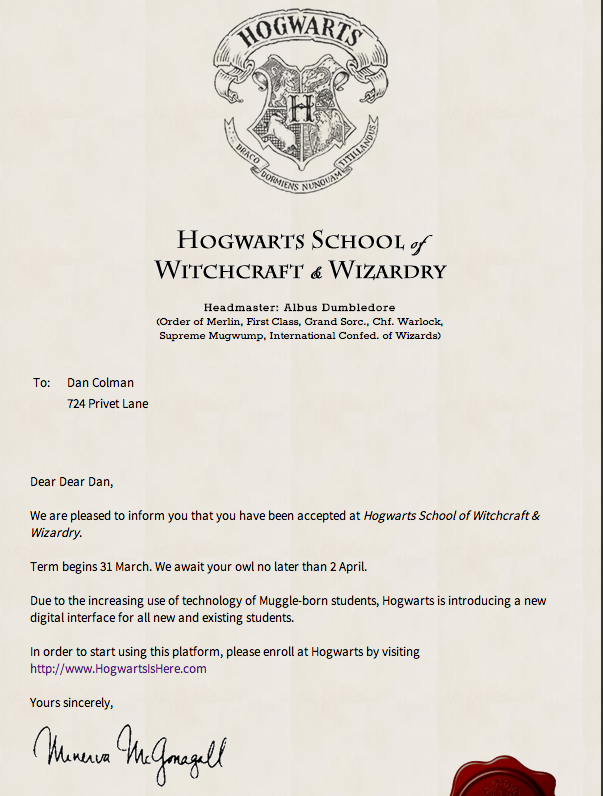
A group of dedicated Harry Potter fans have created a new educational website called Hogwarts is Here. The site is free — you only have to spend fake Galleons on the site — and it lets users enroll at the Hogwarts School of Witchcraft and Wizardry and work through a seven-year curriculum, taking the same courses that Harry, Ron and Hermione did in the great Harry Potter series. The first year consists of courses that will sound familiar to any Harry Potter reader: Charms, Potions, Defense Against the Dark Arts, Astronomy, Herbology, History of Magic, and Transfiguration. The 9‑week online courses feature homework assignment and quizzes. Students can also read digital textbooks, such as A Standard Book of Spells and A Beginner’s Guide to Transfiguration. We have yet to enroll in a course, so we would be curious get your feedback.
Fans of fantasy literature will also want to check out the Tolkien courses listed in our collection of 900 Free Online Courses. Also see this complete reading of The Chronicles of Narnia by C.S. Lewis, found in our collection of Free Audio Books.
Read More...Support Us
We're hoping to rely on loyal readers, rather than erratic ads. Please click the Donate button and support Open Culture. You can use Paypal, Venmo, Patreon, even Crypto! We thank you!

About Us

Open Culture scours the web for the best educational media. We find the free courses and audio books you need, the language lessons & educational videos you want, and plenty of enlightenment in between.
Advertise With Us
FREE UPDATES!
GET OUR DAILY EMAIL
Get the best cultural and educational resources on the web curated for you in a daily email. We never spam. Unsubscribe at any time.
FOLLOW ON SOCIAL MEDIA
Open Culture editor Dan Colman scours the web for the best educational media. He finds the free courses and audio books you need, the language lessons & movies you want, and plenty of enlightenment in between.
Advertise With Us

