Teacher Calls Jacques Derrida’s College Admission Essay on Shakespeare “Quite Incomprehensible” (1951)
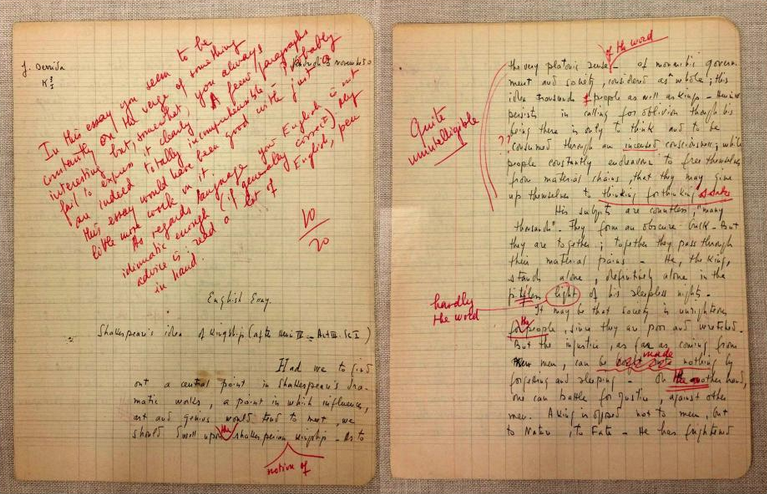
Click here for larger image, then click again to zoom in.
Backstories of famously accomplished people seem incomplete without some past difficulty or failure to be overcome. In narrative terms, these incidents provide biographies with their dramatic tension. We see Abraham Lincoln rise to the highest office in the land despite the humblest of origins; Albert Einstein rewrites theoretical physics against all academic odds, given his supposed early childhood handicaps. In many cases, these stories are apocryphal, or exaggerated for effect. But whatever their accuracy, they always seem to reflect undeniable character traits of the person in question.
In the case of influential philosopher Jacques Derrida, progenitor of the both beloved and reviled critical theory known as “Deconstruction,” the stories of academic struggle and great mental suffering are well-documented. Furthermore, their details accord perfectly well with the mature thinker who, remarks the site Critical Theory, “can’t answer a simple god-damned question.” The good-natured snark on display in this description more or less sums up the feedback Derrida received during some formative years of schooling while he prepared for his entrance exams to France’s university system in 1951 at the age of 20.
Derrida may have “left as big a mark on humanities departments as any single thinker of the past forty years,” writes The New York Review of Books, but during this period of his life, he failed his exams twice before finally gaining admittance. Once, he “choked and turned in a blank sheet of paper. The same month, he was awarded a dismal 5 out of 20 on his qualifying exam for a license in philosophy.” One essay he submitted on Shakespeare, written in English (above), received a 10 out of 20. The feedback from Derrida’s instructor will sound very familiar to perplexed readers of his work. “Quite unintelligible,” writes the evaluator in one marginal comment. The main comment at the top of the paper reads in part:
In this essay you seem to be constantly on the verge of something interesting but, somewhat, you always fail to explain it clearly. A few paragraphs are indeed totally incomprehensible.
Another examiner—points out the NYRB—left a comment on his work “that has since become a commonplace”:
An exercise in virtuosity, with undeniable intelligence, but with no particular relation to the history of philosophy… Can come back when he is prepared to accept the rules and not invent where he needs to be better informed.
As it turns out, Derrida was not particularly interested in the rules, but in inventing a new method. Even if his “apostasy” caused him great mental anguish—“nausea, insomnia, exhaustion, and despair” (all normal features of any higher educational experience)—it’s probably fair to say he could not do otherwise. Although his intellectual biography, like the history of any revered figure, is unlikely to offer a blueprint for success, there is perhaps at least one lesson we may draw: Whatever the difficulties, you’re probably better off just being yourself.
Related Content:
130+ Free Online Philosophy Courses
8‑Bit Philosophy: Plato, Sartre, Derrida & Other Thinkers Explained With Vintage Video Games
Jacques Derrida Deconstructs American Attitudes
Josh Jones is a writer and musician based in Durham, NC. Follow him at @jdmagness
Read More...Edvard Munch’s Famous Painting The Scream Animated to the Sound of Pink Floyd’s Primal Music
In this short video, Romanian animator Sebastian Cosor brings together two haunting works from different times and different media: The Scream, by Norwegian Expressionist painter Edvard Munch, and “The Great Gig in the Sky,” by the British rock band Pink Floyd.
Munch painted the first of four versions of The Scream in 1893. He later wrote a poem describing the apocalyptic vision behind it:
I was walking along the road with two Friends
the Sun was setting — the Sky turned a bloody red
And I felt a whiff of Melancholy — I stood
Still, deathly tired — over the blue-black
Fjord and City hung Blood and Tongues of Fire
My Friends walked on — I remained behind
– shivering with anxiety — I felt the Great Scream in Nature
Munch’s horrific Great Scream in Nature is combined in the video with Floyd’s otherworldly “The Great Gig in the Sky,” one of the signature pieces from the band’s 1973 masterpiece, Dark Side of the Moon. The vocals on “The Great Gig” were performed by an unknown young songwriter and session singer named Clare Torry.
Torry had been invited by producer Alan Parsons to come to Abbey Road Studios and improvise over a haunting piano chord progression by Richard Wright, on a track that was tentatively called “The Mortality Sequence.” The 25-year-old singer was given very little direction from the band. “Clare came into the studio one day,” said bassist Roger Waters in a 2003 Rolling Stone interview, “and we said, ‘There’s no lyrics. It’s about dying — have a bit of a sing on that, girl.’ ”
Forty-two years later, that “bit of a sing” can still send a shiver down anyone’s spine. For more on the making of “The Great Gig in the Sky,” and Torry’s amazing contribution, see the clip below to hear Torry’s story in her own words.
Follow Open Culture on Facebook and Twitter and share intelligent media with your friends. Or better yet, sign up for our daily email and get a daily dose of Open Culture in your inbox. And if you want to make sure that our posts definitely appear in your Facebook newsfeed, just follow these simple steps.
Related Content:
Pink Floyd’s David Gilmour Sings Shakespeare’s Sonnet 18
The Night Frank Zappa Jammed With Pink Floyd … and Captain Beefheart Too (Belgium, 1969)
Read More...Hear Kim Gordon, Sonic Youth Rocker, Read From Her New Memoir, Girl in a Band

I’ll admit it. I have a thing for listening to rock biographies and autobiographies on Audible, particularly memoirs narrated by the author him or herself. Look in my personal Audible library and you’ll find Patti Smith reading Just Kids. Keith Richards reading sections of his bestseller Life. And Pete Townshend narrating his 18-hour tome Who Am I. That’s just naming a few.
Right now, I’m getting started with Girl in a Band, the new memoir released by Kim Gordon, the co-founder of the influential indie rock band, Sonic Youth. And it looks like you can do the same with me. Rough Trade has made available online five audio clips, starting with Gordon reading from Chapter 1. Together, they amount to almost an hour of free audio. Find them all below.
Meanwhile, if you want to download the entire memoir for free, you can go here, and then click on the “Try Audible Free” button in the upper right corner. Just realize that you’re signing up for Audible’s 30-Day Free Trial program, which lets you download two free audiobooks and try out the service for 30 days. If you so choose, you can cancel before a fee kicks in. Please make sure you read all of the fine print before you sign up.
Chapter 1:
Writing About New York Is Hard
The Way The Band Composed Songs
First Time Seeing Nirvana
Fashion in New York
Follow us on Facebook, Twitter and Google Plus and share intelligent media with your friends. Or better yet, sign up for our daily email and get a daily dose of Open Culture in your inbox.
Related Content:
1,000 Free Audio Books: Download Great Books for FreeFear of a Female Planet: Kim Gordon (Sonic Youth) on Why Russia and the US Need a Pussy Riot
Read More...Advertisements from Japan’s Golden Age of Art Deco

Get talking with graphic design people, and Japan will come up sooner or later. That country, always a world leader in aesthetics, has put the time and energy of generations into perfecting the discipline. You can see this progress charted out on the Tokyo-based Ian Lynam Design’s “Misruptions/Disruptions: A Japanese Graphic Design History Timeline.” It labels the busy period of 1910–1941 as the time of an “adoption of Western Avant Garde aesthetics in Graphic Design & Typography, coinciding with Left-leaning experimentation and increased state suppression of the Left” — and the time that gave rise to Japanese Art Deco.

Last year, I attended Deco Japan, a show at the Seattle Art Museum, which showcased a great many artifacts from that prewar movement of such combined artistic and commercial abundance. It put on display all manner of paintings, vases, pieces of furniture, household items, and packages, but somehow, the period advertisements struck me as still the most vital of all. The Japanese graphic designers who made them drew, in the words of Capital’s Grace-Yvette Gemmell, “on staples of progressive European and American high and popular art, incorporating stylized versions of gears and clocks that bring to mind Fritz Lang’s Metropolis and Charlie Chaplin’s Modern Times.”

This makes more sense than it sounds like it would: “the Deco use of foreign imagery and design elements was a virtually seamless process given existing practices of both abstraction and cultural appropriation at work in the decorative arts at the time in Japan. Many traditional designs already possessed a sort of visual affinity with the Art Deco aesthetic; the synthesis of conventional design elements with contemporary, pared-down forms appealed to the culture’s collective knowledge of traditional motifs and symbols while feeding their desire for modern consumer products that reflected a keen sense of cosmopolitanism perfectly combining the old with the ultramodern.”
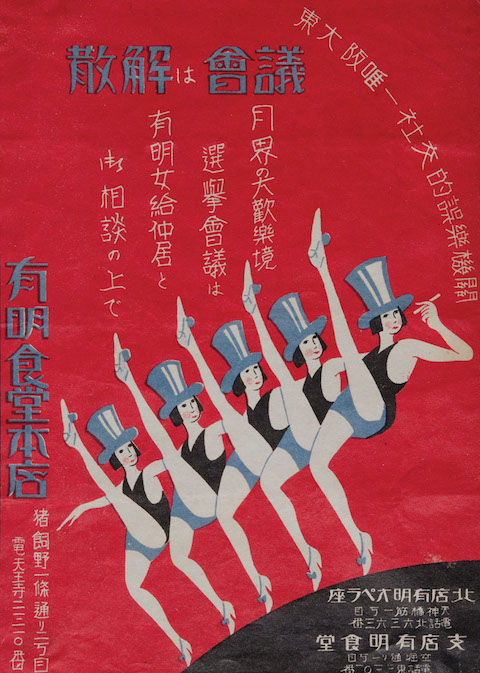
Many of the advertisements, or other works of graphic design like leaflets and magazine covers, to come out of Japan’s Art Deco golden age feature the image of the “moga,” or, in Japanized English, “modern girl.” Having appeared in Japan as a new kind of jazz-loving, bob-haired, relatively liberated woman, the moga quickly became an attractive commercial proposition. The Asian Art Museum printed up a leaflet of their own, listing off the “ten qualifications for being a moga” as originally enumerated in 1929 by illustrator Takabatake Kashō in the magazine Fujin sekai (Ladies’ World):
- Strength, the “enemy” of conventional femininity
- Conspicuous consumption of Western food and drink
- Devotion to jazz records, dancing, and smoking Golden Bat cigarettes from a metal cigarette holder
- Knowledge of the types of Western liquor and a willingness to flirt to get them for free
- Devotion to fashion from Paris and Hollywood as seen in foreign fashion magazines
- Devotion to cinema
- Real or feigned interest in dance halls as a way to show off one’s ostensible decadence to mobo (modern boys)
- Strolling in the Ginza every Saturday and Sunday night
- Pawning things to get money to buy new clothes for each season
- Offering one’s lips to any man who is useful, even if he is bald or ugly, but keeping one’s chastity because “infringement of chastity” lawsuits are out of style

Sound a fair bit more interesting than the women demanded for today’s ads in the West, don’t they?
Related Content:
Gaze at Global Movie Posters for Hitchcock’s Vertigo: U.S., Japan, Italy, Poland & Beyond
René Magritte’s Early Art Deco Advertising Posters, 1924–1927
Hand-Colored Photographs of 19th Century Japan
Colin Marshall hosts and produces Notebook on Cities and Culture as well as the video series The City in Cinema and writes essays on cities, language, Asia, and men’s style. He’s at work on a book about Los Angeles, A Los Angeles Primer. Follow him on Twitter at @colinmarshall or on Facebook.
Read More...David Carr Gives 10 Pieces of Work & Life Advice to UC Berkeley Graduates
David Carr took seven years to get through college. He didn’t have a Master’s degree or a PhD. Before he made it big writing for The New York Times, he spent time in rehab and on welfare. David Carr didn’t fit the profile of your average commencement speaker.
And yet Carr, who died in the Times newsroom on Thursday night, earned his spot speaking before the 2014 graduating class at UC Berkeley’s Graduate School of Journalism. Known for his insightful reporting on changes in publishing, television and social media, Carr understood the world these young journalists were entering. And when he offered 10 pieces of graduation advice, you know the students took note. You should too:
1.) Someone who is underestimated will be the one who changes the world. It’s not the person everyone expects. It might be you.
2.) “Do what is front of you.” Focus on the small steps ahead of you.
3.) Don’t worry about achieving a master plan, about the plot to take over the world.
4.) Be a worker among workers. It’s more important that you fit in before you stick out.
5.) Follow the “Mom Rule.” Don’t do anything you couldn’t explain or justify to your mom.
6.) Don’t just do what you’re good at. Get outside of your comfort zone. Being a journalist is permission for lifetime learning.
7.) Be present. Don’t worry about documenting the moment with your smartphone. Experience it yourself.
8.) Take responsibility for the good and the bad. Learn to own your failures.
9.) Be honest, and be willing to have the difficult conversation.
10.) Don’t be afraid to be ambitious. It’s not a crime.
He says it’s a listicle that won’t appear on Buzzfeed. But it fits perfectly on OC. David, we’re so sorry to see you go.
If you would like to support the mission of Open Culture, consider making a donation to our site. It’s hard to rely 100% on ads, and your contributions will help us continue providing the best free cultural and educational materials to learners everywhere. You can contribute through PayPal, Patreon, and Venmo (@openculture). Thanks!
Related Content:
Michael Pollan Presents an Edible Education, A Free Online Course From UC Berkeley
“Wear Sunscreen”: The Story Behind the Commencement Speech That Kurt Vonnegut Never Gave
David Foster Wallace’s 2005 Commencement Speech “This is Water” Visualized in Short Film
NPR Launches Database of Best Commencement Speeches Ever
Read More...
Rare Interview: Tim Curry Discusses The Rocky Horror Picture Show, During the Week of Its Release (1975)
A defining role can be both blessing and curse. In August of 1975, the week the The Rocky Horror Picture Show opened, its 29-year-old star, Tim Curry gave an interview to STOIC, the Student Television Of Imperial College.
In between clips of Curry’s Frank-n-Furter sashaying through such destined-to-become cult favorites as “Sweet Transvestite” and “The Time Warp,” in fishnets, merry widow, and maquillage designed by David Bowie’s personal makeup artist, the actor entertained questions…in luscious black and white!
Kudos to the young interviewer, Mark Caldwell, for never interrupting or trying to elbow his way into the spotlight with jokey asides or double entendres. The reward is a serious consideration of the filmmaking process and the actor’s craft.
(Bear in mind that it would be at least a year until midnight audiences at New York’s Waverly Theater started throwing toast, rice, and toilet paper at the screen, thus initiating an entire script’s worth of audience participation.)
Having originated the role on the London stage (he auditioned with Little Richard’s “Tutti Frutti”) and reprised it in L.A., Curry was clearly ready to put some space between himself and his iconic creation, announcing—correctly, as it turns out—that any sequels would have to proceed without him.
Then he clammed up for three decades, refusing to discuss his most iconic role until 2005, when he broke the silence during an interview on NPR’s Fresh Air .
It’s clear that Curry saw the making of the film as a serious business, but Rocky Horror fans will find plenty of juicy morsels to feed their obsession. Even virgins will enjoy the story of Frank’s evolving accent —from middle European to “Belgravia Hostess with the Mostest.”
Ayun Halliday is an author, illustrator, and Chief Primatologist of the East Village Inky zine. Follow her @AyunHalliday
Read More...An Illustration of Every Page of Herman Melville’s Moby Dick

Herman Melville’s Moby Dick, the work he is most known for in death, had the effect in life of ruining his literary reputation and driving him into obscurity. This is but one of many ironies attending the massive novel, first published in Britain in three volumes on October 18, 1851. At that time, it was simply called The Whale, and as Melville.org informs us, was “expurgated to avoid offending delicate political and moral sensibilities.” One month later, the first American edition appeared, now titled Moby Dick; Or, The Whale, compiled into one huge volume, and with its censored passages, including the Epilogue, restored. In both printings, the book sold poorly, and the reviews—save those from a handful of American critics, including Melville’s fellow Great American novelist Nathaniel Hawthorne—were largely negative.
Another irony surrounding the novel is one nearly everyone who’s read it, or tried to read it, will know well. We’re socialized through visual media to approach the story as great, tragic action/adventure. As Melville’s friend, publisher Evert Augustus Duyckinck, described it, the novel is ostensibly “a romantic, fanciful & literal & most enjoyable presentment of the Whale Fishery,” driven by the revenge plot of mad old Captain Ahab. And yet, it is not that at all, or not simply that. Despite the fact that it lends itself so well to adventurous retelling, the novel itself can seem very obscure, ponderous, and digressive to a maddening degree. The so-called “whaling chapters,” notably “Cetology,” delve deeply into the lore and technique of whaling, the anatomy and physiology of various whale species, and the history and politics of the venture.
Throughout the novel, ordinary objects and events—especially, of course, the whale itself—acquire such symbolic weight that they become almost cartoonish talismans and leap bewilderingly out of the narrative, forcing the reader to contemplate their significance—no easy task. Depending on your sensibilities and tolerance for Melville’s labyrinthine prose, these very strange features of the novel are either indispensably fascinating or just plain excess baggage. Since many editions are published with the whaling chapters excised, many readers clearly feel they are the latter. That is unfortunate, I think. It’s one of my favorite novels, in all its baroque overstuffedness and philosophical density. But there’s no denying that it works, as they say, “on many levels.” Depending on how you experience the book—it’s either an incredibly gripping adventure tale, or a very dense and puzzling work of history, philosophy, politics, and zoology… or both, and more besides….

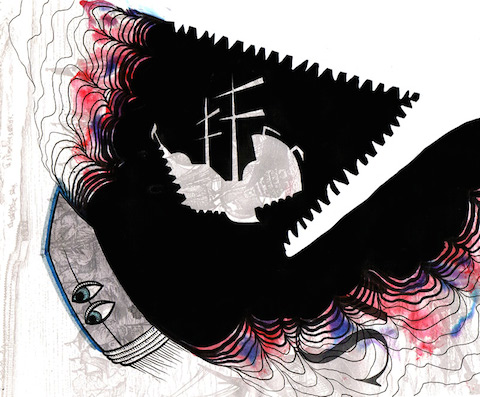
Recognizing the power of Melville’s arresting imagery, artist and librarian Matt Kish decided that he would illustrate all 552 pages of the Signet Classic paperback edition of Moby Dick, a book he considers “to be the greatest novel ever written.” He began the project in August of 2009 with the first page, illustrating those famous first words—“Call me Ishmael”—above. (At the top, see page 489, below it page 158, and directly below, page 116). Kish completed his epic project at the end of 2010. He used a variety of media—ink, watercolor, acrylic paint—and incorporated a number of different graphic art styles. As he explains in the comments under the first illustration, he chose “drawing and painting over pages from old books and diagrams because the presence of visual information on those pages would in some ways interfere with, and clutter up, my own obsessive control over my marks.” All in all, it’s a very admirable undertaking, and you can see each individual illustration, and many of the stages of drafting and composition, at Kish’s blog or on this list we’ve compiled. (You can also find links to the first 25 pages at bottom of this post.) The entire project has also been published as a book, Moby-Dick in Pictures: One Drawing for Every Page, a further irony given the obsessive literariness of Melville’s novel, a work as obsessed with language as Captain Ahab is with his great white nemesis.

Nonetheless, what Kish’s project further demonstrates is the seemingly inexhaustible treasure house that is Moby Dick, a book that so richly appeals to all the senses as it also ceaselessly engages the intellect. Kish has gone on to apply his wonderful interpretive technique to other classic literary works, including Joseph Conrad’s Heart of Darkness and Italo Calvino’s Invisible Cities. These projects are equally striking, but it’s Moby Dick, “the great unread American novel,” that most inspired Kish, as it has so many other artists and readers.
- MOBY-DICK, Page 025
- MOBY-DICK, Page 024
- MOBY-DICK, Page 023
- MOBY-DICK, Page 022
- MOBY-DICK, Page 021
- MOBY-DICK, Page 020
- MOBY-DICK, Page 019
- MOBY-DICK, Page 018
- MOBY-DICK, Page 017
- MOBY-DICK, Page 016
- MOBY-DICK, Page 015
- MOBY-DICK, Page 014
- MOBY-DICK, Page 013
- MOBY-DICK, Page 012
- MOBY-DICK, Page 011
- MOBY-DICK, Page 010
- MOBY-DICK, Page 009
- MOBY-DICK, Page 008
- MOBY-DICK, Page 007
- MOBY-DICK, Page 006
- MOBY-DICK, Page 005
- MOBY-DICK, Page 004
- MOBY-DICK, Page 003
- MOBY-DICK, Page 002
- MOBY-DICK, Page 001
Related Content:
A View From the Room Where Melville Wrote Moby Dick (Plus a Free Celebrity Reading of the Novel)
How Ray Bradbury Wrote the Script for John Huston’s Moby Dick (1956)
Josh Jones is a writer and musician based in Durham, NC. Follow him at @jdmagness
Read More...How the “Paul McCartney is Dead” Hoax Started at an American College Newspaper and Went Viral (1969)
Next time you see the still-youthful and musically prolific Paul McCartney, take a good hard look and ask yourself, “is it really him?” Can you be sure? Because maybe, just maybe, the conspiracy theorists are right—maybe Paul did die in a car accident in 1966 and was replaced by a double who looks, sounds, acts, and writes almost exactly like him. Almost. It’s possible. Entirely implausible, wholly improbable, but within the realm of physical possibility.
In fact, the rumor of Paul’s death and replacement by some kind of pod person imposter cropped up not once, but twice during the sixties. First, in January, 1967, immediately after an accident involving McCartney’s Mini Cooper that month. The car, driven by Moroccan student Mohammad Hadjij, crashed on the M1 after leaving McCartney’s house en route to Keith Richard’s Sussex Mansion. Hadjij was hospitalized, but not killed, and Paul, riding in Mick Jagger’s car, arrived at the destination safely.
The following month, the Beatles Book Monthly magazine quashed rumors that Paul had been driving the Mini and had died, writing, “there was absolutely no truth in it at all, as the Beatles’ Press Officer found out when he telephoned Paul’s St. John’s Wood home and was answered by Paul himself who had been at home all day with his black Mini Cooper Safely locked up in the garage.” “The magazine,” writes the Beatles Bible, “downplayed the incident, and claimed the car was in McCartney’s possession.”
In 1969, rumors of Paul’s death and a conspiracy to cover it up began circulating again, this time with an impressive apparatus that included publications in college and local newspapers, discussions on several radio shows, a university research team, and enough esoteric clues to keep highly suspicious, stoned, and/or paranoid, minds guessing for decades afterward. The formless gossip first officially took shape in print in the article “Is Beatle Paul McCartney Dead?” in Iowa’s Drake University student newspaper, the Times-Delphic. Cataloguing “an amazing series of photos and lyrics on the group’s albums” that pointed to “a distinct possibility that McCartney may indeed be insane, freaked out, even dead,” the piece dives headfirst into the kind of bizarre analysis of disparate symbols and tenuous coincidences worthy of the most dogged of today’s conspiracy-mongers.
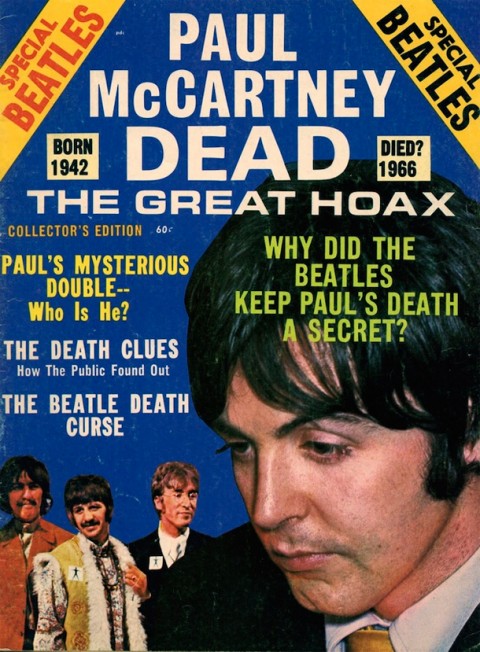
Invoked are ephemera like “a mysterious hand” raised over Paul’s head on the Sgt. Pepper’s cover—“an ancient death symbol of either the Greeks or the American Indians”—and Paul’s bass, lying “on the grave at the group’s feet.” The lyric “blew his mind out in a car” from “A Day in the Life” comes up, and more photographic evidence from the album’s back cover and centerfold photo. Evidence is produced from Magical Mystery Tour and The White Album. Of the latter, you’ve surely heard, or heard of, the voice seeming to intone, “Turn me on, dead man,” and “Cherish the dead,” when “Revolution No. 9” is played backwards. Only a college dorm room could have nurtured such a discovery.
The article reads like a parody—similar to the subversive, half-serious satirical weirdness common to the mid-sixties hippie scene. But whether or not its author, Tim Harper, meant to pull off a hoax, the Paul is dead meme went viral when it hit the airwaves the following month. First, a caller to Detroit radio station WKNR transmitted the theory to DJ Russ Gibb. Their hour-long conversation lead to a review of Abbey Road in The Michigan Daily titled “McCartney Dead; New Evidence Brought to Light.” With tongue in cheek, writer Fred LaBour called the death and replacement of Paul “the greatest hoax of our time and the subsequent founding of a new religion based upon Paul as Messiah.” In the mode of paranoid conspiracy theory so common to the time—a genre mastered by Thomas Pynchon as a literary art—LaBour invented even more clues, inadvertently feeding a public hungry for this kind of thing. “Although clearly intended as a joke,” writes the Beatles Bible, “it had an impact far wider than the writer and his editor expected.”
Part of the aftermath came in two more radio shows that October of 1969. First, in two parts at the top, New York City DJ Roby Yonge makes the case for McCartney’s death on radio station WABC-AM. Recycling many of the “clues” from the previous sources, he also contends that a research team of 30 students at Indiana University has been put on the case. Yonge plainly states that some of the clues only emerge “if you really get really, really high… on some, you know, like, mind-bending drug,” but this proviso doesn’t seem to undermine his confidence in the shaky web of connections.
Was Yonge’s broadcast just an attention grabbing act? Maybe. The next Paul is Dead radio show, just above, is most certainly an Orson Welles-like publicity stunt. Broadcast on Halloween night, 1969, on Buffalo, NY’s WKBW, the show employs several of the station’s DJs, who construct a detailed and dramatic narrative of Paul’s death. The broadcast indulges the same album-cover and lyric divination of the earlier Paul is Dead media, but by this time, it’s grown pretty hoary. But for a small contingent of die-hards, the rumor was mostly put to rest just a few days later when Life magazine published a cover photograph of Paul—who had been out of the public eye after the Beatles’ breakup—with his wife Linda and their kids. Paraphrasing Mark Twain, McCartney famously remarked in the interview inside, “Rumors of my death have been greatly exaggerated,” and added, “If I was dead, I’m sure I’d be the last to know.”
In later interviews, the Beatles denied having anything to do with the hoax. Lennon told Rolling Stone in 1970 that the idea of them intentionally planting obscure clues in their albums “was bullshit, the whole thing was made up.” The hoax did make for some interesting publicity—even featuring in the storyline of a Batman comics issue—but the band mostly found it baffling and annoying. Certain fans, however, refused to let it die, and there are those who still swear that Paul’s imposter, allegedly named Billy Shears and sometimes called “Faul,” still walks the earth. Paul is Dead websites proliferate on the internet—some more, some less convincing; all of them outlandish, and all offering a fascinating descent into the seemingly bottomless rabbit hole of conspiracy theory. If that’s your kind of trip, you can easily get lost—as did pop culture briefly in 1969—in endless “Paul is Dead” speculation.
Related Content:
Paul McCartney’s Conceptual Drawings For the Abbey Road Cover and Magical Mystery Tour Film
Chaos & Creation at Abbey Road: Paul McCartney Revisits The Beatles’ Fabled Recording Studio
Hear Isolated Tracks From Five Great Rock Bassists: McCartney, Sting, Deacon, Jones & Lee
Josh Jones is a writer and musician based in Durham, NC. Follow him at @jdmagness
Read More...Kurt Vonnegut Gives Advice to Aspiring Writers in a 1991 TV Interview
Remember when television was the big gorilla poised to put an end to all reading?
Then along came the miracle of the Internet. Blogs begat blogs, and thusly did the people start to read again!
Of course, many a great newspaper and magazine fell before its mighty engine. So it goes.
So did television in the old fashioned sense. So it goes.
Funny to think that these fast-moving developments weren’t even part of the landscape in 1991, when author Kurt Vonnegut swung by his hometown of Indianapolis to appear on the local program, Across Indiana.
Host Michael Atwood pointed out the irony of a television interviewer asking a writer if television was to blame for the decline in reading and writing. After which he listened politely while his guest answered at length, comparing reading to an acquired skill on par with “ice skating or playing the French horn.”
Gee… irony elicits a more frenetic approach in the age of BuzzFeed, Twitter, and YouTube. (Nailed it!)
Irony and humanity run neck and neck in Vonnegut’s work, but his appreciation for his Hoosier upbringing was never less than sincere:
When I was born in 1922, barely a hundred years after Indiana became the 19th state in the Union, the Middle West already boasted a constellation of cities with symphony orchestras and museums and libraries, and institutions of higher learning, and schools of music and art, reminiscent of the Austro-Hungarian Empire before the First World War. One could almost say that Chicago was our Vienna, Indianapolis our Prague, Cincinnati our Budapest and Cleveland our Bucharest.
To grow up in such a city, as I did, was to find cultural institutions as ordinary as police stations or fire houses. So it was reasonable for a young person to daydream of becoming some sort of artist or intellectual, if not a policeman or fireman. So I did. So did many like me.
Such provincial capitals, which is what they would have been called in Europe, were charmingly self-sufficient with respect to the fine arts. We sometimes had the director of the Indianapolis Symphony Orchestra to supper, or writers and painters, and architects like my father, of local renown.
I studied clarinet under the first chair clarinetist of our orchestra. I remember the orchestra’s performance of Tchaikovsky’s 1812 Overture, in which the cannons’ roars were supplied by a policeman firing blank cartridges into an empty garbage can. I knew the policeman. He sometimes guarded street crossings used by students on their way to or from School 43, my school, the James Whitcomb Riley School.
Vonnegut’s views were shaped at Shortridge High School, where he numbered among the many not-yet-renowned writers honing their craft on The Daily Echo. Thought he didn’t bring it up in the video above, the Echo also yielded his nickname: Snarf.
Vonnegut agreed with interviewer Atwood that the daily practice of keeping a journal is an excellent discipline for beginning writers. He also considered journalistic assignments a great training ground. He made a point of mentioning that Mark Twain and Ring Lardner got their starts as newspaper reporters. It may be harder for aspiring writers to find paying work these days, but the Internet is replete with opportunities for those who crave a daily assignment.
It’s also overflowing with bullet pointed lists on how to become a writer, but if you’re like me, you’ll prefer to receive this advice from Vonnegut, himself, on a set festooned with farming implements, quilts, and dipped candles.
The interview continues in the remaining parts:
Part 2
Part 3
Part 4
Related Content:
Kurt Vonnegut Reads Slaughterhouse-Five
Kurt Vonnegut: Where Do I Get My Ideas From? My Disgust with Civilization
Kurt Vonnegut Explains “How to Write With Style”
Kurt Vonnegut Diagrams the Shape of All Stories in a Master’s Thesis Rejected by U. Chicago
Ayun Halliday is an author, homeschooler, and Chief Primatologist of the East Village Inky zine. Like Vonnegut, she’s a native of Indianapolis, and her mother was the editor of the Short Ridge Daily Echo. Follow her @AyunHalliday
Read More...Lou Reed Sings “Blue Christmas” with Laurie Anderson, Rufus Wainwright & Friends (2008)
Elvis Presley recorded “Blue Christmas” for his Christmas album in 1957 and made the song something of a holiday classic. In the years to come, “Blue Christmas” would be covered by Johnny Mathis, Johnny Cash, The Misfits, Springsteen, Ringo Starr, Bon Jovi and eventually Lou Reed too. Above, we have Lou performing the song at the Knitting Factory in December 2008. He’s joined on stage by Rufus Wainwright, Martha Wainwright, the McGarrigle sisters, his wife Laurie Anderson, Chaim Tannebaum, and Joel Zifkin. Below, find Lou providing the musical background for Sean Lennon and a host of musicians, who play a stirring version of John Lennon’s “Happy Xmas (War Is Over).” Both clips appear on the DVD A Not So Silent Night.
Follow Open Culture on Facebook and Twitter and share intelligent media with your friends. Or better yet, sign up for our daily email and get a daily dose of Open Culture in your inbox. And if you want to make sure that our posts definitely appear in your Facebook newsfeed, just follow these simple steps.
Read More...
Support Us
We're hoping to rely on loyal readers, rather than erratic ads. Please click the Donate button and support Open Culture. You can use Paypal, Venmo, Patreon, even Crypto! We thank you!

About Us

Open Culture scours the web for the best educational media. We find the free courses and audio books you need, the language lessons & educational videos you want, and plenty of enlightenment in between.
Advertise With Us
FREE UPDATES!
GET OUR DAILY EMAIL
Get the best cultural and educational resources on the web curated for you in a daily email. We never spam. Unsubscribe at any time.
FOLLOW ON SOCIAL MEDIA
Open Culture editor Dan Colman scours the web for the best educational media. He finds the free courses and audio books you need, the language lessons & movies you want, and plenty of enlightenment in between.
Advertise With Us



