Watch Fear & Loathing in Las Vegas and 2001: A Space Odyssey Get Run Through Google’s Trippy Deep Dream Software
Last week, The Guardian reported:
Google has made its “inceptionism” algorithm available to all, allowing coders around the world to replicate the process the company used to create mesmerising dreamscapes with its image processing neural-network.
The system, which works by repeatedly feeding an image through an AI which enhances features it recognises, was first demonstrated by Google two weeks ago. It can alter an existing image to the extent that it looks like an acid trip, or begin with random noise to generate an entirely original dreamscape.
Since then a coder, Roelof Pieters, began messing around with the publicly-available software, and decided to take the “Great San Francisco Acid Wave” scene from Terry Gilliam’s Fear and Loathing in Las Vegas (1998) and run it through “Deep Dream,” as the software is known. The results (below), now going viral across the internet, are pretty trippy and intense. Just when you thought Hunter S. Thompson couldn’t get more “out there,” this comes along.
We noticed that Pieters ran a similar experiment with pieces of Kubrick’s 2001: A Space Odyssey, and we couldn’t help but put them on display. Watch above.
If you would like to support the mission of Open Culture, consider making a donation to our site. It’s hard to rely 100% on ads, and your contributions will help us continue providing the best free cultural and educational materials to learners everywhere. You can contribute through PayPal, Patreon, and Venmo (@openculture). Thanks!
Related Content:
Free Online: Hunter S. Thompson’s Fear and Loathing in Las Vegas
Read 18 Lost Stories From Hunter S. Thompson’s Forgotten Stint As a Foreign Correspondent
Read 10 Free Articles by Hunter S. Thompson That Span His Gonzo Journalist Career (1965–2005)
Read More...
2,200 Radical Political Posters Digitized: A New Archive
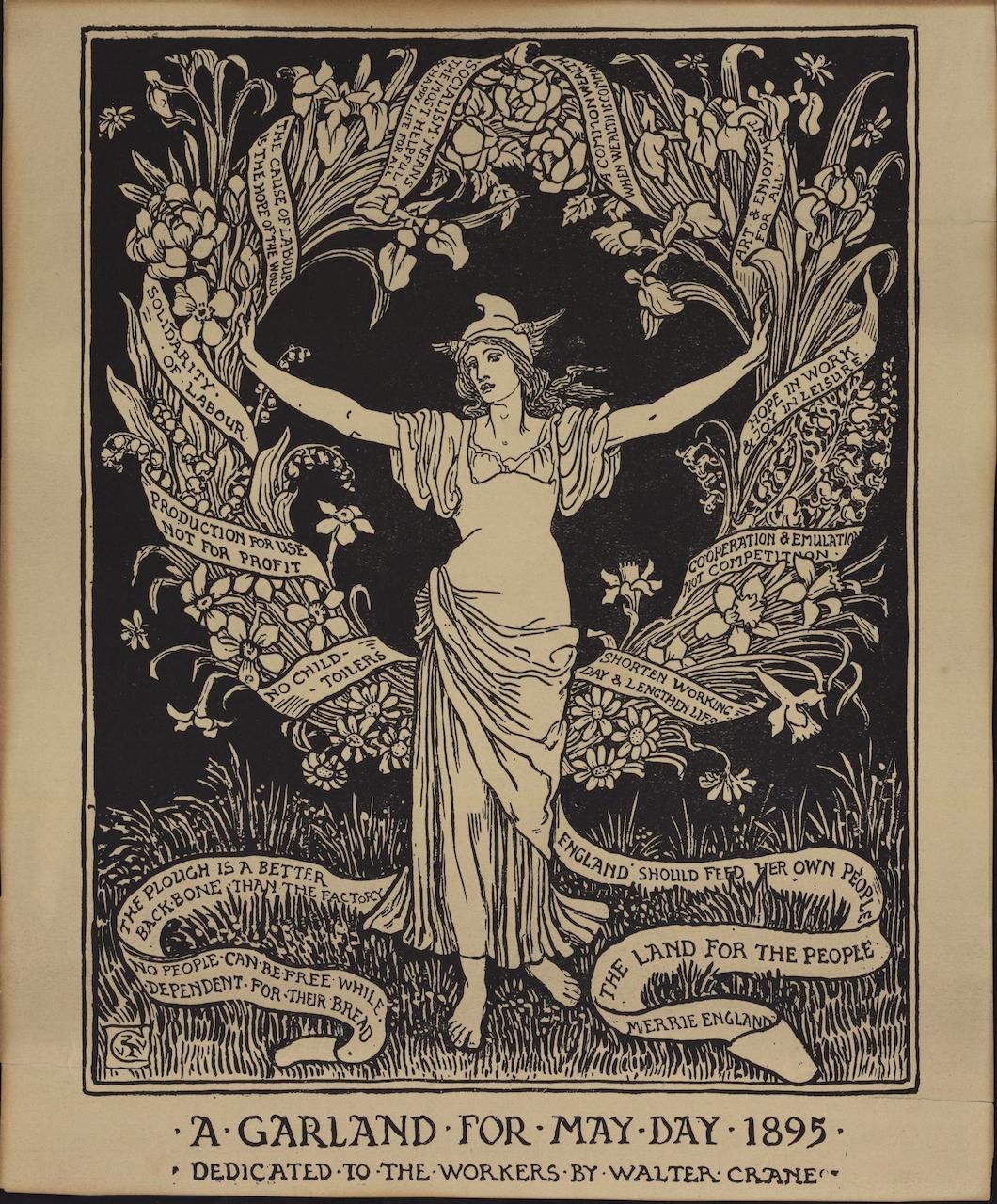
I recently heard someone say his college-bound nephew asked him, “What’s a union?” Whether you love unions, loathe them, or remain indifferent, the fact that an ostensibly educated young person might have such a significant gap in their knowledge should cause concern. A historic labor conflict, after all, provided the occasion for Ronald Reagan to prove his bona fides to the new conservative movement that swept him into power. His crushing of the Professional Air Traffic Controllers Organization (PATCO) in 1981 set the tone for the ensuing 30 years or so of economic policy, with the labor movement fighting an uphill battle all the way. Prior to that defining event, unions held sway over politics local and national, and had consolidated power blocks in the American political landscape through decades of struggle against oppressive and dehumanizing working conditions.
In practical terms, unions have stood in the way of capital’s unceasing search for cheap labor and new consumer markets; in social and cultural terms, the politics of labor have represented a formidable ideological challenge to conservatives as well, by way of a vibrant assemblage of anarchists, civil libertarians, anti-colonialists, communists, environmentalists, pacifists, feminists, socialists, etc. A host of radical isms flourished among organized workers especially in the decades between the 1870s and the 1970s, finding their voice in newsletters, magazines, pamphlets, leaflets, and posters—fragile mediums that do not often weather well the ravages of time. Thus the advent of digital archives has been a boon for students and historians of workers’ movements and other populist political groundswells. One such archive, the Joseph A. Labadie Collection at the University of Michigan Library, has recently announced the digitization of over 2,200 posters from their collection, a database that spans the globe and the spectrum of leftist political speech and iconography.
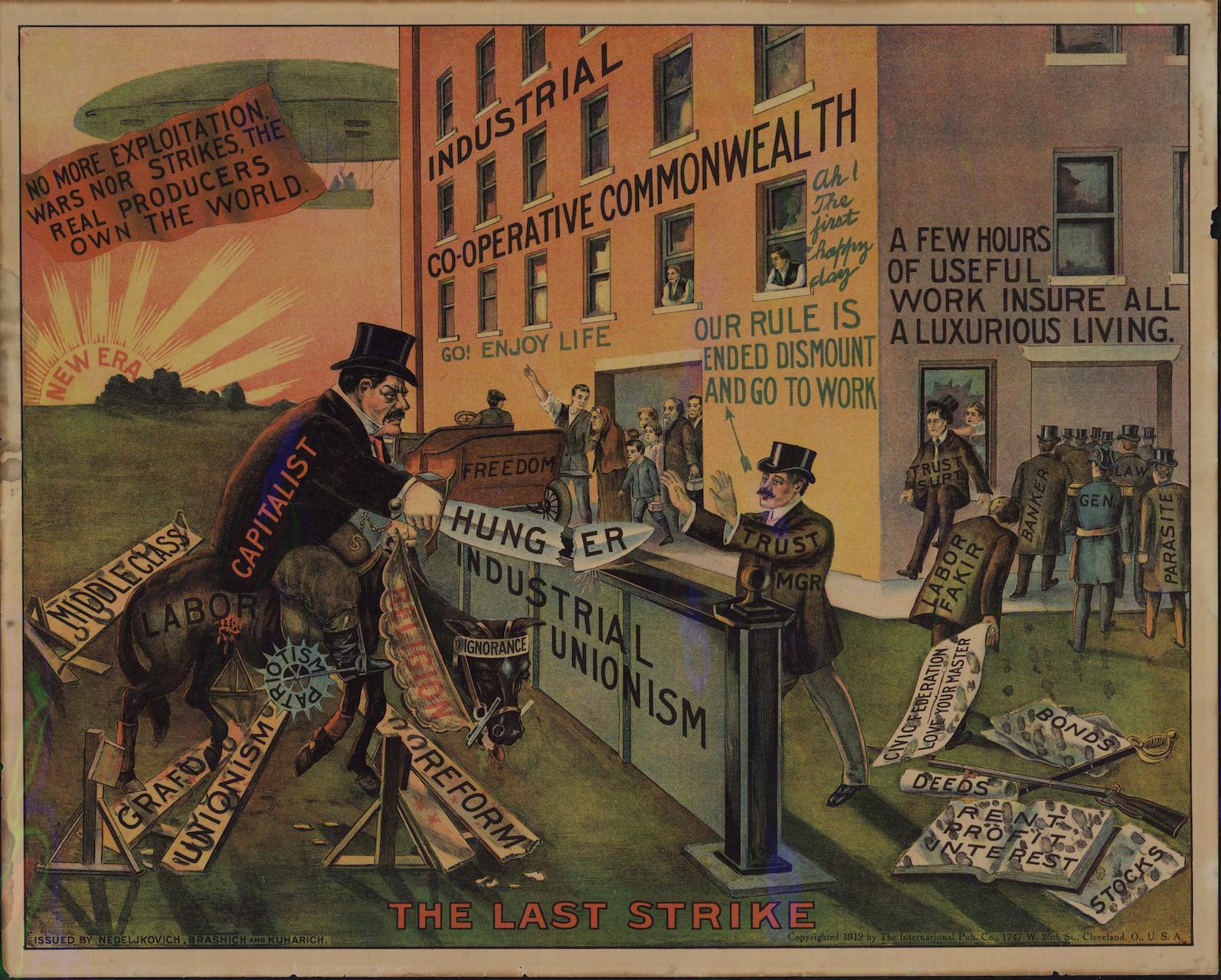
We have cleverly-designed visual puns like the Chicago Industrial Workers of the World poster just above, titled “What is what in the world of labor?” Promoting itself as “One Big Union of All Labor,” the IWW made some of the most ambitious propaganda, like the 1912 poster (middle) in which an “Industrial Co-Operative Commonwealth” replaces the tyranny of the capitalist, who is told by his “trust manager” peer, “Our rule is ended, dismount and go to work.” In this post-revolutionary fantasy, the IWW promises that “A few hours of useful work insure all a luxurious living,” though it only hints at the details of this utopian arrangement. Up top, we have an ornate May Day poster from 1895 by Walter Crane, hoping for a “Merrie England” with “No Child Toilers,” “Production for Use Not For Profit,” and “The Land For the People,” among other, more nationalist, sentiments like “England Should Feed Her Own People.”
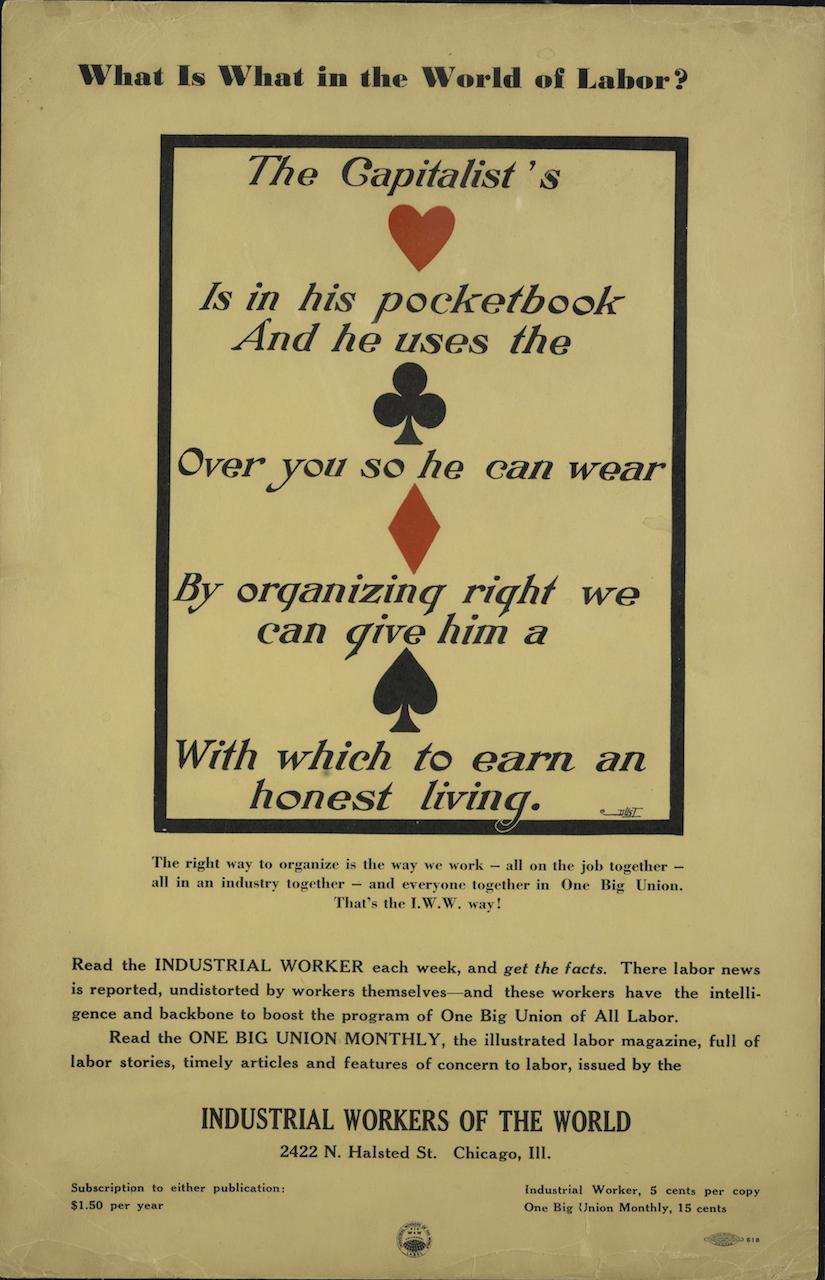
“While all of the posters were scanned at high resolution,” writes Hyperallergic, “they appear online as thumbnails with navigation to zoom.” You can download the images, but only the smaller, thumbnail size in most cases. These hundreds of posters represent “just a portion of the material in the Labadie Collection”—named for a “Detroit-area labor organizer, anarchist, and author” who “had the idea for the social protest archive at the university in 1911.” You can view other political artifacts in the UMich library’s digital collections here, including anarchist pamphlets, political buttons, and a digital photo collection. The collection as a whole gives us a potentially inspiring, or infuriating, mosaic of political thought at its boldest and most graphically assertive from a time before online petitions and hashtag campaigns took over as the primary circulators of popular radical thought.
via Hyperallergic (where you can find some other big, visually striking posters)
Related Content:
Wonderfully Kitschy Propaganda Posters Champion the Chinese Space Program (1962–2003)
Free Online Political Science Courses
Josh Jones is a writer and musician based in Durham, NC. Follow him at @jdmagness
Read More...Venice in Beautiful Color Images 125 Years Ago: The Rialto Bridge, St. Mark’s Basilica, Doge’s Palace & More

A few months ago, Mental Floss put up a post of “Fantastic 120-Year-Old Color Pictures of Ireland.” Fantastic pictures indeed, although the nature of the technology that produced them seems as interesting to me as the 19th-century Irish life captured in the images themselves. They came from the Library of Congress’ geographically organized archive of photocrom prints, a method perhaps known only to die-hard historical photography enthusiasts. For the rest of us, the Library of Congress’ page on the photocrom process explains it: “Photochrom prints are ink-based images produced through ‘the direct photographic transfer of an original negative onto litho and chromographic printing plates.’ ”
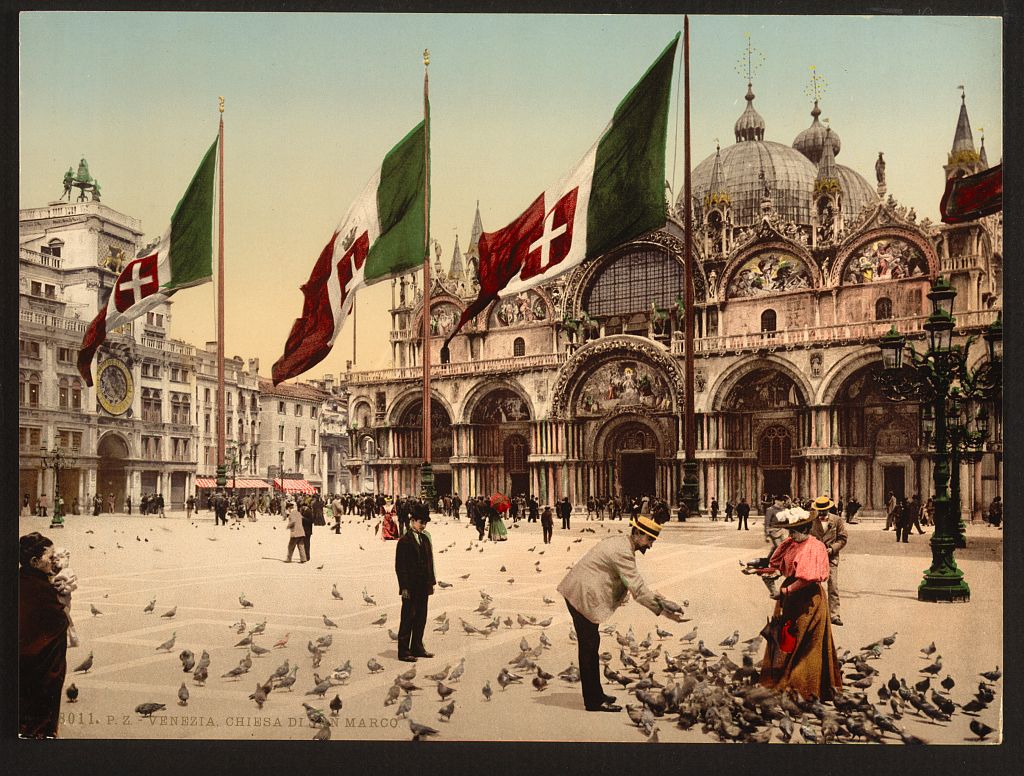
Its inventor Hans Jakob Schmid came up with the technique in the 1880s, a decade that began with color photography consigned to the realm of theory. While Photocrom prints may look an awful lot like color photographs, look at them through a magnifying glass and “the small dots that comprise the ink-based photomechanical image are visible.” “The photomechanical process permitted mass production of the vivid color prints,” each color requiring “a separate asphalt-coated lithographic stone, usually a minimum of six stones and often more than ten stones.”
But that unwieldy-sounding technology and laborious-sounding process has given us, among other striking pieces of visual history, these lush images of fin de siècle Venice, which the writer of place Jan Morris once described as “less a city than an experience.”
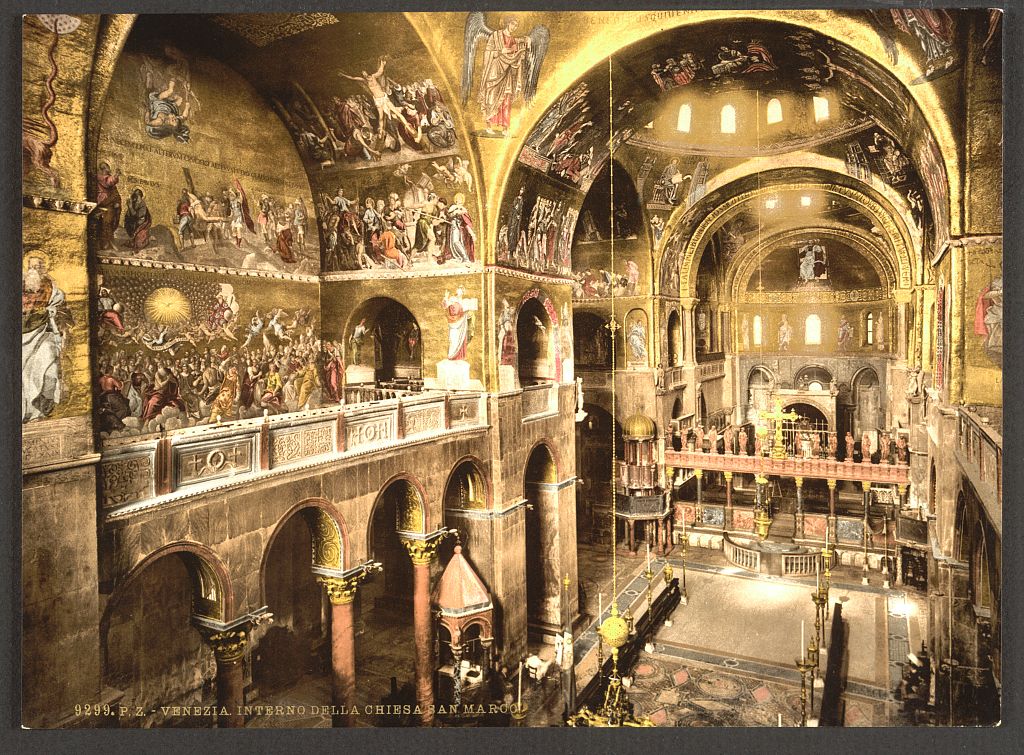
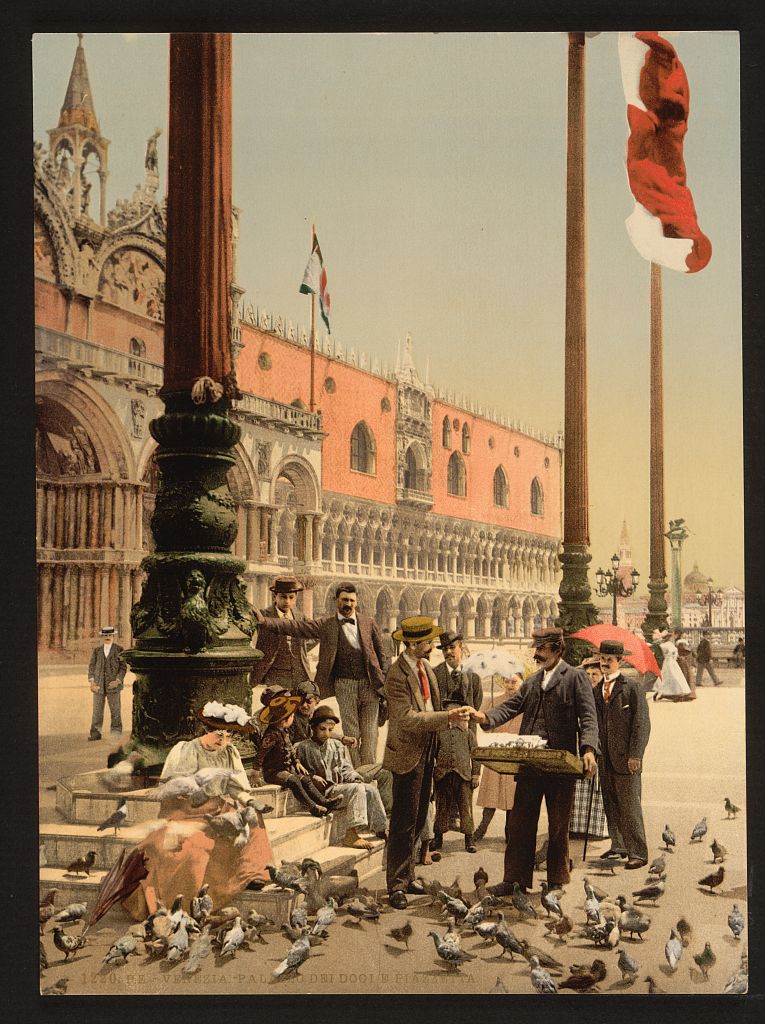
At the top of the post, we have a view of the Rialto Bridge, which spans one of the city’s famous canals; below that a scene of pigeon-feeding in St. Mark’s Piazza; the image just above leaves the pigeons behind to view the interior of St. Mark’s Basilica.
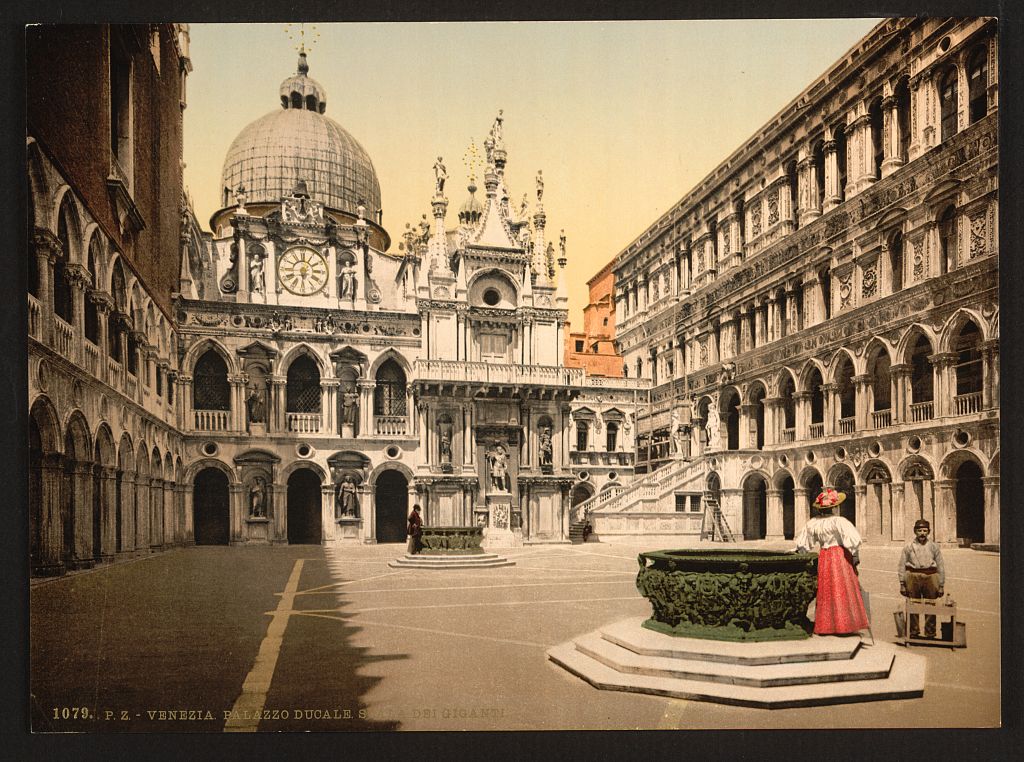
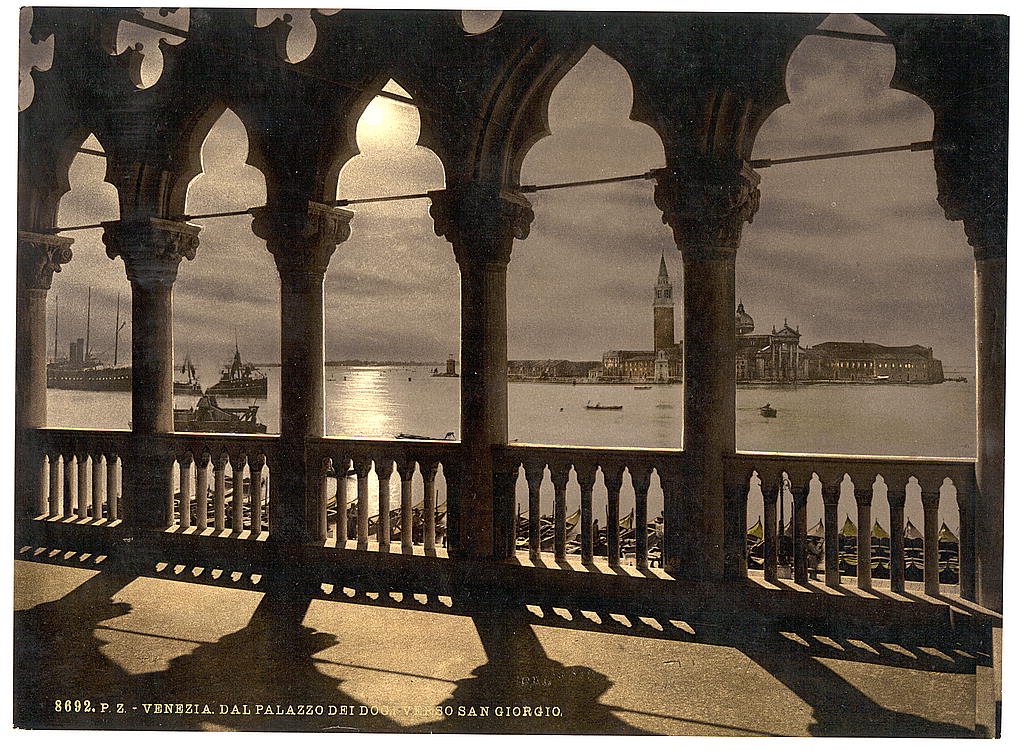
The photos below, all also taken between 1890 and 1900, depict the exterior and interior of the Doge’s Palace, as well as its view of San Giorgio Island by moonlight.
We may not consider these “real” color photographs, but the colors they present, vividly applied in the printing process, somehow more accurately represent the spirit of late 19th-century Europe — one of history’s truly vivid periods, in one of its enduringly vivid human environments. More color images of fin-de-siecle Venice can be viewed here.
Related Content:
Take a Virtual Tour of Venice (Its Streets, Plazas & Canals) with Google Street View
How Venice Works: A Short Film
Venice in a Day: From Daybreak to Sunset in Timelapse
Hand-Colored Photographs of 19th Century Japan
The First Color Photos From World War I: The German Front
The Oldest Color Movies Bring Sunflowers, Exotic Birds and Goldfish Back to Life (1902)
Colin Marshall writes on cities, language, Asia, and men’s style. He’s at work on a book about Los Angeles, A Los Angeles Primer, and the video series The City in Cinema. Follow him on Twitter at @colinmarshall or on Facebook.
Read More...Metropolis II: Discover the Amazing, Fritz Lang-Inspired Kinetic Sculpture by Chris Burden
Recently deceased artist Chris Burden had a long history of working with automobiles in his art. In his early days he crucified himself to the top of a VW Beetle (a piece called Trans Fixed). He set about designing and building a 100 mph and 100 mpg automobile based on intuition called the B‑Car. In Big Wheel he used a motorcycle to power…a big wheel. And in Porsche with Meteorite he suspended the two objects above the museum floor on each end of a gigantic scale.

But his massive kinetic sculpture Metropolis II is something else: a child’s fever dream of a Hot Wheels-scale city, with 1,100 cars driving endlessly on 18 roadways, with two ramps that are 12 feet high and three conveyor systems that feed the cars back into the loop. The metal and the electricity needed to run the sculpture means that the thing is not just a sight to behold, but it’s staggeringly loud.
The title of the kinetic sculpture gives away its reference, that of Fritz Lang’s 1927 Metropolis (watch it online) and its imaginary city scapes of elevated freeways and train tracks and people movers and planes that fly in between:
Burden’s work has its own structures too, some of which are made from building blocks, Lego, and Lincoln Logs, turned into houses and skyscrapers. Don’t expect sensible urban planning in this city: seen from above, Metropolis II is a chaos of roads, and closed systems from which there is no escape.
There was a trial run of the sculpture called Metropolis I, a smaller version that was soon sold to a Japanese collector and taken out of the public view.
For the sequel, Burden went bigger, enlisting eight people full time for five and a half years to build the piece. Said the artist:
“We wanted to expand it and make it truly overwhelming — the noise and level of activity are both mesmerizing and anxiety provoking.”
But instead of a nightmare commentary, Burden wanted the piece to be utopian. The cars are moving at 240 mph, according to scale, and there’s no gridlock. He was looking ahead to a future of driverless cars, as he shared a hatred like many Angelenos of endless traffic jams.
The 30 foot wide sculpture was bought for an undisclosed sum by billionaire businessman Nicholas Berggreun, who also sits on LACMA’s board. He’s loaned it to the museum until 2022 and it is currently now situated in a special wing where visitors can see it both at ground level and from above. It takes one assistant to keep it free of hiccups and it only runs for a few hours at a time, and only on weekends.
However, LACMA’s entryway is also home to a Burden piece one can see 24/7, the iconic Urban Light.
via Coudal
Related Content:
Watch Chris Burden Get Shot for the Sake of Art (1971)
LA County Museum Makes 20,000 Artistic Images Available for Free Download
Chris Burden (R.I.P.) Turns Late-Night TV Commercials Into Conceptual Art
Ted Mills is a freelance writer on the arts who currently hosts the FunkZone Podcast. You can also follow him on Twitter at @tedmills, read his other arts writing at tedmills.com and/or watch his films here.
Read More...The Tree of Languages Illustrated in a Big, Beautiful Infographic

Click image, then click again, to enlarge
Call it counterintuitive clickbait if you must, but Forbes’ Pascal-Emmanuel Gobry made an intriguing argument when he granted the title of “Language of the Future” to French, of all tongues. “French isn’t mostly spoken by French people and hasn’t been for a long time now,” he admits,” but “the language is growing fast, and growing in the fastest-growing areas of the world, particularly sub-Saharan Africa. The latest projection is that French will be spoken by 750 million people by 2050. One study “even suggests that by that time, French could be the most-spoken language in the world, ahead of English and even Mandarin.”
I don’t know about you, but I can never believe in any wave of the future without a traceable past. But the French language has one, of course, and a long and storied one at that. You see it visualized in the information graphic above (also available in suitable-for-framing prints!) created by Minna Sundberg, author of the webcomic Stand Still. Stay Silent.
“When linguists talk about the historical relationship between languages, they use a tree metaphor,” writes Mental Floss’ Arika Okrent. “An ancient source (say, Indo-European) has various branches (e.g., Romance, Germanic), which themselves have branches (West Germanic, North Germanic), which feed into specific languages (Swedish, Danish, Norwegian).”
Sundberg takes this tree metaphor to a delightfully lavish extreme, tracing, say, how Indo-European linguistic roots sprouted a variety of modern-day living languages including Hindi, Portuguese, Russian, Italian — and, of course, our Language of the Future. The size of the branches and bunches of leaves represent the number of speakers of each language at different times: the likes of English and Spanish have sprouted into mighty vegetative clusters, while others, like, Swedish, Dutch, and Punjabi, assert a more local dominance over their own, separately grown regional branches. Will French’s now-modest leaves one day cast a shadow over the whole tree? Perhaps — but I’m not canceling my plans to attend Spanish practice group tonight.
If you would like to support the mission of Open Culture, consider making a donation to our site. It’s hard to rely 100% on ads, and your contributions will help us continue providing the best free cultural and educational materials to learners everywhere. You can contribute through PayPal, Patreon, and Venmo (@openculture). Thanks!
via Mental Floss
Related Content:
Learn 48 Languages Online for Free: Spanish, Chinese, English & More
The History of the English Language in Ten Animated Minutes
How Languages Evolve: Explained in a Winning TED-Ed Animation
Noam Chomsky Talks About How Kids Acquire Language & Ideas in an Animated Video by Michel Gondry
Stephen Fry Gets Animated about Language
Colin Marshall writes on cities, language, Asia, and men’s style. He’s at work on a book about Los Angeles, A Los Angeles Primer, and the video series The City in Cinema. Follow him on Twitter at @colinmarshall or on Facebook.
Read More...Six Books (and One Blog) Bill Gates Wants You to Read This Summer
Bill Gates — Microsoft CEO turned philanthropist, lifelong learner and fan of The Great Courses — is recommending seven texts you should read this summer. They’re not exactly light beach reading. But you’ll learn a lot, and you’ll get more dialed into issues on Gates’ mind. On his website, the video above comes accompanied by reasons for reading each work.:
Hyperbole and A Half , by Allie Brosh:The Book, based on Brosh’s wildly popular website, consists of brief vignettes and comic drawings her young About Life. The adventures she recounts are mostly inside her head, where we hear and see the kind of inner thoughts most of us are too timid to let out in public. You will rip through it in three hours, tops. But you’ll wish it went on longer, because it’s funny and smart as hell. I must have interrupted Melinda a dozen times to read to her passages that made me laugh out loud.
The Magic of Reality, by Richard Dawkins. Dawkins, an evolutionary biologist at Oxford, has a gift for making science enjoyable. This Book is as accessible as the TV series Cosmos is for Younger Audiences-and as Relevant for OldEr Audiences. It’s an engaging, well-illustrated science textbook offering compelling answers to big questions, like “how did the universe form?” And “what causes earthquakes?” It’s also a plea for readers of all ages to approach mysteries with rigor and curiosity.Dawkins’s antagonistic (and, to me, overzealous) view of religion has earned him a lot of angry critics, but I consider him to be one of the great scientific writer / explainers of all time.
If what?, by Randall Munroe. The subtitle of the book is “Serious Scientific Answers to Absurd Hypothetical Questions,” and that’s exactly what it is. People write Munroe with questions that range over all fields of science: physics, chemistry, biology. Questions like, “From what height would you need to drop a steak for it to be cooked when it hit the ground?” (The answer, it turns out, is “high enough that it would disintegrate before it hit the ground.”) Munroe’s explanations are funny, but the science underpinning his answers is very accurate. It’s an entertaining read, and you’ll also learn a bit about things like ballistics, DNA, the oceans, the atmosphere, and lightning along the way.
XKCD, by Randall Munroe. A collection of posts from Munroe’s Blog XKCD, which is made up of Cartoons he Draws making fun of things-Mostly Scientists and Computers, But lots of Other things too. There’s One About Scientists holding A Press Conference to Reveal Their discovery That Life is arsenic-based. They research press conferences and find out that sometimes it’s good to serve food that’s related to the subject of the conference. The last panel is all the reporters dead on the floor because they ate arsenic. It’s that kind of humor, which not everybody loves, but I do.
On Immunity , by Eula Biss. When I stumbled across this book on the Internet, I thought it might be a worthwhile read. I had no idea what a pleasure reading it would be. Biss, an essayist and university lecturer, examines what lies behind people’s fears of vaccinating their children. Like many of us, she concludes that vaccines are safe, effective, and almost miraculous tools for protecting children against needless suffering. But she is not out to demonize anyone who holds opposing views. This is a thoughtful and beautifully written book about a very important topic.
How to Lie With Statistics , by Darrell Huff. I Picked up this Short, Easy-to-Read Book after Seeing it on A Wall Street Journal list of good Books for Investors . I enjoyed it so much That it WAS One of A Handful of Books I recommended to everyone at TED this year. It was first published in 1954, but aside from a few anachronistic examples (it has been a long time since bread cost 5 cents a loaf in the United States), it does not feel dated. One chapter shows you how visuals can be used to exaggerate trends and give distorted comparisons‑a timely reminder, given how often infographics show up in your Facebook and Twitter feeds these days. A useful introduction to the use of statistics, and a helpful refresher for anyone who is already well versed in it.
Should We Eat Meat?, by Vaclav Smil. The richer the world gets, the more meat it eats. And the more meat it eats, the bigger the threat to the planet. How do we square this circle? Vaclav Smil takes his usual clear-eyed view of the whole landscape, from meat’s role in human evolution to hard questions about animal cruelty. While it would be great if people wanted to eat less meat, I do not think we can expect large numbers of people to make drastic reductions. I’m betting on innovation, including higher agricultural productivity and the development of meat substitutes, to help the world meet its need for meat. A timely book, though probably the least beach-friendly one on this list.
You can get more ideas from Bill Gates at Gates Notes.
If you’re looking to do some more DIY education this summer, don’t miss the following rich collections:
1,000 Free Audio Books: Download Great Books for Free.
800 Free eBooks for iPad, Kindle & Other Devices.
1,700 Free Online Courses from Top Universities.
Read More...David Lynch’s Twin Peaks Title Sequence, Recreated in an Adorable Paper Animation
Yea, and there was a rejoicing all round the land last week when Showtime and David Lynch finally worked out a deal to bring back Twin Peaks after initial reports that Lynch had backed out.
So while we wait for 2016, check out Matthew Fuller’s re-creation of the Twin Peaks title sequence in animated paper cut outs. Fuller’s rough hewn creation is adorable, staying true to the languid pace and dreamy objects of the original. (I had kind of forgetten that very large log on display at the one minute mark.)
Fuller just started this YouTube channel And the World Was Paper two weeks ago, kicking it off with a recreation of the new Star Wars trailer. He is also promising a new paper video every fortnight, so be sure to subscribe.
Meanwhile, this paper version of Twin Peaks isn’t the first time the titles has been recreated. Check out Filthy Frackers 8‑bit version here:
Related content:
Play the Twin Peaks Video Game: Retro Fun for David Lynch Fans
David Lynch’s Music Videos: Nine Inch Nails, Moby, Chris Isaak & More
David Lynch Presents the History of Surrealist Film (1987)
Ted Mills is a freelance writer on the arts who currently hosts the FunkZone Podcast. You can also follow him on Twitter at @tedmills, read his other arts writing at tedmills.com and/or watch his films here.
Read More...The Thrill is Gone: See B.B. King Play in Two Electric Live Performances
One of the last great Mississippi bluesmen, Riley B. King, is gone, passed away last night at the age of 89. King made perhaps the most successful crossover of any blues artist into mainstream rock and roll, recording with Clapton and playing for rock audiences for decades. But his sound remained rooted firmly in the very blues he cut his teeth on in the fields of the Mississippi Delta and in Memphis, where he hitchhiked at 22, with $3 in his pocket, and quickly became a hit as a songwriter and D.J. called the Beale Street Blues Boy—B.B. for short. He “was paid four cents,” writes Buzzfeed, “for every album he made.”
“By his 80th birthday,” writes The New York Times, “he was a millionaire many times over. He owned a mansion in Las Vegas, a closet full of embroidered tuxedoes and smoking jackets, a chain of nightclubs…and the personal and professional satisfaction of having endured.” King’s signature guitars, customized Gibson 355s he named Lucille, are as elegant and stylish as the man himself. I once stood in front of one of them in a glass case at the Stax museum in Memphis, staring in awe, examining the places where his hands had worn into the wood, trying to absorb a little of the magic. King’s story is one of success far beyond what most of his peers could imagine. But it is also one of profound dedication to the blues, and of overcoming racism, poverty, and pain—suffering he channeled into his music and never lost sight of through the wealth and fame.
Well-deserved tributes from fans and fellow musicians are everywhere today—to King’s personal warmth and charm, to his impassioned singing, and, of course, his incredibly expressive vibrato guitar playing. “The tone he got out of that guitar, the way he shook his left wrist, the way he squeezed the strings,” says guitarist Buddy Guy, “… man, he came out with that and it was all new to the whole guitar playin’ world. The way BB did it is the way we all do it now. He was my friend and father to us all.” See and hear B.B. do it above in live performances of “The Thrill is Gone” and “Blues Boys Tune.” And just above, see him play and tell his story in a short 1972 documentary called “Sounding Out.” It may be too late now to see the great man perform live, but it’s never to late to learn about his legacy as the undisputed “king of the blues.”
Related Content:
B.B. King Explains in an Animated Video Whether You Need to Endure Hardship to Play the Blues
Josh Jones is a writer and musician based in Durham, NC. Follow him at @jdmagness
Read More...Watch Twin Beaks, Sesame Street’s Parody of David Lynch’s Iconic TV Show (1990)
Who killed Laura Palmer?
If the answer comes unbidden to your lips, you’re no doubt old enough to have spent much of 1990 glued to Twin Peaks, cult director David Lynch’s supremely creepy series. (Note: US-based viewers can watch the show for free on Hulu.)
The name probably won’t mean much to those who entered the noughties with a wobbly toddle, and why would it? Murder victim Palmer may have driven the original series, but she didn’t rank so much as a mention in Sesame Street’s 1991 parody, Twin Beaks, above.
The Muppets also steered clear of Sherilyn Fenn’s teen vixen cherry stem trick…
No one armed men…
No scary owls…
What tethers this G‑rated kiddie version to the original, you may ask?
Hint: it carries a log.
Of course! The log lady is a staple of Twin Peaks parodies, showing up everywhere from a Saturday Night Live skit starring Twin Peaks’ Special Agent Dale Cooper (Kyle MacLachlan) to a 2.5 minute Lego homage that manages to preserve the sex, the violence, and seemingly all of the characters.
The Cookie Monster’s Special Agent Cookie does eat some “darn” fine pie, but ultimately, his fixation on why the town was named “Twin Beaks” is far less compelling than his take on Monsterpiece Theatre’s host Alistair Cooke.
Masterpiece Theatre’s iconic presenter has proved even more irresistible to parodists than the Log Lady.
(In Sesame Street’s case, it worked. There are 35 more Monsterpieces, including number-centric spoofs of The 400 Blows and (gulp) The Postman Always Rings Twice.)
Related Content:
Monsterpiece Theater Presents Waiting for Elmo, Calls BS on Samuel Beckett
Watch The Surreal 1960s Films and Commercials of Jim Henson
Ayun Halliday is an author, illustrator, and Chief Primatologist of the East Village Inky zine. Follow her @AyunHalliday
Read More...96 Drawings of David Bowie by the “World’s Best Comic Artists”: Michel Gondry, Kate Beaton & More

There is a David Bowie for every season. A Christmas David Bowie, a Halloween David Bowie, even a David Bowie Easter celebration. But much more than that, there may be a David Bowie for every Bowie fan, especially for artists influenced by his chameleonic career. See for yourself how a whopping 96 Bowie-loving artists—in this case mainly what Bowie himself calls the “World’s Best Comic Artists”—see the changling rock star/actor/space alien.
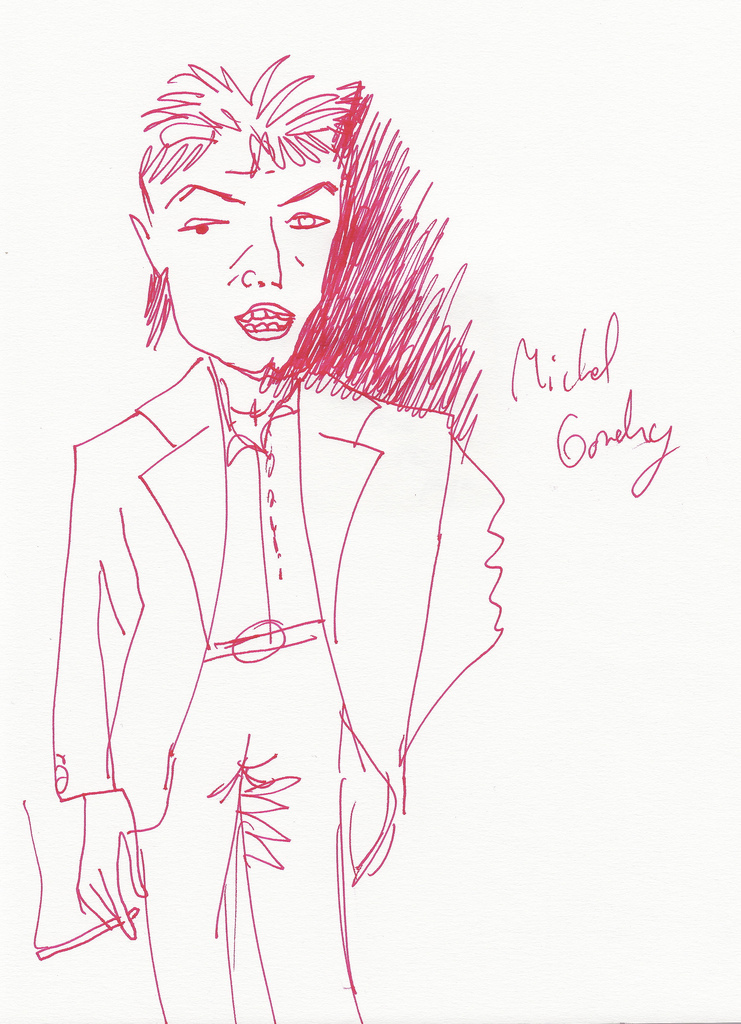
“See my life in a comic… The little details in colour,” writes Bowie on his site of a web gallery of portraits compiled by “comic artist, writer and critic, not to mention huge Bowie fan, Sean T. Collins.” It’s called The Thin White Sketchbook—a clever title that alludes to just one of the myriad Bowie personae represented in the sizeable collection of 96 drawings (see a nostalgic one by prolific illustrator Paul Pope at the top—the book’s first sketch).
Collins’ impressive collection includes work from Michel Gondry (Eternal Sunshine of the Spotless Mind), whose contribution the editor calls “pretty goddamn wonderful if you ask me.” See it above. And below, Kate Beaton, creator of web comic Hark, A Vagrant, gives us Bowie as a dandy, a character with whom, writes Collins, she has a “rich history.”
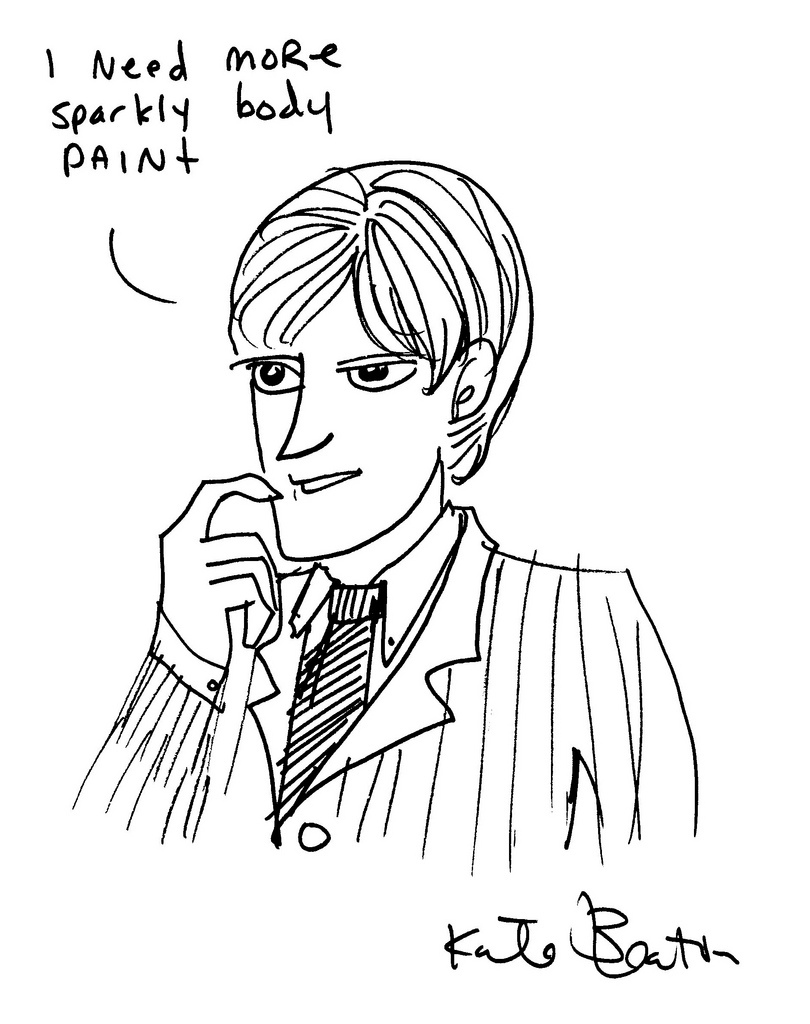
Collins offers brief commentary beneath each image in the collection, which also gives us the strange interpretation below by Bowie-inspired underground comics legend Charles Burns; the intense and Archie-esque contributions further down by Brothers Jaime and Gilbert Hernandez, creators of the 80s New Wave classic comic Love and Rockets; and the outer space-proportioned Bowie at the bottom of the post, from vocalist Tunde Adebimpe of TV on the Radio, a band that has both covered and recorded with Bowie.




View the full set of Bowie drawings, no two remotely the same, at The Thin White Sketchbook’s Flickr page.
via Buzzfeed.
Related Content:
50 Years of Changing David Bowie Hair Styles in One Animated GIF
David Bowie Releases Vintage Videos of His Greatest Hits from the 1970s and 1980s
David Gilmour & David Bowie Sing “Comfortably Numb” Live (2006)
Josh Jones is a writer and musician based in Durham, NC. Follow him at @jdmagness
Read More...Support Us
We're hoping to rely on loyal readers, rather than erratic ads. Please click the Donate button and support Open Culture. You can use Paypal, Venmo, Patreon, even Crypto! We thank you!

About Us

Open Culture scours the web for the best educational media. We find the free courses and audio books you need, the language lessons & educational videos you want, and plenty of enlightenment in between.
Advertise With Us
FREE UPDATES!
GET OUR DAILY EMAIL
Get the best cultural and educational resources on the web curated for you in a daily email. We never spam. Unsubscribe at any time.
FOLLOW ON SOCIAL MEDIA
Open Culture editor Dan Colman scours the web for the best educational media. He finds the free courses and audio books you need, the language lessons & movies you want, and plenty of enlightenment in between.
Advertise With Us


