Why Sitting Is The New Smoking: An Animated Explanation
During the past year, sitting has become the new smoking. “Past studies have found,” declares a 2014 article in The New York Times, “the more hours that people spend sitting, the more likely they are to develop diabetes, heart disease and other conditions, and potentially to die prematurely — even if they exercise regularly.” What’s the science behind this alarming claim? The animated TED-ED video (above) begins to paint the picture. But it doesn’t get into the latest and perhaps most important research. According to science writer Gretchen Reynolds, a recent Swedish study published in the British Journal of Sports Medicine suggests that when you sit all day, your telomeres (the tiny caps on the ends of DNA strands) get shorter. Which is not a good thing. As telomeres get shorter, the rate at which the body ages and decays speeds up. Conversely, the study found “that the telomeres in [those] who were sitting the least had lengthened. Their cells seemed to be growing physiologically younger.”
Several months ago, KQED radio in San Francisco aired a program dedicated to this question, featuring medical and ergonomics experts. To delve deeper into it, listen below. Or click here.
Meanwhile, if you have advice on how to incorporate movement into your day, please share it with your fellow readers in the comments section below.
And if your mind immediately drifts to buying a standing desk, then check out our related post: Who Wrote at Standing Desks? Kierkegaard, Dickens and Ernest Hemingway Too
Follow us on Facebook, Twitter, Google Plus and LinkedIn and share intelligent media with your friends. And if you want to make sure that our posts definitely appear in your Facebook newsfeed, just follow these simple steps.
Read More...Endangered Species (Including Cecil the Lion) Projected Onto the Empire State Building
Anyone with a Facebook or Twitter account last week couldn’t avoid hearing about Walter James Palmer, the Minnesota dentist who allegedly went trophy hunting in Zimbabwe and killed Cecil the Lion, a local favorite who had been illegally lured away from a protected wildlife preserve. I won’t say anything more about it, other than that you can sign a petition to get Palmer extradited to Zimbabwe and let him defend his actions to local authorities.
Meanwhile, back in New York City, two artists Travis Threlkel and Louie Psihoyos were getting ready to turn The Empire State building into a Noah’s Ark of Endangered Animals. And that’s exactly what happened on Saturday night. Placing “40 stacked, 20,000-lumen projectors on the roof of a nearby building,” Threlkel and Psihoyos projected an array of endangered animals “onto a space 375 feet tall and 186 feet wide covering 33 floors,” reports The New York Times. You can see photos of the animals over at the Racing Extinction Twitter stream. Touchingly, there was an homage to Cecil the Lion. A video from the Times appears above; another from The New Yorker below.
To learn more about how Project Mapping works, and to see other examples of Threlkel’s work, see the videos on this page.
Follow us on Facebook, Twitter, Google Plus and LinkedIn and share intelligent media with your friends. And if you want to make sure that our posts definitely appear in your Facebook newsfeed, just follow these simple steps.
Read More...Brooklyn–Based Makers of Artisanal Water Let You Sip From America’s Great Cultural Waters
The Timmy Brothers, based in Brooklyn, create handcrafted water. It’s not just any water. It’s water that lets you travel to different cultural times and places. Want to drink water that evokes memories of Mark Twain’s Mississippi River? Or the great jazz that came out of New Orleans? Well, the Timmy Brothers have just the product for you.
If you’re in Brooklyn, also consider making a side trip to Beacon, NY where David Rees lovingly creates artisanal handcrafted pencils. You’ll never look at pencils the same way again. :-)
Follow us on Facebook, Twitter, Google Plus and LinkedIn and share intelligent media with your friends. And if you want to make sure that our posts definitely appear in your Facebook newsfeed, just follow these simple steps.
Read More...1,000 Musicians Perform Foo Fighters’ “Learn to Fly” in Unison in Italy
Despite breaking his leg during a gig earlier this summer, Dave Grohl and the Foo Fighters have blitzed their way through Europe and America, playing sometimes 5–6 shows per week, in cities often large, but sometimes small.
On September 16th, the band will make a pitstop in my hometown, Mountain View, CA (population 75,000). So it doesn’t seem implausible for the residents of Cesena, Italy (population 100,000) to ask the Foo Fighters to play a show in their small city, which sits right near the Adriatic Sea.
And boy did they make the request in style. I get chills when I watch this, every time.
Follow us on Facebook, Twitter, Google Plus and LinkedIn and share intelligent media with your friends. And if you want to make sure that our posts definitely appear in your Facebook newsfeed, just follow these simple steps.
Read More...Iggy Pop, Henry Rollins & Grace Jones To Star in Gutterdämmerung, “The Loudest Silent Movie on Earth!”
Once upon a time, Joe Strummer wrote and directed Hell W10, a silent black & white film featuring the music of The Clash. And the Pixies’ Black Francis created a driving, jangling soundtrack for one of Weimar Germany’s finest silent films, The Golem: How He Came into the World (1920).
If the melding of vintage and modern aesthetics appeals, then get ready for Gutterdämmerung. Directed by the Belgian-Swedish visual artist Björn Tagemose, Gutterdämmerung promises to be “the loudest silent movie on earth,” with Iggy Pop, Grace Jones and Henry Rollins playing starring roles. BEAT describes the premise of the film as follows:
The film is set in a alternate reality where God has saved the world from sin by taking from mankind the Devil’s Evil Guitar. As a result the Earth has been cleansed into a puritan world with no room for sex, drugs and rock ‘n’ roll (boo). [Queue] Iggy Pop as the punk angel Vicious, who secretly sends the Evil Guitar back to Earth, unleashing all manner of sin upon mankind.
Things get even crazier when Henry Rollins, as the puritan priest, coerces a girl to destroy the guitar, a quest that see’s her face the most evil rock ‘n’ roll bastards on the planet. Grace Jones plays the only person capable of controlling all the testosterone of all the no good rock ‘n’ rollers – obviously.
The director and cast set the scene a little more in the “launch video” above. To be honest, the video feels a bit like a spoof, making me wonder whether this is all a big put on. But they’ve certainly set up a respectable web site where, each week, they’ll announce other personalities starring in the film. So, stay tuned…
Follow us on Facebook, Twitter, Google Plus and LinkedIn and share intelligent media with your friends. And if you want to make sure that our posts definitely appear in your Facebook newsfeed, just follow these simple steps.
Related Content:
Watch the German Expressionist Film, The Golem, with a Soundtrack by The Pixies’ Black Francis
The Clash Star in 1980’s Gangster Parody Hell W10, a Film Directed by Joe Strummer
101 Free Silent Films: The Great Classics
Read More...Harper Lee Gets a Request for a Photo; Offers Important Life Advice Instead (2006)
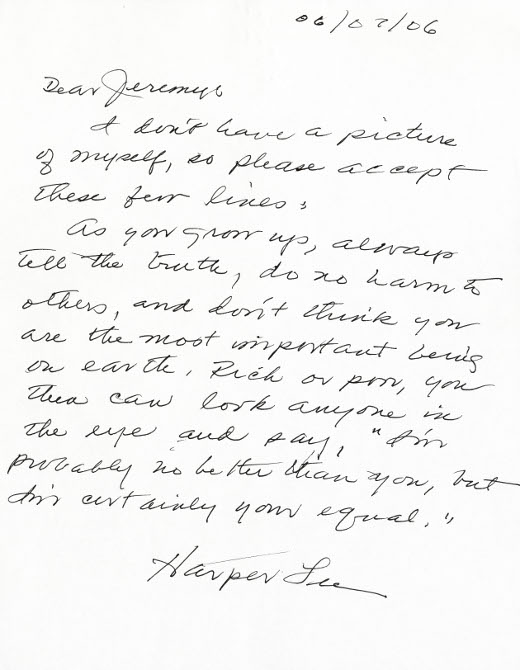
Harper Lee wrote To Kill a Mockingbird in 1960. More than a half decade later, the novel remains one of the most widely-read books in American classrooms. And students still write the 89-year-old author, requesting photographs and autographs.
Occasionally, they get a little more than they bargained for. Take, for example, a student named “Jeremy,” who wrote Lee in 2006 and requested a photo. In return, he got something more valuable and enduring: some pithy life advice. The letter Harper sent to Jeremy reads as follows:
06/07/06
Dear Jeremy
I don’t have a picture of myself, so please accept these few lines:
As you grow up, always tell the truth, do no harm to others, and don’t think you are the most important being on earth. Rich or poor, you then can look anyone in the eye and say, “I’m probably no better than you, but I’m certainly your equal.”
(Signed, ‘Harper Lee’)
Lee’s second novel, Go Set a Watchman, was just released last week — 55 years after her debut. You can read the first chapter (and also hear Reese Witherspoon read it aloud) here.
via Letters of Note
Follow us on Facebook, Twitter, Google Plus and LinkedIn and share intelligent media with your friends. And if you want to make sure that our posts definitely appear in your Facebook newsfeed, just follow these simple steps.
Related Content:
Stephen King Writes A Letter to His 16-Year-Old Self: “Stay Away from Recreational Drugs”
74 Essential Books for Your Personal Library: A List Curated by Female Creatives
Read More...Neil deGrasse Tyson Presents a Brief History of Everything in an 8.5 Minute Animation
Patreon, a crowd funding site where fans can automatically tithe a set amount to their fave artist every time that person uploads content, is a great way for passionate, under-recognized individuals to gain visibility and a bit of dough.
So what’s astrophysicist Neil deGrasse Tyson doing there? He’s already famous, and one would think his gig as director of New York City’s Hayden Planetarium, coupled with the proceeds from his books and dvds, would prove sufficient to any financial needs.
(Is it some sort of Amanda Palmer thing?)
Nope. Turns out Dr. Tyson is there on someone else’s behalf, narrating an episode of Harry Reich’s Minute Physics. The video series often employs whiteboard animations to explain such scientific phenomena as dark matter, wave/particle duality, and bicycles.
The latest Tyson-narrated episode, above, shoots the moon by cramming the entire History of the Universe (and some complimentary Stravinsky) into an 8.5‑minute framework (a negligible amount when you consider phenomena like light years, but still many times the series’ standard minute).
Thus far, 1075 fans of Minute Physics have anted up, resulting in a take of $2,992.66 per video. (Click here to see how that amount compares to the various wages and salaries of Dr. Tyson’s coworkers at the American Museum of Natural History…it’s clear Reich devotes a lot of labor to every episode.)
If you’re feeling flush (or nervous about the upcoming school year), you can join these 1075 fans, earning admission to a supporters-only activity feed where you can ask questions, watch outtakes, preview upcoming attractions, and possibly even get your name in the credits.
Related Content:
Stephen Colbert & Neil deGrasse Break Down Our Awesome 3 Billion-Mile Journey to Pluto
Neil deGrasse Tyson’s StarTalk Radio Show Podcast Tackles the History of Video Games
Ayun Halliday is an author, illustrator, and Chief Primatologist of the East Village Inky zine. Follow her @AyunHalliday
Read More...School Teachers Turn Old Lockers Into Literary Works of Art
At Biloxi Junior High School, the teachers are spending their summer pretty productively. They’re taking an entire hallway lined with dull green (currently unused) lockers and they’re repainting each and everyone of them — 189 in total. By the time students return in the fall, each locker will look like the spine of a famous book, and the hallway will be known as the “Avenue of Literature.” One teacher told WLOX, “We want students to come back to school in August and … be absolutely amazed with what we’ve done and be curious. We want that to be the spark for reading in our classrooms… We’re hoping the students come and they become completely immersed in a collection” that contains everything from Watership Down and Johnny Tremain to books in the Twilight series, reports Electric Lit.
Follow us on Facebook, Twitter, Google Plus and LinkedIn and share intelligent media with your friends. And if you want to make sure that our posts definitely appear in your Facebook newsfeed, just follow these simple steps.
Read More...Stephen Colbert & Neil deGrasse Break Down Our Awesome 3 Billion-Mile Journey to Pluto
The Late Show with Stephen Colbert won’t hit the airwaves until September 8th, but Colbert is already getting his Late Show Youtube channel up and running. That’s where you will find this video breaking down NASA’s amazing flyby of Pluto last week, a journey that involved the New Horizons spacecraft traveling a staggering 3 billion miles. (See photos here.) Joining Colbert is Neil deGrasse Tyson, who needs no introduction around here. Enjoy the banter, and don’t forget that you can download Tyson’s short course, The Inexplicable Universe. It’s free from The Great Courses for a limited time.
If the concept of Colbert interviewing Tyson intrigues you, don’t miss this lengthy interview originally posted on OC in 2011.
Follow us on Facebook, Twitter, Google Plus and LinkedIn and share intelligent media with your friends. And if you want to make sure that our posts definitely appear in your Facebook newsfeed, just follow these simple steps.
Related Content:
Stephen Colbert Reads Ray Bradbury Classic Sci-Fi Story “The Veldt”
Neil deGrasse Tyson Lists 8 (Free) Books Every Intelligent Person Should Read
Neil deGrasse Tyson Delivers the Greatest Science Sermon Ever
Free Online Astronomy Courses
Read More...Read the First Chapter of Harper Lee’s New Book, Then Hear It Read by Reese Witherspoon
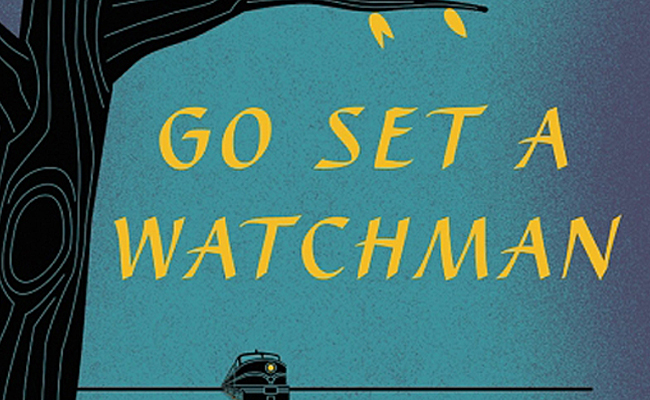
After much press and debate, Harper Lee’s new novel — a sequel of sorts to her beloved book, To Kill a Mockingbird — will be released on July 14th. You can pre-order Go Set a Watchman: A Novel (already #1 on Amazon’s bestseller list). But, even better, you can head over to the The Wall Street Journal or The Guardian and read the first chapter online. The Guardian also features an audio version read by the Oscar-winning actress Reese Witherspoon. Stream it right below. (And, fyi, you can always download a free audio copy of To Kill a Mockingbird through the free trial programs run by Audiobooks.com and Audible.com.)
Follow us on Facebook, Twitter, Google Plus and LinkedIn and share intelligent media with your friends. Note: There’s now a way to make sure that our posts show up in your Facebook newsfeed. Find info on that here.
Read More...Support Us
We're hoping to rely on loyal readers, rather than erratic ads. Please click the Donate button and support Open Culture. You can use Paypal, Venmo, Patreon, even Crypto! We thank you!

About Us

Open Culture scours the web for the best educational media. We find the free courses and audio books you need, the language lessons & educational videos you want, and plenty of enlightenment in between.
Advertise With Us
FREE UPDATES!
GET OUR DAILY EMAIL
Get the best cultural and educational resources on the web curated for you in a daily email. We never spam. Unsubscribe at any time.
FOLLOW ON SOCIAL MEDIA
Open Culture editor Dan Colman scours the web for the best educational media. He finds the free courses and audio books you need, the language lessons & movies you want, and plenty of enlightenment in between.
Advertise With Us

