Watch Online The Passion of Joan of Arc by Carl Theodor Dreyer (1928)
Sit back and enjoy The Passion of Joan of Arc, a 1928 silent film based on the historical record of the trial of Joan of Arc. Directed by Carl Theodor Dreyer and starring Renée Jeanne Falconetti, the film is considered a landmark of cinema. In fact, in the BFI’s poll of 846 critics, it was voted the 8th best film of all time.
Find more classic films in our meta collection, 4,000+ Free Movies Online: Great Classics, Indies, Noir, Westerns, Documentaries & More.
Follow us on Facebook, Twitter, Google Plus and LinkedIn and share intelligent media with your friends. And if you want to make sure that our posts definitely appear in your Facebook newsfeed, just follow these simple steps.
Read More...The Solar System Drawn Amazingly to Scale Across 7 Miles of Nevada’s Black Rock Desert
Wylie Overstreet and Alex Gorosh set out to create something you’ve never seen before — our solar system drawn to actual scale. Forget what you’ve seen in books, or on web sites. To depict things accurately, you need a bigger surface. A really large canvas. Like a seven-mile expanse in Nevada’s Black Rock Desert (which otherwise hosts The Burning Man Festival). It’s on this dry lakebed that Overstreet and Gorosh built “the first scale model of the solar system with complete planetary orbits” and it’s a sight to behold. Creative, industrious, and humbling. Enjoy.
Follow us on Facebook, Twitter, Google Plus and LinkedIn and share intelligent media with your friends. Or better yet, sign up for our daily email. And if you want to make sure that our posts definitely appear in your Facebook newsfeed, just follow these simple steps.
Related Content:
Free Online Astronomy Courses
Magnifying the Universe: Move From Atoms to Galaxies in HD
Carl Sagan, Stephen Hawking & Arthur C. Clarke Discuss God, the Universe, and Everything Else
Lawrence Krauss Explains How You Get ‘A Universe From Nothing’
Read More...Mark Twain Skewers Great Works of Art: The Mona Lisa (“a Smoked Haddock!”), The Last Supper (“a Mournful Wreck”) & More

Some of the U.S.‘s greatest secular sages also happen to be some of its greatest cranks, contrarians, and critics. I refer to a category that includes Ambrose Bierce, H.L. Mencken, and Hunter S. Thompson. The many differences between these characters don’t eclipse a fundamental similarity: not a one embraced any of the usual pieties about the inherent, infallible greatness of Western Civilization, though each one in his own way made a significant contribution to the Western canon. We would be greatly remiss if we did not include among them perhaps the greatest American satirist of all, Mark Twain.
Twain skewered all comers, usually with such wit and invention that we smile and nod even when we feel the sting ourselves. Such was his talent, to deflate puffery in Western literature, politics, religion, and… as we will see, in art. “Throughout his career”—writes UC Berkeley’s Bancroft Library—“Twain expressed his strong reactions to Western painting and sculpture, particularly the Old Masters, both in his published works and in private.” He offered up some hilariously irreverent takes on some of the most revered works of art in history: “his opinions are often passionate, sometimes eccentric, and always lively.” Take for example Twain’s tepid assessment of that most recognizable of Renaissance masterpieces, the Mona Lisa. In an unpublished draft called “The Innocents Adrift,” an account of an 1891 boat trip down the Rhone River, Twain “admitted to being puzzled by the adulation accorded” the painting.
To Twain, the Mona Lisa seemed “merely a good representation of a serene & subdued face… The complexion was bad; in fact it was not even human; there are no people of that color.” The painting’s greenish hue prompted one of Twain’s companions, possibly an invention of the author’s, to exclaim in response, “that smoked haddock!” “After some discussion,” write the UC Berkeley librarians, “the travelers concede that it requires a ‘trained eye’ to appreciate certain aspects of art.” Such training in art appreciation seemed to Twain as much genuine education as instruction in studied, insincere poses.
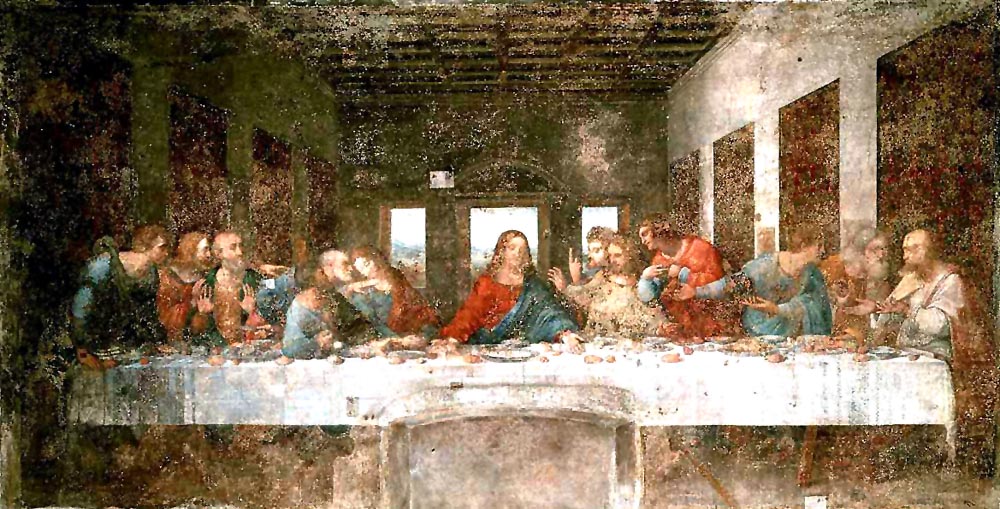
The author took his first “grand tour” in 1867—travelling through Europe and the Levant on the cruise ship Quaker City in the company of many “prosperous—and very proper—passengers.” Unlike these bourgeois travelling companions’ “conventional appreciation for all that they saw,” Twain—writing as a correspondent for the San Francisco Alta California—confessed himself underwhelmed. In particular, he described another Da Vinci, The Last Supper—“the most celebrated painting in the world”—as a “mournful wreck.” (The work was then unrestored; see it above as it looked 100 years later in the 1970s.) Twain later revised his observations for his first full-length book, 1869’s Innocents Abroad, a caricature of ugly American tourists filled with what William Dean Howells called “delicious impudence.” While the others marveled at Da Vinci’s crumbling fresco, Twain, in the current parlance, expressed a great big “meh.”
The world seems to have become settled in the belief, long ago, that it is not possible for human genius to outdo this creation of Da Vinci’s.… The colors are dimmed with age; the countenances are scaled and marred, and nearly all expression is gone from them; the hair is a dead blur upon the wall, and there is no life in the eyes.… I am satisfied that the Last Supper was a very miracle of art once. But it was three hundred years ago.
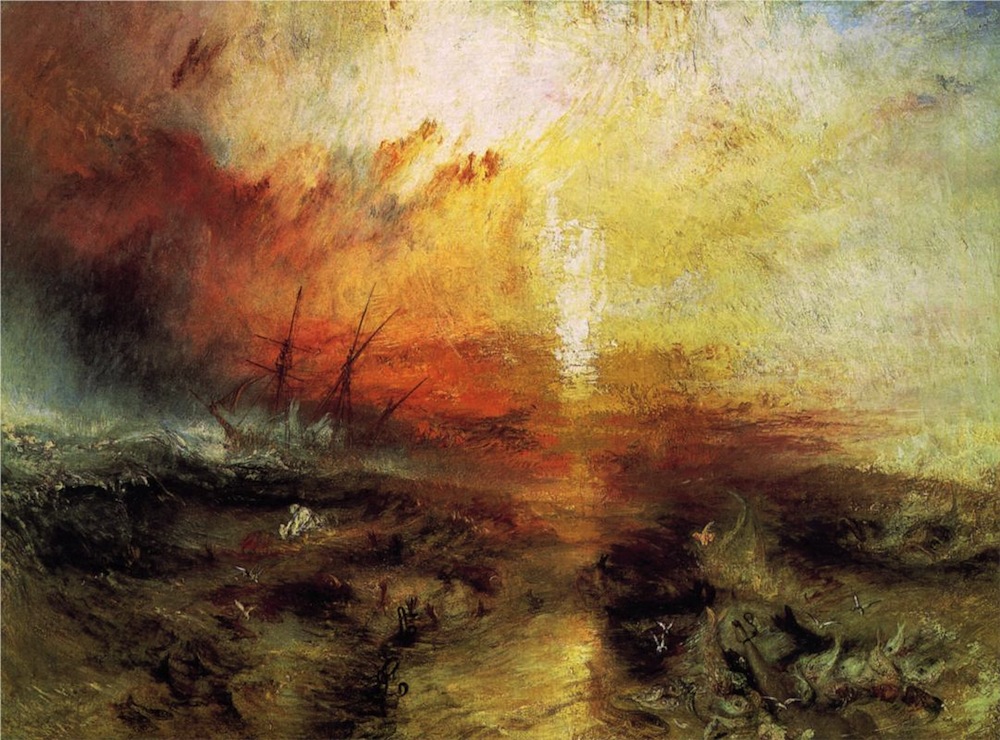
Twain and the professional critics did not always disagree. Take J.M.W. Turner’s famously riotous canvas Slave Ship (or Slavers Overthrowing the Dead and Dying: Typhoon Coming On), above. John Ruskin may have praised the work as the “noblest sea… ever painted by man” and it has come down to us as a violent representation of the horrors of the slave trade, occasioned in part, writes Stephen J. May, by Turner’s sense of “shared guilt about his own role and England’s role in condoning and perpetuating slavery’s malevolent legacy.” The anti-slavery, anti-imperialist Twain would surely have appreciated the sentiment; the painting, however, not so much. Other critics felt similarly, one calling Slave Ship a “gross outrage on nature.” Twain’s summation in an 1878 notebook is much more colorful, a piece of vintage Samuel Clemens undercutting: “Slave Ship—Cat having a fit in a platter of tomatoes.”
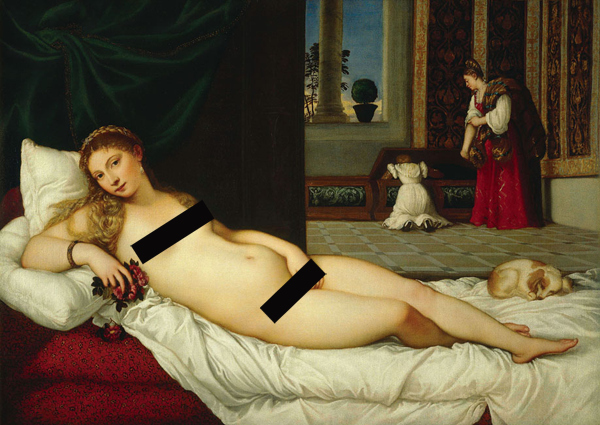
For all his snide portraits of conventional middle-class attitudes toward art, Twain could also be a bit of a prig, as we see in his response to Titian’s Venus of Urbino. In this, he was not so far removed from our own cultural attitudes (or Facebook and Google’s attitudes) about nudity. The censored version of the painting above (see the original here) comes to us via Buzzfeed, who write “Remember kids, blood and gore are fine but boobs will make you blind.” Twain seemed to have unironically agreed, railing in his 1880 travel book A Tramp Abroad against the “indecent license” afforded artists and calling Titian’s suggestive reclining nude “the foulest, the vilest, the obscenest picture the world possesses.” (Ah, if only he had lived to see the internet’s foulest depths.)
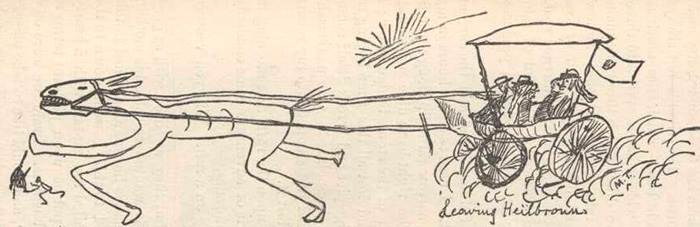
Twain’s own meager contributions to the visual arts—consisting of a dozen sketches, like that above, made for A Tramp Abroad—fall somewhat short of the standards he set for other artists. Nevertheless, he recalled in The Innocents Abroad his dismay at the “acres of very bad drawing, very bad perspective, and very incorrect proportions” in the museums and churches across Europe. What, we might wonder, could possibly move such a harsh, unsparing critic? In art, it seems, Twain valued “strict realism, grandeur of theme and scale, and propriety”—all on display in abundance in American artist Frederic Edwin Church’s The Heart of the Andes, below.

After viewing this idealized South American landscape in St. Louis, Twain called the enormous (over five feet high by ten feet wide) canvas a “most wonderfully beautiful painting.” “We took the opera glasses,” he wrote to his brother, “and examined its beauties minutely…. There is no slurring of perspective about it.” He recommended multiple viewings: “Your third visit will find your brain gasping and straining with futile efforts to take all the wonder in… and understand how such a miracle could have been conceived and executed by human brain and human hands.”
Twain, won over by this sublime spectacle, seems to have temporarily surrendered his critical faculties. In reading his response, I found myself wanting to egg him on: C’mon, what about this soft, gauzy lighting, those lumpy mountains, and the kitschy, overly-sentimental look of the whole thing? But there was room enough in Twain’s critical arsenal for genuine awe as for amused contempt at what he saw as phony expressions of the same. And that breadth of character is what made Mark Twain, well, Mark Twain.
Related Content:
Mark Twain Creates a List of His Favorite Books For Adults & Kids (1887)
Mark Twain Drafts the Ultimate Letter of Complaint (1905)
Mark Twain Writes a Rapturous Letter to Walt Whitman on the Poet’s 70th Birthday (1889)
Josh Jones is a writer and musician based in Durham, NC. Follow him at @jdmagness
Read More...Thomas Dolby Potty Trains His Cat, and There’s Video Proof
One of our favorite curiosities is the The Charles Mingus CAT-alogue for Toilet Training Your Cat–a pamphlet written by the mercurial jazz musician that offers step-by-step advice on how to get your cat to use the loo. The one thing Mingus didn’t provide is video proof that it could actually be done.
That’s where another musician steps in. Above, we have video of Thomas Dolby’s cat, “Mozart,” in action. Dolby, best known for his 1982 hit “She Blinded Me with Science,” is a teacher at heart. The son of an Oxford and Cambridge don, he’s now the Professor of the Arts at Johns Hopkins University. And, on his Youtube channel, he explains how he pulled off the seemingly impossible:
This is my cat Mozart, a Cornish Rex, peeing on the toilet. Many believed this was not possible, but it’s 100% real. When he was a kitten we tried to teach him to use the toilet, using a DVD. We thought it was a no go. But then aged about 3 he suddenly started to do it. Now sometimes when I get up in the night to pee Mo nips in ahead of me and I have to wait till he’s done. Next we need to teach him to flush! ~TD
If anyone is familiar with the DVD he’s referencing, please identify it in the comments below.
Follow us on Facebook, Twitter, Google Plus and LinkedIn and share our posts with your friends. And if you want to make sure that our posts definitely appear in your Facebook newsfeed, just follow these simple steps.
Related Content:
Thomas Dolby Explains How a Synthesizer Works on a Jim Henson Kids Show (1989)
Charles Mingus’ Instructions For Toilet Training Your Cat, Read by The Wire’s Reg E. Cathey
Insanely Cute Cat Commercials from Studio Ghibli, Hayao Miyazaki’s Legendary Animation Shop
Read More...Marshall McLuhan’s 1969 Deck of Cards, Designed For Out-of-the-Box Thinking
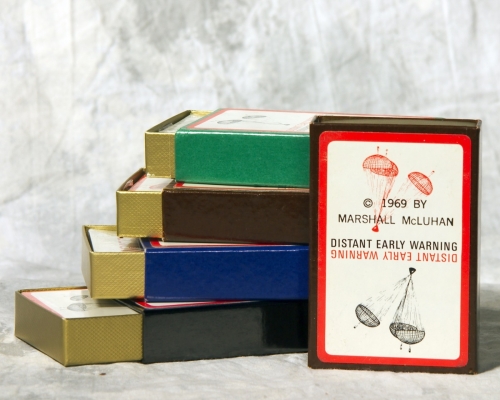
Image via EricMcluhan.com
Six years before Brian Eno and Peter Schmidt designed their first pack of Oblique Strategies cards—a set of random aphorisms meant to clear creative blocks—communication theorist and philosopher Marshall McLuhan had designed a very similar deck in 1969, this one with a more direct nod to the classic playing card deck.

The name of the card deck, Distant Early Warning, was a reference to the 3,000 mile long DEW Line, a system of 63 radar stations that acted as an early detection invasion buffer during the Cold War. And in his 1964 book Understand Media, McLuhan explained,
“I think of art, at its most significant, as a DEW line, a Distant Early Warning system that can always be relied on to tell the old culture what is beginning to happen to it.”
And so with help from advertising and publishing guru Eugene Schwartz, The Marshall McLuhan DEW-Line Newsletter and its spinoff deck of cards was born. Schwartz saw the newsletter much like we see blogs today: a very immediate way of disseminating information, deeper than television and faster than books. The newsletter lasted only two years, came in several forms (one issue was a set of slides, another a record), and represents the height of “McLuhan Mania” in American culture. Business and thought leaders were its target audience.

Much like Oblique Strategies (you can still find vintage versions online), the instructions for Distant Early Warning (also available online here) suggest that the user think of a personal or business problem, shuffle the deck, choose a card and interpret its meaning. Although divinatory cards have long been a part of western culture, the idea of indeterminacy and consulting the I Ching was very much in vogue through artists like John Cage.
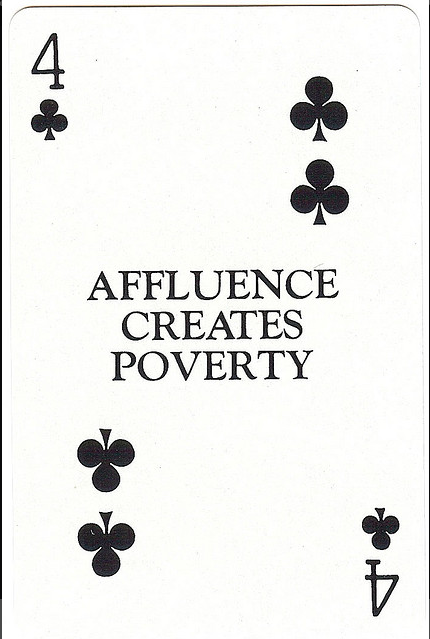
The cards contain plays on aphorisms, like “The Victor Belongs to the Spoils” or “Thanks for the Mammaries.” Sometimes they quote Victorian novelist Samuel Butler, like “The chicken was the egg’s idea for getting more eggs” or W.C. Fields (“How do you like kids?” “Well cooked,” he said sternly), or John Cage (“Silence is all the sounds of the environment at once.”) Many are McLuhan’s own quotes.

McLuhan and Schwartz’ ideas can still be felt in any number of TED talks or whenever a business leader talks about thinking outside the box. Steve Jobs was a walking deck of these cards.
Should you feel like pushing your brain laterally, check out the full deck here at this Flickr feed, and if you long to own a physical copy, it can still be had for Canadian dollars at the site run by McLuhan’s son.
via Flashbak
Related content:
The Visionary Thought of Marshall McLuhan, Introduced and Demystified by Tom Wolfe
McLuhan Said “The Medium Is The Message”; Two Pieces Of Media Decode the Famous Phrase
Norman Mailer & Marshall McLuhan Debate the Electronic Age
Ted Mills is a freelance writer on the arts who currently hosts the FunkZone Podcast. You can also follow him on Twitter at @tedmills, read his other arts writing at tedmills.com and/or watch his films here.
Read More...Hear Dramatizations of H.P. Lovecraft’s Stories On His Birthday: “The Call of Cthulhu,” “The Dunwich Horror,” & More
Horror writer Howard Phillips Lovecraft was a man who lived his life in fear—of people of other races and nationalities, of women, of reality itself. In a recent New York Review of Books write-up, Charles Baxter somewhat derisively characterizes Lovecraft as a disenchanted adolescent (and favorite of disenchanted adolescents), who “never really grew up. ‘Adulthood is hell,’ he once wrote in a letter.” Yet his fiction depicts more than a tormented adult world, but an entire universe brimming with nameless ancient horrors—and occasionally named ones like the creature Cthulhu, whose likeness he once sketched out in a letter to a friend.
The cephalopod-faced monster crystalizes Lovecraft’s disgust with reality in all its strangeness and, for him, all its variety. It’s a perfect image of alienation (just this past week we saw tongue-in-cheek speculation over whether octopuses are aliens; a plausible conceit) and presents us with an elemental uncanniness that characterizes his entire body of work. “Fiction like Lovecraft’s can be brutally hypnotic,” writes Baxter, “the young reader, intellectually undefended and easily shaken enters the writer’s fear-drenched universe and can’t easily get out of it.”
The Call of Cthulhu — Part 1
The Call of Cthulhu — Part 2
Whether you discovered Lovecraft as a young reader or an older one, you may have found yourself similarly entrapped by the horrors of his imagination. And you could count yourself in the company of not only hermetic, misanthropic, death-obsessed young men in punk bands but also of media friendly, death-obsessed writers like Stephen King and Joyce Carol Oates. And, of course, thousands upon thousands of horror fans across the world, including a great many actors, writers, and directors who over the years have adapted Lovecraft’s fiction as old-fashioned radio drama of the kind the author himself might have consumed while isolated from the wicked world in his New England home.
You can hear some choice examples here: at the top of the post we have Richard Coyle’s reading of the novella At the Mountains of Madness. (You can also hear his reading of “The Shadow Over Innsmouth” here.) Next, we have a 1945 dramatization of “The Dunwich Horror,” performed by Academy Award-winning actor Ronald Colman. And then hear the infamous “Call of Cthulhu,” parts one and two, produced by the Atlanta Radio Theatre Company, who have recorded no small number of Lovecraft radio plays. Just above, listen to a reading of “Behind the Wall of Sleep” from old-time radio sci-fi readings archive Mind Webs (which we’ve covered in a previous post). Finally, below, listen on Spotify to the HP Lovecraft Radio Hour Vol 1, a collection of dramatized Lovecraft stories.
Should you happen to tear through these recordings and find yourself in desperate need of more to feed your Lovecraft obsession, fear not; you would have a very hard time exhausting all the options. The World’s Largest H.P. Lovecraft Audio Links Gateway, for example, delivers exactly what it promises. Should that expansive database somehow leave out a reading or dramatization, you’ll perhaps find it over at the H.P. Lovecraft Archive’s sizeable collection. And you must, if you’re a Lovecraft fan, visit the H.P. Lovecraft Historical Society, who host plenty of Lovecraft merch, and links to much more Lovecraft audio, including albums inspired by his work and a podcast.
And on the off chance you knew little or not at all of Lovecraft before reading this post, beware. You may, after listening to some of his weird tales of horror, come away a devoted Lovecraft cultist.
Related Content:
H.P. Lovecraft’s Classic Horror Stories Free Online: Download Audio Books, eBooks & More
Lovecraft: Fear of the Unknown (Free Documentary)
Josh Jones is a writer and musician based in Durham, NC. Follow him at @jdmagness
Read More...A Vintage Infographic of the Human Brain: The Wonders Within Your Head (1938)
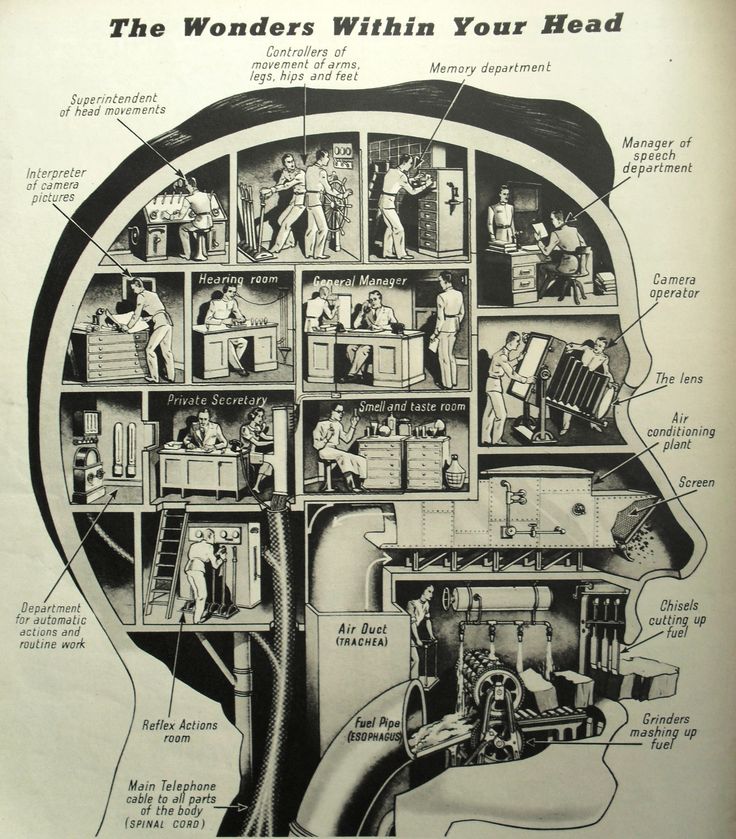
Click here to view the infographic in a larger format.
From the December 6, 1938 issue of LOOK magazine comes this vintage “infographic” showing “The Wonders Within Your Head.” It takes the human brain/head and presents it as a series of rooms, each carrying out a different function. Drawn a little more than a decade after Calvin Coolidge famously declared “The business of America is business,” it’s not surprising that the cognitive functions are depicted in corporate or industrial terms.
Besides for this visualization, the same edition of LOOK featured articles on Jean Harlow, Joan Crawford, President Roosevelt, and the Tragedy of the European Jews. Kristallnacht, or the “Night of Broken Glass,” had taken place a month before in Nazi Germany — another sign that the world was about to become a very, very dark place.
Follow us on Facebook, Twitter, Google Plus and LinkedIn and share intelligent media with your friends. And if you want to make sure that our posts definitely appear in your Facebook newsfeed, just follow these simple steps.
Related Content:
The Tree of Languages Illustrated in a Big, Beautiful Infographic
Download 78 Free Online History Courses: From Ancient Greece to The Modern World
4000 Years of History Displayed in a 5‑Foot-Long “Histomap” (Early Infographic) From 1931
Free Online Biology Courses
Read More...Hear Mahler’s 9th Played in 6 Minutes on the Squeezebox by “The Greatest Accordionist in the World”

NPR called William Schimmel “the greatest accordionist in the world,” and thanks to NPR you can hear Schimmel at work, taking Gustav Mahler’s sprawling Ninth Symphony and “squeezing this immense musical canvas down to just 6 1/2 minutes.” That’s a feat in itself.
Trumpeter Wynton Marsalis makes an appearance on the track, which comes from the newly-released album, Theater of the Accordion: William Schimmel. Enjoy.
Follow us on Facebook, Twitter, Google Plus and LinkedIn and share intelligent media with your friends. And if you want to make sure that our posts definitely appear in your Facebook newsfeed, just follow these simple steps.
Read More...Audrey Hepburn’s Moving Screen Test for Roman Holiday (1953)
When you think of Audrey Hepburn, you think of Roman Holiday, the 1953 film that launched her career. How can you forget Hepburn as Princess Anne? Originally, the part was written for Elizabeth Taylor, then a major star. But something happened during the casting that changed all of that. In his biography of Ms. Hepburn, the author Barry Paris writes:
Her Roman Holiday test took place at Pinewood Studio in London, September 18, 1951, under [Thorold] Dickinson’s direction. “We did some scenes out of the script,” he said, but “Paramount also wanted to see what Audrey was actually like not acting a part, so I did an interview with her. We loaded a thousand feet of film into a camera and every foot of it went on this conversation. She talked about her experiences in the war, the Allied raid on Arnhem, and hiding out in a cellar. A deeply moving thing.”
Later, so the story goes, the director William Wyler watched the footage (shown above) in Rome and found it irresistible. He claimed: “She had everything I was looking for: charm, innocence and talent. She also was very funny. She was absolutely enchanting, and we said, ‘That’s the girl!’ ”
In watching the footage, one thing will leap out. Hepburn’s adolescence was hardly suited for a princess. Living in the Dutch town of Arnhem during World War II, she experienced the harsh German occupation firsthand and suffered from malnutrition, acute anemia, respiratory problems, and edema by the war’s end. It was a formative experience that later made her a devoted activist for children’s rights.
Follow us on Facebook, Twitter, Google Plus and LinkedIn and share intelligent media with your friends. And if you want to make sure that our posts definitely appear in your Facebook newsfeed, just follow these simple steps.
Related Content:
Marlene Dietrich’s Temperamental Screen Test for The Blue Angel (1929)
Marlon Brando Screen Tests for Rebel Without A Cause (1947)
Bruce Lee Auditions for The Green Hornet
Read More...Adorn Your Garden with Howard the Zinn Monk

In January, in the dead of winter, we got you thinking about warmer times by highlighting the Noam Chomsky Garden Gnome, a real product described as follows:
Standing at just under 17 inches, Gnome Chomsky the Garden Noam clutches his classic books, ‘The Manufacture of Compost’ and ‘Hedgerows not Hegemony’ – with his open right hand ready to hold the political slogan of your choosing. His clothes represent a relaxed but classy version of regular gnome attire, including: a nice suit jacket-tunic, jeans, boots, traditional gnome cap, and glasses. Additionally, Noam Gnome stands on a base complete with a carved title – for anyone who may not immediately realize the identity of this handsome and scholarly gnome.
Now that it’s summer, imagine Gnome Chomsky hanging in your garden with Howard the Zinn Monk. Zinn Monk, get it?
First published in 1980, Zinn’s famous book A People’s History of the United States tells “America’s story from the point of view of—and in the words of—America’s women, factory workers, African-Americans, Native Americans, the working poor, and immigrant laborers.” It has sold more than two million copies over the past 35 years. And, as I write this post, it’s the #1 bestselling book in US history on Amazon.
Howard the Zinn Monk isn’t quite selling at the same brisk clip. But the web site justsaygnome.net might make you a Zinn gnome if you ask nicely.
In the meantime, you can watch and enjoy this illustrated video: Howard Zinn’s “What the Classroom Didn’t Teach Me About the American Empire.”
Follow us on Facebook, Twitter, Google Plus and LinkedIn and share intelligent media with your friends. And if you want to make sure that our posts definitely appear in your Facebook newsfeed, just follow these simple steps.
Read More...Support Us
We're hoping to rely on loyal readers, rather than erratic ads. Please click the Donate button and support Open Culture. You can use Paypal, Venmo, Patreon, even Crypto! We thank you!

About Us

Open Culture scours the web for the best educational media. We find the free courses and audio books you need, the language lessons & educational videos you want, and plenty of enlightenment in between.
Advertise With Us
FREE UPDATES!
GET OUR DAILY EMAIL
Get the best cultural and educational resources on the web curated for you in a daily email. We never spam. Unsubscribe at any time.
FOLLOW ON SOCIAL MEDIA
Open Culture editor Dan Colman scours the web for the best educational media. He finds the free courses and audio books you need, the language lessons & movies you want, and plenty of enlightenment in between.
Advertise With Us

