Listen to Ira Glass’ 10 Favorite Episodes of This American Life
Even when one is a longtime, jaded denizen of a major city, celebrity sightings can still induce a thrill. During my tenure in New York City, I ran across my share of famous names, though I’ve never been one to bother a stranger, world famous or no. This almost changed when I ran past Ira Glass one evening and found myself sorely tempted to chat him up. I’m sure he’d be glad I resisted the urge, but having heard his voice on the radio every week for well over a decade… well, I felt like I knew him.
Since 1995, Glass has hosted This American Life, perhaps the most popular public radio show ever produced and—before its hugely successful spin-off Serial—the most popular podcast in the U.S. The show is quickly approaching its twenty-year anniversary (its first episode aired November 17th; hear it here), and in honor of that milestone, we revisit another: the show’s 500th episode, which aired in 2013. For that occasion, Buzzfeed visited with Glass for a revealing interview.
Though he responded to episode 500 with typical understatement—saying it felt “more like an odometer rolling over than anything else”—many fans of the show, myself included, felt a great deal more enthusiasm, as did Los Angeles’ KPCC, who brings us the list below of Glass’ top ten episodes (including one two-parter). Glass noted that his top picks also happen to be fan favorites as well. You can hear all of his favorites at the links below:
- Notes on Camp
- Harper High School One and Two
- The Giant Pool of Money
- Somewhere in the Arabian Sea — “I love how funny and human-sized everyone is in this show. It’s a surprisingly funny show about the war on terror,” Glass writes.
- Switched at Birth — Glass: “The structure of this show — where the whole episode you wonder how a mom could know for decades she was raising the wrong baby and finally, she answers it in the end — is perfect.”
- Break-Up — “The standout story is Starlee Kine’s essay on breakup songs, which includes an interview with Phil Collins that’s so menschy and real, it changed how I saw him forever.”
- Babysitting — “Especially the interview with Myron Jones, which is the best interview I’ve ever done, mainly because he had so much grace and humor talking about his past. Any question I could think of, he’d come back with an amazing story, which is rare.”
- My Big Break — “David Segal takes a turn in the middle of this story that’s one of my favorite reveals in any radio story ever.”
- Harold Washington — “How can you go wrong when the central figure in your story is funny and cantankerous and bighearted and idealistic and utterly pragmatic and on top of all that, totally charismatic? If you don’t know who Harold is, be prepared for a treat.”
- Heretics — “Carlton Pearson, like Harold, is someone they should make a movie about, for lots of the same reasons. An idealistic preacher whose idealism costs him pretty much everything: the church he runs, his reputation, his fortune, nearly his family.”
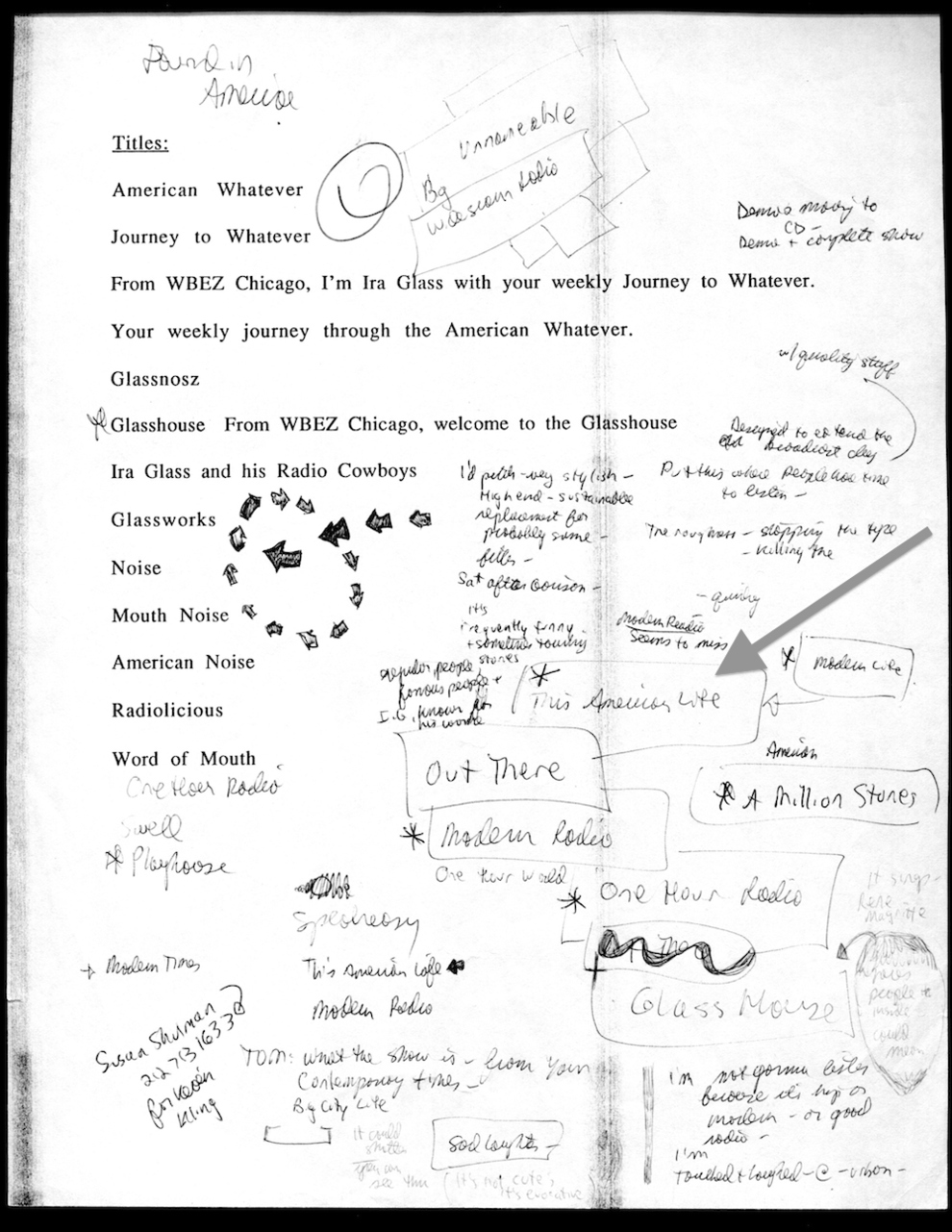
As a special treat, Glass also shared with Buzzfeed the document at the top of the post, a page of ideas for alternate titles for the show originally called Your Radio Playhouse. Before renaming the show in March of 1996, Glass and his crew considered such titles as the uninspiring “American Whatever,” weird “Mouth Noise,” and goofy “Ira Glass and his Radio Cowboys.”
I kind of wish they’d gone with the latter, but it’s hard to imagine the show we know as This American Life could ever have been called anything else. (See it penciled in almost as an afterthought above.) The show’s title perfectly sums up the breadth and scope of a program that tackles everything from the trivial to the highly consequential, often back-to-back in the same themed hour. Though Glass would surely balk at such high praise, I think his show has done more to help Americans know and understand ourselves over the last twenty years than nearly anything else on radio, TV, or the podcasting world.
Related Content:
Ira Glass on the Art and Craft of Telling Great Radio Stories
This American Life Demystifies the American Healthcare System
Josh Jones is a writer and musician based in Durham, NC. Follow him at @jdmagness
Read More...Musician Plays Signature Drum Parts of 71 Beatles Songs in 5 Minutes: A Whirlwind Tribute to Ringo Starr
Kye Smith, a drummer based in Newcastle, Australia, recently hauled his drum kit to a nearby rooftop (an homage to The Beatles’ 1969 rooftop gig?) and started banging out a pretty wonderful tribute to Ringo Starr, playing drum parts from 71 Beatles songs in 5 quick minutes. Smith moves chronologically, playing the songs in the order they were released (not recorded). We start in 1962, move through 1969, and even momentarily visit 1995. On his Facebook page, Smith had this to say:
Way before I found out about punk rock or even knew what a snare drum was I spent my childhood playing vinyl records at my grandparents place spinning artists such as Slim Dusty, ELVIS PRESLEY and The Beatles.
This chronology called for some special treatment and got me out of the studio and onto the rooftop of The Great Northern Hotel — Newcastle, Australia for a pretty stunning view of Newcastle, New South Wales in the background.
Thanks to everyone at The Great Northern for letting me make some noise up there and to Eluminate for helping me shoot it and lug heaps of gear up 7 storeys of stairs!
Below the jump, you can find the list of songs that appear in the video, complete with corresponding time stamps. And keep in mind that Smith, as he mentions on Youtube, is “available for studio and live work and will be opening up some slots for drum lessons shortly.” Contact him here.
PS: If you can name one of the drum parts that was originally played by Paul McCartney, you get bonus points.
Follow Open Culture on Facebook and Twitter and share intelligent media with your friends. Or better yet, sign up for our daily email and get a daily dose of Open Culture in your inbox. And if you want to make sure that our posts definitely appear in your Facebook newsfeed, just follow these simple steps.
Read More...The Worlds of Hitchcock & Kubrick Collide in a Surreal Mashup, The Red Drum Getaway
If you read Open Culture even casually, you know we love Alfred Hitchcock, Stanley Kubrick, and videos that make us see film in a new way. It only makes sense, then, that we’d jump right on Adrien Dezalay, Emmanuel Delabaere, and Simon Philippe’s The Red Drum Getaway, which mashes Hitchcock and Kubrick up into a four-minute shot of distilled cinematic collision. “Jimmy was having a rather beautiful day,” reads the video’s preparatory description, “until he bumped into Jack and things got weird.”
“Jimmy” refers, of course, to Jimmy Stewart as seen in the work of Alfred Hitchcock. “Jack” refers to Jack Nicholson seen in the work of Stanley Kubrick — which, of course, means Jack Nicholson of The Shining. Strange enough, you might think, that those two would ever encounter each other, but what might happen if the gang of droogs from A Clockwork Orange also turned up? Or if poor mild-mannered Jimmy found himself at the aristocratic, NSFW fetish party from Eyes Wide Shut?
When an auteur successfully taps into our subconscious minds, as Hitchcock and Kubrick so often did, we describe their work, in a complimentary sense, as “dreamlike.” But art that feels like a dream can also feed material to our nightmares, and as The Red Drum Getaway more closely intertwines these two disparate cinematic worlds as it goes, it begins to resemble the most harrowing filmic freakouts any of us have ever endured. It makes a perfect setting for Jack, who, as we know, has already gone insane due to his own alcoholism and the goading of the spirits who haunt the Overlook Hotel. And as for Jimmy, surely Vertigo put him through enough of the surreal to prepare him for the psychedelic end of 2001.
Related Content:
The Two Gentlemen of Lebowski: What If The Bard Wrote The Big Lebowski?
Dark Side of the Rainbow: Pink Floyd Meets The Wizard of Oz in One of the Earliest Mash-Ups
Watch Steven Soderbergh’s Creative Mashup of Hitchcock and Gus Van Sant’s Psycho Films
Discover the Life & Work of Stanley Kubrick in a Sweeping Three-Hour Video Essay
Alfred Hitchcock’s Seven-Minute Editing Master Class
Salvador Dalí Creates a Dream Sequence for Spellbound, Hitchcock’s Psychoanalytic Thriller
Colin Marshall writes elsewhere on cities, language, Asia, and men’s style. He’s at work on a book about Los Angeles, A Los Angeles Primer, the video series The City in Cinema, and the crowdfunded journalism project Where Is the City of the Future? Follow him on Twitter at @colinmarshall or on Facebook.
Read More...Postage Stamps from Bhutan That Double as Playable Vinyl Records

The tiny, Himalayan kingdom of Bhutan has a unique national aspiration that sets it apart from its neighbors, China and India. (And certainly the United States too.) Rather than increasing its gross national product, Bhutan has instead made it a goal to increase the Gross National Happiness of its citizens. There’s wealth in health, not just money, the Bhutanese have argued. And since the 197os, the country has taken a holistic approach to development, trying to increase the spiritual, physical, and environmental health of its people. And guess what? The strategy is paying off. A 2006 global survey conducted by Business Week found that Bhutan is the happiest country in Asia and the eighth-happiest country in the world.
It’s perhaps only a nation devoted to happiness that could throw its support behind this — postage stamps that double as playable vinyl records. Created by an American entrepreneur Burt Todd in the early 70s, at the request of the Bhutanese royal family, the “talking stamps” shown above could be stuck on a letter and then later played on a turntable. According to Todd’s 2006 obituary in The New York Times, one stamp “played the Bhutanese national anthem,” and another delivered “a very concise history of Bhutan.” Thanks to WFMU, our favorite independent free form radio station, you can hear clips of talking stamps above and below. Don’t you feel happier already?
Follow Open Culture on Facebook and Twitter and share intelligent media with your friends. Or better yet, sign up for our daily email and get a daily dose of Open Culture in your inbox. And if you want to make sure that our posts definitely appear in your Facebook newsfeed, just follow these simple steps.
Related Content:
How to Clean Your Vinyl Records with Wood Glue
How Vinyl Records Are Made: A Primer from 1956
Read More...Amazing Miniature Sculptures of New York City Landmarks: CBGB, Katz’s Deli, Vesuvio Bakery & More
If you’re near Pasadena, California, stop by the Flower Pepper Gallery and see Facade, the new exhibition featuring the work of visual artist Randy Hage. For decades now, Hage has been fascinated by the beauty of aging structures in New York City. This led him, beginning in the late 1990s, to start photographing aging storefronts in the city, “with their hand painted signs, layers of architecture, wonderful patinas and intriguing history.” Later, he decided to preserve their memory in miniaturized, hyper-realistic sculptures (like the ones now on display in Pasadena through November 18th). In the video above, see just how perfectly Hage manages to recreate New York storefronts in miniature. Here’s another famous-but-now-defunct facade you might recognize:
To take a closer look at his work, visit Hage’s Instagram page where you will see mini sculptures of fading New York institutions like Katz’s Deli, CBGB, McSorley’s Old Ale House, Vesuvio Bakery, and more.
via SuperSonic Art/BoingBoing
Follow Open Culture on Facebook and Twitter and share intelligent media with your friends. Or better yet, sign up for our daily email and get a daily dose of Open Culture in your inbox. And if you want to make sure that our posts definitely appear in your Facebook newsfeed, just follow these simple steps.
Read More...Innovative Film Visualizes the Destruction of World War II: Now Available in 7 Languages
Back in June we highlighted Neil Halloran’s 15 minute film, The Fallen of World War II, which used “innovative data visualization techniques to put the human cost of WW II into perspective, showing how some 70 million lives were lost within civilian and military populations across Europe and Asia, from 1939 to 1945.” It’s a pretty staggering illustration of the deadliest war. As the film went viral, Halloran raised money that would enable him to develop new films exploring “other trends of war and peace — from drones and terrorism to democracy and peacekeeping.” He has also translated the film into six different languages. They all went online in the last few weeks. Here they are: Russian, Japanese, Polish, French, German, and Serbian.
Above, you can watch the original in English (certainly worth doing if you were vacationing in June), and you might also explore the accompanying interactive web site here.
Follow Open Culture on Facebook and Twitter and share intelligent media with your friends. Or better yet, sign up for our daily email and get a daily dose of Open Culture in your inbox. And if you want to make sure that our posts definitely appear in your Facebook newsfeed, just follow these simple steps.
Related Content:
Free Online History Courses
Watch World War II Rage Across Europe in a 7 Minute Time-Lapse Film: Every Day From 1939 to 1945
31 Rolls of Film Taken by a World War II Soldier Get Discovered & Developed Before Your Eyes
Dramatic Color Footage Shows a Bombed-Out Berlin a Month After Germany’s WWII Defeat (1945)
Read More...How a Virus Invades Your Body: An Eye-Popping, Animated Look
It’s getting close to that time of the year again, when the flu starts to wreak havoc. And so, with the help of NPR’s Robert Krulwich and medical animator David Bolinsky, we’re taking an animated look at what actually happens when a virus invades your body and tricks a single cell into making a million more viruses, and how your immune system eventually deals with the whole mess. It’s a nice demystification of phenomena that affects our everyday lives. If you feel inclined to get a flu shot after watching this clip, I can’t say that I blame you.
Follow us on Facebook and Twitter and share intelligent media with your friends. Or better yet, sign up for our daily email and get a daily dose of Open Culture in your inbox. And if you want to make sure that our posts definitely appear in your Facebook newsfeed, just follow these simple steps.
Related Content:
Free Online Biology Courses
What Makes Us Tick? Free Stanford Biology Course by Robert Sapolsky Offers Answers
Carl Sagan Explains Evolution in an Eight-Minute Animation
Read More...Fantastic Mr. Fox Meets The Shining in an Animated, Cautionary Tale About Consumerism
In this short stop-motion film, Alexandra Lemay draws some creative inspiration from Wes Anderson and Stanley Kubrick and leaves us with a “cautionary tale of what happens when we don’t think enough about what we buy.” Produced as part of the National Film Board of Canada’s Hothouse apprenticeship program, All the Rage follows a mink’s experience shopping in a luxury fur store. It’s perhaps not too much of a spoiler to say, it doesn’t end well. Lemay tells you more about the making of the film here. And don’t miss the many great films in the Animation section of our collection, 4,000+ Free Movies Online: Great Classics, Indies, Noir, Westerns, Documentaries & More.
Follow us on Facebook, Twitter, Google Plus and LinkedIn and share intelligent media with your friends. And if you want to make sure that our posts definitely appear in your Facebook newsfeed, just follow these simple steps.
Read More...The Syrian Conflict & The European Refugee Crisis Explained in an Animated Primer
In a quick six minutes, the animation above explains the origins of two very related problems — the Syrian Conflict & the European Refugee Crisis. How did the crisis first erupt? How did it lead to a refugee crisis? And why should we why put xenophobic fears aside and provide refugees with a safe haven in the West? All of these questions get addressed by “Kurzgesagt” (“in a nutshell” in German), whose timely animations you can find on Youtube (including a separate video on the rise of ISIS in Iraq).
Follow us on Facebook, Twitter, Google Plus and LinkedIn and share intelligent media with your friends. And if you want to make sure that our posts definitely appear in your Facebook newsfeed, just follow these simple steps.
Read More...The History of Philosophy Without Any Gaps Podcast, Now at 370 Episodes, Expands into Eastern Philosophy

Perhaps you’ve heard of a phenomenon called “podfade,” wherein a podcast — particularly an ambitious podcast — begins by putting out episodes regularly, then misses one or two, then lets more and more time elapse between each episode, one day ceasing to update entirely. It pleases us to report that The History of Philosophy Without Any Gaps, the podcast offering just that, on whose progress we’ve kept you posted over the past three years, not only shows no signs of podfade, but has even broadened its mandate to include a greater variety of philosophical traditions than before.
For those who haven’t heard the show, The History of Philosophy Without Any Gaps comes from Peter Adamson, philosophy professor at Ludwig Maximilians University Munich and King’s College London, and “looks at the ideas, lives and historical context of the major philosophers as well as the lesser-known figures of the tradition.”
The main show has put out 379 episodes so far, beginning with the pre-Socratics (specifically Thales) and most recently examining Franciscan poverty, and now a new branch has grown, starting from Adamson and collaborator Jonardon Ganeri’s introduction to Indian Philosophy. (Hear the first episode of the Indian Philosophy series below.)
Episodes of this new series on the Indian tradition, Adamson writes, “will appear in alternating weeks with episodes on European philosophy.” He also mentions a “further ambition to cover the other philosophical traditions of Asia (especially Chinese) and also African philosophy and the philosophy of the African diaspora, but of course India will take a while so you’ll have to be patient if you are waiting for me to get to that!”
You can subscribe to The History of Philosophy Without Any Gaps’ Indian philosophy series on its very own podcast RSS feed, or on iTunes here. Philosophically-minded binge-listeners beware; you could lose a lot of time to these two shows. “I’ve been doing my laundry to it for months and I’m only up to Maimonides,” says one commenter on a Metafilter thread about the new series. “I am totally not ready for this Patañjali.”
Related Content:
200+ Free Online Philosophy Courses
Death: A Free Philosophy Course from Yale
Introduction to Political Philosophy: A Free Online Course from Yale University
Colin Marshall writes elsewhere on cities, language, Asia, and men’s style. He’s at work on a book about Los Angeles, A Los Angeles Primer, the video series The City in Cinema, and the crowdfunded journalism project Where Is the City of the Future? Follow him on Twitter at @colinmarshall or on Facebook.
Read More...Support Us
We're hoping to rely on loyal readers, rather than erratic ads. Please click the Donate button and support Open Culture. You can use Paypal, Venmo, Patreon, even Crypto! We thank you!

About Us

Open Culture scours the web for the best educational media. We find the free courses and audio books you need, the language lessons & educational videos you want, and plenty of enlightenment in between.
Advertise With Us
FREE UPDATES!
GET OUR DAILY EMAIL
Get the best cultural and educational resources on the web curated for you in a daily email. We never spam. Unsubscribe at any time.
FOLLOW ON SOCIAL MEDIA
Open Culture editor Dan Colman scours the web for the best educational media. He finds the free courses and audio books you need, the language lessons & movies you want, and plenty of enlightenment in between.
Advertise With Us

