The Physics Professor, the Glamour Model, and a Whole Suitcase Full of Trouble
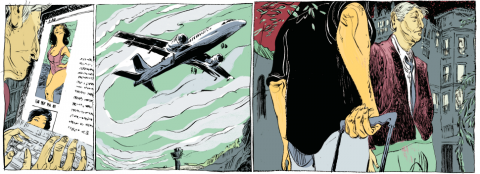 From the annals of Why Smart People Do Dumb Things: The New York Times has a long piece on Paul Frampton, a theoretical physicist at the University of North Carolina-Chapel Hill, who meets a Czech model online, then, rather gullibly, travels to South America to get to know her in person. Instead of finding love in La Paz, Frampton winds up in a dilapidated Buenos Aires prison. It’s a bizarre tale, a story of hubris, naivete, lust, and deception all rolled into one. Grab a coffee, set aside some time, and have a read.
Find us on Facebook, Twitter and Google Plus and we’ll deliver our posts right to your virtual doorstep. Or sign up for our Daily Email!
Read More...Physical Attraction: Marriage Proposal Comes in the Form of a Physics Paper
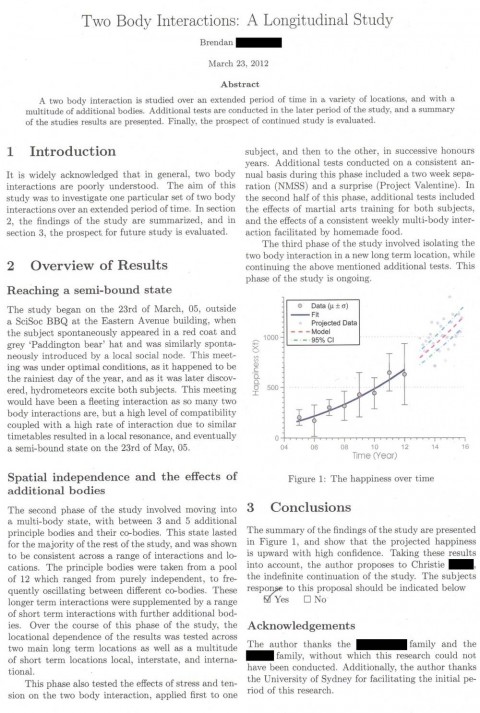
On reddit, a user wrote yesterday, “My boyfriend of 7 years and I are both physicists. Here’s how he proposed to me.” Yes, the marriage proposal is a physics paper of sorts, called “Two Body Interactions: A Longitudinal Study,” that concludes:
The summary of the findings of the study are presented in Figure 1 and that that the project happiness is upward with high confidence. Taking these results into account, the author proposes to Christie the indefinite continuation of the study. The subjects response to their proposal should be indicated below [by checking the “Yes” or “No” box].
Brendan McMonigal and Christie Nelan (pictured here) met at the University of Sydney seven years ago. They will tie the knot this coming May, and we hope you’ll wish them the best.…
via BoingBoing and @stevesilberman
Read More...Édith Piaf’s Moving Performance of ‘La Vie en Rose’ on French TV, 1954
Édith Piaf’s life was anything but rosy. Born in a Parisian slum, she was abandoned by her mother and lived for awhile in a brothel run by her grandmother. As a teenager she sang on the streets for money. She was addicted to alcohol and drugs for much of her life, and her later years were marred by chronic pain. Through it all, Piaf managed to hold onto a basically optimistic view of life. She sang with a lyrical abandon that seemed to transcend the pain and sorrow of living.
On April 3, 1954 Piaf was the guest of honor on the French TV show La Joie de Vivre. She was 38 years old but looked much older. She had recently undergone a grueling series of “aversion therapy” treatments for alcoholism, and was by that time in the habit of taking morphine before going onstage. Cortisone treatments for arthritis made the usually wire-thin singer look puffy. But when Piaf launches into her signature song, “La Vie en Rose” (see above), all of that is left behind.
Nine years after this performance, when Piaf died, her friend Jean Cocteau said of her: “Like all those who live on courage, she didn’t think about death–she defied it. Only her voice remains, that splendid voice like black velvet.”
Follow Open Culture on Facebook and Twitter and share intelligent media with your friends. Or better yet, sign up for our daily email and get a daily dose of Open Culture in your inbox. And if you want to make sure that our posts definitely appear in your Facebook newsfeed, just follow these simple steps.
Read More...Alain de Botton Presents Ten Virtues for the Modern Day
At the end of my college years, I found I needed to take one final political science course to complete my major. I chose a small summer session on the subject of virtue. Having enrolled with no idea what to expect, I finished the quarter less changed by the assigned readings and classroom discussions than by the very — and very unusual — task of having to think about virtue at all. Jokes about the distance of virtue from modern college students’ minds write themselves, but Alain de Botton, a man given to much thought and writing about such lost topics, suspects that the same condition afflicts all of us. Hence his introducing, under the banner of his institution The School of Life, the Virtues Project. It emerges into an unreceptive environment. As de Botton puts it in this introductory post, “In the modern world, the idea of trying to be a ‘good person’ conjures up all sorts of negative associations: of piety, solemnity, bloodlessness and sexual renunciation, as if goodness were something one would try to embrace only when other more difficult but more fulfilling avenues had been exhausted.”
“Throughout history,” he continues, “societies have been interested in fostering virtues, in training us to be more virtuous, but we’re one of the first generations to have zero public interest in this.” In order to bring that number up, de Botton and The School of Life have enumerated ten simple but universal virtues — resilience, empathy, patience, sacrifice, politeness, humor, self-awareness, forgiveness, hope, and confidence — and embedded them in a manifesto, of which you can download a handsome PDF version. This provides the foundational text of the Virtues Project, a component of de Botton’s larger mission, laid out in his recent book Religion for Atheists, to repurpose for modern society the elements of faith that have demonstrated practical value throughout history. Since my adult life, which effectively began as that last poli-sci course ended, has chiefly presented the challenge of winning and maintaining my own self-respect, I’ll be committing these ten virtues to memory, and no doubt watching for the Virtues Project’s lectures and public events to come.
Related content:
Alain de Botton Wants a Religion for Atheists: Introducing Atheism 2.0
Socrates on TV, Courtesy of Alain de Botton (2000)
Alain de Botton Proposes a Kinder, Gentler Philosophy of Success
Colin Marshall hosts and produces Notebook on Cities and Culture and writes essays on literature, film, cities, Asia, and aesthetics. He’s at work on a book about Los Angeles, A Los Angeles Primer. Follow him on Twitter at @colinmarshall.
Read More...Mathemusician Vi Hart Explains the Space-Time Continuum With a Music Box, Bach, and a Möbius Strip
Vi Hart, the Khan Academy’s resident “Recreational Mathemusician” turns the space-time continuum into something that can be played forwards, backwards, upside down, in a circle, and on a Möbius strip.
How you ask?
Music. You know, that stuff that Shakespeare rhapsodized as the food of love?
The fast-talking Hart has way too much to prove in her less than eight minute video to waste time waxing poetic. To her, even the most elusive concepts are explainable, representable. She does manage to create some unintentionally lovely little melodies on a music box that reads holes punched through the notations on a tape printed with a musical stave.
It took several viewings for me to wrap my mind around what exactly was being demonstrated, but I think I’m beginning to grope my way toward whatever dimension she’s currently inhabiting. See if you can follow along and then weigh in as to what you think the mathematically-inclined Bach might be doing in his grave as Hart blithely feeds one of his compositions through her music box, upside down, and backwards.
Related Content:
How a Bach Canon Works. Brilliant.
85,000 Classical Music Scores (and Free MP3s) on the Web
A Big Bach Download – All Bach Organ Works for Free
Ayun Halliday took piano lessons for years. All that remains are the opening bars to Hello Dolly. Follow her @AyunHalliday
Read More...MAKERS Tells the Story of 50 Years of Progress for Women in the U.S.
Among the many thousands of items in my newsfeed yesterday, three popped out and stuck with me: First, a conservative panel called Independent Women’s Forum convened to discuss their sense that “conservative leaders and funders… don’t take women’s issues seriously.” Panel moderator Christina Hoff Sommers joked, “I’m not sure what’s worse: conservatives ignoring women’s issues or conservatives addressing them.” The tone was light, but the sense of frustration these women feel with their male colleagues was very clear.
Secondly, a UK comedian, Michael J. Dolan published a soul-searching piece much discussed stateside in which he admits he was “a misogynist comedian.” Dolan claims that, like racist comedians of old, “Those peddling misogyny, homophobia or other varieties of hate to drunks who don’t know better are going to find themselves out of favour.” And finally, former president Jimmy Carter wrote an editorial to announce that he is severing his six-decade-long ties with the Southern Baptist Convention because of their view that women should be “subservient” to men. “It is simply self-defeating,” wrote Carter, “for any community to discriminate against half its population.”
I mention these examples because they seem to be part of a general trend of cultural reassessment, after several dismally low points in the discussion of gender equality this past year, about the continued institutionalization—in politics, religion, the workplace, and entertainment—of damaging attitudes toward half of the human species. While it sometimes seems that social change takes place at a glacial pace, with several steps back for every step forward, there are always strong undercurrents of progress that aren’t readily apparent until someone takes the time to organize them into narratives.
This is precisely what the filmmakers of MAKERS aim to do. A “multi-platform video experience” from AOL and PBS, the project showcases “hundreds of compelling stories from women of today and tomorrow… both known and unknown.” Unlike worldwide, policy-based efforts like the just-ended 2013 Global Maternal Health Conference, MAKERS restricts its focus to women in the U.S. and, it seems, relies primarily on individual women with prominent public roles—journalists, activists, writers, and celebrities, or at least that’s the sense one gets from their introductory video (above), which might open them up to charges of elitism. But there is more to the project than celebrity profiles. In their own words, the producers of MAKERS describe the project thus:
MAKERS originated from a very clear premise: over the last half century, the work of millions of women has altered virtually every aspect of American culture. MAKERS features groundbreaking women who have sparked change, been first in their fields and paved the way for those that followed. This initiative also extends to profile hundreds of stories of women who are driving social change today.
Delve into the wealth of short documentary videos on the MAKERS YouTube channel and you’ll see that there are dozens of women profiled who aren’t celebrities in the conventional sense. Sure, we’ve got stars of the screen and the power centers of government and the corporate world, e.g. Ellen DeGeneres, Hilary Clinton, and Yahoo CEO Marissa Mayer, but there are also lesser known “makers,” like 15-year-old Tavi Gevinson, founder and editor-in-chief of webzine Rookie. Gevinson is a prodigy who has built her own online media empire, beginning at the age of 11, when her fashion blog Style Rookie became one of the most popular of its kind. Watch her (below) discuss her own approach to typical teenage insecurities in an excerpt from her longer profile.
Another maker with a deeply inspiring story that you won’t hear in the daily news cycle is Katherine Switzer, the first woman to enter the Boston Marathon in 1967. She did so by signing the form with her initials, making marathon officials think she was a man. Below, Switzer recounts the curiosity, bile, and disturbingly violent harassment she faced during the race. It wasn’t until five years later that the race was officially opened to women. By that time, Switzer was an activist for female runners.
The MAKERS project profiles dozens of other women—like civil rights lawyer and founder of Children’s Defense Fund Marian Wright Edelman—who normally fly under the mass-media radar, but whose presence in the culture has an enormous impact. Keep your eye on PBS listings—on February 26th, they will air a three-hour documentary called MAKERS: Women Who Make America, which promises to tell the “remarkable story for the first time” of the sweeping progress American women have made over the last half-century.
Josh Jones is a writer and musician based in Washington, DC. Follow him @jdmagness.
Read More...Richard Ford Reads Raymond Carver’s ‘The Student’s Wife’; One of 14 Podcasts of Famous Writers Reading a Favorite Story
The Guardian recently asked a group of distinguished authors to read one of their favorite short stories. The resulting podcast series began appearing on the newspaper’s Web site last Friday and will continue through the 4th of January. A few of the writers chose widely recognized masterpieces. Many selected more obscure works. So far, there are podcasts of Zadie Smith reading “Umberto Buti” by Giuseppe Pontiggia, Ruth Rendell reading “Canon Alberic’s Scrapbook” by M.R. James, Simon Callow Reading “The Christmas Tree” by Charles Dickens, and Nadine Gordimer reading “The Centaur” by José Saramago.
The American writer Richard Ford (The Sportswriter, Independence Day, Rock Springs) chose to read “The Student’s Wife” by his late friend Raymond Carver. The story was first published in America in 1976, in Carver’s debut short story collection, Will You Please Be Quiet, Please. It exemplifies Carver’s direct, economical style. But don’t make the mistake of calling Carver a “minimalist” around Ford. He describes the story, and the richness of Carver’s writing, in The Guardian:
Its verbal resources are spare, direct, rarely polysyllabic, restrained, intense, never melodramatic, and real-sounding while being obviously literary in intent. (You always know, pleasurably, that you’re reading a made short story.) These affecting qualities led some dunderheads to call his stories “minimalist”, which they are most assuredly not, inasmuch as they’re full-to-the-brim with the stuff of human intimacy, of longing, of barely unearthable humour, of exquisite nuance, of pathos, of unlooked-for dred, and often of love–expressed in words and gestures not frequently associated with love. More than they are minimal, they are replete with the renewings and the fresh awarenesses we go to great literature to find.
You can listen to Ford’s reading of “The Student’s Wife” below, and follow the rest of the stories as they appear through Jan. 4, along with introductions by the authors who selected them, at The Guardian.
Related Content:
The New Yorker’s Fiction Podcast: Where Great Writers Read Stories by Great Writers
Read More...A Year of Grateful Dead Tunes Up in a Mashup
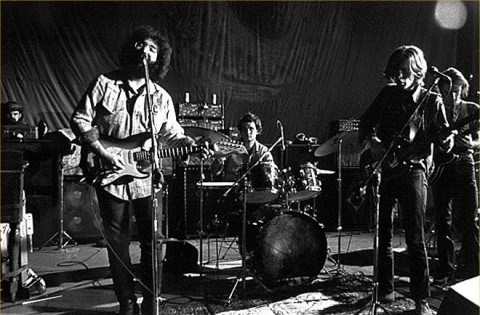
Eventually someone had to do it.
Michael David Murphy created Tuning ’77, a “seamless audio supercut of an entire year of the Grateful Dead tuning their instruments, live on stage.” The mix uses every publicly available recording from 1977, and it’s really all a prelude to this: 8,976 Free Grateful Dead Concert Recordings in the Internet Archive. You can listen to Tuning ’77 here or below. It runs 92 minutes.
via BoingBoing
Read More...Beatboxing Bach’s Goldberg Variations
It might not surpass Glenn Gould’s recording of Bach’s Goldberg Variations from 1981. (Watch him perform it here). But this clip, featuring teenage pianist Kadar Qian and beatbox extraordinaire Kevin Olusola of Pentatonix, has a charm of its own. The clip comes from From the Top, a non-profit whose YouTube channel presents outstanding performances from the country’s best young classical musicians.
If you want your own copy of the Goldberg Variations, you can instantly download The Open Goldberg Variations, the first Kickstarter-funded, open source recording of Bach’s masterpiece. It’s available entirely for free. Also don’t miss the Complete Organ Works of J.S. Bach. They’re free too!
via BoingBoing
Read More...Pier Paolo Pasolini Talks and Reads Poetry with Ezra Pound (1967)
Here’s a collision of cultural figures you don’t see every day: Salo, or the 120 Days of Sodom director Pier Paolo Pasolini sitting down with modernist poet Ezra Pound. Though only eight minutes in length and perhaps not subtitled with ideal fluency, this clip nonetheless hints at the kind of conversation, or conversations, you’d like to have been in the room for. Here Pound and Pasolini discuss the linguistically experimental Italian literary movement “neoavanguardia,” which counted among its adherents Umberto Eco, Edoardo Sanguineti, and Amelia Rosselli. Pasolini, not just a filmmaker but a poet and all-around man of letters himself, would naturally know to bring this subject up, since the group famously looked to Anglophone modernists like Pound himself (as well as T.S. Eliot) for their inspiration.
Pound came to Italy in 1924, by which point he already held expatriate status. Born in 1885 in what we now know as Idaho, he moved to London early in the 20th century. Horrified and devastated by the First World War, he moved to Paris in 1921 before landing in the small Italian town of Rapallo three years later. He there proceeded to tarnish his reputation by endorsing the fascism of Mussolini and even Hitler. Pasolini shows interest not in political questions, but artistic ones: about the avant-garde, about Pound’s beloved 14th- and 15th-century painters, and about his Pisan Cantos. Pasolini actually dons his glasses and performs a reading from that work as Pound gazes on. We then see the 82-year-old poet taking his leave, leaning on his cane, moving haltingly through the rustic Italian countryside that spreads out behind him.
via Biblioklept
Related content:
Ezra Pound’s Fiery 1939 Reading of His Early Poem, ‘Sestina: Altaforte’
Rare Ezra Pound Recordings Now Online
Colin Marshall hosts and produces Notebook on Cities and Culture. Follow him on Twitter at @colinmarshall.
Read More...Support Us
We're hoping to rely on loyal readers, rather than erratic ads. Please click the Donate button and support Open Culture. You can use Paypal, Venmo, Patreon, even Crypto! We thank you!

About Us

Open Culture scours the web for the best educational media. We find the free courses and audio books you need, the language lessons & educational videos you want, and plenty of enlightenment in between.
Advertise With Us
FREE UPDATES!
GET OUR DAILY EMAIL
Get the best cultural and educational resources on the web curated for you in a daily email. We never spam. Unsubscribe at any time.
FOLLOW ON SOCIAL MEDIA
Open Culture editor Dan Colman scours the web for the best educational media. He finds the free courses and audio books you need, the language lessons & movies you want, and plenty of enlightenment in between.
Advertise With Us

