John Cage Plays Amplified Cacti and Plant Materials with a Feather (1984)
On January 1, 1984, 25 million viewers tuned in to watch Good Morning, Mr. Orwell!, a live satellite program created by the Korean-born video artist, Nam June Paik. According to reports in The New York Times, Paik created the program with the hope of proving that television could be “an instrument for international understanding rather than an ominous means of thought control,” as George Orwell warned in 1984. And Paik made his pitch with the help of names you’ll recognize from the 1980s cultural scene (assuming your memory goes back that far) — Peter Gabriel, Laurie Anderson, George Plimpton, Oingo Boingo, Philip Glass, the Thompson Twins, Merce Cunningham and Allen Ginsberg.
Above, we’re featuring one memorable performance from Good Morning, Mr. Orwell!, which aired on PBS stations across the US: the avant-garde composer John Cage playing amplified cacti and plant materials with nothing but a feather. Joined on stage by fellow composer Takehisa Kosugi, Cage performs an improvisation that could have accompanied a Merce Cunningham dance. Meanwhile, George Plimpton, a founder of The Paris Review and the host of Good Morning, Mr. Orwell!, provides some narration.
Follow Open Culture on Facebook and Twitter and share intelligent media with your friends. Or better yet, sign up for our daily email and get a daily dose of Open Culture in your inbox. And if you want to make sure that our posts definitely appear in your Facebook newsfeed, just follow these simple steps.
Related Content:
John Cage Unbound: A New Digital Archive Presented by The New York Public Library
John Cage Performs Water Walk on “I’ve Got a Secret” (1960)
Read More...Animations Revive Lost Interviews with David Foster Wallace, Jim Morrison & Dave Brubeck
David Gerlach left a comfortable job working as a TV producer to launch Blank on Blank, a multimedia nonprofit with a simple mission — to curate journalists’ forgotten interviews with cultural icons, and then bring them back to life again, sometimes as animated shorts. You can start enjoying the fruit of Blank on Blank’s labors by watching a series of web animations, recently produced in collaboration with PBS Digital Studios. Above, we’re starting you off with a four-minute animation of David Foster Wallace reflecting on his early tennis days, the perils of perfectionism, and his tendency to be a “grammar nazi” when teaching college students — something we’ve covered here before. The interview originally aired on WNYC’s Leonard Lopate Show in 1996, and you can listen to the conversation in its entirety here.
Next comes some memorable moments with Jim Morrison, the great singer-songwriter, who met with Village Voice writer Howard Smith back in November, 1969. Going into the meeting, Smith sensed that things wouldn’t be easy. He later recalled, “I had a feeling that it was going to be a tough interview. I just kinda had a feeling that … it was going to be tricky, and I said .… if things get really difficult with him, I’m gonna suggest that we arm wrestle.” As you’ll hear, Smith made his great arm-wrestling escape an inevitability when he needled Morrison, suggesting that the singer had put on too much weight. You can see how things played out above, or catch the complete interview here.
Blank on Blank has produced other animated interviews with Bono, Larry King, and surfer Kelly Slater. But we’re going to wind things down with Dave Brubeck recalling how President Eisenhower sent him to Eastern Europe to fight Communism with Jazz. Brubeck related this story at the Litchfield Jazz Festival in 2008.
If you’re looking to rummage through a big archive of lost interviews, I’d encourage you to spend time with the Blank on Blank podcast available on iTunes and rss.
Related Content:
The Nazis’ 10 Control-Freak Rules for Jazz Performers: A Strange List from World War II
Pakistani Musicians Play Amazing Version of Dave Brubeck’s Jazz Classic, “Take Five”
David Foster Wallace’s 1994 Syllabus: How to Teach Serious Literature with Lightweight Books
An Uplifting Musical Surprise for Dave Brubeck in Moscow (1997)
Read More...The Always-NSFW Kevin Smith and Jason Mewes Catch Up in Jay and Silent Bob Get Old Podcast
With 1994’s Clerks, Kevin Smith opened up the floodgates for independently produced, micro-budget, dialogue-intensive, cursing-intensive movies by, for, and about a certain stripe of feckless Generation‑X twentysomething. These pictures showcased more aggressively foulmouthed (but, in their way, more energetic) versions of the overgrown kids and/or stalled adults whose meandering lives Richard Linklater had dramatized in Slacker three years before. (Watch Slacker online here.) Clerks hit when I hadn’t yet grown out of comic book-reading pre-adolescence, though I do remember becoming aware of Smith’s work from an ad on the back of, yes, a comic book. The page advertised Mallrats, Smith’s big-budget Clerks followup; in its corner posed a pair of smirking young longhairs. “Snootchie bootchies,” read an inexplicable voice bubble emanating from the thinner of the two. I had to know: who were those guys? The zeitgeist now recognizes Jay and Silent Bob, the outwardly dumb but startlingly wise drug dealers played by Jason Mewes and Kevin Smith himself, as having stolen Clerks’ show. (You can watch one of their finer moments in Mallrats above.)
Smith used the characters in Mallrats as well, and went on to write them into subsequent movies like Chasing Amy, Dogma, and of course Clerks II and Jay and Silent Bob Strike Back, their presence unifying all these stories into one coherent reality. Cinephiles argue over whether Smith has delivered on his promise as a director, but some fans think the man has found his true voice as a podcaster. Today, on his own podcast network, he hosts a staggering array of shows, including SModcast, SMoviemakers, Hollywood Babble-On, and Fat Man on Batman. Jay and Silent Bob Get Old (Web — iTunes — RSS feed) reunites the 42-year-old Smith and the 38-year-old Mewes for regular conversations about adulthood, fame, and struggles with sobriety (in Mewes’ case) and weight (in Smith’s), always featuring the most vulgar jokes imaginable. If you haven’t caught up with these guys since the nineties, have a listen to their podcast’s so-very-Not-Safe-for-Work first episode above. They’ve even got back into character for Jay and Silent Bob’s Super Groovy Cartoon Movie, which begins its roadshow across North America on April 20.
Related Content:
Watch Free Online: Richard Linklater’s Slacker, the Classic Gen‑X Indie Film
Colin Marshall hosts and produces Notebook on Cities and Culture and writes essays on literature, film, cities, Asia, and aesthetics. He’s at work on a book about Los Angeles, A Los Angeles Primer. Follow him on Twitter at @colinmarshall.
Read More...A View From the Room Where Melville Wrote Moby Dick (Plus a Free Celebrity Reading of the Novel)
 It’s in Pittsfield, Massachusetts, right in the midst of the Berkshires. Needless to say, not a drop of water in sight.
Now that I’ve got your attention, let me give you an update on The Moby Dick Big Read project. Since we highlighted the project last fall, all 135 chapters of the great American novel have been read by celebrities like Tilda Swinton, Stephen Fry, Mary Oliver, and Simon Callow. And now the complete set of audio recordings are online and ready for free download. Get them here: iTunes, Soundcloud, RSS Feed, or the Big Read web site itself.
We start you off with Tilda’s reading of Chapter 1 right below.
Photo above comes to us via @stevesilberman
Read More...Artist Shepard Fairey Curates His Favorite YouTube Videos
In a video for MOCA, the “defining museum of contemporary art” in Los Angeles, Shepard Fairey, the graphic designer and illustrator best known for the Obama Hope poster of 2008, spent a few minutes rapping about the YouTube videos that have inspired him, both personally and professionally. He starts with one we’ve featured here before — Saul Bass’ Pitch for the Redesign of Ma Bell’s Logo. Read all about that fascinating 1969 project here.
Next up comes the 1981 music video for Blondie’s “Rapture” — momentous because it was the first rap video ever aired on MTV and because it features an appearance by graffiti artist Jean-Michel Basquiat, who stepped in for Grandmaster Flash when he inexplicably went MIA.
Now let’s roll George Clinton’s video for “Atomic Dog” (1982), an inspiration to Fairey because it layers 1980s-video game imagery on top of prison scenes, creating a “template for what a lot of gangster rappers would embrace later.” Call it the ur-gangsta rap video.
Finally, Shepard refers to videos by The Sex Pistols, the English punk band formed in 1975. But when it comes to selecting a particular clip, he leaves us hanging. So, given that curating YouTube videos is our everyday gig, hope you don’t mind if we lay some “God Save the Queen” on you. Enjoy.
via Boing Boing
Read More...
Humans of New York: Street Photography as a Celebration of Life
These days any yahoo with a cell phone and access to the Internet fancies him or herself a Henri Cartier-Bresson, Ruth Orkin or Helen Levitt, but true street photography involves more than just being in the right place at the right time. Brandon Stanton, the self-taught creator of the wildly popular Humans of New York blog, has the dedication as well as the eye and the technical mastery. His curiosity and compassion are abundant, but what really sets his work apart is its 21st century immediacy.
Daily, Stanton wanders the streets of New York, approaches strangers and asks if he can take some pictures. A few hours later, those photos light up Facebook, with captions drawn from the brief collaboration between subject and photographer. In short order, each post garners hundreds of likes and comments. Nasty feedback is a rarity. Stanton’s fans seem content to follow his lead, finding much to celebrate in straightforward poses of parents with children, festively attired seniors, and proud oddballs.
Certain interactions beg longer narratives, which Stanton relates in the “Stories” section of his website. These pieces offer character insights, and often document how the photograph came to be.
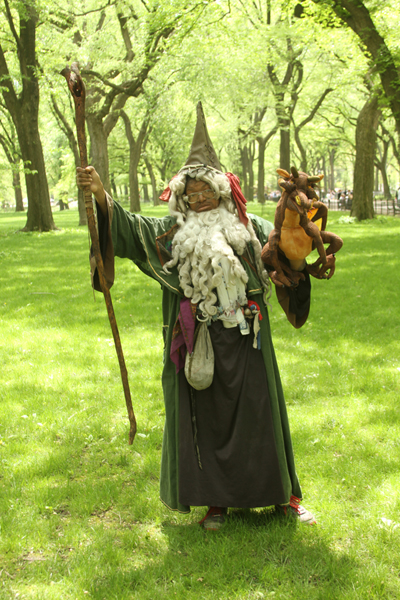
His gift for empathy is best exemplified in his portrait of Black Wolf, The Dragonmaster. I’ve run into this dude everywhere from the Coney Island Mermaid Parade to Central Park, but confess that I found his visual presentation off putting. Unlike me, Stanton looked until he found something universal in the deliberate freakishness.
…we all need to feel important. Not New York important, necessarily, but important. We all need to know that there’s a place in this world that only we can fill. Some people need bigger places than others, but everyone needs a place—a hole in the universe that only they can fill. This need is so deep and food-like and so human that we will do anything to fill it. We’ll go crazy to feel important. A protective, evolutionary sort of crazy. When the body has no food, it will break down muscle to feed itself. When the ego has no food, it will break down the mind to feed itself. If we have no place in this world, we’ll withdraw from this world, and inhabit one where we have a place.
Stanton’s lens provides the import, yielding images so arresting, they stop us in our tracks. Appreciate his collection of extraordinary humans, then challenge yourself to notice such specimens in the wild on a daily basis.
Related Content:
Stanley Kubrick’s Jazz Photography and The Film He Almost Made About Jazz Under Nazi Rule
Ayun Halliday hopes every Glamour Don’t will someday find herself a Human of New York. Follow her @AyunHalliday
Read More...MOOC Interrupted: Top 10 Reasons Our Readers Didn’t Finish a Massive Open Online Course
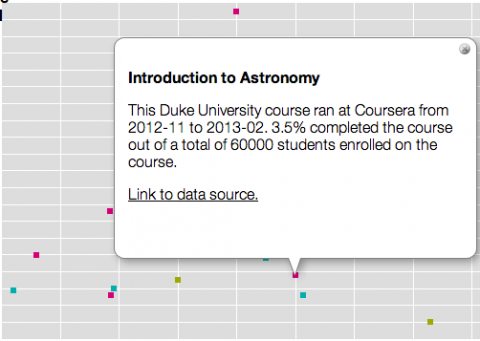
On Tuesday, we gave you a Visualization of the Big Problem for MOOCs, which comes down to this: low completion rates. To be clear, the completion rates aren’t so much a problem for you; they’re more a problem for the MOOC providers and their business models. But let’s not get bogged down in that. We ended our post by asking you to share your own experience with MOOCs — particularly, to tell us why you started and stopped a MOOC. We got close to 50 thoughtful responses. And below we’ve summarized the 10 most commonly-cited reasons. Here they are:
1.) Takes Too Much Time: Sometimes you enroll in a MOOC, only to discover that it takes way too much time. “Just didn’t have time to do all the work.” “As a full-time working adult, I found it exceedingly difficult to watch hours upon hours of video lectures.” That’s a refrain we heard again and again.
2.) Assumes Too Much Knowledge: Other times you enroll in a MOOC, only to find that it requires too much base knowledge, like a knowledge of advanced mathematics. That makes the course an instant non-starter. So you opt out. Simple as that.
3.) Too Basic, Not Really at the Level of Stanford, Oxford and MIT: On the flip side, some say that their MOOCs weren’t really operating on a serious university level. The coursework was too easy, the workload and assignments weren’t high enough. A literature course felt more like a glorified book club. In short, the courses weren’t the real university deal.
4.) Lecture Fatigue: MOOCs often rely on formal video lectures, which, for many of you, is an“obsolete and inefficient format.” And they’re just sometimes boring. MOOCs would be better served if they relied more heavily on interactive forms of pedagogy. Val put it well when she said, “We should not try to bring a brick and mortar lecture to your living room. Use the resources available and make the learning engaging with shorter segments.… The goal should be to teach and teach better. If one of these online universities can figure that out, then the money will follow.”
5.) Poor Course Design: You signed up for a MOOC and didn’t know how to get going. One student related his experience: “From day one I had no idea what I was supposed to do. There were instructions all over the place. Groups to join with phantom members that never commented or interacted, and a syllabus that was being revised as the course went through it’s first week.”
6.) Clunky Community/Communication Tools: This has been the Achilles’ heel of online learning for years, and so far the MOOCs haven’t quite figured it out. It’s not unusual to hear this kind of comment from students: “I find that the discussion forums aren’t very useful or engaging. They are not a very good substitute for active in-class discussion.”
7.) Bad Peer Review & Trolls: Because MOOCs are so big, you often don’t get feedback from the professor. Instead you get it from algorithms and peers. And sometimes the peers can be less than constructive. One reader writes: “I chose to stop doing the peer response section of the class due to some students being treated rudely [by other students]; in fact, the entire peer response section of the class is done in a way I would NEVER have asked of students in a classroom.… [T]here is no involvement of the professor or TA’s in monitoring the TORRENT of complaints about peer reviews.”
8.) Surprised by Hidden Costs: Sometimes you discover that free MOOCs aren’t exactly free. They have hidden costs. Brooke dropped her MOOC when she realized that the readings were from the professor’s expensive textbook.
9.) You’re Just Shopping Around: You shop for courses, which involves registering for many courses, keeping some, and dropping others. That inflates the low completion rate, but it gives you freedom. As one reader said, “I am very, very happy about being able to be so picky.”
10.) You’re There to Learn, Not for the Credential at the End: Sometimes you do everything (watch the videos, do the readings, etc.) but take the final exam. In a certain way, you’re auditing, which suits many of you just fine. It’s precisely what you want to do. But that, too, makes the low completion rates look worse than they maybe are.
Thanks to everyone who took the time to participate. We really appreciate it! And if you’re looking for a new MOOC, don’t miss our list, 300 Free MOOCs from Great Universities (Many Offering Certificates).
Read More...Rock and Roll Heart, 1998 Documentary Retraces the Remarkable Career of Lou Reed
From the album that launched a million bands to possibly the worst rap song of all time—from perfect, career-reviving collaborations to abysmal career-killing ones—Lou Reed’s rock and roll run has seen its share of highs and rock-bottom lows. Reed warrants comparison with Neil Young for his longevity, hit-and-miss prolific output, and gadfly ability to flit from project to project, sound to sound, while still sounding distinctively himself. And like Young, there are too many phases, too many albums, great and terrible, to really do the life’s work justice in any one retrospective.
But the 1998 documentary above, from the PBS American Master’s series, makes an admirable attempt. Called Rock and Roll Heart after Reed’s 1976 album and single of the same name, the film lets Reed tell much of his own story: his teenage years as a devotee of 50s rock and doo wop, his college-days association with poet Delmore Schwartz, episodes in his life that very much came to define his art, which marries a finely-tuned literary sensibility to the simplicity and tunefulness of classic rock and roll. Reed’s warped, lyrical takes on streetlife psychodrama and his love for drone notes and feedback, however, took rock songwriting places it had never been before. At the opening of the film, Reed delivers an epigrammatic gem about himself: “I disliked groups, disliked authority. Uh… I was made for rock and roll.”
Reed’s dislike of groups translates throughout his career into a reputation for difficulty that sent collaborators running from him, either because he fired them (as he most famously did to the brilliant John Cale) or because they’d had enough of his egotism. Nonetheless, many of those same people—Cale included—came back to work with Reed again. Cale shows up above, telling stories of the genesis of The Velvet Underground—of him and Reed playing “Waiting for the Man” and “Heroin” on a Harlem streetcorner on viola and acoustic guitar. Other confreres of Reed’s genius also appear in interviews: Velvet’s drummer Maureen Tucker, David Bowie, Patti Smith, Jim Carroll, Philip Glass, and of course the man Reed credits most for his success, Andy Warhol, in archival footage from 1966.
The love/hate pairing of The Velvets and Nico gets an airing, and there’s loads of film of Lou performing, but at 73 minutes, Rock and Roll Heart feels a little thin, and its tone is almost entirely celebratory, eliding the musical low points (like the stab at rap) and ending with Reed’s forays into theater with Time Rocker. But these are forgivable flaws. There’s no way to cover all the ground Reed’s broken (he’s released an album roughly every year since 1972). And at 71 (if he can recover from that Metallica mash-up), he’s still at it—as he says in an interview above, until he dies.
Related Content:
Philip Glass & Lou Reed at Occupy Lincoln Center: An Artful View
Andy Warhol Quits Painting, Manages The Velvet Underground (1965)
Josh Jones is a writer, editor, and musician based in Washington, DC. Follow him @jdmagness
Read More...Creative Commons Announces “School of Open” with Courses to Focus on Digital Openness
Just in time to celebrate Open Education Week, here comes a new initiative, the School of Open, a learning environment focused on increasing our understanding of “openness” and the benefits it brings to creativity and education in the digital age.
Developed by the collaborative education platform Peer to Peer University (P2PU) with organizational support from Creative Commons, the School of Open aims to spread understanding of the power of this brave new world through free online classes.
We hear about it all the time: Universal access to research, education and culture—all good things, without a doubt—made possible by things like open source software, open educational resources and the like.
But what are these various communities and what do they mean? How can we all learn more and get involved?
School of Open has rolled the conversation back to square one so that understanding the basics is easy. Through a list of new courses created by users and experts, people can learn more about what “openness” means and how to apply it. There are stand-alone courses on copyright, writing for Wikipedia, the collaborative environment of open science, and the process behind making open video.
These free courses start March 18 (sign up by clicking the “start course” button by Sunday, March 17):
- Copyright 4 Educators (US)
- Copyright 4 Educators (AUS)
- Creative Commons for K‑12 Educators
- Writing Wikipedia Articles: The Basics and Beyond
These free courses are open for you to take at any time:
- Get a CC license. Put it on your website
- Open Science: An Introduction
- Open data for GLAMs
- Intro to Openness in Education
- A Look at Open Video
- Contributing to Wikimedia Commons
- Open Detective
The approach at P2PU encourages people to work together, assess one another’s work, and provide constructive feedback. It’s a great place to learn how to design your own course, because the design process is broken down step-by-step, and course content is vetted by users and P2PU staff. The tutorial shows you how the process works.
P2PU is also a place to learn more about what is open content and what is not. Participants in the ongoing course Open Detective learn to identify open source media and then demonstrate mastery by making something of their own using only open content. What if you’re really, really proud of the resource you create in Open Detective? Take it to the next level and get a Creative Commons license to make your work available without giving up full copyright. You guessed it, there’s a course for that too.
Open Education Week is in full swing (through Monday the 18th). There’s a full schedule of webinars to check out, including discussions about the implications of open access for political structures like the World Bank, and the impact of open, global teaching in Syria.
Related Content:
Total Noob to Learning Online? P2PU’s Peer-to-Peer Courses Hold Your Hand
A Meta List of MOOCs
What Entered the Public Domain in 2013? Zip, Nada, Zilch!
Noam Chomsky Spells Out the Purpose of Education
Kate Rix writes about digital media and education. Visit her website at .
Read More...Pixar’s 22 Rules of Storytelling
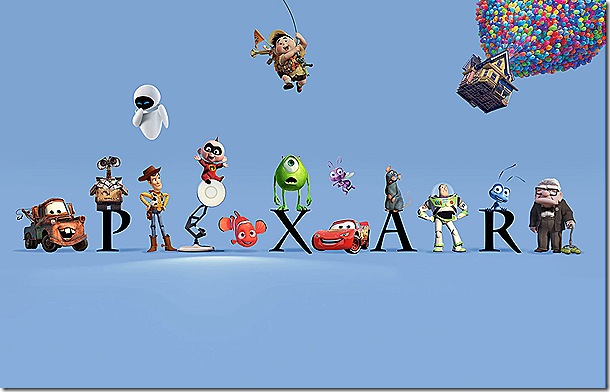
Everyone from Kurt Vonnegut to Ernest Hemingway has shared his ideas on crafting solid narrative writing. One of the most recent sages to join the canon is Emma Coates, Pixar’s former story artist. Her list of the 22 Rules of Good Storytelling gleaned on the job has been gaining Internet traction since it was published last June.
Twenty two? That’s twenty more than Tolstoy. I know some people enjoy a lot of direction, but those of us who relish bushwhacking start to chafe when the road is that heavily signposted.
By all means, sample Coates’ Pixar 22 (see them all below). Apply any and all that work for you, though don’t get your hopes up if your ultimate goal is to sell a story to Dreamworks or Disney. They’ve got formulas of their own.
As for myself, I am repurposing #4 — the only rule that doesn’t contain an implied order or some derivative of “you” — as an extremely jolly parlor game.
Here it is in its original form:
Once upon a time there was ___. Every day, ___. One day ___. Because of that, ___. Because of that, ___. Until finally ___.
While it’s entirely possible to fill in those blanks with the fruits of your own imagination, it’s a true joy to subject one’s most cherished literary, cinematic, and dramatic works to this retroactive Mad Lib. (It works pretty well with established religions too, but I’m not here to tread on the faithful’s toes.)
Warning: there are some major spoilers below. Now that that’s out of the way, let the guessing begin!
Once upon a time there was a poor family in Oklahoma. Every day, they tried to make it work on their hardscrabble farm. One day their last speck of top soil blew away. Because of that, they decided to seek a better life in California. Because of that, every able bodied young male left the family. Until finally their oldest daughter ends up breastfeeding a starving stranger.
How about this?
Once upon a time there was a poor young soldier. Every day, he dreamed of rising above his station. One day he met a beautiful rich girl named Daisy. Because of that, he bought a mansion where he threw enormous parties. Because of that, he hooked back up with Daisy. Until finally, he gets shot to death in his pool.
There’s no denying that it fits this one like a glove:
Once upon a time there was a kid. Every day, he played with his cowboy doll. One day he got a spaceman doll. Because of that, his interest in the cowboy took a serious nosedive. Because of that, the cowboy and the spaceman each swore vengeance upon the other’s house. Until finally there’s a bloodbath from which no one emerges unscathed.
I could keep go on forever, but I don’t want to come off as a toy hog. Instead, I invite you to share your filled out Number Fours in the comments section…or tell us which of the other twenty-one seem most suited to its intended purpose.
Pixar’s 22 Rules for Storytelling
#1: You admire a character for trying more than for their successes.
#2: You gotta keep in mind what’s interesting to you as an audience, not what’s fun to do as a writer. They can be v. different.
#3: Trying for theme is important, but you won’t see what the story is actually about til you’re at the end of it. Now rewrite.
#4: Once upon a time there was ___. Every day, ___. One day ___. Because of that, ___. Because of that, ___. Until finally ___.
#5: Simplify. Focus. Combine characters. Hop over detours. You’ll feel like you’re losing valuable stuff but it sets you free.
#6: What is your character good at, comfortable with? Throw the polar opposite at them. Challenge them. How do they deal?
#7: Come up with your ending before you figure out your middle. Seriously. Endings are hard, get yours working up front.
#8: Finish your story, let go even if it’s not perfect. In an ideal world you have both, but move on. Do better next time.
#9: When you’re stuck, make a list of what WOULDN’T happen next. Lots of times the material to get you unstuck will show up.
#10: Pull apart the stories you like. What you like in them is a part of you; you’ve got to recognize it before you can use it.
#11: Putting it on paper lets you start fixing it. If it stays in your head, a perfect idea, you’ll never share it with anyone.
#12: Discount the 1st thing that comes to mind. And the 2nd, 3rd, 4th, 5th – get the obvious out of the way. Surprise yourself.
#13: Give your characters opinions. Passive/malleable might seem likable to you as you write, but it’s poison to the audience.
#14: Why must you tell THIS story? What’s the belief burning within you that your story feeds off of? That’s the heart of it.
#15: If you were your character, in this situation, how would you feel? Honesty lends credibility to unbelievable situations.
#16: What are the stakes? Give us reason to root for the character. What happens if they don’t succeed? Stack the odds against.
#17: No work is ever wasted. If it’s not working, let go and move on — it’ll come back around to be useful later.
#18: You have to know yourself: the difference between doing your best & fussing. Story is testing, not refining.
#19: Coincidences to get characters into trouble are great; coincidences to get them out of it are cheating.
#20: Exercise: take the building blocks of a movie you dislike. How d’you rearrange them into what you DO like?
#21: You gotta identify with your situation/characters, can’t just write ‘cool’. What would make YOU act that way?
#22: What’s the essence of your story? Most economical telling of it? If you know that, you can build out from there.
via BoingBoing
- Ayun Halliday was not raised to question authority.
Read More...Support Us
We're hoping to rely on loyal readers, rather than erratic ads. Please click the Donate button and support Open Culture. You can use Paypal, Venmo, Patreon, even Crypto! We thank you!

About Us

Open Culture scours the web for the best educational media. We find the free courses and audio books you need, the language lessons & educational videos you want, and plenty of enlightenment in between.
Advertise With Us
FREE UPDATES!
GET OUR DAILY EMAIL
Get the best cultural and educational resources on the web curated for you in a daily email. We never spam. Unsubscribe at any time.
FOLLOW ON SOCIAL MEDIA
Open Culture editor Dan Colman scours the web for the best educational media. He finds the free courses and audio books you need, the language lessons & movies you want, and plenty of enlightenment in between.
Advertise With Us


