After a Tour of Slavoj Žižek’s Pad, You’ll Never See Interior Design in the Same Way
How to react to celebrity academic Slavoj Žižek? You could see him as a wild-eyed visionary and grow infatuated with his powerful-sounding ideas about power, violence, cinema, psychoanalysis, and perversion. Or you could see him as a Pied Piper for delusional graduate students and grow enraged at his perpetuation of fashionable nonsense. But you’d do best, I would argue, to take him simply as a source of entertainment. How could you do otherwise, watching the above clip from Astra Taylor’s documentary Žižek! (previously featured on Open Culture here)? In these three minutes, the sweating Sublime Object of Ideology author gives us a tour of his pad, spending much time and excitement on his kitchen repurposed as a closet: clothes and sheets in the cupboards, socks in the drawers. “I am a narcissist. I keep everything,” he pronounces, having moved onto the shelves and shelves of his own work, from the pamphlets of his “dissident days” to his latest books in Japanese translation.
But it’s his poster of Josef Stalin that really draws your attention — just as Žižek meant it to. If he didn’t, he wouldn’t have hung it in his entryway, making it the first sight every guest gets of his home. Here he describes it not as a proclamation of Stalinism, exactly, but as — in line with everything else he does — a provocation. “This is just for people who come to be shocked and hopefully to get out,” he explains. “My big worry is not to be ignored, but to be accepted. Of course, it’s not that I’m simply a Stalinist. That would be crazy, tasteless, and so on. But obviously there is something in it that it’s not simply a joke. When I say the only change is that the left appropriates fascism and so on, it’s not a cheap joke. The point is to avoid the trap of standard liberal oppositions: freedom versus totalitarian order, and so on, to rehabilitate notions of discipline, collective order, subordination, sacrifice, all that. I don’t think this is inherently fascist.”
via Biblioklept
Related content:
Žižek!: 2005 Documentary Reveals the “Academic Rock Star” and “Monster” of a Man
Examined Life Drops Academic Celebrities Into the Real World (2008)
Derrida: A 2002 Documentary on the Abstract Philosopher and the Everyday Man
Colin Marshall hosts and produces Notebook on Cities and Culture. Follow him on Twitter at @colinmarshall.
Read More...Noam Chomsky Spells Out the Purpose of Education
E + ducere: “To lead or draw out.” The etymological Latin roots of “education.” According to a former Jesuit professor of mine, the fundamental sense of the word is to draw others out of “darkness,” into a “more magnanimous view” (he’d say, his arms spread wide). As inspirational as this speech was to a seminar group of budding higher educators, it failed to specify the means by which this might be done, or the reason. Lacking a Jesuit sense of mission, I had to figure out for myself what the “darkness” was, what to lead people towards, and why. It turned out to be simpler than I thought, in some respects, since I concluded that it wasn’t my job to decide these things, but rather to present points of view, a collection of methods—an intellectual toolkit, so to speak—and an enthusiastic model. Then get out of the way. That’s all an educator can, and should do, in my humble opinion. Anything more is not education, it’s indoctrination. Seemed simple enough to me at first. If only it were so. Few things, in fact, are more contentious (Google the term “assault on education,” for example).
What is the difference between education and indoctrination? This debate rages back hundreds, thousands, of years, and will rage thousands more into the future. Every major philosopher has had one answer or another, from Plato to Locke, Hegel and Rousseau to Dewey. Continuing in that venerable tradition, linguist, political activist, and academic generalist extraordinaire Noam Chomsky, one of our most consistently compelling public intellectuals, has a lot to say in the video above and elsewhere about education.
First, Chomsky defines his view of education in an Enlightenment sense, in which the “highest goal in life is to inquire and create. The purpose of education from that point of view is just to help people to learn on their own. It’s you the learner who is going to achieve in the course of education and it’s really up to you to determine how you’re going to master and use it.” An essential part of this kind of education is fostering the impulse to challenge authority, think critically, and create alternatives to well-worn models. This is the pedagogy I ended up adopting, and as a college instructor in the humanities, it’s one I rarely have to justify.
Chomsky defines the opposing concept of education as indoctrination, under which he subsumes vocational training, perhaps the most benign form. Under this model, “People have the idea that, from childhood, young people have to be placed into a framework where they’re going to follow orders. This is often quite explicit.” (One of the entries in the Oxford English Dictionary defines education as “the training of an animal,” a sense perhaps not too distinct from what Chomsky means). For Chomsky, this model of education imposes “a debt which traps students, young people, into a life of conformity. That’s the exact opposite of what traditionally comes out of the Enlightenment.” In the contest between these two definitions—Athens vs. Sparta, one might say—is the question that plagues educational reformers at the primary and secondary levels: “Do you train for passing tests or do you train for creative inquiry?”
Chomsky goes on to discuss the technological changes in education occurring now, the focus of innumerable discussions and debates about not only the purpose of education, but also the proper methods (a subject this site is deeply invested in), including the current unease over the shift to online over traditional classroom ed or the value of a traditional degree versus a certificate. Chomsky’s view is that technology is “basically neutral,” like a hammer that can build a house or “crush someone’s skull.” The difference is the frame of reference under which one uses the tool. Again, massively contentious subject, and too much to cover here, but I’ll let Chomsky explain. Whatever you think of his politics, his erudition and experience as a researcher and educator make his views on the subject well worth considering.
Josh Jones is a doctoral candidate in English at Fordham University and a co-founder and former managing editor of Guernica / A Magazine of Arts and Politics.
Read More...Marilyn Monroe Reads Joyce’s Ulysses at the Playground (1955)
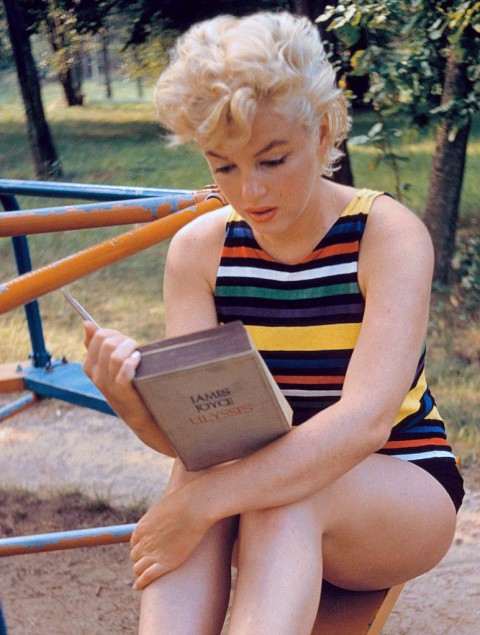 During the 1950s, the pioneering photojournalist Eve Arnold took a series of portraits of Marilyn Monroe. The now iconic photos generally present Monroe as a larger-than-life celebrity and sex symbol. Except for one. In 1955, Arnold photographed Monroe reading a worn copy of James Joyce’s modernist classic, Ulysses. It’s still debated whether this was simply an attempt to recast her image (she often played the “dumb blonde” character in her ’50s films), or whether she actually had a pensive side. (Her personal library, catalogued at the time of her death, suggests the latter.) But, either way, Arnold explained years later how this memorable photo came about:
We worked on a beach on Long Island. She was visiting Norman Rosten the poet.… I asked her what she was reading when I went to pick her up (I was trying to get an idea of how she spent her time). She said she kept Ulysses in her car and had been reading it for a long time. She said she loved the sound of it and would read it aloud to herself to try to make sense of it — but she found it hard going. She couldn’t read it consecutively. When we stopped at a local playground to photograph she got out the book and started to read while I loaded the film. So, of course, I photographed her. It was always a collaborative effort of photographer and subject where she was concerned — but almost more her input.
You can find more images of Marilyn reading Joyce over at The Retronaut. Of course, you can download your own copy of Ulysses from our Free Ebooks collection. But we’d recommend spending time with this finely-read audio version, which otherwise appears in our list of Free Audio Books.
Related Content:
The 430 Books in Marilyn Monroe’s Library: How Many Have You Read?
Stephen Fry Explains His Love for James Joyce’s Ulysses
Henri Matisse Illustrates 1935 Edition of James Joyce’s Ulysses
Read More...Carnegie Mellon Takes Online Courses to Another Level with Its Open Learning Initiative
Open online courses—massive or otherwise—are revolutionizing higher education by making learning more and more accessible.
Carnegie Mellon University has taken online courses to another level, offering virtual classroom environments based on deep research into how adults learn.
The courses are free. Carnegie Mellon’s Open Learning Initiative currently offers 15 courses through a platform that provides targeted progress feedback to students.
The program doesn’t offer course credit or certificates but the courses are sophisticated. CMU spent anywhere from $500,000 to $1 million for each course to write the software, which includes a course builder program for instructors and a system of feedback loops that send student learning data to the instructor, the student and the course design team.
More than 10,000 students enrolled in OLI courses last year. So far CMU promotes OLI courses as supplementary to traditional classroom instruction. But the courses are certainly rich enough to be enjoyed by anyone. They’re mostly in the sciences but include a few language and social science classes too.
The list of currently-available courses appears below. We also have them listed in our complete list of Massive Open Online Courses from Great Universities (many of which happen to offer certificates too):
- American English Speech
- Anatomy and Physiology
- Argument Diagramming
- Biochemistry
- Elementary French 1
- Elementary French 2
- Engineering Statics
- Introduction to Biology
- Introduction to Chemistry
- Introduction to Psychology
- Logic and Proofs
- Media Programming
- Modern Biology
- Probability and Statistics
- Statistical Reasoning
Kate Rix writes about digital media and education. Read more of her work on thenifty.blogspot.com and .
Read More...Watch Nosferatu, the Seminal Vampire Film, Free Online (1922)
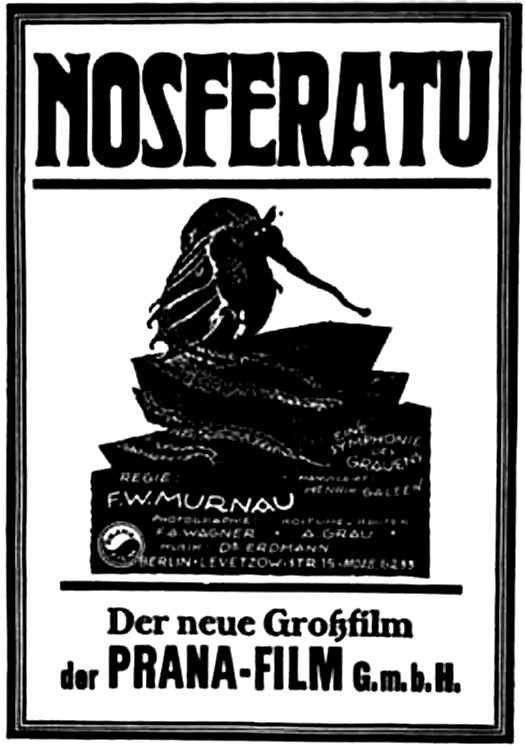
What, you haven’t seen Nosferatu yet? But you’re in luck: not only do you still have a few days left to fit this seminal classic of vampiric cinema into your Halloween viewing rotation, but when the 31st comes, you can watch it free online yet again. An inspiration for countless vampire films that would follow over the next ninety years, F.W. Murnau’s 1922 silent feature adapts Bram Stoker’s Dracula, but just loosely enough so that it could put its own stamp on the myth and not actually have to pay for rights to the novel. Jonathan and Mina Harker? Now Thomas and Ellen Hutter. Jonathan’s boss Renfield? Now a fellow named Knock. Count Dracula, to whose vast and crumbling estate Renfield sends the hapless Jonathan? Now Count Orlok — and unforgettably so. We can post no more relevant endorsement of Nosferatu’s enduring value than to say that it remains scary, or at least eerie, to this day. I defy any sophisticated modern viewer to spend All Hallows’ eve with this picture and not come away feeling faintly unsettled.
Part of it has to do with sheer age: while some visual effects haven’t held up — get a load of Orlok escaping his coffin in the ship’s cargo hold, employing a technique trusted by every nine-year-old with a video camera — the deeply worn look and feel seems, at moments, to mark the film as coming from a distant past when aristocratic blood-sucking living corpses may as well have existed.
This same process has, over four decades, imbued with a patina of menace every horror film made in the seventies. Fans of the 1979 Werner Herzog-Klaus Kinski collaboration Nosferatu the Vampyre, a companion piece obviously worth viewing in any case, can attest to this. You might also consider incorporating in your Halloween night viewing E. Elias Merhige’s Shadow of the Vampire, a satire of the 1920s film industry’s collision of eccentric old-world craftsmanship and savage commercial buffoonery which imagines Orlok as having been played by a geniune vampire. As for Francis Ford Coppola’s rights-having 1992 adaptation Bram Stoker’s Dracula… well, its chief point of interest is still Gary Oldman’s hairstyle.
You can always find Nosferatu on our list of Great Silent Films, part of our larger collection, 4,000+ Free Movies Online: Great Classics, Indies, Noir, Westerns, Documentaries & More.
Related content:
Fritz Lang’s Metropolis: Uncut & Restored
Where Horror Film Began: The Cabinet of Dr. Caligari
Colin Marshall hosts and produces Notebook on Cities and Culture. Follow him on Twitter at @colinmarshall.
Read More...Watch Historic Footage of Joseph Kittinger’s 102,800 Jump from Space (1960)
When I first heard that 43-year old Austrian daredevil and former military parachutist Felix Baumgartner would be jumping 128,000 feet from space, my immediate reaction was, “What? Why?!” Because why would anyone do that? And I assumed it was all some macho stunt to promote Red Bull, his corporate sponsor, which isn’t entirely unfounded. But I also had no sense of the historic context, the scientific implications, and until I read the details, the truly death-defying magnitude of it all. As I watched the jump and then learned more, my wonder and admiration grew, particularly in reading Baumgartner’s own accounts of his seven years of preparation for the feat.
Baumgartner bested Chuck Yeager on the same day in history that Yeager broke the sound barrier (he says Yeager’s going to be “pissed”). He also broke the record set by Joseph Kittinger, an Air Force pilot who leapt from 102,800 feet (19.5 miles) above earth in 1960. You can watch a short documentary of Kittinger’s famous jump above. The technology of 1960 didn’t allow for the crystal-clear images Baumgartner captured with his two suit cameras, but it’s still an impressive little film, made more so by Kittinger’s voice over describing the sensations he experienced during free fall. Below is a classic 1960 newsreel film of the jump, with a dramatic announcer and triumphal, martial music.
Kittinger and Baumgartner first met in 2008, and the elder test pilot supported and helped plan the Red Bull Stratos project that would break his record. He also served as Baumgartner’s mission control, guiding him from his tiny space capsule to the ground. The jump was apparently supposed to take place two years earlier, on the 50th anniversary of Kittinger’s, but was delayed. Below, you can watch Kittinger discuss the project and his own career in a 2010 interview with Red Bull.
Josh Jones is a doctoral candidate in English at Fordham University and a co-founder and former managing editor of Guernica / A Magazine of Arts and Politics.
Read More...Philosophy Made Fun: Read the Free Preview Edition of the Action Philosophers! Comic
“Imagine Plato as a wrestling superstar of ancient Greece, Nietzsche as the original ubermensch, and Bohidharma as the grand master of kung fu. These are not just great thinkers they also make great comics. Action Philosophers! details the lives and thoughts of history’s A‑list brain trust in hip and humorous comic book fashion. ”
That’s how the Action Philosophers! comic book was pitched when its creators, Fred Van Lente and Ryan Dunlavey, published it in 2009. The comic book is still in print, and you can read the fun preview edition online. It starts, of course, with the Pre-Socratics — Thales, Anaximander, Parmenides, and the gang. Enjoy.
Bonus — Read more Action Philosophers! online:
Related Content:
55 Free Philosophy Courses
Monty Python’s Best Philosophy Sketches
Ancient Greek Punishments: The Retro Video Game
Read More...Learn New Languages (From Arabic to Yiddish) with 150+ Free Podcasts

I spend a great deal of time visiting unfamiliar cities, spending days walking, cycling, or riding trains and buses through them. Sometimes the people of these cities speak languages I know; sometimes they speak languages I don’t. Either way, during all these hours in motion, my personal soundtrack comes from an iPod loaded with language-learning podcasts. If you’d like to engage in this delightfully mentally stimulating practice yourself — and I highly recommend it — you can get started by browsing Open Culture’s collection of Free Language Lessons available online. The list covers no fewer than 40 tongues, and many of the lessons come in podcast form. Should you find yourself in need of shows offering Bulgarian survival phrases, instruction in Swedish expressions and culture, or Polish in one minute a day, here is the list you want. From my efforts in studying Spanish, Korean, and Japanese, I can personally (and strongly) recommend several of its offerings.
Coffee Break Spanish and the more advanced Show Time Spanish, both produced by the Radio Lingua network (out of Scotland, of all places) start you off from an absolute zero of presumed knowledge and proceeds to get you up to “cruising altitude,” which I call the point in language acquisition at which you become able to learn from real, untranslated speech. You might then consider downloading a show like Notes in Spanish, and especially the conversationally focused Notes in Spanish Gold. For Japanese, few language podcasts cater to a wider variety of proficiency levels at once than does JapanesePod101, which I supplement with Japanese national broadcaster NHK’s lessons (which also come taught in quite a few languages besides English.) And for Korean, the language that first cultivated in me this whole intellectually and socially thrilling learning addiction, you can do no better than Hyunwoo Sun’s Talk to Me in Korean, quite possibly the most thorough, frequent, slick, and entertaining language-instruction podcast of any kind. Listening to these shows has convinced me that every moment spent not acquiring a new language is a moment wasted. But even if you don’t believe anything that extreme, it’s still a lot of fun. And doing it through these free podcasts, you certainly can’t argue with the price.
Here’s our collection once again: Learn 40 Languages for Free: Spanish, English, Chinese & More
Related Content:
375 Free eBooks: Download to Kindle, iPad/iPhone & Nook
450 Free Audio Books: Download Great Books for Free
530 Free Online Courses from Top Universities
500 Free Movies Online: Great Classics, Indies, Noir, Westerns, etc.
Colin Marshall hosts and produces Notebook on Cities and Culture. Follow him on Twitter at @colinmarshall.
Read More...Samuel Beckett Directs His Absurdist Play Waiting for Godot (1985)
Samuel Beckett’s absurdist play, Waiting for Godot, premiered in Paris in 1953, at the Théâtre de Babylone, under the direction of French actor, Roger Blin. Many other directors staged the play in the years to come, each time interpreting it in their own way. All the while, Beckett complained that the play was being subjected to “endless misunderstanding.” However, when an actor, Peter Woodthrope, once asked him to explain what Godot is all about, Beckett answered quixotically: “It’s all symbiosis, Peter; it’s symbiosis.” Thanks for the clarification, Sam.
Beckett never gave a clear explanation. But perhaps he offered up something better. In 1985, Beckett directed three of his plays — Waiting for Godot, Krapp’s Last Tape and Endgame — as part of a production called “Beckett Directs Beckett.” The plays performed by the San Quentin Players toured Europe and Asia with much fanfare, and with Beckett exerting directorial control. And do keep this in mind. Beckett paces things slowly. So you won’t hear your first sound until the 2:00 mark.
Follow us on Facebook, Twitter, Google Plus and LinkedIn and share intelligent media with your friends. And if you want to make sure that our posts definitely appear in your Facebook newsfeed, just follow these simple steps.
Read More...The History of Byzantium Podcast Picks Up Where The History of Rome Left Off

In May we posted about Mike Duncan’s The History of Rome podcast, which, upon reaching episode 179, had concluded the tale of the Roman Empire’s heyday. Over its five-year run, Duncan’s show amassed a large, enthusiastic audience, most of whom have no doubt continued their exploration of Roman history elsewhere. It has even inspired some to launch history podcasts of their own, one of which presents itself as The History of Rome’s direct successor in subject, style, and tone. The History of Byzantium (RSS — iTunes), which debuted in May, aims to recount the story of Roman Empire of Late Antiquity and the Middle Ages, now better known as the Byzantine Empire, from the years 476 through 1453. Though perhaps less often discussed by the average history buff, the Byzantine Empire nonetheless offers a wealth of historical interest, especially, it seems, to podcasters; you may already have heard Lars Brownworth’s show 12 Byzantine Rulers, which eventually landed him a book deal. And many more Byzantine stories remain to tell.
Pierson, by day a televison critic, explicitly describes his project as both an unofficial sequel and an homage to The History of Rome. “I liked the simplification and explanation of the Roman story,” he writes in his introductory post. “I liked the half an hour length. I liked Mike’s sense of humour and timing. I liked his neutral tone which never felt like it was providing an overbearing opinion on the narrative. When Mike announced he would be stopping with the fall of the West in 476 I considered whether I could possibly take on the task of continuing the story. [ … ] Initially at least I hope to emulate Mike’s style. I want to keep the rough structure and neutral tone established on The History of Rome because I think so highly of it. I hope you won’t see it as simply an imitation and doubtless over time my own style will emerge.” This seems as honest an account as any of the way creators work off of their inspirations, and History of Rome fans will no doubt listen with interest to The History of Byzantium for both the developments in the tale and in Pierson’s way of telling it.
You can subscribe to The History of Byzantium via RSS or iTunes.
And, all of you history buffs, remember that you can find free courses in the History section of our collection of Free Online Courses from Great Universities.
Related content:
The History of Rome in 179 Podcasts
The Digital Tipping Point: The Wild Ride from Podcast to Book Deal
The Decline and Fall of the Roman (and American?) Empire: A Free Audiobook
Colin Marshall hosts and produces Notebook on Cities and Culture. Follow him on Twitter at @colinmarshall.
Read More...Support Us
We're hoping to rely on loyal readers, rather than erratic ads. Please click the Donate button and support Open Culture. You can use Paypal, Venmo, Patreon, even Crypto! We thank you!

About Us

Open Culture scours the web for the best educational media. We find the free courses and audio books you need, the language lessons & educational videos you want, and plenty of enlightenment in between.
Advertise With Us
FREE UPDATES!
GET OUR DAILY EMAIL
Get the best cultural and educational resources on the web curated for you in a daily email. We never spam. Unsubscribe at any time.
FOLLOW ON SOCIAL MEDIA
Open Culture editor Dan Colman scours the web for the best educational media. He finds the free courses and audio books you need, the language lessons & movies you want, and plenty of enlightenment in between.
Advertise With Us

