Read Joyce’s Ulysses Line by Line, for the Next 22 Years, with Frank Delaney’s Podcast
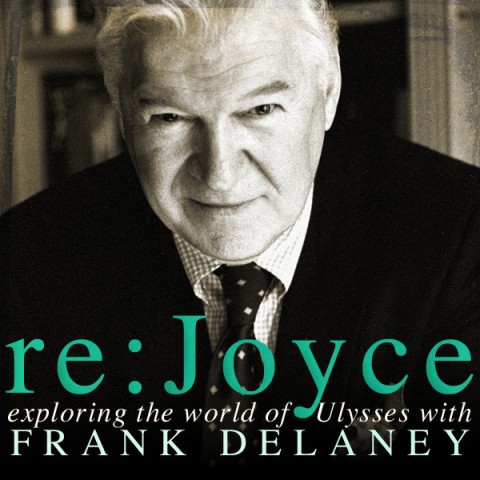
If you need someone to host a multi-decade podcast on James Joyce’s Ulysses, then why settle for less than the most eloquent man in the world? Visit Frank Delaney’s site, and you’ll find it less than shy about proclaiming that National Public Radio once dubbed him just that. A prolific man of letters, Delaney has in his 42-year-long career logged time as a newsreader, book journalist, interviewer, Edinburgh Festival Literature Director, talk show host, Man Booker Prize judge, radio broadcaster, novelist, and historian. In 1981, his book James Joyce’s Odyssey brought his surpassing enthusiasm for Joyce scholarship to public attention, and it took a whole new form on, appropriately enough, Bloomsday 2010, when Delaney added the title of podcaster to his résumé by launching Re: Joyce (iTunes — RSS). The show operates on a simple concept: each Wednesday, Delaney deconstructs a piece of Ulysses, usually for four to fifteen minutes. This will run, so the plan goes, for the next twenty-two years.
An ambitious project, certainly, but I find that podcasting, especially literary podcasting, could always use a little more ambition. “Why?” Delaney asks of the show on its debut episode. “Well, why not? You could say, ‘Why bother?’ And I would say, for the sheer fun of it. Because this is a book that has engrossed and delighted me for most of my adult life, and I know the enjoyment to be had from it. And I also know that such enjoyment has been denied to many, many people who would read Ulysses if they weren’t so daunted by it, and indeed, who tried to read it but had to give up. How do I know this? Because I was one of them.” If this sounds a little like the script of an infomercial, Delaney embraces the sensibility, labeling Re: Joyce his “infomercial for Ulysses.” As far as eloquence — and erudition, not to mention richness of subject matter — he’s certainly surpassed Ron Popeil.
You can download the podcast from iTunes for free or follow the RSS feed here. Copies of Joyce’s Ulysses can be found in our collections of Free eBooks and Free Audio Books. The first episode of Re:Joyce appears below:
Related content:
James Joyce Manuscripts Online, Free Courtesy of The National Library of Ireland
Stephen Fry Explains His Love for James Joyce’s Ulysses
James Joyce’s Ulysses: Download the Free Audio Book
Henri Matisse Illustrates 1935 Edition of James Joyce’s Ulysses
Colin Marshall hosts and produces Notebook on Cities and Culture. Follow him on Twitter at @colinmarshall.
Read More...Philosopher Slavoj Zizek Interprets Hitchcock’s Vertigo in The Pervert’s Guide to Cinema (2006)
Philosopher and psychoanalyst Slavoj Zizek is a polarizing figure, in and out of the Academy. He has been accused of misogyny and opportunism, and a Guardian columnist once wondered if he is “the Borat of philosophy.” The latter epithet might be as much a reference to his occasional boorishness as to his Slovenian-accented English. Despite (or because of) these qualities, Zizek has become a fascinating public intellectual, in part because all of his work is shot through with pop culture references as diffuse as the most studied of fanboys. And even though Zizek, a student of the Freudian theorist Jacques Lacan, can get deeply obscure with the best of his peers, his enthusiasm and rapid-fire free-associations mark him as a true fan of everything he surveys.
The Zizek I just described is fully in evidence in the short clip above from the three-part documentary The Pervert’s Guide to Cinema. Directed by Sophie Fiennes (sister of Joseph and Ralph), The Pervert’s Guide places Zizek in original locations and replica sets of several classic films—David Lynch’s Blue Velvet, Stanley Kubrick’s Eyes Wide Shut, and Hitchcock’s Vertigo, to name just a few. Zizek’s scenes of commentary are edited with scenes from the films to give the impression that he is speaking from within the films themselves. It’s a novel approach and works particularly well in the video above, where Zizek gives us his take on Vertigo. As he says of Hitchcock’s film—which could apply to the one he is in as well—“often things begin as a fake, inauthentic, artificial, but you get caught in your own game.” Viewers of The Pervert’s Guide get caught in Zizek’s interpretive game; it’s a fascinating, ridiculous, and unsettling one.
In the clip, through a series of close analyses of plot points and camera angles, Zizek concludes that Vertigo is the realization of a male fantasy, which necessarily involves violence and nightmarish transformations. In the “male libidinal economy,” he says, in the jargon‑y psychoanalytic speak of his trade, women must be “mortified” before they are acceptable sexual partners. Slipping out of academic argot, he clarifies: “to paraphrase an old saying, the only good woman is a dead woman.” It’s this kind of blunt and utterly unsentimental way of speaking that raises the hackles of some of Zizek’s critics. But I’m not here to defend him. Watching (and reading) him for me is a game of edge-of-your seat “what outrageous or incomprehensible thing is he going to say next?” and I’ll admit, I enjoy it. So I’ll leave you with a final Zizek-ism. Perhaps it will scare you off for good, or perhaps you’re game for a few more rounds of “perversion” with this encyclopedic critic of the self, the social, and the sexual:
“A subject,” says Zizek, “is a partial something, a face, something we see. Behind it, there is a void, a nothingness. And of course, we spontaneously tend to fill in that nothingness with our fantasies about the wealth of human personality and so on, and so on. To see what is lacking in reality, to see it as that, there you see subjectivity. To confront subjectivity means to confront femininity. Woman is the subject. Masculinity is a fake.”
You can watch the film in its entirety here.
via Biblioklept
Related Content:
Žižek!: 2005 Documentary Reveals the “Academic Rock Star” and “Monster” of a Man
Good Capitalist Karma: Zizek Animated
Slavoj Žižek: How the Marx Brothers Embody Freud’s Id, Ego & Super-Ego
Josh Jones is a doctoral candidate in English at Fordham University and a co-founder and former managing editor of Guernica / A Magazine of Arts and Politics.
Read More...The Moby Dick Big Read: Tilda Swinton & Others Read a Chapter a Day from the Great American Novel
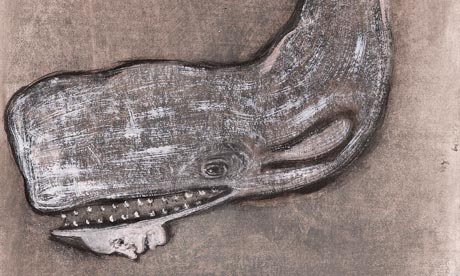
“Moby-Dick is the great American novel. But it is also the great unread American novel. Sprawling, magnificent, deliriously digressive, it stands over and above all other works of fiction, since it is barely a work of fiction itself. Rather, it is an explosive exposition of one man’s investigation into the world of the whale, and the way humans have related to it. Yet it is so much more than that.”
That’s how Plymouth University introduces Herman Melville’s classic tale from 1851. And it’s what sets the stage for their web project launched earlier this week. It’s called The Moby Dick Big Read, and it features celebrities and lesser known figures reading all 135 chapters from Moby Dick — chapters that you can start downloading (as free audio files) on a rolling, daily basis. Find them on iTunes, Soundcloud, RSS Feed, or the Big Read web site itself.
The project started with the first chapters being read by Tilda Swinton (Chapter 1), Captain R.N. Hone (Chapter 2), Nigel Williams (Chapter 3), Caleb Crain (Chapter 4), Musa Okwonga (Chapter 5), and Mary Norris (Chapter 6). John Waters, Stephen Fry, Simon Callow and even Prime Minister David Cameron will read future chapters, which often find themselves accompanied by contemporary artwork inspired by the novel.
If you want to read the novel as you go along, find the text in our collection of Free eBooks. We also have versions read by one narrator in our Free Audio Books collection. Tilda Swinton’s narration of Chapter 1 appears right below:
Read More...The Big List of 530 Free Online Courses from Top Universities (New Additions)
 While you were sunning yourself on the beach this summer — or just taking a nice staycation at home — we were busy tracking down new courses to add to our list of 530 Free Online Courses. Available via YouTube, iTunes or the web, these courses were taped on the campuses of top universities like Stanford, Yale, MIT, Oxford, Harvard and UC Berkeley. They range across diverse disciplines — Philosophy, History, Computer Science, and Physics, to name a few — and you can access them all for free. Below we’re highlighting some of the most recent additions to the big master list, and also throwing in a few interesting bonus picks. Hope you enjoy:
- Aesthetics & Philosophy of Art – iTunes – Web — James Grant, Oxford University
- Contemporary Literature – YouTube – Aysha Iqbal Viswamohan, IIT Madras
- Critical Reasoning for Beginners - iTunes Video – iTunes Audio – Web Video & Audio — Marianne Talbot, Oxford
- Darwin and Design – Web Site – James Paradis, MIT
- Existentialism in Literature and Film — RSS Feed — Sean Dorrance Kelly, Harvard University.
- Exposing Digital Photography – iTunes Video — Web Site — RSS Feed — Dan Armendariz, Harvard
- Life in the Universe – iTunesU – Web – Richard Pogge, Ohio State
- Kant’s Critique of Pure Reason – iTunes Video – iTunes Audio — Video/Audio on Web – Dan Robinson, Oxford
- Philosophy of Religion — iTunes — Web — T. J. Mawson, Oxford
- Science Fiction and Politics — iTunes Audio — Web – Courtney Brown, Emory University
- Shakespeare After All: The Later Plays – Multiple Formats – Marjorie Garber, Harvard
- The Mechanical Universe – PBS Video – Cal Tech
- The History of Western Social Theory – YouTube - Alan MacFarlane, Cambridge University
Bonus — A Few Unconventional Courses:
- Hegel: The Philosophy of History — Web Site — Leo Strauss, U Chicago
- Jack Kerouac – Web 1 and Web 2 – Allen Ginsberg, Naropa University
- Plato’s Apology of Socrates – YouTube – Allan Bloom, UChicago
- The Character of Physical Law – Web — YouTube – Richard Feynman, Cornell
- This Craft of Verse: The Charles Eliot Norton Lectures – Web Audio – Jorge Luis Borges, Harvard
- The Unanswered Question: 6 Lectures on Music - YouTube – Leonard Bernstein, Harvard
Looking for free textbooks? Don’t miss our meta collection of 160 Free Textbooks available on the web.
Read More...Jimi Hendrix Wreaks Havoc on the Lulu Show, Gets Banned From the BBC (1969)
Can you imagine Jimi Hendrix singing a duet with Lulu? Well, neither could Hendrix. So when the iconoclastic guitar player showed up with his band at the BBC studios in London on January 4, 1969 to appear on Happening for Lulu, he was horrified to learn that the show’s producer wanted him to sing with the winsome star of To Sir, With Love. The plan called for The Jimi Hendrix Experience to open their set with “Voodoo Child (Slight Return)” and then play their early hit “Hey Joe,” with Lulu joining Hendrix onstage at the end to sing the final bars with him before segueing into her regular show-closing number. “We cringed,” writes bassist Noel Redding in his memoir, Are You Experienced? The Inside Story of The Jimi Hendrix Experience.
Redding describes the scene that he, Hendrix, and drummer Mitch Mitchell walked into that day as being “so straight it was only natural that we would try to combat that atmosphere by having a smoke in our dressing room.” He continues:
In our haste, the lump of hash got away and slipped down the sink drainpipe. Panic! We just couldn’t do this show straight–Lulu didn’t approve of smoking! She was then married to Maurice Gibb of the Bee Gees, whom I’d visited and shared a smoke with. I could always tell Lulu was due home when Maurice started throwing open all the windows. Anyway, I found a maintenance man and begged tools from him with the story of a lost ring. He was too helpful, offering to dismantle the drain for us. It took ages to dissuade him, but we succeeded in our task and had a great smoke.
When it was time for The Jimi Hendrix Experience to go on camera, they were feeling fairly loose. They tore through “Voodoo Child” and then the program cut to Lulu, who was squeezed awkwardly into a chair next to an audience member in the front row. “That was really hot,” she said. “Yeah. Well ladies and gentlemen, in case you didn’t know, Jimi and the boys won in a big American magazine called Billboard the group of the year.” As Lulu spoke a loud shriek of feedback threw her off balance. Was it an accident? Hendrix, of course, was a pioneer in the intentional use of feedback. A bit flustered, she continued: “And they’re gonna sing for you now the song that absolutely made them in this country, and I’d love to hear them sing it: ‘Hey Joe.’ ”
The band launched into the song, but midway through–before Lulu had a chance to join them onstage–Hendrix signaled to the others to quit playing. “We’d like to stop playing this rubbish,” he said, “and dedicate a song to the Cream, regardless of what kind of group they may be in. We dedicate this to Eric Clapton, Ginger Baker and Jack Bruce.” With that the band veered off into an instrumental version of “Sunshine of Your Love” by the recently disbanded Cream. Noel Redding continues the story:
This was fun for us, but producer Stanley Dorfman didn’t take it at all well as the minutes ticked by on his live show. Short of running onto the set to stop us or pulling the plug, there was nothing he could do. We played past the point where Lulu might have joined us, played through the time for talking at the end, played through Stanley tearing his hair, pointing to his watch and silently screaming at us. We played out the show. Afterwards, Dorfman refused to speak to us but the result is one of the most widely used bits of film we ever did. Certainly, it’s the most relaxed.
The stunt reportedly got Hendrix banned from the BBC–but it made rock and roll history. Years later, Elvis Costello paid homage to Hendrix’s antics when he performed on Saturday Night Live. You can watch The Stunt That Got Elvis Costello Banned From SNL here.
Related content:
‘Electric Church’: The Jimi Hendrix Experience Live in Stockholm, 1969
Read More...Toni Morrison, Nora Ephron, and Dozens More Offer Advice in Free Creative Writing “Master Class”
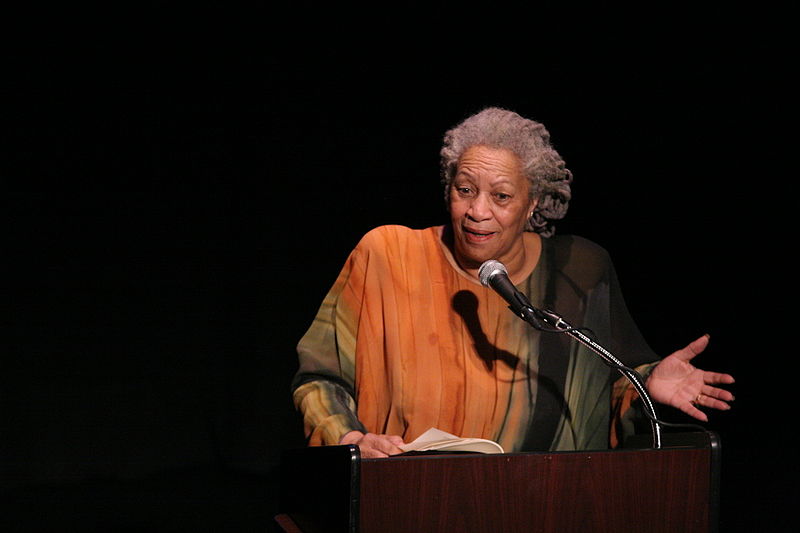
Image by Angela Radulescu, via Wikimedia Commons
If you’re anything like me, you yearn to become a good writer, a better writer, an inspiring writer, even, by learning from the writers you admire. But you neither have the time nor the money for an MFA program or expensive retreats and workshops with famous names. So you read W.H. Auden’s essays and Paris Review interviews with your favorite authors (or at least PR’s Twitter feed); you obsessively trawl the archives of The New York Times’ “Writers on Writing” series, and you relish every Youtube clip, no matter how lo-fi or truncated, of your literary heroes, speaking from beyond the grave, or from behind a podium at the 92nd Street Y.
Well, friend, you are in luck (okay, I’m still talking about me here, but maybe about you, too). The Washington, DC-based non-profit Academy of Achievement—whose mission is to “bring students face-to-face” with leaders in the arts, business, politics, science, and sports—has archived a series of talks from an incredibly diverse pool of poets and writers. They call this collection “Creative Writing: A Master Class,” and you can subscribe to it right now on iTunes and begin downloading free video and audio podcasts from Nora Ephron, John Updike, Toni Morrison, Carlos Fuentes, Norman Mailer, Wallace Stegner, and, well, you know how the list goes.
The Academy of Achievement’s website also features lengthy profiles–with text and downloadable audio and video–of several of the same writers from their “Master Class” series. For example, an interview with former U.S. poet-laureate Rita Dove is illuminating, both for writers and for teachers of writing. Dove talks about the aversion that many people have for poetry as a kind of fear inculcated by clumsy teachers. She explains:
At some point in their life, they’ve been given a poem to interpret and told, “That was the wrong answer.” You know. I think we’ve all gone through that. I went through that. And it’s unfortunate that sometimes in schools — this need to have things quantified and graded — we end up doing this kind of multiple choice approach to something that should be as ambiguous and ever-changing as life itself. So I try to ask them, “Have you ever heard a good joke?” If you’ve ever heard someone tell a joke just right, with the right pacing, then you’re already on the way to the poetry. Because it’s really about using words in very precise ways and also using gesture as it goes through language, not the gesture of your hands, but how language creates a mood. And you know, who can resist a good joke? When they get that far, then they can realize that poetry can also be fun.
Dove’s thoughts on her own life, her work, and the craft of poetry and teaching are well worth reading/watching in full. Another particularly notable interview from the Academy is with another former laureate, poet W.S. Merwin.
Merwin, a two-time Pulitzer Prize winner, discusses poetry as originating with language, and its loss as tantamount to extinction:
When we talk about the extinction of species, I think the endangered species of the arts and of language and all these things are related. I don’t think there is any doubt about that. I think poetry goes back to the invention of language itself. I think one of the big differences between poetry and prose is that prose is about something, it’s got a subject… poetry is about what can’t be said. Why do people turn to poetry when all of a sudden the Twin Towers get hit, or when their marriage breaks up, or when the person they love most in the world drops dead in the same room? Because they can’t say it. They can’t say it at all, and they want something that addresses what can’t be said.
If you’re anything like me, you find these two perspectives on poetry—as akin to jokes, as saying the unsayable—fascinating. These kinds of observations (not mechanical how-to’s, but original thoughts on the process and practice of writing itself) are the reason I pore over interviews and seminars with writers I admire. I found more than enough in this archive to keep me satisfied for months.
We’ve added “Creative Writing: A Master Class” to our ever-growing collection of Free Online Courses.
Image via Angela Radulescu
Josh Jones is a doctoral candidate in English at Fordham University and a co-founder and former managing editor of Guernica / A Magazine of Arts and Politics.
Related Content:
William S. Burroughs Teaches a Free Course on Creative Reading and Writing (1979)
Seven Tips From William Faulkner on How to Write Fiction
Read More...When Asteroids Attack! Neil deGrasse Tyson and NASA Explain How To Stop an Armageddon
If pop culture has taught us non-scientists anything about asteroids, it’s that we should blow them up. From classic video game Asteroids to the Michael Bay disaster classic Armageddon, asteroids are either random bits of floating debris out to destroy us, or massive malignant space tumors hurtling our way to destroy us, which we’re told is how the dinosaurs died out. But, says superstar physicist Neil deGrasse Tyson—in Vice’s short video (above) “Blowing Up Asteroids with NASA and Neil deGrasse Tyson”—“We’re clever enough that we never have to go extinct by an asteroid. We have more choices available to us than Tyrannosaurus Rex did.” Choices like turning an asteroid into space dust? Probably not. Turns out, Armageddon wasn’t entirely scientifically accurate. In fact, NASA shows Michael Bay’s movie to its trainees to see how many scientific absurdities they can find. The record, as of 2007, was at 168.
So what to do! Well, it turns out that the chances of an asteroid colliding with the earth are slim, but still a bit too close for comfort. As Tyson explains above, there is, in fact, an asteroid headed our way, called Apophis, in 2029. If Apophis goes through a region called “the keyhole,” it will impact the earth seven years later. The probability of this occurring as of 2009 is 1 in 250,000. Yikes. Astronaut Mike Gernhardt, a primary investigator at NEEMO (NASA Extreme Environment Mission Operations) is on the case. His team uses underwater simulations in Key Largo, Florida to recreate an asteroid-like environment and explore it, collect samples, etc. in what NASA calls an “Analog Mission.” Just how any of this might prevent an asteroid from destroying the planet escapes me, to be honest (and the “blowing up” part of the video’s title doesn’t ever get an explanation). But the NEEMO project is still pretty cool, as you can witness in an interview with NEEMO Mission Manager Bill Todd below.
The Vice video is part of their Motherboard TV series, which informs us on its site that NEEMO, like everything cool these days, is likely to be defunded. Let’s hope they can figure out how save us from asteroid Armageddon before the money runs out.
via The Atlantic
Josh Jones is a doctoral candidate in English at Fordham University and a co-founder and former managing editor of Guernica / A Magazine of Arts and Politics.
Read More...Russian Punk Band, Sentenced to Two Years in Prison for Deriding Putin, Releases New Single
Yesterday wasn’t particularly a good day for the freedom of expression in Russia. On the same day that a top court banned gay pride marches in Moscow for the next 100 years, three young members of the punk band Pussy Riot were sentenced to two years in a penal colony. Their crime? Staging an anti Putin protest on the altar of the Cathedral of Christ the Savior in Moscow. Protests supporting Pussy Riot were held in 60 cities worldwide (including one in the capital where chess champion Garry Kasparov was beaten by police); Western governments called the sentence disproportionate; and already the band has released a new single called “Putin Lights Up the Fires.” The Guardian has created an accompanying video. Watch it above.…
via BoingBoing
Read More...Kids (and Less Savvy Marketers) Imagine the Internet in 1995
In 1995, a group of 5th grade kids in Helena, Montana got together and made a PSA for the Internet (above). And, man, were they hip, with their techno music and their “by the time I’m in college, the internet will be your telephone, television, and workplace.” In the annals of overblown predictions and technological hubris, mid-nineties internet-fever will go down as the ultimate exception. These kids even anticipated the cute cat mania that would infect the internet forever. Of course, none of them could have foreseen the Twitter revolution, the Facebook decline, rubbable gifs, or spherical panoramic views of Mars, but that’s just quibbling.
It really is astonishing to look back a mere seventeen years at what a primitive technology the internet was. Of course it wasn’t necessarily evident at the time that the online world would indeed become our “telephone, television, and workplace,” and some naysayers, like astronomer and hacker-catcher Clifford Stoll, called BS on the hype. In a 1995 Newsweek article titled “The Internet? Bah!,” Stoll wrote:
The truth is no online database will replace your daily newspaper, no CD-ROM can take the place of a competent teacher and no computer network will change the way government works.
In 2010, Stoll was forced to retract, commenting on Boing Boing coverage of his sourpuss skepticism with:
“Of my many mistakes, flubs, and howlers, few have been as public as my 1995 howler.
But who could blame him? This was the age of such clunky Web services as AOL, which promises much in a 95 ad below, but ultimately delivered little.
Not all web advertising in 1995 looks so dated and silly. AOL’s competitor Prodigy, which fared even worse, certainly had a better ad agency. Their 95 ad below, featuring Barry White, is a romp.
All of this reflection warrants more wisdom from a chastened Clifford Stoll, who in a 2006 TED talk says: “If you really want to know about the future, don’t ask a technologist, a scientist, a physicist. No! Don’t ask somebody who’s writing code. No, if you want to know what society’s going to be like in 20 years, ask a kindergarten teacher.”
via Prefix
Josh Jones is a doctoral candidate in English at Fordham University and a co-founder and former managing editor of Guernica / A Magazine of Arts and Politics.
The Joy of Making Artistic Homemade Guitars
We’ve shown you the Art of Making a Flamenco Guitar, how Fender electric guitars were made way back in 1959, and what goes into building the Hofner bass guitar made famous by Paul McCartney. Next up: a mini documentary on Mark Nilsen and his artistic, homemade guitars. Much like Dan Philips, an artist who builds sustainable homes out of everyday materials (see our post from yesterday), Nilsen makes instruments with materials found in our local environment. It is all part of his belief that if you make your own guitars, you’ll make yourself a better musician.
This video comes from Guitarkadia’s mini documentary series available here.
via The Atlantic
Related Content:
Read More...
Support Us
We're hoping to rely on loyal readers, rather than erratic ads. Please click the Donate button and support Open Culture. You can use Paypal, Venmo, Patreon, even Crypto! We thank you!

About Us

Open Culture scours the web for the best educational media. We find the free courses and audio books you need, the language lessons & educational videos you want, and plenty of enlightenment in between.
Advertise With Us
FREE UPDATES!
GET OUR DAILY EMAIL
Get the best cultural and educational resources on the web curated for you in a daily email. We never spam. Unsubscribe at any time.
FOLLOW ON SOCIAL MEDIA
Open Culture editor Dan Colman scours the web for the best educational media. He finds the free courses and audio books you need, the language lessons & movies you want, and plenty of enlightenment in between.
Advertise With Us


