19 Quotes on Writing by Gore Vidal. Some Witty, Some Acerbic, Many Spot On

Image by David Shankbone, via Wikimedia Commons
Next to “celebrated” (or “celebrity”) the description I’ve most seen applied to the late Gore Vidal is “acerbic,” or some such synonym—“scathing,” “disdainful”… I’m sure he would relish the compliment. One of the most fitting adjectives, perhaps, is “Wilde-like” (as in Oscar Wilde), deployed by Hilton Als in the New Yorker. The adjective fits especially well considering one of Vidal’s most-tweeted quotes from his treasury of Wilde-like aphorisms: “Write something, even if it’s just a suicide note.” It’s clever and morbid and naughty and devil-may-care, and almost entirely fatuous. Unlike several writers recently featured here—Margaret Atwood, Ray Bradbury, Henry Miller, George Orwell, et al.—who helpfully compiled numbered lists of writing advice, Vidal’s pronouncements on his craft were rather unsystematic. But, like many of those named above, what Vidal did leave in the form of advice was sometimes facetious, and sometimes profound. Despite his evident contempt for neat little lists, one writer in the UK has helpfully compiled one anyway. The “suicide note” quote above is number 4:
- Each writer is born with a repertory company in his head.
- Write what you know will always be excellent advice for those who ought not to write at all. Write what you think, what you imagine, what you suspect!
- I sometimes think it is because they are so bad at expressing themselves verbally that writers take to pen and paper in the first place.
- Write something, even if it’s just a suicide note.
- How marvelous books are, crossing worlds and centuries, defeating ignorance and, finally, cruel time itself.
- Southerners make good novelists: they have so many stories because they have so much family.
- You can’t really succeed with a novel anyway; they’re too big. It’s like city planning. You can’t plan a perfect city because there’s too much going on that you can’t take into account. You can, however, write a perfect sentence now and then. I have.
- Today’s public figures can no longer write their own speeches or books, and there is some evidence that they can’t read them either.
- I suspect that one of the reasons we create fiction is to make sex exciting.
Writer’s Digest gives us ten additional quotes of Gore Vidal on writing (unnumbered this time):
“You can improve your talent, but your talent is a given, a mysterious constant. You must make it the best of its kind.”
“I’ve always said, ‘I have nothing to say, only to add.’ And it’s with each addition that the writing gets done. The first draft of anything is really just a track.”
“The reason my early books are so bad is because I never had the time or the money to afford constant revisions.”
“That famous writer’s block is a myth as far as I’m concerned. I think bad writers must have a great difficulty writing. They don’t want to do it. They have become writers out of reasons of ambition. It must be a great strain to them to make marks on a page when they really have nothing much to say, and don’t enjoy doing it. I’m not so sure what I have to say but I certainly enjoy making sentences.”
“Constant work, constant writing and constant revision. The real writer learns nothing from life. He is more like an oyster or a sponge. What he takes in he takes in normally the way any person takes in experience. But it is what is done with it in his mind, if he is a real writer, that makes his art.”
“I’ll tell you exactly what I would do if I were 20 and wanted to be a good writer. I would study maintenance, preferably plumbing. … So that I could command my own hours and make a good living on my own time.”
“If a writer has any sense of what journalism is all about he does not get into the minds of the characters he is writing about. That is something, shall we say, Capote-esque—who thought he had discovered a new art form but, as I pointed out, all he had discovered was lying.”
“A book exists on many different levels. Half the work of a book is done by the reader—the more he can bring to it the better the book will be for him, the better it will be in its own terms.”
[When asked which genre he enjoys the most, and which genre comes easiest:]
“Are you happier eating a potato than a bowl of rice? I don’t know. It’s all the same. … Writing is writing. Writing is order in sentences and order in sentences is always the same in that it is always different, which is why it is so interesting to do it. I never get bored with writing sentences, and you never master it and it is always a surprise—you never know what’s going to come next.”
[When asked how he would like to be remembered:]
“I suppose as the person who wrote the best sentences in his time.”
A series of snippets of Gore Vidal’s wit from Esquire provides the biting (for its non-sequitur jab at rival Norman Mailer): “For a writer, memory is everything. But then you have to test it; how good is it, really? Whether it’s wrong or not, I’m beyond caring. It is what it is. As Norman Mailer would say, “It’s existential.” He went to his grave without knowing what that word meant.”
Vidal returns to the theme of memory in a 1974 interview with The Paris Review, in which he admits to placing the ultimate faith in his memory: “I am not a camera… I don’t consciously watch anything and I don’t take notes, though I briefly kept a diary. What I remember I remember—by no means the same thing as remembering what you would like to.”
While Vidal is memorialized this week as a celebrity and Wilde-like provocateur, it’s also worth noting that he had quite a lot to say about the work of writing itself, some of it witty but useless, some of it well worth remembering.
Josh Jones is a doctoral candidate in English at Fordham University and a co-founder and former managing editor of Guernica / A Magazine of Arts and Politics.
Read More...
Neil deGrasse Tyson’s StarTalk Radio Show Podcast Tackles the History of Video Games
 Neil deGrasse Tyson has a podcast. I repeat, Neil deGrasse Tyson has a podcast. If you’re unfamiliar (and you shouldn’t be), Tyson is Astrophysicist-in-residence at New York’s Natural History Museum and Director of its Hayden Planetarium. He’s also the most prominent advocate for a revitalized U.S. space program. Okay, back to the podcast. As an avid consumer of every science-based podcast out there, I can tell you that the StarTalk Radio Show (iTunes — Feed — Web Site) has quickly risen to the top of my list. The very personable Tyson is the big draw, but he has also made the wise decision to include “comedian co-hosts, celebrities, and other special guests.” In the episode right below, Tyson and comedian Eugene Mirman (whom you might recognize as the voice of Gene from Bob’s Burgers) mix it up with video game designer Will Wright and author Jeff Ryan.
Ryan’s Super Mario: How Nintendo Conquered America—and the history of video games more generally—is the topic of the show. Despite the less-than-stellar audio quality, this is not to be missed. The conversation is rapid-fire: Mirman interjects hilarious inanities while Wright and Ryan speed through the fascinating history and Tyson throws knuckleball questions and enthuses (at 4:30) that the “first real video game,” Space Wars, was about, what else, space. We also get the history of the unforgettable Pong (at 5:59), the original Star Wars game (at 8:17), and, naturally, Donkey Kong (at 3:19), designed by the now wildly famous (in Japan, at least) Shigeru Miyamoto–who also invented Mario, and who had never designed a game in his life before Donkey Kong. All this and some classic 8‑bit video game music to boot.
StarTalk in general has much to recommend it. Tyson is the “nation’s foremost expert on space,” and is probably instantly recognizable from his hosting of NOVA scienceNow and his bestselling books. He is the public face of a scientific community often in need of good press, and he has the rare ability to translate abstruse concepts to the general public in a humorous and approachable way. Previous guests/co-hosts have included Janeane Garofalo (in the “most argumentative Startalk podcast ever”) and John Hodgman (of the Daily Show and the “Mac vs. PC” ads). But above all, c’mon, it’s Neil deGrasse Tyson. The man deservedly has his own internet meme, inspired by his dramatic gestures in this video discussion of Isaac Newton from Big Think.
Enough said.
Watch the full Big Think interview with Tyson here. And don’t forget to subscribe to the StarTalk Radio Show (iTunes — Feed — Web Site).
Josh Jones is a doctoral candidate in English at Fordham University and a co-founder and former managing editor of Guernica / A Magazine of Arts and Politics.
Read More...Who’s Afraid of Ai Weiwei: A Short Documentary
The work of dissident Chinese artist Ai Weiwei is monumental, as is the man’s fearless and outspoken personality. Recently, while standing under the circular display of massive bronze animal heads in Ai’s Circle of Animals/Zodiac Heads at Washington, DC’s Hirshhorn Museum, I found myself wishing I could meet him. The next best thing, I guess, is to see candid footage of his life and work, which is what you find in Who’s Afraid of Ai Weiwei, the short documentary (above) from PBS’s Frontline.
Begun in 2008 by 24-year-old filmmaker Alison Klayman, Who’s Afraid of Ai Weiwei captures the artist immediately before his principled and costly stand against the Beijing Olympics (which he helped to design) and the oppressive police state he claimed it represented. Klayman followed Ai for two years and shot 200 hours of footage, some of which became the short film above. The rest has been edited and released as a feature-length film called Ai Weiwei: Never Sorry, which has picked up prizes at Sundance, the Berlin International Film Festival, and the Human Rights Watch Film Festival.
Ai is unique among his contemporaries in the art world for his willingness to confront social issues not only through visual media but also through media commentary. As Klayman puts it, “Weiwei the artist had become as provocative with his keyboard, typing out a daily diatribe against local corruption and government abuses” on his blog. Ai claims his political involvement is “very personal.” “If you don’t speak out,” he says above, “if you don’t clear your mind, then who are you?” He has written editorials for English-language publications on why he withdrew his support from the Beijing Games and what he thought of last Friday’s opening ceremony in London (he liked it). And, of course, he’s become a bit of a star on Twitter, using it to relentlessly critique China’s deep economic divides and suppression of free speech.
But for all his notoriety as an activist and his well-known internet persona, Ai’s sculpture and photography speaks for itself. Unfortunately, due to his arrest and imprisonment by Chinese authorities in 2011, he was unable to attend the opening of Circle of Animals/Zodiac Heads in LA, and he is still under constant surveillance and not permitted to leave the country. But, true to form, none of these setbacks have kept him from speaking out, about his politics and his art. In the short video below, he discusses the significance of Zodiac Heads, his most recent monumental vision.
Josh Jones is a doctoral candidate in English at Fordham University and a co-founder and former managing editor of Guernica / A Magazine of Arts and Politics.
Read More...Total Noob to Learning Online? P2PU’s Peer-to-Peer Courses Hold Your Hand
 Those of us interested in exploring the myriad free courses available online will appreciate the work being done at P2PU. It’s perhaps a funny name when you first say it out loud, but P2PU’s approach and original learning content are for real.
You may have guessed what the name stands for: peer to peer university. P2PU’s model is innovative. Their idea is that taking an online course should be more like learning on the job than taking a traditional class. Their approach encourages people to work together on projects—whether learning computing programming or something else—and to assess one another’s work with constructive feedback.
Users can design their own courses with help from P2PU. Course design is broken down into discrete steps and course content is vetted by peer users and P2PU staff.
Courses are hands-on and super varied. One course lets users take a hack at designing their own big game—the kind that gets adults out in the streets defending a fountain or hiding treasures under bus stop benches. Another courses lays out the steps for making a music video. Fifteen other people are already taking the challenge. Two have completed it and four mentors have offered their help.
One of the most popular courses is about writing for the web. The comments sections for each step are lively and filled with links to real blogs. Participants in this course share their writing and opinions about what makes for good web writing.
One of the site’s other well-subscribed courses teaches participants how to program using the Twitter API. P2PU breaks the challenge down into nine steps (the first of which is to introduce yourself to others already taking the course). Participants proceed at their own pace and can reach out for help to other students, mentors and P2PU staff along the way.
Not all of the courses focus on new technologies. Always useful and never out-of-date, this course is a perfect fit for number noobs.
You can find a list of P2Pu’s new courses here. And while you’ve got your thinking cap on, don’t forget our big list of 500 Free Online Courses.
Kate Rix is an Oakland-based freelance writer. See more of her work at .
Read More...Professor Ronald Mallett Wants to Build a Time Machine in this Century … and He’s Not Kidding
Time travel. Since Einstein formulated his special theory of relativity, we have known that it is theoretically possible, even if popular notions of time travel have deteriorated slightly from the august H.G. Wells’ The Time Machine to… well, Hot Tub Time Machine. Which is to say that few people—lay or professional—take the concept very seriously anymore. But University of Connecticut Professor Dr. Ronald Mallett still believes, and he has sought to realize his dream of making time travel possible in this century by infiltrating the scientific profession, becoming a respected theoretical physicist, then braving the ridicule and opprobrium, or at least disagreement, of his colleagues to begin work on a time machine.
In the video above, Dr. Mallett describes his experience of “risking professional suicide,” and physical pain, to work out his ideas. Since coming out, so to speak, as a proponent of time travel, Mallett published a memoir in 2006, Time Traveler: A Scientist’s Personal Mission to Make Time Travel a Reality. It’s both a description of his fifty years of scientific work toward his project Space-time Twisting by Light (STL) and a moving personal narrative of growing up under segregation, losing his father at a young age, and becoming one of the first African American theoretical physicists.
Spike Lee has acquired the film rights to his memoir (though the project seems to be stalled), and Mallett has told his story on This American Life, CNN, and in speaking tours around the country. Whether Mallett’s enthusiasm will translate into reality remains to be seen, but his passion for Einstein’s predictions is infectious and illuminating.
The video comes from a new series from THNKR called EPIPHANY, a “daily series inviting impassioned thought leaders across all disciplines to reveal the innovative, the improbable, and the unexpected of their worlds.” Each week is devoted to a new “thought leader.” Visit the EPIPHANY channel to view the rest of Dr. Mallett’s “revelations.”
Another online source for information, the Cassiopeia Project, claims to “make science simple.” In the video below, learn the basics of time travel and special relativity.
via BoingBoing
Read More...Tom Davis, Original Saturday Night Live Writer, “De-animates” at 59
Back in 1975, Tom Davis and Al Franken, two Minnesota-born comedians, joined the writing staff of Saturday Night Live, a new late-night comedy show. Together, Franken & Davis sketched out some unforgettable SNL characters — The Coneheads played by Dan Aykroyd, Jane Curtin and Laraine Newman. Nick The Lounge Singer, a character inhabited wonderfully by Bill Murray. Julia Child brought to life by Aykroyd again. 37 years later, Saturday Night Live is still going strong.
The Franken & Davis comedy team broke up in 1990. Time passed. And, in 2009, their lives went in very different directions. Al Franken was elected to the U.S. Senate. Tom Davis was diagnosed with throat and neck cancer — the disease that finally took his life yesterday. In recent months, Davis wrote openly about his journey with cancer. In a blog post called The Dark Side of Death, he joked about indulging in medical marijuana (“These days I get my marijuana through airport security by hiding it in the morphine”) and the day he’d “de-animate.” But he also talked movingly about the perspective the disease gave him, writing:
I wake up in the morning, delighted to be waking up, read, write, feed the birds, watch sports on TV, accepting the fact that in the foreseeable future I will be a dead person. I want to remind you that dead people are people too. There are good dead people and bad dead people. Some of my best friends are dead people. Dead people have fought in every war. We’re all going to try it sometime. Fortunately for me, I have always enjoyed mystery and solitude.
Many people in my situation say, “It’s been my worst and best year.” If that sounds like a cliché, you don’t have cancer. On the plus side, I am grateful to have gained real, not just intellectual empathy. I was prepared to go through life without having suffered, and I was doing a good job of it. Now I know what it’s like to starve. And to accept “that over which I have no control,” I had to turn inward. People from all over my life are reconnecting with me, and I’ve tried to take responsibility for my deeds, good and bad. As my friend Timothy Leary said in his book, Death by Design, “Even if you’ve been a complete slob your whole life, if you can end the last act with panache, that’s what they’ll remember.”
I think I’ve finally grown up.
When Davis said that “some of my best friends are dead people,” he was probably thinking of Timothy Leary and Jerry Garcia too. Here, you can watch Davis and the Grateful Dead frontman cook a meal together, and above we bring you Franken & Davis conducting a Grateful Dead trivia contest in 1980. Thanks to Tom for the memories and laughs.
via NYTimes
Read More...22-Year-Old P.O.W. Kurt Vonnegut Writes Home from World War II: “I’ll Be Damned If It Was Worth It”
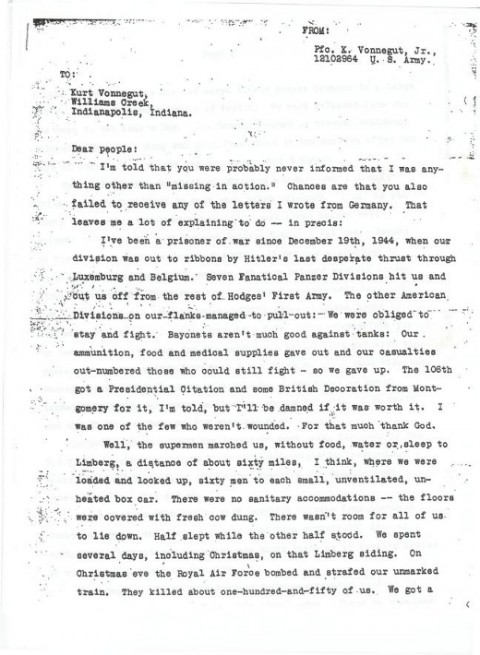
If you read Open Culture, smart money says you’ll also enjoy Letters of Note, a site we occasionally reference. They collect, post, and provide context for “fascinating letters, postcards, telegrams, faxes, and memos” to and from all manners of luminaries throughout the history of art, politics, music, science, media, and, er, letters. Dig into the archives and you’ll find a missive home from Kurt Vonnegut, a notable letter-writer if ever there was one. Dedicated Vonnegut readers will recognize the tone of the novelist, although here, at the age of 22, he had yet to become one. A Private in the Second World War, he was taken prisoner on December 19, 1944, during the Battle of the Bulge. Having then done time in an underground section of a Dresden work camp known, yes, as “Slaughterhouse Five,” he survived the subsequent bombing of the city and wound up in a repatriation camp by May 1945. There, he wrote what follows:
Dear people:
I’m told that you were probably never informed that I was anything other than “missing in action.” Chances are that you also failed to receive any of the letters I wrote from Germany. That leaves me a lot of explaining to do — in precis:
I’ve been a prisoner of war since December 19th, 1944, when our division was cut to ribbons by Hitler’s last desperate thrust through Luxemburg and Belgium. Seven Fanatical Panzer Divisions hit us and cut us off from the rest of Hodges’ First Army. The other American Divisions on our flanks managed to pull out: We were obliged to stay and fight. Bayonets aren’t much good against tanks: Our ammunition, food and medical supplies gave out and our casualties out-numbered those who could still fight — so we gave up. The 106th got a Presidential Citation and some British Decoration from Montgomery for it, I’m told, but I’ll be damned if it was worth it. I was one of the few who weren’t wounded. For that much thank God.
Well, the supermen marched us, without food, water or sleep to Limberg, a distance of about sixty miles, I think, where we were loaded and locked up, sixty men to each small, unventilated, unheated box car. There were no sanitary accommodations — the floors were covered with fresh cow dung. There wasn’t room for all of us to lie down. Half slept while the other half stood. We spent several days, including Christmas, on that Limberg siding. On Christmas eve the Royal Air Force bombed and strafed our unmarked train. They killed about one-hundred-and-fifty of us. We got a little water Christmas Day and moved slowly across Germany to a large P.O.W. Camp in Muhlburg, South of Berlin. We were released from the box cars on New Year’s Day. The Germans herded us through scalding delousing showers. Many men died from shock in the showers after ten days of starvation, thirst and exposure. But I didn’t.
Under the Geneva Convention, Officers and Non-commissioned Officers are not obliged to work when taken prisoner. I am, as you know, a Private. One-hundred-and-fifty such minor beings were shipped to a Dresden work camp on January 10th. I was their leader by virtue of the little German I spoke. It was our misfortune to have sadistic and fanatical guards. We were refused medical attention and clothing: We were given long hours at extremely hard labor. Our food ration was two-hundred-and-fifty grams of black bread and one pint of unseasoned potato soup each day. After desperately trying to improve our situation for two months and having been met with bland smiles I told the guards just what I was going to do to them when the Russians came. They beat me up a little. I was fired as group leader. Beatings were very small time: — one boy starved to death and the SS Troops shot two for stealing food.
On about February 14th the Americans came over, followed by the R.A.F. their combined labors killed 250,000 people in twenty-four hours and destroyed all of Dresden — possibly the world’s most beautiful city. But not me.
After that we were put to work carrying corpses from Air-Raid shelters; women, children, old men; dead from concussion, fire or suffocation. Civilians cursed us and threw rocks as we carried bodies to huge funeral pyres in the city.
When General Patton took Leipzig we were evacuated on foot to (‘the Saxony-Czechoslovakian border’?). There we remained until the war ended. Our guards deserted us. On that happy day the Russians were intent on mopping up isolated outlaw resistance in our sector. Their planes (P‑39’s) strafed and bombed us, killing fourteen, but not me.
Eight of us stole a team and wagon. We traveled and looted our way through Sudetenland and Saxony for eight days, living like kings. The Russians are crazy about Americans. The Russians picked us up in Dresden. We rode from there to the American lines at Halle in Lend-Lease Ford trucks. We’ve since been flown to Le Havre.
I’m writing from a Red Cross Club in the Le Havre P.O.W. Repatriation Camp. I’m being wonderfully well feed and entertained. The state-bound ships are jammed, naturally, so I’ll have to be patient. I hope to be home in a month. Once home I’ll be given twenty-one days recuperation at Atterbury, about $600 back pay and — get this — sixty (60) days furlough.
I’ve too damned much to say, the rest will have to wait, I can’t receive mail here so don’t write.
May 29, 1945
Love,
Kurt — Jr.
Related content:
Kurt Vonnegut Reads from Slaughterhouse-Five
Kurt Vonnegut’s Eight Tips on How to Write a Good Short Story
Kurt Vonnegut: “How To Get A Job Like Mine” (2002)
Colin Marshall hosts and produces Notebook on Cities and Culture. Follow him on Twitter at @colinmarshall.
The Evolution of the Moon: 4.5 Billions Years in 2.6 Minutes (and More Culture From Around the Web)
Here it is. A short history of the Moon. 4.5 billion years covered in a slick 2.6 minutes, all thanks to NASA’s Goddard Space Flight Center. The video, moving from the Moon’s hot creation to its pockmarked present, can be downloaded via NASA’s web site.
Now More Culture from Around the Web (all previously aired on our Twitter Stream):
BBC’s Collection of Famous Authors Reading From Their Works
Five Key TED Talks, According to The New Yorker
“Oh my ass burns like fire! ” Mozart Writes a Letter to His Cousin, 1777
Sylvia Plath’s Drawings (Presented at London’s Mayor Gallery)
Van Gogh’s ‘Starry Night’ Recreated in 7,000 Dominoes
Drunk Texts from Famous Authors, Courtesy of The Paris Review
An Abridged History of Video Games in Under Three Minutes
Matt Taibbi Looks Back at Hunter S. Thompson’s “Fear and Loathing on the Campaign Trail”
How William Faulkner Tackled Race — and Freed the South From Itself
Colum McCann Reads His Story “Transatlantic.” Added to our collection of Free Audio Books
Anne Frank’s Diary Was Almost Never Published. Francine Prose Tells the Story
Darwin & Design (MIT). Added to our List of 500 Free Courses (under Literature)
Famed Harvard Biologist E.O. Wilson Gives Advice to Young Scientists at TEDMed
Author Rohinton Mistry Offers Words of Wisdom to Graduating Class at Ryerson University
Double Indemnity, the Classic Film by Billy Wilder on YouTube
Read More...
The Complete History of the World (and Human Creativity) in 100 Objects
While we’re catching up with historical podcasts, note that BBC Radio 4’s The History of the World in 100 Objects (iTunes – RSS Feed – Web Site) has wrapped up and covered all 100 objects. And not, mind you, just any old objects: these objects come straight from the collection of the British Museum, and thus almost certainly reveal the story of mankind more effectively than most. For that has constituted the program’s project since its inception: to tell, for just under fifteen minutes at a stretch, one chapter of human history as the trained eye can read it in an object like an early writing tablet, a Chinese bronze bell, or an Egyptian clay model of cattle. Don’t let the seeming plainness of these artifacts fool you; the show approaches them with all the most advanced audio production techniques. And after you’ve listened, you’ll realize that, looked at from a suitably historical perspective, there’s not a plain object in this bunch.
Since A History of the World in 100 Objects has finished its journey to the present day, the new listener has no obligation to begin in the ancient world and work their way forward. You might well prefer to begin at the end, as it were, and draw insights from one of our everyday objects like a credit card (albeit, in this broadcast, one that conforms to Shari’a law), or a slightly futuristic object now entering our everyday lives like a solar-powered lamp. From there, you can delve deeper and deeper into our culture and technology’s past: the nifty lamp gives way to the credit card which gives way to a David Hockney painting, which gives way to the HMS Beagle’s chronometer to the mechanical galleon and a Korean roof tile until you’re back at the Mummy of Hornedjitef. If you get back that far and still find yourself longing for more from host Neil MacGregor, be aware that he’s got a new, 20-part historical series going called Shakespeare’s Restless World. The range of source material may have narrowed, but the depth remains.
Related content:
The History of Rome in 179 Podcasts
The History of Philosophy Without Any Gaps – Peter Adamson’s Podcast Still Going Strong
Colin Marshall hosts and produces Notebook on Cities and Culture. Follow him on Twitter at @colinmarshall.
Read More...The History of Philosophy Without Any Gaps — Peter Adamson’s Podcast Still Going Strong

Last August, we featured Peter Adamson’s podcast The History of Philosophy Without Any Gaps (iTunes – RSS Feed – Web Site), a chronologically uninterrupted “look at the ideas and lives of the major philosophers (eventually covering in detail such giants as Plato, Aristotle, Aquinas, Descartes, and Kant) as well as the lesser-known figures of the tradition.” Continuing at the rate of one episode a week, Adamson and his guest philosophical experts have since covered names like Lucretius, Seneca, and Plutarch. They’ve most recently reached Alexander of Aphrodisias, an especially astute ancient commentator on Aristotle and opponent of Stoic attitudes toward fate; Quintilian, Lucian, Themistius, and the interplay between rhetoric and philosophy in the Roman Empire; and the emergence of astronomy, ushered in by Ptolemy during a time when observers still had much to say about astrology.
Don’t miss the episodes where Adamson brings in specialists on the particular philosopher, philosophical subfield, or quirk in philosophical history to which his podcasting journey brings him. Since our last post on the show, we’ve heard Richard Sorabji talk about time and eternity in Aristotle, James Warren on Epicureanism, and Raphael Wolf on Cicero, to name but a few. Such is Adamson’s attention to detail — and dedication to the Zeno’s Paradox-reminiscent cause of pure continuity — that, after putting out 85 episodes, he remains in the ancient world. Imagine the bounty of discussion when he reaches, say, the eighteenth century, let alone the twentieth. To prepare yourself for that, you’d better start listening now; a show expressly created without gaps must, it seems only natural, be experienced without them.
Related content:
The Partially Examined Life: A Philosophy Podcast
Philosophy Bites: Podcasting Ideas From Plato to Singularity Since 2007
55 Free Philosophy Courses
Colin Marshall hosts and produces Notebook on Cities and Culture. Follow him on Twitter at @colinmarshall.
Read More...Support Us
We're hoping to rely on loyal readers, rather than erratic ads. Please click the Donate button and support Open Culture. You can use Paypal, Venmo, Patreon, even Crypto! We thank you!

About Us

Open Culture scours the web for the best educational media. We find the free courses and audio books you need, the language lessons & educational videos you want, and plenty of enlightenment in between.
Advertise With Us
FREE UPDATES!
GET OUR DAILY EMAIL
Get the best cultural and educational resources on the web curated for you in a daily email. We never spam. Unsubscribe at any time.
FOLLOW ON SOCIAL MEDIA
Open Culture editor Dan Colman scours the web for the best educational media. He finds the free courses and audio books you need, the language lessons & movies you want, and plenty of enlightenment in between.
Advertise With Us


