The Enduring Analog Underworld of Gramercy Typewriter
Are typewriters going the way of vinyl?
Note to those cave dwellers who’ve yet to succumb to Mad Men mania, it’s not that same route so traveled by the dodo. For a while it looked like the world’s supply of Underwoods and Olivettis was being requisitioned for hipster jewelry, but their recent comeback is rooted in their intended purpose. These days, they’re near fetish objects for romantic young writers conceived in the shadow of the Mac Classic.
Meanwhile, the likes of Cormac McCarthy and David McCullough, author of 1776, have yet to turn their backs on their beloved, quite likely lucky analog implements.
All due respect to the young Turks seeking to digitize the dinosaur, but the real hero of the typewriter’s post millennial survival is Paul Schweitzer, the ink fingered medicine man at the helm of Gramercy Typewriter. His once-robust competition consigned to the ash heap, Schweitzer has both the stubbornness and expertise to tough it out, in an analog lair that’s the antithesis of sleek.
No one will fault you if your heart lies with your various screens. But let’s not forget where you came from.
Related Content:
Making Paper in L.A., Pianos in Paris: Old Craftsmen Hanging on in a Changing World
- Ayun Halliday is the author of a half dozen some books including the decidedly analog Zinester’s Guide to NYC.
Read More...Ezra Pound’s Fiery 1939 Reading of His Early Poem, ‘Sestina: Altaforte’
In this rare recording from 1939, Ezra Pound gives a passionate reading of his early work about a warmongering 12th century troubadour, a poem called “Sestina: Altaforte.”
The poem was written in early 1909, when Pound was an ambitious 23-year-old American living in London. At that time Pound was in the habit of spending hours every day poring over books in the British Museum reading room.
“I resolved that at thirty I would know more about poetry than any man living,” wrote Pound, “that I would know the dynamic content from the shell, that I would know what was accounted poetry everywhere, what part of poetry was ‘indestructible,’ what part could not be lost by translation, and–scarcely less important what effects were obtainable in one language only and were utterly incapable of being translated.”
In pursuit of this goal, Pound “learned more or less of nine foreign languages.” Among those was Occitan, or Langue d’oc, the language of the medieval troubadours. Pound had become fascinated with the troubadours while studing romance literature at Hamilton College and the University of Pennsylvania. One figure who especially intrigued him was Bertran de Born, the late-12th century nobleman, warrior and troubadour who was immortalized by Dante Alighieri in Canto XXVIII of the Inferno as one of the sowers of discord in Circle Eight, condemned to be hacked to pieces over and over again for his role in fomenting a quarrel between King Henry II of England and his sons Richard II (the “Lionheart”) and Prince Henry. In John Ciardi’s translation of the Inferno, Dante describes the hideous figure of Bertran, his head cut off for the sin of sowing discord between kinsmen:
I saw it there; I seem to see it still–
a body without a head, that moved along
like all the others in that spew and spill.
It held the severed head by its own hair,
swinging it like a lantern in its hand;
and the head looked at us and wept in its despair.
It made itself a lamp of its own head,
and they were two in one and one in two;
how this can be, He knows who so commanded.
Pound would eventually translate several of Bertran’s surviving poems, but he found it difficult. He decided first to write his own poem in the voice of Bertran, incorporating bloodthirsty images from the medieval poet’s own verse and setting the new poem in the 12th century Sestina form, which originated with the troubadours of southern France. In his essay “How I Began,” Pound recalls the composition of “Sestina: Altaforte”:
I had De Born on my mind. I had found him untranslatable. Then it occurred to me that I might present him in this manner. I wanted the curious involution and recurrence of the Sestina. I knew more or less of the arrangement. I wrote the first strophe and then went to the Museum to make sure of the right order of permutations, for I was then living in Langham Street, next to the “pub,” and had hardly any books with me. I did the rest of the poem at a sitting. Technically it is one of my best, though a poem of such a theme could never be very important.
The Sestina is a complex form with 39 lines (six stanzas of six lines each followed by an envoi of three lines) all ending with one of six words that are grouped together in each stanza. For “Sestina: Altaforte,” Pound chose the words “clash,” “crimson,” “opposing,” “rejoicing,” “music” and “peace.” The images of clashing swords and crimson blood earned Pound’s poem the nickname “Bloody Sestina.” It was the first of his poems to make it into Ford Maddox Hueffer’s prestigious English Review. When Pound recited the poem in 1909 at a gathering of poets at a London restaurant, he reportedly put so much passion into his performance that “the table shook and cutlery vibrated in resonance with his voice.”
That same passion can be heard in the recording above, made thirty years later when Pound was visiting America for the first time in 28 years. It was recorded on May 17, 1939 in the Woodberry Poetry Room at Harvard University. For dramatic effect, Pound accompanied himself on a kettledrum. To read the words of “Sestina: Altaforte” as you listen to Pound’s voice, click here to open the text in a new window. And to hear all of Pound’s 1939 recordings, go to PennSound, where you can hear those recordings and many more by Pound.
Read More...Hugh Hefner Defends “the Playboy Philosophy” to William F. Buckley (1966)
“Mr. Hefner’s magazine is most widely known for its total exposure of the human female,” says William F. Buckley, introducing the guest on this 1966 broadcast of his talk show Firing Line. “Though of course other things happen in its pages.” Not long before, publisher and pleasure empire-builder Hugh Hefner’s Playboy magazine ran a series of articles on “the Playboy philosophy,” a set of observations of and propositions about human sexuality that provided these men fodder for their televised debate. Hefner stands against religiously mandated, chastity-centered codes of sexual morality; Buckley demands to know how Hefner earned the qualifications to issue new codes of his own. Describing the Playboy philosophy as “sort of a hedonistic utilitarianism,” Buckley tries simultaneously to understand and demolish these 20th-century revisions of the rules of sex.
“The Playboy founder is no match for the Catholic who snipes him at will with ‘moral’ bullets,” writes the poster of the video. “The acerbic, dry Buckley is on attack mode with a conservative audience, in moral panic, behind him. The Catholic had the era of conservatism behind him. [ … ] In the 21st century though, Buckley (passed 2008) would have a harder time defending morality with Hefner.” One wonders how, were Buckley still alive, he and Hefner might approach these issues were they to revisit this debate today. Times have certainly changed, but I suspect Buckley would raise the same core objection to Hefner’s argument that loosening the old strictures on sex leads, perhaps counterintuitively, to more satisfied, more monogamous pairings: “How in the hell do you know?” Though this and certain other of Buckley’s questions occasionally wrong-foot Hefner, the faithful can rest assured that he keeps enough cool to fire up his signature pipe on camera.
Related Content:
Yeah, Baby! Deep Purple Gets Shagadelic on Playboy After Dark
James Baldwin Bests William F. Buckley in 1965 Debate at Cambridge University
Jack Kerouac Meets William F. Buckley (1968)
Colin Marshall hosts and produces Notebook on Cities and Culture. Follow him on Twitter at @colinmarshall.
Read More...Commuters Play Beethoven’s “Bus Station Sonata” in the UK
At the Haymarket Bus Station in Newcastle (UK), commuters and passers-by were invited to contribute a note or two to a Beethoven Sonata. Men and women, young and old, people from different walks of life — they all lent a hand and shared in a centuries-old musical tradition. Compared to some of the elaborate flashmob performances we’ve seen, this presentation was rather simple. But, as you know, sometimes less is more.
Thanks Anton for sending our way.
Read More...“Name That Tune” at the Bob Dylan Concert (Echoes of Newport, 1965)
On Thursday night, I finally understood it — how fans felt back in July 1965, when Bob Dylan strapped on an electric guitar and did sonic violence to the norms and expectations of the Newport Folk Festival. Fans wanted to hear the Bob Dylan they knew and loved — the folk Dylan who played a simple acoustic guitar, harmonica and not much more. But the times were-a-changin, and they got something different, very different. See here.
Almost 50 years later, Dylan keeps giving his fans a different Dylan. When the Never Ending Tour rolled through San Francisco this week, he played songs the fans came to hear — classics like Love Minus Zero/No Limit, Like A Rolling Stone, Tangled Up in Blue, and A Hard Rain’s A‑Gonna Fall. Except he set them to new melodies, and between his gravelly voice and the gravelly sound system, it took some fans minutes to realize what they were listening to. I cite one example above. In how many minutes can you name that tune?
(Note: The song above was originally recorded in Dresden in July. It was also played in SF this past week.)
Related Content:
Bob Dylan and The Grateful Dead Rehearse Together in Summer 1987. Listen to 74 Tracks
The 1969 Bob Dylan-Johnny Cash Sessions: Twelve Rare Recordings
Read More...Cartoonist Kate Beaton Plays on Literary Classics — The Great Gatsby, Julius Caesar & More
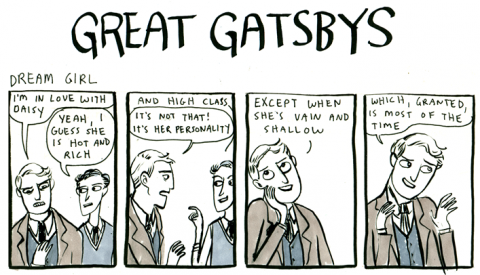
Listen, Old Sport, as far as that Leonardo DiCaprio Gatsby movie goes, I haven’t seen it. But I’ll bet a swimming pool of gin it’s nowhere near as funny as cartoonist Kate Beaton’s 3‑panel takes on F. Scott Fitzgerald’s classic novel.
Of course, F. Scott’s original wasn’t exactly what one would call a knee slapper — whereas Beaton’s comic collection, Hark! A Vagrant, merits a permanent spot in one’s bathroom library. Beaton’s take on The Great Gatsby is by no means a literal adaptation, but her mean-faced, venom-tongued creations get it spiritually right. They also do a number on Bronte, Jane Austen, Nietzsche and Shakespeare’s Julius Caesar, to name but a few of the author’s other literary targets. (See her archive here.) Not bad for a Canadian with degrees in History and Anthropology. Is it wrong to think Zelda would approve?
At any rate, it’s high time someone blew the lid off of what’s behind the eyes of Dr. T.J. Eckelberg. Gratifying, too, to see Tom and Daisy’s child getting some long past due consideration. Now that I think about it, our compulsion to keep beating on boats against the current is kind of funny. Top drawer stuff, Old Sport, top drawer stuff.
Find works by F. Scott Fitzgerald in our collections of Free Audio Books and Free eBooks.
Related Content:
Philosophy Made Fun: Read the Free Preview Edition of the Action Philosophers! Comic
- Ayun Halliday is the author of a half dozen some books including No Touch Monkey! And Other Travel Lessons Learned Too Late.
Read More...Muhammad Ali Plans to Fight on Mars in Lost 1966 Interview
Perhaps you remember the short animated film, I Met the Walrus. It revisits the moment when Jerry Levitan, a 14-year-old kid, slipped into John Lennon’s Toronto hotel room in 1969 and asked the Beatle for an interview. And he got one. The film provides all the proof you need.
Now here’s a nice companion story. It’s the summer of 1966, and 17-year-old Michael Aisner approaches Muhammad Ali, then the heavyweight champion of the world, and asks him to appear on his high school radio show. The kid persists and eventually lands the interview. The audio segment, rarely heard until now, reminds us what makes Ali so charismatic and endearing. The champ answers some of Aisner’s questions seriously. But he also launches into a hilarious riff about how he plans to take a spaceship to Mars, battle the Martian champ (named something like Winnekawanaka) and thereby win the “Universal Title.” Pretty priceless. The complete audio segment appears here.
Follow us on Facebook and Twitter, and share the cultural goodness with your friends!
Read More...World Shakespeare Festival Presents 37 Plays by the Bard in 37 Languages: Watch Them Online
I’ve seen Shakespeare performed all over the country, from Central Park to Golden Gate Park, and in every kind of adaptation imaginable. By far, the most memorable performance for me was a Noh staging of Othello, in Japanese, with masks and haunting chorus. I didn’t understand a word of it, but I spent the entire performance riveted by the culture shock of watching a play I knew so well transformed by a cultural vocabulary I didn’t. While I’ve sometimes bristled at best-selling literary critic Harold Bloom’s seemingly banal claims about Shakespeare’s “universal genius,” I cannot deny that the Bard’s work seems to translate across time and space without a loss of its incredible power and pathos.
Shakespeare-lovers in London this past spring were treated to a similar experience as mine, magnified by 37. As part of the massive World Shakespeare Festival, the Globe to Globe project presented an unprecedented opportunity for theatergoers to see all 37 of Shakespeare’s plays performed in 37 different languages at the bard’s own theater, the Globe. The plays (watch them here) were staged by some of the world’s top theater directors, with over six-hundred actors from “all nations” and attended by “audiences from every corner of our polyglot community.” In a time when various parts of Europe struggle to come to terms with increasingly multicultural demographics, this festival was an opportunity for a global theater fellowship of actors and audiences to come together in mutual appreciation and camaraderie.
The video above gives us a glimpse of several ceremonial, behind-the-scenes moments; before each performance, a member of the company sprinkled alcohol around the stage as an offering to the god of theater and wine, Dionysus. In a rapid montage, we see a dozen different actors from various plays sprint, skip, dance, and slide across the front of the stage, joyfully pouring libations. Afterward, another actor releases two balloons, one labeled The Globe, the other with the company’s name. The productions, all available to view online, are impressive not only for their linguistic range, but also for the range of costuming and stagecraft on display. Watch, for example, Troilus and Cressida in Maori, with a fierce band of Maori warriors stomping across the stage. Or see The Merry Wives of Windsor in Swahili by Nairobi’s Bitter Pill Company. To my delight, the Japanese production of Corolianus by the Chiten company features actors in Noh masks. As an added bonus, the Globe to Globe site has audio of actors from the various companies discussing their experiences of the festival in both their native languages and in English.
Related Content:
Shakespeare’s Satirical Sonnet 130, As Read By Stephen Fry
Impressionist Does Shakespeare in 25 Celebrity Voices
Josh Jones is a doctoral candidate in English at Fordham University and a co-founder and former managing editor of Guernica / A Magazine of Arts and Politics.
Read More...
Aldous Huxley’s Most Beautiful, LSD-Assisted Death: A Letter from His Widow
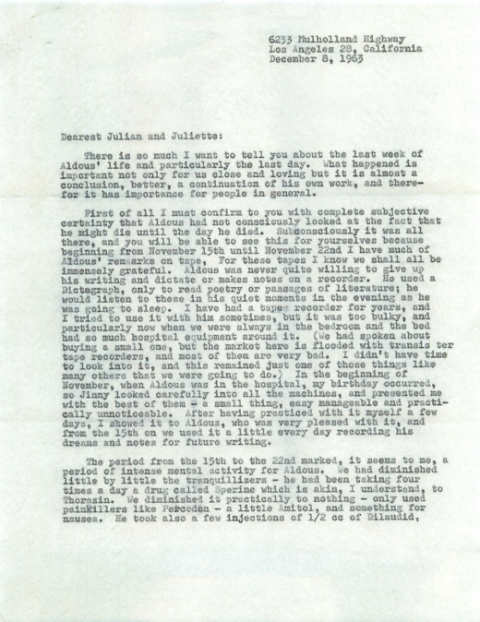
Just over a year ago, we featured a clip of an interview with Laura Archera Huxley, widow of British dystopian novelist and noted psychedelic drug enthusiast Aldous Huxley. When he approached death’s door in 1963, he asked her to give him a dose of “LSD, 100 µg, intramuscular.” If you’ve got to check out, this sounds, by Laura’s description, like one of the preferable ways to do it, or at least a way that aligned closely with Huxley’s convictions. “There was absolutely no jolt, no agitation,” she recalled on camera. “Nothing except this very quiet — like a music that becomes less and less audible. Like fading away. [ … ] There was a beautiful expression in the face. It was a very beautiful expression in the face.” Letters of Note added much detail onto this spare account by posting a letter sent from Laura to Huxley’s brother Julian not long after the writer’s death from laryngeal cancer. One page appears above, and at Letters of Note you can find scans of all of them plus a complete transcript.
“I had the feeling actually that the last hour of breathing was only the conditioned reflex of the body that had been used to doing this for 69 years, millions and millions of times,” wrote Laura. “There was not the feeling that with the last breath, the spirit left. It had just been gently leaving for the last four hours. [ … ] [Everyone attending Huxley] said that this was the most serene, the most beautiful death. Both doctors and nurse said they had never seen a person in similar physical condition going off so completely without pain and without struggle. [ … ] We will never know if all this is only our wishful thinking, or if it is real, but certainly all outward signs and the inner feeling gave indication that it was beautiful and peaceful and easy.” Just above, you’ll find the video we previously posted of Laura’s briefer description of the same events.
Related Content:
Aldous Huxley Warns Against Dictatorship in America
Ken Kesey’s First LSD Trip Animated
Aldous Huxley Reads Dramatized Version of Brave New World
Colin Marshall hosts and produces Notebook on Cities and Culture. Follow him on Twitter at @colinmarshall.
Read More...Where Your Web Searches, Emails, and Videos Live: A Tour Inside Google’s Data Centers
So much of what we experience as digital is intangible. The color and texture of the Internet exists only for the time we have that particular site loaded. With just a click of the mouse, the lushness disappears.
Except that it doesn’t, really.
Backstage, every email, photo, YouTube video and document we share lives in a very real place, which is weird when you think about it. These massive data centers are like vaults of ones and zeros, some of which could wreak havoc in the wrong hands but, honestly, most of which will never mean anything again to anybody.
Every time anyone uses a Google product, for example, like conducting a search or looking up directions, their computer talks to one of the world’s most powerful server networks, which are housed in huge data centers. Very few people actually get to see where Google’s servers live. These data centers are high security, for good reason.

The company recently launched Where the Internet Lives, part of a mini campaign to pull back the curtain on how the web works. They hired a photographer to capture eight of their data centers on, well, not really film, but you get the picture. Oh, and the data centers aren’t brick and mortar either. More like glass and drywall and pipes. Lots and lots of pipes.
And like Willie Wonka and his famous factory, Google invited Wired magazine reporter Stephen Levy to visit and write a story about the previously off-limits facilities.
Take a street view tour of the North Carolina data center (and see their “security team” at work). Photographer Connie Zhou’s images are lovely and the facilities are beautiful in an eerie, futuristic way. See how water is used to keep the processors cool, where data is backed up, failed drives destroyed to keep data safe and how workers get around.
Google employees get a fair amount of play, with shots of them working to build, maintain and repair the machines.
It’s a peek behind the scenes, but it’s also marketing. And what’s interesting is that it’s a lot like the automobile industry’s marketing (think of Saturn’s ads in praise of the assembly-line worker) and campaigns by the Big Three to attract auto workers in the 1940s. Some of the photo captions recall the nostalgic, Utopian messaging of the post-War era, when efficient, modern suburban communities were sprouting up around industrial centers. This lunch room looks pretty nice, and the sauna is right outside.
Kate Rix writes about digital culture and education. Visit her work online at katerixwriter
Read More...Support Us
We're hoping to rely on loyal readers, rather than erratic ads. Please click the Donate button and support Open Culture. You can use Paypal, Venmo, Patreon, even Crypto! We thank you!

About Us

Open Culture scours the web for the best educational media. We find the free courses and audio books you need, the language lessons & educational videos you want, and plenty of enlightenment in between.
Advertise With Us

FREE UPDATES!
GET OUR DAILY EMAIL
Get the best cultural and educational resources on the web curated for you in a daily email. We never spam. Unsubscribe at any time.
FOLLOW ON SOCIAL MEDIA

Open Culture editor Dan Colman scours the web for the best educational media. He finds the free courses and audio books you need, the language lessons & movies you want, and plenty of enlightenment in between.
Advertise With Us

