See Ugly Thrift Store Paintings through Artist Wayne White’s Pretty Eyes
It reads like Hipster 101. Creative misfit teen makes a conscious choice to be a freak, grows up, sticks it to the mainstream, gains acclaim painting funny words and phrases on ugly thrift store “art”. Except Wayne White, the man responsible in large part for the look of PeeWee’s Playhouse and the subject of a recent documentary, Beauty is Embarrassing, isn’t much interested in mocking easy prey. Pity. With those bedroom eyes and that banjo, he’d make a great a character on HBO’s Girls (provided, of course, he were thirty years younger).
Age has conferred a number of lessons that he imparts on the thrift store ride-along above. For instance, those squares with whom less seasoned artists are so preoccupied don’t give a hoot what the likes of him does or doesn’t do. Also, there’s no profit to be had in painting on originals. “That would be a comment on the artists.” Instead he trawls for reproductions, which he views as products that have had all the pretty sucked out of them.
His pleasure in finding a suitably unlovely Venetian scene in an ornate frame is refreshing, knowing that it’s not powered by snide irony. The only irony he acknowledges is that the universe has seen fit to let him prosper as an artist in this economy. Whether this will prove a lasting legacy remains to be seen, but a few minutes with Wayne White should be enough to permanently alter your perception of that hideous covered bridge scene on your local Salvation Army’s wall.
- Ayun Halliday is the Chief Primatologist of The East Village Inky zine, and author of seven books, including the forthcoming graphic novel, Peanut.
Read More...A List of 60 Free Courses Granting Certificates from Great Universities (Some Starting This Week!)
Earlier this year we began telling you about a potential revolution in education — the birth of MOOCs, or Massive Open Online Courses. As explained above, these courses let students, thousands at a time, take courses from great universities for free online. What’s more, most of these courses offer students a credential — something like a certificate of completion — if they master the material covered in the class. Some of the MOOC providers are well known: Coursera, Udacity, and edX. Others, like Class2Go, Google Course Builder and Venture Lab, are just emerging. But, together, they’re producing courses at breakneck speed, and we thought it was time to start organizing a list for you.
Today, we’re rolling out a list of 60 Free Courses Granting Certificates from Great Universities. The list organizes courses chronologically by start date, and it indicates the kind of credential the courses offer — for example, Certificates of Completion, Statements of Accomplishment, or Certificates of Mastery. The list, which happens to include another 15 courses not bearing certificates, will be regularly updated. You can expect it to grow rapidly, and you can always access it by clicking Certificate Courses in the top navigation of our web site. Below we have listed a number of online courses starting this week:
- Finance — Stanford on Venture Lab — October 15 (10 weeks)
- Introduction to Computer Science — Harvard on edX — October 15 (24 weeks)
- Startup Boards: Advanced Entrepreneurship — Stanford on Venture Lab — October 15 (9 weeks)
- Designing a New Learning Environment — Stanford on Venture Lab — October 15 (9 weeks)
- Technology Entrepreneurship — Stanford on Venture Lab — October 15 (9 weeks)
- Experimental Genome Science — Duke on Coursera — October 15 (12 weeks)
- A Crash Course on Creativity — Stanford on Venture Lab — October 17 (10 weeks)
Get the full list here. It includes 75 Massive Open Courses in total.
Read More...Rare 1946 Film: The Great Russian Composer Sergei Prokofiev Plays Piano, Discusses His Music
In 1946 the great Russian composer Sergei Prokofiev was at the height of his success in the Soviet cultural world, but the state of his health was falling.
Only a year before, in the Great Hall of the Moscow Conservatory, Prokofiev had conducted the glorious premier performance of his widely praised Fifth Symphony. “The hall was probably lit as usual,” remembered the pianist Sviatoslav Richter, who was there, “but when Prokofiev stood up, it seemed as though the light poured down on him from on high. He stood there, like a monument on a pedestal.” But a few days later Prokofiev fainted and took a terrible fall, injuring his head and nearly dying as a result. The diagnosis was severe high blood pressure. Prokofiev’s doctors advised him to move away from Moscow to someplace quiet, so in the summer of 1946 he purchased a dacha in the wooded suburb of Nikolina Gora.
A short time later a government film crew visited the 55-year-old Prokofiev at his new home. The clip above is one of two surviving takes, according to Simon Morrison of Princeton University, author of The People’s Artist: Prokofiev’s Soviet Years. In the film, Prokofiev sits at the piano and plays a selection from one of the waltzes in his ballet Cinderella, which had premiered the previous fall at the Bolshoi Theatre. The composer then walks over to his desk and is asked to say a few words about what he is working on. His reply, as translated on YouTube:
Well, right now I am working on a symphonic suite of waltzes, which will include three waltzes from Cinderella, two waltzes from War and Peace and one waltz from the movie score Lermontov. The War and Peace has just been brilliantly produced in Leningrad, where the composer Cheshko made an especially noteworthy appearance as a tenor, giving a superb performance in the role of Pierre Bezukhov. Besides this suite, I am working on a sonata for violin and piano [No. 1 in F minor], upon completion of which I will resume work on the Sixth Symphony, which I had started last year. I have just completed thre suites from the Cinderella ballet and I am now turning the score over to copyists for writing the parts, so that most likely the suites will already be performed at the beginning of the fall season.
The video concludes with a fragment of silent footage which, according to Morrison, shows Prokofiev playing the cadenza of the finale of his Third Piano Concerto at Moscow in 1927 with “Persimfans,” an early Soviet orchestra that operated without a conductor, in keeping with the proletarian ideals of the revolution. The rare films offer a fascinating glimpse of the great composer’s playing technique. As Morrison told us in an email:
The footage taken at Nikolina Gora clearly shows that he had massive hands, fluid (if a little rusty) technique, and awkwardly rigid posture. He plays from the forearms down, metronomically, with an ease and finesse that indisputably contributed to his technique of chromatic displacement (playing music in one key or tonality but then inflecting it with pitches from other tonal areas). His was an intuitive manner of composition, influenced by the natural feel of the keyboard under his hands–slide-slipping between black and white keys, as shadows of one another.
Less than two years after the Nikolina Gora newsreel footage was made, Prokofiev’s life took a bad turn. On February 10, 1948 he was accused, along with Dmitri Shostokovich and others, of “formalism,” which the pianist and Prokofiev scholar Boris Berman describes as “a political libel in the guise of an aesthetic term.” Formalist art was viewed as being elitist and “undemocratic” for its preoccupation with form over content. As a result, Prokofiev and the others were unable to perform or broadcast their work. And just ten days after his denunciation, Prokofiev’s wife Lina was arrested and charged with “espionage” for trying to send money to her mother in Spain. She was sentenced to 20 years in prison. Stress from the crises caused Prokofiev’s health to deteriorate further, and on March 5, 1953 he died from a cerebral hemorrhage. Joseph Stalin died the same day.
h/t Matthew Barnes
Related content:
Tchaikovsky’s Voice Captured on an Edison Cylinder (1890)
Read More...The Uncensored Andy Warhol-Directed Video for The Cars’ Hit “Hello Again” (NSFW)
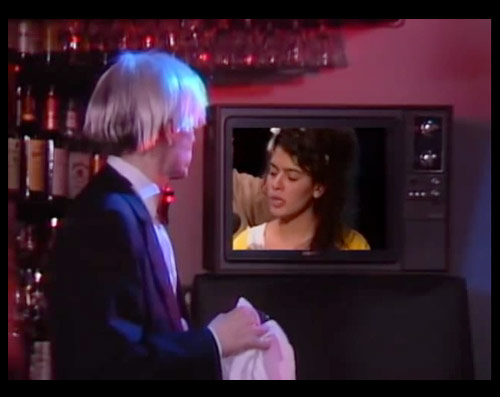
Andy Warhol was many things to many people in his long and eventful career: painter and provocateur, promoter and director. But it surprised me to learn that he also made music videos. Well, he made one music video, for The Cars single “Hello Again” from their 1984 album Heartbeat City. The biggest hit from that album, “You Might Think,” was a massive MTV video hit and one of the first music videos to use computer graphics. Warhol plays on much of the aesthetic of the “You Might Think” video, which kind of epitomized the cheesy, slightly sexist, mid-eighties look The Cars made big: giant, scantily-clad women, rudimentary computer graphics scenes featuring sunglasses and cocktails, and, of course, plenty of cars. But there’s also lots of signature Warhol here: lots of parties, lots of bodies, lots of sex (and nudity).
Pop music always played a significant role in Warhol’s work, so it seems only natural that he would align himself with the cutting-edge mid-eighties synthpop of the Cars. What’s more, he appears in a cameo as a bartender in the video, which also features a very young Gina Gershon. For obvious reasons, the extended, uncensored version of Warhol’s video (watch it here) didn’t make the rounds on MTV. The censored version is, you might say, just a little less sexy, and a lot less Warhol. Since Warhol died in 1987, this video represents one of the last pieces of the artist’s work. Warhol, an early adopter of digital graphics technology, had previously used Amiga computers to animate images of Marilyn Monroe and create computer art of his friend Debbie Harry. See him “paint” the “first computer artwork,” a portrait of Harry, on an Amiga computer below.
Related Content:
Three “Anti-Films” by Andy Warhol: Sleep, Eat & Kiss
Andy Warhol’s ‘Screen Test’ of Bob Dylan: A Classic Meeting of Egos
Josh Jones is a doctoral candidate in English at Fordham University and a co-founder and former managing editor of Guernica / A Magazine of Arts and Politics.
Read More...60-Second Adventures in Religion: Watch New Animations by The Open University
American friends who went studying abroad in the Great Britain of the 70s all have a story about discovering the Open University. They usually did so late at night, more than a little inebriated, and well into a bout of semi-exotic channel-flipping. Suddenly they’d stumble upon a plaid-jacketed lecturer introducing psychology, say, or biology, or some branch of literature, and find themselves surprised and transfixed. Back then, the OU had to lean on television and radio as content distribution systems, but now that they can make use of the internet, they’ve put out all sorts of educational materials of great interest to Open Culture readers. We’ve previously featured their 60-Second Adventures in Thought and 60-Second Adventures in Economics. Now you can watch and learn about another subject from the latest in their series of animated, joke-filled intellectual primers, 60-Second Adventures in Religion.
“Karl Marx was a German philosopher-economist, and the least funny of the Marxes,” says the narrator of the first adventure, “Religion as Social Control.” “He famously called religion ‘the opium of the people,’ in that religion was not only used by those in power to oppress the workers, but it also made them feel better about being oppressed when they couldn’t afford real opium.” The other three adventures approach religion as ritual, religion as mother, and religion as virus. Each video (watch them below) references a different theorist and takes their views as seriously as such a humorous project can, though they all avoid ascribing absolute authority to anyone in particular. The fourth installment, for instance, opens by quoting Richard Dawkins, whom the narrator introduces as “an atheist, evolutionary biologist, and probably not someone you should ask to be a godfather.” But hearing about his thoughts on the virus of religion will certainly get you curious about what else OU has to offer on the subject.
(You can also download 60-Second Adventures in Religion on iTunes.)
Religion as Ritual
Religion as Mother
Religion as Virus
Related Content:
60-Second Adventures in Thought
Science Behind the Bike: Four Videos from the Open University on the Eve of the Tour de France
540 Free Online Courses from Top Universities
Colin Marshall hosts and produces Notebook on Cities and Culture. Follow him on Twitter at @colinmarshall.
Read More...Philosophy Made Fun: Read the Free Preview Edition of the Action Philosophers! Comic
“Imagine Plato as a wrestling superstar of ancient Greece, Nietzsche as the original ubermensch, and Bohidharma as the grand master of kung fu. These are not just great thinkers they also make great comics. Action Philosophers! details the lives and thoughts of history’s A‑list brain trust in hip and humorous comic book fashion. ”
That’s how the Action Philosophers! comic book was pitched when its creators, Fred Van Lente and Ryan Dunlavey, published it in 2009. The comic book is still in print, and you can read the fun preview edition online. It starts, of course, with the Pre-Socratics — Thales, Anaximander, Parmenides, and the gang. Enjoy.
Bonus — Read more Action Philosophers! online:
Related Content:
55 Free Philosophy Courses
Monty Python’s Best Philosophy Sketches
Ancient Greek Punishments: The Retro Video Game
Read More...Behold Charles Laughton Delivering the Gettysburg Address in its Entirety in Ruggles of Red Gap
The Gettysburg Address is the sort of eloquent speech schoolchildren were once expected to commit to memory, much as they were required to bring apples for the teacher and dip each others’ pigtails in ink. Nowadays, with ever more historical ground clamoring to be covered, it’s really only those celebrated opening lines that tend to stick. No doubt they’ll show up in the Stephen Spielberg-directed Lincoln bio-pic slated to open later this fall.
Stray back in time for a real refresher course, courtesy of erstwhile Hunchback of Notre Dame and Shakespearean wunderkind, Charles Laughton. His soup-to-nuts recitation of the celebrated speech is the unexpected highlight of Ruggles of Red Gap, a 1935 screwball Western that time has relegated to the semi-shadows. It’s a beautifully understated performance that manages to illuminate the meaning of each and every word. (It also makes me more forgiving of the film’s early minutes, when Laughton’s portrayal of a very proper English butler succumbs to a silver-candelabra-up-the-heiner level of broadness.)
Just as impressive is director Leo McCarey’s decision to set the scene atop a giddy vaudeville routine featuring a saloon full of clueless cowboys and barkeeps. It’s a ton of fun.
Read More...Ishu Patel’s Oscar-Nominated, Animated Films Reveal a Singular, Handcrafted Vision
I’m happy to date myself and say this: in the days before computer graphics, when animators worked painstakingly by hand (yes, I know, computer rendering is painstaking), animated films just seemed… I don’t know, prettier, more impressively artful. I’ll take the heat for saying so and give you two short films as evidence, both from innovative animator Ishu Patel. Originally from Gujarat, India, Patel has made only a handful of short films in his twenty-five year career, most of them for the National Film Board of Canada. But six of those films won top honors at international film festivals and two—Paradise and The Bead Game—were nominated for Academy Awards.
Paradise (above), made in 1984, uses hand-drawn designs and so-called “under-the-camera” animation techniques such as cut-out, back-lit plasticine, sand, and painted glass to render an exotic and shimmering world. Each frame is a work of art on its own; in fact, Patel includes stills from the films on his site, some showing preliminary sketches. Much of Paradise takes place inside a palace that resembles an intricate chalk drawing. There, a lone monarch watches as a flamboyant bird (of paradise?) transforms itself into a dazzling succession of colorful forms. Outside, in a landscape right out of Henri Rousseau, a solitary black bird lurks, attempting to rival the other bird’s beauty, with little success. The original score by Gheorghe Zamfir (yes, Zamfir, of the pan flute fame) conjures Ennio Morricone.
In 1977’s The Bead Game (below), Patel’s first animated film, the setting is much sparser—a solid black background and a spare, percussive soundtrack by J.P. Ghosh. But the activity is unrelenting as a collection of beads evolve from single cells, to epithelial folds, to a series of creatures, each one devouring the previous until humans arrive. Once we do, we develop progressively more destructive ways to kill each other. The finale is a psychedelic tour-de-force. One can only imagine the amount of time and care that went into stop-motion animating these hundreds of beads. The effect is simply stunning and results in a singular vision one rarely sees in CGI-only work. Again, I’ll take the heat, but I stand by it: animation by hand produced work that no computer-generated image has yet rivaled.
Patel’s films will be added to the Animation section of our list of 500 Free Online Movies.
Josh Jones is a doctoral candidate in English at Fordham University and a co-founder and former managing editor of Guernica / A Magazine of Arts and Politics.
Read More...Learn New Languages (From Arabic to Yiddish) with 150+ Free Podcasts

I spend a great deal of time visiting unfamiliar cities, spending days walking, cycling, or riding trains and buses through them. Sometimes the people of these cities speak languages I know; sometimes they speak languages I don’t. Either way, during all these hours in motion, my personal soundtrack comes from an iPod loaded with language-learning podcasts. If you’d like to engage in this delightfully mentally stimulating practice yourself — and I highly recommend it — you can get started by browsing Open Culture’s collection of Free Language Lessons available online. The list covers no fewer than 40 tongues, and many of the lessons come in podcast form. Should you find yourself in need of shows offering Bulgarian survival phrases, instruction in Swedish expressions and culture, or Polish in one minute a day, here is the list you want. From my efforts in studying Spanish, Korean, and Japanese, I can personally (and strongly) recommend several of its offerings.
Coffee Break Spanish and the more advanced Show Time Spanish, both produced by the Radio Lingua network (out of Scotland, of all places) start you off from an absolute zero of presumed knowledge and proceeds to get you up to “cruising altitude,” which I call the point in language acquisition at which you become able to learn from real, untranslated speech. You might then consider downloading a show like Notes in Spanish, and especially the conversationally focused Notes in Spanish Gold. For Japanese, few language podcasts cater to a wider variety of proficiency levels at once than does JapanesePod101, which I supplement with Japanese national broadcaster NHK’s lessons (which also come taught in quite a few languages besides English.) And for Korean, the language that first cultivated in me this whole intellectually and socially thrilling learning addiction, you can do no better than Hyunwoo Sun’s Talk to Me in Korean, quite possibly the most thorough, frequent, slick, and entertaining language-instruction podcast of any kind. Listening to these shows has convinced me that every moment spent not acquiring a new language is a moment wasted. But even if you don’t believe anything that extreme, it’s still a lot of fun. And doing it through these free podcasts, you certainly can’t argue with the price.
Here’s our collection once again: Learn 40 Languages for Free: Spanish, English, Chinese & More
Related Content:
375 Free eBooks: Download to Kindle, iPad/iPhone & Nook
450 Free Audio Books: Download Great Books for Free
530 Free Online Courses from Top Universities
500 Free Movies Online: Great Classics, Indies, Noir, Westerns, etc.
Colin Marshall hosts and produces Notebook on Cities and Culture. Follow him on Twitter at @colinmarshall.
Read More...Stephen Fry Friday: His Musings on Life, Swearing, Shakespeare, Nanoscience & More
Stephen Fry is a man of many talents. He’s a novelist, contributor to newspapers and magazines, TV personality, comedian, podcaster, linguist of sorts. And according to his Twitter profile, he’s also a “Lord of Dance, Prince of Swimwear & Blogger.” In short, Stephen Fry covers a lot of ground, and, throughout the years, we’ve shown you Fry opining on many subjects. But you can’t really appreciate his intellectual range until you’ve seen his musings placed next to one another. So we’re proclaiming today “Stephen Fry Friday” and we’re presenting our favorite Fry clips from years past. We start above with Fry’s take on “The Joys of Swearing” and the rest follows:
The Strange New World of Nanoscience
What is nano? And how will nanoscience shape our future? It’s all explained in a snappy 17 minute video — NANO YOU — that Fry narrated for Cambridge University.
What I Wish I Knew When I Was 18
It’s a perennial fan favorite — Fry reflecting on his life, all 55 years of it, and offering up life lessons to youngsters. Truth be told, older folks will get something out of this video too.
On Philosophy and the Importance of Unbelief
Getting into the nitty gritty of philosophy, Fry gives us one more life lesson: If you assume there’s no afterlife, you’ll likely have a fuller, more enriching life.
A Kinetic Take on Language
For a brief time in 2008, Fry produced a series of podcasts – called “Podgrams” – that drew on his writings, speeches and collective thoughts. In one episode, he meditated on language — the English language, his own language, Barthes, Chomsky, and Pinker — and then Matthew Rogers took that meditation and ran with it, producing a “kinetic typography animation” that artfully illustrates a six minute segment of Fry’s longer talk.
Shakespeare’s Satirical Sonnet 130, As Read By Stephen Fry
It’s not surprising that someone this immersed in language would deeply admire the Shakespearean tradition.…
Why Fry Loves Joyce’s Ulysses
And Joyce’s Ulysses too (which you can download as a fine free audio book here).
Stay tuned, we’ll have more Stephen Fry in the months and years to come.…
Read More...Support Us
We're hoping to rely on loyal readers, rather than erratic ads. Please click the Donate button and support Open Culture. You can use Paypal, Venmo, Patreon, even Crypto! We thank you!

About Us

Open Culture scours the web for the best educational media. We find the free courses and audio books you need, the language lessons & educational videos you want, and plenty of enlightenment in between.
Advertise With Us

FREE UPDATES!
GET OUR DAILY EMAIL
Get the best cultural and educational resources on the web curated for you in a daily email. We never spam. Unsubscribe at any time.
FOLLOW ON SOCIAL MEDIA

Open Culture editor Dan Colman scours the web for the best educational media. He finds the free courses and audio books you need, the language lessons & movies you want, and plenty of enlightenment in between.
Advertise With Us

