Allen Ginsberg Recordings Brought to the Digital Age. Listen to Eight Full Tracks for Free
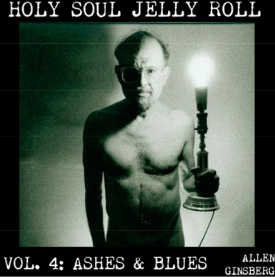
Today marks the release of the final volume in the Allen Ginsberg box set Holy Soul Jelly Roll: Poems & Songs 1949–1993, a collection of previously released and unreleased recordings. For whatever reason, Ginsberg Recordings decided to stagger the digital release of the set over the month of September, beginning with Volume Four (Ashes & Blues), followed by Three (Ah!), Two (Caw! Caw!), and finally, today, Volume One (Moloch!). The last volume “contains the stunning 1956 Berkeley Town Hall reading of Ginsberg’s seminal poem ‘Howl,’ as well as other important historic early poems.” You can preview and buy all four volumes on iTunes, but you needn’t pay to hear some full tracks: Ginsberg Recordings made the “8 song sampler” available on Soundcloud for us. Here is the track listing:
1. A Supermarket In California
2. Green Valentine Blues
3. Kral Majales (King Of May)
4. CIA Dope Calypso
5. Laughing Song
6. First Party at Ken Kesey’s With Hell’s Angels
7. Vomit Express
Listening to these poems brings a couple things to mind. One, the realization, too often lost, that “There was a time when not every moment of our lives was recorded, photographed, tweeted, facebooked, or otherwise made instantly available to the global billions of the connected,” in the words of Ginsberg friend and archivist Stephen Taylor. In those ancient days, recordings mattered and the things people chose to put on tape or film or whatever medium they chose were precious because of their rarity and their fragile physicality. Two, these recordings underscore the perfect pitch of the collection’s title, which takes in all at once the complementary natures of Ginsberg the holy fool—mystic, trickster, and sensual “white Negro” (to take Norman Mailer’s snide 50s term for hipster bohemians). Ginsberg was all these things, usually in the same poem. His voice can slide in subtle or startling turns from bathos to pathos, from the fantastic imaginary to keenly-observed social critique.
In the first recorded poem above, “A Supermarket in California,” Ginsberg imagines himself shopping for groceries at night with Walt Whitman, an elaborate extended excursion into the poet’s process. In an intro, he calls this a “coming down” poem after writing “a lot of great poetry.” Reminiscent of Wallace Stevens’ “The Man on the Dump,” Ginsberg describes “shopping for images” in a “hungry fatigue… dreaming of your enumerations.” The “you” here is Whitman, and in the poem the two stroll down store aisles, sampling the “neon fruit” without paying. In a funny image, Ginsberg asks his muse, “which way are we going? Which way does your beard point tonight?” Maybe Ginsberg thought it a minor poem, but I’d call it a tiny delicacy next to the sprawling monster “Howl.”
Another short autobiographical poem above—well-stocked with images as precise, but not so neon, as “Supermarket”—is “First Party at Ken Kesey’s with Hell’s Angels.” I can only imagine this is an accurate account of events not much embellished but perceptively edited to give us an elliptical succession of loosely connected vignettes. None of the images surprise so much as confirm exactly what one expects to find at Ken Kesey’s (with Hell’s Angels): “Cool black night through the red woods,” “a few tired souls hunched over in black leather jackets,” “a yellow chandelier at three a.m.,” “twenty youths dancing through the vibration in the floor,” “a little marijuana in the bathroom,” and, of course, “four police cars parked outside the painted gate.” It’s not a masterpiece, but it’s a little showcase of Ginsberg’s talent for compression and, to use the word he applies to his hero Walt Whitman, “enumerations” of jazz-inflected lines that pop into focus with pleasing immediacy.
“CIA Dope Calypso” is also true to its title, an upbeat island-style ditty with congas, guitar and maracas–a song about the Southeast Asian heroin trade (allegedly!), Ginsberg sings, “supported by the C‑I-A.” Never afraid to hurl verbal Molotovs at his imperialist foes, Ginsberg does so here with strained and silly rhymes and a good deal of tongue-in-cheek in-joking. It’s a “jelly roll” performance—wickedly subversive.
All of these recordings are great fun, but Ginsberg seems best known for the “Holy Soul” part of his persona, the thundering prophet mystic warrior of “Howl,” and that’s here in the box set too, with “Howl” and other poems. We’ve previously featured Ginsberg’s riveting 1955 reading of the epic “Howl” at San Francisco’s Six Gallery, dramatized in Rob Epstein and Jeffrey Friedman’s semi-biopic Howl, with James Franco as Ginsberg. Below, see the poem’s apocalyptic “Moloch” section set to some terrifying animated images from the 2010 film:
If Holy Soul Jelly Roll doesn’t fully sate your taste for Ginsberg’s voice, never fear: there is much more to come from Ginsberg Recordings.
Josh Jones is a doctoral candidate in English at Fordham University and a co-founder and former managing editor of Guernica / A Magazine of Arts and Politics.
Read More...
Christopher Hitchens Remembers Ayatollah Khomeini’s Fatwa Against His Friend Salman Rushdie, 2010
When his telephone rang on February 14, 1989, Christopher Hitchens was thunderstruck. A newspaper reporter was on the line, asking for his reaction to a radio speech from Tehran earlier that day in which the theocratic ruler of Iran, Ayatollah Ruhollah Khomeini, called on Muslims around the world to murder his friend the novelist Salman Rushdie because of something Rushdie had written in his book The Satanic Verses. As Hitchens later wrote in his memoir, Hitch-22:
I felt at once that here was something that completely committed me. It was, if I can phrase it like this, a matter of everything I hated versus everything I loved. In the hate column: dictatorship, religion, stupidity, demagogy, censorship, bullying, and intimidation. In the love column: literature, irony, humor, the individual, and the defense of free expression. Plus, of course, friendship–though I like to think that my reaction would have been the same if I hadn’t known Salman at all. To re-state the premise of the argument again: the theocratic head of a foreign despotism offers money in his own name in order to suborn the murder of a civilian citizen of another country, for the offense of writing a work of fiction. No more root-and-branch challenge to the values of the Enlightenment (on the bicentennial of the fall of the Bastille) or to the First Amendment to the Constitution, could be imagined.
Rushdie went into hiding, but his Japanese translator, Hitoshi Igarashi, was murdered, and attempts were made against the lives of several other translators and a publisher. Bookstores in England and California were firebombed, and many more received threats of violence. The public reaction to all of this was a bitter disappointment to Hitchens. In his book, God is Not Great: How Religion Poisons Everything, he wrote:
One might have thought that such arrogant state-sponsored homicide, directed at a lonely and peaceful individual who pursued a life devoted to language, would have called forth a general condemnation. But such was not the case. In considered statements, the Vatican, the archbishop of Canterbury, the chief sephardic rabbi of Israel all took a stand in sympathy with–the ayatollah. So did the cardinal archbishop of New York and many other lesser religious figures. While they usually managed a few words in which to deplore the resort to violence, all these men stated that the main problem raised by the publication of The Satanic Verses was not murder by mercenaries, but blasphemy. Some public figures not in holy orders, such as the Marxist writer John Berger, the Tory historian Hugh Trevor-Roper, and the doyen of espionage authors John Le Carré, also pronounced that Rushdie was the author of his own troubles, and had brought them on himself by “offending” a great monotheistic religion. There seemed nothing fantastic, to these people, in the British police having to defend an Indian-born ex-Muslim citizen from a concerted campaign to take his life in the name of god.
This month Rushdie published Joseph Anton: A Memoir, describing his nine-years of life in hiding under the Ayotollah’s death order. The new book’s relevance could not be more obvious, given the Anti-American rioting that broke out in much of the Muslim world this month in reaction to a YouTube video called Innocence of Muslims. Hitchens died last December, and his voice in the matter is sorely missed. But it isn’t hard to imagine what he might have said. In a 2009 Vanity Fair essay, “Assassins of the Mind,” Hitchens wrote: “For our time and generation, the great conflict between the ironic mind and the literal mind, the experimental and the dogmatic, the tolerant and the fanatical, is the argument that was kindled by The Satanic Verses.”
For a recent discussion with Rushdie, listen to his September 21 interview with Studio360:
Read More...Watch Simon & Garfunkel Play Their Big Central Park Concert (1981)
On September 19, 1981, Paul Simon and Art Garfunkel got up in front of 500,000 people in New York City and played a show. That in itself sounds perhaps not terribly unusual, but bear in mind that they put on the concert in Central Park. Even that might not strike you as notable these days, but the early eighties found major American cities on the ropes. Their public spaces had reached an especially advanced state of deterioration, and commentators often singled out New York as a dreary bellwether of just this sort of aggressive urban decay. Looking back, to name just one example, we think of subway cars covered, every exposed surface both interior and exterior, with a palimpsest of graffiti. But Manhattan’s Central Park had only fared a shade better, and the city found itself lacking the three million dollars needed to repair and maintain the now-beloved vast green space. Parks Commissioner Gordon Davis recruited the Queens-raised and New York-rooted Simon and Garfunkel to perform the free benefit show that would become the album and movie The Concert in Central Park, dedicating the revenue from merchandising and licensing to renovation.
You can watch the ninety-minute concert film above. Originally broadcast on HBO, it comes directed by New York native Michael Lindsey-Hogg, director of many clips for the Beatles and the Rolling Stones (not to mention the son of Orson Welles). Simon and Garfunkel’s performance, which runs two songs and twelve minutes longer than The Concert in Central Park the album, includes much of what you’d expect — “Mrs. Robinson,” “Scarborough Fair,” “Still Crazy After All These Years,” “Bridge Over Troubled Water,” “The Sounds of Silence” — and a bit of what you wouldn’t. It also offers a look back to a time when nobody quite knew whether New York City would get out of its slump, a time when Simon’s lyric about “Central Park, where they say you should not wander after dark” made more sense. Despite false starts since, it now seems safe to say that the recovery has happened. By the same token, the concert itself, despite its success, proved a false start for an expected long-term Simon and Garfunkel reunion. But they would come together again to tour in the early 2000s, and rumors of possible future live shows continue to swirl.
via Mental Floss
Related content:
Paul Simon, Then and Now: Celebrating His 70th Birthday
A Paul Simon Feelin’-Very-Groovy Moment
Colin Marshall hosts and produces Notebook on Cities and Culture. Follow him on Twitter at @colinmarshall.
Read More...Watch Steven Spielberg’s Debut: Two Films He Directed as a Teenager
When Steven Spielberg was six or seven years old his father took him to see Cecil B. DeMille’s The Greatest Show on Earth. When he arrived at the theater he felt cheated, because he thought he was going to see a real circus, with real-life clowns and elephants and lion tamers. But as the pictures moved across the screen the boy’s disappointment soon gave way to enchantment. One scene in particular–the film’s spectacular train wreck–would alter the course of his life.
After seeing the movie, Spielberg talked his dad into to buying him an electric train set. When he got a second train his boyish instinct was to re-create the crash scene from The Greatest Show on Earth. He rammed the two trains together at high speed, just for the joy of watching the pieces fly apart. His father was not amused. After paying a second time to have the trains repaired, he warned Steven that if he crashed them again, the train set would be taken away. When Spielberg was about 12 years old, he got an idea. As he later recalled:
Whatever got into me, I needed to see those trains crashing. But I also didn’t want to lose my train set. My dad had sitting around the house, which I had always taken for granted, this little eight millimeter Kodak film movie camera with a turret that had three lenses–kind of a wide, medium and close-up lens. I never really bothered with the camera, but I thought: Well, I know what I can do. What if I filmed the trains crashing into each other? I can just watch the film over and over and over again. And that’s how I made my first movie. All in the camera. I didn’t have an editing machine. I just put the camera low to the track, the way we as children like to put our eyes close to the toys we’re playing with, so the scale seems to be realistic. I filmed one train going left to right. I cut the camera, turned it around and filmed the other train coming right to left. And intuitively I figured out that if I put my camera in the middle and they met in the middle, I’d have my train wreck. And that’s what I did. Luckily the trains didn’t break. But I looked at that film over and over and over again, and then I thought: I wonder what else I could do with this camera?
Spielberg began making films obsessively. “I used to just crank them out, these little one-reelers, one after the other,” he told an audience at the American Film Institute in the 1970s. “They were just little dramatic exercises. It was a hobby and nothing more, although subconsciously I was beginning to take it seriously.” He began screening his films for kids in the neighborhood. One of his sisters would make popcorn and he would charge 25 cents for admission as a way to make money to buy more film. As time went on Spielberg learned film grammar and began splicing different pieces of film together. When he was 14 years old he enlisted a group of school friends to act in a 40-minute World War II movie called Escape to Nowhere. In the documentary clip above, Spielberg and his father, Arnold, remember the making of the movie.
Escape to Nowhere (fragment):
Spielberg filmed Escape to Nowhere in 1962 near his family’s home in Phoenix, Arizona. The Sonoran Desert scenery around Echo Canyon and Camelback Mountain stood in for North Africa, and about 20 to 30 of Spielberg’s friends and classmates played soldiers on both sides of the battle.
“He had a limited supply of German helmets,” writes Joseph McBride in Steven Spielberg: A Biography, “so he would have his soldiers run past the camera and pass their helmets to other kids, who then would dash around behind the camera and make their appearances.” None of the cast were old enough to drive a jeep, so his parents played those roles. In one scene, according to McBride, Spielberg’s mother, Leah Adler, pulled a helmet over her hair and played a German soldier.
“My special effects were great,” Spielberg said in 1980. “For shell explosions, I dug two holes in the ground and put a balancing board loaded with flour between them, then covered it with a bush. When a ‘soldier’ ran over it, the flour made a perfect geyser in the air. Matter of fact, it works better than the gunpowder used in movies today.” For some neighbors the scene was a bit too realistic. McBride quotes a former cast member describing the scene:
“The Highway Patrol came after us,” reports Haven Peters, who played one of the leading roles. “We were out in the desert, and some people drove by and reported to the state police that all these guys were trooping around in Nazi helmets and guns. Two or three cars of troopers came out to investigate. We thought, Are we all going to be arrested for trespassing? Somebody told them we were making a movie, and I remember Steve’s dad talking to them and cooling them off. After that they were really interested, and they hung around to watch.”
For his next juvenile epic, Spielberg ventured into the science fiction genre. The film, Firelight, was in many ways a trial run for his 1977 blockbuster, Close Encounters of the Third Kind.
Firelight (fragment):
Firelight had its origins in a Boy Scout camping trip that Spielberg missed out on. It was the only overnight scouting trip he had missed in a year, according to McBride, and when he caught up with his friends he was devastated when they told him they had seen something amazing and unexplainable at night while camping: “a blood-red orb rising up behind some sagebrush, shooting off into space.” As former patrol leader Bill Hoffman told McBride, “It wasn’t true at all. As far as I can tell, it was a complete fabrication.” Nevertheless, Spielberg had the idea for his next film, and he was better equipped this time. Here again is McBride:
The making of Firelight was made possible by the prizes Steve had won for Escape to Nowhere in the state amateur film contest. “He won a whole bunch of stuff,” his father recalls. “He won a 16mm Kodak movie camera. I said, ‘Steve, I can’t afford to spend money for film for 16mm. Let’s swap it for an 8mm, and we’ll get a good one.’ So we bought a real good Bolex-H8 Deluxe, the big camera that was built on a 16mm frame, but cut for 8mm, and so you could get 400-foot reels on it. It had telephoto lenses, single-frame motion, and slow-motion, so he could make all kinds of stuff with that. And he won a whole library of books relative to filmmaking. he loved those books, but he said, ‘I’m going to donate them to the school library. I don’t need them. I have the feel for it.’ As a gift for being that generous, I said, ‘OK, we’re going to up the ante.’ We bought a Bolex projector, and we also bought a sound system. It was the first sound system out for consumer use, a Bolex Sonorizer.”
The scenes in Firelight were shot in 1963 in various locations around Phoenix, including the Spielberg home. The actors dubbed their lines afterward. The movie is set in a fictional Arizona town, with a story that is in some ways similar to Close Encounters. It involves an unhappily married man obsessed with UFOs who tries to get skeptics to believe in him. As the story moves along, a squad of National Guardsmen, a dog, and a little girl played by Spielberg’s sister Nancy all get abducted by aliens. For special effects Spielberg built a papier-mâché mountain and used the multiple exposure feature on his new camera to superimpose the glowing “spaceships” over scenes. McBride offers his assessment of the film:
Firelight introduces the themes of supernatural intruders, suburban alienation and escape, broken families and abducted children, scientific adventure, and spiritual renewal that would become familiar in Spielberg’s mature work. The young couple on the run in Firelight also point toward the Richard Dreyfuss and Melinda Dillon characters in Close Encounters, and the earlier film’s UFO expert, Howard Richards, is an older, more fallible, less blissful version of François Truffaut’s Lacombe. But unlike Close Encounters, which radically departed from sci-fi movie tradition to depict its extraterrestrials as benign rather than menacing, Firelight derives in large part from the mood of anxiety and paranoia that characterized the genre in the 1950s, when Spielberg became hooked on sci-fi.
Spielberg premiered Firelight to a packed house of family, friends and curious local residents at the Phoenix Little Theatre on March 24, 1964, when he was 17 years old. The film made a profit of one dollar. “I counted the receipts that night,” Spielberg recalled, “and we charged a dollar a ticket. Five hundred people came to the movie and I think somebody probably paid two dollars, because we made one dollar profit that night, and that was it.”
The day after the screening, Spielberg moved to California with his father, who was splitting up with his mother. A few years later, when he was showing his film work around Hollywood, Spielberg left two of the original reels from Firelight with a producer as an example of his work. Alas, just a week or so later the production company went out of business and the producer disappeared with Spielberg’s reels. All that remains of Firelight are fragments, including the one above.
Related Content:
Terry Gilliam: The Difference Between Kubrick (Great Filmmaker) and Spielberg (Less So)
Steven Spielberg on the Genius of Stanley Kubrick
Read More...Wearable Sculpture by Nick Cave (But No, Not That Nick Cave) Invade Microsoft
Don’t get too excited, Bad Seeds fans — although, come to think of it, you might reasonably get excited anyway at these “soundsuits,” crafted by the other Nick Cave, a dancer and visual artist. The brief video above, from Cave’s show Meet Me at the End of the Earth last year at the Seattle Art Museum, gives you an idea of what these things look like and how they move. Using a near-bewildering variety of striking textures and unconventional components — “sandwich bags, spinning tops and crocheted doilies” get specific mentions — Cave crafts several layers of visual interest inside which to place a particularly adventurous modern dancer. Seattle Art Museum curator Pam McClusky describes the soundsuits as “a cross between Carnival, Liberace, Shonibare, Cockney, haute couture and African ceremony.” To say the least.
Viewing Cave’s soundsuits in a museum setting is one thing; witnessing them in action out in the wild is quite another. As long as we’re talking about the greater Puget Sound area, play the video just above and watch a squadron of soundsuit-clad dancers invade Microsoft. One can hardly imagine a starker clash than Cave’s aesthetic of patchwork flamboyance and the Microsoft campus, that locus classicus of the slickly beige Pacific Northwest high-tech nineties. But for an even more fascinating artistic contrast, I say we put an end to the name-related confusion and unite this Nick Cave in collaboration with the brooding Australian singer-songwriter. Until that comes together, fans of one Cave can visit the other’s Soundsuit Shop to gather the materials for their own mash-up.
via Metafilter
Colin Marshall hosts and produces Notebook on Cities and Culture. Follow him on Twitter at @colinmarshall.
Read More...Jazz Legend Jaco Pastorius Gives a 90 Minute Bass Lesson and Plays Live in Montreal (1982)
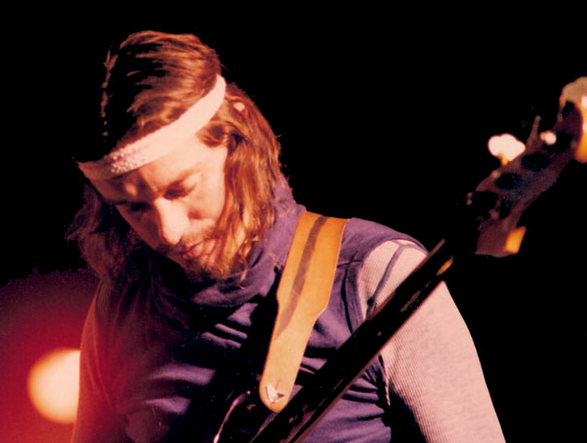
Image by Pino Alpino, via Wikimedia Commons
Of this video—an hour and a half long bass lesson and interview with the late, great jazz bassist Jaco Pastorius—one youtube commenter writes, “this isn’t a bass lesson… this is a bass humiliation!” It’s an apt description—for the aspiring player of any instrument, watching Pastorius at work is a humbling experience. Even Jerry Jemmott, no slouch on the instrument, seems a little overwhelmed as he interviews Jaco. But the articulate—and personally troubled—bassist was a humble guy, more than willing to share his skills and knowledge. As a player, composer, and producer, Pastorius towered over other progressive jazz players in the 70s and 80s, accompanying names like Pat Metheny and Wayne Shorter. He was also a member of fusion powerhouse Weather Report, a solo artist, and one of the most in-demand session players and producers of his time.
While bass players get too little recognition in rock, in jazz, the instrument has always commanded a degree of respect. But Pastorius took electric jazz bass to a place that belongs entirely to him, playing bass and melody parts at once on the instrument and incorporating mind-blowingly nimble solos and high runs into original compositions and standards alike. I came to Pastorius late in my musical education thanks to his influence on English bassist and electronic producer Squarepusher (Tom Jenkinson), who, since the mid-nineties, has fused his own frenetic Pastorius-like bass licks with the stutter and clatter of drum-and-bass. In 2009, Squarepusher had the effrontery to release a live solo album consisting only of electric bass compositions, a move that would have been impossible without Pastorius’ precedent-setting solo work. Pastorius turned the electric bass into a lead instrument. His first solo album, the self-titled Jaco Pastorius (1976), broke ground with original compositions for bass guitar and bass transcriptions of songs like Charlie Parker’s “Donna Lee.” At that time, no one had heard anything like it.
Pastorius, who suffered from bipolar disorder, died of wounds sustained in a bar fight on September 21st, 1987. In honor of the 25th anniversary of his death, revisit the man and his method in the video above, and geek out to Jaco’s live performance at the 1982 Montreal Jazz Festival.
Josh Jones is a doctoral candidate in English at Fordham University and a co-founder and former managing editor of Guernica / A Magazine of Arts and Politics.
Read More...David Lynch Teaches Louis C.K. How to Host The David Letterman Show
As Season 3 of Louie winds to a close, we find things looking up for the hapless Louis CK. The head of CBS invites Louie to his office and gives him a career-defining opportunity, the chance to take over the Late Show from a retiring David Letterman. But that is all predicated on one thing — the schlumpy comedian becoming a polished late-night talk show host in a few short months. And the man tasked with helping Louie make the transition is none other than David Lynch, playing the role of “Jack Dahl.” Jerry Seinfeld, Chris Rock, and Jay Leno all make appearances in this episode. But make no mistake, it’s Lynch, the only non-comedian of the bunch, who provides the biggest laughs.
https://www.youtube.com/watch?v=Qob3FTPJ7cM
Related Content:
Seinfeld, Louis C.K., Chris Rock, and Ricky Gervais Dissect the Craft of Comedy (NSFW)
Read More...Thelonious Monk Creates a List of Tips for Playing a Gig: “Don’t Listen to Me, I Am Supposed to Be Accompanying You!”
We’re fascinated by lists. Other people’s lists. Even the ones left behind in shopping carts are interesting (Jarlsburg, Gruyere and Swiss? Must be making fondue.) But it’s the lists made by famous people that are the really good stuff.
It’s fun to peek into the private musings of people we admire. Johnny Cash’s “To Do” list sold for $6,400 at auction a couple of years ago and inspired the launch of Lists of Note, an affectionate repository of personal reminders, commandments and advice jotted by celebrities and other notables.
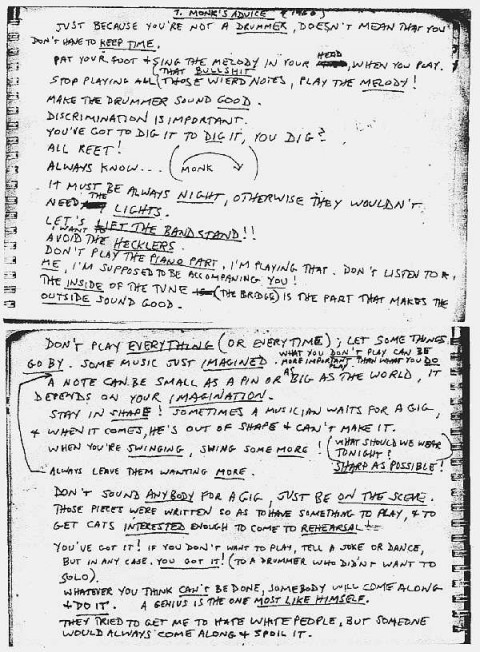
Most of the site’s best lists are in the “memo to self” category, some with tongue in cheek and others in earnest. But a few offer advice to others. Transcribed by soprano sax player Steve Lacy in a spiral-bound notebook, Thelonious Monk created a primer of do’s and don’ts for club musicians. For the greenhorns, Monk presented a syllabus for Band Etiquette 101 titled “1. Monk’s Advice (1960).” For the rest of us, it’s a view into one of the greatest, quirkiest minds of American music.
Some highlights:
“Don’t play the piano part. I’m playing that. Don’t listen to me. I’m supposed to be accompanying you!”
Monk himself was famous for his eccentricity—some say he was mentally ill and others blame bad psychiatric medications. He was known to stop playing piano, stand up and dance a bit while the band played on. But through his advice he reveals his fine sense of restraint.
“Don’t play everything (or every time); let some things go by. Some music just imagined. What you don’t play can be more important than what you do.”
Monk was evidently a stickler for band protocol. He leads his list with “Just because you’re not a drummer doesn’t mean that you don’t have to keep time!”
What should players wear to a gig? Definitively cool, Monk replies “Sharp as possible!” Read that as rings on your fingers, a hat, sunglasses and your best suit coat.
Here’s a transcript of the text:
- Just because you’re not a drummer, doesn’t mean that you don’t have to keep time.
- Pat your foot and sing the melody in your head when you play.
- Stop playing all that bullshit, those weird notes, play the melody!
- Make the drummer sound good.
- Discrimination is important.
- You’ve got to dig it to dig it, you dig?
- All reet!
- Always know
- It must be always night, otherwise they wouldn’t need the lights.
- Let’s lift the band stand!!
- I want to avoid the hecklers.
- Don’t play the piano part, I am playing that. Don’t listen to me, I am supposed to be accompanying you!
- The inside of the tune (the bridge) is the part that makes the outside sound good.
- Don’t play everything (or everytime); let some things go by. Some music just imagined.
- What you don’t play can be more important than what you do play.
- A note can be small as a pin or as big as the world, it depends on your imagination.
- Stay in shape! Sometimes a musician waits for a gig & when it comes, he’s out of shape & can’t make it.
- When you are swinging, swing some more!
- (What should we wear tonight?) Sharp as possible!
- Always leave them wanting more.
- Don’t sound anybody for a gig, just be on the scene.
- Those pieces were written so as to have something to play & to get cats interested enough to come to rehearsal!
- You’ve got it! If you don’t want to play, tell a joke or dance, but in any case, you got it! (to a drummer who didn’t want to solo).
- Whatever you think can’t be done, somebody will come along & do it. A genius is the one most like himself.
- They tried to get me to hate white people, but someone would always come along & spoil it.
Kate Rix is an Oakland-based freelancer. Find more of her work at .
Read More...Seinfeld, Louis C.K., Chris Rock, and Ricky Gervais Dissect the Craft of Comedy (NSFW)
Recorded and aired last year, HBO’s Talking Funny is an hour long, unscripted sit-down with four of the biggest names in comedy—Ricky Gervais, Jerry Seinfeld, Chris Rock, and Louis C.K.. If you’re familiar with the work of any or all of these guys, you know you’re in for a little profundity and a lot of profanity. This is definitely, I repeat, not safe for work, and not safe for anyone who takes offense easily. They go to some pretty nervy places, but that’s what we’ve come to expect from these four. Well, three actually. Seinfeld comes in for some good-natured ribbing for an entire career of working “clean,” dropping an f‑bomb maybe once or twice in his act, ever.
So, if you can take the strong language that pops up occasionally–albeit in very reflective and hilarious ways that I argue diffuse tension and aren’t in the least bit mean-spirited–then you will be rewarded by a conversation between four highly accomplished actors and comedians who love to talk about their craft, compare war stories, deconstruct their comic personae, and express genuine appreciation for each other’s work. But as soon as the conversation seems to get too heady or sentimental, it’s back to sick humor and insults. There’s something of the insecure ten-year old boy in each of these guys, who tend to use comedy as a defensive weapon to fend off pain and sadness without running away from either one; it works differently in each comic, and it’s fascinating to watch.
Gervais is especially thoughtful about his responsibility to the audience (after some initial bravado), which comes as some surprise considering his usual role as an oblivious ass. Seinfeld, the elder statesman, gets some deference from the others, but even at 57 is still boyish and slightly corny. Rock and C.K. are two of the smartest comics of their generation and also two of the most profane, but again, I think they pull it off because they are also two of the most honest and least threatening men to ever grace a stage—C.K. the self-deprecating sad sack and Rock the diminutive class clown with a perpetual impish grin. Make up your own mind about the touchy subjects, or avoid them altogether, but overall, I think each of these comedians comes across as lovable precisely because they’re willing to be themselves, vulnerabilities, childish insults, sweaty male ids, and all. They might make it look easy, but this is work for professionals.
Related Content:
How the Great George Carlin Showed Louis CK the Way to Success (NSFW)
“Learn English With Ricky Gervais,” A New Podcast Debuts (NSFW)
Comedians in Cars Getting Coffee: Jerry Seinfeld’s News Series Debuts on the Web
Josh Jones is a doctoral candidate in English at Fordham University and a co-founder and former managing editor of Guernica / A Magazine of Arts and Politics.
Read More...Two Legends Together: A Young Bob Dylan Talks and Plays on The Studs Terkel Program, 1963
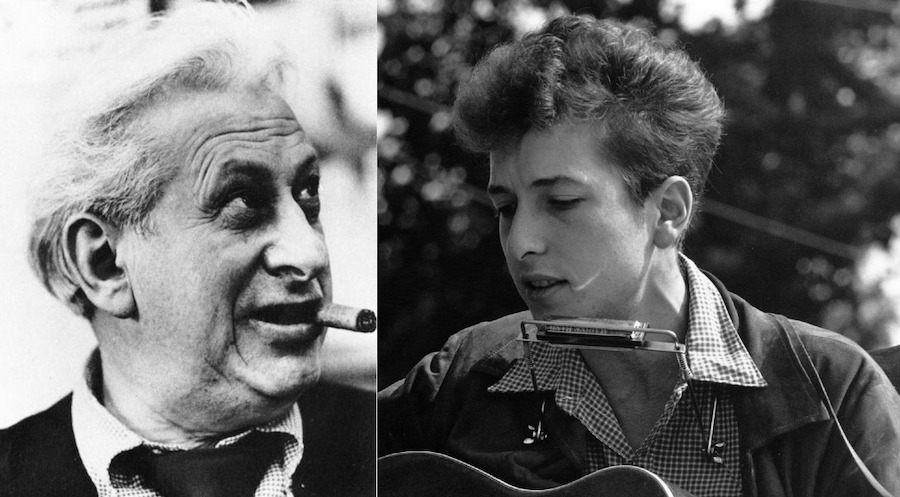
In the spring of 1963 Studs Terkel introduced Chicago radio listeners to an up-and-coming musician, not yet 22 years old, “a young folk poet who you might say looks like Huckleberry Finn, if he lived in the 20th century. His name is Bob Dylan.” (Listen to the interview below.)
Dylan had just finished recording the songs for his second album, The Freewheelin’ Bob Dylan, when he traveled from New York to Chicago to play a gig at a little place partly owned by his manager, Albert Grossman, called The Bear Club. The next day he went to the WFMT studios for the hour-long appearance on The Studs Terkel Program. Most sources give the date of the interview as April 26, 1963, though Dylan scholar Michael Krogsgaard has given it as May 3.
Things were moving fast in Dylan’s life at that time. He was just emerging as a major songwriter. His debut album from the year before, Bob Dylan, was made up mostly of other people’s songs. The Freewheelin’ Bob Dylan, which was finished but hadn’t yet been released, contained almost all original material, including several songs that would become classics, like “Blowin’ in the Wind,” “Don’t Think Twice, It’s All Right” and “A Hard Rain’s a Gonna Fall.” Within a few months Dylan would make his debut at the Newport Folk Festival and perform at the historic March on Washington. But when Dylan visited WFMT, it’s likely that many of Terkel’s listeners had never heard of him. In the recorded broadcast he plays the following songs:
- Farewell
- A Hard Rain’s a‑Gonna Fall
- Bob Dylan’s Dream
- Boots of Spanish Leather
- John Brown
- Who Killed Davey Moore?
- Blowin’ In The Wind
Dylan tells Terkel that “A Hard Rain’s a Gonna Fall” is not about atomic fallout, even though he wrote the song in a state of anxiety during the Cuban missile crisis. “No, it’s not atomic rain,” Dylan says, “it’s just a hard rain. It isn’t the fallout rain. I mean some sort of end that’s just gotta happen.… In the last verse, when I say, ‘the pellets of poison are flooding their waters,’ that means all the lies that people get told on their radios and in their newspapers.”
But as the conversation progresses it becomes clear that the motivation behind Dylan’s comments isn’t to dispel myths or to clear up any of the “lies that people get told on their radios.” Rather, he’s driven by his life-long dread of being pigeonholed by others. Dylan is happy to spread his own myths. At one point he tells Terkel a “stretcher” that would have made Huckleberry Finn proud: He claims that when he was about ten years old he saw Woody Guthrie perform in Burbank, California. Regardless of its factuality, the Dylan-Terkel interview is an entertaining hour, a fascinating window on the young artist as he was entering his prime. You can stream it here.
If you would like to support the mission of Open Culture, consider making a donation to our site. It’s hard to rely 100% on ads, and your contributions will help us continue providing the best free cultural and educational materials to learners everywhere. You can contribute through PayPal, Patreon, and Venmo (@openculture). Thanks!
Read More...Support Us
We're hoping to rely on loyal readers, rather than erratic ads. Please click the Donate button and support Open Culture. You can use Paypal, Venmo, Patreon, even Crypto! We thank you!

About Us

Open Culture scours the web for the best educational media. We find the free courses and audio books you need, the language lessons & educational videos you want, and plenty of enlightenment in between.
Advertise With Us

FREE UPDATES!
GET OUR DAILY EMAIL
Get the best cultural and educational resources on the web curated for you in a daily email. We never spam. Unsubscribe at any time.
FOLLOW ON SOCIAL MEDIA

Open Culture editor Dan Colman scours the web for the best educational media. He finds the free courses and audio books you need, the language lessons & movies you want, and plenty of enlightenment in between.
Advertise With Us


