Peter Sellers Gives a Quick Demonstration of British Accents
A while ago we brought you a hilarious series of recordings of the British comedic actor Peter Sellers reading The Beatles’ “She Loves You” in four different accents. Today we have a brief clip from a telephone call by Sellers on the set of Stanley Kubrick’s 1964 film Dr. Strangelove or: How I Learned to Stop Worrying and Love the Bomb (in which Sellers played three different roles). Here he demonstrates the nuances of a few of the many accents around Great Britain. From cockney to upper class and from London to Edinburgh, it’s classic Sellers all the way.
Related content:
Peter Sellers: His Life in Home Movies
Peter Sellers Performs The Beatles in Shakespearean Mode
Read More...Great Cinema Discussed Director By Director on The Auteurcast
Few propositions in film scholarship inspire as much controversy as the so-called “auteur theory,” which holds that a film’s director imbues the work with its strongest and most identifiable creative influence. Some consider this notion laughably implausible; others consider it untouchably self-evident. But even if you don’t fully buy into this auteur-centrism — and it can’t hurt to throw down a fistful of salt before the entire edifice of film theory — you can still use it as a helpful tool to navigate the realm of cinema, especially if most of it remains terra incoginta to you. Say you happen onto a movie you enjoy — Full Metal Jacket, for instance — and find out it was directed by a certain Stanley Kubrick. You could then do much worse for additional viewing material than to watch everything else the man ever directed.
As for accompaniment in this cultural journey, you could do much worse than Rudie Obias and West Anthony, hosts of The Auteurcast. Taking one filmmaker at a time, they watch and discuss every movie that filmmaker has made. Of course they’ve covered Stanley Kubrick: you can listen to their conversation on Full Metal Jacket right above, and I myself joined them as a guest when they talked about A Clockwork Orange. Having put out 136 episodes so far, Obias and Anthony have recently made their way to two auteurs as seemingly on the opposite ends of a spectrum (though exactly what spectrum, I can’t say for sure) as James Cameron, he of Titanic and Avatar, and Paul Thomas Anderson, he of Magnolia, There Will Be Blood, and (to be discussed in an upcoming episode) The Master. To catch up on The Auteurcast as you catch up on cinema itself, you can download all of their past episodes as a torrent, then subscribe via RSS or iTunes.
Related content:
500 Free Movies Online: Great Classics, Indies, Noir, Westerns, etc.
Colin Marshall hosts and produces Notebook on Cities and Culture. Follow him on Twitter at @colinmarshall.
Read More...Philosopher Slavoj Zizek Interprets Hitchcock’s Vertigo in The Pervert’s Guide to Cinema (2006)
Philosopher and psychoanalyst Slavoj Zizek is a polarizing figure, in and out of the Academy. He has been accused of misogyny and opportunism, and a Guardian columnist once wondered if he is “the Borat of philosophy.” The latter epithet might be as much a reference to his occasional boorishness as to his Slovenian-accented English. Despite (or because of) these qualities, Zizek has become a fascinating public intellectual, in part because all of his work is shot through with pop culture references as diffuse as the most studied of fanboys. And even though Zizek, a student of the Freudian theorist Jacques Lacan, can get deeply obscure with the best of his peers, his enthusiasm and rapid-fire free-associations mark him as a true fan of everything he surveys.
The Zizek I just described is fully in evidence in the short clip above from the three-part documentary The Pervert’s Guide to Cinema. Directed by Sophie Fiennes (sister of Joseph and Ralph), The Pervert’s Guide places Zizek in original locations and replica sets of several classic films—David Lynch’s Blue Velvet, Stanley Kubrick’s Eyes Wide Shut, and Hitchcock’s Vertigo, to name just a few. Zizek’s scenes of commentary are edited with scenes from the films to give the impression that he is speaking from within the films themselves. It’s a novel approach and works particularly well in the video above, where Zizek gives us his take on Vertigo. As he says of Hitchcock’s film—which could apply to the one he is in as well—“often things begin as a fake, inauthentic, artificial, but you get caught in your own game.” Viewers of The Pervert’s Guide get caught in Zizek’s interpretive game; it’s a fascinating, ridiculous, and unsettling one.
In the clip, through a series of close analyses of plot points and camera angles, Zizek concludes that Vertigo is the realization of a male fantasy, which necessarily involves violence and nightmarish transformations. In the “male libidinal economy,” he says, in the jargon‑y psychoanalytic speak of his trade, women must be “mortified” before they are acceptable sexual partners. Slipping out of academic argot, he clarifies: “to paraphrase an old saying, the only good woman is a dead woman.” It’s this kind of blunt and utterly unsentimental way of speaking that raises the hackles of some of Zizek’s critics. But I’m not here to defend him. Watching (and reading) him for me is a game of edge-of-your seat “what outrageous or incomprehensible thing is he going to say next?” and I’ll admit, I enjoy it. So I’ll leave you with a final Zizek-ism. Perhaps it will scare you off for good, or perhaps you’re game for a few more rounds of “perversion” with this encyclopedic critic of the self, the social, and the sexual:
“A subject,” says Zizek, “is a partial something, a face, something we see. Behind it, there is a void, a nothingness. And of course, we spontaneously tend to fill in that nothingness with our fantasies about the wealth of human personality and so on, and so on. To see what is lacking in reality, to see it as that, there you see subjectivity. To confront subjectivity means to confront femininity. Woman is the subject. Masculinity is a fake.”
You can watch the film in its entirety here.
via Biblioklept
Related Content:
Žižek!: 2005 Documentary Reveals the “Academic Rock Star” and “Monster” of a Man
Good Capitalist Karma: Zizek Animated
Slavoj Žižek: How the Marx Brothers Embody Freud’s Id, Ego & Super-Ego
Josh Jones is a doctoral candidate in English at Fordham University and a co-founder and former managing editor of Guernica / A Magazine of Arts and Politics.
Read More...Regina Spektor Live in L.A. — A Free 30 Minute Set with Songs from Her New Album
Regina Spektor’s sixth studio album, What We Saw From The Cheap Seats, is out. That means we’re hearing a lot more from the singer-songwriter whose music took form in the East Village of New York City. Several weeks back, Spektor gave a thoughtful interview on NPR’s Fresh Air, where, among other things, she recalled the discrimination her family faced in the Soviet Union and her childhood immigration to the United States. Now, we’re catching up with her in Southern California — at Apogee’s Berkeley St. Studios in L.A., to be precise — where Spektor played an intimate concert featuring songs from the new album. Catch one song, “The Party,” right above, and the complete 30-minute session here. If you have a decent internet connection, I’d skip to the HD version and enjoy. Kudos to KCRW for making this available.
h/t @opedr
Read More...Reef View: Google Gives Us Stunning Underwater Shots of Great Coral Reefs
Most of us have looked up our own addresses using Google Street View. But have you ever wished you could virtually dive right into the ocean, lake or river near your home?
It may not be long until you can. Google has taken its Street View model, complete with directional arrows and swipe-controlled scaling, and plunged into the watery universe.
In a collaboration with a major scientific study of the ocean, Street View now includes panoramic views of six of the world’s living coral reefs. These images, shot using a special camera, allow us to zoom in and see schools of fish and sea turtles make their way over the sea floor off the coast of Australia’s Heron Island. Check out the shape and texture of this ancient volcanic rock near Apo Island in the Philippines.
Above the Molokini Crater near Maui you might be surprised to stumble upon some other snorklers.
Scooting along is amazingly fun and the photographic clarity is incredible. Take a cool swim with a manta ray and an underwater photographer off the Great Barrier Reef. It really does feel like you’re there—only you’re not (and the Google watermarks bring you back to reality ).
View Larger Map
Photos come courtesy of the Catlin Seaview Survey, an international study of the oceans. Researchers use a continual 360 degree panoramic camera to capture underwater images. In deeper trenches, they send the camera down on robots.
Scientists with the study say that some 95 percent of the ocean still hasn’t been seen by the human eye. Short of traveling to all these spots ourselves, this may be our best chance to bring that number down.
Related Content:
Perpetual Ocean: A Van Gogh-Like Visualization of our Ocean Currents
Google Street View Opens Up a Look at Shackleton’s Antarctic
Tour the Amazon with Google Street View; No Passport Needed
Google Art Project Expands, Bringing 30,000 Works of Art from 151 Museums to the Web
Kate Rix is an Oakland-based freelance writer. See more of her work at .
Read More...Johnny Cash: The Man, His World, His Music
Johnny Cash once called 1968 the happiest year of his life. It was the year his masterpiece At Folsom Prison came out, the year he was named the Country Music Association’s Entertainer of the Year, and the year he married the love of his life, June Carter. So it was a fortunate time for a young filmmaker named Robert Elfstrom to meet up with Cash for the making of a documentary.
Elfstrom traveled with Cash for several months in late 1968 and early 1969. The resulting film, Johnny Cash: The Man, His World, His Music, is a revealing look at Cash, his creative process and his ties to family. Elfstrom followed along on a tour that took Cash and his group (including, at different times, Chet Atkins and the Carter Family singers) to a wide range of places, including a prison, an Indian reservation and Cash’s own native soil in the American South. Cash and Carter visit his parents and other family members, and in one moving scene Cash returns to his abandoned childhood home in Dyess, Arkansas, a cotton farming town that was created under President Franklin D. Roosevelt’s New Deal program in the 1930s to give poor families a chance to start over.
The film gives some sense of the complexity of Cash’s personality. There is one scene near the beginning, for example, in which Cash goes hunting and wounds a crow. He then cradles the injured bird in his hands and talks friendly to it. “That scene, to me, says a lot about who Johnny Cash is,” Elfstrom told PBS in a 2008 interview. “John was not always warm and fuzzy like a panda bear all the time. He’s like that part of the time, but he also has a sharp edge and steeliness to him.” Elfstrom went on to describe the situation:
One day, we were hanging out in his house, and he said, “I want to go hunting.” He grabbed his shotgun and was walking through the land around his house when he spied a crow and whipped off a shot. John was a dead shot, so he wounded the crow, and the bird hit the ground. When he picked up the crow, you could feel that something was going through John’s head; he’d almost killed something that maybe he shouldn’t have, and he felt badly about it, but that instinct to hunt and wound was a part of him too. So John carried the crow and sat down in the shade, and I could see he was kind of pissed off at himself. I kept some distance from him, and the next thing I knew, he was writing a song to the crow.
One of the most striking things about Elfstrom’s film is the way it manages, despite the constraints of the cinéma vérité form, to connect the events of Cash’s life to his music. For example, at one point Cash is walking through the barren village of Wounded Knee in South Dakota, listening to the story of the massacre of 1890 from one of the descendants of the victims, and in the next scene he is singing “Big Foot,” his song about the tragedy. The film shows Cash’s generosity toward unknown musicians. It also offers a glimpse of his close friendship with the young Bob Dylan. When Cash and Dylan got together in February of 1969 for a recording session in Nashville, Elfstrom was there. He documented the scene as the two men recorded Dylan’s “One Too Many Mornings.” Elfstrom told PBS:
John and Bob had gotten close at that point. John was saying, “Gee, I wish Bob would move down here to Tennessee. I’ve got a lot of land, and we could be neighbors!” So that was fascinating. We recorded the two of them very late at night, and they were doing a duet of one of Dylan’s songs. In the middle of the song, both John and Bob forgot the lyrics. So the recording session stopped while people scampered around the Columbia Records building trying to find the lyrics to a Bob Dylan song. When the lyrics were finally found, the two of them got together again and did some great recording. It was really an amusing session because John and Bob were teasing each other all the time.
The film was originally named Cash, and was slightly longer than the version above. In 2008 it was re-edited and renamed Johnny Cash: The Man, His World, His Music for broadcast on PBS. It’s a revealing portrait of the country music legend, but Elfstrom allowed his subject certain areas of privacy. In particular he avoided documenting Cash’s well-known addiction to drugs. “Even back then, the powers-that-be wanted me to emphasize the substance abuse stuff, and I had to fight the entire time to stay clear of that,” said Elfstrom. “I didn’t want that pollution to confuse the message of what John was doing. I was totally willing to take John at face value, and I think he himself recognized that early on and trusted me. He was a man struggling through life like all of us, doing his best, trying to come out on top.”
Johnny Cash: The Man, His World, His Music will be added to our collection of 500 Free Movies Online.
Read More...The Illustrated Guide to a Ph.D.
Matthew Might, a computer science professor at the University of Utah, writes: “Every fall, I explain to a fresh batch of Ph.D. students what a Ph.D. is. It’s hard to describe it in words. So, I use pictures.” It’s September 26. That means fall is here again, and it’s time to bring you an encore presentation of Matt’s Illustrated Guide to the PhD. Have a look, and you’ll see the whole undertaking in a less hubristic way:
Imagine a circle that contains all of human knowledge:

By the time you finish elementary school, you know a little:

By the time you finish high school, you know a bit more:

With a bachelor’s degree, you gain a specialty:

A master’s degree deepens that specialty:

Reading research papers takes you to the edge of human knowledge:

Once you’re at the boundary, you focus:

You push at the boundary for a few years:

Until one day, the boundary gives way:

And, that dent you’ve made is called a Ph.D.:

Of course, the world looks different to you now:

So, don’t forget the bigger picture:

Keep pushing.
You can find Matt’s Illustrated Guide hosted on his web site. This guide/reality check is published under a Creative Commons License. You can also buy a print version for $6.50. (The money goes to charity.) Matt offers more insights for Ph.D. students here.
Read More...Federico Fellini Introduces Himself to America in Experimental 1969 Documentary
Today, if you want an introduction to a filmmaker like Federico Fellini, you’ll most likely just look him up on Wikipedia. In 1969, you wouldn’t have had quite so convenient an option, though were you an NBC-watching American, you might have caught a broadcast of Fellini: A Director’s Notebook. Directed by Fellini himself at the behest of NBC producer Peter Goldfarb, the fifty-minute documentary (now added to our collection of 500 Free Movies Online) follows the Italian auteur as he peripatetically seeks out inspiration for his current and future projects. Among these, we hear about Satyricon, one of his immortal works, and about The Voyage of G. Mastoma, which stalled before it even reached mortality. Consorting with hippies in a field, taking a spirit medium down into the “catacombs” of the Rome Metro, dropping in on favorite actor/counterpart Marcello Mastroianni, and receiving a stream of visiting eccentrics in his office, Fellini narrates his own thoughts about his directorial process. It seems to come down to searching for the right atmospheres — the obscure, the foreign, the desperate, the bizarre — and taking them in.
Fellini: A Director’s Notebook provides what Fellini called a “semihumorous introduction” to the director, his work, and the environment of frowning absurdism that seemed to encircle him wherever he went. But with its frequent language-shifting, its often dark and vaguely troubling imagery, its air of simultaneous asexuality and indiscriminate louchness, and its obviously deliberate craft, the film would seem to fall into the territory between forms. But if it feels too elaborate, artificial, and studded with half-glimpsed grotesques to count as a straightforward portrait of an artist, Fellini’s films set themselves apart to this day with their thorough possession of those same qualities. Cultural history has not recorded in much detail how the average American home viewer of 1969 handled this plunge into the viscous essence of Fellini. But I’ll bet every single one who enjoyed it immediately marked their calendars, if surreptitiously, to go check out the man’s interpretation of Petronius.
Related content:
Fellini’s Fantastic TV Commercials
Colin Marshall hosts and produces Notebook on Cities and Culture. Follow him on Twitter at @colinmarshall.
Read More...Hand Lettering Bob Dylan’s Lyrics to “Subterranean Homesick Blues”
If you’ve ever seen D.A. Pennebaker’s classic 1967 documentary Don’t Look Back (or even if you haven’t), you know the famous scene — Bob Dylan fliping through cue cards as the dizzying lyrics of “Subterranean Homesick Blues” flow by, all while poet Allen Ginsberg and singer Bob Neuwirth make cameo appearances in the background. (Watch it below.) This innovative clip has since inspired countless tribute videos by the likes of Steve Earle, the rapper Evidence, “Weird Al” Yankovic, Google, and the 1992 film Bob Roberts. Now comes the latest riff on the iconic footage by designer/illustrator Leandro Senna. He gives us “Bob Dylan’s Hand Lettering Experience,” a video that stitches together 66 hand-designed cards, each made with only pencil, black tint pens and brushes. No technological enhancements or retouching were allowed. On Senna’s web site, you can see each and every card in a larger format.
via BoingBoing
Read More...The Big Ernest Hemingway Photo Gallery: The Novelist in Cuba, Spain, Africa and Beyond
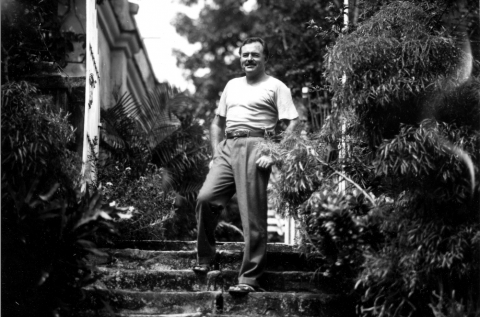
We associate Ernest Hemingway with foreign locales: Spain, Italy, Paris, Africa and Cuba. He may be the definitive peripatetic writer, famously hauling his manuscripts-in-progress around the world while soaking in enough material for the next book.
Lucky for us Hemingway may also be one of the most photographed writers of his generation. The photographs in the Ernest Hemingway Collection take us into a mid-century world where writers, actors, political leaders and beautiful jet-setters mingled on patios and yachts at ease before the camera. These were the days before paparazzi started hiding in bushes.
The collection is available to us with a typical Hermingway-esque story attached. When he died in 1961 in Idaho, most of his personal effects were still in Cuba. Heminway lived for 20 years in the Finca Vigia, a home he bought with the royalties from For Whom the Bell Tolls. It was at Finca Vigia that he wrote The Old Man and the Sea. Rather than writing in the workshop that his wife Mary had built for him there, he used the bedroom, leaving the new room for his numerous pet cats to use.
At the time of his death, American travel into Cuba was banned. However President Kennedy made special arrangements for Hemingway’s widow Mary to return to Finca Vigia and retrieve his personal belongings. Years later, the John F. Kennedy Presidential Library and Museum received the materials, including more than 10,000 photographs, books from Hemingway’s private library (including A Draft of XVI Cantos signed by Ezra Pound) and the hand-written sailing log Hemingway kept of his travels aboard Pilar. The photographs are now organized chronologically and geographically: Early Years 1899–21; Paris Years 1922–1930; Wars 1917–1945; Key West Years 1928–1939; Idaho Years 1939–1960; Africa 1933–1934 and Africa 1953–1954; Europe 1948–1959; Cuba Years 1939–1960; and Spain 1953–1960.
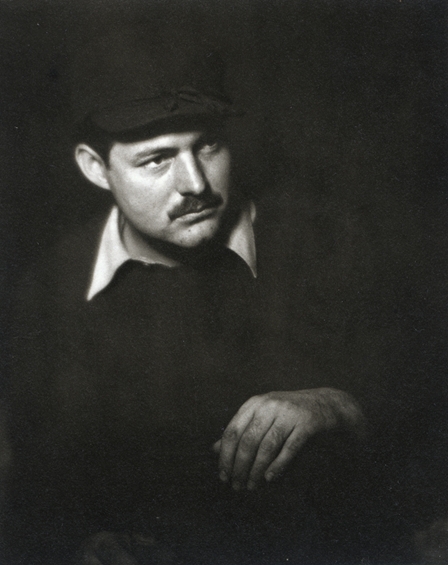
Hemingway was in Paris when he sat for this portrait in March, 1928. The photographer, Helen Pierce Breaker, was a friend and had been a bridesmaid in Hemingway’s wedding to his first wife, Hadley.
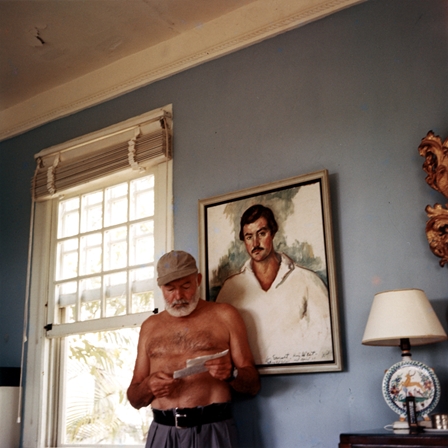
By the early 1950s, Hemingway was living in Cuba. The painting behind him here at Finca Vigia is a portrait of himself by Waldo Peirce titled Kid Balzac.
Kate Rix is an Oakland-based freelance writer. Find more of her work at .
Read More...Support Us
We're hoping to rely on loyal readers, rather than erratic ads. Please click the Donate button and support Open Culture. You can use Paypal, Venmo, Patreon, even Crypto! We thank you!

About Us

Open Culture scours the web for the best educational media. We find the free courses and audio books you need, the language lessons & educational videos you want, and plenty of enlightenment in between.
Advertise With Us

FREE UPDATES!
GET OUR DAILY EMAIL
Get the best cultural and educational resources on the web curated for you in a daily email. We never spam. Unsubscribe at any time.
FOLLOW ON SOCIAL MEDIA

Open Culture editor Dan Colman scours the web for the best educational media. He finds the free courses and audio books you need, the language lessons & movies you want, and plenty of enlightenment in between.
Advertise With Us

