Metamorphose: 1999 Documentary Reveals the Life & Work of Artist M.C. Escher
Made in 1999 by Dutch director Jan Bosdriesz, the documentary Metamorphose: M.C. Escher, 1898–1972 takes its title from one of Escher’s more well-known prints in which the word “metamorphose” transforms itself into patterns of abstract shapes and animals. It’s one of those college-dorm prints one thinks of when one thinks of M.C. Escher, and it’s wonderful in its own way. But the documentary reveals other sides of the artist—his art-school days, his sojourn in Italy—that produced a very different kind of work. Escher began as a student of architecture, enrolled in the School for Architecture and Decorative arts in Haarlem by his parents, who struggled to help him find his way after he failed his high school exams.
Once in Haarlem, the lonely and somewhat morose Escher finds himself drawn to graphic art instead. One of his teachers, accomplished Dutch artist Samuel Jessurun de Mesquita, whose influence is evident in Escher’s work and life, sees some of Escher’s linocuts and likes them. In archival footage of an interview with Escher, the artist says that Jessurun de Mesquita asked him, “Wouldn’t you rather be a graphic artist instead of an architect?”
Escher admits, “I wasn’t all that interested in architecture.” It’s a little bit of a surprising admission given Escher’s wild architectural imagination, but perhaps what he meant was that he wasn’t interested in the conventional, but rather in the architecture of the fantastic, the impossible spaces he imagined in much of his work.
We learn other things about Escher: One of his woodcuts from this period is titled “Never Think before You Begin,” showing a lonely figure on a dark and treacherous path with only a tiny light to guide him, a representation of Escher’s decision to pursue graphic art. The narrator informs us that “it took more than thirty years for him to earn enough from his work to live on.” Luckily, as with many artists who struggle for years, Escher had rich parents. We can thank them for their patronage. To give you some idea of Escher’s morbid character, we learn that he chose the topic “Dance of Death” for a three-hour lecture to his fellow art students in Haarlem. Escher told them, “The dance of death and life are two expressions with the same meaning. What else do we do other than dance death into our souls?”
Metamorphose is an impressive documentary, beautifully shot and edited, with a balance of stock footage of the period, interviews with the artist himself, and long, lingering shots of his work. The film covers Escher’s entire artistic life, ending with footage of the artist at work. These “last images” of Escher, the narrator says, “are not gloomy. We see an artist in his studio, doing the things he enjoys,” a man “proud of his success.” At the end of his life, he still honored his teacher, de Mesquita, and the South Italian coast that sheltered him during his formative years.
Related Content:
Mathematics Made Visible: The Extraordinary Art of M.C. Escher
Inspirations: A Short Film Celebrating the Mathematical Art of M.C. Escher
Josh Jones is a doctoral candidate in English at Fordham University and a co-founder and former managing editor of Guernica / A Magazine of Arts and Politics.
Read More...Hundreds of Fans Collectively Remade Star Wars; Now They Remake The Empire Strikes Back
Forget gravity. Forget even irony. The universe knows no greater force, as it were, than the collective enthusiasm of Star Wars fans. 35 years after the first of them came out, the films’ power to inspire remains unsettlingly immediate and widespread. Or at least that goes for the original trilogy of Star Wars movies, the first of which, A New Hope, underwent a popular fan-made remake in 2009. The result, Star Wars Uncut, didn’t come as the project of a single enterprising aficionado plopping himself into the George Lucas seat, but as a fully “crowd-sourced” motion picture assembled out of fifteen-second clips shot by contributors called to action by one Casey Pugh. The hypnotic result, whose final cut first screened earlier this year and which you can watch above, offers Star Wars as patchwork quilt, the construction of its squares ranging from deliberately lo-fi (not to mention non-deliberately lo-fi) to surprisingly credible.
With one down, the next two of those beloved movies await. The Empire Strikes Back Uncut, whose trailer appears just above, has now officially opened to contributors, who can claim a fifteen-second segment of their own to re-create. They get thirty days to submit the fruit of their cinematic labors, and then the entire film re-opens to accept another round of submissions. This might seem like the kind of irreverent homage that would irk the creator of the original, but Lucasfilm has actually endorsed the project this time around. Will their involvement extinguish the underground scrappiness of the earlier effort? Will fans choke under the awesome responsibility of reinterpreting The Empire Strikes Back, that most respected of all Star Wars properties? They’re questions of import to a true believer, though that believer might take solace in the top-voted reaction in Star Wars Uncut’s YouTube comments: “Still better than The Phantom Menace.”
via MetaFilter
Related content:
Star Wars Retold with Paper Animation
Colin Marshall hosts and produces Notebook on Cities and Culture. Follow him on Twitter at @colinmarshall.
Read More...Read Joyce’s Ulysses Line by Line, for the Next 22 Years, with Frank Delaney’s Podcast
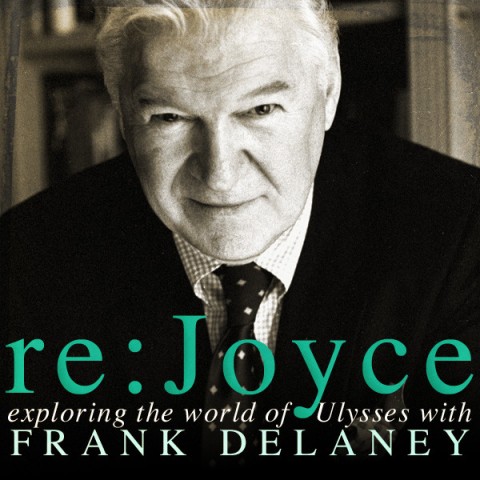
If you need someone to host a multi-decade podcast on James Joyce’s Ulysses, then why settle for less than the most eloquent man in the world? Visit Frank Delaney’s site, and you’ll find it less than shy about proclaiming that National Public Radio once dubbed him just that. A prolific man of letters, Delaney has in his 42-year-long career logged time as a newsreader, book journalist, interviewer, Edinburgh Festival Literature Director, talk show host, Man Booker Prize judge, radio broadcaster, novelist, and historian. In 1981, his book James Joyce’s Odyssey brought his surpassing enthusiasm for Joyce scholarship to public attention, and it took a whole new form on, appropriately enough, Bloomsday 2010, when Delaney added the title of podcaster to his résumé by launching Re: Joyce (iTunes — RSS). The show operates on a simple concept: each Wednesday, Delaney deconstructs a piece of Ulysses, usually for four to fifteen minutes. This will run, so the plan goes, for the next twenty-two years.
An ambitious project, certainly, but I find that podcasting, especially literary podcasting, could always use a little more ambition. “Why?” Delaney asks of the show on its debut episode. “Well, why not? You could say, ‘Why bother?’ And I would say, for the sheer fun of it. Because this is a book that has engrossed and delighted me for most of my adult life, and I know the enjoyment to be had from it. And I also know that such enjoyment has been denied to many, many people who would read Ulysses if they weren’t so daunted by it, and indeed, who tried to read it but had to give up. How do I know this? Because I was one of them.” If this sounds a little like the script of an infomercial, Delaney embraces the sensibility, labeling Re: Joyce his “infomercial for Ulysses.” As far as eloquence — and erudition, not to mention richness of subject matter — he’s certainly surpassed Ron Popeil.
You can download the podcast from iTunes for free or follow the RSS feed here. Copies of Joyce’s Ulysses can be found in our collections of Free eBooks and Free Audio Books. The first episode of Re:Joyce appears below:
Related content:
James Joyce Manuscripts Online, Free Courtesy of The National Library of Ireland
Stephen Fry Explains His Love for James Joyce’s Ulysses
James Joyce’s Ulysses: Download the Free Audio Book
Henri Matisse Illustrates 1935 Edition of James Joyce’s Ulysses
Colin Marshall hosts and produces Notebook on Cities and Culture. Follow him on Twitter at @colinmarshall.
Read More...Dizzy Gillespie Runs for US President, 1964. Promises to Make Miles Davis Head of the CIA
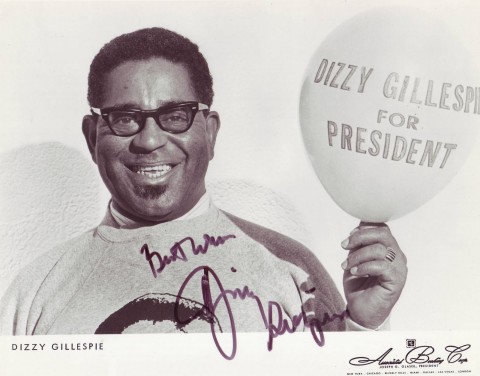
There comes a point in every national election year when I reach total saturation and have to tune it all out to stay sane—the nonstop streams of vitriol, the spectacles of electoral dysfunction, the ads, the ads, the ads. I’m sure I’m not alone in this. But imagine how differently we could feel about presidential elections if people like, I don’t know, Dizzy Gillespie could get on a major ticket? That’s what might have happened in 1964 if “a little-known presidential campaign… had been able to vault the millionaires-only hurdle.” What began as one of Dizzy’s famous practical jokes, and a way to raise money for CORE (Congress for Racial Equality) and other civil rights organizations became something more, a way for Dizzy’s fans to imagine an alternative to the “millionaire’s‑only” club represented by Lyndon Johnson and Barry Goldwater.
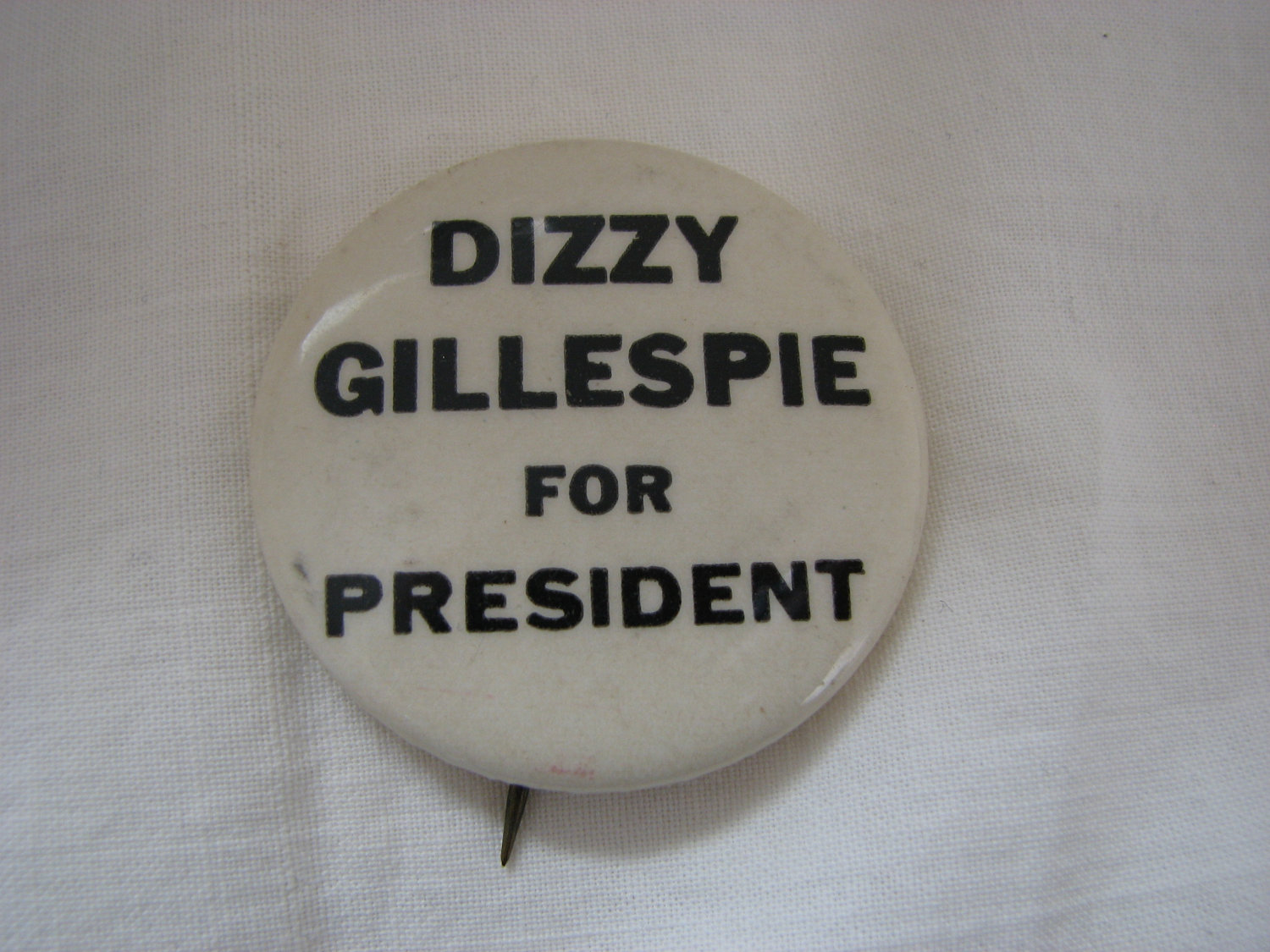
Gillespie’s campaign had “Dizzy Gillespie for President” buttons, now collector’s items, and “Dizzy for President” became the title of an album recorded live at the Monterey Jazz Festival in 1963.
A take on his trademark tune “Salt Peanuts,” “Vote Dizzy” was Gillespie’s official campaign song and includes lyrics like:
Your politics ought to be a groovier thing
Vote Dizzy! Vote Dizzy!
So get a good president who’s willing to swing
Vote Dizzy! Vote Dizzy!
It’s definitely groovier than either one of our current campaigns. Dizzy “believed in civil rights, withdrawing from Vietnam and recognizing communist China,” and he wanted to make Miles Davis head of the CIA, a role I think would have suited Miles perfectly. Although Dizzy’s campaign was something of a publicity stunt for his politics and his persona, it’s not unheard of for popular musicians to run for president in earnest. In 1979, revolutionary Nigerian Afrobeat star Fela Kuti put himself forward as a candidate in his country, but was rejected. More recently, Haitian musician and former Fugee Wyclef Jean attempted a sincere run at the Haitian presidency, but was disqualified for reasons of residency. It’s a little hard to imagine a popular musician mounting a serious presidential campaign in the U.S., but then again, the 80s were dominated by the strange reality of a former actor in the White House, so why not? In any case, revisiting Dizzy Gillespie’s mid-century political theater may provide a needed respite from the onslaught of the current U.S. campaign season.
Josh Jones is a doctoral candidate in English at Fordham University and a co-founder and former managing editor of Guernica / A Magazine of Arts and Politics.
Read More...Election 2012: Your Free Ticket to a Popular Stanford Course
Last Tuesday night, Stanford University kicked off a big course on the 2012 Election. 600 students packed into a crowded auditorium, filling every seat, waiting for the course to begin. Led by David Kennedy (Pulitzer Prize-winning historian), Rob Reich (Political Science, Stanford), and James Steyer (CEO, Common Sense Media), the course brings together “experts from Stanford’s faculty, along with distinguished participants in and analysts of American politics.” And, together, they’re examining major issues at stake in the election — foreign policy, the economy, the Supreme Court, campaign financing, campaign strategy, etc.
The first week featured conversations with two seasoned campaign strategists — Mark McKinnon and Chris Lehane — who put away their daggers and had an unusually civil conversation about the Obama-Romney contest, and the state of American politics more generally. Also joining the conversation was Gary Segura, a Stanford expert in polling, who offered up some firm predictions about the election.
Although the course is filled to capacity, you can attend the course virtually on iTunes and YouTube for free. (It will be added to our collection of 500 Free Courses Online.) A complete list of upcoming speakers can be found here.
Full disclosure: This course was partly organized by Stanford Continuing Studies where I happily spend my working days. If you live in the San Francisco Bay Area, you should check out our amazing program.
Read More...
William Faulkner Quits His Post Office Job in Splendid Fashion with a 1924 Resignation Letter
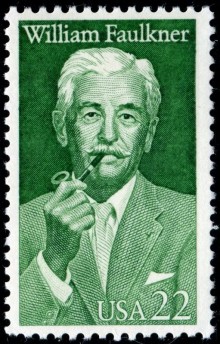 Long before William Faulkner got his big break in literature, he, like many of us, had a good old-fashioned day job. Faulkner had a series of odd jobs in fact. But, most famously, he worked from 1921 to 1924 as the postmaster at the University of Mississippi, where, according to legend, he did the following: sometimes threw mail in the garbage, other times read magazines before bringing them to people’s homes, often played cards and wrote fiction during working hours, occasionally went golfing instead of delivering mail, and generally ignored his colleagues and customers. But, who could blame him? Especially when he earned $20,000 in today’s money and had great literary ambitions to pursue. Eventually, when a postal inspector came to investigate, Faulkner resigned. The resignation letter, recently highlighted by Letters of Note, is short (a mere 56 words) and cutting. But, scathing as it was, it didn’t stop the US postal system from issuing a commemorative Faulkner stamp in 1987.
October, 1924
As long as I live under the capitalistic system, I expect to have my life influenced by the demands of moneyed people. But I will be damned if I propose to be at the beck and call of every itinerant scoundrel who has two cents to invest in a postage stamp.
This, sir, is my resignation.
(Signed by Faulkner)
Related Content:
Drinking with William Faulkner
William Faulkner Audio Archive Goes Online
William Faulkner Reads from As I Lay Dying
Read More...Sean Connery Reads C.P. Cavafy’s Epic Poem “Ithaca,” Set to the Music of Vangelis
This video combines three things that make me happy: the voice of Sean Connery, the music of Vangelis (Blade Runner, Chariots of Fire), and the poetry of C.P. Cavafy. Put them all together and you get a blissful soundscape of rolling synth lines, rolling Scottish R’s, and a succession of Homeric images and anaphoric lines. And the video’s quite nice as well.
Cavafy, whose work, I’m told, is really untranslatable from the original Greek, always seems to come out pretty well to me in English. “Ithaca,” one of his most popular poems, expresses what in lesser hands might be a banal sentiment akin to “it’s the journey, not the destination.” But in Cavafy’s poem, the journey is both Odysseus’s and ours; it’s epic where our lives seem small, and it translates our minor wanderings to the realm of mythic history.
Anyway, it seems rude to say much more and drown the poem in commentary. So, follow along with Sean Connery and enjoy… happy Friday.
Find the text of the poem after the jump. (more…)
Read More...How to Make Better Decisions, a Thought-Provoking Documentary by the BBC
“In this program,” says narrator Peter Capaldi at the outset, “we’re going to show you how to be more rational, and deal with some of life’s biggest decisions.” It’s a pretty big claim, and you may doubt that it’s true (especially during the silly opening scene involving a group of nerds trying to score a date) but give this 2008 BBC Horizon program a little time and you might come away with a few things to think about. How to Make Better Decisions takes us inside cognitive science laboratories and out on the streets to demonstrate how the emotional part of our brain gets the better of the rational part. The film introduces a number of intriguing concepts, including Prospect Theory, “the framing effect,” and “priming.” More controversially, it highlights some research that suggests the possibility that our intuition may have something to do with an ability to sense future events. How to Make Better Decisions is 49 minutes long, and we’ve decided to add it to our growing collection of Free Movies Online.
Related content:
Dan Ariely’s Animated Talk on How and Why We’re Dishonest
Read More...Norman Mailer: Strong Writer, Weak Actor, Brutally Wrestles Actor Rip Torn
“Gorging on the man’s image and voice is a reminder of his strength as a writer that’s easiest to overlook: an awareness of his own limitations. This is a quality that his acting lacks.” This Christine Smallwood writes of the novelist Norman Mailer after having watched the late-sixties/early-seventies trilogy of films he directed and starred in: Wild 90, Beyond the Law, and Maidstone. Her post on the New Yorker’s blog Page-Turner considers these pictures, recently released as a box set in the Criterion Collection’s Eclipse Series, ultimately finding them hugely flawed but not uninterestingly so. They have cinematography by a young D.A. Pennebaker, they foreshadow reality television in their own skewed way, and they capture the spectacle of Norman Mailer reveling in, essentially, the role of himself. Not that this counts as an acting technique: “Mailer lurches, lumbers, rants, reels,” writes Smallwood. “He doesn’t bother with a story that would drum up interest or fix attention, because he knows, and you know, that you’re watching because he’s Norman Mailer.”
But a force fiercer than Mailer’s will to impose his own reality rips into the very end of Maidstone, and the result has become a popular clip on the internet. That force’s name is Rip Torn. He plays the brother-in-law and would-be assassin of Mailer’s character, an iconoclastic auteur running for President of the United States. On camera, Torn suddenly attacks Mailer, and the two launch into what looks like an actual brawl, involving techniques up to and including a hammer to the ear. “The intrusion of bald ‘real life’ means that Mailer has to reckon with another person,” writes Smallwood. “This, I think, is what motivated his interest in violence more generally: it interrupted the constant preoccupation of being Norman Mailer, forcing him out of himself. In his writing, he could sometimes discipline himself into achieving those moments, as when he imagined the mind-set of a policeman in ‘Armies of the Night,’ but onscreen he needed to get hit.”
Related content:
Norman Mailer & Martin Amis, No Strangers to Controversy, Talk in 1991
Norman Mailer & Marshall McLuhan Debate the Electronic Age
Colin Marshall hosts and produces Notebook on Cities and Culture. Follow him on Twitter at @colinmarshall.
Read More...Samuel L. Jackson Stars in “Wake the F**ck Up for Obama,” a NSFW Political Children’s Tale
Last summer, Samuel L. Jackson delighted listeners when he narrated the audio version of Adam Mansbach’s twisted little children’s bedtime story, Go the F**k to Sleep. Now, Jackson returns with Wake the F**ck Up for Obama. According to the New York Post (if they say it, it must be true!), Mansbach wrote the Dr. Seussian script for the political ad. And it was apparently funded by the Jewish Council for Research and Education, a liberal super PAC funded by George Soros’ 25-year-old son. Until today, I thought that Citizens United, the SCOTUS decision that unleashed a torrent of Super PAC ads on our airwaves, did more to undermine American democracy than any foreign threat. But when the video hit the 2:44 mark, you start to have your doubts.
via Galley Cat
Read More...Support Us
We're hoping to rely on loyal readers, rather than erratic ads. Please click the Donate button and support Open Culture. You can use Paypal, Venmo, Patreon, even Crypto! We thank you!

About Us

Open Culture scours the web for the best educational media. We find the free courses and audio books you need, the language lessons & educational videos you want, and plenty of enlightenment in between.
Advertise With Us

FREE UPDATES!
GET OUR DAILY EMAIL
Get the best cultural and educational resources on the web curated for you in a daily email. We never spam. Unsubscribe at any time.
FOLLOW ON SOCIAL MEDIA

Open Culture editor Dan Colman scours the web for the best educational media. He finds the free courses and audio books you need, the language lessons & movies you want, and plenty of enlightenment in between.
Advertise With Us

