Too Big for Any Museum, AIDS Quilt Goes Digital Thanks to Microsoft
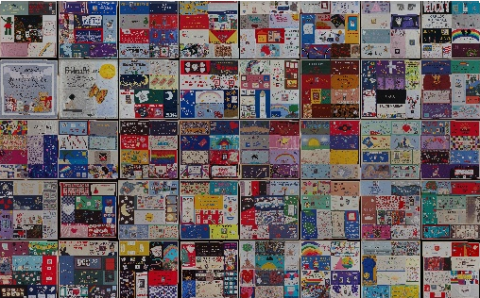
Twenty-five years ago a group of friends gathered in a San Francisco apartment to memorialize companions who had died of AIDS. They used one of the oldest techniques around to honor their loved ones: they made a quilt, the now-famous AIDS Memorial Quilt, with unique panels for each person felled by the disease. Now including some 48,000 panels, the quilt has grown into a massive, public expression of grief. Its panels come from around the world. It was even nominated for the Nobel Peace Prize in 1989. (Find more on the history of the quilt here.)
Like any good archive—and the quilt is an archive of life and loss—the AIDS Memorial Quilt serves as a historical repository, a storehouse of sentimental information for scores of people. But beyond that the quilt is a piece of political folk art. AIDS, after all, is a uniquely political disease, at least in the United States. The idea for the quilt was conceived during a candlelight march for assassinated San Francisco Mayor George Moscone and Supervisor Harvey Milk. Efforts to lift the stigma of AIDS are closely linked to gay rights activism.
While the quilt is on view in Washington, D.C. this summer, Microsoft offers the world up close and personal access. Even if the Mall is too small to hold the entire quilt, the Internet isn’t. All 48,000 panels are newly digitized through a collaboration between Microsoft and the University of Iowa, the University of Southern California and the Names Quilt Foundation.
You can fly like a bird over the whole, beautiful piece. You can zoom in to read the thousands of names—some in block letters, others stitched in cursive. You can count the rainbows, too.
You can also search the quilt by name or, if you know it, by the block number of a particular panel through the AIDS Quilt Touch interface. The site allows unique searches for each time the quilt has been displayed. This is important because the quilt is so massive that the Mall in Washington can’t hold it all. It’s always displayed in sections, so if you want to know where a special panel has been on view, recently, it’s now possible to find out.
Kate Rix is a freelance writer based in Oakland. See more of her work at .
Read More...John Lennon’s Appearances in How I Won the War, the Absurdist 1967 Film
After seeing it mentioned in Monday’s post on the “Strawberry Fields Forever” demos, any curious aficionado of Beatles-related ephemera will want to know more about Richard Lester’s How I Won the War, in which John Lennon made his only non-musical acting appearance. The trailer above gives you an idea of the sensibility of the film, whose desert shoot in Spain allowed Lennon the time and got him into the headspace to conceive of that beloved song. Ever shifting between tones, genres, and looks, the movie follows the attempt of the British Army’s “3rd Troop, the 4th Musketeers” to build a cricket pitch behind enemy lines in WW II Tunisia. In the small part of Musketeer Gripweed, Lester cast the 26-year-old, bespectacled Lennon. The two had already established a working relationship, with Lester having directed all of the Fab Four in their musical films A Hard Day’s Night and Help!
An enterprising fan assembled the video just above by stringing together all of Lennon’s scenes, which come to just under eight minutes out of the full film’s 109. Watching all these gags decontextualized adds a layer of absurdity, and How I Won the War’s humor is pretty absurd to begin with. You’d perhaps do best to approach the movie as an absurdist black comedy that both uses and parodies countless traditions in British film.
Not that it worked for a 25-year-old Roger Ebert, who waxed sarcastic at the time about the ballyhooing of Lennon’s eight minutes: “By now we have seen John Lennon’s bloody picture on the cover of Ramparts, and read the advertisements in which critics are pounded over the head with each other’s reviews, and we know this a film the old fogeys and fascist baby-eaters will hate and the young, pure, enlightened liberals will find Truth in.” Brave and hilarious anti-war statement featuring a colossal cultural figure, or nonsensical piece of slapstick that happens to include a Beatle? Copies of How I Won the War can be purchased on DVD.
Related content:
John Lennon and Yoko Ono on the Dick Cavett Show
John Lennon and The Rolling Stones Sing Buddy Holly
Colin Marshall hosts and produces Notebook on Cities and Culture. Follow him on Twitter at @colinmarshall.
Read More...19 Quotes on Writing by Gore Vidal. Some Witty, Some Acerbic, Many Spot On
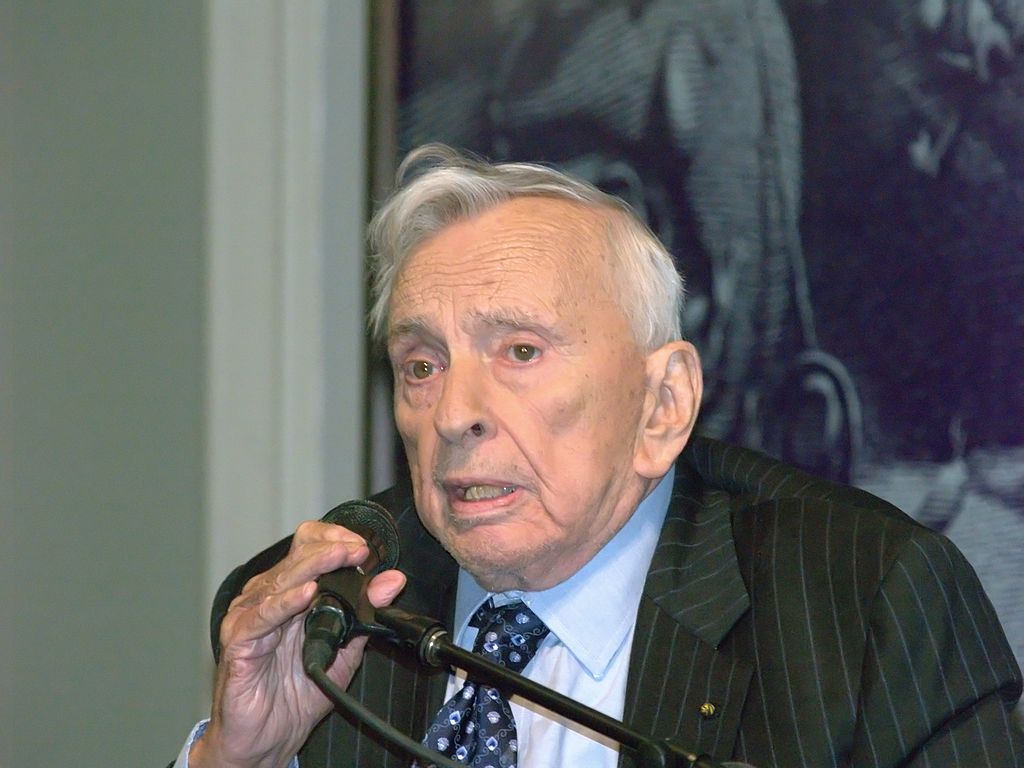
Image by David Shankbone, via Wikimedia Commons
Next to “celebrated” (or “celebrity”) the description I’ve most seen applied to the late Gore Vidal is “acerbic,” or some such synonym—“scathing,” “disdainful”… I’m sure he would relish the compliment. One of the most fitting adjectives, perhaps, is “Wilde-like” (as in Oscar Wilde), deployed by Hilton Als in the New Yorker. The adjective fits especially well considering one of Vidal’s most-tweeted quotes from his treasury of Wilde-like aphorisms: “Write something, even if it’s just a suicide note.” It’s clever and morbid and naughty and devil-may-care, and almost entirely fatuous. Unlike several writers recently featured here—Margaret Atwood, Ray Bradbury, Henry Miller, George Orwell, et al.—who helpfully compiled numbered lists of writing advice, Vidal’s pronouncements on his craft were rather unsystematic. But, like many of those named above, what Vidal did leave in the form of advice was sometimes facetious, and sometimes profound. Despite his evident contempt for neat little lists, one writer in the UK has helpfully compiled one anyway. The “suicide note” quote above is number 4:
- Each writer is born with a repertory company in his head.
- Write what you know will always be excellent advice for those who ought not to write at all. Write what you think, what you imagine, what you suspect!
- I sometimes think it is because they are so bad at expressing themselves verbally that writers take to pen and paper in the first place.
- Write something, even if it’s just a suicide note.
- How marvelous books are, crossing worlds and centuries, defeating ignorance and, finally, cruel time itself.
- Southerners make good novelists: they have so many stories because they have so much family.
- You can’t really succeed with a novel anyway; they’re too big. It’s like city planning. You can’t plan a perfect city because there’s too much going on that you can’t take into account. You can, however, write a perfect sentence now and then. I have.
- Today’s public figures can no longer write their own speeches or books, and there is some evidence that they can’t read them either.
- I suspect that one of the reasons we create fiction is to make sex exciting.
Writer’s Digest gives us ten additional quotes of Gore Vidal on writing (unnumbered this time):
“You can improve your talent, but your talent is a given, a mysterious constant. You must make it the best of its kind.”
“I’ve always said, ‘I have nothing to say, only to add.’ And it’s with each addition that the writing gets done. The first draft of anything is really just a track.”
“The reason my early books are so bad is because I never had the time or the money to afford constant revisions.”
“That famous writer’s block is a myth as far as I’m concerned. I think bad writers must have a great difficulty writing. They don’t want to do it. They have become writers out of reasons of ambition. It must be a great strain to them to make marks on a page when they really have nothing much to say, and don’t enjoy doing it. I’m not so sure what I have to say but I certainly enjoy making sentences.”
“Constant work, constant writing and constant revision. The real writer learns nothing from life. He is more like an oyster or a sponge. What he takes in he takes in normally the way any person takes in experience. But it is what is done with it in his mind, if he is a real writer, that makes his art.”
“I’ll tell you exactly what I would do if I were 20 and wanted to be a good writer. I would study maintenance, preferably plumbing. … So that I could command my own hours and make a good living on my own time.”
“If a writer has any sense of what journalism is all about he does not get into the minds of the characters he is writing about. That is something, shall we say, Capote-esque—who thought he had discovered a new art form but, as I pointed out, all he had discovered was lying.”
“A book exists on many different levels. Half the work of a book is done by the reader—the more he can bring to it the better the book will be for him, the better it will be in its own terms.”
[When asked which genre he enjoys the most, and which genre comes easiest:]
“Are you happier eating a potato than a bowl of rice? I don’t know. It’s all the same. … Writing is writing. Writing is order in sentences and order in sentences is always the same in that it is always different, which is why it is so interesting to do it. I never get bored with writing sentences, and you never master it and it is always a surprise—you never know what’s going to come next.”
[When asked how he would like to be remembered:]
“I suppose as the person who wrote the best sentences in his time.”
A series of snippets of Gore Vidal’s wit from Esquire provides the biting (for its non-sequitur jab at rival Norman Mailer): “For a writer, memory is everything. But then you have to test it; how good is it, really? Whether it’s wrong or not, I’m beyond caring. It is what it is. As Norman Mailer would say, “It’s existential.” He went to his grave without knowing what that word meant.”
Vidal returns to the theme of memory in a 1974 interview with The Paris Review, in which he admits to placing the ultimate faith in his memory: “I am not a camera… I don’t consciously watch anything and I don’t take notes, though I briefly kept a diary. What I remember I remember—by no means the same thing as remembering what you would like to.”
While Vidal is memorialized this week as a celebrity and Wilde-like provocateur, it’s also worth noting that he had quite a lot to say about the work of writing itself, some of it witty but useless, some of it well worth remembering.
Josh Jones is a doctoral candidate in English at Fordham University and a co-founder and former managing editor of Guernica / A Magazine of Arts and Politics.
Read More...
The History of Western Social Theory, by Alan MacFarlane, Cambridge University
These lectures were presented by Alan MacFarlane in November 2001 in the Department of Social Anthropology, University of Cambridge. They were part of a course on theory and methods in anthropology designed for second year social anthropology undergraduates. Above, watch Lecture 1: A Map of Social Theories, 1000–2000. The remaining lectures follow below:
Lecture 2: The Baron de Montesquieu (1689–1755)
Lecture 3: Adam Smith (1723–1790)
Lecture 4: Alexis de Tocqueville (1805–1859)
Lecture 5: Karl Marx (1818–1883)
Lecture 6: Emile Durkheim (1858–1917)
Lecture 7: Max Weber (1864–1920)
Lecture 8: Ernest Gellner (1925–1995)
Lecture 9: F.W.Maitland (1850–1906)
You will find this course added to our collection, 1,700 Free Online Courses from Top Universities.
Read More...Take a Panoramic Tour of NASA’s Kennedy Space Center with Google Street View
The Kennedy Space Center in Florida turns 50 this year. To celebrate the occasion, NASA and Google Street View have teamed up to give the public unprecedented access to this center of space innovation. Starting today, you can explore 6,000 panoramic views of the Space Center. Some of the highlights touted by Google include:
- The Space Shuttle Launch Pad
- The Top of the Gigantic Launch Pad
- The Vehicle Assembly Building
- Launch Firing Room #4
- The Shuttle’s Main Engines
- The Saturn V Rocket
- The Atlantis Orbiter
- The Endeavour Orbiter
You can start your tour here. Other great places to visit with Street View include: Pompeii and other historical sites, the Amazon Basin, Shackleton’s Antarctic, Versailles, The White House, and 151 Great Museums Across the Globe.
Read More...Charles Mingus and His Eviction From His New York City Loft, Captured in Moving 1968 Film
In November of 1966, the great jazz bassist and composer Charles Mingus was forcibly evicted from his apartment in New York City. Thomas Reichman’s documentary Mingus (above) captures the sad moment when the musician, with his five-year-old daughter Carolyn at his side, looks through his scattered belongings the night before city officials arrive to cart everything away.
With the camera rolling, Mingus plays a few notes on a piano and then picks up a rifle and shoots a bullet into the ceiling. He finds a bottle of wine and gives a sip to his daughter. He recites his own version of the Pledge of Allegiance:
I pledge allegiance to the flag–the white flag. I pledge allegiance to the flag of America. When they say “black” or “negro,” it means you’re not an American. I pledge allegiance to your flag. Not that I have to, but just for the hell of it I pledge allegiance. I pledge allegiance to the flag of the United States of America. The white flag, with no stripes, no stars. It is a prestige badge worn by a profitable minority.
Scenes from the apartment are intercut with footage of Mingus and his sextet performing at a little club in Peabody, Massachusetts called Lennie’s-on-the-Turnpike. The combo features Mingus on bass, Dannie Richmond on drums, Charles McPherson on alto saxophone, John Gilmore on tenor saxophone, Lonnie Hillyer on trumpet and Walter Bishop, Jr., on piano. The music includes parts of “All the Things You Are,” Take the ‘A’ Train” and “Secret Love.”
But the film is more about the man than the music. It records an especially painful moment in Mingus’s life. He had hoped to use the loft at 5 Great Jones Street in Greenwich Village as a music school. In the final sequence, a crowd of reporters and cameramen jostle for position to record the humiliating scene as Mingus’s belongings, including his musical instruments, are hauled out to the curb and loaded onto a truck. Tears appear in Mingus’s eyes when the police block him from going back into the building. When the cops find hypodermic needles among his things, Mingus himself is loaded into a police car and taken away.
Related content:
1959: The Year that Changed Jazz
Thelonious Monk: Straight No Chaser
How to Potty Train Your Cat: A Handy Manual by Charles Mingus
Read More...The Latest, Greatest Cultural Perk of Amazon Prime: Stream Movies and TV Shows to the iPad

When Amazon launched Amazon Prime in 2005, it didn’t offer that much in the way of benefits — just free shipping on Amazon goods. Now if you pony up $79 per year, you get some good cultural perks: You can borrow over 145,000 e‑books and read them on your Kindle and devices with Kindle apps. What’s more, you can stream thousands of movies and TV shows through your computer, select blu-ray players and now … drum roll please .… the iPad. Just yesterday, Amazon released its free iPad app, which means that Prime members can start streaming movies on their tablets right away. If you’re not a member, you can always try out a one month Free Trial to Amazon Prime. And if that doesn’t move you, you can simply dive into our collection of 500 Free Movies Online. Ars Technica has more details on the pros and cons of the app here.
Read More...Jerry Garcia Sings a Soulful Peggy‑O (For His Would-Be 70th Birthday)
Jerry Garcia — it would have been his 70th birthday today. But he exited far too soon. At only 53. Here we have him a short year before his death singing a soulful version of Peggy‑O. Lyrics here. More Jerry goodness awaits you at the Free Grateful Dead Concert Archive. Enjoy…
Related Content:
UC Santa Cruz Opens a Deadhead’s Delight: The Grateful Dead Archive is Now Online
NASA & Grateful Dead Drummer Mickey Hart Record Cosmic Sounds of the Universe on New Album
Read More...Versailles 3D, Created by Google, Gives You an Impressive Tour of Louis XIV’s Famous Palace
With 3D scale models, music, and video, Google’s Versailles 3D brings the best of 21st century web arts to 18th century art history. The palace was built by Louis XIV, the “Sun King,” who exemplified all of the authoritarian excesses of the French monarchy. Fortunately for posterity, he was also a patron of the arts, to whom we owe much of the work of Moliere, Racine and painters such as Charles Le Brun. And then there is his architectural legacy, the palace of Versailles, which started out as a humble hunting lodge, built by his father Louis XIII in 1624. In the next several decades, father, then son, commissioned the elaborate set of buildings that constitute Europe’s largest chateau and the seat of French government from Louis XIV’s ascension until the Revolution of 1789. If you’re thinking of visiting, the official chateau de Versailles website has slideshows of grounds and galleries, a boutique, and some worthwhile interactive features. But Google, as usual, has tried to outdo its competition, this time by partnering with it. In connection with the Versailles curators, The Google Cultural Institute has created a multimedia almost-substitute for a real life excursion to the gargantuan and enduring symbol of Ancien Regime France.
The next video is a preview of a “Google Chrome Experiment” called “Chaos to Perfection,” an “interactive stroll around the palace,” accompanied by an original soundtrack from French band Phoenix. (The “experiment” itself is somewhat slow loading, and requires the Chrome browser).
Finally, the engineers at Google (and partners Aloest, Westimages, le FabShop and Les 84) give us a look behind the scenes of Versailles 3D. Wonder how they created the elaborate 3D scale models of the palace grounds and buildings? Well, the video below provides a barrage of backstage glimpses of the process, along with scenes from the opening of the Palace History Gallery on June 14th.
And, of course, there will be mobile apps, Google promises, “soon.”
Josh Jones is a doctoral candidate in English at Fordham University and a co-founder and former managing editor of Guernica / A Magazine of Arts and Politics.
Read More...Napoleon: The Greatest Movie Stanley Kubrick Never Made
Think about all the big cinematic ideas Stanley Kubrick realized — Dr. Strangelove, 2001, A Clockwork Orange — and then imagine the ones he didn’t. You can do better than imagining, actually, since, the director left behind enough evidence of aborted works for Wikipedia to put together an entire page called “Stanley Kubrick’s unrealized projects.” He wanted to adapt Calder Willingham’s Natural Child and Stefan Zweig’s The Burning Secret, but the material proved too controversial for the content restraints of the Hays Code. He wanted to make a Holocaust film with Isaac Bashevis Singer, who declined; he wanted to make another Holocaust film with Julia Roberts, but Steven Spielberg put out Schindler’s List first. (He ultimately deemed the Holocaust cinematically unapproachable, as he did The Lord of the Rings when the Beatles presented him that idea.) He wanted to adapt Umberto Eco’s Foucault’s Pendulum, “toyed” with Patrick Süskind’s Perfume, considered reinventing pornography… the list goes on.
Napoleon casts a shadow over all of these fragments. Though Kubrick never made his life of Napoleon Bonaparte, he never seemed to forget the idea, either; he claimed to have read over 500 books about the man in years of preparation for a shoot that never came. David Hemmings was to play his Napoleon, Audrey Hepburn his Josephine. The project’s ever more intimidating budget — vast, location-filmed battle scenes presumably having something to do with that — and the release of Sergei Bondarchuk’s War and Peace and Waterloo sank the project, but you can still read its screenplay online. Taschen, publisher of lavish, visually intense tomes, produced the video above on the process behind Stanley Kubrick’s Napoleon: The Greatest Movie Never Made, their book — or rather, their enormous hollow book filled with smaller books — that distills the nonexistent film’s remains. Don’t have enough room on your shelf? Then take a look at Vice magazine’s “Stanley Kubrick’s Napoleon: A Lot of Work, Very Little Actual Movie” instead.
Related content:
Stanley Kubrick’s Very First Films: Three Short Documentaries
The Making of Stanley Kubrick’s A Clockwork Orange
James Cameron Revisits the Making of Kubrick’s 2001: A Space Odyssey
Terry Gilliam: The Difference Between Kubrick (Great Filmmaker) and Spielberg (Less So)
Colin Marshall hosts and produces Notebook on Cities and Culture. Follow him on Twitter at @colinmarshall.
Read More...Support Us
We're hoping to rely on loyal readers, rather than erratic ads. Please click the Donate button and support Open Culture. You can use Paypal, Venmo, Patreon, even Crypto! We thank you!

About Us

Open Culture scours the web for the best educational media. We find the free courses and audio books you need, the language lessons & educational videos you want, and plenty of enlightenment in between.
Advertise With Us

FREE UPDATES!
GET OUR DAILY EMAIL
Get the best cultural and educational resources on the web curated for you in a daily email. We never spam. Unsubscribe at any time.
FOLLOW ON SOCIAL MEDIA

Open Culture editor Dan Colman scours the web for the best educational media. He finds the free courses and audio books you need, the language lessons & movies you want, and plenty of enlightenment in between.
Advertise With Us


