Six Early Short Films By Tim Burton
If you’ve gone to the movies lately, you may well have seen the trailer for Tim Burton’s upcoming Frankenweenie. While its black-and-white stop-motion animation looks nifty — and it’ll surely look even niftier in IMAX 3D — Burton enthusiasts know full well that the film isn’t entirely new. The original Frankenweenie, a much shorter and rougher-edged but nevertheless uniquely charming picture, came out 28 years ago, and you can watch it free on Youtube today. A live-action film with a kinetically askew visual sensibility, this first Frankenweenie tells the same story as the new one: a boy brings his beloved dead dog back to life using the reviving power of electricity, but few residents of his small town approve of the resulting bolt-necked, stitched-together creature. Burton has made the long, hard road to acceptance faced by well-meaning but ramshackle beings one of his dominant themes, so his desire to make a second Frankenweenie comes as no great surprise — especially since he also made the first one.
Working for Disney at the time, the young Burton managed to land players like Shelley Duvall, Daniel Stern, and a 13-year-old Sofia Coppola for this charmingly goofy homage to Frankenstein. Sadly, the studio ultimately considered the project a waste of money, and too scary to screen for children, and sent Burton packing. But however discouraging the experience must have felt in the moment, it gave him 30 full minutes to tell a story. His earlier shorts, like the thirty-second Houdini: The Untold Story above, had to operate under much more compressed conditions. (Legend has it that Burton turned that film in to a teacher in lieu of a book report.) After his 1985 feature breakthrough Pee-Wee’s Big Adventure, he still found the occasional chance to make a short, as when he created The Jar, for the television series Alfred Hitchcock Presents.
Some viewers like Burton’s movies better the more resources he has to make them; others prefer the fruits of his more constrained (and thus restrained) years. To best decide for yourself, you’ll want to take this highly entertaining course in the formation of his distinctive style by watching his early shorts, six of which have become available online.
- Houdini: The Untold Story (1976)
- Stalk of the Celery Monster (1979)
- Luau (1982)
- Vincent (1982)
- Frankenweenie (1984)
- The Jar (1986) (originally aired as an episode of Alfred Hitchcock Presents)
Related content:
Tim Burton’s The World of Stainboy: Watch the Complete Animated Series
Frankenweenie: Tim Burton Turns Frankenstein Tale into Disney Kids Film (1984)
Vincent: Tim Burton’s Early Animated Film Tim Burton: A Look Inside His Visual Imagination
500 Free Movies Online Colin Marshall hosts and produces Notebook on Cities and Culture. Follow him on Twitter at @colinmarshall.
Read More...When Super Heroes Get Old and Retire to Miami
What happens when seemingly immortal figures end up being mortal after all? What happens when four super friends — Batman, Robin, Superman, Aquaman — end their crime fighting days and live out their golden years in Miami? You’ve got to admit, it’s an intriguing concept. And Kevin Bapp plays out the scenario in this funny little trailer for a potential Cartoon Network pilot. Enjoy…
via Slate
Read More...22-Year-Old P.O.W. Kurt Vonnegut Writes Home from World War II: “I’ll Be Damned If It Was Worth It”
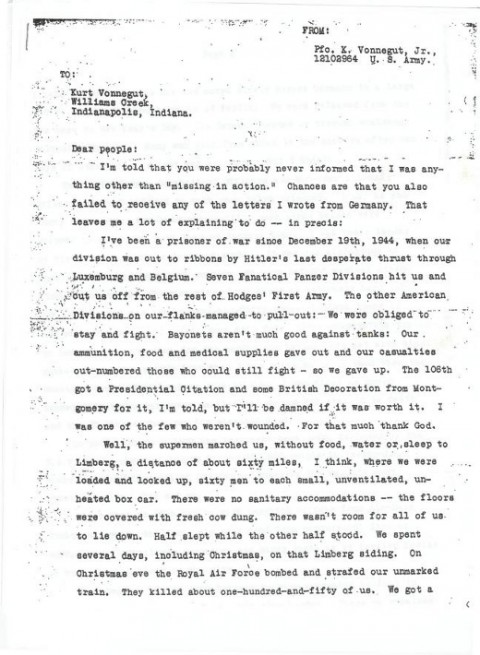
If you read Open Culture, smart money says you’ll also enjoy Letters of Note, a site we occasionally reference. They collect, post, and provide context for “fascinating letters, postcards, telegrams, faxes, and memos” to and from all manners of luminaries throughout the history of art, politics, music, science, media, and, er, letters. Dig into the archives and you’ll find a missive home from Kurt Vonnegut, a notable letter-writer if ever there was one. Dedicated Vonnegut readers will recognize the tone of the novelist, although here, at the age of 22, he had yet to become one. A Private in the Second World War, he was taken prisoner on December 19, 1944, during the Battle of the Bulge. Having then done time in an underground section of a Dresden work camp known, yes, as “Slaughterhouse Five,” he survived the subsequent bombing of the city and wound up in a repatriation camp by May 1945. There, he wrote what follows:
Dear people:
I’m told that you were probably never informed that I was anything other than “missing in action.” Chances are that you also failed to receive any of the letters I wrote from Germany. That leaves me a lot of explaining to do — in precis:
I’ve been a prisoner of war since December 19th, 1944, when our division was cut to ribbons by Hitler’s last desperate thrust through Luxemburg and Belgium. Seven Fanatical Panzer Divisions hit us and cut us off from the rest of Hodges’ First Army. The other American Divisions on our flanks managed to pull out: We were obliged to stay and fight. Bayonets aren’t much good against tanks: Our ammunition, food and medical supplies gave out and our casualties out-numbered those who could still fight — so we gave up. The 106th got a Presidential Citation and some British Decoration from Montgomery for it, I’m told, but I’ll be damned if it was worth it. I was one of the few who weren’t wounded. For that much thank God.
Well, the supermen marched us, without food, water or sleep to Limberg, a distance of about sixty miles, I think, where we were loaded and locked up, sixty men to each small, unventilated, unheated box car. There were no sanitary accommodations — the floors were covered with fresh cow dung. There wasn’t room for all of us to lie down. Half slept while the other half stood. We spent several days, including Christmas, on that Limberg siding. On Christmas eve the Royal Air Force bombed and strafed our unmarked train. They killed about one-hundred-and-fifty of us. We got a little water Christmas Day and moved slowly across Germany to a large P.O.W. Camp in Muhlburg, South of Berlin. We were released from the box cars on New Year’s Day. The Germans herded us through scalding delousing showers. Many men died from shock in the showers after ten days of starvation, thirst and exposure. But I didn’t.
Under the Geneva Convention, Officers and Non-commissioned Officers are not obliged to work when taken prisoner. I am, as you know, a Private. One-hundred-and-fifty such minor beings were shipped to a Dresden work camp on January 10th. I was their leader by virtue of the little German I spoke. It was our misfortune to have sadistic and fanatical guards. We were refused medical attention and clothing: We were given long hours at extremely hard labor. Our food ration was two-hundred-and-fifty grams of black bread and one pint of unseasoned potato soup each day. After desperately trying to improve our situation for two months and having been met with bland smiles I told the guards just what I was going to do to them when the Russians came. They beat me up a little. I was fired as group leader. Beatings were very small time: — one boy starved to death and the SS Troops shot two for stealing food.
On about February 14th the Americans came over, followed by the R.A.F. their combined labors killed 250,000 people in twenty-four hours and destroyed all of Dresden — possibly the world’s most beautiful city. But not me.
After that we were put to work carrying corpses from Air-Raid shelters; women, children, old men; dead from concussion, fire or suffocation. Civilians cursed us and threw rocks as we carried bodies to huge funeral pyres in the city.
When General Patton took Leipzig we were evacuated on foot to (‘the Saxony-Czechoslovakian border’?). There we remained until the war ended. Our guards deserted us. On that happy day the Russians were intent on mopping up isolated outlaw resistance in our sector. Their planes (P‑39’s) strafed and bombed us, killing fourteen, but not me.
Eight of us stole a team and wagon. We traveled and looted our way through Sudetenland and Saxony for eight days, living like kings. The Russians are crazy about Americans. The Russians picked us up in Dresden. We rode from there to the American lines at Halle in Lend-Lease Ford trucks. We’ve since been flown to Le Havre.
I’m writing from a Red Cross Club in the Le Havre P.O.W. Repatriation Camp. I’m being wonderfully well feed and entertained. The state-bound ships are jammed, naturally, so I’ll have to be patient. I hope to be home in a month. Once home I’ll be given twenty-one days recuperation at Atterbury, about $600 back pay and — get this — sixty (60) days furlough.
I’ve too damned much to say, the rest will have to wait, I can’t receive mail here so don’t write.
May 29, 1945
Love,
Kurt — Jr.
Related content:
Kurt Vonnegut Reads from Slaughterhouse-Five
Kurt Vonnegut’s Eight Tips on How to Write a Good Short Story
Kurt Vonnegut: “How To Get A Job Like Mine” (2002)
Colin Marshall hosts and produces Notebook on Cities and Culture. Follow him on Twitter at @colinmarshall.
Drunk History: An Intoxicated Look at the Famous Alexander Hamilton — Aaron Burr Duel
Improv comedy troop Upright Citizens Brigade, who recycled U.S. history in code duello, an improvised enactment of the Alexander Hamilton-Aaron Burr duel, have created “Drunk History,” which takes the cringe-worthy premise of the man-on-the-street pop quiz and adds some additional elements—binge drinking and goofy historical re-enactments with actors like Michael Cera (Superbad, Arrested Development, etc.). In this first episode of “Drunk History,” Mark Gagliardi, after drinking a bottle of scotch, narrates the story of the Hamilton-Burr duel, and Cera, in a ridiculous powdered wig and a pair of Vans, mimes the part of Hamilton. Gagliardi’s slurred narration and anachronistic touches like Cera/Hamilton on a cell phone ratchet up the absurdity.
The real story of the duel on July 11, 1804 involves some complications of electoral politics and ideological conflicts between the Federalist former Treasury Secretary Hamilton and the anti-Federalist Vice-President Burr. A long-standing personal feud between the two men was probably exacerbated by class conflict: Hamilton had humble origins as a poor immigrant from the Caribbean and Burr was son of a president of the future Princeton University and grandson of Puritan divine Jonathan Edwards. Although dueling was illegal at the time, the aristocratic practice continued to settle disputes between gentlemen, and both Hamilton and Burr had been involved in several prior duels. Nevertheless, Hamilton was reluctant to meet Burr’s challenge and is said to have deliberately missed his first shot (and in some disputed accounts, his pistol was loaded when he fell to the ground).
The Hamilton-Burr duel is one of the most interpersonally dramatic events in American history—easy fodder for comedic treatment like “Drunk History” and code duello and highly serious accounts like the PBS series American Experience’s “The Duel.” But what sometimes gets obscured behind the drama are the political conflicts over Federalist positions, conflicts that have never quite been resolved and form the basis for our most heated national debates, including the still-raging politics, even after the Supreme Court’s ruling, of the Affordable Care Act.
In the video below, historian Carol Berkin explains the often confusing debate between what came to be called, erroneously, Federalism and those who opposed the doctrine.
Josh Jones is currently a doctoral student in English at Fordham University and a co-founder and former managing editor of Guernica / A Magazine of Arts and Politics.
Read More...Watch as David Hockney Creates ‘Late November Tunnel, 2006’
David Hockney turns 75 today, and he’s still going strong. Having lived mostly in America since the mid-1960s, Hockney moved back to England a decade ago and has spent a great deal of time painting landscapes in his native Yorkshire.
In the footage above, filmed by Bruno Wollheim for the 2009 documentary A Bigger Picture and set to music by Anna Rusbatch, Hockney is shown working en plein air in one of his favorite places: a quiet stretch of country road lined with trees that he calls “the tunnel,” near the village of Kilham, in the Yorkshire Wolds. “Late November Tunnel, 2006” is an oil painting made on two canvases fused together. It’s one of a series of studies Hockney has made of the same place at different times of the day and year. The series, like several others Hockney has made around Eastern Yorkshire, calls to mind Claude Monet’s famous four-season studies at Giverny. After years living in the Mediterranean climate of Los Angeles, writes Martin Gayford in the Winter 2011 issue of RA Magazine:
Hockney found the spectacle of the changing seasons fascinating, and decided to start working on the landscape of the Yorkshire Wolds, near his house in Bridlington (a comfortable base which was once a small hotel). In a way it was a return to his roots, a landscape of memory. He had grown up in Bradford on the other side of Yorkshire, but as a teenager he had worked in the fields in the Yorkshire Wolds during school holidays. And he would visit his late mother and sister who lived in Bridlington. Hockney began this phase of his work by making drawings and watercolours, then painting oils in the open air–like nineteenth-century painters such as Monet and Constable–standing beside the road in all weathers.
“Late November Tunnel, 2006” and other paintings from the series, including later works created by Hockney on iPhones and iPads, were included in a major exhibit earlier this year at the Royal Academy of Arts. The exhibit has moved on to the Guggenheim Museum in Bilbao, Spain. The catalogue, David Hockney: A Bigger Picture, is available from Abrams.
Related content:
David Hockney’s iPad Art Goes on Display
Download David Hockney’s Playful Drawings for the iPhone and iPad
Read More...The Grand Finale: All 135 Space Shuttle Launches in One Video
When NASA launched its last space shuttle a year ago, McLean Fahnestock paid tribute to the 30-year old shuttle program by putting footage from every launch into one video. 135-in‑1. It makes for an arresting sequence. But, unfortunately, the 1986 Challenger explosion ends up overwhelming the story. One Vimeo commenter, Jeremy Ricketts, got it right when he said:
I don’t know about the rest being a decorative border to Challenger. In my eyes it highlighted what an insanely amazing accomplishment it was that out of all these launches, only two have ever resulted in failure of that type. This is the first reliable, reusable vehicle to ever bring humans to space. Given the violence of the launches and sheer absurdity of strapping a winged vehicle to the site of a rocket, it highlights (in my view) what an amazing feat it was, even in light of [the] Challenger.
Anyway, while we’re on the subject, don’t miss some of our favorite space shuttle videos from times past — like Endeavour’s Launch Viewed from Booster Cameras, William Shatner’s Narration of a Film Documenting the History of the Space Shuttle, and The Best of NASA Space Shuttle Videos from 1981 to 2010.
Enjoy the rest of the weekend.
via Kottke
Read More...William Faulkner Reads His Nobel Prize Speech
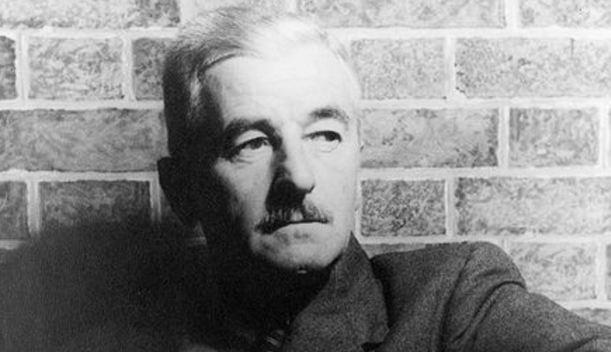
Today is the 50th anniversary of the death of William Faulkner. To mark the occasion, we bring you a 1954 recording of Faulkner reading his Nobel Prize speech from four years earlier. “I feel that this award was not made to me as a man,” Faulkner says on the tape, “but to my work–a life’s work in the agony and sweat of the human spirit, not for glory and least of all for profit, but to create out of the materials of the human spirit something which did not exist before.”
In classic novels like As I Lay Dying, Absalom, Absalom! and The Sound and the Fury, Faulkner created his own cosmos, combining his knowledge of the people and history of Mississippi with his gift for spinning tales. He called his cosmos Yoknapatawpha County. “I discovered,” Faulkner said in his 1956 Paris Review interview, “that my own little postage stamp of native soil was worth writing about and that I would never live long enough to exhaust it, and that by sublimating the actual into the apocryphal I would have complete liberty to use whatever talent I might have to its absolute top.”
Faulkner died at Wright’s Sanatorium in Byhalia, Mississippi in the early morning hours on July 6, 1962, which also happened to be the birthday of the great-grandfather he was named for, William Clark Falkner, the flamboyant railroad builder and novelist who was remembered as the “Old Colonel.” Faulkner had been suffering from back pain due to an earlier fall from a horse. His preferred way to deal with pain was to drink alcohol. After a binge he would typically go to the sanatorium to recover. This particular visit had seemed routine. Joseph Blotner describes the scene in Faulkner: A Biography:
The big clock ticked past midnight and July 6 came in–the Old Colonel’s birthday–with no promise of a letup in the heat. Insects thumped against the screens while electric fans hummed here and there. Faulkner had been resting quietly. A few minutes after half past one, he stirred and then sat up on the side of his bed. Before the nurse could reach him he groaned and fell over. Within minutes Dr. Wright was there, but he could not detect any pulse or heartbeat. He began external heart message. He continued it for forty-five minutes, without results. He tried mouth-to-mouth resuscitation, again with no results. There was nothing more he could do. William Faulkner was gone.
When Albert Camus died two years earlier, Faulkner was asked by La Nouvelle Revue Française to write a few words about his fallen friend. What Faulkner wrote of Camus could be his own epitaph:
When the door shut for him, he had already written on this side of it that which every artist who also carries through life with him that one same foreknowledge and hatred of death, is hoping to do: I was here.
NOTE: To follow along as Faulkner reads his Nobel address, you can find the text at the Ole Miss Faulkner on the Web site. (The page will open in a new window.) The Ole Miss page also includes a partial recording of Faulkner giving his speech in Stockholm on December 10, 1950, along with film footage of the ceremony. (Faulkner won the Nobel Prize in Literature for 1949 but it wasn’t presented until 1950, the year Bertrand Russell won the award. So Russell and Faulkner can both be seen in the film footage.) To hear more of Faulkner’s 1954 Caedmon recordings, visit Harper Audio. You can also hear over 28 hours of lectures by Faulkner at the audio archive of the University of Virginia, where he was writer-in-residence in 1957 and 1958. The archive concludes with a half-hour press conference given by the English Department faculty 50 years ago today, as they reacted to the news of Faulkner’s death.
Read More...Peter Weiss’s Marat/Sade Pushed the Boundaries of Theater, and Still Does
This 1967 film adaptation of Peter Weiss’s play Marat/Sade (its full title is The Persecution and Assassination of Jean-Paul Marat as Performed by the Inmates of the Asylum of Charenton Under the Direction of the Marquis de Sade) is based on the play’s famous 1964 theatrical production by the Royal Shakespeare Company. Translated from German by Geoffrey Skelton and directed by Peter Brook, the RSC production starred Patrick Magee as de Sade, Clive Revill as Marat, and Glenda Jackson as Charlotte Corday, Marat’s killer. The original cast and director from the ’64 staging came together for the film in 1967, with Ian Richardson stepping into the role of Marat. It’s a jarring experience, with masterful performances and some very dark humor.
The play imagines the Marquis de Sade in 1808, fifteen years after the French Revolution, staging the death of Jacobin hero Jean-Paul Marat as a play and enlisting as actors his fellow inmates at the Charenton Asylum, where de Sade was confined from 1801 to his death in 1814, and where he did, in fact, write and direct plays. The film is essential viewing for fans of confrontational Brechtian Verfremdungseffekt (distancing or alienation effects) and the dizzying device of sustained mise en abyme. Marat/Sade still unsettles theater audiences nearly 50 years after its first production. The RSC recently revived the play at their newly-refurbished theater in Stratford and sent several audience members fleeing; at one preview, 80 theatergoers left at the intermission. Wherever and whenever Marat/Sade is performed, it offers a bracing critique of political violence with its unsparing depictions of madness, torture, and revolutionary fervor.
via Mefi
Josh Jones is currently a doctoral student in English at Fordham University and a co-founder and former managing editor of Guernica / A Magazine of Arts and Politics.
Read More...Johnny Cash: Singer, Outlaw, and, Briefly, Television Host
Johnny Cash needs no introduction. But unless you happened to be watching ABC between June 1969 and March 1971, The Johnny Cash Show might. Cash added one more chapter to his legendarily storied career by hosting 58 episodes of the musical variety show from the Ryman Auditorium in Nashville, then the home of the Grand Ole Opry. You might expect from such a setup nothing but country music, and Cash and his producers did indeed make a point of introducing the genre’s stars to all of America as well as highlighting its skilled but low-profile performers who wouldn’t otherwise have received national exposure. But many Johnny Cash Show broadcasts reached well beyond Cash’s own presumptive base, making non-country luminaries accessible to country listeners as much as the other way around. Above you’ll find a popular video of Joni Mitchell singing “Both Sides, Now” on the program; Bob Dylan and Neil Young also made appearances representing the next generation of singer-songwriters.
But Cash also routinely shared the stage with his elders, most notably Louis Armstrong in a broadcast that featured Armstrong singing “Crystal Chandeliers” and “Ramblin’ Rose” and both of them performing “Blue Yodel #9.” He also joined in when he brought on Pete Seeger, which demonstrates an impressive collaborative range. I didn’t expect to see poet Shel Silverstein turn up on the show, but then I’d forgotten that he wrote “A Boy Named Sue,” one of Cash’s best-known songs, not to mention the lesser-known “25 Minutes to Go,” which each of them recorded individually on their own albums. Alas, despite its surprising cultural reach, The Johnny Cash Show couldn’t survive the caprice of networks eager to capture a younger demographic; it got the axe, alongside the likes of Green Acres, The Beverly Hillbillies, and Hee-Haw in the so-called “rural purge” of the early seventies.
Related content:
The 1969 Bob Dylan-Johnny Cash Sessions: Twelve Rare Recordings
Johnny Cash Remembered with 1,000+ Drawings
Dennis Hopper Reads Rudyard Kipling on Johnny Cash Show
Colin Marshall hosts and produces Notebook on Cities and Culture. Follow him on Twitter at @colinmarshall.
Read More...The Evolution of the Moon: 4.5 Billions Years in 2.6 Minutes (and More Culture From Around the Web)
Here it is. A short history of the Moon. 4.5 billion years covered in a slick 2.6 minutes, all thanks to NASA’s Goddard Space Flight Center. The video, moving from the Moon’s hot creation to its pockmarked present, can be downloaded via NASA’s web site.
Now More Culture from Around the Web (all previously aired on our Twitter Stream):
BBC’s Collection of Famous Authors Reading From Their Works
Five Key TED Talks, According to The New Yorker
“Oh my ass burns like fire! ” Mozart Writes a Letter to His Cousin, 1777
Sylvia Plath’s Drawings (Presented at London’s Mayor Gallery)
Van Gogh’s ‘Starry Night’ Recreated in 7,000 Dominoes
Drunk Texts from Famous Authors, Courtesy of The Paris Review
An Abridged History of Video Games in Under Three Minutes
Matt Taibbi Looks Back at Hunter S. Thompson’s “Fear and Loathing on the Campaign Trail”
How William Faulkner Tackled Race — and Freed the South From Itself
Colum McCann Reads His Story “Transatlantic.” Added to our collection of Free Audio Books
Anne Frank’s Diary Was Almost Never Published. Francine Prose Tells the Story
Darwin & Design (MIT). Added to our List of 500 Free Courses (under Literature)
Famed Harvard Biologist E.O. Wilson Gives Advice to Young Scientists at TEDMed
Author Rohinton Mistry Offers Words of Wisdom to Graduating Class at Ryerson University
Double Indemnity, the Classic Film by Billy Wilder on YouTube
Read More...
Support Us
We're hoping to rely on loyal readers, rather than erratic ads. Please click the Donate button and support Open Culture. You can use Paypal, Venmo, Patreon, even Crypto! We thank you!

About Us

Open Culture scours the web for the best educational media. We find the free courses and audio books you need, the language lessons & educational videos you want, and plenty of enlightenment in between.
Advertise With Us

FREE UPDATES!
GET OUR DAILY EMAIL
Get the best cultural and educational resources on the web curated for you in a daily email. We never spam. Unsubscribe at any time.
FOLLOW ON SOCIAL MEDIA

Open Culture editor Dan Colman scours the web for the best educational media. He finds the free courses and audio books you need, the language lessons & movies you want, and plenty of enlightenment in between.
Advertise With Us

