Stephen Fry Explains His Love for James Joyce’s Ulysses
Today is “Bloomsday,” the day when literature lovers around the world gather in bookstores and Irish pubs and other fitting places to celebrate James Joyce’s masterpiece of high modernism, Ulysses.
June 16, 1904 was the day Joyce first went out for a walk with his future wife, Nora Barnacle–a fateful day in his life, which he decided to commemorate in his great novel, first published in Paris in 1922. All the events in the book–more than 700 densely written pages of experimental prose rich in allusions and structured around Homer’s Odyssey–take place on that single day in 1904. Just as William Blake could hold eternity in an hour, Joyce could frame an epic in a day.
To celebrate the occasion we bring you a pair of videos. Above, the British actor and writer Stephen Fry speaks briefly about his love of Joyce’s book. To find out if there are any events near you, visit the Rosenbach Museum & Library’s Bloomsday Central Web site. And to dive into the book, you can find copies in our collections of Free Audio Books and Free eBooks.
Related content:
Henri Matisse Illustrates 1935 Edition of James Joyce’s Ulysses
James Joyce’s Ulysses: Download the Free Audio Book
James Joyce Reads ‘Anna Livia Plurabelle’ from Finnegans Wake
Read More...1905 Video: The Funeral of Hiram Cronk, The Last Surviving Veteran of the War of 1812
200 years ago today, America stunned the world when it declared war on Britain, beginning what’s now called The War of 1812. The Revolutionary War had ended only 29 years earlier. But despite agreements made with the Treaty of Paris (1783), the British kept pressuring the United States, trying to stifle America’s trade with France and the young nation’s expansion into the Northwest Territory, among other things. So the two countries went to war again.
Now fast forward 93 years and watch as Hiram Cronk, the last surviving veteran of the war, gets laid to rest. Cronk, a shoemaker by trade, served with the New York Volunteers in the defense of Sackett’s Harbor, and lived to be 105 years old. Above, you’ll see crowds lining the streets of Brooklyn and watching the military procession pass by. Some 25,000 people paid their respects that day.
Read More...Whole Lotta Led Zeppelin: Live at the Royal Albert Hall and The Song Remains the Same–the Full Shows
Here’s a Friday night double feature for the die-hard rock and roll fan: two full-length Led Zeppelin movies.
Both films grew out of band manager Peter Grant’s dream of bringing the experience of a Led Zeppelin concert to the big screen. And although both were essentially attempts at the same thing, the two films were shot more than three years apart, so they show the band in two distinct periods of its career.
Led Zeppelin Live at the Royal Albert Hall:
On January 9, 1970, less than three months after the release of Led Zeppelin II, the band played the historic Royal Albert Hall on the third night of an eight-show UK tour. By all accounts it was a high-energy show. When the concert was over, Nick Logan of the New Music Express wrote:
I spoke to Jimmy Page after the show and he confessed that the whole band had suffered extreme nerves beforehand, mainly because people like John Lennon, Eric Clapton and Jeff Beck had requested tickets. “But it was just like it was at the Albert Hall in the summer,” said Jimmy, “with everyone dancing around the stage. It was a great feeling. What could be better than having everyone clapping and shouting along? It’s indescribable; but it just makes you feel that everything is worthwhile.
You can read Logan’s review of the show, along with other press reports, at LedZeppelin.com. The concert was filmed by Peter Whitehead and Stanley Dorfman. But the band was unhappy with the quality of the footage, and it was put away until the release of the two-disc Led Zeppelin DVD in 2003. The film (above) captures the powerful early phase of the band’s career. Here’s the set list:
- We’re Gonna Groove
- I Can’t Quit You Baby
- Dazed and Confused
- White Summer
- What Is and What Should Never Be
- How Many More Times
- Moby Dick
- Whole Lotta Love
- Communication Breakdown
- C’mon Everybody
- Somethin’ Else
- Bring It On Home
The Song Remains the Same:
Unhappy with the Royal Albert Hall film, Grant waited several years before trying to produce another concert film. With little more than a week left in the band’s 1973 North American tour, he hired filmmaker Joe Massot to document the final three shows at New York’s Madison Square Garden. Massot scrambled to assemble a film crew before the concerts, which took place July 27–29. Not surprisingly, the production was a disorganized mess. Again the band was unhappy with the concert footage. Eventually Massot was fired from the project and Peter Clifton was hired to complete the film. In 1974 the band rented space at Shepperton Studios in England to film supplementary concert footage.
The movie was finally released in October of 1976. Fans loved it but critics found the film amateurish and self-indulgent. The concert footage was interspersed with “fantasy sequences” filmed by Massot of Grant and the band members playing different roles. “The Song Remains the Same is not a great film,” Page said later, “but there’s no point in making excuses. It’s just a reasonably honest statement of where we were at that particular time.” The concert captures the band at the height of their fame. Here are the songs played in the concert scenes:
- Bron-Yr-Aur
- Rock and Roll
- Black Dog
- Since I’ve Been Loving You
- No Quarter
- The Song Remains the Same
- The Rain Song
- Dazed and Confused
- Stairway to Heaven
- Moby Dick
- Heartbreaker
- Whole Lotta Love
Read More...
A Master List of 500 Free Courses From Great Universities
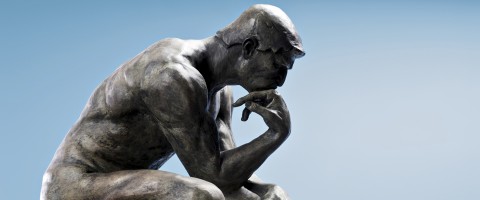 During the past two days, our list of Free Online Movies has been getting some good exposure. And we’ve got no complaints. But while assembling the movie list, we were also busy putting together a list of 500 Free Online Courses from top universities. Here’s the lowdown: This master list lets you download free courses from schools like Stanford, Yale, MIT, Oxford, Harvard and UC Berkeley. Generally, the courses can be accessed via YouTube, iTunes or university web sites. Right now you’ll find 55 courses in Philosophy, 50 in History, 50 in Computer Science, 35 in Physics, and that’s just beginning to scratch the surface. Most of the courses were recently produced. But, in some cases, we’ve layered in lecture series by famous intellectuals recorded years ago. Here are some highlights from the complete list.
- African-American History: Modern Freedom Struggle – YouTube– iTunes – Clay Carson, Stanford
- Financial Markets 2011 — YouTube — iTunes — Web Site – Robert Shiller, Yale
- Growing Up in the Universe – YouTube – Richard Dawkins, Oxford
- Human Behavioral Biology – iTunes Video – YouTube – Robert Sapolsky, Stanford
- Introduction to the Old Testament (Hebrew Bible) – Download Course – Christine Hayes, Yale.
- Heidegger’s Being & Time – iTunes — Hubert Dreyfus, UC Berkeley
- Intensive Introduction to Computer Science Using C, PHP, and JavaScript – Multiple Formats – iTunes – David Malan, Harvard
- Introduction to Cosmology and Particle Physics – YouTube – Sean Carroll, Caltech
- Invitation to World Literature – Web Site — David Damrosch, Harvard
- iPhone Application Development in iOS5 - HD Video iTunes — Standard-Def Video iTunes — Paul Hegarty, Stanford
- Justice: What’s the Right Thing to Do? – YouTube — Web Site- Michael Sandel, Harvard
- Philosophy of Language – iTunes – John Searle, UC Berkeley
- Physics for Future Presidents – YouTube – Richard Muller, UC Berkeley
- Quantum Electrodynamics – Web Site - Richard Feynman, Presented at University of Auckland
- Science, Magic and Religion - iTunes — YouTube – Courtenay Raiai, UCLA
- The American Novel Since 1945 – YouTube – iTunes Audio – iTunes Video — Download Course – Amy Hungerford, Yale
- The Art of Living – Web Site – Team taught, Stanford
Visit this list of Free Courses for many more hours of free enrichment. Separately, you might also want to check out our collection of Free Language Lessons. It offers free lessons in over 40 languages.
Read More...James Cameron Revisits the Making of Kubrick’s 2001: A Space Odyssey
2001: A Space Odyssey, so its fans will tell you, is awesome, amazing, astonishing, astounding — and that doesn’t even exhaust their list of “A” adjectives. But however emphatically they’re spoken, those words don’t tell you much. I fear they sometimes even put off potential 2001-lovers — or at least those who would enjoy a screening or three — who fear themselves unequal to the imposing labor of appreciation ahead. You’ll learn more meaningful things about Kubrick’s film in 2001: The Making of a Myth (made in 2001), a 45-minute documentary on its conception, its production, and its undiminished resonance in our cultural imagination.
Introduced by filmmaker James Cameron — he of The Terminator, Avatar, and Aliens, science-fiction spectacles of an entirely different nature — the program brings in a host of the original contributors to 2001’s look, feel, and psychological and technological verisimilitude. We hear from those involved in the photography, design, editing, and even technical consultancy. Actor Keir Dullea, still best known for his role as astronaut Dave Bowman, has much to say about working with his co-star HAL, and even the fellows in the ape suits offer insights into their non-verbal craft. Critical minds such as Elvis Mitchell and Camille Paglia weigh in on the picture’s simultaneous visceral and intellectual impact, but Arthur C. Clarke, who wrote 2001 the book while Kubrick shot 2001 the film, puts it most sharply when describing the intent of his director counterpart: “He wanted to make the proverbial good science-fiction movie.” Mission accomplished.
H/T Maria Popova (aka BrainPicker)
Related content:
Rare 1960s Audio: Stanley Kubrick’s Interview with The New Yorker
Dark Side of the Moon: A Mockumentary on Stanley Kubrick and the Moon Landing Hoax
Arthur C. Clarke Predicts the Internet & PC in 1974
Colin Marshall hosts and produces Notebook on Cities and Culture. Follow him on Twitter at @colinmarshall.
Read More...Marlon Brando Screen Tests for Rebel Without A Cause (1947)
During the 1940s, Warner Brothers bought the rights to Robert Lindner’s book, Rebel Without a Cause: The Hypnoanalysis of a Criminal Psychopath, and began turning it into a film. A partial script was written, and a 23-year old Marlon Brando was asked to do a five-minute screen test in 1947. For whatever reason, the studio abandoned the original project, and eventually revived it eight years later with a new script and a new actor — James Dean, of course. Dean’s own screen test for Rebel Without a Cause appears here.
If you would like to support the mission of Open Culture, consider making a donation to our site. It’s hard to rely 100% on ads, and your contributions will help us continue providing the best free cultural and educational materials to learners everywhere. You can contribute through PayPal, Patreon, and Venmo (@openculture). Thanks!
Related Content:
The Godfather Without Brando?: It Almost Happened
The James Dean Story by Robert Altman (Complete Film)
Paul Newman and James Dean Screentest for East of Eden
Read More...Watch Ray Bradbury: Story of a Writer, a 1963 Film That Captures the Creative Process of the Legendary Sci-Fi Author
Story of a Writer shows all the contradictions the late Ray Bradbury embodied: An unstoppably curious admirer of science and technology who some called a “mechanical moron,” a non-driver in midcentury Los Angeles, an imaginer of the future who worked in a basement crowded with paper files and tribal masks. We watch the classic IBM motto “THINK” catch the 43-year-old writer’s eye, yet we notice another sign posted above his typewriter: “DON’T THINK!” This half-hour television documentary captures that most instinctual of craftsmen in the rational genre of science fiction in all sorts of activities grounded in his time, place, and profession: telling stories and performing magic for his daughters, offering guidance to younger writers, “workshopping” a piece with a circle of associates in his living room, bicycling through town to get ideas, and touring a fallout shelter showground.
Produced by David L. Wolper, best known for programs like Roots, The Thorn Birds, and This is Elvis, Story of a Writer interweaves with these scenes from Bradbury’s daily life a jaggedly cinematic adaptation of his short story “Dial Double Zero.” In it, a man receives a series of unwanted phone calls from what eventually starts to sound like the phone system itself, which has, for unexplained reasons, spontaneously developed intelligence. In Bradbury’s imagination, technology may do troubling things, but rarely malevolent ones. “I’ve always been in favor of science that can prolong and beautify our lives,” he says in voiceover. The broadcast even includes one of Bradbury’s many plainspoken but enthusiastic lectures about the craft of writing, which has much in common with his similarly themed 2001 speech previously featured on Open Culture. As he sums up his recommendations to aspirants concerned about the quality of their work: “It doesn’t have to be the greatest. It does have to be you.”
You can find Ray Bradbury: Story of a Writer listed in our collection, 4,000+ Free Movies Online: Great Classics, Indies, Noir, Westerns, Documentaries & More.
via The Atlantic
Related content:
Ray Bradbury: Literature is the Safety Valve of Civilization
Ray Bradbury Gives 12 Pieces of Writing Advice to Young Authors (2001)
Ray Bradbury Reads Moving Poem on the Eve of NASA’s 1971 Mars Mission
Colin Marshall hosts and produces Notebook on Cities and Culture. Follow him on Twitter at @colinmarshall.
Read More...World Cinema: Joel and Ethan Coen’s Playful Homage to Cinema History
Chacun son cinéma (To Each His Own Cinema) is a 2007 French anthology film that brings together short films by 36 acclaimed directors. Lars von Trier, Jane Campion, Gus Van Sant, and Abbas Kiarostami all contributed to the project. Meant to commemorate the 60th anniversary of the Cannes Film Festival, the film originally aired on Canal+ in France. And, for reasons that remain unknown to us, that broadcast didn’t include the short film contributed by Joel and Ethan Coen, World Cinema. Nor did it appear on a later DVD release. If you wait long enough, these kinds of films eventually surface on YouTube. And, as luck would have it, you can watch World Cinema above. Fans of the Coen Brothers will immediately recognize Josh Brolin, who played a very similar character in their Academy Award-winning film, No Country for Old Men. Grant Heslov and Brooke Smith also make appearances. H/T Biblioklept
Related Content:
Tuileries: A Short, Slightly Twisted Film by Joel and Ethan Coen
40 Great Filmmakers Go Old School, Shoot Short Films with 100 Year Old Camera
Read More...Rare 1930s Audio: W.B. Yeats Reads Four of His Poems
The great Irish poet William Butler Yeats was born on this day in 1865. To mark the date we bring you a series of recordings he made for BBC radio in the final decade of his life.
“I’m going to read my poems with great emphasis upon their rhythm,” says Yeats in the first segment, recorded in 1932, “and that may seem strange if you are not used to it. I remember the great English poet William Morris coming in a rage out of some lecture hall, where somebody had recited a passage out of his Sigurd the Volsung. ‘It gave me a devil of a lot of trouble,’ said Morris, ‘to get that thing into verse!’ It gave me a devil of a lot of trouble to get into verse the poems that I am going to read, and that is why I will not read them as if they were prose.”
Yeats made ten radio broadcasts between 1931 and 1937. In the first reading, from 1932, Yeats begins with his famous early poem, “The Lake Isle of Innisfree,” which he once called “my first lyric with anything in its rhythm of my own music. ” He recites his verse in a somber tone that contemporary poet Seamus Heaney once described as an “elevated chant”:
The Lake Isle of Innisfree
I will arise and go now, and go to Innisfree,
And a small cabin build there, of clay and wattles made:
Nine bean-rows will I have there, a hive for the honeybee,
And live alone in the bee-loud glade.
And I shall have some peace there, for peace comes dropping slow,
Dropping from the veils of the morning to where the cricket sings;
There midnight’s all a glimmer, and noon a purple glow,
And evening full of the linnet’s wings.
I will arise and go now, for always night and day
I hear lake water lapping with low sounds by the shore;
While I stand by the roadway, or on the pavements gray,
I hear it in the deep heart’s core.
The next poem was written in 1889, less than a year after “The Lake Isle of Innisfree.” “A couple of miles from Innisfree,” says Yeats, “no, four or five miles from Innisfree, there’s a great rock called Dooney Rock where I had often picnicked when a child. And when in my 24th year I made up a poem about a merry fiddler I called him ‘The Fiddler of Dooney’ in commemoration of that rock and all of those picnics.”
The Fiddler of Dooney
When I play on my fiddle in Dooney,
Folk dance like a wave of the sea;
My cousin is priest in Kilvarnet,
My brother in Moharabuiee.
I passed my brother and cousin:
They read in their books of prayer;
I read in my book of songs
I bought at the Sligo fair.
When we come at the end of time,
To Peter sitting in state,
He will smile on the three old spirits,
But call me first through the gate;
For the good are always the merry,
Save by an evil chance,
And the merry love the fiddle,
And the merry love to dance:
And when the folk there spy me,
They will all come up to me,
With ‘Here is the fiddler of Dooney!’
And dance like a wave of the sea.
The third poem was recorded in March of 1934. It was first published in Yeats’s 1899 anthology, The Wind Among the Reeds, and tells the story of an old and weary peasant woman:
The Song of the Old Mother
I rise in the dawn, and I kneel and blow
Till the seed of the fire flicker and glow;
And then I must scrub and bake and sweep
Till stars are beginning to blink and peep;
And the young lie long and dream in their bed
Of the matching of ribbons for bosom and head,
And their day goes over in idleness,
And they sigh if the wind but lift up a tress:
While I must work because I am old,
And the seed of the fire gets feeble and cold.
The tape ends with a pair of recordings from 1937: another reading of “The Lake Isle of Innisfree,” followed by two stanzas from the 1931 poem “Coole and Ballylee.” (Find the complete six-stanza poem here.) The poem was inspired by the graceful Galway estate of Isabella Augusta, Lady Gregory, a co-founder of the Abbey Theatre. The poem was first published as “Coole Park and Ballylee” in the 1932 volume Words for Music Perhaps and Other Poems, but was shortened to “Coole and Ballylee” in the 1933 edition of The Winding Stair and Other Poems.
Coole and Ballylee (two stanzas)
Another emblem there! That stormy white
But seems a concentration of the sky;
And, like the soul, it sails into the sight
And in the morning’s gone, no man knows why;
And is so lovely that it sets to right
What knowledge or its lack had set awry,
So arrogantly pure, a child might think
It can be murdered with a spot of ink.
Sound of a stick upon the floor, a sound
From somebody that toils from chair to chair;
Beloved books that famous hands have bound,
Old Marble heads, old pictures everywhere;
Great rooms where travelled men and children found
Content or joy; a last inheritor
Where none has reigned that lacked a name and fame
Or out of folly into folly came.
The recordings will be added to the Poetry section in our Free Audio Books collection. You can also listen to a version of these recordings on Spotify below:
Read More...Found: Lost Great Depression Photos Capturing Hard Times on Farms, and in Town
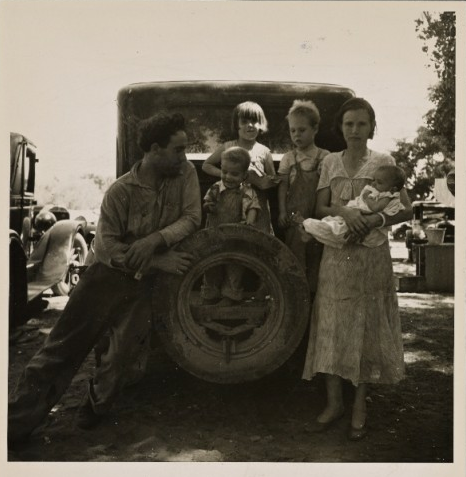
During the Great Depression, the Farm Security Administration took on the task of “introducing America to Americans” through photography. The FSA hired Dorothea Lange, Walker Evans, Gordon Parks and other artists to capture images of ordinary Americans, specifically poor farmers.
Some of the images are now iconic, notably Lange’s image of a destitute migrant mother of seven. That image and most others are cataloged in the collections of the Library of Congress, but some languished and were forgotten. Others ended up in general circulation, so that, in theory, anyone with a library card could check out an original print.
Recently a photography curator with the New York Public Library tracked down the missing images—some 1,000 of them—and created a special online archive where they can finally be seen.
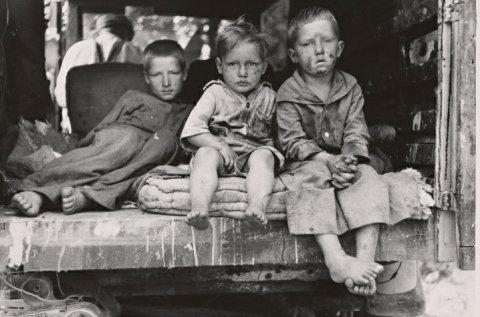
Many depict rural life: A 91-year-old woman sits in front of her North Carolina cabin. A worker takes a break from carving a dirt road into the New Mexico landscape. A black man in black face prepares to perform in a traveling medicine show. The children of migrant fruit pickers in Michigan sit forlornly on a truck.
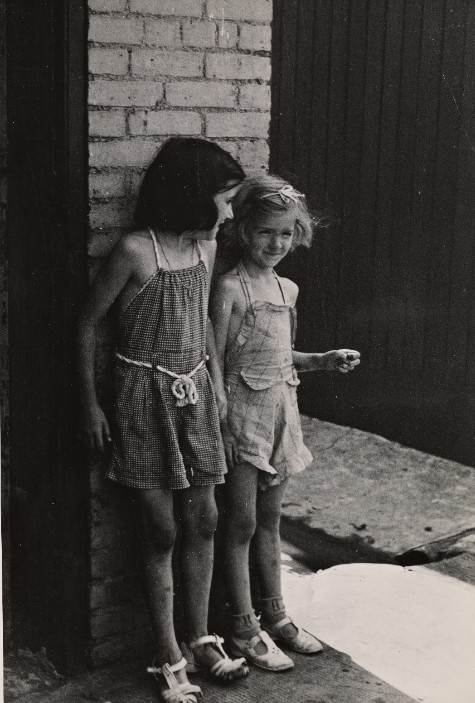
But not all the photographs document the plight of rural America. Some of the collection’s most powerful images are of Americans struggling in cities. Here two young girls play outside in a Baltimore slum. Three people sit outdoors on a Sunday in New Orleans. And then we capture a scene on the Lower East Side of New York City.
Not surprisingly Dorothea Lange’s work is among the strongest in this collection. One of the most powerful images comes several pages into her work’s archive, so be sure to click through. The story behind “From Texas tenant farmer to California fruit tramp” (the first image above) sums up the era: “1927 made $7000 in cotton. 1928 broke even. 1929 went in the hole. 1930 went in still deeper. 1931 lost everything. 1932 hit the road.”
Kate Rix is an Oakland-based writer. See more of her work at .
Read More...Support Us
We're hoping to rely on loyal readers, rather than erratic ads. Please click the Donate button and support Open Culture. You can use Paypal, Venmo, Patreon, even Crypto! We thank you!

About Us

Open Culture scours the web for the best educational media. We find the free courses and audio books you need, the language lessons & educational videos you want, and plenty of enlightenment in between.
Advertise With Us

FREE UPDATES!
GET OUR DAILY EMAIL
Get the best cultural and educational resources on the web curated for you in a daily email. We never spam. Unsubscribe at any time.
FOLLOW ON SOCIAL MEDIA

Open Culture editor Dan Colman scours the web for the best educational media. He finds the free courses and audio books you need, the language lessons & movies you want, and plenty of enlightenment in between.
Advertise With Us

