Microsoft Rolls Out Its New Tablet in Fine Apple Style
This week, Microsoft rolled out its new tablet, simply called Surface, which gives you another way to enjoy our courses, movies, ebooks, audio books and the rest. In many ways, Surface resembles the iPad in its look and feel. And when it came to unveiling the tablet, Microsoft’s execs couldn’t think outside the box created by Steve Jobs. A video made by ReadWriteWeb makes that rather painfully yet amusingly clear.…
Don’t forget to follow us on Twitter, Facebook and now Google+
Read More...Salvador Dalí Sketches Five Spanish Immortals: Cervantes, Don Quixote, El Cid, El Greco & Velázquez
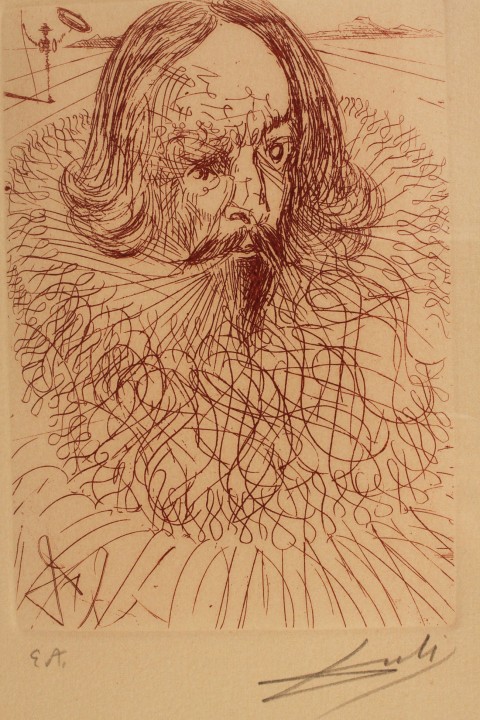
A few weeks back, we brought you Salvador Dalí’s 100 Illustrations of Dante’s The Divine Comedy and mentioned that we were saving Dalí’s drawings of Don Quixote for another day. Well, that day has come.
In the early 1960s, a Swiss publisher commissioned Dalí to create a print edition celebrating five real and imagined figures who loom large in the Spanish cultural imagination. The collection was called The Five Spanish Immortals, and it featured sketches of Cervantes, Europe’s first great novelist and his unforgettable protagonist, Don Quixote. The book also paid homage to the medieval hero El Cid; the master painter El Greco; and Diego Rodríguez de Silva y Velázquez — someone The Met calls “the most admired—perhaps the greatest—European painter who ever lived.” Cervantes appears above, and the remaining quartet below.
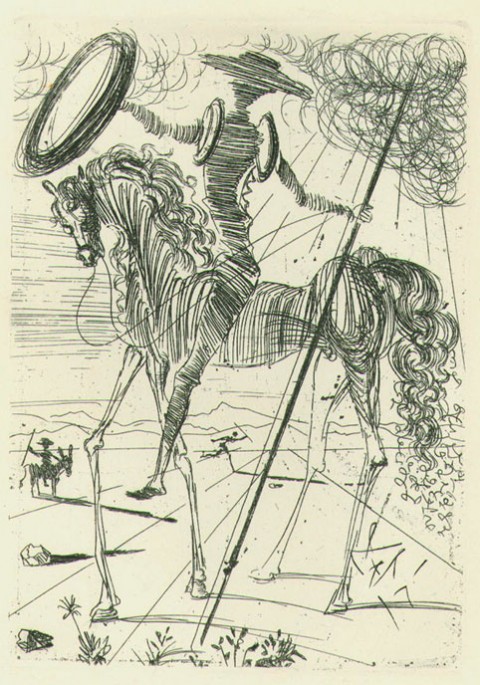
Don Quixote
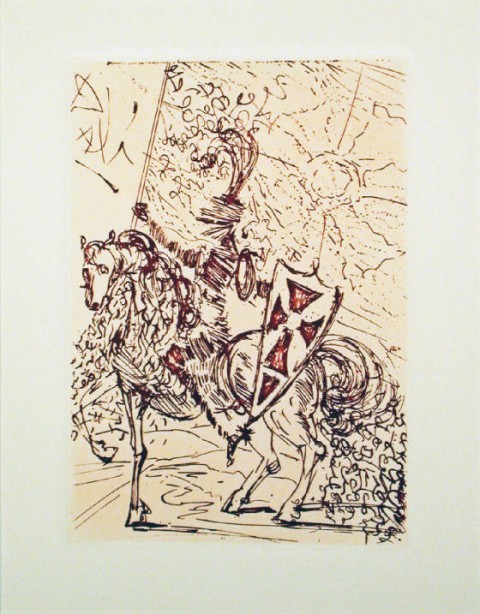
El Cid
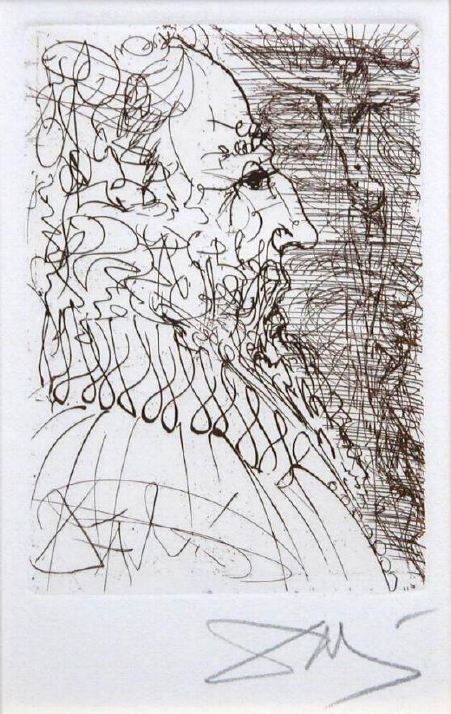
El Greco
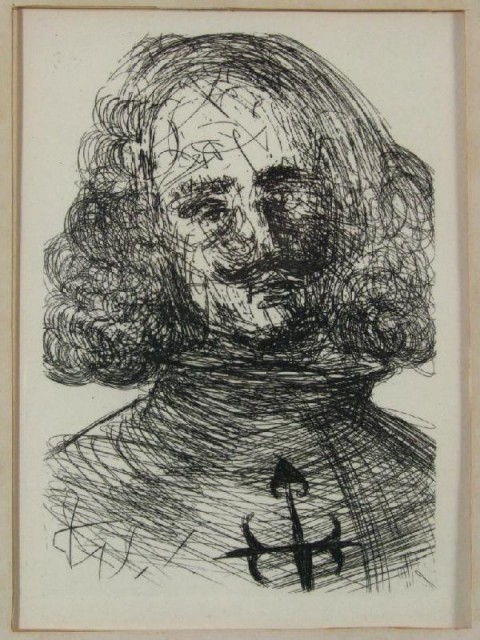
Velázquez
Read More...The Karl Marx Credit Card — When You’re Short of Kapital

Is it a tragedy? Is it a farce? In the land once called East Germany, in a town once called Karl-Marx-Stadt, a bank called Sparkasse Chemnitz ran an online poll letting customers vote for images to place on their credit cards. And the hands-down winner was Karl Marx, an ironic pick given that … well, you don’t need me to explain why.
In response to this selection, Planet Money has encouraged readers to post a tagline for the card on Twitter, using the hashtag #marxcard. Here are a few of our favorites so far:
- There are Some Things Money Can’t Buy. Especially If You Abolish All Private Property.
- From each according to their ability, to each according to his need. For everything else, there’s
#Marxcard. - The Marx Card — Because Credit is the Opiate of the Masses.
- The Karl Marx MasterCard — When You’re Short of Kapital
Got your own to suggest? cc: us on Twitter: @openculture
If you would like to support the mission of Open Culture, consider making a donation to our site. It’s hard to rely 100% on ads, and your contributions will help us continue providing the best free cultural and educational materials to learners everywhere. You can contribute through PayPal, Patreon, and Venmo (@openculture). Thanks!
Related Content:
Reading Marx’s Capital with David Harvey (Free Course)
Read More...Salman Khan Returns to MIT, Gives Commencement Speech, Likens School to Hogwarts
This week, Salman Khan returned to his alma mater, MIT, to deliver the commencement speech to the 2012 graduates. As you know, MIT helped spark the open education movement when it launched its OpenCourseWare site in 2002. A decade later, the university has placed materials for 2100 courses online (find many highlighted in our collection of Free Online Courses). So it’s fitting that the new face of open education would deliver the big speech.
The talk is a bit inwardly focused, a celebration of MIT and its Hogwarts qualities. But the latter half gets to Khan’s philosophy of life, his recipe for living well in the world. It boils down to 1) being positive and smiling when in doubt, 2) surrendering your ego during times of conflict, 3) listening to others, 4) downplaying material concerns and focusing on health and relationships, and 5) using a number of thought experiments to gain perspective on life. Those he explains along the way.…
Read More...The History of Philosophy Without Any Gaps — Peter Adamson’s Podcast Still Going Strong
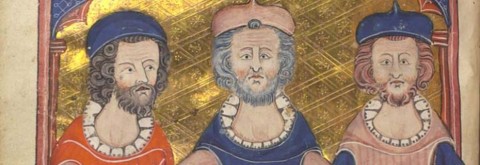
Last August, we featured Peter Adamson’s podcast The History of Philosophy Without Any Gaps (iTunes – RSS Feed – Web Site), a chronologically uninterrupted “look at the ideas and lives of the major philosophers (eventually covering in detail such giants as Plato, Aristotle, Aquinas, Descartes, and Kant) as well as the lesser-known figures of the tradition.” Continuing at the rate of one episode a week, Adamson and his guest philosophical experts have since covered names like Lucretius, Seneca, and Plutarch. They’ve most recently reached Alexander of Aphrodisias, an especially astute ancient commentator on Aristotle and opponent of Stoic attitudes toward fate; Quintilian, Lucian, Themistius, and the interplay between rhetoric and philosophy in the Roman Empire; and the emergence of astronomy, ushered in by Ptolemy during a time when observers still had much to say about astrology.
Don’t miss the episodes where Adamson brings in specialists on the particular philosopher, philosophical subfield, or quirk in philosophical history to which his podcasting journey brings him. Since our last post on the show, we’ve heard Richard Sorabji talk about time and eternity in Aristotle, James Warren on Epicureanism, and Raphael Wolf on Cicero, to name but a few. Such is Adamson’s attention to detail — and dedication to the Zeno’s Paradox-reminiscent cause of pure continuity — that, after putting out 85 episodes, he remains in the ancient world. Imagine the bounty of discussion when he reaches, say, the eighteenth century, let alone the twentieth. To prepare yourself for that, you’d better start listening now; a show expressly created without gaps must, it seems only natural, be experienced without them.
Related content:
The Partially Examined Life: A Philosophy Podcast
Philosophy Bites: Podcasting Ideas From Plato to Singularity Since 2007
55 Free Philosophy Courses
Colin Marshall hosts and produces Notebook on Cities and Culture. Follow him on Twitter at @colinmarshall.
Read More...Richard Dawkins Explains Why There Was Never a First Human Being
Last year, right before publishing his illustrated children’s book The Magic of Reality, Richard Dawkins appeared at The New Yorker Festival and walked the crowd through a short thought experiment. Imagine pulling out your family genealogy. Now snap a photo of each ancestor going back 185 million generations. What would it show? First off, your very distant grandfather was a fish. Secondly, you can never put your finger on the very first human being, a proverbial Adam and Eve. 185,000,000 snapshots can never capture that one moment.
If you would like to support the mission of Open Culture, consider making a donation to our site. It’s hard to rely 100% on ads, and your contributions will help us continue providing the best free cultural and educational materials to learners everywhere. You can contribute through PayPal, Patreon, and Venmo (@openculture). Thanks!
Related Content:
Free Online Biology Courses
Darwin: A 1993 Film by Peter Greenaway
Richard Dawkins & John Lennox Debate Science & Atheism
Read More...Modern Masters: Watch BBC Series Introducing the Art of Warhol, Matisse, Picasso and Dali
Modern art. Like it or not, it’s had a profound impact on the way our world looks. As critic Alastair Sooke explains in this four-part series from the BBC, the great artworks of the past century have exerted an influence that extends far beyond museum walls.
Modern Masters, first broadcast in 2010 on the mainstream channel BBC One, looks at the life, work, and abiding influence of Henri Matisse, Pablo Picasso, Salvador Dali and Andy Warhol. “Art during the 20th century was radical, intoxicating, and immensely influential,” says Sooke, deputy art critic of The Daily Telegraph. “Matisse, Picasso, Dali and Warhol didn’t just change art history; they changed the world.”
Episode one, Andy Warhol: For a series examining the influence of 20th century art through the prism of celebrity artists, it’s fitting that Sooke should begin with an artist obsessed with celebrity. Sooke follows Warhol (see above) from his impoverished childhood in Pittsburgh to New York City, where he struggled as a commercial artist before becoming famous as a pop artist. Along the way he shows how Warhol’s aesthetic sensibility now permeates our culture. The other three episodes proceed along similar lines. Each is just under an hour long.
Episode two, Henri Matisse:
Episode three, Pablo Picasso:
https://www.youtube.com/watch?v=cU5TDkjhLNs#t=09
Episode four, Salvador Dali:
Related Content:
Robert Hughes, Famed Art Critic, Demystifies Modern Art: From Cézanne to Andy Warhol
Simon Schama Presents Van Gogh and the Beginning of Modern Art
Read More...Paul McCartney Turns a Spry 70 Today, Thanks to Meditation, a Vegetarian Diet and Three Hour Gigs
Paul McCartney turns 70 today, and he’s looking a whole lot more spry than some of his contemporaries. (Hello Keith Richards!) What’s the key to his longevity? It starts with putting on three hour shows. He recently told one newspaper, “I’ve been having cardio-vascular exercise for years but it’s on stage. I can’t believe I do a three-hour show without taking a breath.”
You could also trace his durability back to lifestyle choices made in the 1960s. Above, McCartney explains to David Lynch how he took up transcendental meditation when the Beatles met Maharishi Mahesh Yogi through George Harrison and his wife in 1967. Famously, The Beatles traveled to India in ’68 to study TM at the Maharishi’s ashram. The trip didn’t go well, but McCartney stuck with the meditation. Below, we also give you McCartney extolling the virtues of a vegetarian diet, something he took up decades ago. The clip comes from a longer video he shot for PETA, a non-profit he has supported for years..
Do Khan Academy Videos Promote “Meaningful Learning”?
If you ever wondered whether professional scientists are skeptical about some of the incredibly fun, attractive and brief online videos that purport to explain scientific principles in a few minutes, you’d be right.
Derek Muller completed his doctoral dissertation by researching the question of what makes for effective multimedia to teach physics. Muller curates the science blog Veritasium and received his Ph.D. from the University of Sydney in 2008.
It’s no small irony that Muller’s argument, that online instructional videos don’t work, has reached its biggest audience in the form of an online video. He launches right in, lecture style, with a gentle attack on the Khan Academy, which has famously flooded the Internet with free instructional videos on every subject from arithmetic to finance.
While praising the academy’s founder, Salman Khan, for his teaching and speaking talent, Muller contends that students actually don’t learn anything from science videos in general.
In experiments, he asked subjects to describe the force acting upon a ball when a juggler tosses it into the air. Then he showed them a short video that explained gravitational force.
In tests taken after watching the video, subjects provided essentially the same description as before. Subjects said they didn’t pay attention to the video because they thought they already knew the answer. If anything, the video only made them more confident about their own ideas.
Science instructional videos, Muller argues, shouldn’t just explain correct information, but should tackle misconceptions as well. He practices this approach in his own work, like this film about weightlessness in the space station. Having to work harder to think through why an idea is wrong, he says, is just as important as being told what’s right.
Kate Rix is an Oakland-based freelance writer. See more of her work at .
Read More...Udacity to Launch 5 New Courses, from Statistics to Physics. Shooting for Largest Online Class Ever.
This weekend, the Wall Street Journal published a gushing little profile on Sebastian Thrun. By now, you probably know his bio. Thrun helped invent the self-driving car at Google and taught artificial intelligence at Stanford, before ditching his tenured teaching position and launching Udacity, a new venture that offers MOOCs (Massive Open Online Courses) to students everywhere.
Also this weekend, Thrun kicked off an effort to “break the student record for the largest online class ever taught” with his new class, Introduction to Statistics: Making Decisions Based on Data. It starts June 25, and above you can watch Thrun give a short (Hans Rosling-like) introduction to the class. The course is entirely free and open to students everywhere. Students will receive dynamic feedback along the way, and diligent students will get a certificate of completion at the end. So what’s stopping you? Certainly not money or geography. Other courses starting on June 25 include:
Intro to Physics: Landmarks in Physics
Algorithms: Crunching Social Networks
Logic & Discrete Mathematics: Foundations of Computing
Software Testing: How to Make Software Fail
Related Content:
Coursera Adds Humanities Courses, Raises $16 Million, Strikes Deal with 3 Universities
Harvard and MIT Create EDX to Offer Free Online Courses Worldwide
Why the University System, as We Know It, Won’t Last …. and What’s Coming Next
Free Online Certificate Courses from Great Universities: A Complete List
Read More...Support Us
We're hoping to rely on loyal readers, rather than erratic ads. Please click the Donate button and support Open Culture. You can use Paypal, Venmo, Patreon, even Crypto! We thank you!

About Us

Open Culture scours the web for the best educational media. We find the free courses and audio books you need, the language lessons & educational videos you want, and plenty of enlightenment in between.
Advertise With Us

FREE UPDATES!
GET OUR DAILY EMAIL
Get the best cultural and educational resources on the web curated for you in a daily email. We never spam. Unsubscribe at any time.
FOLLOW ON SOCIAL MEDIA

Open Culture editor Dan Colman scours the web for the best educational media. He finds the free courses and audio books you need, the language lessons & movies you want, and plenty of enlightenment in between.
Advertise With Us