Van Morrison, Jefferson Airplane & The Grateful Dead: Watch Classic Concerts from Wolfgang’s Vault
In Wolfgang’s Vault, you’ll find Van Morrison singing “Cyprus Avenue.” But it won’t be the original track from his 1968 album Astral Weeks; it’ll be a different, nearly eight-and-a-half-minute rendition, which you’ll watch Morrison perform onstage at New York’s Fillmore East on September 23, 1970. Those who have seen Morrison perform live in any era tend to describe it as an experience highly distinct from hearing him sing on record, and ultimately a necessary one for those seeking to fully appreciate his work. Unlike so many musicians who rose to great popularity in the late sixties and early seventies, Morrison continues to tour, and so these opportunities remain available. But how many of Morrison’s fans could possibly have made it to his shows at the Fillmore East back then? How many, for that matter, were alive back then? Those of us who weren’t have Wolfgang to thank, I suppose, for making available these historic concert clips that deepen our understanding of artists like Morrison.
Yet Wolfgang himself, it turns out, is no longer among us. Known in full as Wolodia “Wolfgang” Grajonca, he rose to prominence when, after a name change and a trying relocation from Berlin to San Francisco, he became the west coast concert promoter and iconic counterculture rock impresario Bill Graham. Small wonder, then, that the internet archive which bears his name contains so much compelling vintage concert footage. Browse it by performer, and you’ll spot many of the names you’d expect to: Jefferson Airplane, The Band, The Grateful Dead. But dig even deeper and you’ll find real surprises, like Yoko Ono playing Giants Stadium in 1986 and a vast cache of songs, captured on thrillingly lo-fi video, performed by visually pioneering and media-satirizing new wave band The Tubes. An afternoon spent in Wolfgang’s Vault makes a fine primer on the most enduring rock played in Graham’s heyday, but also yields some delightfully odd performances you’d never expect to see today.
Related content:
Free Grateful Dead Concert Archive
Martin Scorsese Captures Levon Helm and The Band Performing “The Weight” in The Last Waltz
Colin Marshall hosts and produces Notebook on Cities and Culture. Follow him on Twitter at @colinmarshall.
Read More...Elmore Leonard’s 10 Rules for Writers
“If it sounds like writing,” says Elmore Leonard, “I rewrite it.”
Leonard’s writing sounds the way people talk. It rings true. In novels like Get Shorty, Rum Punch and Out of Sight, Leonard has established himself as a master stylist, and while his characters may be lowlifes, his books are received and admired in the highest circles. In 1998 Martin Amis recalled visiting Saul Bellow and seeing Leonard’s books on the old man’s shelves. “Bellow and I agreed,” said Amis, “that for an absolutely reliable and unstinting infusion of narrative pleasure in a prose miraculously purged of all false qualities, there was no one quite like Elmore Leonard.”
In 2006 Leonard appeared on BBC Two’s The Culture Show to talk about the craft of writing and give some advice to aspiring authors. In the program, shown above, Leonard talks about his deep appreciation of Ernest Hemingway’s work in general, and about his particular debt to the 1970 crime novel The Friends of Eddie Coyle, by George V. Higgins. While explaining his approach, Leonard jots down three tips:
- “You have to listen to your characters.”
- “Don’t worry about what your mother thinks of your language.”
- “Try to get a rhythm.”
“I always refer to style as sound,” says Leonard. “The sound of the writing.” Some of Leonard’s suggestions appeared in a 2001 New York Times article that became the basis of his 2007 book, Elmore Leonard’s 10 Rules of Writing. Here are those rules in outline form:
- Never open a book with the weather.
- Avoid prologues.
- Never use a verb other than “said” to carry dialogue.
- Never use an adverb to modify the verb “said.”
- Keep your exclamation points under control!
- Never use the words “suddenly” or “all hell broke loose.”
- Use regional dialect, patois, sparingly.
- Avoid detailed descriptions of characters.
- Same for places and things.
- Leave out the parts readers tend to skip.
You can read more from Leonard on his rules in the 2001 Times article. And you can read his new short story, “Ice Man,” in The Atlantic.
Read More...Mars Rover, Curiosity, Will Face Seven Minutes of Terror on August 5
In the video above, NASA engineers explain the extremely precise calculations governing the landing of Curiosity, the seventh Mars Rover since the failed Soviet Mars 2 and 3 missions in 1971. Launched in November of 2011, Curiosity is scheduled to touch down in Gale Crater at exactly 10:31PM Pacific time, this August 5th. Using dramatic computer-generated imagery, the video shows the rover’s approach as it breaches the atmosphere and hurtles toward the surface of the planet in several complicated stages, a descent that takes exactly seven minutes. The engineers call this span of time “seven minutes of terror”; since the signal delay from the spacecraft to earth is fourteen minutes, NASA engineers must wait an additional seven minutes after its entry to learn whether the entirely-computer-guided craft has made it safely to the surface or crashed and burned. Since it’s speeding down from the upper atmosphere at 13,000 miles an hour and heating up to 1600 degrees, their fears are certainly warranted. And fear may be a symbolically appropriate emotional response to a planet named for the ancient god of war, with moons named Phobos and Diemos—“fear” and “terror,” respectively.
The Mars program has had several false starts and a history very much rooted in the Cold War space race. During the the 1960s, the U.S. and USSR sent competing flyby and orbiter missions to the red planet, but it wasn’t until July 4, 1997 that NASA was able to land a functioning rover, the Pathfinder, on the surface. A British-led attempt to land another rover, Beagle 2, was a failure, but NASA successfully landed Spirit in January, 2004. Sadly, Spirit became mired in the thick sand of the planet’s surface and could not be freed. Spirit’s twin, Opportunity, made a successful landing two weeks later and has continued to operate without serious incident, save periods of downtime over the Mars winter, when its solar panels cannot collect enough sunlight to power it. Intended to find signs of water on the planet, Opportunity has made discoveries that provide clues to the geological history of Mars. After its ninth year of work, NASA’s only functioning rover is beginning to show its age. NASA engineers hope the S.U.V.-sized Curiosity will survive its ordeal and continue the work of its predecessors, seeking more signs of water, and maybe finding signs of life.
J. David Jones is currently a doctoral student in English at Fordham University and a co-founder and former managing editor of Guernica / A Magazine of Arts and Politics.
Read More...Woody Allen Lives the “Delicious Life” in Early-80s Japanese Commercials
Sometimes I think the only real advantage of American celebrity would be the offers to act in Japanese television commercials. We’ve previously featured James Brown pitching Nissin noodles, Harrison Ford’s Japanese-speaking spots for Kirin Beer remain beloved pop-cultural artifacts, and evidently Jodie Foster sends cosmetics and coffee flying off the shelves. Sofia Coppola even built her film Lost in Translation around a Hollywood actor, portrayed with unforgettable resignation by Bill Murray, visiting Tokyo to shoot a Suntory Whisky ad. Above you’ll find a series of commercials from the early eighties for the Japanese department store Seibu, featuring none other than Woody Allen. He arranges his desk, paints calligraphy, wincingly receives some kind of moxibustion treatment, and makes a purchase from a vending machine emblazoned with a picture of himself, all while a singer (as far as my limited Japanese allows me to understand) rattles off a list of durable and edible goods.
When these spots first aired, many Japanese viewers didn’t recognize Allen. According to a contemporary Lakeland Ledger article, Seibu’s marketers planned it that way, intending to introduce him to Japan themselves as a representative of their sensibility : “Responding to the decline in the youth market, Seibu wanted the store represented by ‘an adult’ [ … ] With his multiple talents, Mr. Allen seemed ideal to personify Seibu’s multiple features.” In each of these clips, Allen presents (and the singer sings) the Japanese phrase “おいしい生活,” which I read as “delicious life,” which the Ledger article translates as “tasteful life,” and which one YouTube commenter translates as “delicious lifestyle.” (“The sweet life” might convey a similar idea.) For evidence of this campaign’s cultural impact, look no further than Japan’s title for the Woody Allen film, released nearly twenty years later, that we know as Small Time Crooks: おいしい生活. Woody, you’ve done London, you’ve done Barcelona, you’ve done Paris, you’ve done Rome — hasn’t the time come to take your camera to Tokyo?
Related content:
The Best Japanese Commercial Ever? James Brown Sells Miso Soup
Woody Allen on The Dick Cavett Show Circa 1970
David Lynch’s Surreal Commercials
Colin Marshall hosts and produces Notebook on Cities and Culture. Follow him on Twitter at @colinmarshall.
Read More...The LEGO Turing Machine Gives a Quick Primer on How Your Computer Works
This past Saturday, we celebrated the centennial of Alan Turing’s birth by presenting two films that explore the life and achievements of the great mathematician/father of computer science: Dangerous Knowledge and Breaking the Code. Today, before the anniversary fades into the background, let us send one more film your way — this one a “short documentary” that brings Turing’s famous computing machine to life. The device, as Turing imagined it in 1936, was meant to simulate the logic of computer algorithms, revealing the extent and limits of what can be computed. Turing never built the machine. He only offered a conceptual blueprint. But two researchers at the Centrum Wiskunde & Informatica in Amsterdam have kindly recreated the Turing Machine with LEGO, and then produced a short film demonstrating how the machine carries out the most basic functions of your computer. Watch it go.
You can find more information on the building and inner-workings of the LEGO Turing Machine here.
If you would like to support the mission of Open Culture, consider making a donation to our site. It’s hard to rely 100% on ads, and your contributions will help us continue providing the best free cultural and educational materials to learners everywhere. You can contribute through PayPal, Patreon, and Venmo (@openculture). Thanks!
Related Content:
Free Online Computer Science Courses
Cambridge University to Create a Lego Professorship
Two Scenes from Stanley Kubrick’s Dr. Strangelove, Recreated in Lego
Read More...Magician Marco Tempest Dazzles a TED Audience with “The Electric Rise and Fall of Nikola Tesla”
Marrying form and content, Swiss magician Marco Tempest uses the relatively new technology of projection mapping to illuminate several vignettes of Nikola Tesla, the Serbian inventor of alternating current, the hydroelectric dam, and hundreds of other necessary, fantastic, and sometimes tragically unrealized technologies. Over the course of the 20th century, Tesla was overshadowed by his onetime employer, Thomas Edison, who is given credit for Tesla’s most famous ideas. Edison has emerged from history as less a scientist than a venture capitalist, arch-marketer, and popularizer of other, smarter people’s ideas (those of filmmaking team the Lumiere Brothers, for example), while Tesla’s reputation as a mystic genius has only grown since his death in relative obscurity and absolute poverty in 1943.
Tesla has occupied a prominent place in popular culture for over two decades now: There was David Bowie’s performance as the inventor in 2006’s The Prestige, a 2001 biography simply entitled Wizard, and, of course, the success of very earnest 90s hair metal band Tesla. Forecasting the Tesla revival, Orchestral Maneuvers in the Dark recorded their song “Tesla Girls” in 1984. A new Tesla legacy to watch is the pioneering high-end electric car company Tesla Motors, founded by PayPal billionaire Elon Musk. Whether or not Tesla Motors’ expensive new fully-electric sedan lives up to its promise, Nikola Tesla’s name lives as an exemplar of ambition, futurism, persistence, scientific wonder, and as Marco Tempest demonstrates above, the importance of enthusiastic showmanship.
J. David Jones is currently a doctoral student in English at Fordham University and a co-founder and former managing editor of Guernica / A Magazine of Arts and Politics.
Read More...John Maynard Keynes Explains Cure to High Unemployment in His Own Voice (1939)
When someone questions the effectiveness of Keynesian economics, the obvious reply is: Remember World War II?
The British economist John Maynard Keynes argued that there is a role for government intervention when aggregate demand for goods and services drops, as it did during the Great Depression. Without increased public spending to make up for decreased private spending, he said, an economy will slide into a vicious circle of low demand and low output, ensuring a prolonged period of high unemployment. Government thrift at such times will only deepen the problem. “The boom, not the slump,” said Keynes, “is the right time for austerity.”
In 1939 dark clouds of war were gathering over Europe, but Keynes saw a silver lining: an opportunity to prove his theory correct. He believed that the massive government-funded war mobilization would finally give sufficient stimulus to end the Great Depression. On May 23 of that year Keynes gave his famous BBC radio address, “Will Re-armament Cure Unemployment?” He said, in part:
It is not an exaggeration to say that the end of abnormal unemployment is in sight. And it isn’t only the unemployed who will feel the difference. A great number besides will be taking home better money each week. And with the demand for efficient labor outrunning the supply, how much more comfortable and secure everyone will feel in his job. The Grand Experiment has begun. If it works–if expenditure on armaments really does cure unemployment–I predict that we shall never go back all the way to the old state of affairs. Good may come out of evil. We may learn a trick or two, which will come in useful when the day of peace comes.
When the day of peace did come, the Great Depression was over and England and America were embarked on a long period of rising economic prosperity. In these times of recession and government austerity, it may be good to remember something else Keynes said in his radio address: “If we can cure unemployment for the wasted purposes of armaments, we can cure it for the productive purposes of peace.”
You can find Keynes’ classic work, The General Theory of Employment, Interest and Money, in our collection of Free eBooks.
Related Content:
Read More...Hollywood, Epic Documentary Chronicles the Early History of Cinema
Most people who saw Martin Scorsese’s Hugo will recall its brief dramatization of a screening of the Lumiere Brothers’ 1896 silent film L’Arrivée d’un Train en Gare de la Ciotat (popularly known as Arrival of a Train at the Station). This short film documents, quite simply, a train arriving at a station, but it supposedly both thrilled and terrified its first audiences, so much that they scrambled from their seats as the locomotive barreled toward the camera, as though it might transgress the screen and plow into the theater. It’s hard to imagine a film having that much power to physically shock an audience out of its seats today, even with the current glut of 3‑D spectacles on IMAX screens, the beautiful Hugo included.
The medium may have lost its novelty, but its history continues to fascinate. Scorsese’s love-letter to silent film won several Academy Awards this year in technical categories, and the coveted best picture Oscar went to The Artist, the first silent film to win that award since 1927’s Wings, starring Clara Bow. (Wings actually received the Best Picture equivalent—Best Production—in 1929). 1927 is also the year the “talkies” came to town; Al Jolson’s The Jazz Singer put silent film effectively out of business. Hollywood: A Celebration of the American Silent Film, a 13-part documentary series released in 1980, begins its first episode, “The Pioneers” (above), with several aged silent filmmakers’ reactions to Jolson’s film, reactions which are almost uniformly negative, as one might expect given their professional commitment to a medium that transformed overnight and left most of them behind.
However, the stars and directors interviewed in the film don’t necessarily seem bitter over the loss of silent film. Instead, they display a wistful reverence for the “international language” that film was before it learned to speak—in dozens of different languages. Narrated by the inimitable James Mason, Hollywood revisits the grandeur of the silent film era and disabuses viewers of the stereotypical idea that all silent films were “jerky and flickering and a little absurd, moving at the wrong speed with a tinkling piano.” Instead, each episode of the documentary walks us through a series of incredibly dramatic movies with elaborate (often outlandish) sets and costuming, and actors skilled in the “high art of pantomime.” It’s a riveting journey, and an era well worth revisiting whatever one thought of this year’s Oscars.
The full documentary series is available here. And don’t miss our collection of Silent films available online … for free.
H/T @brainpicker
Read More...The Complete History of the World (and Human Creativity) in 100 Objects
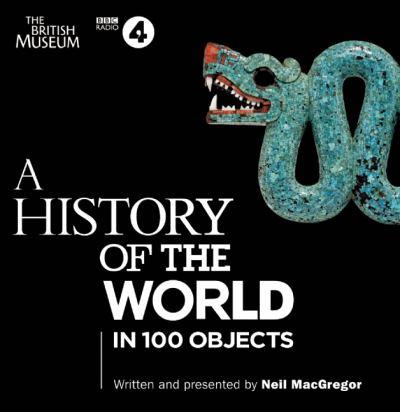
While we’re catching up with historical podcasts, note that BBC Radio 4’s The History of the World in 100 Objects (iTunes – RSS Feed – Web Site) has wrapped up and covered all 100 objects. And not, mind you, just any old objects: these objects come straight from the collection of the British Museum, and thus almost certainly reveal the story of mankind more effectively than most. For that has constituted the program’s project since its inception: to tell, for just under fifteen minutes at a stretch, one chapter of human history as the trained eye can read it in an object like an early writing tablet, a Chinese bronze bell, or an Egyptian clay model of cattle. Don’t let the seeming plainness of these artifacts fool you; the show approaches them with all the most advanced audio production techniques. And after you’ve listened, you’ll realize that, looked at from a suitably historical perspective, there’s not a plain object in this bunch.
Since A History of the World in 100 Objects has finished its journey to the present day, the new listener has no obligation to begin in the ancient world and work their way forward. You might well prefer to begin at the end, as it were, and draw insights from one of our everyday objects like a credit card (albeit, in this broadcast, one that conforms to Shari’a law), or a slightly futuristic object now entering our everyday lives like a solar-powered lamp. From there, you can delve deeper and deeper into our culture and technology’s past: the nifty lamp gives way to the credit card which gives way to a David Hockney painting, which gives way to the HMS Beagle’s chronometer to the mechanical galleon and a Korean roof tile until you’re back at the Mummy of Hornedjitef. If you get back that far and still find yourself longing for more from host Neil MacGregor, be aware that he’s got a new, 20-part historical series going called Shakespeare’s Restless World. The range of source material may have narrowed, but the depth remains.
Related content:
The History of Rome in 179 Podcasts
The History of Philosophy Without Any Gaps – Peter Adamson’s Podcast Still Going Strong
Colin Marshall hosts and produces Notebook on Cities and Culture. Follow him on Twitter at @colinmarshall.
Read More...Bill Murray’s Baseball Hall of Fame Speech (and Hideous Sports Coat)
Charleston, South Carolina is a long way from Cooperstown, NY. About 622 miles, to be precise. And it’s in Charleston that Bill Murray, the actor, was inducted into the South Atlantic League Hall of Fame on Tuesday. Why bestow such an honor on the star of Ghostbusters, Stripes, and various Wes Anderson films? Because, rather quietly, Murray has owned parts of many minor league baseball teams, including, these days, the Charleston RiverDogs, a class A affiliate of the New York Yankees. So, with the Yankees’ General Manager Brian Cashman in attendance, Murray gave his Hall of Fame Induction Speech, knowingly sporting a hideous shirt and jacket. The opening minutes will speak to anyone who remembers, as a kid, entering a baseball stadium for the first time and seeing that vast field of green.
Related Content:
Fact Checking Bill Murray: A Short, Comic Film from Sundance 2008
Bill Murray Introduces Wes Anderson’s Moonrise Kingdom (And Plays FDR In December)
Read More...Support Us
We're hoping to rely on loyal readers, rather than erratic ads. Please click the Donate button and support Open Culture. You can use Paypal, Venmo, Patreon, even Crypto! We thank you!

About Us

Open Culture scours the web for the best educational media. We find the free courses and audio books you need, the language lessons & educational videos you want, and plenty of enlightenment in between.
Advertise With Us

FREE UPDATES!
GET OUR DAILY EMAIL
Get the best cultural and educational resources on the web curated for you in a daily email. We never spam. Unsubscribe at any time.
FOLLOW ON SOCIAL MEDIA

Open Culture editor Dan Colman scours the web for the best educational media. He finds the free courses and audio books you need, the language lessons & movies you want, and plenty of enlightenment in between.
Advertise With Us

