Evolver: A Darwinist Reimagination of The Beatles’ 1966 album
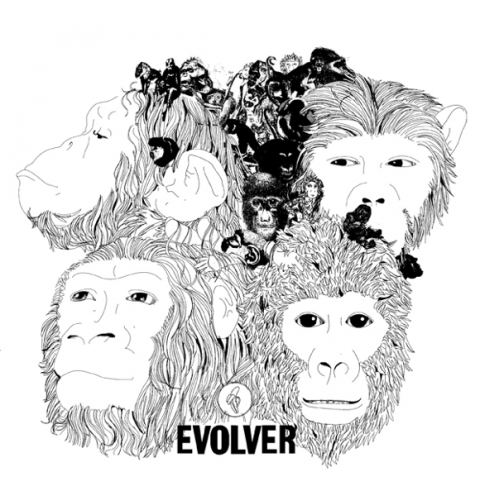 The Evolver T‑Shirt, it’s the perfect gift for the science believin’ Beatles fan. It’s obviously a play on The Beatles’ great 1966 album Revolver. And, over at BoingBoing, Mark Frauenfelder asked readers to rethink the titles of various songs on the album — to imagine them in evolutionary terms. Here are some of the creative suggestions:
Taxman = Macaques, Man
And Your Bird Can Sing = And Your Chimp Can Swing
I’m Only Sleeping = I’m Only Simian
Doctor Robert = Doctor Fossey
I Want to Tell You = I Want to Groom You
Tomorrow Never Knows = Too Many Bonobos
Personally, I think “Tomorrow Never Knows” could stay just as it is. Doesn’t it already capture the Darwinian spirit in its own way?
Related Content:
Darwin’s Personal Library Goes Digital: 330 Books Online
Darwin: A 1993 Film by Peter Greenaway
Read More...Science Behind the Bike: Four Videos from the Open University on the Eve of the Tour de France
Right in time for the Tour de France (which gets underway tomorrow) the Open University has released a new video series called Science Behind the Bike. During the past two decades, science has taken cycling to new places — sometimes good, sometimes bad. The introduction of performance enhancing drugs nearly damaged the sport beyond repair, and it certainly destroyed the careers and reputations of many leading cyclists. But all along, somewhere outside the public glare, many well-intentioned scientific minds have toiled away, trying to find legitimate ways to advance the sport. Physiologists, physicists, engineers, software designers, techies from Formula 1 racing — they’ve all brought a new perspective to cycling.
In the video above, Science Behind the Bike looks at how science and technology have influenced the making and breaking of the prestigious World Hour Record first established in 1893. Then, below, Forces breaks down the physics of cycling; Physiology explains, well, the physiology that boosts performance; and Technology digs deeper into the high-tech hardware that cyclists push along. If you’re a fan of the sport, you’ll undoubtedly appreciate appearances by Chris Boardman, Francesco Moser, Graeme Obree and Rebecca Romero.
Forces
Physiology
Technology
Related Content:
Brussels Express: The Perils of Cycling in Europe’s Most Congested City
David Byrne: From Talking Heads Frontman to Leading Urban Cyclist
Read More...Two Vintage Films by Salvador Dalí and Luis Buñuel: Un Chien Andalou and L’Age d’Or
While studying at the University of Madrid in the late 1910s, a young Luis Buñuel befriended an even younger Salvador Dalí. The first fruit of their association, a short film called Un Chien Andalou, appeared a decade later, in 1929, and quickly achieved the international renown it still has today. Several elements had to fall into place to bring this cinematic dream — or cinematic nightmare, or, most accurately, something nebulously in-between — into reality. First, Buñuel gained experience in the medium by assistant-directing on major silent-era European films like Mauprat, La chute de la maison Usher, and La Sirène des Tropiques. Then, Buñuel dreamt of the simultaneous image of a cloud slicing through the moon and a razor slicing through an eye. Then, Dalí dreamt of a human hand covered in ants. With those two visuals in place, they proceeded to collaborate on the rest of the film, working under the principle that “no idea or image that might lend itself to a rational explanation of any kind would be accepted.”
We could discuss Un Chien Andalou’s rationally inexplicable images, but wouldn’t that defeat the purpose? The moon, the eye, the hand, the ants, the cyclist in the nun’s habit — these nonsensical but enduring images must be seen, and you can do that free on YouTube. But at sixteen minutes, the movie will only whet your aesthetic appetite for Buñuel and Dalí’s particular flavor of flamboyantly nonsensical, grimly satirical imagery. Luckily, you can follow it up with 1930’s L’Age d’Or, which began as another Buñuel-Dalí joint venture until the two suddenly went their separate ways after writing the script. Buñuel took over, crafting a wryly savage five-part critique of the Roman Catholic Church. Buñuel and Dalí had prepared themselves for shock-induced physical violence at the premiere of Un Chien Andalou, only to find that the crowd had heartily approved. But L’Age d’Or drew enough fire for both pictures and then some, getting banned in France and eventually withdrawn from distribution until re-emerging in 1979. Now you can watch it whenever you like on the internet, suggesting that the controversy has evaporated — yet the images remain as surreal a way as any to begin your weekend. A restored version of the film can be viewed here.
You will find these surreal films listed in our collection, 4,000+ Free Movies Online: Great Classics, Indies, Noir, Westerns, Documentaries & More.
Related content:
The Seashell and the Clergyman: The World’s First Surrealist Film
A Tour Inside Salvador Dalí’s Labyrinthine Spanish Home
Colin Marshall hosts and produces Notebook on Cities and Culture. Follow him on Twitter at @colinmarshall.
Read More...Jason Silva Preaches the Gospel of “Radical Openness” in Espresso-Fueled Video (at TEDGlobal 2012)
The TEDGlobal 2012 conference kicked off this week in Edinburgh, Scotland, with “Radical Openness” being its main theme. How do we learn from one another and relate to one another in an interconnected world? And how do ideas spread, as TED would say, in our global community? Those are the basic questions at hand.
Sometimes called a “performance philosopher,” the filmmaker Jason Silva offered up another one of his “philosophical shots of espresso,” creating a video that preaches the gospel of Radical Openness. Thinkers like Richard Dawkins, Matt Ridley, Steven Johnson, Kevin Kelly, and Ray Kurzweil provide the inspiration.
For the privilege of contemplating the concept of Radical Openness, audience members paid $6,000 a pop. The rest of us will get to watch the talks on video in due time.
via The TED Blog
Read More...Jean-Luc Godard Takes Cannes’ Rejection of Breathless in Stride in 1960 Interview
It will surprise no one familiar with Jean-Luc Godard and his masterpiece Breathless (À bout de souffle) that the film and its director were invited to the Cannes Film Festival in 1960, months after the movie’s release. Maybe more surprising is that Breathless wasn’t actually screened at the festival at all, but at a theater nearby on the Rue d’Antibes, and it did not win any awards. (The Palme d’Or that year went to Federico Fellini’s La Dolce Vita. In the interview above, Godard—looking both poised and a little annoyed—fields questions from a slightly obnoxious reporter about the exclusion of Breathless and his reputation as a troublemaker.
Despite the Cannes slight, there was no lack of accolades for the film and its director that year. Breathless won the 1960 Prix Jean Vigo, and Godard was named Best Director at the Berlin Film Festival. Developed from a true-crime sketch by Godard’s fellow New Wave director François Truffaut, Breathless revolutionized French film in the 60s, giving rise to French New Wave cinema. And it sparked similar “new waves” internationally, directly inspiring the gritty 70s films by American upstarts Brian de Palma, Martin Scorsese, and Dennis Hopper. The film’s lead, Jean-Paul Belmondo, would go on to mega-stardom in French cinema, and he received Cannes’ highest honor for his performance in Breathless more than 50 years after the film’s release. Sadly, Breathless’s female lead Jean Seberg committed suicide in 1979. In a short interview below, also from 1960, she discusses her roles in Otto Preminger’s Saint Joan and Godard’s Breathless.
The mercurial Godard—who, now in his eighties, provocatively declares that “film is over”—was initially inspired by radical Marxist politics, and he considered his work an avant-garde reaction against the moribund “Tradition of Quality” in French filmmaking. Breathless was made on a low budget and shot entirely with an Éclair Cameflex hand-held camera to approximate a documentary style—commonplace today in film and television, but in 1960, it made a unique aesthetic statement.
Read More...Bruce Springsteen Singin’ in the Rain in Italy, and How He Creates Powerful Imaginary Worlds
David Brooks, the sage New York Times op-ed writer, begins yesterday’s thought piece, The Power of the Particular, with these lines:
They say you’ve never really seen a Bruce Springsteen concert until you’ve seen one in Europe, so some friends and I threw financial sanity to the winds and went to follow him around Spain and France. In Madrid, for example, we were rewarded with a show that lasted 3 hours and 48 minutes, possibly the longest Springsteen concert on record and one of the best. But what really fascinated me were the crowds.…
Here were audiences in the middle of the Iberian Peninsula singing word for word about Highway 9 or Greasy Lake or some other exotic locale on the Jersey Shore. They held up signs requesting songs from the deepest and most distinctly American recesses of Springsteen’s repertoire.
The oddest moment came midconcert when I looked across the football stadium and saw 56,000 enraptured Spaniards, pumping their fists in the air in fervent unison and bellowing at the top of their lungs, “I was born in the U.S.A.! I was born in the U.S.A.!” Did it occur to them at that moment that, in fact, they were not born in the U.S.A.?
Brooks goes on to explain this phenomenon by introducing the psychological concept of “paracosms,” which describes the creation of powerful fantasy worlds. And he suggests that only the most distinctive artists, the ones who come from a truly particular place, can create this special connection with fans. Springsteen does just that. But part of his appeal is sometimes his transcendence — his ability to transcend his own music and embrace the universal spirit of rock ‘n roll. Case in point: The Boss singing The Beatles classic “Twist and Shout” in Florence earlier this month. It’s raining, raining hard, but did anyone notice?
Thanks to Wired writer Steve Silberman for flagging that clip for us.…
Read More...Dick Cavett’s Epic Woodstock Festival Show (August, 1969)
Even if you never tuned in back then, you need only watch a few famous clips of Dick Cavett in action to understand why he earned the reputation of running the first major American talk show that qualified as “cool,” “smart,” or “hip.” His operation showcased some of the most important elements of late-sixties and seventies America, those that the other talk shows tended to ignore, misrepresent, or simply misunderstand. Cavett himself embodied a sensibility, neither strictly frivolous nor strictly high-toned, that allowed him the widest possible cultural range. “The idea that one man could be both playful and serious was never deemed to be quite natural on American television, and Cavett was regarded as something of a freak even at the time,” wrote critic and Cavett guest Clive James. “Eventually he paid the penalty for being sui generis in a medium that likes its categories to be clearly marked.” For an idea of what that position enabled, just watch Cavett’s musical guests: he had Frank Zappa, he had John Lennon, he had Janis Joplin for her final interview.
And then we have the “Woodstock episode.” Aired on August 16, 1969, the day after the festival, but taped mere hours after the last notes rang out in Bethel, it brought Cavett together with Jefferson Airplane, David Crosby, Stephen Stills, and Joni Mitchell. (Jimi Hendrix, though scheduled to show up, played long at the festival and wound up too “zonked” to appear on television.) Specifically, it brought them together on a strikingly elaborate, aggressively colorful one-off set that seated host and guests on a circle of what look like Naugahyde marshmallows. Whatever the aesthetic transgressions of this broadcast’s design, they lead to more than one memorable moment in talk-show history, as when Cavett tears off in frustration the tacky scarf his staff insisted he tie on for the occasion. Pull up the Woodstock episode on YouTube for the performances — Mitchell’s “Chelsea Morning” and Jefferson Airplane’s “Somebody to Love” featuring Crosby, to name two — but stay for the conversation, especially the part when Cavett responds to Grace Slick calling him “Jim” one time too many: “You’ve got to learn my name, Miss Joplin!”
Related content:
George Harrison in the Spotlight: The Dick Cavett Show (1971)
John Lennon and Yoko Ono on the Dick Cavett Show
Colin Marshall hosts and produces Notebook on Cities and Culture. Follow him on Twitter at @colinmarshall.
Read More...Johnny Depp Recites ‘Chorus 113’ from Kerouac’s Mexico City Blues
In 1995 Johnny Depp made a cameo appearance on an improbable TV mini-series called The United States of Poetry. The series was broadcast on PBS and featured highly stylized vignettes spotlighting a range of poets–Joseph Brodsky, Derek Walcott, Czeslaw Milosz and Allen Ginsberg to name but a few–along with some famous names better known for their work in other fields–Lou Reed, Leonard Cohen, Jimmy Carter–in six fast-moving episodes, each tied to a theme. Depp appeared in “Show Five: The Word” to read from a poem by one of his own idols, Jack Kerouac.
In the scene above, Depp reads a selection from Kerouac’s 1959 book of improvisational verse, Mexico City Blues: 242 Choruses. “I want to be considered a jazz poet,” Kerouac writes in the introduction to the book, “blowing a long blues in an afternoon jam session on Sunday. I take 242 choruses; my ideas vary and sometimes roll from chorus to chorus or from halfway through a chorus to halfway into the next.” Here’s the chorus Depp reads from:
Chorus 113
Got up and dressed up
and went out & got laid
Then died and got buried
in a coffin in the grave,
Man–
Yet everything is perfect,
Because it is empty,
Because it is perfect
with emptiness,
Because it’s not even happening.
Everything
Is Ignorant of its own emptiness–
Anger
Doesn’t like to be reminded of fits–
You start with the Teaching
Inscrutable of the Diamond
And end with it, your goal
is your startingplace,
No race has run, no walk
of prophetic toenails
Across Arabies of hot
meaning–you just
numbly don’t get there
For more on Johnny Depp’s literary interests and Jack Kerouac’s literary greatness you can explore the Open Culture archives, beginning with:
Johnny Depp Reads Letters from Hunter S. Thompson
Jack Kerouac reads from On the Road (1959)
Read More...
Bob Dylan Classic, “Forever Young,” Animated for Children
Bob Dylan recorded “Forever Young” on his 1974 album Planet Waves. It’s a classic “paternal love song,” a song inspired by his then four year-old son Jakob, who later became the frontman of The Wallflowers. Countless musicians have since covered this Dylan standard — from Joan Baez and Johnny Cash to Rod Stewart, The Pretenders, Eddie Vedder and even Norah Jones, who sang a poignant version at Steve Jobs’ memorial service last year.
The lyrics of “Forever Young” lend themselves perfectly to a children’s book:
May you grow up to be righteous
May you grow up to be true
May you always know the truth
And see the lights surrounding you
May you always be courageous
Stand upright and be strong
May you stay forever young
Forever young, forever young
May you stay forever young
And so, in 2008, Dylan teamed up with Paul Rogers to publish the illustrated version of Forever Young. The lyrics are the only text; and the illustrations (highlighted in the video above) provide the real narrative, showing a youngster coming of age in the folk scene of 1960s Greenwich Village. The book (available in paper and digital formats) is a pleasure to read to kids. But it’s even better when they read it to you…
Read More...“Science: It’s a Girl Thing!” OMG, Seriously?! The Botched Video by the EU
Even more than in the U.S., women in Europe lag behind men in the science and engineering professions, accounting for barely a third of science researchers. Understandably concerned about the gender gap, European Union officials launched a campaign targeting girls between the ages of 13 and 17. Their message: Science is cool. Girls can do it and make a difference in the world.
So far, so good. Unfortunately, the resulting video “Science: It’s a Girl Thing” is about as on point as a Spice Girls video.
The first clue is the lipstick i in Science. Three vamps are silhouetted Charlie’s Angels-style as dance music pulses away. A young man in glasses gazes over his microscope in curiosity as each girl tosses her curls or shows her perfect foot in a high heel.
Science? Yay! Let’s shop!
One hot babe does indeed take some time to write formulas willy-nilly on some plexiglass while others giggle between shots of beakers, rouge and exploding eye shadow.
When my 13 year old daughter watched the video, she thought it was an ad for a cosmetics company.
The European Research, Innovation and Science Commissioner Maire Geoghegan-Quinn defends the video as a way to “show girls and women that science does not just mean old men in white coats.” No, it means a young man in a white coat who seems to wonder what the three ditzy dames are doing in his lab. The video has generated so much criticism that the E.U. has pulled it off the Science: It’s a Girl Thing website and replaced it with an interview with a young Polish woman working on her PhD in virology.
This video is much better. But what’s with the silly cutaways to frozen yogurt?
Kate Rix is an Oakland-based freelance writer. Check out more of her work at .
Read More...Support Us
We're hoping to rely on loyal readers, rather than erratic ads. Please click the Donate button and support Open Culture. You can use Paypal, Venmo, Patreon, even Crypto! We thank you!

About Us

Open Culture scours the web for the best educational media. We find the free courses and audio books you need, the language lessons & educational videos you want, and plenty of enlightenment in between.
Advertise With Us

FREE UPDATES!
GET OUR DAILY EMAIL
Get the best cultural and educational resources on the web curated for you in a daily email. We never spam. Unsubscribe at any time.
FOLLOW ON SOCIAL MEDIA

Open Culture editor Dan Colman scours the web for the best educational media. He finds the free courses and audio books you need, the language lessons & movies you want, and plenty of enlightenment in between.
Advertise With Us

