Detour: The Cheap, Rushed Piece of 1940s Film Noir Nobody Ever Forgets
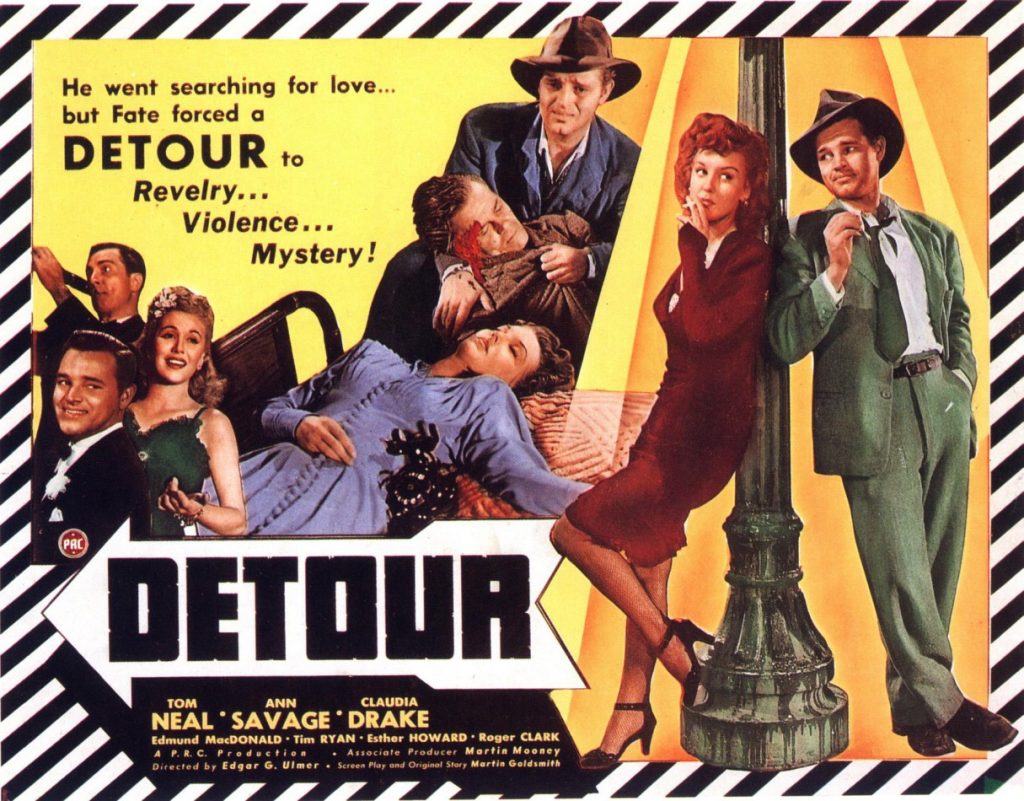
According to cinema lore, Edgar G. Ulmer’s Detour, a slapdash, unprofessional $20,000 melodrama shot in a mere mistake-filled six days, has somehow, over the past 66 years, accrued a sizable and appreciative following among film noir enthusiasts. Except it turns out that, in reality, its budget probably ran to some $117,000. And those six days might have actually been three six-day weeks. And the Austrian-born Ulmer, who had not only worked for such European luminaries as F.W. Murnau, Billy Wilder, and (so he claimed) Fritz Lang, but even made The Black Cat for Universal Pictures, hardly lacked professional bona fides. And the film’s careful use of sound and striking use of light set it apart even from its brethren in the genre.
And speaking of that genre, a hearty critical agreement now holds that Detour distills, in its brief 68 minutes, the most vital emotional and aesthetic elements of film noir in a way that none of its other exemplars have managed. And mistakes? What mistakes? As Roger Ebert wrote on ushering the film into his Great Movies canon, “Placing style above common sense is completely consistent with Ulmer’s approach throughout the film.”
To recount Detour’s story here — a piano-player down on his luck; a sudden death; a scheming, venomous dame — would be to miss the point. To cite out its many, er, unconventional production choices — nonexistent backgrounds concealed with fog, shots simply flipped over and re-used, stock footage meant to pad the runtime almost to feature length, unconvincing rear projection even by 1945’s standards — would be to miss the point from another direction. The film has fallen into the public domain, so watch it free online and experience for yourself the way that, for all its apparent bluntness, it stealthily lodges itself in your sense memory. To call a movie “dreamlike” reeks of cliché, but Detour presents the elements of film noir in such a pure, naked state that you have little choice but to accept them directly, the way you would accept the “facts” of a dream. Though seemingly incompetent on all the levels subject to conscious analysis, the film operates effectively on all the levels beneath, hence the lasting inspiration it offers to certain filmmakers today. Make Detour, if you can, a double-feature with David Lynch’s Lost Highway, which plays almost like a straight tribute to Ulmer’s picture. As a dedicated transcendental meditator with a fascination for the dark side of Los Angeles and a tendency to bend archetypal characters toward his often oblique but always vivid stylistic will, Lynch has internalized Detour’s legacy — intended or otherwise — more deeply than any other filmmaker alive today.
More noir classics can be found in our collection of 60+ Free Noir Films.
Colin Marshall hosts and produces Notebook on Cities and Culture. Follow him on Twitter at @colinmarshall.
Read More...Robert Altman’s First Film Found at Flea Market (Free to Watch Online)
Long before Robert Altman gave us MASH (1970), Nashville (1975), The Player (1992) and Gosford Park (2001), he paid his dues in the film industry, shooting 65 “industrial movies” during the 1950s. One such film recently surfaced in a Kansas City flea market, and it’s believed to be Altman’s first film. Gary Huggins, also a filmmaker, told SF Weekly, “I bought a stack of old instructional films for $10 and never got around to screening them.” “Modern Football [the title of the discovered footage] sounded really dull. But when I recently did, I glimpsed Altman, who cameos as a sports reporter, and knew I had something incredible.” Find the 26-minute film above, and the cameo at the 2:37 mark. Then consider catching up with Altman six years later when he c0-directed The James Dean Story at the start of his Hollywood career. Watch the Dean documentary online, or find it housed in our collection of 450 Free Movies Online.
Read More...Dementia 13: The Film That Took Francis Ford Coppola From Schlockster to Auteur
The Conversation, Apocalpyse Now, The Godfather — Francis Ford Coppola’s movies come so big that even the most casual cinephiles vividly remember their first experiences with them. Of course, Coppola made all of those in the seventies, when he held down the position of one of the leading lights of the New Hollywood movement, when major American studios grew willing to tap the unconventional but ultimately formidable cinematic talents of a variety of young auteurs. They backed everyone from Coppola to Martin Scorsese to Peter Bogdanovich to Michael Cimino, and we enjoy the fruits of their gamble even today. Enthusiasts of American cinema remember that period — along with its echo, the Sundance-Miramax-driven “indie” boom of the nineties — as a golden age. Coppola hasn’t stopped making films, and even if his latter-day projects like Youth Without Youth and Tetro haven’t gained such iconic stature in the culture, something in them nevertheless lodges in your mind, demanding further viewing and reflection.
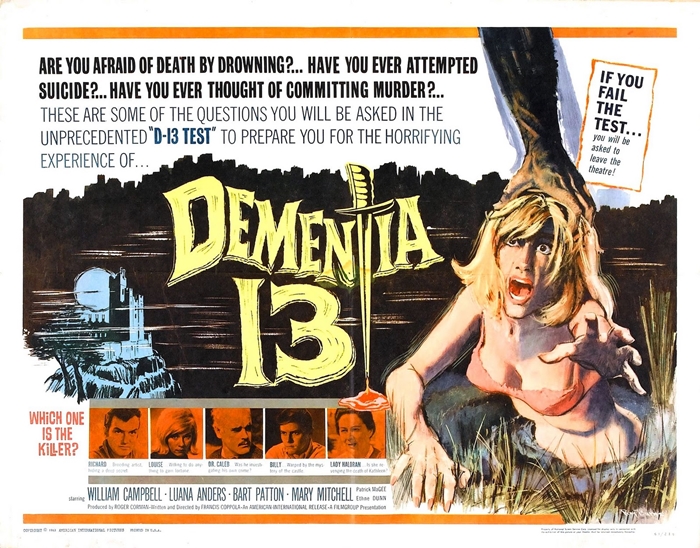
You’ll find an equally fascinating example of Coppola’s work if you look before the New Hollywood era, all the way back to a 75-minute piece of black-and-white psychological horror called Dementia 13. Watch it in its entirety on YouTube for both the formative piece of Coppola’s art and the 1963 piece of Roger Corman-produced junk that it somehow is. The picture represents a transition point between the young Coppola, sound technician and director of “nudie” films, and the mature Coppola, lauded with critical and commercial acclaim but subject to an almost self-destructive grandness of ambition. Corman, who had $22,000 laying around after his last production, asked Coppola for a Psycho knockoff. Coppola proceeded to round up a few of his UCLA pals and shoot Dementia 13 in Ireland, returning with an altogether more subtle and subdued movie than Corman could have expected. (Not that it’s particularly hard to overshoot Roger Corman-style expectations in those departments.)
To watch Dementia 13 now is to witness Coppola’s control of tension and darkness in its embryonic — but still impressive — form. Nobody involved in the production could have deluded themselves about its goal of shooting a few maximally gruesome axe murders as quickly and cheaply as possible, but even such straitened circumstances allow for pockets of artistry to bubble through. Emerging from the school of cheap thrills into ultimate respectability wasn’t an unknown story for Coppola’s cinematic generation. Today’s serious young directors seem to prefer honing their chops with now-inexpensive video gear, making films that cost far less than $22,000 and thus avoiding compromising their sensibilities. That strikes me as a step forward, but watching movies in the class of this unlikely Corman-Coppola partnership will always make you wonder what we’ve lost now that our best filmmakers don’t have to pay their dues in the wild world of schlock.
Colin Marshall hosts and produces Notebook on Cities and Culture. Follow him on Twitter at @colinmarshall.
Read More...Quentin Tarantino Gives Sneak Peek of Pulp Fiction to Jon Stewart in 1994
They’re now fixtures in our culture — one on television, the other in cinema. But that wasn’t quite the case in 1994. The world had yet to lay eyes on Pulp Fiction, Quentin Tarantino’s rollicking film that eventually landed the Palme d’Or at the ’94 Cannes Film Festival. And Jon Stewart was still five years away from taking the helm of The Daily Show, which … you know … is the wittiest show on American TV. The clip above brings you back to their salad days, with Tarantino (31 years old) and Stewart (32 years old) talking about Pulp Fiction, Reservoir Dogs, and the great spaghetti westerns of Sergio Leone.…
If you would like to support the mission of Open Culture, consider making a donation to our site. It’s hard to rely 100% on ads, and your contributions will help us continue providing the best free cultural and educational materials to learners everywhere. You can contribute through PayPal, Patreon, and Venmo (@openculture). Thanks!
Related Content:
Quentin Tarantino’s Original Wish List for the Cast of Pulp Fiction
Quentin Tarantino’s Handwritten List of the 11 “Greatest Movies”
Read More...John Belushi’s Improvised Screen Test for Saturday Night Live (1975)
In this rare footage from 1975, a 26-year-old John Belushi warms up with some eyebrow calisthenics before doing his signature Marlon Brando impression in a screen test for a new late-night television program called Saturday Night Live. He got the part, of course, and his star rose rapidly along with the show’s. By 1978 Belushi could boast of having the number one late-night television show (SNL), the number one movie (Animal House) and the number one musical album (The Blues Brothers’ Briefcase Full of Blues). But sadly it all came crashing down 30 years ago this month–on March 5 1982–when he died of a drug overdose. In this clip we remember the young Belushi: cocky, talented, with a brilliant future ahead of him.
Related Content:
Father Guido Sarducci Pitches “The Five Minute University”
William S. Burroughs on Saturday Night Live, 1981
The Stunt That Got Elvis Costello Banned From Saturday Night Live
Read More...Leonard Bernstein’s Masterful Lectures on Music (11+ Hours of Video Recorded at Harvard in 1973)
In 1972, the composer Leonard Bernstein returned to Harvard, his alma mater, to serve as the Charles Eliot Norton Professor of Poetry, with “Poetry” being defined in the broadest sense. The position, first created in 1925, asks faculty members to live on campus, advise students, and most importantly, deliver a series of six public lectures. T.S. Eliot, Aaron Copland, W.H. Auden, e.e. cummings, Robert Frost, Jorge Luis Borges — they all previously took part in this tradition. And Bernstein did too.
Delivered in the fall of 1973 and collectively titled “The Unanswered Question,” Bernstein’s lectures covered a lot of terrain, touching on poetry, linguistics, philosophy and physics. But the focus inevitably comes back to music — to how music works, or to the underlying grammar of music. The lectures run over 11 hours. They’re considered masterpieces, beautiful examples of how to make complicated material accessible. And they’re available in full on YouTube. You can watch the first lecture (on Musical Phonology) above, and find the remaining five lectures below. The lectures can also be purchased as DVDs or in book format.
Lecture 2: Musical Syntax
Lecture 3: Musical Semantics
Lecture 4: The Delights & Dangers of Ambiguity
Lecture 5: The 20th Century Crisis
Lecture 6: The Poetry of Earth
This lecture series has been added to our extensive collection, 1,700 Free Online Courses from Top Universities.
If you would like to support the mission of Open Culture, consider making a donation to our site. It’s hard to rely 100% on ads, and your contributions will help us continue providing the best free cultural and educational materials to learners everywhere. You can contribute through PayPal, Patreon, and Venmo (@openculture). Thanks!
Read More...In Search of Mœbius: A Documentary Introduction to the Inscrutable Imagination of the Late Comic Artist Mœbius
“I’ll die in some truly banal manner, the way I live,” says the subject of BBC Four’s In Search of Mœbius. I don’t know what would constitute a non-banal manner of death — or, for that matter, a banal one — but nobody familiar with modern comic art could believe that Jean Giraud, also known as Mœbius, could possibly have lived a banal life. If you haven’t read a comic since your childhood Sunday funnies, you need only watch this program to understand why the artist’s passing on Saturday brought forth so many breathless tributes. You’ll also catch a glimpse of the vast possibilities offered by comic art as a form. The inscrutable workings of Mœbius’ peculiar imagination drove him far into this territory, and many creators (in comics and elsewhere) still struggle to follow him.
Aside from Mœbius himself, the program interviews the coterie from his early years in France at Métal Hurlant, the magazine that would open the space for his distinctively subconscious-fueled, near-psychedelic yet richly textural science-fiction sensibility. It goes on to talk with well-known admirers who, feeling the resonance of those particular (and particularly difficult to describe) qualities of Mœbius’ vision that cross so many national and artistic boundaries, found ways to work with him.
These high-profile collaborators range from Marvel Comics founder Stan Lee, who enlisted Mœbius to take Silver Surfer in new aesthetic and intellectual directions, to screenwriter Dan O’Bannon, biomechanical surrealist H.R. Giger, and filmmaker/mystic Alejandro Jodorowsky, who worked with him on an unrealized (but still tantalizing) film adaptation of Dune.
In Search of Mœbius also explores the real landscapes that must have worked their way into Mœbius’ imagination, contributing to the strikingly unreal landscapes that worked their way out of it. We see the deserts of Mexico, traces of which appear in his Western series Blueberry, where he visited his mother in the 1950s. We see the Los Angeles he considered “really an amazing city,” where his work on Silver Surfer took him. We even see him in his native land, standing before the harshly iconic Bibliothèque nationale de France. Mœbius may be gone, but the world inside his head remains forever open for us on the page to explore. H/T @EscapeIntoLife
Colin Marshall hosts and produces Notebook on Cities and Culture. Follow him on Twitter at @colinmarshall.
Read More...Michio Kaku: We’re Born Scientists But Switch to Investment Banking (and More Culture Around the Web)
 Physics of the Future: How Science Will Shape Human Destiny and Our Daily Lives by the Year 2100 — That’s the new book by theoretical physicist, best-selling author, and unabashed popularizer of science Michio Kaku. And, here’s one prediction he makes. The U.S. won’t play as prominent a role in science during the years ahead. The reason why he explains in The Wall Street Journal.
Fifty percent of Ph.D. physicists are foreign-born, and they’re here compliments of the H1‑B visa. There’s a brain drain into the United States; that’s why we’re still No. 1. But it can’t last forever.
And indeed while China and India start to lure their best talent home, the best American students are leaving the hard sciences for lucrative careers, such as investment banking. Kaku goes on to say:
I have nothing against investment banking, but it’s like massaging money rather than creating money. If you’re in physics, you create inventions, you create lasers, you create transistors, computers, GPS. [If you’re an investment banker, on the other hand] you don’t create anything new. You simply massage other people’s money and take a cut.
More Culture Around the Web:
Paul Graham’s Ambitious Startups Ideas: #3 Replace Universities
World’s Oldest Charles Dickens Film Discovered
How To Be Creative. Jonah Lehrer on Why Anyone Can Innovate
Josef Skvorecky on the Nazis’ Control-Freak Hatred of Jazz
Author Neil Gaiman Talks about His Trusted Fountain Pens
Neil deGrasse Tyson’s Senate Testimony from this Week on the Past, Present, & Future of NASA
Beat poet Allen Ginsberg Interviewed by Conservative Columnist John Lofton, 1990
Read More...Nabokov Reads Lolita, and Names the Greatest Books of the 20th Century
If you heard our interview on The John Batchelor Show tonight (catch it at the 29:50 mark), and if you want to check out the marvelous clip of Vladimir Nabokov reading Lolita, here it is. Don’t forget to find us on Twitter and Facebook:
Originally aired on 1950s French television, this clip gives you some vintage Vladimir Nabokov. Early on, the Russian novelist reads the wonderfully poetic first lines of Lolita:
Lolita, light of my life, fire of my loins. My sin, my soul. Lo-lee-ta: the tip of the tongue taking a trip of three steps down the palate to tap, at three, on the teeth. Lo. Lee. Ta.
Then we get down to real business. Putting on his literary critic cap, Nabokov tells us what 20th novels make real or pretend claims to greatness. First the fakers:
I’ve been perplexed and amused by fabricated notions about so-called “great books.” That, for instance, Mann’s asinine Death in Venice, or Pasternak’s melodramatic, vilely written Doctor Zhivago, or Faulkner’s corncobby chronicles can be considered masterpieces, or at least what journalists term “great books,” is to me the same sort of absurd delusion as when a hypnotized person makes love to a chair.
And then the true greats in order of personal preference:
1) James Joyce’s Ulysses
2) Kafka’s The Metamorphosis
3) Andrei Bely’s St. Petersburg
4) The first half of Proust’s fairy tale, In Search of Lost Time
We’re adding this video to our Cultural Icons collection, which features great writers, artists and thinkers speaking in their own words. And if we have piqued your interest, don’t miss these other Nabokov gems:
Nabokov Tweaks Kafka’s “The Metamorphosis”
Vladimir Nabokov Marvels Over Different “Lolita” Book Covers
Vladimir Nabokov on Lolita: Just Another Great Love Story?
If you would like to support the mission of Open Culture, consider making a donation to our site. It’s hard to rely 100% on ads, and your contributions will help us continue providing the best free cultural and educational materials to learners everywhere. You can contribute through PayPal, Patreon, and Venmo (@openculture). Thanks!
Read More...How Bertrand Russell Turned The Beatles Against the Vietnam War
The Beatles were so much a part of the youth movement that blossomed in the 1960s that it’s amusing to think that one of the main issues that energized the movement–peace–came to the Beatles through a 92-year-old man.
As Paul McCartney explains in this clip from a January 14, 2009 interview on The View, it happened when he decided to pay a visit to philosopher Bertrand Russell. A co-founder of analytic philosophy, Russell had been a life-long social and political activist. During World War I, he was not allowed to travel freely in Britain due to his anti-war views. He lost his fellowship at Trinity College, Cambridge, and was eventually jailed for six months for supposedly interfering with British Foreign Policy. After World War II, Russell lobbied strenuously for the abolition of nuclear weapons. In the 1960s, he opposed the Vietnam War.
After the Beatles became big in 1963 and 1964, McCartney began taking advantage of his celebrity status by calling on people he admired. In an interview with Barry Miles for the book Paul McCartney: Many Years From Now, McCartney describes his meeting with Russell:
Somehow I got his number and called him up. I figured him as a good speaker, I’d seen him on television, I’d read various bits and pieces and was very impressed by his dignity and the clarity of this thinking, so when I got a chance I went down and met him. Bertrand Russell lived in Chelsea in one of those little terrace houses, I think it was Flood Street. He had the archetypal American assistant who seemed always to be at everyone’s door that you wanted to meet. I sat round waiting, then went in and had a great little talk with him. Nothing earth-shattering. He just clued me in to the fact that Vietnam was a very bad war, it was an imperialist war and American vested interests were really all it was all about. It was a bad war and we should be against it. That was all. It was pretty good from the mouth of the great philosopher. “Slip it to me, Bert.”
McCartney reported his experience to the other members of the Beatles, and it was John Lennon who really took the anti-war message and ran with it. For a reminder of those days, watch the video below of Lennon and Yoko Ono at their “Bed-In” for peace in 1969:
If you would like to support the mission of Open Culture, consider making a donation to our site. It’s hard to rely 100% on ads, and your contributions will help us continue providing the best free cultural and educational materials to learners everywhere. You can contribute through PayPal, Patreon, and Venmo (@openculture). Thanks!
Read More...Support Us
We're hoping to rely on loyal readers, rather than erratic ads. Please click the Donate button and support Open Culture. You can use Paypal, Venmo, Patreon, even Crypto! We thank you!

About Us

Open Culture scours the web for the best educational media. We find the free courses and audio books you need, the language lessons & educational videos you want, and plenty of enlightenment in between.
Advertise With Us

FREE UPDATES!
GET OUR DAILY EMAIL
Get the best cultural and educational resources on the web curated for you in a daily email. We never spam. Unsubscribe at any time.
FOLLOW ON SOCIAL MEDIA

Open Culture editor Dan Colman scours the web for the best educational media. He finds the free courses and audio books you need, the language lessons & movies you want, and plenty of enlightenment in between.
Advertise With Us

