In Search of Haruki Murakami: A Documentary Introduction to Japan’s Great Postmodernist Novelist
Haruki Murakami holds the titles of both the most popular novelist in Japan and the most popular Japanese novelist in the wider world. After publishing Norwegian Wood in 1987, a book often called “the Japanese Catcher in the Rye,” Murakami’s notoriety exploded to such an extent that he felt forced out of his homeland, a country whose traditional ways and — to his mind — conformist mindset never sat right with him in the first place. Though he returned to Japan in the aftermath of the Kobe earthquake and the Tokyo underground gas attacks, he remained an author shaped by his favorite foreign cultures — especially America’s. This, combined with his yearning to break from established Japanese literary norms, has generated enough international demand for his work to sell briskly in almost every language in which people read novels.
I myself once spent a month doing nothing but reading Murakami’s work, and this BBC documentary Haruki Murakami: In Search of this Elusive Writer makes a valiant attempt to capture what about it could raise such a compulsion. Rupert Edwards’ camera follows veteran presenter Alan Yentob through Japan, from the midnight Tokyo of After Hours to the snowed-in Hokkaido of A Wild Sheep Chase, in a quest to find artifacts of the supremely famous yet media-shy novelist’s imaginary world. Built around interviews with fans and translators but thick with such Murakamiana as laid-back jazz standards, grim school hallways, sixties pop hits, women’s ears, vinyl records, marathon runners, and talking cats, the broadcast strives less to explain Murakami’s substance than to simply reflect it. If you find your curiosity piqued by all the fuss over 1Q84, Murakami’s latest, you might watch it as something of an aesthetic primer.
Related content:
Read 5 Stories By Haruki Murakami Free Online (For a Limited Time)
A Photographic Tour of Haruki Murakami’s Tokyo, Where Dream, Memory, and Reality Meet
Colin Marshall hosts and produces Notebook on Cities and Culture. Follow him on Twitter at @colinmarshall.
Read More...Enroll in MIT’s First Free Certificate Course Today
Note: You can now find through the following link a complete list of Massive Open Online Courses (MOOCs), many offering certificates.
In the waning days of 2011, MIT announced MITx, a new e‑learning initiative that will offer certificates (find a list of Free Online Certificate Courses here) to students demonstrating mastery of free MIT courses. The university set a spring launch date for MITx, and they have now opened for enrollment the very first course. Taught by Anant Agarwal, Circuits and Electronics is an online adaption of MIT’s first undergraduate analog design course. According the MITx web site, this prototype course will run — free of charge — for students worldwide from March 5, 2012 through June 8, 2012. And students will have the opportunity to demonstrate their mastery of the material and earn a certificate from MITx. You can get more information on the course, or simply enroll in Circuits and Electronics, today. Just click here.
Many other engineering and computer science courses can be found in our collection of 400 Free Courses Online.
UPDATE: MIT professor David Pritchard and his education research group, RELATE are offering an online MIT-level course in Introductory Newtonian Mechanics. The course is free and does not require a textbook. Enrollment has just opened (it starts with an optional prerequisites test), and the course runs from March 1 — May 14, 2012. Individuals who complete the course will receive a letter of completion. This MIT course is unrelated to the MITx project mentioned right above.
via Wired Campus
Read More...William S. Burroughs on Saturday Night Live, 1981
Let’s rewind the videotape to November 7, 1981. That’s when Beat writer William S. Burroughs made his first appearance on American national television. Appropriately, it was on the irreverent, late-night comedy show, Saturday Night Live. Actress Lauren Hutton makes the introduction, setting up Burroughs to read from Naked Lunch (1959) and Nova Express (1964). You can watch the action above, which happens to be the opening scene of Burroughs, a 1983 documentary by Howard Brookner. The complete film is listed in our collection of 450 Free Movies Online (look under Documentaries), along with a 1997 BBC documentary on the author. For more good video dedicated to Burroughs, don’t miss the following:
William S. Burroughs Reads His First Novel, Junky (find it also in our collection of Free Audio Books)
“The Thanksgiving Prayer,” Read by William S. Burroughs and Shot by Gus Van Sant
Gus Van Sant Adapts William S. Burroughs’ The Discipline of D.E.: An Early 16mm Short
William S. Burroughs on the Art of Cut-up Writing
via @BrainPicker
Read More...Peter Sellers Reads The Beatles’ “She Loves You” in 4 Different Accents: Dr. Strangelove, Cockney, Irish & Upper Crust
Back in the late 1950s, George Martin recorded two albums with the late, great Peter Sellers. When Martin started working with the Beatles a few years later, he put the actor in touch with the musicians, and they became fast friends. This relationship paved the way for some good comedy. As you might recall, Sellers made a cameo appearance on “The Music of Lennon and McCartney” in 1964, and read A Hard Day’s Night in a way that comically recalls Laurence Olivier’s 1955 performance in Richard III. (Watch the spoof here.) And then, also during the mid 60s, Sellers recorded a comic reading of She Loves You — once in the voice of Dr. Strangelove (above), again with cockney and upper-crusty accents (both right below), and finally with an Irish twist (the last item). The recordings were all released posthumously between 1981 and 1983 on albums no longer in circulation.
Cockney
Upper Crust
Irish
Related Content:
Here Comes The Sun: The Lost Guitar Solo by George Harrison
Guitarist Randy Bachman Demystifies the Opening Chord of ‘A Hard Day’s Night’
The Beatles’ Rooftop Concert: The Last Gig
Read More...
Famous Literary Characters Visualized with Police Composite Sketch Software
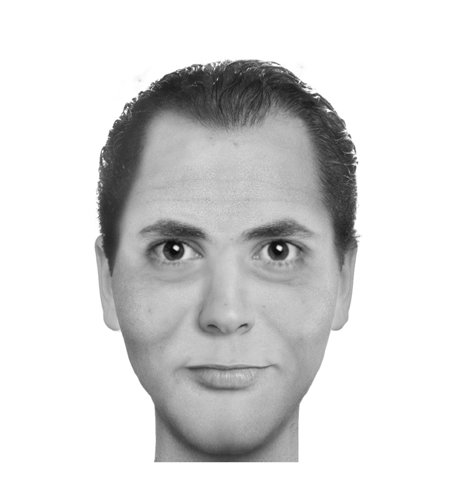
In his 1955 classic, Lolita, Vladimir Nabokov described the facial features of his scandalous protagonist, Humbert Humbert, in small bits. When taken together, here’s what you get:
Gloomy good looks… Clean-cut jaw, muscular hand, deep sonorous voice… broad shoulders … I was, and still am, despite mes malheurs, an exceptionally handsome male; slow-moving, tall, with soft dark hair and a gloomy but all the more seductive cast of demeanor. Exceptional virility often reflects in the subject’s displayable features a sullen and congested something that pertains to what he has to conceal. And this was my case… But instead I am lanky, big-boned, wooly-chested Humbert Humbert, with thick black eyebrows… A cesspoolful of rotting monsters behind his slow boyish smile… aging ape eyes… Humbert’s face might twitch with neuralgia.
In a rather brilliant move, Brian Joseph Davis has run these descriptions through law enforcement composite sketch software and brought Humbert Humbert almost to life. (See above.) And he has done the same for a cast of other literary characters on his Tumblr, called The Composites. Other characters getting the perp treatment include Emma Bovary (Gustave Flaubert’s Madame Bovary), Edward Rochester (Charlotte Brontë’s Jane Eyre), and Keith Talent (Martin Amis’ London Fields), among others. Find them all here. h/t Metafilter
Related Content:
Vladimir Nabokov on Lolita: Just Another Great Love Story?
Vladimir Nabokov Marvels Over Different “Lolita” Book Covers
Nabokov Reads Lolita, Names the Great Books of the 20th Century
Read More...Watch Breaking the Code, About the Life & Times of Alan Turing (1996)
Updated on December 24, 2013: Yesterday the British government brought a sad chapter to a close when it finally issued a posthumous pardon to Alan Turing, who was convicted in 1952 of breaking laws that criminalized homosexuality. The post you see below was originally written in February, 2012, when the question of Turing being pardoned was still up for debate. The film featured above is still very much worth your while.
This week the British government finally pardoned Alan Turing. One of the greatest mathematicians of the 20th century, Turing laid the foundations for computer science and played a key role in breaking the Nazi Enigma code during World War II. In 1952 he was convicted of homosexuality. He killed himself two years later, after being chemically castrated by the government.
On Monday, Justice Minister Tom McNally told the House of Lords that the government of Prime Minister David Cameron stood by the decision of earlier governments to deny a pardon, noting that the previous prime minister, Gordon Brown, had already issued an “unequivocal posthumous apology” to Turing. McNally was quoted in the Guardian:
A posthumous pardon was not considered appropriate as Alan Turing was properly convicted of what at the time was a criminal offense. He would have known that his offense was against the law and that he would be prosecuted. It is tragic that Alan Turing was convicted of an offense which now seems both cruel and absurd–particularly poignant given his outstanding contribution to the war effort. However, the law at the time required a prosecution and, as such, long-standing policy has been to accept that such convictions took place and, rather than trying to alter the historical context and to put right what cannot be put right, ensure instead that we never again return to those times.
The decision came as a disappointment to thousands of people around the world who had petitioned for a formal pardon during the centenary year of Turing’s birth. The Guardian also quoted an email sent by American mathematician Dennis Hejhal to a British colleague:
i see that the House of Lords rejected the pardon Feb 6 on what are formal grounds.
if law is X on date D, and you knowingly break law X on date D, then you cannot be pardoned (no matter how wrong or flawed law X is).
the real reason is OBVIOUS. they do not want thousands of old men saying pardon us too.
Efforts to obtain a pardon for Turing are continuing. British citizens and UK residents can still sign the petition.
To learn more about Turing’s life, you can watch the 1996 BBC film Breaking the Code (above, in its entirety), featuring Derek Jacobi as Turing and Nobel Prize-winning playwright Harold Pinter as the mysterious “Man from the Ministry.” Directed by Herbert Wise, the film is based on a 1986 play by Hugh Whitemore, which in turn was based on Andrew Hodge’s 1983 book Alan Turing: The Enigma.
Breaking the Code moves back and forth between two time frames and two very different codes: one military, the other social. The film runs 91 minutes, and has been added to our collection of Free Movies Online.
Read More...
14 Years of US Weather in 33 Minutes, Set to Beethoven
There’s condensation in the air. You can feel it.
This video packs 14 years of United States weather (1997 — 2011) into 33 minutes, presenting a total of 120,900 individual frames, each spaced one hour apart. And they’re all set to Beethoven’s Piano Concerto No. 5 in E flat Major. If you want to get right to the drama, we recommend jumping to the climactic 27th minute. H/T Devour.
Related Content:
Global Warming: A Free Course from UChicago Explains Climate Change
Chilean Earthquake Waves Shown in Animation
NASA Captures Giant Solar Storm
Read More...Neil Young on the Travesty of MP3s
Neil Young made headlines last week when he appeared at the Wall Street Journal’s “D: Dive Into Media” conference and voiced his disapproval of the way music is being heard these days. “We live in a digital age,” Young said, “and unfortunately it’s degrading our music, not improving it.”
Young is deeply dissatisfied with the sound quality of compressed MP3 digital files, which he said carry only five percent of the data from the original vinyl or master recordings. “It’s not that digital is bad or inferior,” he told the Journal’s Walt Mossberg and Peter Kafka. “It’s that the way it’s being used is not sufficient to transfer the depth of the art.”
The full 32-minute interview is now available online, and can be seen above. Throughout the discussion, Young’s commitment to his cause is clear. “My goal,” he said, “is to try and rescue the art form that I’ve been practicing for the past 50 years.”
Read More...Celebrate the 200th Birthday of Charles Dickens with Free Movies, eBooks and Audio Books
Today is the 200th birthday of Charles Dickens. He was born in Portsmouth, England on February 7, 1812, the second of eight children. When he was 12 years old his father was sent to debtors’ prison, along with most of his family, and Charles went to live with a friend of the family, an impoverished old lady. He was forced to quit school and work in a blacking factory, where he pasted labels on jars of shoe polish.
Dickens never forgot those early traumas. He incorporated his experiences and observations of social injustice into his works, including David Copperfield, Oliver Twist and A Christmas Carol. (Find free novels below.) He was the most popular writer of Victorian England, a virtual rock star in the days before recorded music and movies. His stories, published serially in magazines, were eagerly awaited by the public. Most have remained in print ever since.
The Dickens bicentenary is being celebrated with special events around the world, including a wreath-laying ceremony this morning at Poets’ Corner in Westminster Abbey, where actor and filmmaker Ralph Fiennes, author Claire Tomalin, and two of Dickens’s descendants are scheduled to give readings. For a listing of events today and throughout the year, go to Dickens2012.org. Also take a look at the short retrospective of Dickens-inspired movies (above) from the British Film Institute.
To help celebrate, we have gathered together some of the best Dickens material from across the Web:
Films (see our complete list of Free Movies):
- Oliver Twist: Another classic by David Lean, this 1948 film stars John Howard Davies as Oliver and Alec Guinness as Fagin. In 1999 it was ranked 46th on the BFI’s list of the top 100 British films of all time.
- A Tale of Two Cities: The 1958 film by Ralph Thomas, starring Dirk Bogarde as Sydney Carton and Dorothy Tutin as Lucie Manette. The film was shot in France’s Loire Valley, with several thousand U.S. soldiers, posted in nearby Orleans, cast as extras.
- A Christmas Carol: George C. Scott gives an excellent performance as Ebenezer Scrooge in this critically acclaimed 1984 film directed by Clive Donner. It premiered in America on CBS television, and was released theatrically in Great Britain.
- David Copperfield: A 2000 U.S.-Irish television adaptation starring Hugh Dancy as David Copperfield, Michael Richards as Wilkins Micawber and Sally Field as Betsey Trotwood.
- The Pickwick Papers: A 1952 film, adapted and directed by Noel Langley and starring James Hayter as Samuel Pickwick.
eBooks (see our complete list of Free eBooks)
- A Christmas Carol – Download Multiple Formats — Kindle
- A Tale of Two Cities – Download Multiple Formats
- Bleak House – Download Multiple Formats
- David Copperfield – Download Multiple Formats
- Great Expectations – Download Multiple Formats
- Hard Times – Download Multiple Formats
- Mystery of Edwin Drood – Download Multiple Formats
- Oliver Twist – Download Multiple Formats
Audio Books (see our complete list of Free Audio Books)
- A Christmas Carol – Multiple Formats
- A Tale of Two Cities — Multiple Formats
- A Collection of Christmas Stories — Multiple Formats
- Bleak House – Multiple Formats
- David Copperfield – Multiple Formats
- Great Expectations – Multiple Formats
- Hard Times – Multiple Formats
- Oliver Twist – Multiple Formats
Related Content:
Download 20 Popular High School Books Available as Free eBooks & Audio Books
Read More...The Art of Living: A Free Stanford Course Explores Timeless Questions
What is a liberal education? And how can it help you live a more authentic and purposeful life? They are timely and timeless questions that get answered by The Art of Living, a team-taught course presented to Stanford freshmen. The first lecture (above) addresses these questions head on. And the remainder of the course (17 videos) puts the initial thinking into practice, using great works of literature and philosophy to explore what it means to live a well-lived life. Socrates, Plato, Shakespeare, Kierkegaard, Nietzsche, and Toni Morrison all guide the way. Taught by Lanier Anderson, Kenneth Taylor and Joshua Landy, the Stanford course puts you in a position to address “fundamental and enduring questions about what it means to be human.” Whether you work in business, science or the arts, you will get something big out of the class.
You can find The Art of Living in its entirety here. Or find the course listed in the Philosophy Section of our collection, 4,000+ Free Movies Online: Great Classics, Indies, Noir, Westerns, Documentaries & More.
Read More...Support Us
We're hoping to rely on loyal readers, rather than erratic ads. Please click the Donate button and support Open Culture. You can use Paypal, Venmo, Patreon, even Crypto! We thank you!

About Us

Open Culture scours the web for the best educational media. We find the free courses and audio books you need, the language lessons & educational videos you want, and plenty of enlightenment in between.
Advertise With Us

FREE UPDATES!
GET OUR DAILY EMAIL
Get the best cultural and educational resources on the web curated for you in a daily email. We never spam. Unsubscribe at any time.
FOLLOW ON SOCIAL MEDIA

Open Culture editor Dan Colman scours the web for the best educational media. He finds the free courses and audio books you need, the language lessons & movies you want, and plenty of enlightenment in between.
Advertise With Us

