Updated Book Titles: Less Pretentious, More Accurate
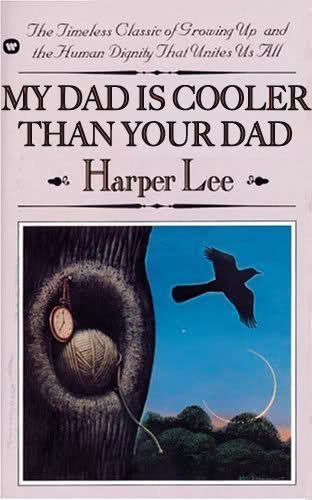
Over at OhNoTheyDidn’t, you can find some alternative titles for some of the most famous books ever written — or, in ONDT’s own words, titles that are “more accurate and less pretentious” than the originals.
Before clicking over to the (slightly NFSW) whole collection, test your high/low cultural agility by trying to guess a few originals from their updates:
1. My Dad is Cooler Than Your Dad
2. Emotions Are For Poor People
3. Shakespeare Minus the Good Writing
4. Likable Rapists
5. White People Ruin Everything
If you got all five right, nay, if you got any right, we’re counting on you for the Clueless sequel.
Sheerly Avni is a San Francisco-based arts and culture writer. Her work has appeared in Salon, LA Weekly, Mother Jones, and many other publications. You can follow her on twitter at @sheerly.
Read More...Hofmann’s Potion: 2002 Documentary Revisits the History of LSD
A few years ago, we posted this 1978 interview with Timothy Leary, in which the charismatic LSD champion, prisoner, and future Ron Paul supporter speaks passionately about the benefits of taking acid. But for a more balanced perspective on the controversial drug, we recommend the 2002 film Hofmann’s Potion, by Canadian filmmaker Connie Littlefeld.
Littlefield structures her narrative chronologically, beginning with Swiss scientist Albert Hofmann’s first synthesis of the compound in 1938, and its early experimental use in the treatment of schizophrenics and alcoholics. She then traces LSD’s rise to prominence when it became the drug of choice during the 60’s counterculture, followed by the drug’s ultimate vilification and criminalization.
The 56-minute documentary features new and archival footage of discussions with Hofmann, Aldous Huxley, Stanislav Grof, Abram Hoffer and other early figures in the drug’s brief but turbulent history. The interview with Leary’s Harvard colleague Richard Alpert — now known as Ram Dass — at minute 43:37 is particularly interesting, as is the film’s ultimate conclusion that the correct realm for evaluating the value of LSD is neither medical nor recreational, but spiritual.
After watching the Littlefield documentary, take a look at this disturbing 10-minute discussion of Project MKULTRA, a decades-long CIA program which exposed American citizens to LSD and other drugs for study, often without their knowledge or permission.
Also worth a read, a new book by Don Lattin called The Harvard Psychedelic Club: How Timothy Leary, Ram Dass, Huston Smith, and Andrew Weil Killed the Fifties and Ushered in a New Age for America.
Sheerly Avni is a San Francisco-based arts and culture writer. Her work has appeared in Salon, LA Weekly, Mother Jones, and many other publications. You can follow her on twitter at @sheerly.
Read More...Farewell Sidney Lumet, 1924–2011
The clip above features Peter Finch’s explosive “mad as hell” speech from Sidney Lumet’s Network (1976). It is as relevant today as it was 35 years ago, if not more so — just like its director.
In this this recent interview, Mr. Lumet, who also brought us such classics as 12 Angry Men, Serpico, The Verdict, and Dog Day Afternoon, speaks about his legacy, his career, and the city that was the setting for so many of his great films. He died yesterday of lymphoma at his home in Manhattan.
via NYT
Sheerly Avni is a San Francisco-based arts and culture writer. Her work has appeared in Salon, LA Weekly, Mother Jones, and many other publications. You can follow her on twitter at @sheerly.
Read More...Star Wars the Musical: The Force is Strong in this One
In 1996, three California 17-year-olds (who should have known better) channeled all of their money and passion into staging a rock opera based on Star Wars IV: A New Hope. They’d only scheduled it for a three night run, but it played to a sold-out crowd and, according to Salon’s Drew Grant, earned the two greatest honors a fan can hope for: A review in The New York Times and a cease and desist letter from George Lucas.
The whole thing is now finally online. Salon has gathered all six parts onto one page, and you can also watch it on vimeo. We have included Part 1 above…
via Salon
Sheerly Avni is a San Francisco-based arts and culture writer. Her work has appeared in Salon, LA Weekly, Mother Jones, and many other publications. You can follow her on twitter at @sheerly.
Read More...Bubble Watch: Is China Next?
Last month, China hit another major milestone. It passed Japan and became the second largest economy in the world, leaving only the US in its way. Give China a decade, maybe a little more, and it will inevitably surge into the lead. That’s the accepted narrative.
But then we come across this: the possibility that a mounting real estate bubble might derail China’s plans. This report from Australian public television gives you a disturbing look at how the Chinese government has pumped vast amounts of capital into fixed assets, like commercial and residential real estate, to keep the country’s economy growing. And what they’re left with is what James Chanos (a hedge fund manager) has famously described as “Dubai times one thousand.” Right now, there are an estimated 64 million empty apartments in China, and approximately 30 billion square feet of commercial real estate under construction — equivalent to a five-by-five foot office cubicle for every man, woman and child in China. It’s one thing to read these facts, another thing to see what it all looks like. And that’s the opportunity you get above.
For a more precise roadmap of what a Chinese crash might look like, you should spend some time with this piece in Canadian Business magazine.
Read More...Billy Collins Poetry Brought to Animated Life
Who doesn’t love Billy Collins, the former US Poet Laureate? The actor Bill Murray reads his poetry at construction sites. Adorable toddlers recite his poetry from memory. And now artists have created animated videos that bring 11 Collins poems to life. You can find the animated version of “Budapest” above, and the remaining poems at Billy Collins Action Poetry.
Read More...Free: Richard Feynman’s Physics Course from Cornell (1964)
We’re beaming you back to 1964. Richard Feynman, our favorite Bongo-playing, Nobel Prize-winning physicist, reduces science to the barest essentials, to its most fundamental truth. If a theory doesn’t square with experiment, it’s wrong. That holds true for clever theories, elegant theories, and all of the rest.
This clip is just a small outtake from a seven-part lecture series that Feyman presented at Cornell in 1964, and the lectures are all now freely available on the web thanks to Bill Gates. You can watch the full series on our site, or on a Miscrosoft site, but be warned: if you choose the latter, you’ll need to download Microsoft’s Silverlight software to watch the lectures.
For more free physics lessons, don’t miss our collection of Free Online Physics Courses, part of our larger collection, 1,700 Free Online Courses from Top Universities.
Feynman fans will also want to see this other open project: The Feynman Lectures on Physics, The Most Popular Physics Book Ever Written, Now Completely Online.
If you would like to support the mission of Open Culture, consider making a donation to our site. It’s hard to rely 100% on ads, and your contributions will help us continue providing the best free cultural and educational materials to learners everywhere. You can contribute through PayPal, Patreon, and Venmo (@openculture). Thanks!
Read More...The Quadrocopter Opera
Physics gets its own little opera. And you’ll never look at quadrocopters, those ball juggling robots, in quite the same way. Nice work “Operamanda”…
via @chr1sa
Read More...The Ramones Live in 1978: 26 Songs in 54 Minutes
Princes of New York punk, kings of CBGB’s (take virtual tour here), and the only Americans, then or now, who could pull off skinny jeans with impunity, The Ramones were masters of the short and sweet. Here’s a recording of a live 1978 set at the Palladium in New York City: 26 songs, 54 minutes, all set to clips from old sci-fi movies.
via NPR
Sheerly Avni is a San Francisco-based arts and culture writer. Her work has appeared in Salon, LA Weekly, Mother Jones, and many other publications. You can follow her on twitter at @sheerly.
Read More...The Shape of A Story: Writing Tips from Kurt Vonnegut
A few years ago, Open Culture readers listed Slaughterhouse Five as one of your top life-changing books. But Kurt Vonnegut was not only a great author. He was also an inspiration for anyone who aspires to write fiction – see for example his 8 rules for writing fiction, which starts with the so-obvious-it’s-often-forgotten reminder never to waste your reader’s time.
In this video, Vonnegut follows his own advice and sketches some brilliant blueprints for envisioning the “shape” of a story, all in less than 4 minutes and 37 seconds.
FYI. Original works by Vonnegut appear in Free Audio Books and Free eBooks collections.
Related Content:
Ray Bradbury Gives 12 Pieces of Writing Advice to Young Authors (2001)
John Steinbeck’s Six Tips for the Aspiring Writer and His Nobel Prize Speech
Writing Tips by Henry Miller, Elmore Leonard, Margaret Atwood, Neil Gaiman & George Orwell
Sheerly Avni is a San Francisco-based arts and culture writer. Her work has appeared in Salon, LA Weekly, Mother Jones, and many other publications. You can follow her on twitter at @sheerly.
Read More...Support Us
We're hoping to rely on loyal readers, rather than erratic ads. Please click the Donate button and support Open Culture. You can use Paypal, Venmo, Patreon, even Crypto! We thank you!

About Us

Open Culture scours the web for the best educational media. We find the free courses and audio books you need, the language lessons & educational videos you want, and plenty of enlightenment in between.
Advertise With Us

FREE UPDATES!
GET OUR DAILY EMAIL
Get the best cultural and educational resources on the web curated for you in a daily email. We never spam. Unsubscribe at any time.
FOLLOW ON SOCIAL MEDIA

Open Culture editor Dan Colman scours the web for the best educational media. He finds the free courses and audio books you need, the language lessons & movies you want, and plenty of enlightenment in between.
Advertise With Us

