US Justice Department Looks to Restructure Google Books Settlement
The US Justice Department officially weighed in today on the Google Books settlement with publishers and authors. On the plus side for Google, the government wants to see the project continue because it has clear social benefits. On the downside, the DOJ has concerns about antitrust and copyright issues, and it’s looking for the deal to get restructured. You can get more details in The Wall Street Journal. It’s late. I’m out.
Related Content:
Google Book Search: A Disaster for Scholars?
Read More...Uranium Wars: A Free Audio Chapter
Just a quick fyi: Audible.com is giving away a free chapter (in audio) from a new book, Uranium Wars: The Scientific Rivalry that Created the Nuclear Age (preview it on Amazon here). Written by Amir Aczel, a skilled popular science writer, the book takes a close look at the scientists who discovered the destructive potential of uranium and launched the beginning of the nuclear age. Since the book has been getting good reviews, I thought that I’d flag this free giveaway. Also, as mentioned here before, Audible runs a regular promotion that will let you download a free audiobook of your choice (for example, Uranium Wars) if you start a 14 day free trial. Once the trial is over, you can continue your Audible subscription, or cancel it, and still keep the free book. The choice is yours. You can initiate that process here.
Read More...Universities Launch “Futurity” to Bring Science to the Web
A little breaking news… 35 leading universities have launched a new web site, Futurity.org, with a simple goal — educating the public about new scientific breakthroughs. In the old days, universities depended on the traditional press to spread the word about new scientific advances. Now, with journalism in crisis and newspapers folding, the schools can no longer bank on that. And so we get Futurity, which is essentially a nonprofit wire service that will distribute news through major news suppliers on the web (Yahoo News & Google News) and also through social media channels (Twitter, Facebook and MySpace). On the list of participating universities, you will find UC Berkeley, Stanford, Johns Hopkins, Carnegie Mellon, The University of Chicago, Duke, Princeton, Yale and many others. You can get a full list here, and read more about the venture here.
Thanks Denise for the tip on this one. Have something you want to share with your fellow readers? Send your tips to ma**@*********re.com
Read More...The Life and Works of William Butler Yeats
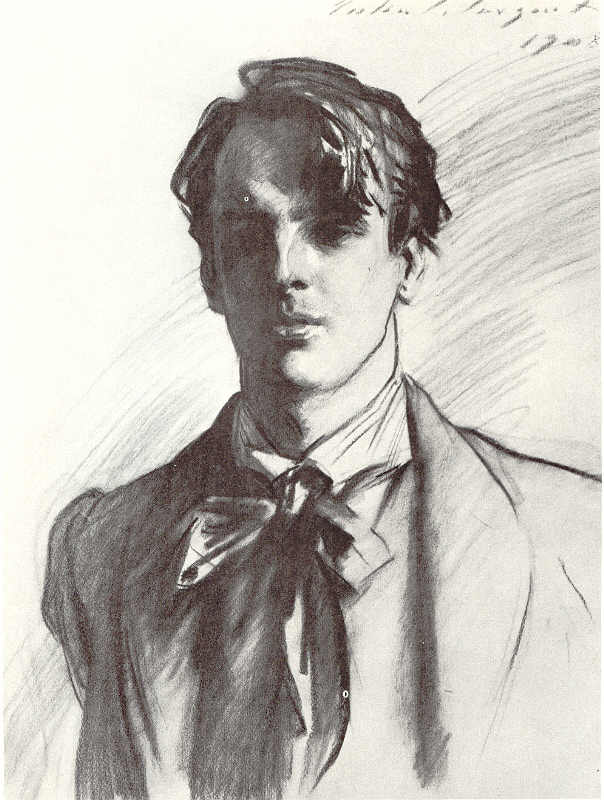
Portrait of William Butler Yeats by John Singer Sargent, via Wikimedia Commons
It’s a happy trend. Increasingly, we’re seeing museums launching dynamic online exhibitions to accompany their exhibitions on the ground. In the past, we highlighted the Tate Modern’s panoramic tour of Mark Rothko’s work. And now we point you to The Life and Work of William Butler Yeats, an online exhibition created by The National Library of Ireland. When you enter the tour, you can scan through 200 artifacts & manuscripts and “attend” three in-depth tutorials exploring the evolution of three major poems (‘Sailing to Byzantium’, ‘Leda and the Swan’ and ‘Nineteen Hundred and Nineteen’). You can also listen to Yeats, one of Ireland’s towering poets, reciting his famous poem ‘The Lake Isle of Innisfree.’ To listen, click “Areas” on the bottom navigation, then click “Verse and Vision” on the center menu, and then the audio will begin to play. You can read the text of the poem here. Finally, you’ll find more Yeats poems in our Free Audio Book collection.
Read More...Watch Birds Sitting on Electrical Wires Become Sheet Music & Make a Melody
What’s the story behind this video? Here it is, straight from the producer, Jarbas Agnelli from Brazil: “Reading a newspaper, I saw a picture of birds on the electric wires. I cut out the photo and decided to make a song, using the exact location of the birds as notes (no Photoshop edit). I knew it wasn’t the most original idea in the universe. I was just curious to hear what melody the birds were creating.” You can get more details here.
If you would like to support the mission of Open Culture, consider making a donation to our site. It’s hard to rely 100% on ads, and your contributions will help us continue providing the best free cultural and educational materials to learners everywhere. You can contribute through PayPal, Patreon, and Venmo (@openculture). Thanks!
Read More...Modern Physics: The Theoretical Minimum
For the past two years, Stanford has been rolling out a series of courses (collectively called Modern Physics: The Theoretical Minimum) that gives you a baseline knowledge for thinking intelligently about modern physics. The sequence, which moves from Isaac Newton, to Albert Einstein’s work on the general and special theories of relativity, to black holes and string theory, comes out of Stanford’s Continuing Studies program (my day job). And the courses are all taught by Leonard Susskind, an important physicist who has engaged in a long running “Black Hole War” with Stephen Hawking. The final course, Statistical Mechanics, has now been posted on YouTube, and you can also find it on iTunes in video. The rest of the courses can be accessed immediately below. Six courses. Roughly 120 hours of content. A comprehensive tour of modern physics. All in video. All free. Beat that.
Modern Physics: The Theoretical Minimum
- Classical Mechanics (Fall 2007) iTunes YouTube
- Quantum Mechanics (Winter 2008) iTunes YouTube
- Special Relativity (Spring 2008) iTunes YouTube
- Einstein’s General Theory of Relativity (Fall 2009) iTunes YouTube
- Cosmology (Winter 2009) iTunes YouTube
- Statistical Mechanics (Spring 2009) iTunes YouTube
PS If you live in the San Francisco Bay Area, you should consider checking out Prof. Susskind’s new course. It will take a yearlong look at new revolutions in Particle Physics, and how important theories will be tested by the Large Hadron Collider in Europe. His course begins next week. Learn more here.
Related Content:
Has Stephen Hawking Been Wrong For The Last 30 Years?
Learning Physics Through Free Online Courses
Read More...James Watson on Jesus as Scientist
Speaking Wednesday night at Harvard, James Watson, the co-discoverer of DNA, was asked by NPR’s Robert Krulwich: “Can a gentle person do well in science?” His response: “Jesus would not have succeeded.” Sad commentary, and it’s the type of comment that you’d expect from Watson. But it’s also somewhat disproved by the career of E.O. Wilson, who shared the stage with Watson that night. You can get more coverage of this conversation over at the NewScientist.
In the meantime, check out our Science Podcast Collection, which includes Krulwich’s program, Radio Lab. These podcasts are also available on our free iPhone app.
Related Content:
The Digital Encyclopedia of Life
E.O. Wilson’s Olive Branch: The Creation
Read More...Get Smart with Your iPhone
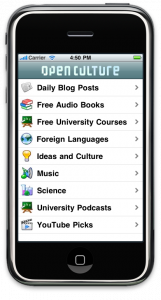 During the lazy days of summer, we quietly launched a new, free iPhone app. Now summer is fading, people are getting back to work, students back to school, and it’s time to get the word out. This app takes our intelligent media collections and let’s you listen to them on the go. Once you download the app, you can listen to free audio books, university courses, foreign language lessons, science podcasts and other intelligent content on the iPhone.
The app opens all media files in native iPhone software — iTunes, Safari, the YouTube player, etc. You will need WI-FI (Apple says so) to download the content. This app, which was very generously developed by Fred Hsu, is a work in progress. Don’t hesitate to give us feedback. And, if you don’t mind, please leave a nice review/rating in the App Store and spread the word.
Lastly, let me leave you with some praise that we received today. “I love this application. Been using it a lot for the Biology – Human Anatomy Courses available. Thank you so much for developing this app. Absolutely Brilliant!!!” Does this intrigue you enough to check it out?
Read More...Every TED Talk Under the Sun
If you regularly visit Open Culture, then you’re probably familiar with TED Talks — the series of 15 minute “riveting talks by remarkable people” that TED produces and makes free to the world. We’ve included TED in our collection, Intelligent Video: The Top Cultural & Educational Video Sites, and it’s one of the best sources of intelligent video out there. Having said that, I was pleased to find this Google spreadsheet of every TED Talk ever posted online. Although TED hosts many videos on its web site (and on its iTunes and YouTube channels), these platforms don’t give you clean access to the entire TED catalogue. Meanwhile, this simple and sortable spreadsheet does. So enjoy, and use it well.
via BoingBoing
Related Content:
Read More...Underwater Astonishments
Brilliant, and we’ve added this one, too, to our YouTube Favorites. Now I’m off for the long weekend. See you Tuesday!
Read More...Support Us
We're hoping to rely on loyal readers, rather than erratic ads. Please click the Donate button and support Open Culture. You can use Paypal, Venmo, Patreon, even Crypto! We thank you!

About Us

Open Culture scours the web for the best educational media. We find the free courses and audio books you need, the language lessons & educational videos you want, and plenty of enlightenment in between.
Advertise With Us

FREE UPDATES!
GET OUR DAILY EMAIL
Get the best cultural and educational resources on the web curated for you in a daily email. We never spam. Unsubscribe at any time.
FOLLOW ON SOCIAL MEDIA

Open Culture editor Dan Colman scours the web for the best educational media. He finds the free courses and audio books you need, the language lessons & movies you want, and plenty of enlightenment in between.
Advertise With Us


