English and its Evolution
A little something for the language buffs among us. The Structure of English Words (iTunes) is another Stanford course. To be exact, it comes out of the Stanford Continuing Studies program (my day job), and we’re opening enrollments for our Fall term next Monday. (If you live in the San Francisco Bay Area, give our offering a look. If you live outside the Bay Area, then you may want to check out our popular series of online writing courses.) You can find the course description for The Structure of English Words, taught by Professor Will Leben, directly below. To find hundreds of other free courses, then check out our collection of Free Online University Courses:
Read More...Thanks to historical, cultural, and linguistic factors, English has by far the world’s largest vocabulary—leading many of us to have greater than average difficulty with words, and some of us to have greater than average curiosity about words.
Our historical and linguistic study will cover both erudite and everyday English, with special attention to word meaning and word use, to both rules and exceptions. Most words originated with an image. “Reveal” = “pull back the veil,” “depend” = “hang down from.”
Change is constant. “Girl” once meant “a young child of either sex;” an early synonym for “stupid” was “nice.” Despite resistance to change among some experts and some members of the general public, new words are entering at an accelerating rate, from “Frankenfood” to “ungoogleable.” Are there good changes and bad ones? And who gets to decide? Exploring the historical and contemporary richness of English will suggest some answers.
Try a 30-Day Free Trial to Audible Premium Plus & Get a Free Audiobook
Looking for a free, professionally-read audio book from Audible.com? Here’s a great, no-strings-attached deal.
If you start a 30 day free trial for an Audible Premium Plus Plan (click here), you can download a free audio book of your choice. They have over 200,000 books to choose from, which will play on almost any portable device or on your computer itself.
If you remain a subscriber to Audible Premium Plus after the 30-day free trial, you will get 1 new audiobook per month and pay $14.95/month. Plus, you will get unlimited access to Audible originals (audio books produced by Audible that aren’t available anywhere else), a library of other audio books, and exclusive podcasts.
When you sign up for the Audible Premium Plus plan, the credit for the free audio book will appear in your Audible account. (If you have an Amazon.com username/password, the whole signup process takes a matter of seconds. Audible is part of Amazon.com)
At the end of your free trial, you can opt out of the program and still keep the free audio book. Or you can stay with this valuable program and keep enriching yourself whenever you want. To get started, click right here.
The web site Audiobooks.com (another provider of audio books) also offers a free trial program that lets you download three free audio books. Get details on that here.
Note: We are a member of Amazon/Audible.com’s affiliate program, and this page contains affiliate links. If you sign up for an Audible plan via our links, we will receive a small fee.
Read More...Twilight Series: How to Get Free Audio Books

We get a lot of requests for books from the Twilight series. While these books generally aren’t available as free mp3 downloads, there is something of a workaround. If you sign up for a free 30 day trial from Audible.com (which has no strings attached), you can download two FREE audio books. We have information on the Free Trial program here. Or if you click on the links below, they will take you to an Amazon.com page (Amazon owns Audible). There, you will see in the upper right hand side of the page a “Try Audible Free” button. If you click that button, you can start the Free Trial and get books from the Twilight series.
- Twilight: The Twilight Saga, Book 1

- New Moon: The Twilight Saga, Book 2
- Eclipse: The Twilight Saga, Book 3
- Breaking Dawn: The Twilight Saga, Book 4
Enjoy…
Read More...Plastics Out, Statistics In
A memorable scene from The Graduate (1967). But, as the New York Times tells us today, plastics is out; statistics is now in.
Read More...John Hughes: Backdrop for an Adolescence
John Hughes films. The Who. Now you’ve got the backdrop for my teenage years. This is for me, and perhaps even for you… (Sorry to those who can’t relate. We’ll be back on track soon enough.)
Junot Díaz Reads From “Drown”
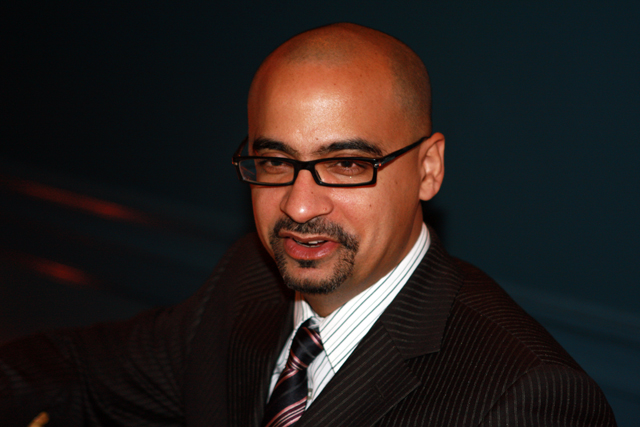
Image by Christopher Peterson, via Wikimedia Commons
I first heard about Junot Díaz in the early 90s. He was only in his 20s, already publishing in The New Yorker, and getting a lot of wunderkind talk. By 1996, he published, Drown, a bestselling collection of short stories that earned high praise. And then, things slowed down. It took a good eleven years for him to publish The Brief Wondrous Life of Oscar Wao. But the patience paid off. The novel won him a Pulitzer in fact. And it’s an excellent read. Really.
Having said this, I want to highlight Díaz reading one of his early New Yorker stories that also found its way into Drown. It’s called How to Date a Brown Girl (Black Girl, White Girl, or Halfie). The free audio clip, which is listed in our collection of Free Audio Books (and produced by The New Yorker), has some colorful language, but it’s not gratuitous.
Looking for free, professionally-read audio books from Audible.com? Here’s a great, no-strings-attached deal. If you start a 30 day free trial with Audible.com, you can download two free audio books of your choice. Get more details on the offer here.
Read More...New Pynchon Book Out Today: Watch the Trailer
Thomas Pynchon’s new book, Inherent Vice, is on sale today. Check it out. Below we have, yes, a video trailer for the new book, and it sounds like Pynchon (who has famously stayed out of the public eye) is actually narrating the thing.
Become of a Fan of Open Culture on FaceBook here or follow us on Twitter
Read More...Yale Open Courses Now on iTunesU
Over the past two years, Yale has released fifteen free “open courses.” Initially, these courses were only available through Yale’s web site and later YouTube. Now, they’re also accessible through iTunesU — which means that you can put these courses on your iPod with relative ease. Just click here and scroll down, and you’ll find well-produced courses that cover economics, history, literature, physics, medicine and more. Thanks to this integration with iTunes, we’ll soon be able to include these courses in the Open Culture iPhone app. If you haven’t played with it, give it a try. In the meantime, all Yale courses appear in our collection of Free Courses, featuring online classes from top universities.
Read More...Never Mind Amazon, Get Your Free Orwell Here
The whole mini-controversy surrounding Amazon’s deletion of George Orwell’s 1984 and Animal Farm from Kindle accounts reminded me of something. Over at the Internet Archive, you can find 1984 available as a free audio book. And, nicely, the recording is professionally done. You can download the full zip file here. Or alternatively you can get the individual mp3 files, or stream them, from this page. On a more permanent basis, you can find Orwell’s 1949 work housed in our Free Audio Book Collection along with lots of other free texts.
Read More...The Ancient History Learning Guide
For lifelong learners, courses on Ancient Greece and Rome always remain in steady demand. While these courses are poorly represented in undergraduate programs (at least in the States), they’re popular in continuing education programs designed for older students. Eventually, it seems, many students come to the conclusion that you can’t skip over the foundations and still make sense of it all. And so they go back to basics.
The Teaching Company, a commercial provider of courses for lifelong learners, has recognized this demand and built a very rich collection of lectures dedicated to the Ancients. (NOTE: Our readers can get $10 off of their courses, by clicking here and using the code word “CULTURE”. Be sure to check out the courses in mp3 format, particularly the ones on sale. They’re very affordable.) These courses are polished and well thought out. I recommend them highly.
Then you should know about some of the free alternatives. Thanks to the “open course” movement, you can now find a series of free courses online, including some from top-ranked universities. Let me give you a quick overview of your options:
Last fall, Yale University introduced a new round of open courses that included Donald Kagan’s Introduction to Ancient Greek History. A leading figure in the field, Kagan takes students from the Greek Dark Ages, through the rise of Sparta and Athens, The Peloponnesian War, and beyond. You’ll cover more than a millennium in 24 lectures. As I’ve noted elsewhere, Yale’s courses are high touch. And what’s particularly nice is that the course can be downloaded in one of five formats (text, audio, flash video, low bandwidth quicktime video, and high bandwidth quicktime video). Simply choose the format that works for you, and you’re good to go.
When you’ve completed the arc of Greek history, you can move next to the UC Berkeley course, The Roman Empire. The course taught by Isabelle Pafford moves from Julius Caesar to Constantine (roughly 40 BC to 300 AD) in 42 lectures. And the audio comes straight from the classroom, which means that you’ll get solid information but you’ll also have to endure some extraneous talk about homework assignments and exams. (It’s free, so don’t complain.) You can download this course in one of three ways: iTunes or streamed audio. Lastly, I should note that Pafford has taught another related course at Berkeley — The Ancient Mediterranean World (iTunes — Feed - MP3s).
Once you have the big survey courses under your belt, you can switch to some more focused courses coming out of Stanford. Let’s start with Patrick Hunt’s course Hannibal (iTunes). As I’ve noted in a previous post, this podcasted course takes you inside the life and adventures of Hannibal, the great Carthaginian military tactician who maneuvered his way across the Alps and stunned Roman armies in 218 BC. The course also gives you glimpses into cutting-edge trends in modern archaeology. Because Hannibal still remains a figure of intense historical interest, it’s not surprising that this course has ranked as one of the more popular courses on iTunesU.
Another short course worth your time is Virgil’s Aeneid: Anatomy of a Classic. Presented by Susanna Braund (a Stanford classics professor at the time), the course teases apart the epic poem that was an instant when it was written 29–19 BC), and still endures today. Divided into 5 installments, each running about two hours, this podcast offers a good introduction to one of the central texts in the Latin tradition.
Finally, let me throw in a quick bonus course. The Historical Jesus, another Stanford course taught by Thomas Sheehan, looks inside the historical/Roman world of Jesus of Nazareth. This is a history course, not a religion course, and it uses the best literary and historical evidence to answer the questions: “Who was the historical Jesus of Nazareth? What did he actually say and do…? What did the man Jesus actually think of himself and of his mission…? In short, what are the differences — and continuities — between the Jesus who lived and died in history and the Christ who lives on in believers’ faith?
UPDATE: Thanks to a reader, I was reminded of another related course: 12 Byzantine Rulers: The History of the Byzantine Empire (iTunes — Site). These podcasts cover the legacy of the Roman Empire that emerged in the East (after it had collapsed in the West). You can read more about this course in one of my early blog posts.
All of these courses can be found in our larger collection of Free Online Courses. There you will find 200 high quality courses that you can listen to anytime, anywhere.
Read More...Support Us
We're hoping to rely on loyal readers, rather than erratic ads. Please click the Donate button and support Open Culture. You can use Paypal, Venmo, Patreon, even Crypto! We thank you!

About Us

Open Culture scours the web for the best educational media. We find the free courses and audio books you need, the language lessons & educational videos you want, and plenty of enlightenment in between.
Advertise With Us

FREE UPDATES!
GET OUR DAILY EMAIL
Get the best cultural and educational resources on the web curated for you in a daily email. We never spam. Unsubscribe at any time.
FOLLOW ON SOCIAL MEDIA

Open Culture editor Dan Colman scours the web for the best educational media. He finds the free courses and audio books you need, the language lessons & movies you want, and plenty of enlightenment in between.
Advertise With Us


