Christmas Audio Tales: Orson Welles’ Christmas Carol (and More)
Let me serve up a quick few bits of audio for the holiday.
Let’s start with a free podcast of Charles Dickens’ A Christmas Carol. Written in 1843, Dicken’s tale remains one of the most popular Christmas stories of all time. It gave us the indelible characters of Ebenezer Scrooge, Tiny Tim, and the Ghosts of Christmas Past, Present, and Future. And it invented the notion of “christmas spirit.”
You can listen to a fairly straightforward reading of the text on iTunes. But you may want to spend your time with this 1939 radio presentation staged by Orson Welles, which notably features Lionel Barrymore. (Or you can listen to Welles’ 1938 version here.)
Also, over at BoingBoing today, Cory Doctorow has posted a recording he made of Lewis Carroll’s Alice in Wonderland (etext here). You can download it in mp3 or other formats. I’ve also added Doctorow’s reading to our AudioBook Podcast Collection, where you can find an alternative reading of Carroll’s work, plus 100 other classic works on free audio. (For our complete collection of enriching podcasts, see our Podcast Library.)
Read More...How Did Hannibal Cross the Alps?: The #2 Podcast on iTunesU
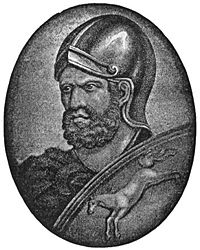 During a week when university podcasts received widespread attention (thanks to a very popular article in the NY Times), we’ve kept a close eye on the high-ranking podcasts on iTunesU. Quite consistently, one podcast — How Did Hannibal Cross the Alps? — has ranked at the top. It currently sits in the #2 position, right behind What is Existentialism?.
The Hannibal lecture was presented at Stanford by Patrick Hunt, an archaeologist who recently wrote Ten Discoveries That Rewrote History (see related post) and whose long term project is to figure out how the great military leader crossed the Alps in 218 BCE with his large army, which included dozens of war elephants. I had a chance to catch up with Patrick and ask him why, over 2,000 years later, the adventures of Hannibal still manage to capture our imagination. Here is what he had to say:
“Here are some reasons I think the Hannibal topic is mesmerizing. First, the logistics of moving a large army — at least 25,000 surviving soldiers — over sometimes terrifying mountain barriers is very daunting and immensely challenging. Second, this is exponentially compounded by the fact that even with able scouts the increasingly steep terrain and bad weather en route to the summit were threateningly unfamiliar to the vast majority of Hannibal’s army in this early winter of 218 BCE. Even in summer, the weather can be harsh and wildly unpredictable. In winter, it can be that much worse. Third, there were Celtic tribes to contend with, who would roll boulders down on troops and ambush them from (more…)
Read More...Andy, Are You Goofing on Apple?
 Fake Steve Jobs, a wildly popular blog written by Daniel Lyons, an editor at Forbes, has been goofing on the real Steve Jobs all year. And now things have taken an odd turn. During the same week that Apple apparently shut down ThinkSecret.com (an Apple rumor site) in exchange for cash, Apple may be applying similar pressure to Fake Steve Jobs. Or maybe not.
If today’s blog post can be taken at face value, Apple lawyers have followed up hard-assed threats with a cash offer (of $500,000) to make FSJ go away. The recent posts all sound convincing. But then you note the references to Andy Kaufman, the master of walking the line between complete sincerity and absurdity. First, there’s the picture of Kaufman getting strong armed during one of his famous wrestling matches with women. Next, there’s the reference to a “Tony Clifton,” which is the name given to a strange bit character Kaufman played during the 1970s (see below).
FSJ is a satire site, and you shouldn’t get fooled. But you do. Just like the inevitable dupe does every April 1. Good stuff.
The Final Cut of Blade Runner: Now Out on DVD
Back in October, Ridley Scott released a final and definitive director’s cut of Blade Runner, presenting to audiences the film that he would have made if studio execs hadn’t meddled with things. A short two months later, the final cut is now out on DVD. It was released yesterday, barely in time for the holidays. For more on the making and remaking of Blade Runner, you can listen to this recent interview with Ridley Scott.
Read More...
Yale Launches Open Courses
Click here for 250 Free Online Courses From Great Universities
Yesterday, Yale announced that it is providing “free and open access to seven introductory courses taught by distinguished teachers and scholars at Yale University.” I’ve listed the course lineup below, with links to each course. You can access the homepage for the project here.
With this launch, Yale becomes the latest prestigious American university to give global users access to online educational content. But its approach is rather different. The high profile initiatives led by MIT and UC Berkeley both deliver high volumes of content, and they’re designed to be scalable. (MIT gives users access to mass quantities of course materials created by its faculty, while Berkeley distributes through iTunes and YouTube over 50 courses that the university records at a reasonable cost.) In contrast, Yale’s project is more boutique and high-touch.
Each course features a syllabus, reading assignments, class notes, and polished lectures, which, when taken together, contribute to a more rounded learning experience. The lectures can be downloaded in one of five formats (text, audio, flash video, low bandwidth quicktime video, and high bandwidth quicktime video). And quite notably, Yale has designed the courses to be downloaded fairly easily, which means that you can put the lectures onto an mp3 player if you’re a little tech savvy. This does raise the question, however: why aren’t the lectures also posted on Yale’s iTunes site? This would surely facilitate the downloading of lectures for many users, and it would offer an easy way to drive substantial traffic to the courses.
As some have already noted (see the comments on this page), Yale isn’t offering online courses in the truest sense, meaning you won’t get access to a live instructor here. Nor will you be able to interact with other students. It’s a one-way, solitary educational experience. But there’s a reason for that. Not long ago, Yale experimented with a more comprehensive form of online learning when it created, along with Stanford and Oxford, an e‑learning consortium called “The Alliance for Lifelong Learning” (a/k/a AllLearn). For many reasons, the venture (where I spent five years) wasn’t ultimatley viable. And so Yale has opted for another model that has its own virtues — it’s less capital intensive; it’s free (AllLearn charged for its courses); and it will get educational materials into far more people’s hands, which is perhaps what matters most.
As a quick note, let me add that this project was funded by the Hewlett Foundation, and Yale expects to add up to 30 additional courses over the next several years.
To visit Yale’s open courses, visit the following links:
- Astronomy 160: Frontiers and Controversies in Astrophysics
- English 310: Modern Poetry
- Philosophy 176: Death
- Physics 200: Fundamentals of Physics
- Political Science 114: Introduction to Political Philosophy
- Psychology 110: Introduction to Psychology
- Religious Studies 145: Introduction to the Old Testament

Led Zeppelin Reunion — First Images
Last night in London, Led Zeppelin played its first full show together since 1980 (though they did play a short set at Live Aid in 1985, which I was fortunate enough to see). Here’s the first video clip to make its way onto YouTube.
Nobel Prize Winners on YouTube
YouTube gets smarter one painfully small step at a time. First courses from Berkeley; next videos of Nobel Prize winners. More coming?
Read More...
Conrad’s Heart of Darkness — Free Audiobook Podcasts
Joseph Conrad would be turning 150 years old, and to mark the occasion, The Guardian has taken a good look back at the Polish-born writer who wrote some of England’s finest novels, even though English was his third language. (Polish and French were his first two.) Conrad’s masterpiece, of course, is The Heart of Darkness (1899), and we’ll take this opportunity to highlight two free audiobook versions of the text. The first version comes recommended by a reader over at Metafilter. You can find the mp3 files here. A second/different version can be found on iTunes. (Both versions permanently reside in our Audiobook Podcast Collection.)
Read More...Learning Foreign Languages the Mango Way
What’s an easy way to learn a new language at no cost, whenever and wherever you want? One is to take advantage of our extensive collection of Free Foreign Language Lessons. Another is to check out Mango Languages, a web site that offers free online language courses that will teach you the basics in French, German, English, Italian, Spanish, Mandarin Chinese, Japanese and more.
We’d usually outline the pros and cons of learning languages the Mango Way. But there’s no reason to reinvent the wheel. So we’re directing your attention to Jon Gordon, the host of Future Tense, whose recent broadcast took a short look at Mango’s offering. You can listen to it here (MP3 — RealAudio — Feed) and read some more here. You can also access Future Tense on iTunes.
NOTE: To get started with Mango Languages, you will need to register with the website.
Read More...
On Hanukkah
For the first night of Hanukkah, we bring you a classic bit from Saturday Night Live (1989) starring Jon Lovitz called “Hanukkah Harry Saves Christmas.” You can watch the video directly on NBC’s site along with other vintage SNL videos. (Sorry, I couldn’t find an embed for this one.)
Read More...Support Us
We're hoping to rely on loyal readers, rather than erratic ads. Please click the Donate button and support Open Culture. You can use Paypal, Venmo, Patreon, even Crypto! We thank you!

About Us

Open Culture scours the web for the best educational media. We find the free courses and audio books you need, the language lessons & educational videos you want, and plenty of enlightenment in between.
Advertise With Us

FREE UPDATES!
GET OUR DAILY EMAIL
Get the best cultural and educational resources on the web curated for you in a daily email. We never spam. Unsubscribe at any time.
FOLLOW ON SOCIAL MEDIA

Open Culture editor Dan Colman scours the web for the best educational media. He finds the free courses and audio books you need, the language lessons & movies you want, and plenty of enlightenment in between.
Advertise With Us


