Syd Barrett’s “Effervescing Elephant” Comes to Life in a New Retro-Style Animation
The story is well known. Syd Barrett, spiralling into depression, “hallucinations, disorganized speech, memory lapses, intense mood swings, and periods of catatonia,” left Pink Floyd in April, 1968, before recording two solo albums (The Madcap Laughs and Barrett) and then fading into obscurity. Above you can watch a delightful, new animation of “Effervescing Elephant,” a song Barrett first wrote during his teenage years and recorded in 1970. The new “retro-style” animation comes from Yoann Hervo. Below, find another animated take on “Effervescing Elephant,” this one from Steve Bobinksi.
If you would like to support the mission of Open Culture, consider making a donation to our site. It’s hard to rely 100% on ads, and your contributions will help us continue providing the best free cultural and educational materials to learners everywhere. You can contribute through PayPal, Patreon, and Venmo (@openculture). Thanks!
Related Content:
Psychedelic Scenes of Pink Floyd’s Early Days with Syd Barrett, 1967
Pink Floyd Performs on US Television for the First Time: American Bandstand, 1967
Read More...John Steinbeck Has a Crisis in Confidence While Writing The Grapes of Wrath: “I am Not a Writer. I’ve Been Fooling Myself and Other People”
In a 1904 letter, Franz Kafka famously wrote, “a book must be the axe for the frozen sea inside us,” a line immortalized in pop culture by David Bowie’s “Ashes to Ashes.” Where Bowie referred to the frozen emotions of addiction, the arctic waste inside Kafka may have had much more to do with the agony of writing itself. In the year that he composed his best-known work, The Metamorphosis, Kafka kept a tortured journal in which he confessed to feeling “virtually useless” and suffering “unending torments.” Not only did he need to break the ice, but “you have to dive down,” he wrote on January 30th, “and sink more rapidly than that which sinks in advance of you.”
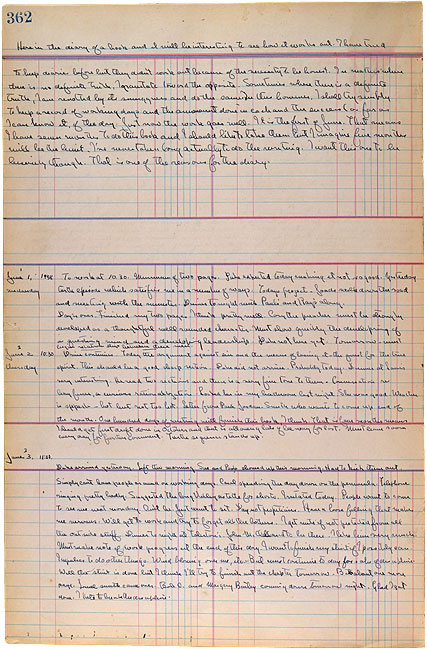
Whether as writers we find the evidence of Kafka’s crippling self-doubt to be a comfort I cannot say. For many people, no matter how successful, or prolific, some degree of pain inevitably attends every act of writing. And many, like Kafka, have left personal accounts of their most productive periods. John Steinbeck struggled mightily during the composition of his masterpiece, The Grapes of Wrath. His journal entries from the period tell the story of a frayed and anxious man overwhelmed by the seeming enormity of his task. But his example is instructive as well: despite his fragile mental state and lack of confidence, he continued to write, telling himself on June 11th, 1938, “this must be a good book. It simply must.” (See some of Steinbeck’s handwritten entries in the image above, courtesy of Austin Kleon.)
In setting the bar so high—“For the first time I am working on a real book,” he wrote—Steinbeck often felt crushed at the end of a day. “My whole nervous system in battered,” he wrote on June 5th. “I hope I’m not headed for a nervous breakdown.” He finds himself a few days later “assailed with my own ignorance and inability.” He continues in this vein. “Where has my discipline gone?” he asks in August, “Have I lost control?” By September he’s seeking perspective: “If only I wouldn’t take this book so seriously. It is just a book after all, and a book is very dead in a very short time. And I’ll be dead in a very short time too. So to hell with it.” The weight of expectation comes and goes, but he keeps writing.
The “private fruit” of Steinbeck’s diary entries, writes Maria Popova, “is in many ways at least as important and morally instructive” as the novel itself. At least that may be so for writers who are also beset by devastating neuroses. For Steinbeck, the diary (published here) was “a tool of discipline” and “hedge against self-doubt.” This may sound counterintuitive, but keeping a diary, even when the novel stalls, is itself a discipline, and an acknowledgement of the importance of being honest with oneself, allowing turbulence and doldrums to be a conscious part of the experience.
Steinbeck “feels his feelings of doubt fully, lets them run through him,” writes Popova, “and yet maintains a higher awareness that they are just that: feelings, not Truth.” His confrontations with negative capability can sound like “Buddhist scripture,” anticipating Ray Bradbury’s Zen in the Art of Writing. We needn’t attribute any religious significance to Steinbeck’s journals, but they do begin to sound like confessions of the kind many mystics have recorded over the centuries, including the imposter syndrome many a saint and bodhisattva has admitted to feeling. “I’m not a writer,” he laments in one entry. “I’ve been fooling myself and other people.” Nonetheless, no matter how excruciating, lonely, and confusing the effort, he resolved to develop a “quality of fierceness until the habit pattern of a certain number of words is established.” A ritual act, of a sort, which “must be a much stronger force than either willpower or inspiration.”
In the audio above, hear actor Paul Hecht read excerpts from Steinbeck’s diaries in an episode of the Morgan Library’s Diary Podcast. You can read Steinbeck’s diaries in the published volume, Working Days: The Journal of The Grapes of Wrath, 1938–1941.
via Austin Kleon
Related Content:
John Steinbeck’s Six Tips for the Aspiring Writer and His Nobel Prize Speech
See John Steinbeck Deliver His Apocalyptic Nobel Prize Speech (1962)
Josh Jones is a writer and musician based in Durham, NC. Follow him at @jdmagness
Read More...How Did the Romans Make Concrete That Lasts Longer Than Modern Concrete? The Mystery Finally Solved
An explosion in recent years of so-called “ruin porn” photography has sparked an inevitable backlash for its supposed fetishization of urban decay and economic devastation. Documenting, as theorist Brian McHale writes, the “ruin in the wake of the deindustrialization of North American ‘Rust Belt’ cities” like Detroit, “ruin porn” shows us a world that only a few decades ago, thrived in a post-war economic boom that seemed like it might go on forever. Our morbid fascination with images from the death of American manufacturing offers a rich field for sociological inquiry. But when scientists look over what has happened to so much of the architecture from the early to mid-twentieth century, they’ve mostly had one very pressing question:
What is going on with the concrete?
Or more specifically, why do structures built only a few years ago look like they’ve been weathering the elements for centuries, when buildings thousands of years old, like many parts of the Pantheon or Trajan’s Markets in Rome, look like they’re only a few years old? The concrete structures of the Roman Empire, writes Nicole Davis at The Guardian, “are still standing more than 1,500 years after the last centurion snuffed it.” Roman concrete was a phenomenal feat of ancient engineering that until recently had stumped scientists who studied its durability. The Romans themselves “were aware of the virtues of their concrete, with Pliny the Elder waxing lyrical in his Natural History that it is ‘impregnable to the waves and every day stronger.”
The mystery of the Roman concrete recipe has finally been revealed. Researchers at the University of Utah have just published a study in American Mineralogist showing how the compound of “volcanic ash, lime (calcium oxide), seawater and lumps of volcanic rock” actually did, as Pliny claimed, become stronger over time, through the very action of those waves. “Seawater that seeped through the concrete,” notes Davis, “dissolved the volcanic crystals and glasses, with aluminous tobermorite and phillipsite crystalizing in their place.” These new crystals reinforce the concrete, making it more impervious to the elements. Modern concrete, “by contrast… is not supposed to change after it hardens—meaning any reactions with the material cause damage.” (The short video above explains the process in brief.)
The recent study builds on previous work conducted by lead author, University of Utah geologist Marie Jackson. In 2014, Jackson, then at the University of California, recreated the Roman concrete recipe and discovered one of the minerals within it that makes it superior to the modern stuff. But it took a couple more years before she and her colleagues figured out the role of seawater on forming the rare crystals. Now, they are recommending that builders begin using Roman concrete in the near future for seawalls and other marine structures. The research “opens up a completely new perspective for how concrete can be made,” says Jackson. “What we consider corrosion processes can actually produce extremely beneficial mineral cement and lead to continued resilience, in fact, enhanced perhaps resilience over time.”
As we increasingly turn our postmodern gaze toward the failures of postwar industrialization–toward not only crumbling cities but crumbling dams and bridges–one secret for building infrastructure that can last for centuries comes to us not from an algorithm or an AI but from an ancient recipe combining the primeval forces of volcanoes and ocean waves.
via The Guardian
Related Content:
Roman Architecture: A Free Course from Yale
Rome Reborn: Take a Virtual Tour of Ancient Rome, Circa 320 C.E.
Ancient Rome’s System of Roads Visualized in the Style of Modern Subway Maps
Josh Jones is a writer and musician based in Durham, NC. Follow him at @jdmagness
Read More...A Digital Archive of Soviet Children’s Books Goes Online: Browse the Artistic, Ideological Collection (1917–1953)

At both a geographical and historical distance, the Soviet Union doesn’t look like much of a place for kids. If you grew up during the Cold War in, say, the United States, you might well have the impression (of which The Simpsons’ “Worker and Parasite” remains the defining crystallization) of a gray, harshly utilitarian land behind the Iron Curtain concerned with nothing more whimsical than bread lines and production quotas. But if you grew up in the Soviet Union, at least at one of the right times and in one of the right places, you might feel a now much-discussed nostalgia, not for the economic difficulties of your Soviet childhood, but for the sensibilities of the vanished society you grew up in. An online interactive database called Playing Soviet: The Visual Languages of Early Soviet Children’s Books, 1917–1953 provides a kid’s-eye view into the early decades of that society.
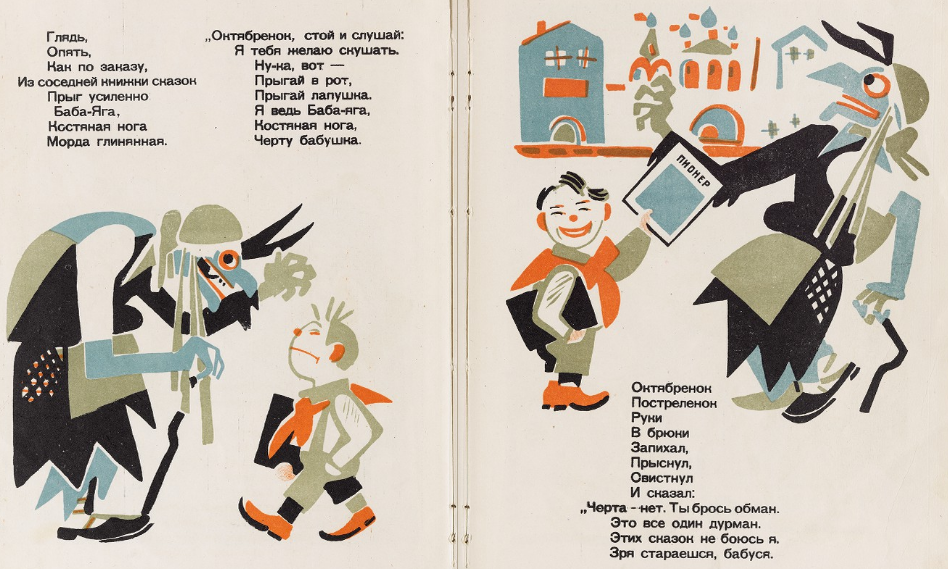
A project of the Cotsen Collection at Princeton’s Firestone Library, the archive contains a variety of fully digitized children’s books that show one venue in which, amid these years of “Russia’s accelerated violent political, social and cultural evolution,” in the words of the database’s front page, certain kinds of graphic art could flourish. “The illustration and look of Soviet children’s books was of tantamount importance as a vehicle for practical and concrete information in the new Soviet regime.”
This ambitious effort, driven by “directives for a new kind of children’s literature” to be “founded on the assumption that the ‘language of images’ was immediately comprehensible to the mass reader, far more so than the typed word,” brought in a great many artists and designers such as Alexander Deineka, El Lissitzky, and Vladimir Lebedev, tasking them all with creating “imaginative models for Soviet youth in the new languages of Soviet modernism.”
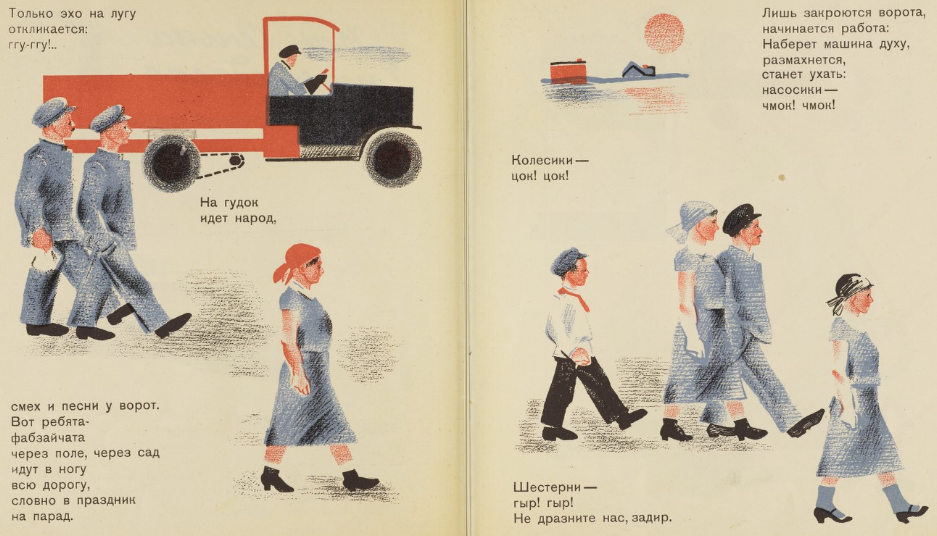
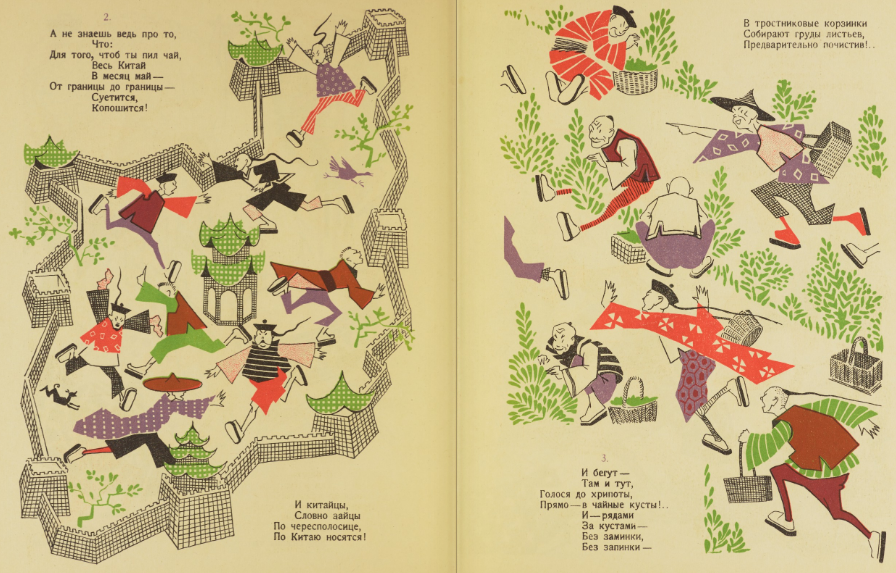
Mental Floss’ Shaunacy Ferro notes how many of the books “were designed to indoctrinate children into the world of the ‘right’ way to think about Soviet culture and history,” pointing to a volume called How the Revolution Was Victorious, which meant “to ensure the correct interpretation of the anti-governmental coup among the young generation of new Soviet readership.” Some of the other reading material that resulted, like 1930’s industrially focused What Are We Building? or the slightly earlier How Senka Ezhik Made a Knife, wears its instructional value on its sleeve (or rather, its cover). Others, like 1925’s The Little Octobrist Rascal or that same year’s China-set A Cup of Tea, offer higher doses of playfulness mixed in with the ideology.
Playing Soviet also includes the work of Vladimir Mayakovsky, whose Whom Should I Be?, a representative book from the “golden age” of Soviet Children’s literature, we featured here on Open Culture earlier this year. Russia Beyond the Headlines’ Alexandra Gueza highlights Mayakovsky’s What is Good and What is Bad? (“in which he explains that walking in the rain and thunderstorms is bad, cleaning your teeth is good, fighting with the boys is bad, while studying is good”) and October 1917–1918: Heroes and Victims of the Revolution, whose “good guys” include “a worker, a Red Army soldier, a sailor, a seamstress” and whose “bad guys” include “a factory owner, a landowner, a rich farmer, a priest, a merchant.” Goodnight Moon it certainly isn’t, but then, how many American children’s books had to attempt a fundamental reinvention of society?
via Hyperallergic
Related Content:
Soviet-Era Illustrations Of J. R. R. Tolkien’s The Hobbit (1976)
Enter an Archive of 6,000 Historical Children’s Books, All Digitized and Free to Read Online
Hayao Miyazaki Picks His 50 Favorite Children’s Books
The First Children’s Picture Book, 1658’s Orbis Sensualium Pictus
Based in Seoul, Colin Marshall writes and broadcasts on cities and culture. He’s at work on the book The Stateless City: a Walk through 21st-Century Los Angeles, the video series The City in Cinema, the crowdfunded journalism project Where Is the City of the Future?, and the Los Angeles Review of Books’ Korea Blog. Follow him on Twitter at @colinmarshall or on Facebook.
Read More...John Wayne Recites and Explains the Pledge of Allegiance (1972)
Back in 1972, John Wayne recorded a spoken word album called America, Why I Love Her, described as “a series of heartfelt, patriotic speeches over a bed of stirring music.” You can stream the entire album below (or over on Spotify). Above, we’re featuring the 8th track on the release, Wayne’s recitation and exegesis of the Pledge of Allegiance. Some will find it corny, others rousing. Personally, I’m not a fan of syrupy nationalism. But I’ll give Wayne’s interpretation this–his take recognizes America as a place of inclusiveness and openness, giving everyone equal access to its opportunities and institutions. Compare it with the nationalist rhetoric you hear today, and, you might find yourself longing for John Wayne’s sunnier America.
“I pledge allegiance to the flag”
What do those words mean to you? To me they say, “Thank
you, America, for your strength, your courage and your
freedom…which has been a beacon to the world for two
hundred years.”
“Of the United States of America”
Whose bright stars are fifty states…each bearing its
own stamp of individuality. People…two hundred
million strong…people who have come to her from all
corners of the earth.
“And to the republic for which it stands”
A land of laws…with an ingenious system of checks and
balances that allows no man to become a tyrant…and
lets no group prevail…if their power is not tempered
with a real concern for the governed…A land where the
right of dissent and of free speech is jealously
guarded…where the ballot box is the sword…and the
people its wielder.
“One nation under God”
A land where freedom of worship is a cornerstone of her
being…A land graced with temples and churches,
synagogues and altars that rise in profusion to embrace
all the religions of the world.
“Indivisible”
A land forged by the hot steel of raw courage…and
formed forever…by the awful crucible of civil war.
“With liberty”
Where man in pursuit of an honest life will not be
denied his chance…where her citizens move freely
within her vast borders without hindrance or fear…A
land brimming with opportunity…where freedom of
choice is the guide for all.
“And justice”
The courts of our land are open to all. Its wheels of
justice grind for all causes…all people. They look to
every avenue for justice…every concern of the
law…and they temper their reasoning with mercy…
“For all!”
If you would like to support the mission of Open Culture, consider making a donation to our site. It’s hard to rely 100% on ads, and your contributions will help us continue providing the best free cultural and educational materials to learners everywhere. You can contribute through PayPal, Patreon, and Venmo (@openculture). Thanks!
Read More...Browse a Collection of Over 83,500 Vintage Sewing Patterns
My costume design professor at Northwestern University, Virgil Johnson, delighted students with his formula for period clothing. I have forgotten some of the mathematic and semantic particulars—does dressing someone five years behind the times a “frumpy” character make? Or is it merely one?
I do recall some anxious hours, preparing for the school’s main stage production of the incestuous Jacobean revenge tragedy, ’Tis Pity She’s a Whore. The societal corruption of the play was underscored by having the supporting characters slouch around, snorting mimed cocaine in cutting edge, mid-80s Vogue Patterns … those big unstructured jackets were very a la mode, but they gobbled up a lot of high-budget fabric, and I didn’t want to be the one to make a costly sewing mistake.
What sticks in my mind most clearly is that 20 years was the sweet spot, the appropriate amount of elapsed time to ensure that one would not appear dumpy, dowdy, or oblivious, but rather prudent and discerning. Donning a garment that was 15 years out of fashion might be daringly “retro,” but another five and that same garment could be heralded as “vintage.”
The collaborative Vintage Pattern Wiki puts the magic number at 25, requesting that contributors make sure the patterns they post are from 1992 or earlier, and also out-of-print.

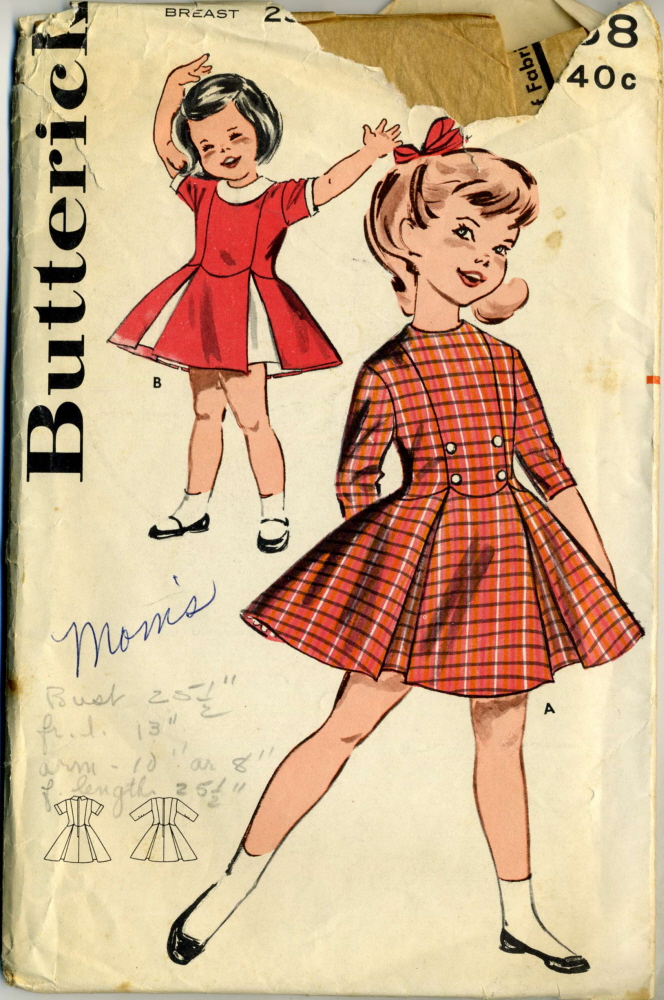
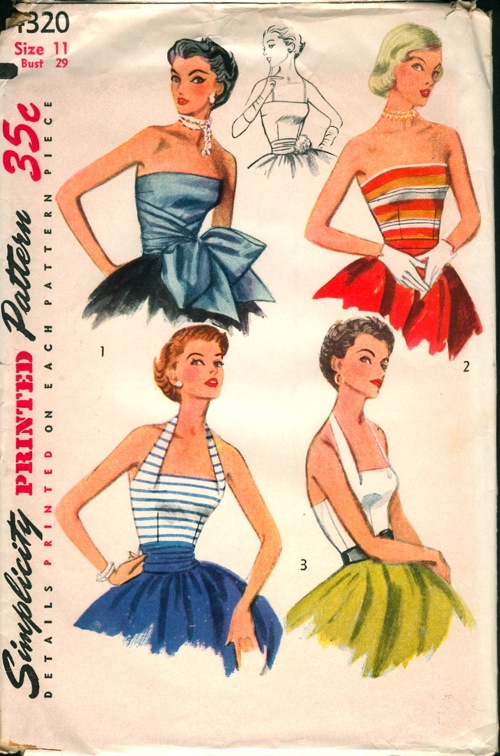
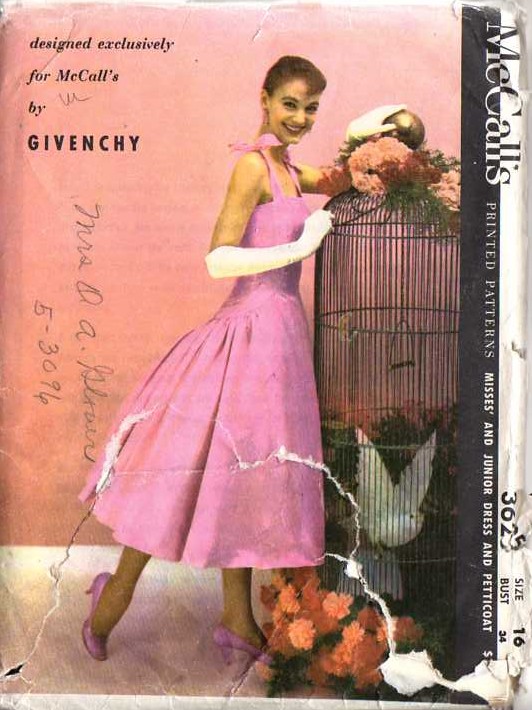
The browsable collection of over 83,500 patterns runs the gamut from Dynasty-inspired pussy bow power suits to Betty Draper-esque frocks featuring models in white gloves to an 1895 boys’ Reefer Suit with fly-free short trousers.
Visitors can narrow their search to focus on a particular garment, designer or decade. If you click these links, you can see patterns from the following decades: 1920s, 1930s, 1940s, 1950s, 1960s, 1970s, and 1980s.
The movie star collection is particularly fun. (Flattering or no, I’ve always wanted a pair of Katharine Hepburn pants…)
And it goes without saying that the dog days of summer are the perfect time to get a jump on your Halloween costume.
Those who are itching to get sewing should check the links below each pattern envelope cover for vendors who have the pattern in stock and photos and posts by community members who have made that same garment.
The prices and handwritten jottings of the original owners will also put you in a vintage mood.
The hunt starts here.

Related Content:
The Online Knitting Reference Library: Download 300 Knitting Books Published From 1849 to 2012
Frida Kahlo’s Colorful Clothes Revealed for the First Time & Photographed by Ishiuchi Miyako
Ayun Halliday is an author, illustrator, theater maker and Chief Primatologist of the East Village Inky zine. Follow her @AyunHalliday.
Read More...Watch Johnny Cash’s Poignant Final Interview & His Last Performance: “Death, Where Is Thy Sting?” (2003)
“Ask someone to name a song that always has the power to reduce them to tears,” writes Independent culture editor Christopher Hooton, “and the chances are they’ll swiftly reply ‘Johnny Cash. Hurt,’” the country legend’s heartbreaking cover of Trent Reznor’s masochistic anthem. Asked to name a music video with the same emotional resonance, and you’re just as likely to get the same answer. I find myself tearing up just reading Hooton’s description of it. Shot at The House of Cash, the singer’s decrepit home (and shuttered museum), director Mark Romanek’s wrenching video speaks to us of “the transience of life, the gracelessness of death, the Ozymandian crumbling of an oeuvre and the decline of a genre, an era and an attitude.”
It does all that, but does much more besides: the video, and Cash’s last recordings in general, show us a man in the depths of lovelorn grief, yet unafraid to face mortality and decline and unwilling to deny their ravages. We mourn with Cash and for him, but his final performances are so riveting because, while most of us may fear death, he did not.
“Corinthians 15:55,” his last original song—on his final, posthumous collection, Ain’t No Grave—is named after the verse that asks “Death, where is thy sting?” Throughout the album, Cash sounds, writes Adam Richter, “unimpressed by the threat of death…. Singers are almost never as prepared as Cash was to bid adieu to all that.”
The “Hurt” video netted Cash, Romanek, and his team six MTV Video Music Award nominations. Before it won for Best Cinematography, Cash sat down with Kurt Loder on August 20th, 2003, for what would turn out to be his final interview. Although he confesses to a distaste for the work of making videos, of “Hurt,” he says, “I felt we were doing something worthwhile.” He talks about meeting Rick Rubin and making the American Recordings series of albums, some of the most widely praised records of his career, and the music he had always wanted to make. And he expresses the fierce independence, compassion, and authenticity that made him such a phenomenal writer and admirable human being.
“You can’t let people delegate to you what you should do,” Cash says, pointing at his heart, “when it’s coming from way in here, you know?… I wouldn’t let anybody influence me into thinking I was doing the wrong thing by singing about death, hell, and drugs.” We’re all lucky that he didn’t. Cash’s expressions of grief after the death of June Carter cut deep, but it was his ability not only to play the outlaw but also to empathize with people who are abused, persecuted, and excluded by the law that set him apart from other country and gospel singers, and made him a hero to millions of people who don’t share his roots or his faith.
The month before Cash gave his final interview, he gave his last performance at the Carter Ranch. (Watch it above.) Less than a month after the interview, he was dead. In 2007, the House of Cash, the house Cash had lived in since 1968, burned to the ground. Cash surely would have mourned the loss, but it wouldn’t have kept him down for long, I suspect. Not only did he stare down death with grace, humor, and dignity, but he faced the pains of life with those same qualities.
Related Content:
Johnny Cash Sings “Man in Black” for the First Time, 1971
Johnny Cash & Joe Strummer Sing Bob Marley’s “Redemption Song” (2002)
Josh Jones is a writer and musician based in Durham, NC. Follow him at @jdmagness
Read More...Test
Lorem ipsum dolor sit amet, consectetur adipiscing elit. Mauris eu arcu diam. Morbi condimentum nisi vitae mauris bibendum, at euismod dolor consectetur. Phasellus a neque nec erat tincidunt pellentesque. Mauris ultricies, odio eget mollis condimentum, ante nibh rutrum arcu, ut dignissim felis orci non lorem. Vestibulum at blandit nisi, ac ornare mauris. Fusce eu fermentum tortor, eu auctor quam. Duis eleifend lacinia nibh dictum volutpat. Nunc maximus leo sit amet lacus commodo, quis feugiat urna fermentum.
Sed consectetur ligula sed tortor lobortis commodo. Cras at ligula eget dolor venenatis dignissim non in augue. Nunc et lectus id eros suscipit hendrerit. Quisque porttitor nulla pretium laoreet gravida. Ut congue urna bibendum urna egestas dapibus. Vestibulum pharetra convallis interdum. Suspendisse arcu mi, convallis a eleifend eu, varius vitae ex. Nunc lacus ipsum, aliquam sit amet ornare ac, pellentesque non ligula. Suspendisse pulvinar quis lectus eu volutpat. Nulla nec consequat felis. Suspendisse ullamcorper, nulla porttitor condimentum placerat, mauris nisl rutrum turpis, ac laoreet nibh velit id tellus. Nam quis velit diam. Aenean venenatis, justo in fermentum ornare, turpis sem hendrerit felis, in pretium quam elit quis orci. Pellentesque habitant morbi tristique senectus et netus et malesuada fames ac turpis egestas.
Cras venenatis nunc quis feugiat commodo. Ut lorem nibh, lobortis id fermentum id, mollis id purus. Proin mollis quis nisi ut mollis. Curabitur purus ligula, viverra eget tellus vitae, blandit fermentum tellus. Cras quis nisi sed nulla iaculis iaculis dictum quis augue. Phasellus a rhoncus ex, id pellentesque mi. Aliquam mollis odio non erat pretium lobortis. Morbi in facilisis tellus, at rutrum neque. Phasellus rutrum quam vitae tortor vestibulum pellentesque. Morbi eu metus a est tincidunt aliquet eget nec sapien. Sed dignissim velit nunc, et lobortis tortor faucibus at. Proin turpis tortor, blandit nec dapibus at, elementum luctus urna. Nulla magna mi, rhoncus at auctor et, mattis non mauris. Donec at convallis magna.
Read More...The 10 Most Depressing Radiohead Songs According to Data Science: Hear the Songs That Ranked Highest in a Researcher’s “Gloom Index”
One of my favorite music-themed comedy sketches of recent years features a support group of Radiohead fans flummoxed and disappointed by the band’s post-Ok Computer output. The scenario trades on the perplexity that met Radiohead’s abrupt change of musical direction with the revolutionary Kid A as well as on the fact that Radiohead fans tend toward, well… if not PTSD or severe mood disorders, at least a heightened propensity for generalized depression.
“Much of Radiohead’s music is undeniably sad,” writes Analytics Specialist and Radiohead fan Charlie Thompson. Rather than play something “less depressing,” however, as many an acquaintance has asked him over the years, Thompson decided “to quantify that sadness, concluding in a data-driven determination of their most depressing song.”
Now, purely subjectively, I’d place “How to Disappear Completely” in the top spot, followed closely by Amnesia’s “Pyramid Song.” But my own associations with these songs are personal and perhaps somewhat arbitrary. I might make a case for them based on lyrical interpretations, musical arrangement, and instrumentation. But the argument would still largely depend on matters of taste and acculturation.
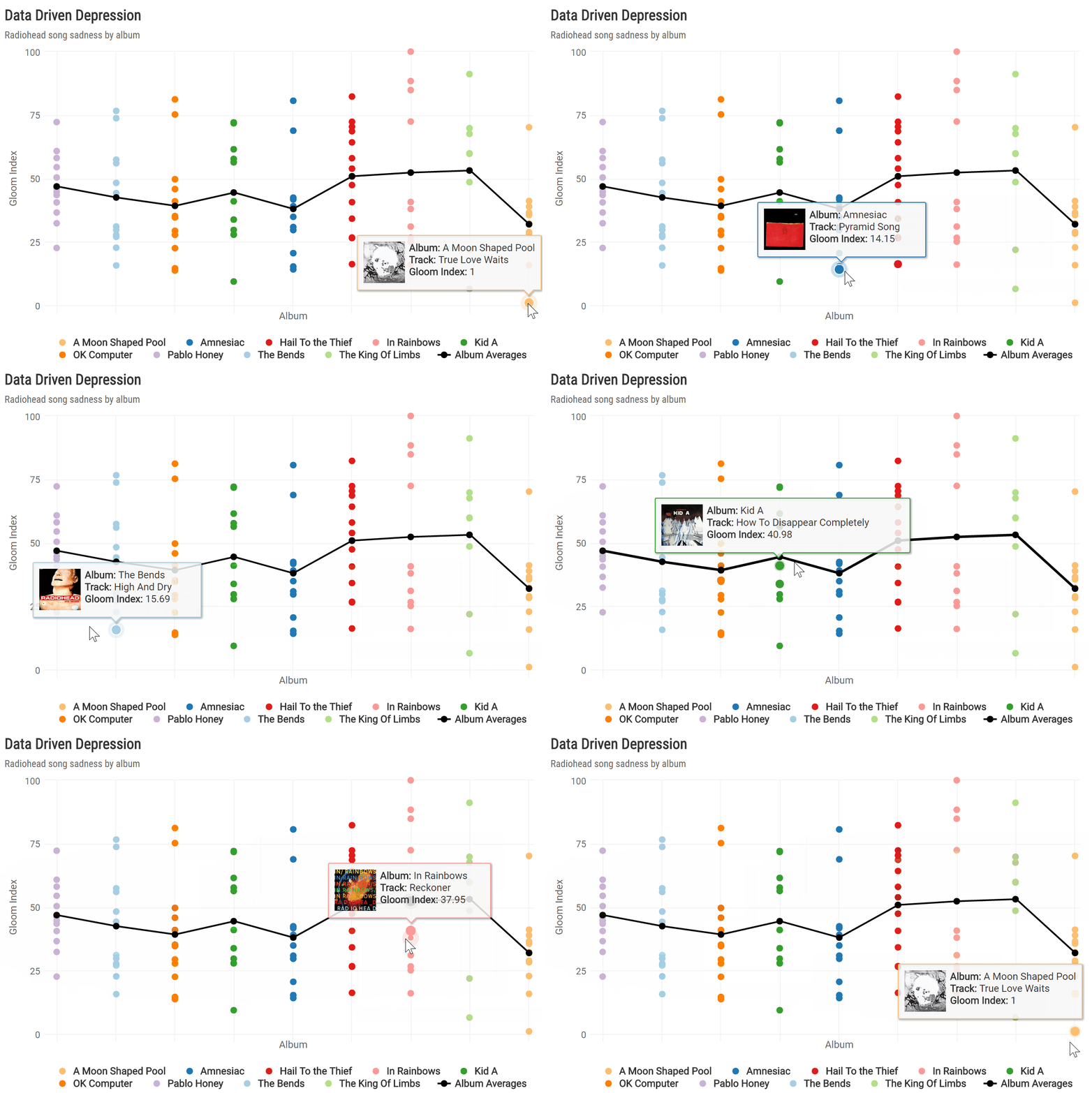
Thompson, on the other hand, believes in “quantifying sentiment.” To that end, he created a “gloom index,” which he used to measure each song in the band’s catalog. Rather than listening to them all, one after another, he relied on data from two online services, first pulling “detailed audio statistics” from Spotify’s Web API. One metric in particular, called “valence,” measures a song’s “positivity.” These scores provide an index “of how sad a song sounds from a musical perspective.” (It’s not entirely clear what the criteria are for these scores).

Next, Thompson used the Genius Lyrics API to examine “lyrical density,” specifically the concentration of “sad words” in any given song. To combine these two measures, he leaned on an analysis by a fellow data scientist and blogger, Myles Harrison. You can see his resulting formula for the “Gloom Index” above, and if you understand the programing language R, you can see examples of his analysis at his blog, RCharlie. (Read a less data-laden summary of Thompson’s study at the analytics blog Revolutions.) Thompson also plotted sadness by album, in the interactive graph further up.
So, which song rated highest on the “Gloom Scale”? Well, it’s “True Love Waits” from their most recent album A Moon Shaped Pool (hear a live acoustic version up above.). It’s a damned sad song, I’ll grant, as are the nine runners-up, all of which you can hear in the YouTube and Spotify playlists above). “Pyramid Song” appears at number 5, but “How to Disappear Completely” doesn’t even rank in the top ten. From a purely subjective standpoint, this makes me suspicious of the whole operation. But you tell us, readers, what do you think of Thompson’s experiment in “quantifying sentiment” in music?
Here’s the top 10:
1. True Love Waits
2. Give Up The Ghost
3. Motion Picture Soundtrack
4. Let Down
5. Pyramid Song
6. Exit Music (For a Film)
7. Dollars & Cents
8. High And Dry
9. Tinker Tailor Soldier …
10. Videotape
via Kottke
Related Content:
Radiohead’s “Creep” Played on the Gayageum, a Korean Instrument Dating Back to the 6th Century
A Free Course on Machine Learning & Data Science from Caltech
Josh Jones is a writer and musician based in Durham, NC. Follow him at @jdmagness
Read More...Joni Mitchell Sings an Achingly Pretty Version of “Both Sides Now” on the Mama Cass TV Show (1969)
“Records can be a bad trip. The audience can play your mistakes over and over. In a television special they see you once and you work hard to make sure they’re seeing you at your best.”
It’s hard to imagine anyone blessed with Mama Cass’ golden pipes being embarrassed by a recorded performance. A live gig, yes, though, celebrities of her era were subjected to far fewer witnesses.
The Internet was an undreamable little dream in 1969, when the sole episode of The Mama Cass Television Show aired. The former singer of the Mamas and the Papas died five years later, presumably unaware that future generations would have knowledge of, let alone access to, her failed pilot.
She may have described her variety show as “low key” to the Fremont, California Argus, but the guest list was padded with high wattage friends, including comedian Buddy Hackett, and singers Mary Travers and John Sebastian. Joni Mitchell, above, delivered an above-reproach performance of “Both Sides Now.”
Later, Mitchell and Travers joined their hostess for the heartfelt rendition of “I Shall Be Released” below, a performance that is only slightly marred by Elliot’s insane costume and an unnecessarily syrupy backing arrangement of strings and reeds.
Those who can’t live without seeing the complete show can purchase DVDs online.
Related Content:
Vintage Video of Joni Mitchell Performing in 1965 — Before She Was Even Named Joni Mitchell
James Taylor and Joni Mitchell, Live and Together (1970)
Ayun Halliday is an author, illustrator, theater maker and Chief Primatologist of the East Village Inky zine. She’ll is appearing onstage in New York City through June 26 in Paul David Young’s political satire, Faust 3. Follow her @AyunHalliday.
Read More...Support Us
We're hoping to rely on loyal readers, rather than erratic ads. Please click the Donate button and support Open Culture. You can use Paypal, Venmo, Patreon, even Crypto! We thank you!

About Us

Open Culture scours the web for the best educational media. We find the free courses and audio books you need, the language lessons & educational videos you want, and plenty of enlightenment in between.
Advertise With Us

FREE UPDATES!
GET OUR DAILY EMAIL
Get the best cultural and educational resources on the web curated for you in a daily email. We never spam. Unsubscribe at any time.
FOLLOW ON SOCIAL MEDIA

Open Culture editor Dan Colman scours the web for the best educational media. He finds the free courses and audio books you need, the language lessons & movies you want, and plenty of enlightenment in between.
Advertise With Us


