How Doors Open onto Philosophical Mysteries in Robert Bresson’s Films: A Short Video Essay by Kogonada
FYI: Last Friday, Colin Marshall highlighted for you the new feature film by kogonada, whose many video essays–on Ozu, Linklater, Malick, Anderson, etc.–we’ve shown you here before. Rather by coincidence, The Criterion Collection just posted kogonada’s latest video essay, this one examining how “doors open onto philosophical mysteries in the films of French master Robert Bresson.” Watch “Once There Was Everything” above, and pair it with his other Bresson essay (“Hands of Bresson”) from three years ago. It appears right below.
If you would like to support the mission of Open Culture, consider making a donation to our site. It’s hard to rely 100% on ads, and your contributions will help us continue providing the best free cultural and educational materials to learners everywhere. You can contribute through PayPal, Patreon, and Venmo (@openculture). Thanks!
Related Content:
The Perfect Symmetry of Wes Anderson’s Movies
“Auteur in Space”: A Video Essay on How Andrei Tarkovsky’s Solaris Transcends Science Fiction
Signature Shots from the Films of Stanley Kubrick: One-Point Perspective
Read More...Ansel Adams, Dorothea Lange, Clem Albers & Francis Stewart’s Censored Photographs of a WWII Japanese Internment Camp
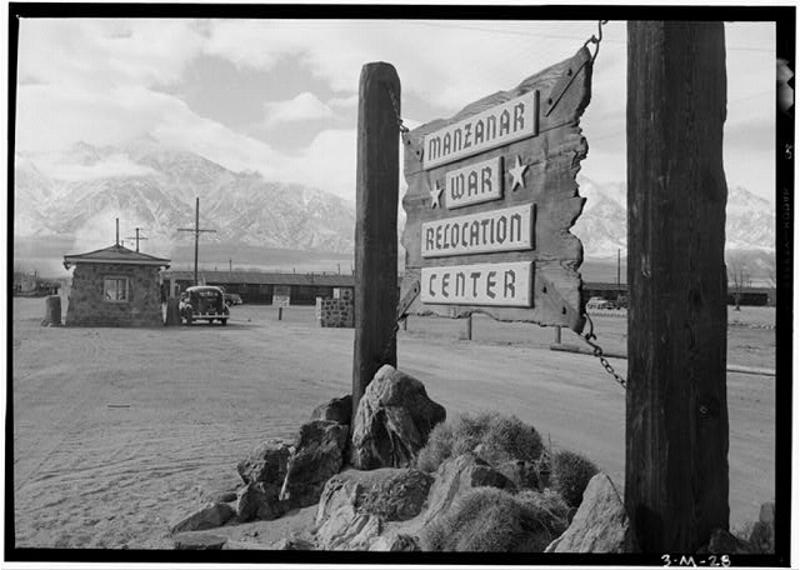
Image by Ansel Adams
In places where atrocities or widespread human rights violations occur, we sometimes hear ordinary citizens later claim they didn’t know what was going on. In the case of the internment of Japanese Americans during World War II, this would be almost impossible to believe. “120,000 people,” notes Newsweek, “lost their property and their freedom,” rounded up in full view of their neighbors. Every major publication of the time reported on Franklin Roosevelt’s 1941 Executive Order. Newsweek wrote “that people in coastal areas ‘were more anxious than ever to get rid of their aliens after rumors that signal lights were seen before submarine attacks’ ” off the coast of Southern California. There were many such rumors, the kind that spread xenophobic fear and paranoia, and which people used to vocally support, or tacitly approve of, sending their neighbors to internment camps because of their ancestry.

Image by Francis Stewart
Other reactions were less than subtle. The West Seattle Herald confronted readers with the blunt headline “GET ‘EM OUT!” Nonetheless, Newsweek’s Rob Verger writes, “the policy was by no means greeted with unanimous support,” and a vigorous public debate played out, with opponents pointing to the blatant racism and violations of civil rights. Two-thirds of the internees were American citizens. Yet all Japanese Americans were repeatedly called “aliens,” language consistent with the virulently anti-Japanese propaganda campaigns emerging at the same time.
Once the camps were built and the internees imprisoned, however, a massive propaganda effort began, not only the sell the camps as a necessary national security measure, but to portray them as idyllic villages where the patriotic internees patiently waited out the war by farming, playing baseball, making arts and crafts, running general stores, attending school, waving flags, and running newspapers.

Image by Clem Albers
Much of that information was conveyed to the public visually by photographers hired by the War Relocation Authority to document the camps. Among them were Clem Albers, Francis Stewart, and Dorothea Lange—well known for her photographs of the Great Depression. All three visited the camp called Manzanar in the foothills of the Sierra mountains. Another famous photographer, Ansel Adams, gained access to Manzanar by virtue of his friendship with its director, Ralph Merritt.

Image by Dorothea Lange
Their photographs, for the most part, show busily working men and women, smiling schoolchildren, and lots of patriotic leisure activities, like Stewart’s photo of sixth grade boys playing softball, further up. The photographers were strictly prohibited from photographing guards, watchtowers, searchlights, or barbed wire, and the heavy military presence at the camp is nearly always out of frame, with some very rare exceptions, like Albers’ photograph above of military police.
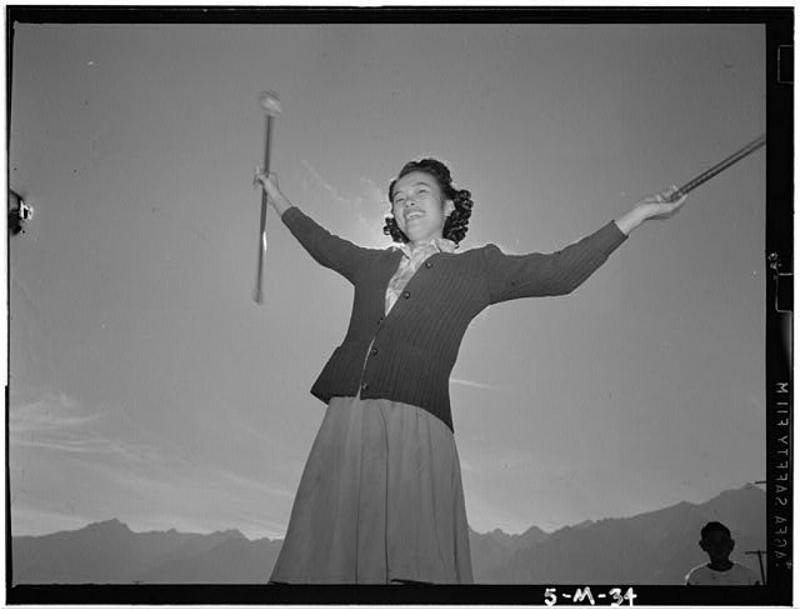
Image by Ansel Adams
Adams worked under these prohibitions as well, but his photos captured camp life as honestly as he could. The stunning landscapes sometimes compete, even in the background, with the real subject of some of his images (as in the photo at the top). But he also conveyed the harsh barrenness of the region. He tried to intimate the oppressive police apparatus by capturing its shadow. “The purpose of my work,” he wrote to the Library of Congress in 1965 upon donating his collection, “was to show how these people, suffering under a great injustice, and loss of property, business and professions, had overcome a sense of defeat and despair [sic].” His images often show internees “in heroic poses,” writes Dinitia Smith, as above, in order to ennoble their conditions. Lange’s photographs, on the other hand, like that of a young girl below, “seemingly unstaged and unlighted… bear the hallmarks” of her “distinctively documentary style.” Her pictures “compress intense human emotion into carefully composed frames.” Some of her photos show smiling, relaxed subjects. Many others, like the photograph of a barracks interior further down, show the faces of weary, uncertain, and despondent civilian prisoners of war.

Image by Dorothea Lange
Perhaps because of her refusal to sentimentalize the camps, or because of her left-wing politics and opposition to internment (both known before she was hired), Lange’s work was censored, not only through restricted access, but through the impoundment of over 800 photographs she took at 21 locations. Those photos were recently published in a book called Impounded: Dorothea Lange and the Censored Images of Japanese American Internment and hundreds of them are free to view online at the Densho Digital Repository’s Dorothea Lange Collection. The National Park Service’s collection features 16 pictures from Lange’s visit to Manzanar. At the NPS site, you’ll also find collections of photographs from that camp by Adams, Albers, and Stewart. Each, to one degree or another, faced a form of censorship in what they could photograph or whether their work would be shown at all. What most ordinary people saw at the time did not tell the whole story. For all practical purposes, writes Oberlin Library, “life at a Japanese internment camp was comparable to the life of a prisoner behind bars.”
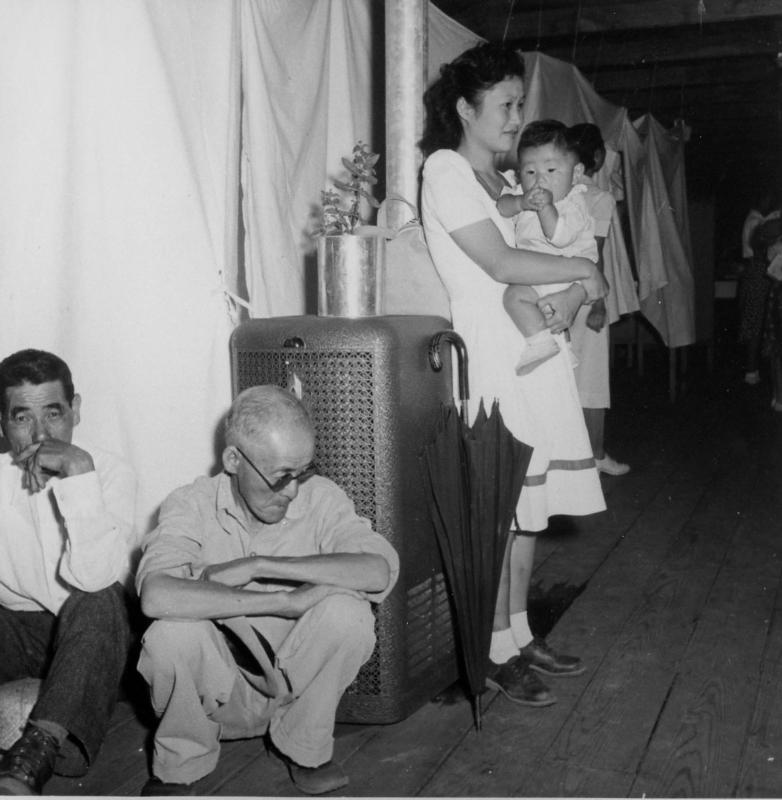
Image by Dorothea Lange
Related Content:
478 Dorothea Lange Photographs Poignantly Document the Internment of the Japanese During WWII
200 Ansel Adams Photographs Expose the Rigors of Life in Japanese Internment Camps During WW II
Dr. Seuss Draws Anti-Japanese Cartoons During WWII, Then Atones with Horton Hears a Who!
Josh Jones is a writer and musician based in Durham, NC. Follow him at @jdmagness
Read More...36 Abstract Covers of Vintage Psychology, Philosophy & Science Books Come to Life in a Mesmerizing Animation
Animated ebook covers are the wave of the future.
Graphic and motion designer Henning M. Lederer surfs that wave on the most unexpected of boards—a collection of abstract mid-century covers drawn from the Instagram feed of artist Julian Montague, who shares his enthusiasm for vintage minimalism.
Lederer first came to our attention in 2015, when we covered the first installment of what seems destined to become an ongoing project.
His latest effort, above, continues his explorations in the subjects which most frequently traded in these sorts of geometric covers—science, psychotherapy, philosophy and sociology.
No word on what inspired him to toss in the first cover, which features a cheerful, Playmobil-esque mushroom gatherer. It’s endearing, but—to quote Sesame Street—is not like the others. Those of us who can’t decipher Cyrillic script get the fun of imagining what sort of text this is—a mycology manual? A children’s tale? A psychological examination—and ultimately rejection—of midcentury publishers’ fascination for spirals, diagonal bars, and other non-narrative graphics?
Whether or not you’d be inclined to pick up any of these titles, you may find yourself wanting to dance to them, compliments of musician Jörg Stierle’s trippy electronics.
Or take your cue from yet another cover contained therein: I. P. Pavlov’s Essays in Psychology and Psychiatry with a Special Section on Sleep and Hypnosis.
Here’s the one that started it all:
Related Content:
Artist Animates Famous Book Covers in an Elegant, Understated Way
500+William S. Burroughs Book Covers from Across the Globe: 1950s Through the 2010s
Ayun Halliday is an author, illustrator, theater maker and Chief Primatologist of the East Village Inky zine. Follow her @AyunHalliday.
Read More...The Secret Rhythm Behind Radiohead’s “Videotape” Now Finally Revealed
“Videotape” ends Radiohead’s 2007 album In Rainbows, and like many of their albums, it tends towards the funereal. (Think of the drunken “Life in a Glasshouse” from Amnesiac or “Motion Picture Soundtrack” from Kid A). And at first, it does sound very simple, four plaintive descending chords and Thom Yorke’s high melody over the top of it.
But in this 10 minute video essay from Vox Pop: Earworm, the song’s structure is peeled back to reveal a secret–that the chord sequence is not on the downbeat, but shifted a half-beat earlier. Hence, it is a heavily syncopated song that removes all clues to its syncopation.
Advanced musicians out there might not be blown away by any of this, but for fans of Radiohead and those just coming to music theory, the video is a good introduction to complex rhythm ideas. The fun comes from the backwards way in which Vox and Warren Lain–who devoted a whole 30 minutes to exploring the song–came across the secret.
It starts with video of Thom Yorke trying to play a live version along to a click track, and then to Phil Selway’s drums. For some reason Yorke can’t do it. And that’s because his brain is wanting to put the chords on the downbeat, the most natural, obvious choice. To play off beat, without further rhythmic information, shows the band “fighting against not just their own musical instincts, but their own brainwaves” as the Vox host explains.
There is much discussion in the YouTube comments over whether these 10 minutes are worth the analysis. It’s not that Radiohead invented anything new here–check out the off-beat opening of something like XTC’s “Wake Up”–but more that the band goes through the whole song (at least in the recorded version) without revealing the real rhythm, like playing in a certain key and never touching the root note.
To sum up: Radiohead push themselves in the studio and take those experiments into the live experience and challenge themselves. Which is way more than the majority of rock bands ever do. And bless ‘em, Yorke and co., for doing so.
Related Content:
The Hidden Secrets in “Daydreaming,” Paul Thomas Anderson’s New Radiohead Music Video
Eight Radiohead Albums Reimagined as Vintage Paperback Books
Ted Mills is a freelance writer on the arts who currently hosts the artist interview-based FunkZone Podcast and is the producer of KCRW’s Curious Coast. You can also follow him on Twitter at @tedmills, read his other arts writing at tedmills.com and/or watch his films here.
Read More...Stream 935 Songs That Appeared in “The John Peel Festive 50” from 1976 to 2004: The Best Songs of the Year, as Selected by the Beloved DJ’s Listeners
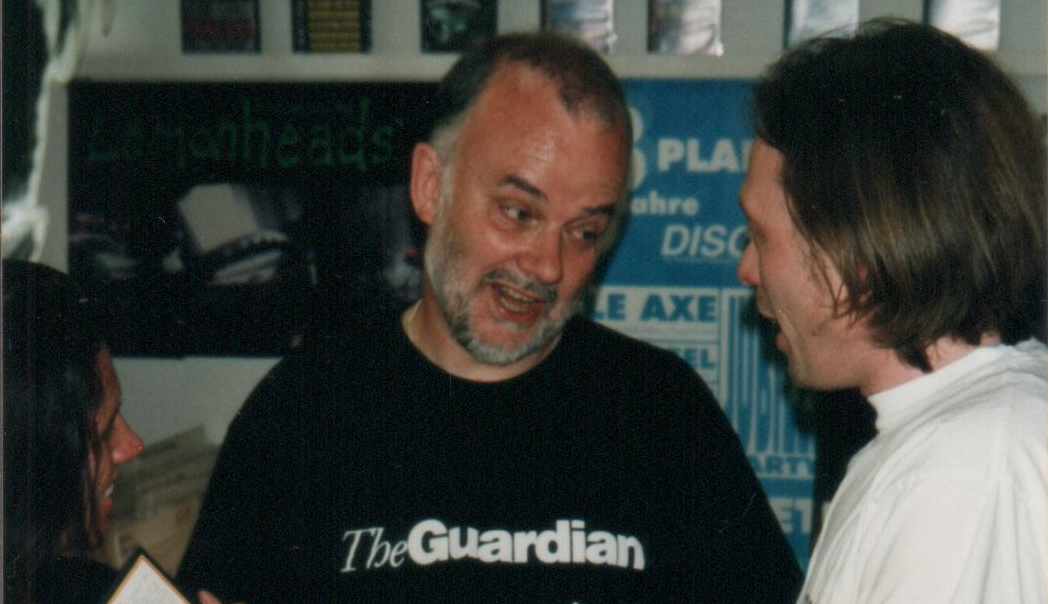
Image by Zetkin, via Wikimedia Commons
We’ve devoted space here before to legendary BBC DJ John Peel’s musical legacy, from his formidable record collection to his many hours of “Peel Sessions,” the recordings he made in BBC studios of artists like David Bowie, Joy Division, The Smiths, The Specials, Siouxsie and the Banshees and so, so many more–usually when they were on the cusp of superstardom or enduring cult status. It was Peel’s particular talent for discovering and promoting such artists that set him apart from his peers. Rather than riding the cultural wave of the moment, he listened at the margins, cultivating and curating what he heard. Whether punk, glam, new wave, hardcore, ska, techno, or industrial, it seems John Peel got there first, and the rest of the industry followed after him.
Peel did not approach his role in a critical vein—sitting in judgment of the music around him. He approached it as an enthusiastic and obsessive fan, which explains much of his appeal to the listeners who loved his broadcasts. He honored those listeners each year by compiling a list of their favorites in what he called “The John Peel Festive 50.” This end-of-the-year event “became a Christmas institution, writes the BBC, “more loved than fairy lights and Christmas crackers.”
Listeners of Peel’s show voted for their three favorite tracks in November. The following month, the highest-ranked “Festive 50” were all played on the air. He described the process as a truly democratic, crowdsourced endeavor, as we would say today.
It’s really just me marking every single vote down in a ledger. There is obviously the temptation to slip something in that I like, especially if it’s just outside the 50, and something crap has gone above it. But I have a very workman-like brain so it just wouldn’t be on to fix it.
Peel “wasn’t always happy with what the listeners voted for,” often feeling “there were too many ‘white boys with guitars’ making an appearance.” The predictability of several of the lists irked him, and seemed to work against the spirit of his mission to tirelessly promote adventurous, experimental music. Peel may have been popular, but in matters of taste, he was no populist. For the most part, however, he remained faithful to the fans’ picks, and noted that he never would have been able to choose the top three songs of the year himself: “I couldn’t get any fewer than a list of 250.”
The tradition, with a few hiccups, continued from its inception in 1976 till Peel’s death in 2004, and the massive Spotify playlist above aggregates the hundreds of those picks—932 songs, to be exact, over 70 hours of music. From Dylan, Clapton, and the Stones to Neko Case—and along the way, no shortage of tracks from the punk and post-punk artists most closely associated with Peel’s show. While the listener’s picks do fall heavily into the “white boys with guitars” category, there’s plenty more besides, including early tracks from Eric B. & Rakim, P.J. Harvey, Stereolab, 10,000 Maniacs, Cocteau Twins, and many more. You can explore the tracks in Peel’s “Festive 50” lists here. They’re sorted by decade: 1970s — 1980s — 1990s — 2000s.
Note: Here’s a direct link to the Spotify playlist, and if you need Spotify’s software, download it here.
Related Content:
Hear a 9‑Hour Tribute to John Peel: A Collection of His Best “Peel Sessions”
Revisit the Radio Sessions and Record Collection of Groundbreaking BBC DJ John Peel
Josh Jones is a writer and musician based in Durham, NC. Follow him at @jdmagness
Read More...Senator Al Franken Does a Pitch Perfect Imitation of Mick Jagger (1982)
If Senator Al Franken won’t run for President in 2020, perhaps he’d temper fans’ disappointment with a repeat of his early 80’s turn as Mick Jagger, above.
The performance took place at Stockton State, a public university conveniently located in New Jersey–what the late Tom Davis, Franken’s long time Saturday Night Live writing partner and Keith Richards to his Jagger called “the Blair Witch scrub forests twenty-five miles north of Atlantic City.”
Franken’s performance is an immersive triumph, especially for those who remember his best known SNL character, the lispingly upbeat Stuart Smalley.
His Jagger is the opposite of Stuart–butch, preening, athletic … a less than sober student fan in the Stockton State crowd might have drunkenly wondered if he or she had accidentally bought tickets to the Tattoo You tour. Those lips are pretty convincing.
The costuming is dead on too, and Franken did not take the route Chris Farley would later take, lampooning the male strippers of Chippendales. He may not be Jagger-rangy, but he’s certainly fit in an outfit that leaves no room to hide.
As Davis recalled in his 2010 memoir, Thirty-Nine Years of Short-Term Memory Loss: The Early Days of SNL from Someone Who Was There:
As we started “Under My Thumb,” Franken came running out as Mick Jagger, wearing yellow football pants and Capezios and was so good, it was scary. Unfortunately, Franken and Davis at Stockton State never sold very well… maybe it would be re-released if one of us became president, or shot a president.
Knowing that Davis, who died five years ago, would likely never have predicted the outcome of the recent election, and that Senator Franken, outspoken as he is, is in no position to joke about the second option, we suggest truffling up a used copy, if you’d like to see more.
And for comparison’s sake, here are the originals performing to an arena-sized crowd in Arizona in 1981:
Related Content:
Mick Jagger Defends the Rights of the Individual After His Legendary 1967 Drug Bust
When William S. Burroughs Appeared on Saturday Night Live: His First TV Appearance (1981)
Ayun Halliday is an author, illustrator, theater maker and Chief Primatologist of the East Village Inky zine. Follow her @AyunHalliday.
Read More...10 Longevity Tips from Dr. Shigeaki Hinohara, Japan’s 105-Year-Old Longevity Expert

Photo by Karsten Thormaehlen, via Wikimedia Commons
Robert Browning’s poem “Abt Vogler” imagines composer Georg Joseph Vogler as an old man reflecting on his diminishing powers and the likelihood that his life’s work would not survive in the public’s memory.
Let us overlook the fact that Vogler was 65 when he died, or that Browning, who lived to 77, was 52 when he composed the poem.
What’s most striking these days is its significance to longevity expert, physician, and chairman emeritus of St. Luke’s International University, Dr. Shigeaki Hinohara, who passed away last month at the age of 105:
My father used to read it to me. It encourages us to make big art, not small scribbles. It says to try to draw a circle so huge that there is no way we can finish it while we are alive. All we see is an arch; the rest is beyond our vision but it is there in the distance.
Like many centenarians, Dr. Hinohara attributed his longevity to certain practices, backing it up with numerous books on the topic (including Living Long, Living Good).
He touched on some of these beliefs in a 2009 Japan Times interview with Judit Kawaguchi, from which the following pointers are drawn.
Ten Tips For a Healthy Old Age from Dr. Shigeaki Hinohara
Eat to Live Don’t Live to Eat
As far as Clint Eastwood, Sister Wendy Beckett and Fred Rogers are concerned, Dr. Hinohara was preaching to the choir. Your average Italian great grandmother would be appalled.
For breakfast I drink coffee, a glass of milk and some orange juice with a tablespoon of olive oil in it. Olive oil is great for the arteries and keeps my skin healthy. Lunch is milk and a few cookies, or nothing when I am too busy to eat. I never get hungry because I focus on my work. Dinner is veggies, a bit of fish and rice, and, twice a week, 100 grams of lean meat.
Keep on Truckin’…
Nor was Dr. Hinohara a sit-around-the-piazza-drinking-limoncello-with-his-cronies kind of guy. For him a vigorously plotted out calendar was synonymous with a vigorous old age:
Always plan ahead. My schedule book is already full … with lectures and my usual hospital work.
Mother Was Wrong…
…at least when it comes to bedtime and the importance of consuming three square meals a day. Disco naps and bottled water all around!
We all remember how as children, when we were having fun, we often forgot to eat or sleep. I believe that we can keep that attitude as adults, too. It’s best not to tire the body with too many rules such as lunchtime and bedtime.
To Hell with Obscurity!
You may not be able to pull in the same crowds as a man whose career spans founding a world class hospital in the rubble of post WWII Tokyo and treating the victims of the radical Aum Shinrikyo cult’s sarin gas subway attack, but you can still share your ideas with those younger than you. If nothing else, experience will be on your side:
Share what you know. I give 150 lectures a year, some for 100 elementary-school children, others for 4,500 business people. I usually speak for 60 to 90 minutes, standing, to stay strong.
Don’t Slack on Everyday Physical Activity
Dr. Hinohara schlepped his own bags and turned his back on such modern conveniences as elevators and escalators:
I take two stairs at a time, to get my muscles moving.
Having Fun Is Better Than Tylenol (Or Bitching About It)
Rather than turning off young friends and relatives with a constant litany of physical complaints, Dr. Hinohara sought to emulate the child who forgets his toothache through the diversion of play. And yes, this was his medical opinion:
Hospitals must cater to the basic need of patients: We all want to have fun. At St. Luke’s we have music and animal therapies, and art classes.
Think Twice Before You Go Under the Knife
Not willing to put all your trust into music therapy working out for you? Consider your age and how a side dish of surgery or radiation might impact your all over enjoyment of life before agreeing to radical procedures. Especially if you are one of those aforementioned sit-around-the-piazza-drinking-limoncello-with-your-cronies type of guys.
When a doctor recommends you take a test or have some surgery, ask whether the doctor would suggest that his or her spouse or children go through such a procedure. Contrary to popular belief, doctors can’t cure everyone. So why cause unnecessary pain with surgery?
Divest of Material Burdens
Best selling author and professional organizer, Marie Kondo, would approve of her countryman’s views on “stuff”:
Remember: You don’t know when your number is up, and you can’t take it with you to the next place.
Pick a Role Model You Can Be Worthy Of
It need not be someone famous. Dr. Hinohara revered his dad, who introduced him to his favorite poem and traveled halfway across the world to enroll at Duke University as a young man.
Later I found a few more life guides, and when I am stuck, I ask myself how they would deal with the problem.
Find a Poem That Speaks to You and Let It Guide You
The good doctor didn’t recommend this course of action in so many words, but you could do worse than to follow his example. Pick a long one. Reread it frequently. For added neurological oomph, memorize a few lines every day. Bedazzle people half your age with an off-book recitation at your next family gathering. (It’ll distract you from all that turkey and stuffing.)
- Robert Browning
Related Content:
Alejandro Jodorowsky’s 82 Commandments For Living
Ayun Halliday is an author, illustrator, theater maker and Chief Primatologist of the East Village Inky zine. Follow her @AyunHalliday.
Read More...Leonardo da Vinci’s Visionary Notebooks Now Online: Browse 570 Digitized Pages

Quick, what do you know about Leonardo da Vinci? He painted the Mona Lisa! He wrote his notes backwards! He designed supercool bridges and flying machines! He was a genius about, um… a lot of other… things… and, um, stuff…
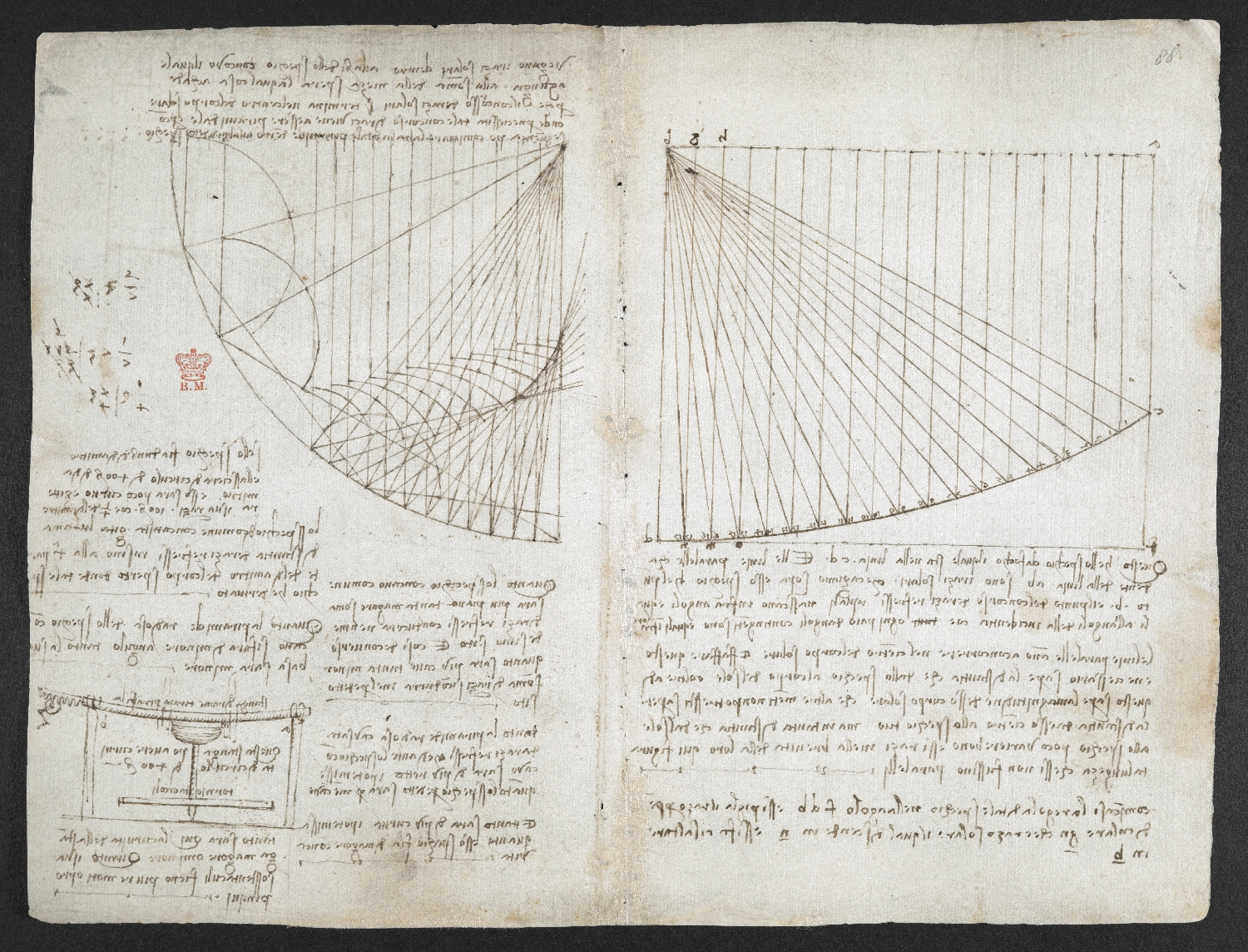
Okay, I’m sure you know a bit more than that, but unless you’re a Renaissance scholar, you’re certain to find yourself amazed and surprised at how much you didn’t know about the quintessential Renaissance man when you encounter a compilation of his notebooks—Codex Arundel—which has been digitized by the British Library and made available to the public.
The notebook, writes Jonathan Jones at The Guardian, represents “the living record of a universal mind.” And yet, though a “technophile” himself, “when it came to publication, Leonardo was a luddite…. He made no effort to get his notes published.”

For hundreds of years, the huge, secretive collection of manuscripts remained mostly unseen by all but the most rarified of collectors. After Leonardo’s death in France, writes the British Library, his student Francesco Melzi “brought many of his manuscripts and drawings back to Italy. Melzi’s heirs, who had no idea of the importance of the manuscripts, gradually disposed of them.” Nonetheless, over 5,000 pages of notes “still exist in Leonardo’s ‘mirror writing’, from right to left.” In the notebooks, da Vinci drew “visions of the aeroplane, the helicopter, the parachute, the submarine and the car. It was more than 300 years before many of his ideas were improved upon.”
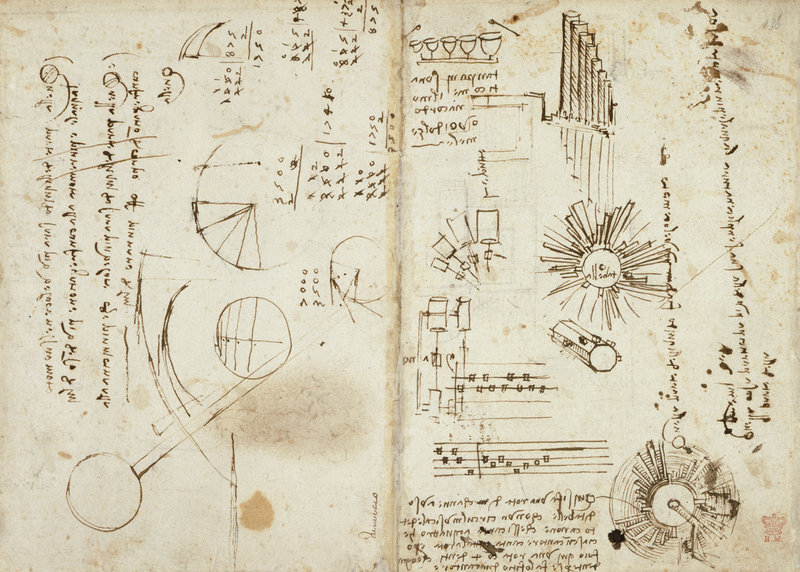
The digitized notebooks debuted in 2007 as a joint project of the British Library and Microsoft called “Turning the Pages 2.0,” an interactive feature that allows viewers to “turn” the pages of the notebooks with animations. Onscreen glosses explain the content of the cryptic notes surrounding the many technical drawings, diagrams, and schematics (see a selection of the notebooks in this animated format here). For an overwhelming amount of Leonardo, you can look through 570 digitized pages of Codex Arundel here. For a slightly more digestible, and readable, amount of Leonardo, see the British Library’s brief series on his life and work, including explanations of his diving apparatus, parachute, and glider.
And for much more on the man—including evidence of his sartorial “preference for pink tights” and his shopping lists—see Jonathan Jones’ Guardian piece, which links to other notebook collections and resources. The artist and self-taught polymath made an impressive effort to keep his ideas from prying eyes. Now, thanks to digitized collections like those at the British Library, “anyone can study the mind of Leonardo.”
Related Content:
Leonardo Da Vinci’s To Do List (Circa 1490) Is Much Cooler Than Yours
Josh Jones is a writer and musician based in Durham, NC. Follow him at @jdmagness
Read More...Wes Anderson Names 12 of His Favorite Art Films

Image by Raffi Asdourian, via Wikimedia Commons
Asked to list their favorite films of all times, most directors tend towards the canon. And why not? 8 1/2–loved by Scorsese and Lynch and many others–is an indisputable masterpiece, for example. So is The Godfather, Rashomon, Vertigo, and any number of movies that make top film lists over and over. The point is, most of the time, these lists are samey.
That’s why this list from Wes Anderson is a hoot. Here he’s not asked to list his favorites of all time, but rather to create a Top 10 list of Criterion titles. Yet here’s his M.O.: “I thought my take on a top-ten list might be to simply quote myself from the brief fan letters I periodically write to the Criterion Collection team,” he says.
A lot of these films are rarities, and Anderson admits he’s only just seen some of them for the first time. Martin Ritt’s The Spy Who Came in from the Cold is one. Roberto Rossellini’s The Taking of Power by Louis XIV is another. Of the latter, he says, “This is a wonderful and very strange movie. I had never heard of it. The man who plays Louis cannot give a convincing line reading, even to the ears of someone who can’t speak French—and yet he is fascinating.”
Anderson’s comments are often questions, not definitive statements. Like us, he is just as mystified by a film, and that feeling is probably why he likes them in the first place.
Of that Rossellini film he wonders “What does good acting actually mean?” And of Claude Sautet’s Classe tous risques he asks, “Who is our Lino Ventura?” referring to the Italian-born French actor who was once described as “The French John Wayne.” (So, the real question is this: who is our modern day John Wayne?)
We’ll leave the rest for you to read, but for a director so invested in artifice and nostalgia it was a surprise to hear how much he loves surrealist Luis Buñuel:
“He is my hero. Mike Nichols said in the newspaper he thinks of Buñuel every day, which I believe I do, too, or at least every other.”
Wes Anderson’s Criterion Collection Top 10
1. The Earrings of Madame de… (dir. Max Ophuls)
2. Au hasard Balthazar (dir. Robert Bresson)
3.Pigs and Battleships/The Insect Woman/Intentions of Murder (dir. Shohei Imamura)
4. The Taking of Power by Louis XIV (dir. Roberto Rossellini)
5. The Spy Who Came in from the Cold (dir. Martin Ritt)
6. The Friends of Eddie Coyle (dir. Peter Yates)
7. Classe tous risques (dir. Claude Sautet)
8. L’enfance nue (dir. Maurice Pialat)
9. Mishima: A Life in Four Chapters (dir. Paul Schrader)
10. The Exterminating Angel (dir. Luis Buñuel)
Related Content:
Watch Wes Anderson’s Charming New Short Film, Castello Cavalcanti, Starring Jason Schwartzman
Wes Anderson from Above. Quentin Tarantino From Below.
Stanley Kubrick’s List of Top 10 Films: The First and Only List He Ever Created
Ted Mills is a freelance writer on the arts who currently hosts the artist interview-based FunkZone Podcast and is the producer of KCRW’s Curious Coast. You can also follow him on Twitter at @tedmills, read his other arts writing at tedmills.com and/or watch his films here.
Read More...Attempting to Set the World Record for Most Frida Kahlo Lookalikes in One Place: It Happened in Dallas

Fun fact: The Dallas Museum of Art and the Latino Center for Leadership Development celebrated Frida Kahlo’s 110th birthday last week. And the festivities were capped off with an attempt to set the Guinness World Record for the largest gathering of people dressed as Frida Kahlo in one space.
According to the rules of Frida Fest, to participate in the record attempt, individuals had to provide their own costume, and make sure their costumes included the following elements:
- A unibrow drawn onto the face joining the eyebrows. This can be done with make-up or by sticking hair.
- Artificial flowers worn in the hair, a minimum of three artificial flowers must be worn.
- A red or pink shawl.
- A flower-printed dress that extends to below the knees on all sides; the dress must not have any slits up the side.
Notes NPR, there’s “no official word yet on whether a record was set, but prior to Thursday, there didn’t appear to be another record-holder listed in the Guinness World Records.”
You can see a gallery of 44 photos on the museum’s Facebook page. Enjoy.

Photo Courtesy of Ashley Gongora and Kathy Tran — at Dallas Museum of Art.

Photo Courtesy of Ashley Gongora and Kathy Tran — at Dallas Museum of Art.
If you would like to support the mission of Open Culture, consider making a donation to our site. It’s hard to rely 100% on ads, and your contributions will help us continue providing the best free cultural and educational materials to learners everywhere. You can contribute through PayPal, Patreon, and Venmo (@openculture). Thanks!
Related Content:
The Frida Kahlo Action Figure
Frida Kahlo’s Colorful Clothes Revealed for the First Time & Photographed by Ishiuchi Miyako
Frida Kahlo and Diego Rivera Visit Leon Trotsky in Mexico, 1938
Read More...Support Us
We're hoping to rely on loyal readers, rather than erratic ads. Please click the Donate button and support Open Culture. You can use Paypal, Venmo, Patreon, even Crypto! We thank you!

About Us

Open Culture scours the web for the best educational media. We find the free courses and audio books you need, the language lessons & educational videos you want, and plenty of enlightenment in between.
Advertise With Us

FREE UPDATES!
GET OUR DAILY EMAIL
Get the best cultural and educational resources on the web curated for you in a daily email. We never spam. Unsubscribe at any time.
FOLLOW ON SOCIAL MEDIA

Open Culture editor Dan Colman scours the web for the best educational media. He finds the free courses and audio books you need, the language lessons & movies you want, and plenty of enlightenment in between.
Advertise With Us


