John Ashbery Reads “Self-Portrait in a Convex Mirror”
Poet John Ashbery has passed away, at the age of 90. About the poet, Harold Bloom once said. “No one now writing poems in the English language is likelier than Ashbery to survive the severe judgment of time. He is joining the American sequence that includes Whitman, Dickinson, Stevens and Hart Crane.” In 1976, Ashbery won the Pulitzer Prize for his collection, Self-Portrait in a Convex Mirror. Above, you can hear him read the title poem, his masterpiece. The Guardian calls “Self-Portrait in a Convex Mirror,” a densely written epic about art, time and consciousness that was inspired by the 16th century Italian painting of the same name.” The text of the poem appears on the Poetry Foundation website.
Find other poetry readings in our collection, 1,000 Free Audio Books: Download Great Books for Free.
If you would like to support the mission of Open Culture, consider making a donation to our site. It’s hard to rely 100% on ads, and your contributions will help us continue providing the best free cultural and educational materials to learners everywhere. You can contribute through PayPal, Patreon, and Venmo (@openculture). Thanks!
Related Content:
8 Glorious Hours of Dylan Thomas Reading Poetry–His Own & Others’
Hear Jorge Luis Borges Read 30 of His Poems (in the Original Spanish)
Read More...Bob Dylan Hates Me: An Animation
Filmmaker Caveh Zahedi met his idol twice. And lived to animate the story. Enjoy.
Related Content:
Bob Dylan Classic, “Forever Young,” Animated for Children
I Met the Walrus: An Animated Film Revisiting a Teenager’s 1969 Interview with John Lennon
Watch Kids’ Priceless Reactions to Hearing the Timeless Music of The Beatles
Hear Bob Dylan’s Newly-Released Nobel Lecture: A Meditation on Music, Literature & Lyrics
Read More...
Read 1,000 Editions of The Village Voice: A Digital Archive of the Iconic New York City Paper
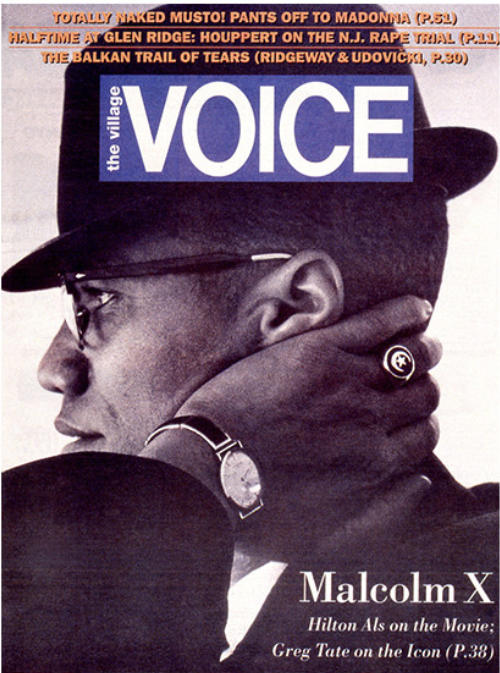
After The Village Voice announced this week that it was folding its print operation, a couple people compared the venerable NYC rag’s demise to the end of Gawker, the snarky online tabloid taken down by Hulk Hogan and his shadowy financier Peter Thiel. For too many reasons to list, this comparison seems to my mind hardly apt. There’s a gesture toward the Voice’s profane unruliness, but the alternative weekly, founded in 1955, transcended the blog age’s sophomoric nihilism. The hermetic container of its newsprint sealed out frothing comment sections; no links ferried readers through rivers of personalized algorithms.

The Voice published hard journalism that many, including Voice writers themselves, have ruefully revisited of late. Its music and culture writers like Nat Hentoff, Lester Bangs, Sasha Frere-Jones, Robert Christgau and so many others are some of the smartest in the business. Its columnists, editors, and reviewers—Andrew Sarris, J. Hoberman, Robert Sietsema, Tom Robbins, Greg Tate, Michael Musto, Thulani Davis, Ta-Nehisi Coates—equally so.
In its over sixty-year run, Voice writers sat in the front rows for the birth for hard bop, free jazz, punk, no wave, and hip-hop, and all manner of downtown experimentalism in-between and after.
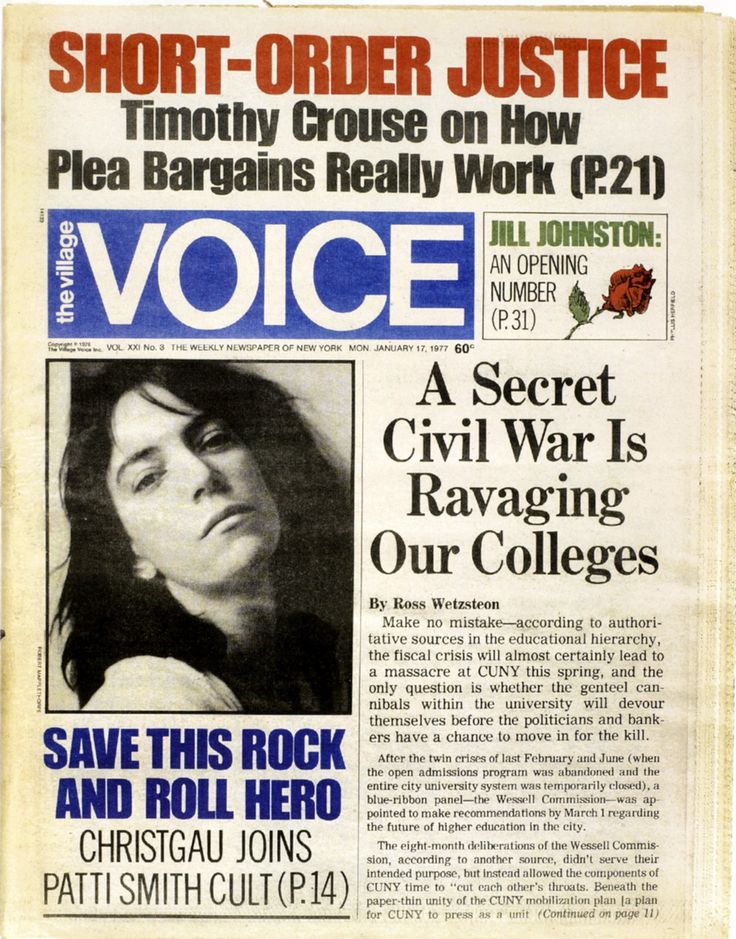
Amongst the many remembrances from current and former Voice staff in a recent Esquire oral history, one from editor and writer Camille Dodero stands out: “The alt-weekly’s purpose was, in theory, speaking truth to power and the ability to be irreverent, and print the word ‘fuck’ while doing so.’” Mission accomplished many times over, as you can see yourself in Google’s Village Voice archive, featuring 1,000 scanned issues going all the back to 1955, when Norman Mailer founded the paper with Ed Fancher, Dan Wolf, and John Wilcock. There are “blind spots” in Google’s archive of the Voice, noted John Cook at the erstwhile Gawker. In 2009, his “searches didn’t turn up any coverage of Norman Mailer’s 1969 campaign or the Stonewall riots… and there’s not much on Rudy Giuliani’s mayoral bid.” Many years later, months and years in the Google archive remain blank, “no editions available.”

The Voice has had its own blind spots. Writer Walter Troy Spencer referred to Stonewall, for example, as “The Great Faggot Rebellion” and used a phrase that has perhaps become the most wearisome in American English: “there was mostly ugliness on both sides.” This anti-gay prejudice was a regular feature of the paper’s first few years, but by 1982, just as the AIDS crisis began to filter into public consciousness, the Voice was the second organization in the US to offer extended benefits to domestic partners. It became a prominent voice for New York’s LGBTQ culture and politics, through all the buyouts, cutbacks, and unbeatable competition that brought it to its current pass.
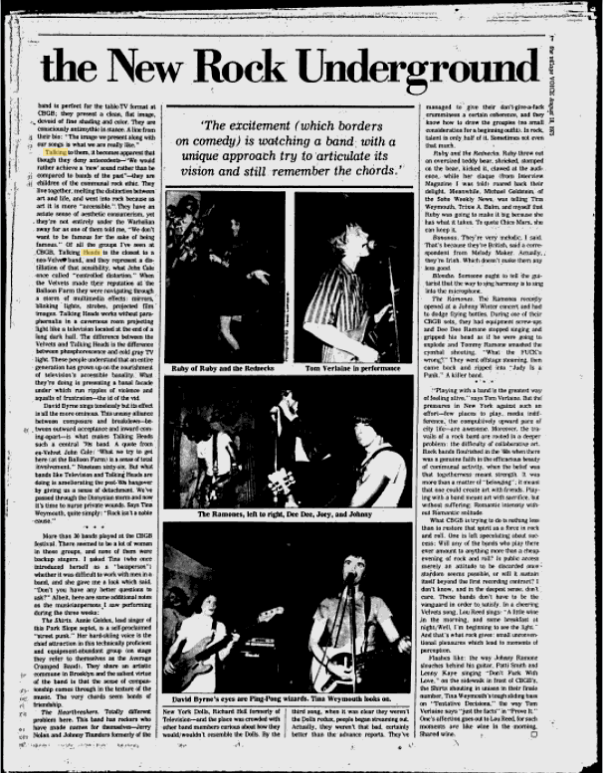
The paper also became a voice for the most interesting things happening in the city at any given time, such as the goings on at a Bowery dive called CBGB in 1975. Character studies have long been a Voice staple. Lester Bangs’ write-up of Iggy Pop two years later cut to the heart of the matter: “It’s as if someone writhing in torment has made that writhing into a kind of poetry.” Back in ’75, Andrew Sarris wrote a rather jaw-dropping profile of Hervé Villechaize (in which he begins a sentence, “The problem of midgets….”). …. the more I look through Voice back issues, the more I think it might have been a Gawker of its time, but as onetime columnist Harry Siegel tells Esquire, “what made it unique depends a lot on the age of who you’re asking. It was a very different paper in different decades. It was valuable enough for a long time that people paid money to read it.”
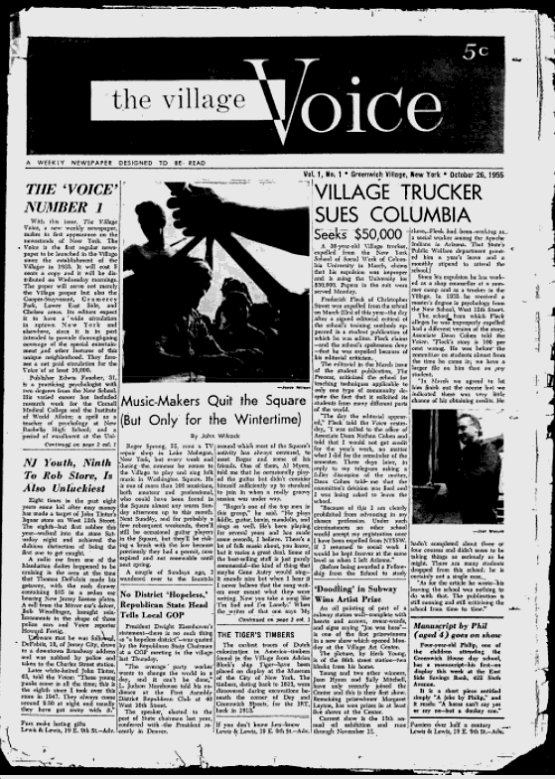
Indeed its first issue cost 5 cents, though by the nondescript cover, above, you wouldn’t guess it would amuse or titillate in the ways the Village Voice became well-known for—in its columns, photos, cartoons, and libertine advertising and classifieds. But most people these days remember it as “free every Wednesday,” to proffer dance, film, theater, music, restaurants, to line subway cars and birdcages, and to open up the city to its readers. The Voice is dead, long live the Voice.
Enter the digital archive of the Voice here.
Writings from the Voice have been collected in these anthologies: The Village Voice Anthology (1956–1980) and The Village Voice Reader.
Related Content:
Josh Jones is a writer and musician based in Durham, NC. Follow him at @jdmagness
Read More...Neil deGrasse Tyson is Creating a New Space Exploration Video Game with the Help of George R.R. Martin & Neil Gaiman
Although Neil deGrasse Tyson is somewhat hesitant to go in on plans to terraform and colonize Mars, that doesn’t mean he doesn’t like a good ol’–yet science-based–video game. Several outlets announced recently that the videogame Space Odyssey, spearheaded by deGrasse Tyson–one of America’s main defenders of logic and Enlightenment–has surpassed its Kickstarter funding goal. The game promises to send players on “real science-based missions to explore space, colonize planets, create and mod in real time.”
In the game, according to deGrasse Tyson, “you control the formation of planets, of comets, of life, civilization. You could maybe tweak the force of gravity and see what effect that might have.” It will be, he says, “an exploration into the laws of physics and how they shape the world in which we live.”
The game has been forming for several years now, and most importantly to our readers, has called in several sci-fi and fantasy writers to help create the various worlds in the game, as they have aptly demonstrated their skills in doing so on the printed page. That includes George R.R. Martin, currently ignoring whatever HBO is doing to his creation Game of Thrones; Neil Gaiman, who creates a new universe every time he drops a new novel; and Len Wein, who has had a hand in creating both DC’s Swamp Thing and Marvel’s Wolverine. Also on board: deGrasse Tyson’s buddy Bill Nye, former NASA astronaut Mike Massimino, and astrophysicist Charles Liu.

The idea of world/galaxy-building is not new in video games, especially recently. No Man’s Sky (2015) features “eighteen quintillion full-featured planets” and Minecraft seems limitless. But Space Odyssey (still a temporary title!) is the first to have deGrasse Tyson and friends working the controls in the background. And a game is as good as the visionaries behind it. 
According to the Kickstarter page, the raised funds will go into “the ability to have this community play the game and engage with it while the final build is underway. As the Kickstarter gaming community begins to beta test game-play and provide feedback, we can begin to use the funds raised via Kickstarter to incorporate your modding, mapping and building suggestions, together building the awesome gaming experience you helped to create.”
DeGrasse Tyson will be in the game himself, urging players onward. There’s no indication whether Mr. Martin will be popping up, though.
Related Content:
Ted Mills is a freelance writer on the arts who currently hosts the artist interview-based FunkZone Podcast and is the producer of KCRW’s Curious Coast. You can also follow him on Twitter at @tedmills, read his other arts writing at tedmills.com and/or watch his films here.
Read More...Neil deGrasse Tyson Demonstrates the Physics-Defying Rattleback
The rattleback–it’s been intriguing us since prehistoric times. Seeming to defy the laws of physics, it spins in one direction, “rattles” to a stop, and then changes direction, as Neil deGrasse Tyson demonstrates above. How does the rattleback work? To get into that, watch this technical video from William Case, a professor at Grinnell College. Or review the resources on this web page. In either case, you will need to wear your thinking cap.
If you would like to support the mission of Open Culture, consider making a donation to our site. It’s hard to rely 100% on ads, and your contributions will help us continue providing the best free cultural and educational materials to learners everywhere. You can contribute through PayPal, Patreon, and Venmo (@openculture). Thanks!
Related Content:
Read More...Discover the Paintings, Drawings & Collages of Sylvia Plath: Now on Display at the Smithsonian National Portrait Gallery
Sylvia Plath was a study in contrasts. Her popularization as a confessional poet, feminist literary icon, and tragic casualty of major depression; her middle-class Boston background and tortured marriage to poet Ted Hughes—these are the highlights of her biography, and, in many cases, all many people get to know about her. But “she was much more than that,” Dorothy Moss tells Mental Floss. As Vanessa Willoughby puts it in a stunning essay about her own encounters with Plath’s work, “this woman was not the sum of a gas oven and two sleeping children nestled in their beds.”
Moss, a curator at the Smithsonian National Portrait Gallery has organized an exhibit featuring many more sides of the poet’s divided, yet purposeful self, including her work as a visual artist. Readers of Plath’s poetry may not be surprised to learn she first intended to become an artist. Her visual sense is so keen that fully-formed images seem to leap out of poems like “Blackberrying,” and into the reader’s hands; like the “high green meadows” she describes, her lines are “lit from within” by a deep appreciation for color, texture, and perspective.
Blackberries / Big as the ball of my thumb, and dumb as eyes / Ebon in the hedges, fat / With blue-red juices. These they squander on my fingers.
The blackberries come alive not only in their personification but through the kind of vivid language that could only come from someone with a painterly way of looking at things. Plath “drew and painted and sketched constantly as a child,” says Moss, and first enrolled at Smith College as an art major.
The exhibition, the National Portrait Gallery writes, “reveals how Plath shaped her identity visually as she came of age as a writer in the 1950s.” Unsurprisingly, her most frequent subject is herself. Her visual art, like her poetry, notes Mental Floss, “is often preoccupied with themes of self-identity.” But as in her eloquently-written letters and journals, as well as her published literary work, she is never one self, but many—and not all of them variations on the sly, yet brooding intellectual we see staring out at us from the well-known photographs.
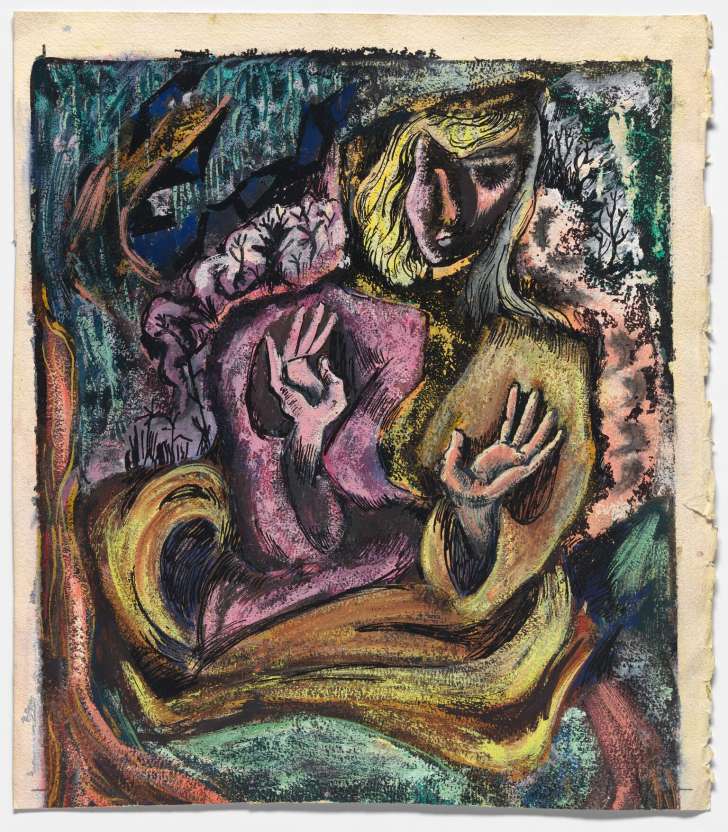
We’ve previously featured some of Plath’s drawings and self-portraits here, but the Smithsonian exhibit offers a considerably richer selection than has been available online. The ink and gouache portrait at the top, for example, seems to draw from Marc Chagall in its materials and swirling lines and colors. It also recalls language in a diary entry from 1953:
Look at that ugly dead mask here and do not forget it. It is a chalk mask with dead dry poison behind it, like the death angel. It is what I was this fall, and what I never want to be again.
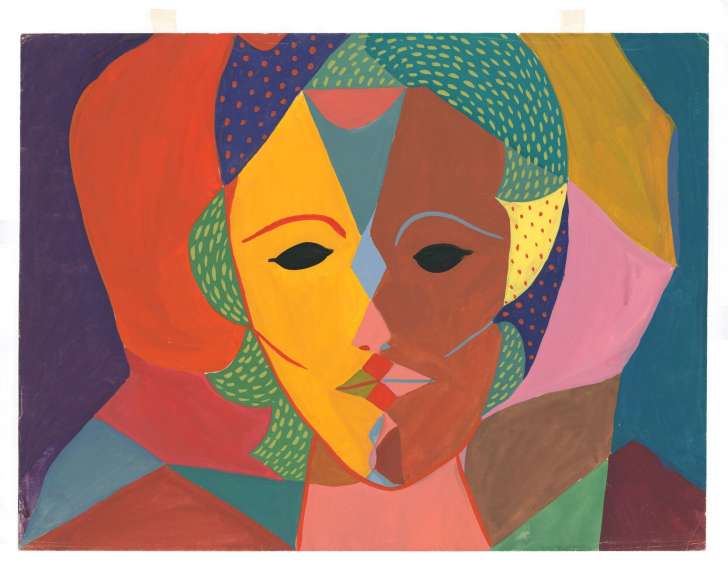
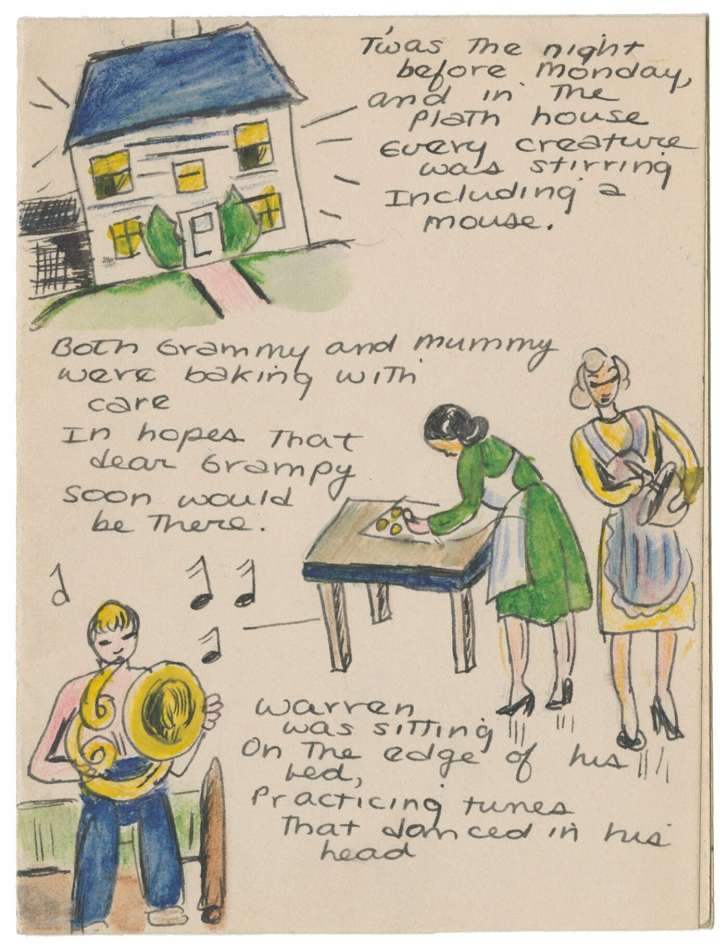
The hands thrown up in defense or surrender, the black lifeless eyes… Plath emerges from the ring of dead trees behind her like a suffering saint. Another portrait, further up also resembles a mask, calling to mind the ancient origins of the word persona. But the style has totally changed, the tumult of brushstrokes smoothed out into clean geometric lines and uniform patches of color. Three masks combine into one face, a trinity of Plaths. The poet always had a sense of herself as divided, referring to two distinct personalities as her “brown-haired” and “platinum” selves. The brown-haired young girl made several charming sketches of her family, with humorous commentary. (Her troubling father is tellingly, perhaps, absent.)

Hers was an epitome of standard-issue 50s white, middle class American childhood, the kind of supposedly idyllic upbringing which no small number of people still remember today in a glowing, nostalgic haze. In Plath’s excavations of the identities that she cultivated herself and those she had pushed upon her, she gazed with radical intensity at America’s patriarchal social fictions, and the violence and entitlement that lay beneath them. The collage above from 1960 presents us with the kind of layered, cut-up, hybrid text that William Burroughs had begun experimenting with not long before. You can see more highlights from the Plath exhibit, “One Life: Sylvia Plath,” at the National Portrait Gallery. Also featured are Plath’s family photos, books, letters, her typewriter—and, in general, several more dimensions of her life than most of us know.
“One Life: Sylvia Plath” runs from June 30, 2017 through May 20, 2018.
Related Content:
The Art of Sylvia Plath: Revisit Her Sketches, Self-Portraits, Drawings & Illustrated Letters
Hear Sylvia Plath Read 15 Poems From Her Final Collection, Ariel, in 1962 Recording
Sylvia Plath’s 10 Back to School Commandments (1953)
Josh Jones is a writer and musician based in Durham, NC. Follow him at @jdmagness
Read More...On the Power of Teaching Philosophy in Prisons
Philosophy is often seen as an arcane academic discipline, in competition with the hard sciences or laden with abstruse concepts and language inaccessible to ordinary people. Such a perception may be warranted. This is not to damn academic philosophy but to highlight what has been lost through professionalization: classical notions of ethics as “the art of living” or what Michel Foucault called “the care of the self”; the ancient Greek idea of parrhesia—bold, honest speech unclouded by proprietary jargon; philosophy as a practice like meditation or yoga, a technique for self-knowledge, self-control, and wise, just, and considerate relationships with others.
From Socrates to Aristotle to Epicurus and the Stoics, ancient Western thinkers believed philosophy to be intimately relevant to everyday life. This was very much the case in ancient Eastern thought as well, in the Jainist sages, the Buddha, or Lao-Tzu, to name a few. We will find some form of popular philosophy on every continent and every historical age. And while plenty of modern teachers still believe in philosophy for everyone, they operate in a consumer culture that often deems them irrelevant, at best. Still, many educators persist outside the academy, endeavoring to reach not only ordinary citizens but a class of disempowered people also deemed irrelevant, at best: the imprisoned, many of whom have had few educational resources and little to no exposure to philosophical thinking.
We have many examples of influential thinkers writing from prison, whether Boethius’ early Christian Consolations of Philosophy, Antonio Gramsci’s passionate Marxist prison letters, Oscar Wilde’s De Profundis, or Martin Luther King, Jr.’s essential “Letter from a Birmingham Jail.” These have maybe provided readers who have never been jailed with tragic, yet romantic notions of doing philosophy while doing time. But the philosophers who enter prisons to work with people convicted—justly or otherwise—of all manner of crimes cannot afford to have romantic ideas. Philosopher Alan Smith found this to be especially so after teaching in UK prisons for 14 years, and writing boldly and candidly about the experience in his Guardian column “Philosophy for Prisoners.”
Finally retiring in 2013, Smith confessed, “If I carried on in prison, I would have to do it differently; I would have to admit that it was prison.” He may have felt burned out at the end of his sojourn, but he hadn’t lost his sense of ethical purpose:
When we don’t know about history and art and society we are adrift. Most of you reading this will never have had that experience, but many of the men I taught were ignorant of just about everything, and as grown men felt this keenly. Education was a relief, a route to self-respect.
Those who do this work report on how so many inmates hunger for routes to self-knowledge, reflection, and rigorous intellectual exercise. Several educators at The Philosophy Foundation, for example, have written about their experiences teaching philosophy in various UK prisons. Conditions are different, and often much bleaker, in the US—a country with 5% of the world’s population and 25% of its prisoners—but here, too, philosophers have helped inmates discover new truths about themselves and their society. In the very short TED talk up top, Damon Horowitz, who teaches at San Quentin through the Prison University Project, gives a passionate, rapid-fire accounting of his mission behind bars: “Everyone’s got an opinion. We are here for knowledge. Our enemy is thoughtlessness.” A chorus of venerable ancients would assuredly agree.
Further down, you can see participants in Princeton’s Prison Teaching Initiative talk about the virtues and rewards of their accredited program. That includes teachers and students alike.
Note: You can find 140+ Free Philosophy Courses in our ever-growing list, 1,700 Free Online Courses from Top Universities.
Related Content:
Tim Robbins’ Improv Classes Transform Prisoners’ Lives & Lower Recidivism Rates
Patti Smith Reads from Oscar Wilde’s De Profundis, the Love Letter He Wrote From Prison (1897)
What Prisoners Ate at Alcatraz in 1946: A Vintage Prison Menu
Josh Jones is a writer and musician based in Durham, NC. Follow him at @jdmagness
Read More...Long Before Photoshop, the Soviets Mastered the Art of Erasing People from Photographs — and History Too
Adobe Photoshop, the world’s best-known piece of image-editing software, has long since transitioned from noun to verb: “to Photoshop” has come to mean something like “to alter a photograph, often with intent to mislead or deceive.” But in that usage, Photoshopping didn’t begin with Photoshop, and indeed the early masters of Photoshopping did it well before anyone had even dreamed of the personal computer, let alone a means to manipulate images on one. In America, the best of them worked for the movies; in Soviet Russia they worked for a different kind of propaganda machine known as the State, not just producing official photos but going back to previous official photos and changing them to reflect the regime’s ever-shifting set of preferred alternative facts.
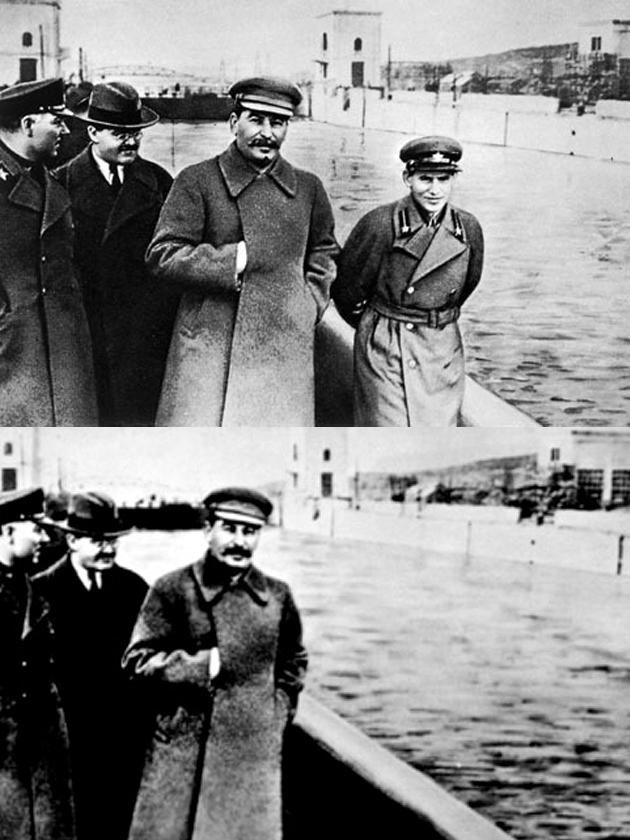
“Like their counterparts in Hollywood, photographic retouchers in Soviet Russia spent long hours smoothing out the blemishes of imperfect complexions, helping the camera to falsify reality,” writes David King in the introduction to his book The Commissar Vanishes: The Falsification of Photographs and Art in Stalin’s Russia. “Stalin’s pockmarked face, in particular, demanded exceptional skills with the airbrush. But it was during the Great Purges, which raged in the late 1930s, that a new form of falsification emerged. The physical eradication of Stalin’s political opponents at the hands of the secret police was swiftly followed by their obliteration from all forms of pictorial existence.”
Using tools that now seem impossibly primitive, Soviet proto-Photoshoppers made “once-famous personalities vanish” and crafted photographs representing Stalin “as the only true friend, comrade, and successor to Lenin, the leader of the Bolshevik Revolution and founder of the USSR.”
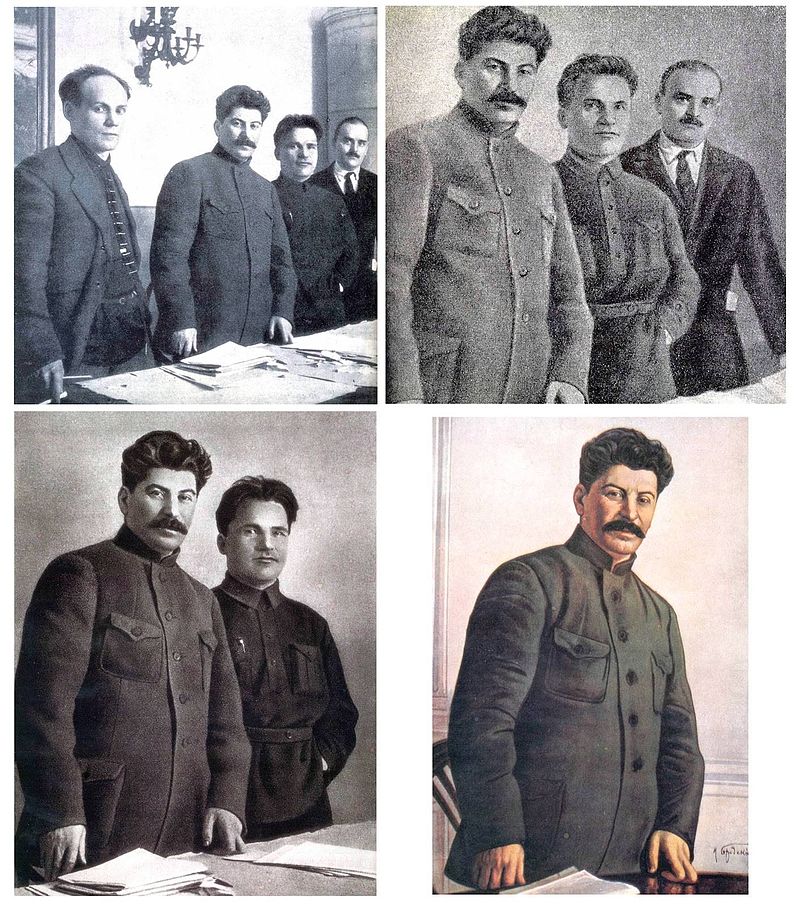
This quasi-artisanal work, “one of the more enjoyable tasks for the art department of publishing houses during those times,” demanded serious dexterity with the scalpel, glue, paint, and airbrush. (Some examples, as you can see in this five-page gallery of images from The Commissar Vanishes, evidenced more dexterity than others.) In this manner, Stalin could order written out of history such comrades he ultimately deemed disloyal (and who usually wound up executed as) as Naval Commissar Nikolai Yezhov, infamously made to disappear from Stalin’s side on a photo taken alongside the Moscow Canal, or People’s Commissar for Posts and Telegraphs Nikolai Antipov, commander of the Leningrad party Sergei Kirov, and Chairman of the Presidium of the Supreme Soviet Nikolai Shvernik — pictured, and removed one by one, just above.
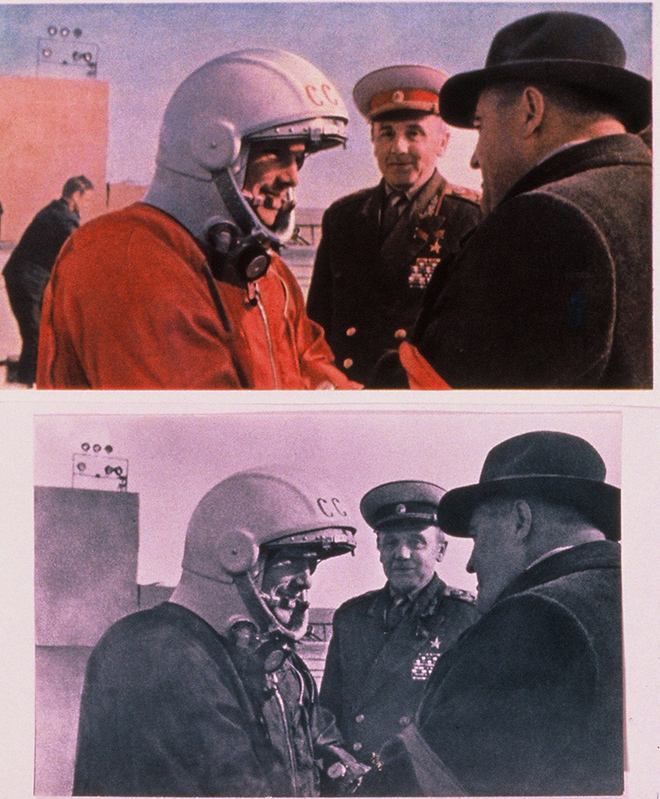
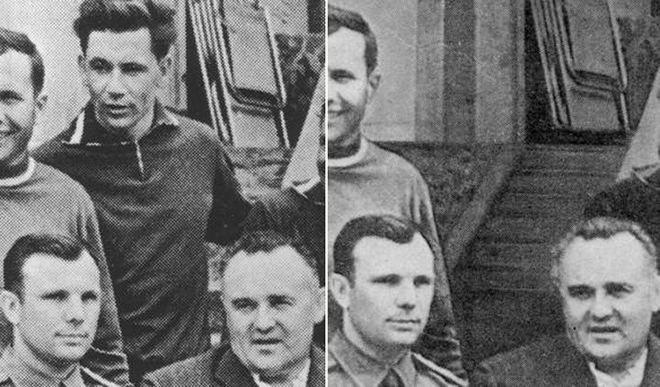
This practice even extended to the materials of the Soviet space program, writes Wired’s James Oberg. Cosmonauts temporarily erased from history include Valentin Bondarenko, who died in a fire during a training exercise, and the especially promising Grigoriy Nelyubov (pictured, and then not pictured, at the top of the post), who “had been expelled from the program for misbehavior and later killed himself.” Yuri Gagarin, the cosmonaut who made history as the first human in outer space, did not, of course, get erased by the proud authorities, but even his photos, like the one just above where he shakes hands with the Soviet space program’s top-secret leader Sergey Korolyov, went under the knife for cosmetic reasons, here the removal of the evidently distracting workman in the background — hardly a major historical figure, let alone a controversial one, but still a real and maybe even living reminder that while the camera may lie, it can’t hold its tongue forever.
Related Content:
Joseph Stalin, a Lifelong Editor, Wielded a Big, Blue, Dangerous Pencil
Leon Trotsky: Love, Death and Exile in Mexico
Based in Seoul, Colin Marshall writes and broadcasts on cities and culture. He’s at work on the book The Stateless City: a Walk through 21st-Century Los Angeles, the video series The City in Cinema, the crowdfunded journalism project Where Is the City of the Future?, and the Los Angeles Review of Books’ Korea Blog. Follow him on Twitter at @colinmarshall or on Facebook.
Read More...India on Film, 1899–1947: An Archive of 90 Historic Films Now Online
India, the largest democracy in the world, is a rising economic powerhouse, and a major player in the fields of media, entertainment, and telecommunications.
But for many armchair travelers, subcontinental modernity takes a backseat to postcard visions of elephants, teeming rustic streets, and snake charmers.
Fans of Rudyard Kipling and E.M. Forster will thrill to the vintage footage in a just released British Film Institute online archive, India on Film (see a trailer above).
1914’s The Wonderful Fruit of the Tropics, a stencil-coloured French-produced primer on the edible flora of India offers just the right blend of exoticism and reassurance (“the fruit of a mango is excellent as a food”) for a newly arrived British housewife.
A Native Street in India (1906) speaks to the populousness that continues to define a country scheduled to outpace China’s numbers within the next 10 years.
An Eastern Market follows a Punjabi farmer’s trek to town, to buy and sell and take in the big city sights.
The archive’s biggest celeb is surely activist Mahatma Gandhi, whose great nephew, Kanu, enjoyed unlimited filming access on the assurance that he would never ask his uncle to pose.
The Raj makes itself known in 1925’s King Emperor’s Cup Race, a Handley Page biplane arriving in Calcutta in 1917, and several films documenting Edward Prince of Wales’ 1922 tour
Explore the full BFI’s full India on Film: 1899–1947 playlist here. It features 90 films in total, with maybe more to come.
Related Content:
Parvati Saves the World: Watch a Remix of Bollywood Films That Combats Rape in India
Google’s Moving Ad About 1947 Partition of India & Pakistan Tops 10 Million Views
1,150 Free Movies Online: Great Classics, Indies, Noir, Westerns, etc.
Ayun Halliday is an author, illustrator, theater maker and Chief Primatologist of the East Village Inky zine. Follow her @AyunHalliday.
Read More...How TV Addles Kids’ Brains: A Short Film Directed by Godfrey Reggio (Maker of Koyaanisqatsi) & Scored by Philip Glass
On October 4, 1982, “more than 5,000 people filled the Radio City Music Hall to experience a remarkable event. That event was the world premiere of Koyaanisqatsi.” So says the poster for the wide release of that film, an experimental documentary without spoken words on the natural and manmade environment that neither looked nor sounded — nor felt — like anything many of its viewers had ever experienced in a movie theater before.
Unable to muster any of their standard reactions, they had no choice but to sit and observe as, in slow motion and fast motion and every speed in between, waterfalls thundered, chasms yawned, skyscrapers soared, commuters scurried, and rockets launched before their eyes — all to the music of Philip Glass. You might say that Koyaanisqatsi (see trailer below), as well as its formally similar sequels Powaqqatsi and Naqoyqatsi, puts its viewers in an altered state of mind.
The trilogy’s director, a former monk-in-training named Godfrey Reggio, might say the same thing about television, whose flickering blueish presence emerges from time to time in his work, but he wouldn’t mean it in a good way. In 1995, between Powaqqatsi and Naqoyqatsi, he made a short called Evidence which, in the words of koyaanisqatsi.org, “looks into the eyes of children watching television — in this case Walt Disney’s Dumbo. Though engaged in a daily routine, they appear drugged, retarded, like the patients of a mental hospital.”
Accompanying and in a sense commenting on their glazed, often slack-jawed expressions, we once again, as in Reggio’s transfixing feature documentaries, have a Glass-composed score. Unlike moviegoers in a theater, “television viewers become prey to the television’s own light impulses, they go into an altered state — a transfixed condition where the eyes, the mind, the breathing of the subject is clearly under the control of an outside force. In a poetic sense and without exaggerating one might say that the television technology is eating the subjects who sit before its gaze.”
In the more than two decades since, this kind of criticism of television has given way to a more general criticism of electronic media, most of whose currently popular forms didn’t exist in 1995; Reggio and Glass’ most recent collaboration, 2013’s Visitors, deals with “humanity’s trancelike relationship with technology.” You and your children may have escaped the “tractor beam that holds its subjects in total control” as Evidence depicts it, but in the 21st century the number of tractor beams has greatly multiplied. And so the question remains worth asking: which ones have you under their control?
Related Content:
Koyaanisqatsi at 1552% Speed
Based in Seoul, Colin Marshall writes and broadcasts on cities and culture. He’s at work on the book The Stateless City: a Walk through 21st-Century Los Angeles, the video series The City in Cinema, the crowdfunded journalism project Where Is the City of the Future?, and the Los Angeles Review of Books’ Korea Blog. Follow him on Twitter at @colinmarshall or on Facebook.
Read More...Support Us
We're hoping to rely on loyal readers, rather than erratic ads. Please click the Donate button and support Open Culture. You can use Paypal, Venmo, Patreon, even Crypto! We thank you!

About Us

Open Culture scours the web for the best educational media. We find the free courses and audio books you need, the language lessons & educational videos you want, and plenty of enlightenment in between.
Advertise With Us

FREE UPDATES!
GET OUR DAILY EMAIL
Get the best cultural and educational resources on the web curated for you in a daily email. We never spam. Unsubscribe at any time.
FOLLOW ON SOCIAL MEDIA

Open Culture editor Dan Colman scours the web for the best educational media. He finds the free courses and audio books you need, the language lessons & movies you want, and plenty of enlightenment in between.
Advertise With Us

